“We have 3 kids, $1k saved, $0 invested. Is it too late for us?”
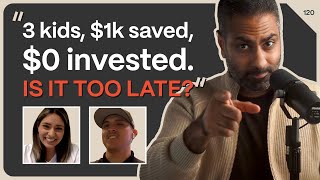
Anna and Gabriel have three kids, $1,000 saved, and $56,300 in debt on a $103k household income. Ramit walks them through their finances, Gabriel's history with addiction and spending, and how they can shift from blame to shared responsibility with their money.
Questions this video answers
Three children: ages 2, 4, and 7.
Savings $1,000; investments $0; total debt $56,300.
Anna gross monthly $5,400; Gabriel gross monthly $3,200; combined gross monthly $8,600 (~$103,000/year).
Net worth approximately -$55,368; fixed costs 61%.
Chapters
Have you ever admitted out loud that you were spoiled?
Yeah, they told me they spoiled. Like I was spoiled. I was hard, like a little spoiled kid.
Do they still spoil you?
I would think in a way, yeah, probably.
Our first child was a sweet surprise. And so right off the bat we were like having kids and working full time. But then I started noticing, like with our finances, things are not adding up. Where is this money going? Where is it all being wasted? And there were a few times where, you know, I was like, you know, I'm not going to come home. Like, this is it, it's over. Like I don't want anything to do with it. And it's so funny because I graduated with a psychology degree and looking back now I'm like, all the signs, all the flags were there. But it's like when it's your family, you put the blinders on, you know.
You know, recently CNBC wrote about me and how I drive a 17 or 18 year old car and a lot of people got mad at me.
Oh Ramit, what's the point of being a millionaire if you drive an old Honda? First of all, this Honda is sweet.
What's your problem?
But what was not mentioned is that I love to spend money on clothes. I have a sweater that costs more than my car. Now listen, I know that's crazy. I know. But for a lot of us, our rich life is crazy to other people as well. And that is the whole point of my philosophy. Your rich life is yours. It's not mine. It's not your parents or your friends. It's what you want to spend money on extravagantly. So this week on my podcast newsletter, I am going to share 10 unusual rich life expenditures. These are the crazy, surprising, bewildering ways people are spending money on their rich life. Because they know it's not anybody else's, it is their own. I want you to be inspired by these examples so you can create your rich life. But to get these examples, you've got to go to iwt.com podcastnewsletter this podcast newsletter goes out on Saturday, September 9th. And you cannot get it anywhere else except iwt.com podcastnewsletter let's meet Anna and Gabriel. Anna's 31 and Gabriel's 28. They've got three young children and they've been married almost 10 years now. They currently live in Gabriel's parents house. And Anna wants to move on. She wants to begin the next part of their lives. But there's a challenge when it comes to the way that they talk about money. And there is something in their history that we're going to dive into today. This is Anna and Gabriel.
The situation is just. I feel like we've been stuck doing the same patterns over and over again. And even though over the years our income has grown, it just seems like we can't get out of, you know, living with Gabriel's parents. Separate home, but same property or land. And even so, even after having three kiddos, we're still there.
And your children, how old are they?
So we have a two year old, a four year old, and a seven year old.
All right, Congratulations. That's a great, beautiful family. You're living with Gabriel's parents in a separate. Like an ADU or some type of separate unit. Is that right?
Yeah, it's like a studio.
We started. We did have our own apartment, and Anna was going to school and I was the only one working. She was working part time, so that was still tight. I mean, we made it work. My parents helped us out. We've been married for nine years. It'll be 10 years next. Next year. So, yeah, we were. I was 20 years old, so they were helping us out with. Sometimes with groceries. They would go to Costco and help us out.
So it's been tight since you met. You could theoretically go the rest of your lives with money being tight. Why come here? Why decide to potentially make a change, Anna?
Because it's too tight. I. I want. Yeah, I want to be able to move out, to rent a house and just have more space where I'm not necessarily, like, with my kids in the same room all the time.
Gabriel, why do you think that we're here right now? Why do you think Anna filled out this application.
I'd made? I think I made bad decisions. To be honest. I feel guilt. I made some impulsive decisions, and I think it was my fault. We dug ourselves maybe into a hole, and I'm accepting my fault.
What was the impulsive decisions.
For example, I bought a quad during my times that I was my addiction.
What's a quad?
Like a four wheeler.
Oh, okay.
Yeah. All right.
How much did that cost?
Like 8,000?
No, about 9,000.
Right now it has a flat tire and I haven't fixed it.
How many times you ride that thing?
Like five times?
That's like $2,000 a ride. Cool.
Yeah. And.
And I.
And I. I admit it was an impulsive. That's one of the impulsive purchases that I had because I did it on my own. And then I just told Anna, oh, I'M gonna go pick up the quad.
He leaves, and he comes back, and there's, like, a trailer with a quad on it in front of our house. And I was like, what is this?
Wow. So, yeah, was this kind of during the full. Full blown addiction? It was impulsivity as well.
Yeah. Getting a car, maybe that was over our budget at the time.
Which car?
BMW X3. 2019.
How much did that cost?
What was it, Anna? I think it was 50, 60?
Yeah. Around 60. Yeah.
60,000. Okay. All right.
And the other big thing, obviously, was that I was a little over three years of just on my addiction. I kind of did the math, and it was around, I would say, like, 30, 000 that I wasted with choice and alcohol. But I've been sober three years now, so I feel like there's a new me. So it's like a Gabriel 2.0. And so I want to work at it, and I do. I want to get out of my parents. It's. It's nice to have them, but sometimes I want to have my own space. I want the kids to have their own space. So I'm willing to work at it.
I love hearing it. Thanks for being honest. Thanks for taking responsibility. And I love your vision. Gabriel 2.0. That's cool. In fact, I'll tell you this. I've never heard someone who went through addiction look back and actually calculate how much they think it cost them.
I know it was a big chunk, and now it opened my eyes even more and made me want to change my. My mindset and my. Maybe my lifestyle as well, too. Now. I mean, it's not. It's not a small amount, so it's.
A lot of money. But I'll tell you something what's impressive to me. Sometimes people come on and they're very concerned that they did the math wrong. I'm less concerned about that. What I always look for is what type of character traits do they show? Do they come prepared? Do they care for their partner, and are they listening? And the fact that you calculated that is very impressive. You came prepared and ready to change. I appreciate that. I noticed that. And that means a lot, I think, to us and to you.
I really love this. I never judge someone for not knowing some technicality about personal finance. And I'll never judge someone for being poor or not having enough money. Why would I? What really impresses me about Gabriel is how seriously he is taking this entire conversation.
He got help.
He even looked back to calculate how much money he spent during his addiction. And he's acknowledging that he was impulsive. Personally, I would rather work with someone in $50,000 of credit card debt with this kind of attitude than someone who makes $250,000 and has no desire to change. What I want to do is I want to hear from Anna. I'm not an addiction expert, so I'm going to ask for the broad.
So, Anna, can you tell me, from your perspective, the brief version of what was it like as Gabriel went through addiction and seems to have gone through treatment and is now Gabriel 2.0? What's that like for you?
It was very hard. I started noticing just little things here and there, and I would kind of brush, brush them off. Our first child was a sweet surprise. And so right off the bat, we were, like, having kids and working full time. Of course, my attention wasn't always on him and my concern wasn't on him. So, you know, I would let it slide. And so a couple months would go by, but then I started noticing, like, with our finances, things are not adding up. Like, where is this money going? Where is it all being wasted? And so again, I would question him, but we would always meet somehow ends meet. So then life would keep going. Yeah, I would start finding little things here and there, and I would question it, and he would always deny it. And it's so funny because I graduated with a psychology degree, and looking back now, I'm like, all the signs, all the flags were there, but it's like, when it's your family, you put the blinders on. So, yeah, it was hard. Just kind of praying about, like, what do I need to do? What's my next steps? Like, I obviously want my kids to be safe. I want them be protected. And there were a few times where, you know, I was like, you know, I'm not going to come home. Like, this is it. It's over. Like, I don't want anything to do with it. But sure enough, after months of, like, encouraging him to seek counseling and just to talk to people, he decided to take that big step and, you know, go to a facility center. And he was there for three months. And even during that time, like, my in laws were super sweet and so supportive, and they helped me meet the meat that he obviously couldn't provide during those three months.
Wow, three months. That's a long time.
Yeah, it was hard. Yeah. I had two kids and I was pregnant as well with our third.
Okay.
All right. Thank you for sharing that with me. Gabriel, hearing that. Anything surprise you from hearing that?
Well, it's just Sometimes I. I feel guilt. That's why I'm. I'm here, to try to make it up and cover that ground that I lost. And I guess that's. That would be why I'm kind of nervous. Because, like, I don't. Let's see. Of, like, if. When the podcast airs and say the addiction part and then people, well, comment. I just don't know how I'm gonna react. But I do care. But I don't care if that makes sense.
Tell you what. I don't have a lot of experience with people who have gone through addiction and certainly gone to treatment centers, but you let me deal with the people online who say anything.
Okay? Okay.
Of course there are people on the Internet who say things, but I can tell you right now, just from listening to both of your stories, there's nothing here that people would make fun of that any reasonable person would. And if they do, I will handle them myself. Okay.
Thank you. Yeah.
What's it been like in those three years that you've been back?
Well, when I came back, there was some guidelines or parameters that I had to follow, so I couldn't have. I didn't have a cell phone.
I didn't.
I couldn't have money with me. I had to be with someone.
In other words, you were never alone in six months. Yeah.
Never alone.
Yeah.
One was because obviously I could fall back, and two was also because I was taking medication. Now I'm off the medication, so now I'm more alert. More. I just slowly, like I said, like, been updating into a new version of myself. And I think it's. It's getting better talking about money.
But.
We still need to work on it.
Yeah.
Okay.
Well, that's why we're here.
Good. Okay.
Anna, what. What's it been like for you? Three years? I understand that he wasn't allowed to have money for a while. Talk to me about that.
Yeah, so the first year was a big adjustment because. Yeah, like, you mentioned, like, the first six months. Gosh, I would even say it was even longer. There is, like, rules that they sent him home with, and of course, like, his parents and all of us made sacrifices to, like, be able to help him through those rules. He can never be anywhere by himself. No money. And so. Yeah, and so I would say definitely the last two years have been, like, a total turnaround, just who he is, who his character is. Like, I would tell him at the beginning, I'm like, is this really you? Like, you know, is this guy here to stay? And now total Difference because now he's totally active with. He wants to do stuff with the kids. He wants to be there for the kids.
Okay. All right. Well, you know what, I just want to acknowledge Anna. Obviously you took on so much of the burden of helping and supporting, but also his parents. Sounds like you have a really strong family support system. We don't all have that. And so big kudos to your families as well.
Thank you.
Thank you.
You know, I want to acknowledge something really special about Anna and Gabriel. They've gone through Gabriel's addiction and listen to the way they talk. They are a team now. Whether you've had personal experience with addiction or not, you know that this can't have been easy. And we are only hearing a compressed version of what their entire family went through for years. What's really remarkable to me is how they are approaching this conversation. Do you notice the tone of voice? Do you notice their body language? If you're watching this on YouTube, notice even how they're framing the challenge. They have kids and they live in a studio at his parents place. I've had people on this podcast who have a lot more money and they live in a much bigger place, and they were screaming and catastrophizing about it, but to me, I noticed this sort of ease that Anna and Gabriel have that comes from being a teenager. Of course they have problems, but what I really love is that they are approaching it with calmness and unity. That is something that I really admire.
So you mentioned that you have different money mindsets. How would you describe your money mindset, Gabriel?
I am more of a spender. Like, kind of like, spend now and think about it later. Like, I'm an impulsive buyer, I guess sometimes I've been trying not to be.
And so you just stay away from those areas of temptation, right? Yeah.
Yes.
Anna, what's your money mindset? How would you describe it?
I would say, like, I'm okay with waiting to buy things. Like, I could save up and then buy whatever we need later. Or. Yeah. Or like, if we don't have the money for it, then we don't have the money for it type of thing.
And if you don't have the money for something, Gabriel, will you buy it on credit?
Yeah, if we don't have the money, I don't. I wish no credit. I mean, I tried not to get anything on credit now.
Okay, all right.
But go ahead. But we did just get a washer on Credit.
How much?
800.
And why? Just out of curiosity. I mean, your parents are being Very generous. You can stay there, but is it your responsibility to replace the washer, or did they offer to do it?
Gabriel offered.
Yeah, I offered.
Oh, you offered?
Yeah, I offered.
With what money?
Well, Anna did tell me that we had. Cause since I came back from the rehab, I've kind of just let her handle the money. And she did tell me that we did have the money to pay it off. And I guess it's. My mindset is still. Well, if we can get on credit and just pay it off slowly, like, not slowly, but, like, in a few, like, two months, like, pay it off.
Why not just get it just theoretically with cash or something like that. Like, why put it on a credit card? If you say credit card points.
No, no, no. Just zero interest. I'm listening to say zero interest.
Did you open up a Lowe's card? He did. What do I say about those retail cards?
They're not good.
They're horrible. What does that mean, 0% interest?
Well, we don't get charged interest. That's. I guess.
But, like, you also wouldn't get charged interest if you just handed over 800.
Yeah. And I guess that's, again, that's one of my spending patterns that I maybe have, and that's kind of the mindset that I want to change. Yeah.
What do you think would be a healthy relationship for the two of you to have with money? What would it look like.
To be more on board, like, on the decisions, I guess.
What does that mean, on board?
Like, the same. She told me at the store, like, let's pay. We can pay it off right now. And I'm like, yeah, but like, I guess. I don't know. It's just, like, in my. Like, that's the way out my old thinking. And it just came out, like, why, if we have zero percent interest? So maybe now I need to be like, yeah, you're right. Let's just pay it off.
Does she know more about money than you do?
Yeah, I think so.
I'm just imagining the two of you at Lowe's. There's, like, a gigantic pallet with a washer, and you're just about to check out, and then you're like, you know what? I think we should open up a Lowe's card. And she's like, huh? Like, why. Why did that come up for you, that you wanted to advise her to open up a Lowe's car?
Well, now that you say. I think in a way, it might have been the way that I was brought up. My dad, I think, instead of. And he has the money, but he hoped like he'll go to Home Depot and stuff like that and get, say he needs to build a fence and he'll get it on the credit card. Even though I know that he has the money.
Question, is your dad debt free?
No. Well, no, no.
What? So that's like let's charge it up on the card. But he's got credit card debt.
Yeah, he could be.
He could be. Yes.
So why isn't he?
I, I, I honestly, we, we the same way. Maybe that me and Anna count. Like I try to tell them like, well, if you have the cash, why don't you just. I try to give him the advice.
You're like, don't do what I do, just do what I say. It's better. Is this about to become a multigenerational podcast? I'm going to get your dad. Your parents are going to come on here too. It's going to be amazing.
Awesome. That would be pretty cool.
So can I go out on a limb here and say that some of the dynamics in your marriage in terms of money, might they be mirrored like 30ft away in your parents house?
I would think yes.
Okay.
The problem is that I don't have the income that my dad has. So maybe that's not a good idea for me to mirror. That's kind of why I wanted to come on here and do the podcast, because I need to change that mindset.
Let's talk about it. Because I'll tell you something, If I had to go get a washer and God forbid I had to walk into one of these home repair shops and I saw a washer for 800 bucks, I would put it on my credit card. I would, I'll put it on my credit card. Knowing that I have my credit card set up to automatically pay off in full every single month. I don't even look at it. It just pays it off. I also know that I have the cash to do that. Make sense?
Yeah. Yeah.
Okay. So we probably need to adapt a little bit of the way you think about money. No problem. That's money mindset changes. I don't mind that. I'm also interested in the dynamic between the two of you, how you make money decisions.
He fully trusts me. Like every week he'll just give me like what he makes and I, I just stick it in the, in the bank and then from there I just took it. Like I just pay off everything or whatever. I just make sure there's enough.
So you're handling the day to day. He's Gabriel. Sounds like you're mostly on board with what Anna wants to do, but once in a while, you're going to go out and get something of your own, and then Anna's got to figure out how to make it work.
Yeah, right. Yeah. But it's not like I just go out and like, oh, I'm going to go get this. Like, I do ask her, like, oh, is there, like, is there a chance?
Have you ever said no?
I think so. Trying to think of the last time I said no. I don't know if I fully said no, but I think it's like, oh, well, can you wait for it or something? I don't know. It's probably the same thing as saying no.
Not the same thing at all. That's interesting.
I can't think of the last time I said no.
Okay.
So Anna, you're the kind of financial executive in the household, but also the operational person. The day to day, Gabriel is bringing his paycheck to you and saying, here you go. Once in a while he comes and asks, hey, I need to buy these shoes, et cetera. Is there money? To which you always reply, either yes or can you wait a couple of weeks? Fair.
Yeah.
All right.
Is this system working for you?
No, because I would want for him to kind of. I would want for him to be the vision of like, where I want our money to go. So I would like for him to kind of know that stuff so that way he wouldn't have to come to me and ask like, hey, can I get this? Or I need work boots or whatever.
Okay, fair enough.
And Gabriel, same question for you. Is the system working for you?
Technically, yes. Because I feel the less I know, like, I know there's been situation, like, in the past where I see that we have money in the, in the account, and it's easy for me, like, oh, it's fine. I. I can just. I'll get it. So sometimes that's. I think that's my struggle. I. Sometimes I don't even want to know how much money we have because then I'll make those impulsive decisions. So I do want to get more involved.
Good answer.
Knowing, yeah, good answer.
I like that you said, yes, it is working because it's a great system for you. You just bring your paycheck and then you're like, here you go, I'm out of here.
P.S.
Give me some shoes. It is working for you. But I also like that you say, hey, I want to. I want to know a little bit more. However, when I see money in there sometimes. It makes me want to spend it. I get that. Before we continue, are you continuing to get treatment for the impulsive behavior?
Well, I'm meeting with my therapist every two weeks.
You talk. You talk about this A little.
Yeah. Not too much, but maybe I can bring it up.
Great. Yeah, that would be awesome.
That scene at Lowe's is so interesting to me. Just this idea that a couple would even be debating whether to open up a credit card while standing in line is absolutely wild to me. That would be like me standing in line for Chipotle and deciding to buy an alligator. It literally makes no sense to me. And then Gabriel telling Anna. Anna, who knows way more about money, that they should open up the card. And Anna, who's never said no and even sounded startled by my question, just quietly letting it happen. All the while, the ghost of Gabriel's dad is watching over them. This is like a movie scene. I'm actually curious what else Gabriel learned from his dad about money.
My dad has his own landscaping business, and, yeah, it just. I never really struggled with, like, anything around the house. Like, I was always had. I was, like, spoiled, I guess you can say.
Like, have you ever admitted out loud that you were spoiled?
Yeah.
Okay. Are your parents both alive?
Yes.
Okay. And if I asked them today, did you spoil Gabriel? What would they say?
They would say, yeah.
Yeah, okay.
Then they told me. Yeah, what do they say? They told me they spoiled. Like, I was spoiled. I would talk like a little spoiled kid, and. And I would say, well, not anymore. I'm not like, yeah, okay.
Do they still spoil you?
I would think in a way, yeah, probably. I don't know. But I just feel like they do help us out a lot, and I don't know if that's spoiled or not. Like, I guess the only thing I could think of is, like, I work with my dad, and, well, he just gifted me a truck for. For us to have a second car. I don't know if that's spoiled in me or not.
Like, how much is that truck worth?
He paid 20,000 for it from one of our clients.
Oh, okay. He bought it for 20k and gave it to you?
Yeah.
And did you have to pay anything for that truck?
No. Okay.
All right, got it.
It's just the registration.
I guess my. My dad would be an impulsive, like, buyer too, as well. He'll show up with a pickup that a client offered him.
Okay. Anna, would you say that Gabriel's dad might be impulsive with money as well? Gabriel's Word.
Yeah. So I definitely see a lot of similarities and if it fair enough to say. And his dad shares his story, his testimony all the time. So his dad was also an alcoholic. And so I think the impulsiveness, I think they share that because I definitely see his dad, like my father in law is like the most generous person I've ever met. And so, like, I don't know if this is like impulsive, but he will gladly like pay for everyone's meal, like if we go out to dinner or do things like that. Yeah.
And Gabriel, are you the same way in terms of that generosity?
Yeah, I believe so.
He tries.
Yeah, I try. Yes. To my, to my, I guess you could say to my, my, my budget, I guess.
Yeah.
I do it to a smaller scale.
So for example, like if you were out with, let's just say friends or family or something like that, might you offer to just pick up the check for everybody?
Yeah, if it's like not something like, say if we go out with friends to in and out, I might pay for their meals, which is not super expensive. But if we go out to like a nice restaurant, then that's where I'm like, no, well, I can't. Like so.
Got it. All right, Anna, how about you? How were you raised with money? What do you remember about growing up as a kid and money in your family?
I remember like watching my dad scratch his head a few times just as he was like sitting with the mom in the bed, just taking out the money to pay rent. I remember we had to rent one of our rooms to like a roommate just to meet the rent for that month. Granted, we did live in like southern Orange county, so rent was like, expensive. Yeah. And. And there was a season where that happened, like part of my life growing up, like maybe in the elementary school years, but then later we didn't need that kind of help anymore. Like we didn't need a roommate anymore. And so. Yeah. And so I remember going to the store and my mom saying, no, we can't buy a ruby, or you know, things like that.
What changed for you to not have to have a tenant in your house?
My dad's income went up. He just started getting better at what he was doing, which was like poor cement concrete or he started doing like the foundation of homes and stuff like that.
Got it. Did your mom work?
No, she was a full time stay at home mom.
Gabriel said that he was spoiled. Would you say that you were spoiled as a kid or. No?
No, no.
Do you learn about savings, investing, things like that. Before you.
No, no, no, no. We never talked about money. I was actually the one that, like, encouraged my mom to take me to the bank to open up my first checking and savings account.
Wow.
Do you like money?
I. Yes.
When you think of money, what words come to mind for you, Anna?
Freedom came to mind. What other word would come? Money, fun. And future.
Wow. Freedom, fun, future. They're all abundant. They're all future oriented. They're very positive. Do you know that? That's really striking, Gabriel, what about for you? When you think of money, what words come to mind?
To me, it's like a. Like to have money, obviously. I. More picture like a house. Like our own house. Like a home.
Okay, home. What else?
Yeah, not being so tight, like living, I guess, almost paycheck by paycheck.
It's really interesting to hear the way that you both think about money. And in a way it's funny because two of us can say the same words, freedom or fun, and we can see them totally differently. Because, Gabriel, I bet that quad that you bought was fun, right? Super fun.
Yeah.
But I bet you that's not the type of fun that Anna thinks about, is it, Anna?
Right.
It's very interesting that Gabriel had a positive upbringing with money, but he doesn't really have a cohesive philosophy about money today. If anything he mentions it would be not worrying about money. That's his dream, which is not a real philosophy, because the absence of something is not enough to be a financial philosophy. And also, interestingly, Anna grew up with stress on her family finances. And now she talks about fun, freedom and future. It's very interesting how people can have a certain background and the way they react to that background can be completely unexpected. Now listen to how they divide up the financial responsibilities.
It works in the short term. It actually works quite effectively because Anna seems quite capable. But there's two problems. One is it drives you apart because she's the one who has to be responsible all the time and like, mind the numbers and you don't. So that's a huge wedge which drives people apart. And then two is what happens if something happens to Anna. Now we got an existential problem for someone who does not know how to deal with money.
Yeah.
So that's why I totally respect that in the past, you had to put blinders on when you came out of rehab and they gave you these rules. Of course you had to follow them. Right. And of course you had to give up control. And Anna and your family were there to support and it. It was fantastic. But what I'm hearing is Anna wants to give back some of that control. Because, of course, you've proved it. I love that you have a support system now where you can talk to a therapist and we can do this gradually in terms of giving you more control. But I do want you to take the blinders off slowly. Yeah. How does that sound to you?
Sounds good. Okay.
Anna, how does that sound to you?
Good.
Why do you think she needs you for this process?
Well, now, because she wants me to be more involved. To be aware of what. Where we're spending our. Where the money is going and what we are spending on and what she wants to pay off or.
Yeah. Why does she want you to be more involved? Why? Why?
Because she wants to not be responsible. Fully responsible for it, maybe.
What else? She works full time. Right? Anna, you have a full time job and you have. And you have three kids.
Okay.
All right. So you have a busy household. So that's number one. Gabriel. What is it? Can you say it for me out loud?
She just want me to be more involved.
Yeah. Like she needs a little help.
Yeah. Yeah.
Right. Like, that's a lot of work for one person, Anna. Is that fair to say?
Yeah. Okay. I think that by you seeing the numbers and what can be done with the numbers will hopefully help us be united into sacrificing now so that we can have, like, a better future.
Okay.
Okay. Well done. That was really cool. Round of applause for the two of you. It's hard stuff to really communicate what actually you want and why. Boy, it's easy for us to jumble it up with a lot of words. And sometimes we just need really simple, simple things. You have a four year old, right? Your four year old asks, I don't know, why is there a moon or something? Like, we don't need to get into all the astronomy. It's just like the moon gives us light at night. Clear. Sometimes we want to start there and be super clear. And then later we can get into the details. All right, let's get into the numbers. All right, let me walk you through.
Their numbers very quickly. Their assets are zero. Their investments are zero. Their savings are $1,000. Their debt is $56,300. Anna's gross monthly income is $5,400. Gabriel's gross monthly income is 3,200. Their combined gross monthly income is 8,600 or $103,000 per year. And finally, their fixed costs are 61%, which is pretty good. However, they pay no rent.
Total Net Worth.
Negative 55,368.
All right. What do you think about that?
It's scary to me.
Why?
Because if one of us were to lose our jobs, like, we don't know where the income would come from, and. Or again, thinking in the future, like, there's no money in our retirement.
Yeah.
Okay.
And, Gabriel, what do you think about that?
Honest. I feel. Guilt.
Regret.
Because I wish I could have done things differently. But I'm hopeful that we can change it. Powerful.
Do you believe that you could change it?
Yeah. Yeah, I wish I could. I mean, the things that happen, happen. But now is to look forward. The only thing to do now is to look forward and to change my habits that I had before to better ones.
Okay, so negative 55, 000 net worth. Not great. Just going to be honest. You both are around the age of 30. You have three kids. Okay? In certain cases, that would be disastrous. However, you have, like, a magic card, like a joker. And you know what that magic card is? Is that you don't pay rent. That's a secret code you both have. So we're going to talk about that. We're going to talk about the rest of your spending. But just know that there's.









