“We panic over money but spend $84K on travel & shopping”
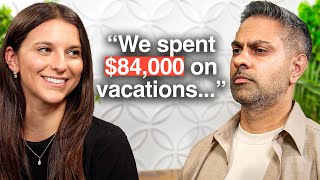
Maddie and Paul are engaged, combining finances, and panicking about money despite spending $84K yearly on travel and shopping. Maddie, the primary earner, micromanages Paul's job search while he figures out what comes after leaving corporate law. They're wrestling with the gap between knowing they're financially okay and actually feeling secure.
Chapters
I have sort of a constant fear of getting laid off. It's like a recurring nightmare because I just feel so much pressure that I am the only one bringing in income. I deal with it by putting a lot of pressure on Paul to figure out his side of the equation, and it comes out in probably not the best way. I have a very sort of, like, urgency stress around it.
I actually try to avoid having this conversation.
Why?
That specific subject is just one. That is very touchy. Maddie does understand all of these concepts, but there's something just, like, deep down innate inside that is scared that it will all disappear.
You think it's possible to feel good about money?
Not from my experience. We're also planning a wedding, so meet Paul and Maddie.
Paul's 33, Maddie's 29. The they recently got engaged, and they combined their finances. Unfortunately, he left his job, and Matty now panics about their finances. As you listen to today's conversation, you're going to hear a lot of expectations. What are our friends doing? What does our family think? I want you to listen closely and remember that we are all affected by social expectations and peer pressure. Let's start at the engagement party that they were recently planning.
So I love planning parties, and I feel like I'd already planned everything. And I feel like you came to me and you're like, should we have a conversation about whether or not this is a good decision, given that I'm just about to stop working and we're going to be on one income? And then that made me panic. Everything was kind of already planned, and I'd already told everyone about it, and I didn't want to backtrack, but I think it ended with us both feeling not great and me thinking, okay, well, we're still going to do it, because I really want to, and it's important to me, but it's going to be kind of, like, stressful as we do it, because this is looming over us as it maybe not be a good decision.
Isn't that, like, the worst of all goals? Yeah.
Yeah.
Like, definitely we're gonna do this thing. We're not even sure if we should do it, and we're gonna feel bad the entire time.
Exactly. Yeah.
Okay. Is that normal for your decisions?
A hundred percent. I feel like I constantly live between, like, two kind of feelings, which is like, I'm gonna live a bougie great life. I work hard. I've made great money. I can kind of do what I want, and we can travel a ton and have a great wedding and all these things and just feeling than the other side constantly feeling, like, stressed and guilty about it. So I feel like, in one sense, I feel like my spending is, like, out of control and I can't stop it. The other side is that we have a lot of money and we can do it, I guess. But that side is. I don't know, it's. Yeah, it kind of constantly flip flops.
Okay. Paul, do you feel the same way?
For the most part, yeah.
Yeah. You oscillate between, oh, my God, we're gonna run out of money. We can't do this. We're overspending, versus we actually make a lot of money. We're good.
I try to calm her down when she gets in the panic spirals, but honestly, it makes me hesitate a bit. It makes me think, maybe she's right, maybe we shouldn't be doing this. Is this something, is this reckless? So I probably have a bit less of the instinct to panic about we're gonna run out of money. Um, but some changes in my job have. Have caused me to start being a bit more concerned about things like this. For sure.
I think I have more of a scarcity mindset, which is it feels like anything can be taken away from us at any point and we need to be like, almost like hoarding money. And I think the best example of that is, like, I believe that our money is our checking account. I don't feel comfortable tapping into anything outside of my checking account. I do understand it.
Okay.
And I know all about compound interest and investing over time, but for some reason, there's a mental gap between what I understand and how I emotionally feel.
Yeah, you don't feel it here intellectually, do you? Look at the numbers.
Yeah, I fully understand the numbers. I'm very analytical. I grasp all the concepts, but emotionally I'm, like, freaked out.
Isn't that interesting?
Yeah.
What do you make of that?
Some sort of generational childhood trauma seeping into a fear of losing everything?
Yeah, it definitely hits home. I think that's a huge part of how we ended up on this podcast, was Mattie does understand all of these concepts, but there's something just like deep down innate inside that is. Is scared that it will all disappear.
And do you feel the same way, scarcity wise?
No, I don't.
Okay.
I don't. I'd say I actually feel pretty optimistic about the future. And when I. When I think about money, I think of what it can do for us down the line. I also, I don't want to make it all About Maddie. Like, I think my. My work situation over the last year or two has added a lot of stress to the situation.
What's that work situation?
So, basically I was working at a company and I was launching a business, a new business unit for them, and it went pretty well for the first year or so. And then the market downturn happened and we basically just couldn't get the business to work out. And it was incredibly stressful. It took such a toll on me. Um, and I ended up leaving the company. And so now I've been off work for. For a month and a half now. So we've transitioned into one income. And I think that puts a. Definitely puts a bit of a, you know, a burden on. On Matty emotionally. And because of the money, I have.
Sort of a constant fear of getting laid off, whether that's grounded in reality or not. And right now it's definitely not grounded in reality, but it's like a. It's like a recurring nightmare because I just feel so much pressure that I am the only one bringing in an income. And I think also kind of helpful context is. So Paul used to be a corporate lawyer. So we used to be in this place of immense stability. And he really didn't like being a lawyer for obvious reasons.
Wait, just tell everyone what those obvious reasons are. Let's go ahead and tell everyone about the legal field, Paul.
Oh, it's about as exciting as accounting. And you have to work 100 hours a week.
I like lawyers. Every time I talk to a corporate attorney, I'm always like, you're very interesting. You have a very. They're like Lego masters or they do something really cool on the side. But of course, that's all I see. I don't realize they're billing, you know, like 15 hours a day and doing reading briefs all day. So. All right, you left the legal world and go on Maddie and wanted to.
Do something more entrepreneurial. It kind of coincided when we moved cities, so we didn't have as much of a network. He ended up joining sort of a scale up. And at the time, we were really excited. We were sort of running the numbers around the equity and all of that stuff. And you usually take a salary cut. So I was like, we felt good about that trade off at that time, but that was a long time ago. That was like 2019, 2020. The world looked very different. And I think the sort of realization that sort of that equity was worth nothing and Paul kind of feeling not fulfilled in that role after a couple years and it being really stressful. And him having to leave, I think it just kind of took us from a place of immense stability to immense instability.
Paul, you mentioned that you're not working right now has caused a lot of stress for Mati. What about for you?
If anything, the last year on the job was even more stressful, and that took a huge toll on me because I think I have my identity tied up a lot in being successful at work. And when I couldn't get that business to work, it. It took a huge toll on my mental health and definitely took a. A toll on our relationship as well. Um, so if anything, there was, you know, when I. When I did end up leaving the company, it was. It was almost a relief, and I started to. To feel better.
Oh, I definitely struggled with it a lot. When things aren't going well for me somewhere, I'm, like, very inclined to sort of, okay, well, I'm just gonna jump ship and do something different. And I felt like Paul was really unhappy for a really long time, and it frustrated me that he didn't take action to make a move. Like, it's not like he is the founder of this business. He wasn't that tied to it. So I think by the time this was all happening, I already felt a lot of frustration towards him because I felt as if it was kind of like a little too late. I was like, you weren't happy a year ago. Why didn't we look into making a move a year ago? And now the market is really horrible, and it's a different climate. And now is when you want to leave. And now we're going to be on one income because of it.
Keep going.
Finish the sentence for me. We're going to be on one income. Therefore.
Therefore I'm going to feel a ton of financial pressure, and we won't necessarily be able to live within our means. We will have to dip into our savings.
I actually try to avoid having this conversation because that specific subject is just one that is very touchy. The idea of at the end of the month, expenses, exceeding income and dipping into a savings pot or investment portfolio, that really kills me. I think, you know, we should be making progress, and we were making such good progress. And if I could have just made that job opportunity work, then we would be in this great position of just, you know, growing our money for the future.
Like you mentioned, you were really stressed when you were at work. How are you feeling now?
It changes by the week is probably the honest answer.
Yeah.
Yeah.
From what?
From a sense of everything's Going to be okay. This is a temporary moment of being on one income. We can get by being on one income. It's totally fine. Matti makes great money. This will be resolved six months from now. This will all be in the rearview mirror. But then sometimes I get caught in the negative spiral too, of thinking, what if this does go for six months and longer or longer?
Yeah, what if it does?
Then we basically have to make lifestyle changes. We should probably be reducing our expenses, making sure that we fit within Maddie's income.
We're also planning a wedding.
When is that?
September 2025.
So you're planning the wedding, but you have this financial instability.
Yes.
How do you deal with that?
I deal with it by putting a lot of pressure on Paul to figure out his side of the equation, and it comes out in probably not the best way. I sort of micromanage him and put a lot of pressure on him to sort of just get any job. Whereas his philosophy is I should take the time and find a job that will be really fulfilling. And especially having sort of had two different career paths that he didn't necessarily love for various different reasons, I think it's really important for him to find something that he. That will put him on a path for like a great career. He's like, so incredibly intelligent.
Wait, are you making his case or are you making your case?
So I'm making my rational case and.
Then you'll tell me what you actually feel. Okay, go on.
So this is my rational case is.
That it's important for him to find the thing he loves. He already went from one career to another. It didn't quite work. So intellectually, he. He needs to what?
Find the best career option for him for the long term.
Even if it takes time.
Even if it takes time.
Wow.
Okay.
However, my actual day to day feelings are just get any job tomorrow.
Any job.
Not any job, but any. Like. Like something will come up on LinkedIn and I'll be like, apply for this. And pal would be like, no, why would I apply for it? I'm like, who cares? Just apply. Like, whatever, just take the job and if you don't like it, quit three months later. Like, I have a very sort of like, urgency stress around it.
I see.
You mentioned you micromanage him. What do you mean by that?
Yeah, she. I mean, she likes to be very involved in the job hunt process. She likes to make sure that, you know, I'm applying to companies every day, that I'm consistently scouring LinkedIn, that my. My list of contacts that I'm networking with is always being updated and meeting new people all the time. It's you, you, you know, you have to play a long game to find the right opportunity and these things take time and you should be taking steps along the way consistently. But you know, I'll get there eventually. Matty just likes to see a bit more day to day progress of how.
Do you monitor his LinkedIn and his contacts and stuff like that.
We work from home together a lot, so I'll kind of come over and I'll be like, did you respond to this person? Have you emailed this person yet? Did this person reply to you? I just like, I feel like I feel more on top of it than he does and I feel like I need to be constantly following up. If someone emails him, like he might respond a day or two later and like, that just does not fly with me in this recruiting process because I'm worried he's going to miss out on an opportunity and it's going to take us longer. Okay, find something.
Okay, got it. So you're kind of checking in with him daily? Maybe, maybe more than daily. Multiple times a day? Oh, yes.
Oh, yes.
Did you do this? What about that? Et cetera. How do you Even know what LinkedIn people he's talking to?
I ask him and he'll tell me. Sometimes I'll see it like pop up on his phone.
Okay.
Once he tells me something, it like goes in my like mental filing cabinet. So then I'm like, okay, I have like little mental reminders. Be like, check in on this. Make sure Paul did that. Make sure Paul responded to this.
And just out of curiosity, what do you get out of this?
I guess it feels like I have some sense of control over something that feels very out of my control.
Yeah. How do you feel when you get the questions from her about your LinkedIn check ins and things like that?
I immediately feel my chest tighten up, you know, the, the feeling of, of stress and my heart rate skips a beat of, oh, I need a, I need a good update for Maddie right now. Like I need to be able to show her I made progress.
And what does that feel like?
I mean, it's a very, it's a very tough thing to, to kind of like accomplish.
Does it remind you at all of any other career situation where you felt like you had to give a positive update regularly?
In my last job for sure.
How did that end up?
That ended up with me and yeah, the worst like mental state I've ever been in. All right.
And what if this just went on for, let's say, six months, nine months, Over a year.
Yeah.
So.
So I think, to answer your question, at some point, a deadline would have to come in. Personally, I'm kind of avoiding the step of the running the numbers fully on how many months we can take before I have to take a more drastic step.
Okay. Have you run those numbers?
Absolutely not.
But you feel.
I feel like the deadline is tomorrow. We've done a lot of couples therapy, and we're super aligned, and we're very open, and we're great communicators. I feel like this is the main blocker in us being super happy.
This is the main blocker. This being what?
Our financial security? I won't even say stability, because I know that it's not necessarily that, but it's feeling financially secure and feeling excited for our future together financially, and also our career trajectories and just feeling confidence that everything's gonna work out.
Do you think that if he had a job tomorrow that you would feel financially secure?
I want to say yes, but I know the answer is probably not yes.
I mean, when he had a job and he was making good money, did you feel financially secure?
No. No. It's the short answer.
You've heard me talk about gender dynamics on this program. Studies show that women do more household labor, even if they work the same number of hours as men. But notice what's happening here. Maddie is taking on the labor of checking on Paul's job search. She's micromanaging his process. Now, this is an example of Maddie unnecessarily taking on labor when she doesn't need to. Her partner is not asking her.









