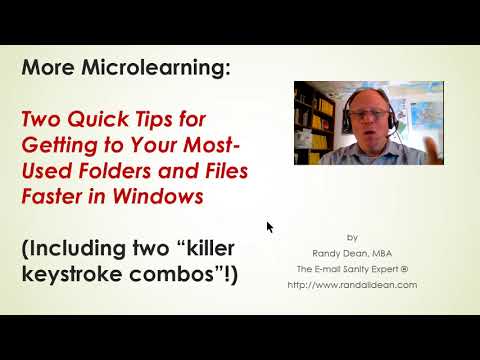
In this microlearning video, Randy Dean (email sanity expert) celebrates reaching 4,000 YouTube subscribers by sharing two quick productivity tips for Windows users. The first tip demonstrates the Windows+E shortcut to open File Explorer, then shows how to pin frequently used folders (e.g., YouTube channel videos, Presentations) to the Quick Access pane for instant access. The second tip walks through creating shortcuts for favorite folders via the "Create Shortcut" command, sending those shortcuts to the desktop, and then using the Windows+D shortcut to show the desktop instantly while keeping applications open. Dean also mentions a PowerPoint shortcut (Shift+F5) to launch presentation mode directly. Throughout, he emphasizes how these small time‑saving actions can add up to hours saved over a year. The video ends with a call to action: visit randaldean.com, subscribe, like, and email for a PDF of productivity tip sheets.
Chapters
All right. Hi everybody, Randy Dean here, email sanity expert. I want to continue on this pathway of building these microlearning videos in celebration of hitting 4,000 subscribers a couple weekends ago. And this one I think could be super helpful for a number of you. It's just two really simple, quick tips on how to get to the folders that you use most more quickly when you use Windows. Uh, most of us have a few folders that we use all the time, and it would be really nice to be able to get to them very fast. So let's start this off. I'm going to also include two killer keystroke combos in here. Why don't I do one of them right now? I'm going to escape out of the program, and the first one is called Windows+E. Now it's the Windows key, looks like the little Windows icon, and the letter E. And when you do Windows+E, look what that does. It brings up your File Explorer just like that. But here's what I can recommend that you do. You'll notice I have this panel up here called Quick Access, and underneath it you'll see I've already pinned several of the folders that I use most frequently right here. Plus there's a few other folders that I've just used recently that get there too because it's watching sort of what I'm doing. But what I could do is come down here into my OneDrive. I'm going to go into my Documents. Let me go into my Company Files, and I want to go in a couple levels deeper. I want to come down, and what I'd like to do is take my YouTube channel video folder, and I'm going to simply right-click on this and pin to Quick Access. Now, by doing that, let me show you what happened. Now, YouTube is right there on the video file list under Quick Access, and I can get to that folder in just a couple seconds by using Windows+E, click on YouTube, or click on Presentations. But wait, there's more! There's another one that you can do which I think is almost just as useful. Notice that you can also come into any one of your folders, and you'll see this one's got Frequent Folders right here under Quick Access. What I want to do is come down here inside of my, uh, Documents yet again, and I'm going to go back into here, and you'll see I've got my Presentations folder right here. And, uh, actually, I want to do the other Presentations folder. I'm going to go a little bit deeper. This one, this is the one I know I'm using most frequently. So what I'm going to do is right-click on this, and you'll see that you've got a lot of options. I can do the Pin to Quick Access,. But if I instead— let me show you how do you do this, because this is like a two-step drop here. I am going to come up here to the top layer above it, click on this folder. So now I've got all of my folders over here that are inside this folder, including the one that I just showed you, Presentations. Now that I've got that in this panel list, if I do a right-click, I get another option. Beyond Pin to Quick Access, it's right here. It's called Create Shortcut. So create the shortcut. Now when you create the shortcut, you'll be like, where'd it go? But if you page all the way to the bottom of the file, let's do this, you will see that the presentation shortcut— there's one right there. I'm going to take the newest one, which I just did right here. You'll see I played around with this a few times. I am going to take that, right-click on it and watch this, send to desktop. So what I just did is I just took that presentations folder and I put it on the desktop. And while we're at it, you know what I want to do? I'm going to come up here to the presentations folder one more time. Let's go down to it because there's a couple folders inside of here that I use very frequently. I'm going to actually click on this now, and I want to take my programs folder, right-click, also create a shortcut. And my Clients folder, right-click, create a shortcut. Now that I've made these shortcuts— well, there's the Client shortcut right there— I am going to right-click and hit Send to Desktop yet again. And let's go find that new shortcut for Programs. There it is. Right-click and Send to Desktop. So as you can see, what I'm doing is I'm making shortcuts of my most used folders that are out on my desktop. But now I want to show you killer keystroke number 2. Remember, the first one was Windows+E to open up my File Explorer. Let's close my File Explorer and let's do now a Windows+D. And look at this. Presentation shortcut, client shortcut, program shortcut. Look, I already had program shortcut, so I can click right here and hit Delete. That way I don't have a big mess out here. But you can even move these around a little bit so that they're in a place where it's easier for you to see if you want them to be off to the side somewhere. So I could move them over here, and that way I know right where they are. It'll tell you when you're deleting your files, by the way. Now what's interesting is when I did the Windows+D, it didn't close the programs. So take a look, I can go back into my PowerPoint that easy. It's still open, it just took me to the desktop very quick. And so as you can see, using the combination of these two tips, adding your most used folders to your Quick Access and then using the Windows+E to open File Explorer, and also creating shortcuts you can put on your desktop and using the Windows+D shortcut, you can really quickly get to the folders you use most often right away, and that will save you a few seconds every time. But over the course of a year, that could be hours and days. All right, let's finish this thing up. Uh, remember my old keystroke combo for PowerPoints? Shift-Function-F5 will launch this right into presentation mode. Let me show you another little tip, or I could just come down here and click slideshow, and that also puts you into presentation mode. Thank you for your time. I'm Randy Dean, email sanity expert. You'd like to learn a little bit more about me and what I do, go check out my website randaldean.com. If you like the video, consider giving it a like, consider subscribing. It's really— we're doing well adding some subscribers right now. And if you want to get my productivity PDF tip sheets, including now on my YouTube video guide, a list of several of these microlearning videos, send me an email randy@randaldean.com, put YouTube PDF in the subject line, and I'll give you a whole bunch of cool new tools that you can work on. Thanks everybody.