4 Main Vaisnava Qualities | Book Distribution-an AtomBomb | SB 4.21.37 | 1990 | Gopāla Kṛṣṇa Goswāmī
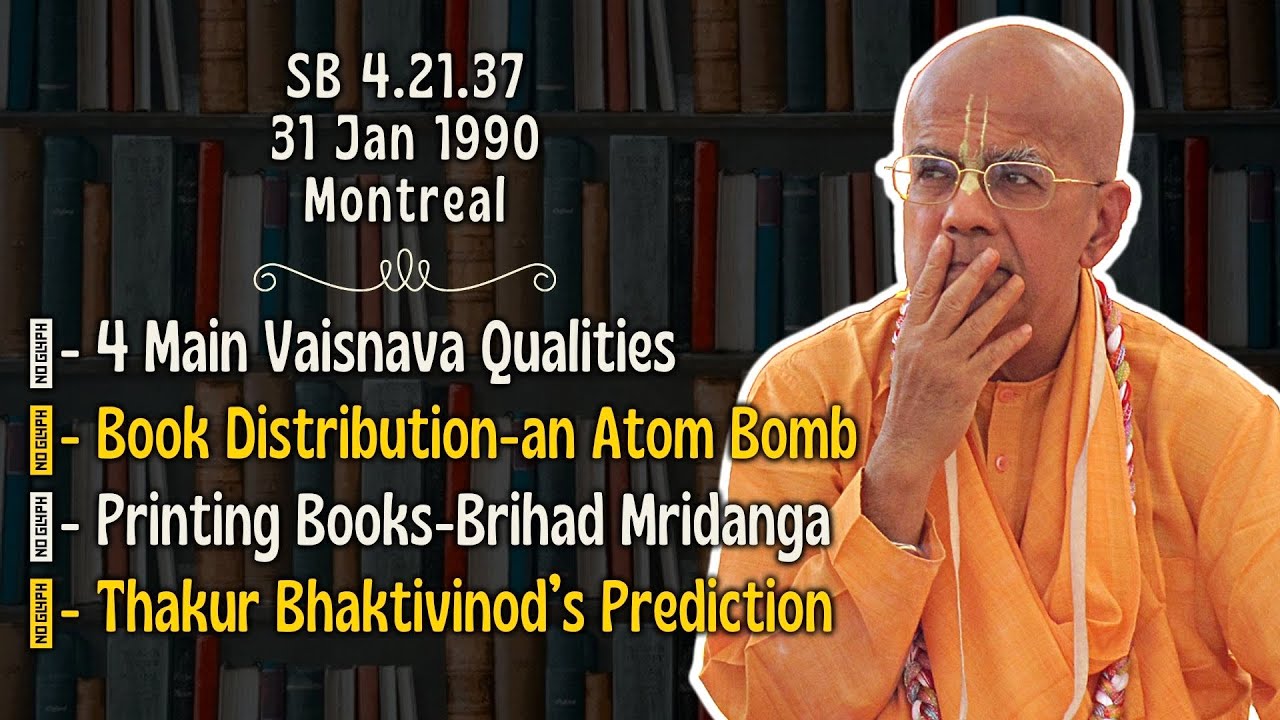
In this devotional lecture, the speaker expounds on a verse from the 4th Canto of the Śrīmad‑Bhāgavatam in which King Prithu enumerates the qualities that distinguish an exalted Vaishnava. The discussion narrows the 26 traditional spiritual qualities to four broad "spiritual assets": tolerance, penance (austerity), knowledge, and education. Each asset is explained with scriptural references (Bhagavad‑gītā, Caitanya‑Mahāprabhu, Rūpa‑Gosvāmī) and practical illustrations, especially how tolerance underpins successful book‑distribution preaching. The lecture then details the historical lineage of book distribution—from Bhaktisiddhānta Sarasvatī through A. C. Bhaktivedānta Swāmī Prabhupāda—using the metaphor of an "atom bomb" to describe its transformative impact. Guru‑aparādha (offenses against the spiritual master) is highlighted as the gravest sin, reinforcing the need for humility and respect. The speaker stresses the necessity of penance, rational scriptural knowledge over sentimental devotion, and systematic education (progressive study of the Bhāgavatam). Finally, internal preaching (mind‑training) is presented as a prerequisite for effective external preaching, with concrete advice on making the mind a friend and maintaining patience in the face of rejection. The lecture concludes with a Q&A segment addressing the balance between material wealth and spiritual richness, the danger of over‑endeavoring, and the importance of internal conviction before outward distribution of books.
Chapters
Om Namo Bhagavate Vasudevaya. Om Namo Bhagavate Vasudevaya. Om Namo Bhagavate Vasudevaya. So for today's discussion, we have selected a verse from the 4th Canto which describes the qualities of a Vaishnava and a Brahman. "If a person senses at the feet of a Vaishnava, his advancement is all spoiled. In the Shastras it is found that a very great yogi, Dvāsa Muni, committed a Vaishnava prāsa, and thus for one full year had to travel all over the universe, even to Vaikuntha-loka, to defend himself from the offense. At last, even when he approached the Supreme Personality of Godhead in Vaikuntha, he was refused protection. Therefore, one should be very careful about committing offenses to the feet of a Vaiṣṇava. The most grievous of vaiṣṇava-aparāda is guru-aparāda, which refers to offenses at the lotus feet of the spiritual master. In the chanting of the holy name of the Supreme Personality of Godhead, the guru-aparādha is considered the most grievous offense. Among the 10 offenses committed against the chanting of this holy name, the false offenses are disobedience of the spiritual master and blasphemy of the Vedic literature. Om ajñāna-cimānandasya-jñāna-mānyanāśalākya. Hare Krishna, Hare Krishna. Kuleśvim rājākladvītānām. So this very famous verse of the Bhāgavatam is being spoken by King Prithu. The reason we selected this verse for our discussion today is that in this verse King Prithu is describing the qualities which make a Vaiṣṇava exalted. Just like, how is one recognized as a rich man? He is recognized as a rich man if he has a big bank balance, lot of property, and so on, isn't it? How is one recognized as an educated man? In the material world, one is considered educated if he has many degrees and so on next to his name. So spiritually, one decorates himself with certain spiritual qualities. Of course, we would discuss in detail the 26 qualities which a Vaishnava must aspire to cultivate. But the 4 qualities which Pritu Maharaj has called spiritual assets. A materialist is after material assets. Material assets means bank balance, stocks, investments, properties, cars, and so on, isn't it? But a devotee is after spiritual assets, and spiritual assets means he must have power of tolerance, penance, knowledge, and education. Now in these 4 spiritual assets, all the 26, the other 22 assets that are also described by Caitanya Mahāprabhu Caitanya Mahāprabhu Gosvāmī, get included, because these four assets are so broad that if we strictly just cultivate these four assets, then all of the good qualities will automatically develop. So let us examine the spiritual assets that Prithu Mahārāja is highlighting. He says, the characteristic powers of tolerance— this is one. Tolerance is very necessary for succeeding on the spiritual path. Therefore, in the second chapter of the Bhagavad-gita, Kṛṣṇa says, mataḥ svāśaś ca kānte asitoṣṇa sukha-duḥ kadāha, erga-ma paīno netyu-sampeṭu-saḥ-bhārata. One must have this quality of tolerance, just like the coming and going. Of winter and summer seasons. It is also the coming and going of honor and dishonor, victory and defeat, happiness and distress. And we have to be equally poised or undisturbed in all situations. Therefore, the Bhagavad-gītā uses the word dīrā. Dīrā means One who is constantly educated, and as a result he becomes tolerant. So we have to become dīrās. We are here to, in this Kṛṣṇa consciousness movement, to become dīrās. When we come to Kṛṣṇa consciousness, we are not dīrās. We don't have any tolerance. In the true existence there is no tolerance, isn't it? When you're driving a car and somebody comes in front of you from the wrong side, you're ready to curse him, isn't it? You're driving a car and someone just overtakes you from the wrong side, you're ready to get out of the window and give him some abuses, isn't it? Because we have no tolerance. You're walking on the road and somebody comes and bumps into you, you're ready to shoot him down. So in the material world, basically we have no tolerance. But in spiritual life, this quality of tolerance has to be developed. Caitanya Mahāprabhu therefore has also emphasized by stating, "Sinaad api suniteena tarur api saishrūnaḥ amānina manādhana-kīrtanādī sadāḥrī." One should become very tolerant, more tolerant than a tree, devoid of all sense of false prestige and ready to offer all respects to others. In spiritual life, when we offer respects to another Vaiṣṇava or a senior Vaiṣṇava. One doesn't become poor in spiritual life. One is always anxious to offer respects. Therefore the spiritual principle is to address each other as prabhu. Prabhu means master. And in spiritual life we acknowledge That I am a fool number one, but this other person is my prabhu, he is my master. And by having this attitude of being a servant of the servant of the servant, this is what Caitanya Mahāprabhu has exemplified and mood of being a servant of the servant of the servant of the servant, one can gradually progress on the spiritual path. So this tolerance must be there. We have the mind is always disturbing. Kṛṣṇa says every living entity is struggling with the mind and the 6 senses, isn't it? So the mind is playing havoc with everyone. Therefore Kṛṣṇa, Arjuna had to say, "Āñcalay mana Kṛṣṇa." That this mind is more turbulent than the wind. And is determined, obstinate. The mind is obstinate. Every day you will hear how you must give up sense gratification, but the mind is so obstinate, it says, "No, I cannot give up sense gratification." So the mind is so obstinate. You know, devotees have a tendency to think that, "Oh, it is only my mind that is disturbing me. It is only my mind which is obstinate." But actually everybody's mind is obstinate, everybody's mind is treacherous. Therefore we have to develop this quality of tolerance. When Kapiladeva was asked by Devadūji as to how do you recognize a saintly personality, the first quality which Kapiladeva mentioned in response to his mother's inquiry was titikśava. That means A devotee of the Lord must be very tolerant. So we must develop this quality of tolerance. And the quality of tolerance comes with spiritual maturity and with the execution of devotional service. The beauty of Kṛṣṇa consciousness is that if we sincerely execute the process of Kṛṣṇa consciousness, then all these qualities will automatically develop. Just like when one is hungry, the different parts of the body all become weak, but then just by sending the food to the stomach, the different parts all become strong. So the quality of tolerance must be there. And tolerance also means patience. Rūpa Gosvāmī has said, Patience must be there in order to succeed spiritually. You cannot say, "I have been in Kṛṣṇa consciousness now for 6 months. Where is Kṛṣṇa? Show me Kṛṣṇa." There's one man I meet all the time in Delhi. So he comes and tells me, "I've been chanting Swāmi Ji for 2 years. Where is Kṛṣṇa? Why is Kṛṣṇa not coming and talking to me?" So Kṛṣṇa is talking to you, but we are still not purified enough to see Kṛṣṇa. So they must be patient, and if this patience is there, then we will be able to succeed on the spiritual path. So we must understand that happiness and distress, victory and defeat, these are all temporary. Therefore, Prahlāda Mahārāja advised his friends not to be attached to either of these ideologies or desires. Then also Prahlāda Mahārāja said, I am not interested in dividing the society into friends and enemies, because to a spiritualist, everybody is his friend. Everyone is— he is a well-wisher of everyone. So this quality of tolerance is very necessary. Just like when we go out on book distribution, for example, when we go out on preaching assignments, you have to practice tolerance. When you're going out on the street trying to get people to take our books, obviously everybody is not going to stop and say, "Yes, Prabhu, what do you have to sell? A book? Here, here's $10, give me a book." No! 99.9% of the people that you meet on the street are not interested in it, isn't it? So you may say, Oh, then what is the value of our pushing on this activity of book distribution? The value is that this is the desire of the Lord, and this has been manifested by the disciplic succession, Bhaktisiddhanta Sarasvati and Prabhupada. They emphasized the importance of book distribution. Why? Because by book distribution You are giving people the ammunition by which their material desires can be destroyed. Just like Prabhupada used to say, book distribution is like an atom bomb. What happens when you plant— if somebody was to keep a bomb over here, when the bomb bursts, blasts, it destroys everything, isn't it? So similarly, by book distribution, All your material desires get destroyed. Why? Because in these books Prabhupada and all the great acharyas are telling us what we should do and what we should not do. So bhaktisiddhanta Sarasvatī ṣhakura, the great spiritual master of Śrīla Prabhupāda, he very strongly emphasized The activity of book distribution. Bhaktisiddhanta Sarasvati used to send his disciples out to distribute books, and they would go out all day, and in the night they would come back just with few paisas. Few paisas could be compared to few cents. So they would go out all day, and they would come back with maybe 5 cents in the whole day. And he will be very, very pleased. So Bhaktisiddhānta Sarasvatī, he once drew a picture of a mridanga. You have that mridanga there. He once drew a picture of a mridanga, and he called Prabhupāda next to him, and he said, "The printing press is a bhrīhad-mridanga." Bhrīhad means in Bengali the big mridanga. Why is it the big Madhanga books? Because with this Madhanga, your sound will only travel for few blocks. Then even if you have a very powerful amplifier system, the sound will only travel till the end of the corner road, maybe the most. But when you distribute these books, the sound may even travel the 20,000 miles. Because you may distribute a book on Saint Catherine Street, and the person may keep it with him, and he may open the book in London. You may print a book in India, and you may distribute it all over the world. So bhaktisiddhanta Saraswati Ji told Prasada: "If you ever get money, just print my books. Just print these books." So Prabhu-pāda had this idea of book distribution in his heart because this was the order of his guru maharaj. As far as Prabhupada took the instructions of his spiritual master very, very seriously. He never deviated from the instructions even for one second. Therefore he was so successful. So Prabhupada started this program of book distribution even before he came to the West. For example, on one occasion Prabhupāda was distributing this newspaper called Back to Godhead in Delhi. And, you know, Delhi is very, very hot in the summer season, and in the winter season it is pleasant. So he was out distributing those books— actually it was a newspaper— and he had a sunstroke. And he fell down and fainted. But then as soon as he was brought back to consciousness, he again started distributing those books. He started distributing his Back to Godhead magazine. So even before Prabhupada came to the West, when Prabhupada was struggling to establish the foundation for Kṛṣṇa consciousness, he was personally writing and distributing these books. He was translating in the night, in the daytime going and begging for donations, and then printing these books, and then going to also sell these books. Because Bhaktisiddhānta Sarasvatī had planted in him the seed of book distribution. After Bhaktivedānta, another great spiritual master in our line of disciplic succession, Thakura Bhaktivinoda is called the grandfather of the Kṛṣṇa conscious movement because Thakura Bhaktivinoda, Vācīrānanda Thakura Bhaktivinoda, who is the mercy of Caitanya Mahāprabhu, it was he who visualized that, "Yes, Lord Caitanya's teachings are going to come through." And Thakura Bhaktivinoda, he was a householder. He was a magistrate. He had 12 children, and Bhaktisiddhanta Saraswati was one of his 12 children. But he made all of them into pure devotees. So Thakura Bhaktinoda had written a book on the life of Caitanya Mahāprabhu. Then in 1896, the year that Prabhupāda took birth on this planet, Ṛkṣṇa-kṛṣṇa-bhakti, you know, had sent this book on the life of Lord Caitanya. Where? To McGill University. McGill University in Montreal was the first university in the world, in the Western world, where the seed of Kṛṣṇa consciousness was planted. The first university. And believe it or not, that book was at McGill University library till 1966. When one of our devotees took the book away. So anyway, from 1896 to 1966, this book was in the library. So anyway, the Tathāgatī Vinod had made this projection that one day in Māyāpur, devotees from all over the world will come and dance and sing and glorify. Caitanya Mahāprabhu. And Thakura Bhakti Vinod himself, after his retirement, as I told you, he was a government magistrate. So when he retired, he would go house to house in Calcutta and beg people to give just 1 rupee for, uh, selling Kṛṣṇa-kārtikas. And he was personally distributing this literature. So the point is that The spiritual master teaches by example. So Bhaktivinoda Thakura said, teach, taught by example. And Prabhupada also taught us by example the importance of distributing his books. Whenever he would get a chance, he would convince people to buy these books. And Prabhupada encouraged the devotees of this Kṛṣṇa conscious movement to do book distribution. The history of the book distribution is read out in the letters which you all hear every morning, so I will not repeat that. But all I will say is that Prabhupāda said that if you want me to live forever, then please distribute my books. As long as book distribution goes on, he said, I will never die. Because nānātama-nārthakūṇa is said. "He reasons ill who says that the Vaishnava dies when thou art living still and sound." So the Vaishnava lives and sounds through his instructions. Therefore, even when the Vaishnava dies, we don't cry. We may cry on the one hand when the exalted Vaishnava dies, because there is some physical separation. And on the other hand, when the exalted Vaiṣṇava dies, we have a feast. When Haydnāṣṭhākura died, Caitanya Mahāprabhu carried him and danced and had such a huge feast. Because the Vaiṣṇava is always living in his instructions. So Prabhupāda instructed us to expand this book distribution. Then disciples would write letters to Prabhupāda. And the secretary would bring the mail to Prabhupada. The first letter that Prabhupada would always read is book distribution. He wanted to see the scores of book distribution because book distribution is an activity by which we are preaching and giving someone the seed for devotional service. Prabhupada said that these books are so powerful that if somebody even touches these books, he can get a human birth again. Just by touching these books. Just you give a book and somebody touches it, he can get a human birth. He can. And if he buys the book and takes it home, then there's a very good chance that today or tomorrow he will read it. He may laugh at you, brush you aside, whatever, but he will read it. And when he reads it, ha, he'll say, "Oh, I'm fool number one. I'm wasting my valuable human life in eating, sleeping, defending, and mating, which even the dogs and the pigs are doing." The whole human civilization today is concentrating so heavily on sex life, for example. The pigeons are having sex life 100 times a day, and the monkeys are also having sex life 100 times a day. So what is the value? If after this human form of life, that is all we are going to meditate upon. So this knowledge we can get from these scriptures. So when we go out to distribute books, we have to practice tolerance, isn't it? Because without tolerance you cannot distribute books, without tolerance you cannot preach. You go out for 2 hours and it is very cold, you say, "Oh, I can't stay outside, I have to come back inside." Or you go out for 2 hours and somebody says, "No, no." You meet some rude, nasty people. Then you say, "Ah, people are too nasty. Nobody wants these books." No. But if we are tolerant, then we will go on trying, trying, trying. We will have faith in the words of the spiritual master, which is, "Distribute these books and make society happy." So we can, this activity of book distribution, which all of you are presently engaged in, is an activity which is very, very dear to the Lord. This is an activity that is executed by the inner confidential devotees of Caitanya Mahāprabhu. Just like, you know, every big man has a confidential cabinet, isn't it? Like if you go to the Prime Minister, he will have 2 or 3 people who are like his very close friends. Am I right? Isn't it? You go to the president of a company, he has few people who are like his close trusted lieutenants, they say, trusted assistants. So similarly, those who take part in book distribution and preaching, they are the confidential devotees of Caitanya Mahāprabhu. Caitanya Mahāprabhu does not allow everyone to preach on His behalf, but when He sees that somebody is sincere, then He gives them the opportunity to engage in book distribution. So we should consider ourselves to be the most fortunate that after having traveled through so many millions of birth and death, now we are engaged in this activity of book distribution. So just like when Prabhupada was on this planet, he used to read the scores of book distribution. So now even in the spiritual planet, every morning we read out these scores. He is hearing the scores. Ah, my devotees are doing so much of book distribution. I know when Prabhupada was here in '68, you know, in Montreal, Prabhupada was here for 3 months. That's where I met him in 1968. Prabhupada used to go to Expo. We went to Expo a few times. There were Expo at that time. And we did book distribution and kirtan and even on Phillips Square and McGill University Prabhupada went once or twice. So the point is, by understanding the importance of this mission, we can become instruments of fulfilling the desires of the Lord. What is the desire of the Lord? To make everyone happy. Kṛṣṇa appears to make everyone happy. And Kṛṣṇa is dependent upon His devotees in order to make everyone happy. So penance, this is another spiritual asset that Pritu Mahārāja is mentioning, penance. Penance basically means austerity. Austerity means voluntarily accepting inconveniences for a higher goal. The higher goal is love of God. Without penance you cannot please God. These days people want God but they don't want penance, isn't it? People want— like in America, for example, you know, there was a survey done last year and the survey showed that there's a very powerful trend towards people becoming religious again. So we are very happy that people are again saying they want to become religious. But do they want austerity along with religion? No, no austerity. I'm ready to go to the church, but please don't tell me what I should do, what I should not do. Isn't it? I'll go to the temple, but don't tell me what not to do. Let me do what I can do. Just like in India, there's a television serial going on right now called the Mahabharata. You must have heard of that. You've heard of that, isn't it? Before that there was the Ramayana, and now it's the Mahabharata. So every Sunday from 9 to 10, you don't see any man on the street, no car. 99% of the whole country, of those who have TV, are watching that serial, Mahabharata. It's an all-time world record. Every Sunday. In that Mahābhārata they have ISKCON posters. But because everybody is watching Mahābhārata, does it mean that people are practicing satva-syaṅga? Now they have given up smoking, drinking, illicit sex, gambling? No. So people want religion, but they don't want austerity. You understand? So religion without austerity is a failure. So, tenants must be there. Tāpo devyam kato gayena satvām śrīyāyaḍaṣmaḍham asko kempta-mānāṁ tam. There must be the practice of spiritual austerity, and this spiritual austerity is what will give one eventually spiritual happiness. So Prithu Mahārāja says, "Penance is one of the assets of a devotee." So when you have to go through some difficulty in executing Kṛṣṇa consciousness, Don't be scared. Of course you will have to go through some difficulty. Do not worry, but execute penance and Kṛṣṇa will reciprocate. So when you have to go out on book distribution and you have to go out in the cold, or you have to go out in the heat, or you have to go out to a place where the cops are always chasing you, don't be disturbed. Torrin your charity because you are executing the highest welfare activity. In the mature world, people want to do charity. They build hospitals, they build schools, they give charity. But the highest charity is when you give people knowledge by which they can give up sinful life. That is the highest knowledge. So Caitanya Mahāprabhu has instructed us I freely distribute this knowledge by which there can be love of God. Just like the clouds. The clouds, when they pour water, they pour water without discrimination, without seeing who is fit, who is non-fit. Similarly, we must distribute this knowledge of God freely without seeing who is fit and who is not fit. So penance must be there. When you go on harināma, sometimes everybody is going to harināma, they feel very shy. Somebody may see me who knows me, my uncle may see me, my auntie may see me. Nothing to worry. If they see you, they will benefit because they will hear the Holy Name because of you. You don't have to be embarrassed. So penance is also necessary for spiritual advancement. Then knowledge. Without knowledge you cannot execute religion. Prabhupada used to say, "Do not take to Kṛṣṇa consciousness sentimentally." Why is that? Because if you take to something sentimentally today, tomorrow you will reject it. Today you are in a good mood, you are taking to it. Tomorrow you are in a bad mood, you will reject it. So don't take your Kṛṣṇa consciousness sentimentally. Nithai, are you going to be able to see me after the class? Okay. So don't take your Kṛṣṇa consciousness sentimentally. Take the Kṛṣṇa consciousness out of rational understanding. Understand the philosophy properly. And that means cultivate knowledge, isn't it? Like in India you see a lot of people, they chant Hare Kṛṣṇa, but it's all sentimental. They have no śāstric knowledge. Many times people come and associate with ISKCON, they just chant, they jump high, you know, jump so tall that it looks like they are really making spiritual advancement. You don't judge spiritual advancement by seeing how high one jumps or how fast one jumps. But you judge spiritual advancement by seeing how much spiritual knowledge the other person has. You understand? So they may jump very high, but they don't have spiritual knowledge. And because they don't have spiritual knowledge, when they are out on the road and they see a beautiful woman or they see an opportunity to make money, they say, "Oh, let me make money now." And they forget Kṛṣṇa. Bye-bye, Kṛṣṇa. So we must understand this knowledge properly. If we have the spiritual knowledge, then when your mind is saying, "Come on, do sense gratification," you will say, "No, I have already done this a thousand times, still I am dissatisfied. Why do you want to push me once more?" It is just like when you have a skin disease and you have an itching sensation. The more you scratch— when you scratch, you get some temporary pleasure, but then the disease becomes more serious, isn't it? So we don't want to scratch our desires for sense gratification. We want to control them. When you have skin disease, the doctor tells you, "Don't scratch, even if you feel like scratching," isn't it? So you feel you have itching sensation. Please don't scratch because you know your disease will get worse. When you are hung, when you have a bad stomach, they tell you to fast. You feel like eating, but you don't eat because there's a higher goal in life. So that is recovering your health. So similarly, there must be spiritual knowledge, then you can defeat the temptation of sense gratification. And education. Education means we must systematically study these books which Prabhupada has written. Nārpada has written these books in a very lucid style with word meanings, samskāra, indexes, and so on. So we should progressively study these books. Start with the first canto and go to the twelfth canto. Now you go straight to the tenth canto and read about Kṛṣṇa's Vāsudeva līlā. So we must progressively study this, and then our intelligence will be so sharp that you will have absolutely no difficulty in making spiritual advancement. So these are the assets by which a devotee develops his spiritual life. You may go out on the street to do book distribution, but if you do not know what is inside these books, how will you distribute books? Prabhupada was once talking to his devotees, book distributors, and he said, he said, do you know what is inside those books? They said no. Prabhupada said, then if they ask you what is inside, what will you tell them? You must know what is inside. So we must know the philosophy also. We don't have to know every word. Just like when you go to a store to buy a product and you want to ask the salesman, okay, what is this product, what can it do for you? If the salesman tells you he doesn't know what the product can do, then you don't feel inspired to buy the product. But if the salesman talks to you in a very convincing manner, tells you how good the product is, this is what it can do, then you feel more inspired to buy it. So we must know what these books are saying, because raja-vidyā-rāja-vidyām, this is the perfection of education. And by all these spiritual access, one becomes more powerful than even the king. The devotee of the Lord is more powerful than even the king. But even devotee, even though he may be spiritually powerful, he does not exhibit his powers. Because the Bhāgavatam gives a nice example. Just like when you have the branches of a tree which are being— which has a lot of ripe fruits in it, due to the presence of the fruits in the branches of the tree, the weight of the fruits is pulling the branches down, you understand. And when the branches of the tree don't have fruits, the branches shoot upward. So similarly, a key medium for spiritual advancement. So Prithu Maharaj has explained How we can cultivate spiritual assets. In the purport, Prabhupada talks about how Caitanya Mahāprabhu has instructed Rūpa Gosvāmī that the creeper has to, which has a feeble stem, has to take the support of another tree to grow. So similarly, by taking shelter of these instructions of the process, we can make spiritual advancement and we will be able to make, go back to Godhead. So these qualities which Prasad Raaval Maharaj is highlighting are very important. We should all aspire to cultivate them. And being aware about other spiritual assets that we should cultivate, we can endeavor to perfect these qualities and thereby sail happily on the spiritual path. Hare Krishna. I stopped a little early so we can have a Was that okay, Kripa-nīmī? These qualities, did you all cultivate? So I also wanted to have a little iti-gocī. And should I take on one or two questions, or should I go to the iti-gocī now, Kripa-nīmī? Yeah. Okay, I'll take 3 questions. Samaḥ tvākvaśyam, apraṣām avāvaram paṭhī iti-gocī. Kulaśekara ṣrīñeṇa. Okay. He had firmly understood that Kṛṣṇa is the Supreme. But knowledge— but today, in today's environment, 20th century, if you don't have this scriptural knowledge, then it is very hard to convince the materialists and all about spiritual life, isn't it? Like on the Sunday feast, so many people come with so many silly ideologies. How are you going to defeat them? And how are you going to defeat your own mind? First you have to defeat your own mind, then you can defeat other people's mind. But if you cannot defeat your own mind, how can you defeat other people? You follow? A devotee should only endeavor as much as is needed to keep body and soul together. That is the guideline. A devotee should not work so hard. Rūpa Gosvāmī in Nectar of Devotion talks against over-endeavoring. If you over-endeavor, leave no time for japa, no time for temple, no time for this, then what is the value? Am I right? I don't know. You should balance the two. So when Kṛṣṇa gives a devotee material offerings, the devotee must offer it back to the guru. Kṛṣṇa was given so much money, dakṣīna, by his disciples, but he offered every penny back to Kṛṣṇa. They may be materially rich, but they have become spiritually poor. So what is the value? We want people who are materially rich and spiritually rich, not materially rich and spiritually poor. In a sense, I may be materially rich, but if I'm spiritually bankrupt, then what's the use? Any more questions? Yes. When your mind is criticizing, when your mind is critical, don't worry. It's not so bad. At least don't translate it into action and verb. In Kali-yuga, there is a concession of the mind, but it doesn't mean that we should misuse it. Because if your mind is criticizing, then slowly, slowly, whatever is in the mind comes in the tongue. And what is in the tongue comes in the action. Sometimes you're very angry at some devotee, okay, sir, then whenever you get a chance you will shout at that person. And then if you're more angry, you may even slap that person. You follow? So the safest path is to keep the mind pure. It's offensive, quoi? Ah, the mind should avoid criticizing. But if the mind is criticizing, then stop that. If something is wrong, then you correct it. You understand? When you see the child doing something wrong, then you correct it. You understand? Did I answer your question? I don't— okay, we can talk after the class. You can ask me. Any last question? We— yes, very intelligent question. You must preach to yourself internally. Preaching consists of two aspects: internal preaching and external preaching. First you preach to yourself internally, then you will preach externally. But if you don't preach internally, how will you preach externally? You will go on St. Catherine Street and your mind is thinking of the movies, and then how can you distribute books? You must be convinced yourself from your heart. When you go on the street, you see somebody coming, you must pray to Guru and Kṛṣṇa, "Please make me an instrument so that I can save this conditioned soul from going to hell." Hello? So you must do internal preaching all the time. Internal preaching you must do 24 hours. Yes, any question? Any other questions? So the mind goes away, so make the mind your friend. Manayevo manushnam kāṇam bandhayam mokṣya bandhayam ishayasāṅgau muktāṇaṁ śamaṇām. Punikati. We have to make the mind our friend. I want you to hear, we're going to start Easter Ghost in a few minutes. I just saw him upset. So we have to make the mind our friend. We have to bring the mind in control. What? You can't, but go on practicing it. Whenever the mind wanders, you run behind and pick it up. Just like you see the mothers who come to the temple with a young child. So whenever the child is running out on the road, the mother runs behind the child and pulls the child back, isn't it? So whenever your mind runs, pull it back. Don't you see in the temple, the mothers are all running behind their children? Wherever the children run, the mothers chase the children. So you have to chase the mind and bring him back. Okay? Okay. Hare Kṛṣṇa.
More from PRASAD

Rare Pastimes & Timeless Lessons of Guru Mahārāja | Stories Every Disciple Should Hear

ISKCON Legends- pure devotees meet-HH Jayapataka Swami, HH Gopal Krishna Goswami, HH Radhanath Swami



Jagannātha Ratha-yātrā Through Śrīla Prabhupāda's Mercy | 29 April 2006 | Nairobi, Kenya

Lord Jagannātha's Appearance Pastime | 21.07.2019 | ISKCON Calgary | Śrīla Gopāla Kṛṣṇa Gosvāmī

The Ācārya Teaches by His Own ExampleGuṇḍicā Mārjana by Guru Mahārāja #shorts

Guṇḍicā Mārjana – Lord Jagannātha's Pastime | 21.7.2019 | ISKCON Calgary |Śrīla Gopāla Kṛṣṇa Gosvāmī

H.H. Gopāla Kṛṣṇa Gosvāmī Mahārāja - Exemplary Sādhana and Deity Worship # shorts

भगवान की कृपा कैसे प्राप्त होगी ? | 11 Jan 2014 | Punjabi Bagh | Srila Gopal Krishna Goswami

Material Education vs Spiritual Education | Srila Gopal Krishna Goswami #shorts