A summary study of BG Chapter 2 | Rus-Split | 14 Sep 1989 | Moscow | Srila Gopal Krishna Goswami
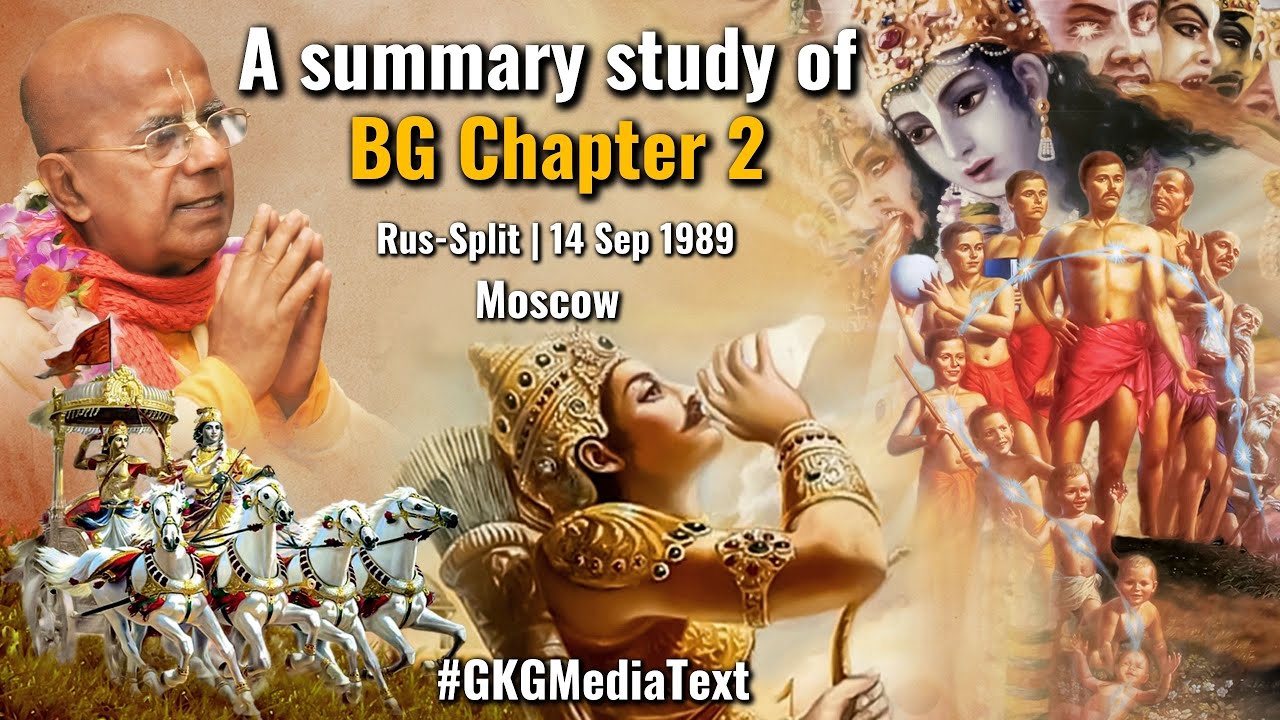
Srila Gopal Krishna Goswami presents Bhagavad-gita Chapter 2 as the foundation of spiritual life, covering the eternal soul versus the perishable body, duty, karma, and the practice of withdrawing the senses. He uses everyday analogies and Bible verses to explain why material gain is futile and spiritual progress requires surrendering to a qualified teacher.
Chapters
Prasad Raaval. Actually, there's a World Book Fair going on, as some of you may be aware. So we are participating in that World Book Fair from India, and by Krishna's grace, we have a very prominent location where we are displaying these books, and so many nice people are coming. Today we met so many nice people. They wanted to buy our books. They wanted, they were showing great interest in these books. So I'm very grateful that by Prabhupada and Kṛṣṇa's mercy, once again He's brought me to this wonderful city to be with all of you devotees. So what I was thinking is on this trip I will discuss the Bhāgavad-gītā Because the Bhagavad-gītā is the ABC of spiritual life. I was thinking that we will discuss one chapter a day. Today we will discuss the second chapter, tomorrow the third chapter. I'll be here on Thursday, Friday, Saturday, Sunday, Monday, and then again Friday. Today is Thursday, so after today Friday, Saturday, Sunday, Monday, and then Friday, then Friday night I leave for Canada. Of course, in the daytime I have to go to the book fair. But you devotees, please don't come to the book fair. If the devotees come there to the book fair, then the karmis will not find any space to read our books. So do you like this idea of discussing one chapter of the Gītā one day? So we'll do a little bit of kīrtan and then start with the second chapter of the Gītā today. Where is our spiritual drummer, Kula Shekhar? Our spiritual Ringo Starr. He wants to play, I don't care. Or anyone. Or he's a professional drummer.
Are there any more cartons?
All glories to the assembled devotees. All glories to the assembled devotees. All glories to the assembled devotees. All glories to Shri Guru and Shri Guranga.
You need some more instruments here, but we have them here.
Om Namo Bhagavate Vasudevaya. Om Namo Bhagavate Vasudevaya. Om Namo Bhagavate Vasudevaya. Om Namo Bhagavate Vasudevaya. Om Jñānātmanandaḥ sya jñānāñjanaḥ śalakyaḥ cakṣuṁ mletāñyena tasmai śrī-gṛhovena-mahaḥ śrī-cetanyam manovistam sapitam yenabhūto leḥ svayam rūpakadāmayam dadāti Hare Kṛṣṇa, Hare Kṛṣṇa, Kṛṣṇa, Kṛṣṇa, Hare, Hare, Hare, Hare Rāma, Hare Rāma, Rāma, Rāma, Hare, Hare, Hare. So as I said earlier, today we will discuss the second chapter of the Bhāgavad-gītā. Of course it is impossible to discuss the whole second chapter in one hour, so what I will attempt to do is just highlight some of the main points covered in this second chapter. I don't want any of you to think that the second chapter only includes what we will discuss in our talk today. At least by hearing a summary presentation of the second chapter, your knowledge of the second chapter may get better. Thakur Bhaktivedanta Swami Prasad RA has said that this second chapter is the most important chapter of the whole Bhagavad-gītā. Because the second chapter explains the ABC of spiritual life. Just like when your children want to learn how to write Russian, you first teach them ABC. What do you say ABC in Russian? A, B, C. So this second chapter is the A, B, C of spiritual life. Because spiritual life starts with the understanding that you are not this body. So in this second chapter we say That, uh, Kṛṣṇa is making a very forceful attempt to get Arjuna to get out of the bodily identification. In the first chapter of the Bhāgavad-gītā, we have seen that even though Arjuna was ordered by Kṛṣṇa to fight, Arjuna was still hesitant in fighting. For example, Arjuna is refusing to fight because he says in the second chapter, he doesn't know which is better. Defeating them or being defeated by the enemy. He could not even understand which would be better. Arjuna did not want to fight people like Bhishma and Dronacharya who were all like his teachers. Of course, at the present moment in the society that you and I have been brought up, there is no respect for teachers. Neither the teachers care for the students nor the students care for the teachers. Even in places like India, if the teachers don't get their salary raises, they go on strike. But in the Vedic days, the teacher was held in great esteem. So, so Arjuna was saying, "Now Bhishma and Drona, they're all fighting on the other side. How can I attack them? After all, they were my teachers at one time." Where Arjuna had learnt His art of fighting from these two great warriors. So Arjuna was completely confused what he should do. For example, in the very famous 7th verse of the second chapter, Arjuna says that I'm completely confused about my duty, so please guide me. He says, now I'm a disciple surrendered unto you, please instruct me, O my dear Lord. Arjuna was so unhappy and confused that he said, —"That even if I become the king of the whole world, still I cannot be satisfied." Like in this country, we may think, "If I get a brand new 1989 Lada, I'll become happy." But Arjuna is saying that, "Even if I become the ruler of the whole world, still I cannot be happy." The demigods have a standard of living which is much higher than what you and I can have even in America, forget Russia. So, so Arjuna said that even if I get the standard of living that is there in the demigods, still I cannot be happy. Please guide me, Krishna. Of course, Arjuna also said, now you please guide me, and I'm a soul surrendered unto you. So if you want to get spiritual knowledge, not only do you have to approach someone for guidance, but you also have to be surrendered to what he's going to tell you. If you just approach somebody and say, "Please guide me," and when he gives you some guidance, instruction, you say, "No, no, no, I can't accept it," then that is useless. So just like Arjuna was confused, similarly we are all confused about so many assignments and duties. We do not know what we should be doing and what we should not be doing. So just like Arjuna approached Krishna for guidance and he was surrendered, Similarly, we have to approach the proper authority for guidance, and we should be surrendered to the instructions that we receive. So after Krishna saw that Arjuna had surrendered unto him, then he started speaking the philosophy. Krishna did not speak the philosophy till Arjuna surrendered to him. So if you want to understand the spiritual philosophy, you have to understand the principle of surrender. So Krishna points out to Arjuna that you are speaking very, very learned words, but you are not acting in that understanding. Krishna said that those who are intelligent, they don't cry either for the living or the dead, because anyone who is intelligent, he understands that this body is going to be destroyed, but the soul cannot undergo any change at all. So this brings us to the key philosophy presented in the second chapter, that is the difference between the body and the soul. So as long as we understand that there is a difference between the body and the soul, we can make progress on the spiritual path. But if we think that this body and the soul is one, then of course there's no question of spiritual advancement. Actually, if we carefully examine, we will see that even the other religious scriptures of the world all support the point that there is a difference between the body and the soul. We have that very famous statement from the Bible, "What shalt thou do if thou gainest the whole world, but suffer the loss of your eternal soul?" You may become the king of the whole world for this life, But if you have engaged in sinful activities, then in your next life you have to become a dog or a cat or whatever. So what is the value of all this material gain if your future has not been secured? So Kṛṣṇa starts His instruction on the difference between the body and the soul by presenting the following verse: Dheinos men yatha dehe kāmāram yava nām-jaraḥ. Tatha dehyantera prāpti dīrasthātana mūyati. Kṛṣṇa says, just like the embodied soul, it is continuously passing in this body from boyhood to youth to old age. Similarly, the soul passes into another body at death, and a sober person is not bewildered by this change. 2:13. So this is very easy to experience. So let us meditate on this verse. Because if we understand the significance of this verse, understanding the subsequent verses will become easier. For example, we can say that from boyhood to old age, though the body has undergone so many changes, something has remained the same. The body keeps changing its appearance regularly. Every 5 years, all the cells of your body are replaced, and this is confirmed by the scientists also. For example, certainly at the age of 6, you don't look the same when you were, when you were newly born. And certainly at the age of 25, you don't look the same that you looked when you were 5 years old. Yeah, okay, I said at the age of 5, I said, uh, and certainly at the age of 50, you don't look like you looked when you were 25 years of age. And certainly when you're 70 or 80, you don't look like the sweet 20 or 19 or 20 or 30 or 40 you looked at when you were younger. If you really You want to believe this, you should just have a look at the photo album of your mother or grandmother, and you will see in your grandmother's photo album how your grandmother today looks completely different from when she was a young baby. Taboo kaku anabula kadabula jiya uchh kuch. At least in the Western countries, there are some people who take a photograph every year on their birthday. So in a way, it is very good because you can see every year how your body looks different from the previous year. So when you were a young boy, you said, "This is I, this is my picture." And when you get to be 50, 60, 70 years old, you still look at a picture when you were a baby and you say, "This is my picture when I was a young baby." So it is obvious then when you're using the word "I," or this is I when I was 5 years old, you're not referring to the body. Because if you are referring to your body, Then how can you refer to your body as 'I'? Because the 'I' of today looks completely different from the 'I' of a baby, when you were a baby. Therefore the conclusion is, which is stated in this very famous text, 20th of the 2nd chapter, 'Najayete mriyete bhākada ācena ya bhūtabhāvitavanabhūya, ajo nityaśāśata yāmpurāno na hanyate hanyamāne śarīre.' Krishna says in this very famous verse that for the soul there's never birth nor any death. The soul is eternal. So we must understand that when the body is destroyed, the soul is not destroyed. So the soul is eternal. We can see practically when a man dies, everybody cries, isn't it? Even if you don't feel like crying, it's a social custom that you must cry when you see somebody dying. So why do we cry when a person dies? The body is still there. Come on, go and hug the body. Why do you have to cry? Because there's something in the body that has gone away, and that something is— do you approve of the translation or no? So that something is a soul, and the nature of the soul is it is eternal. Now this brings us to another very important understanding, which is that the real beauty is not the individual in the body, but the real beauty is the presence of the soul in the body. Because when the soul is not in the body, nobody wants to touch a dead person's body. So the real beauty is the presence of the soul in the body. Krishna has also explained in this second chapter that the soul cannot be cut by any weapon, nor can it be burned by fire. Nor can it be moistened by water, nor can it be withered by the wind. The wind cannot push it away. This soul cannot be burned, nor can it be ever dried. He is unchangeable, immovable, and eternally the same. So the point is, this soul is our real identity. Krishna gives a nice example to say how the soul obtains different bodies. Just like we change our clothes, huh? So just like you throw away your old clothes and wear new clothes, similarly the soul throws away your old body and takes on new bodies. What is difficult to understand in this simple statement? If we have the capacity to throw away our old clothes and wear our new clothes, why can't the soul treat the body as a covering and discard the old clothes and take on a new set of clothes? Now, some of you may say, since all of you belong to the 20th century and we are living in a very scientific age, some of you may want to say, is there anyone who can do open heart surgery and show, oh, this is where the soul is sitting? You know, now they have the American spacecraft Voyager, had just traveled into outer space, and now it has discovered Neptune, Jupiter, all these planets. And it has taken pictures which are hundreds of thousands of miles away and transmitted the pictures to the Earth, station at the Earth. So some of you may say, if the camera can take a picture 200,000, 300,000 miles away and transmit it back to Earth, why cannot our camera take the picture of the soul in the body? Isn't it? Doesn't it make sense? If you can take, if a camera, if the scientists can produce a camera that can take a picture at 300,000 miles away from Earth and send the pictures back, and those pictures look as if you're taking out a picture in the small room, certainly they can picture the soul in the body, isn't it? After all, the soul is only one ten thousandth of the tip of your hair. If you were to take the tip of your hair, divide it into 100 pieces, and then take each of these pieces and divide them further into 100 pieces, That is the measurement of the soul. So therefore Kṛṣṇa says in the Bhāgavad-gītā text 29: "Some look on the soul as amazing, some describe him as amazing, and some hear of him as amazing, and while others, even after hearing about him, cannot understand him at all." Text 29. For example, if you were to tell your scientist friends that in the body there is something which is only 1/10,000 of the tip of the hair, and which is the source of all the energy for your existence, they will be— they'll say impossible. And there are others like us, like we are all convinced there is a soul in the body, but at the same time there is no doubt that we are amazed to describe that something that measures 1/10,000th of the tip of your hair can be the source of energy that can work day and night, 24 hours a day. And some of you sitting in this room are hearing about this with faith, but you find it so difficult to understand that you say, "Okay, let me just accept it without debating." So this is exactly what Kṛṣṇa says in the Bhāgavad-gītā, that this talk about the soul is totally amazing. This atomic soul has been in the body of a gigantic animal. Elephant. Elephant also has a soul. I don't know if in Russia, Soviet Union, you see elephants on the streets. Do you? Only in the zoo, probably. But in India, you can see elephants on the road. Not everywhere, but on some highways and all. So even in the giant elephant, there is a soul. In all our Rath Yatra processions in India, we have the elephant also. Yes, we have elephant in the procession. And the elephant, the soul is also there in a tiny ant. It is also there in those micro— microscopic germs. You know, there are millions and millions of these germs that occupy 1 inch of space, huh? You and I just sit down, how many inches do we need? At least about 20 inches of area. But in 1 inch you can have millions of micro— microscopic germs sitting down. And there's a gigantic banyan tree. Do you have banyan trees in your country? No. Anyway, banyan trees are very, very big trees. So the soul is also there in the banyan trees. So anything that grows has a soul. So this we must understand, that the nature of the soul is eternal. What type of body the soul is going to get, this is determined by the actions that we execute. Based upon the actions we execute, our future shall be determined. There is a very nice statement of the Bible which supports the Vedic conclusion, which is, "As you sow, you shall reap." So it is only natural that based on how we act, our future is going to be decided. So Kṛṣṇa, after convincing Arjuna that the soul doesn't die, he's telling him, "Fight!" Because in this fight, even if you kill the other side, nothing is lost because the real entity within the body is not going to be killed by you. Of course, this does not mean that each of us can start attacking each other and saying, "Ah, you are not this body, so what's the harm if I slap you?" And this cannot be used by the meat eaters to justify that, "So what?" The animals, we're eating the animals, so what? The soul is not dying. We have to understand that violence is justified only when it is directed by the Supreme Lord or His pure representative. Kṛṣṇa was ordering Arjuna to fight, not for any material gain, but for a right cause, for the benefit of establishing the victory of virtue over vice. Just like, just like in the battle, the president of the country may order the soldier, "Go and shoot." So when a soldier shoots, he does not get arrested. But the same soldier without direction from the president, if he shoots, then he gets arrested. So similarly, fighting can only take place when it is ordered by Kṛṣṇa or His pure representative. Another point to understand is that Arjuna belonged to a special class of individuals known as the Kshatriyas. The Kshatriyas are the warrior class. According to the Vedic system, there is division of the society into four social and spiritual orders. Just like for a body to be healthy, you must have the head, the hands,— the belly and the legs, isn't it? So similarly you must have the head, namely the Brahmanas, the hands, namely the Kshatriyas, the belly, namely the Vaishyas, and the legs, namely the Sudras. The Brahmins are supposed to be the intellectual guides of society, the spiritual guides of society. These days in society, anybody comes up with a new theory, we call him an intellectual. Just like any drawing that doesn't make sense, they call it modern art. I don't know in your country, but at least in North America and all, if there's an artist, he just draws something and you cannot figure out what it is, they say it is modern art. So the Brahmins are those who are concerned about the welfare of the people and who are also practicing purity. And the Kshatriyas are those who do the administration and the protection of the people. Just like you have the police force and so on to defend the citizens of Soviet Union. So according to the Vedic system, this assignment of defending the old people, the weaker sections of society, and the children must be done by those who belong to the Kshatriya class. Their duty is to fight. As the supreme teacher of the whole world, Krishna was instructing Arjuna that he must fight because when a Kshatriya is fighting for a religious cause, then just by fighting for the religious cause, the gates of the heaven open and he reaches the gates of the heaven. Just like in our present-day world situation, when on a battlefield a soldier kills many enemies of the enemy, many enemy soldiers, he gets a gold medal, isn't it? Like in Soviet Union, you see a lot of people walking on the streets with the World War II medals. So, in the shaivin Vedic system, if the Kshatriyas would fight for the religious cause, then they would go to the heavenly planets. And then you of course need food in the stomach, isn't it? We may have all these tall buildings and missiles and all the modern facilities, but if you don't have food in the belly, Then you can't live. In the Śrīmad-Bhāgavatam there's a very nice example. The example is that if a man is hungry and you go to him with a very nice garland of sandalwood flowers and you give it on him, he's not going to smell because his belly is hungry. A hungry man, a hungry man is not looking for garlands, he's looking for food in the stomach. So yeah, we all need food because when we don't get our milk, we don't get our grains, then we all get furious. This responsibility of producing grains for the belly is the business of the Vaishyas. Today, why do we have a food shortage everywhere all over the world? Because we don't have Vaishyas. The Sudras are doing the work of the Vaishyas. They are doing the work of the Kshatriyas. And believe it, they are also doing the work of the Brahmanas. And therefore, and therefore you have a chopstick theory society. So it is ja— the sūdras are compared to the legs of the body. Just like the leg supports the whole body, the sūdras are supposed to support the whole body. Now any of you know there's a difference between the head and the legs, isn't it? From the head you can think, but your legs cannot think. Am I right? Is this law applicable in your country also? It's a universal law, isn't it? If you tell the legs, now you do the work of the brain, will it work? But that is exactly what we are doing. We are telling the Sudras, you be the Brahmins. So when you tell the leg to start doing the thinking and you tell the brain to go to sleep, then how can you exist? So Arjuna being a member of the Kshatriya class, his main business was to engage in this battle. Another point that Krishna makes in the second chapter, the second chapter just doesn't contain knowledge of the difference between the body and the soul, is that one must give up fruitive activities. So what do we mean by fruitive activities? By fruitive activity, it means a business transaction. Just like you go to a store, you pay so many rubles, and in exchange you get some commodity. So fruitive activity means you will follow religious principles or do some sacrifice, but in exchange for that you want some benefit. You want to become rich or beautiful or whatever. So Krishna says, "Please give up fruitive activities." Also Krishna explains in the second chapter,, that one must become tolerant. In the very famous text 14, Kṛṣṇa makes the following point: mātās paśyajekoṁ teya sitoṣna-drukkha-dukkhā-dā-argama-paiṇo netyastam tetekśāśva-bhārata. He says, "The non-permanent appearance of happiness and distress and their disappearance in due course are like the appearance and disappearance of winter and summer seasons." They arise from sense perception, o Skayana Bhārata, and one must learn to tolerate them without being disturbed. So in this verse, the word titikshava is very significant. This is a Sanskrit word. So titikshava means tolerance. You can see that just like now it is raining, today it is raining. I was told that this is the rainy season in Moscow. But this rainy season, it's not a permanent thing, isn't it? Or is it permanent? It is raining today, but it is not going to rain in December, for example. Like today you may be happy, huh? You may get a promotion on your job, or you may get whatever you're looking for and you'll become happy. But tomorrow you may not get what you want. So just like the winter season comes and goes away, similarly the summer season comes and goes away. Similarly, happiness and distress come and go away. After all, happiness and distress is just a result of the perception of the senses. For example, you have trained your mind to believe that when you get what you want, you must be happy. Am I right? It is all a question of training. I'll give you a simple example to illustrate this point. Just like a materialist, if he doesn't get a lot of money, he doesn't get a lot of women, sense enjoyment, he's very, very sad. But a spiritualist, he's not looking for these things. So how is it that a spiritualist is happy without women, drugs, intoxication, and meat, and the materialist is not happy without these things? How is it? The two translators are sitting together, they're just waiting for the other person to make a mistake. Okay, so it is because the spiritualist can live without these things because he has trained his mind. That these things are not necessary. And the materialist cannot live without these things because he has trained his mind that without these things I cannot live. So similarly, Kṛṣṇa is saying, "Please understand, Arjuna, that everything is temporary." So we have to develop tolerance. Sometimes some devotee may offend you, but don't be disturbed. Please understand, happiness and distress will both be there. So Kṛṣṇa also tells us in the second chapter,— that we may, we must become steady in mind. So you can become steady in mind or adhida when your mind is fixed at the lotus feet of the Lord. Krishna says, "Don't be happy when you are praised and don't be sad when you are criticized." Krishna explains that one must withdraw the senses from sense objects. Krishna gives a very nice example, the example of a toy choice. "The tortoise draws his limbs inside the shell." All of you understand this example? So just like the tortoise draws his limbs inside the shell, Kṛṣṇa says withdraw the senses from sense objects. What are the senses and sense objects? The eyes are one of the senses and the sense object for the eyes is to see something vulgar. The ears is one of the senses and the sense object for the ears is sound. The tongue is one of the senses, and the sense object for the tongue is taste. The nose is one of the senses, and the sense object for the nose is smell. So when the nose wants to smell Channel Number 5, withdraw it from there. When the eyes are saying, "Take me to some..." When the eyes are saying, "Take me to something obscene," withdraw it. When the ears are saying, "Let me listen to the latest rock music," Withdraw it, except when Alexei is playing. So anyway, you must withdraw the senses from sense objects. So even though the desire for sense enjoyment is remaining, Kṛṣṇa says, even the desire is there, due to higher intelligence, control your desire and abstain from sense enjoyment. Just like when you go into a department store, you may see so many expensive jewelry items and nice mink fur coats and all that. And you may want to put them in your pocket, but then your intelligence will say, "No, no, no, I cannot rob it because if I rob it, I'll get caught by the police." So the desire is there in your heart to rob it, but still you don't rob. So similarly, the desire for sense enjoyment may be there, but your higher intelligence controls it and abstains from it. So, um, I'll stop at that. So if we can control our senses, that means we have proof that we are not identifying with the body. When you identify with the body, you engage in sense enjoyment. When you think this body is your real self, that's when you want to squeeze enjoyment. But when you understand that this body is not your real self, then you don't want to engage in sense enjoyment. After all, the eyes, the ears, the nose, all these are not your real identity. So we have briefly presented to you the summary of different aspects of the second chapter. Hare Kṛṣṇa. Hare Kṛṣṇa. As I said, the second chapter can be discussed for a whole month. Once Bhaktisiddhānta Sarasvati discussed one verse for the Bhāgavatam for 60 days. So certainly I don't expect to discuss 79 verses in 1 hour. We have covered the important points of this chapter, isn't it? I'm sorry, when I leave Russia I forget my Russian, then when I come back I take a refresher course from Malanka. So tomorrow my refresher course is going to be better than today. Today is my first lecture, so. So, what Prasad? Such book in Russian? No problem, you'll have it very soon. Coming, it's at the customs. Crazy question? You should ask some philosophical question. What this means is that when the layers of ignorance that are covering intelligence are removed, then you will be able to see everything in its proper perspective. Just like, for example, if the lights were to go off in this room, we would not be able to see things properly. But when the lights come back, then again you can see things properly. At the present moment, intelligence is covered by ignorance. So by spiritual association your ignorance is removed. Are you satisfied? More questions? No more ques— Yes. So the question is, if one offends a devotee, does it mean the whole parampara is offended? In a way, yes, because Kṛṣṇa cannot tolerate the offense at the feet of His devotee. Therefore one has to be very careful in Vaiṣṇava relationships. Bhāṣya try his best not to offend any Vaiṣṇava. In the Śrīmad-Bhāgavatam there is a story how Duraṣa Muni had offended Amṛśma Rāja and Duraṣa Muni went to Kṛṣṇa. Spiritual question.
Prasāda RAVAL. Prasāda RAVAL. In Bhāgavad-gītā it says that as long as the soul is inside the body he is being controlled by Paramātmā. Does it mean that when the soul come out comes out from the body, he is being controlled by some other aspect of Paramātmā, of Supreme Lord.
The Paramātmā does not control the soul. The Paramātmā is simply the witnessing bird, the witness. Based on the desires of the living entity, the Paramātmā gives the necessary facility. It is always controlled by the laws of nature. When the soul comes out of the body, it enters into another womb. When it gets liberated, then again it goes and obtains a spiritual body. The free choice of the living entity. The soul is the enjoyer or the sufferer based on the decision that the living entity makes. Any vāprasa? Yeah, the soul. Instantly.
Does it feel— does he feel some sufferings? Oh, the soul.
When the soul has to enter into the hellish planet, the soul also gets a body. The body actually experiences the pain, but the soul is the enjoyer or sufferer in the company of the body.
Yes. How can one know his previous relatives?
How can you know your previous relatives? Not correct translation. How to find your, you know, your relatives? How to find in which bodies are they? In which bodies? It's hard to find the relatives of this life, forget the relatives of previous life. Anyway, spiritual life means to understand that all these relatives are temporary. Tomorrow, or one of these days, I will give you the whole story of King Chitraketu. It's a very long story which I don't want to start now, but in that story The dead child, when he was brought back to life, he said, "I've had so many mothers and fathers." "Now which ones are you referring to?" We are not against relatives, so please don't misunderstand what I have said. A devotee thinks the whole world is his relative because we are all children of the same Father. Dividing the society into friends and enemies, but we don't divide the society into friends and enemies. Well, if there are certain conventions that they practice, they can follow them. But the point to understand is that unless a person is engaged in pious activities in his lifetime, just by doing some functions, he cannot be guaranteed a higher birth. Just like very often when people die, at least in India I've seen, in Western countries they put an advertisement and they say, "So-and-so left for his heavenly abode." So they are all saying he left for his heavenly abode, but if the man is engaged in sinful activities, there is no way he can go to the heavenly abode.
It's said the soul always has lived. No free choice. And when one gets to spiritual abode, Kṛṣṇa says that one who gets to spiritual abode, he never comes back. Can you Comment on this point. Yes.
In English there is a saying, "Once burned, twice shy." I will reply to your question with a very long answer. I will tell you a story that Prabhupāda used to tell us. Just be patient, because in the end your answer will be born. So Prabhupāda had once gone to meet a friend of his, and he had taken with him His son, this was before Prabhupāda took sannyāsa. So on the table there was a table fan, huh? You know what a table fan is? In Russia you have. So Prabhupāda's son was always stretching his hand out to put his hand inside the fan. So every time he would put his hand, Prabhupāda would pull it back. You know, children like to put their hand inside, but the father knows that the blade will cut their hand. So Prabhupāda's friend, he said, he put the switch off and he told Prabhupāda, "Let the boy put his hand inside," because he saw that again, again the boy was trying to put his hand inside. So when he put his hand inside, the blade of the fan hit the hand so hard that the boy started crying. So then Prabhupāda's son told the boy, "Put your hand again." He said, "No, no, no, I don't want to put it." So this is known as once burnt, twice shy. So, so, so I'm coming to your answer now. So the soul, after he returns to the spiritual abode, he has a free choice, but he does not want to come back to the material world because he knows in the material world there's nothing but misery. Just like you have the free choice to have any type of garment you want. So we have the free choice, but when you know something is wrong, you don't want it back. So the soul, when it goes back to the spiritual abode, it doesn't want to come back. So it's already 9 o'clock. I don't know if we should stop now, isn't it? So one last question. Well, Prabhupada said, "If you love Me, cooperate with Me." So that means we cooperate with the authorities who are taking responsibility for running the temples. Also, we cooperate with each other. The Vaishnavas must cooperate with each other, not that they're always fighting with each other. Last question. It doesn't really concern us all, this chakra yoga now. You just get— you just go in a chakra yourself. It's not very relevant. Just understand what has been explained. So I think we should stop. It's 10 past 9. Should we go on? So it's, um, 10 past 9. I think we'll stop. Did you all find this This discussion on the second chapter little helpful? Do you think it's a good approach? Tomorrow we will take the third chapter and on Saturday the fourth chapter. Very good approach. Who said that? Okay. And on Saturday the fourth chapter and on Sunday the fifth chapter. Am I right? Yes. On Monday the sixth chapter and on the 22nd I will summarize the six chapters again. Or the 7th chapter, whatever you want. Okay. So then in the next one week, hopefully all of you will become scholars of the Bhagavad-gītā. Because the most important philosophy of the Bhagavad-gītā actually is in the first 6 verses, first 6 chapters. If you understand the first 6 chapters, spiritual life will become very easy. They have a saying in India called Indian stretchable time. That means if the appointment is for 2 o'clock, you can show up anytime between 2 and 3. Do they have that in Russia also? Russian stretchable time? So we'll have it because in the morning I have to go to the book fair. So I'll be at the book fair from 10 o'clock till about 3, 3:30, then I'll come over there. Nice preaching at the book fair. Today I met one man, he designs cars. He's a vegetarian, doesn't take intoxication, doesn't take cigarettes, nothing. Then I met another man. He is a doctor from Armenia. Anyone from Armenia here? He ordered all the Bhāgavatam, Caitanya-caritāmṛta, all the books he wants to buy. Then I met another very big scientist. I have his card. He was also very, very interested in all these books. Gopāl Kṛṣṇa Mahārāja ki jāna!
More from PRASAD

Rare Pastimes & Timeless Lessons of Guru Mahārāja | Stories Every Disciple Should Hear

ISKCON Legends- pure devotees meet-HH Jayapataka Swami, HH Gopal Krishna Goswami, HH Radhanath Swami



Jagannātha Ratha-yātrā Through Śrīla Prabhupāda's Mercy | 29 April 2006 | Nairobi, Kenya

Lord Jagannātha's Appearance Pastime | 21.07.2019 | ISKCON Calgary | Śrīla Gopāla Kṛṣṇa Gosvāmī

The Ācārya Teaches by His Own ExampleGuṇḍicā Mārjana by Guru Mahārāja #shorts

Guṇḍicā Mārjana – Lord Jagannātha's Pastime | 21.7.2019 | ISKCON Calgary |Śrīla Gopāla Kṛṣṇa Gosvāmī

H.H. Gopāla Kṛṣṇa Gosvāmī Mahārāja - Exemplary Sādhana and Deity Worship # shorts

भगवान की कृपा कैसे प्राप्त होगी ? | 11 Jan 2014 | Punjabi Bagh | Srila Gopal Krishna Goswami

Material Education vs Spiritual Education | Srila Gopal Krishna Goswami #shorts