Appearance of Lord Narasiṁha Deva | Rus-Split | 08 May 1990 | Srila Gopal Krishna Goswami
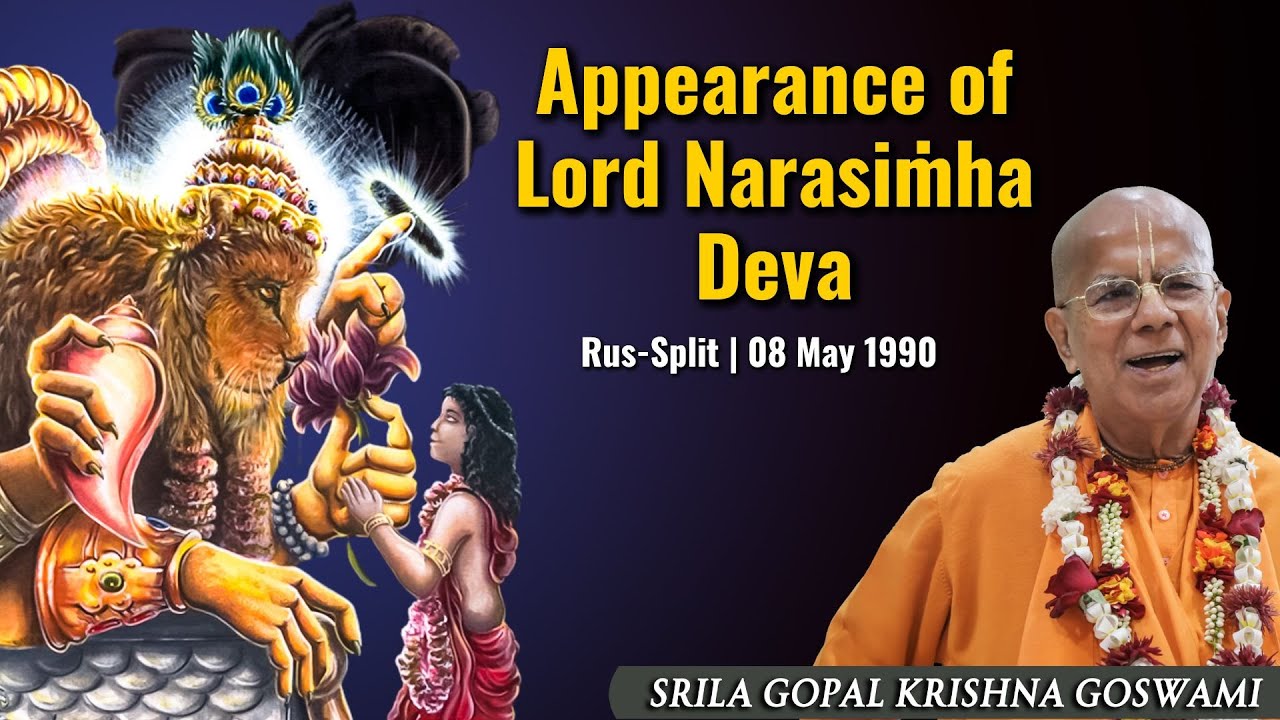
In this devotional lecture Prasad Raval commemorates the appearance day of Lord Nṛsiṁha Deva, recounting the mythic narrative of Hiranyakāśipu’s extreme austerities, his request for invulnerability, and the Lord’s incarnation as half‑lion, half‑man to protect the devotee Prahlāda and destroy the demon. Raval explains the background of the gate‑keepers Jaya and Vijaya, their three demonic births, and how Hiranyakāśipu, despite being a demon, possessed deep Vedic knowledge and performed unparalleled tapas. The lecture highlights Prahlāda’s extraordinary devotion, his teachings to classmates, and his fearless service, using these qualities as a model for modern devotees. Raval draws parallels between ancient materialism and contemporary society, stressing that sense‑control, not material austerity, leads to true happiness. He then shifts to practical ISKCON guidance: the importance of chanting Nṛsiṁha prayers, observing the appearance day, and the central role of book distribution and preaching as the most effective service, linking these activities to spiritual purity and the disciplic succession. Additionally, Raval emphasizes humility and sincere supplication, explaining that Krishna resides in every heart and tests a preacher’s sincerity by prompting heartfelt, childlike pleading for mercy. He advises devotees to cry out for Krishna’s grace as a child would for a chocolate, to chant Hare Krishna fervently, and to invest ample time with potential recipients, as A. C. Bhaktivedanta Swami Prabhupāda taught that one should spend as long as needed to persuade someone to accept a book, after which the divine preaching begins. Throughout, he uses analogies to modern life, politics, and technology to make the teachings relevant.
Chapters
Om namo bhagavate vasudevaya. Om namo bhagavate vasudevaya. Om namo bhagavate vasudevaya. Om namo bhagavate vasudevaya. So today, being the appearance day of Lord Nrsimhadeva, We will discuss the appearance of Hiranyakāśipu and how the Lord eventually destroyed Hiranyakāśipu. So this pastime of the Lord is very significant from many angles, and we shall be relating the story plus reading from the Bhāgavatam from time to time. And if possible, if it is not going to be too different, difficult for translation, I also want to read the whole chapter in which the appearance of Lord Nrsimhadeva is described. The Lord appeared in the form of Lord Nrsimhadeva to protect His devotee Prahlāda and to destroy Hiranyakāśipu. Of course, we know that even to be destroyed by the Lord is indeed a great privilege, because unless You are very dear to the Lord, you can't be touched by the Lord. And certainly to have the privilege of being killed on the lap of the Lord is a great, great privilege. Who would not want to die on the Lord's lap, isn't it? So Yudhishthira Maharaj was very bewildered because he saw Śrī Śrīpāla entering into the body of the Lord. Because Śrī Śrīpāla all along was living like an enemy. He was born as Kṛṣṇa's cousin, but all the time he was envious of Kṛṣṇa. So Yudhiṣṭhira wanted to know, how did this happen? How is it possible that somebody who is a demon, who is always criticizing the Lord, he is able to merge into the body of the Lord? So it was revealed to Yudhiṣṭhira Mahārāja that Śrī Śrīpāla was not an ordinary demon. Once upon a time, there were two doorkeepers of the Vaikuntha planets whose names were Jaya and Vijaya. And one day, the sons of Brahmā, Kumaras, were going to see the Lord in the Vaikuntha planets. And Jaya and Vijaya, the two doorkeepers, they did not let them come in. They stopped them. So the Kumaras were very offended and they said, you will have to take your 3 births, you will have to take your birth as 3 times as enemies of the Lord. They could either take 3 births as enemies of the Lord or 7 births as devotees of the Lord. But they decided to take their birth as devotees of the Lord. I'm sorry, as enemies of the Lord. So Jaya and Vajaya, They appeared as Hiranyakāśipū and Hiranyakṣa in Satya-yoga, as Rāvanān and Kumbhakarna in Treta-yoga, and Śiṣipuṭlaṇa and Dantavakra in Dvārpa-yoga. So with this background you can understand that even though Hiranyakāśipū was a demon, in the core of his heart he was not an ordinary demon. Hiranyakāśipū had very ambitious plans. He wanted to become like Lord Brahma. He was actually the king of the demons. Everybody was scared of him. But one thing is, even though he was a demon, he believed in the value of tapasya. Our demons of 20th century, they don't believe in tapasya. But Hiranyakashipu knew the Vedic philosophy very clearly. He instructed the Vedic philosophy on so many occasions. And he had become so powerful with his austerities that everyone, even Nārada Muni, was offering him obeisances. Everyone except Brahmā, Śiva, and Viṣṇu. They all became like his disciples. So just imagine how powerful Hiranyakaśipu was. Even Nārada Muni, the great sage, was under him. All the demigods were regularly offering obeisances and offerings unto him. He had become so powerful because of his austerities. The point is that without austerity you cannot get anything in life. Because Hiranyakashipu had Vedic understanding, he knew that even if I want to become Lord Brahma, I have to perform sacrifices. So everybody was scared of Hiranyakashipu. Even all the demigods were scared of him. So when Hiranyakāśipu started his austerities to become very powerful like Brahmā, he was performing very great penances. For example, he would— Hiranyakāśipu was standing on his toes with his hands towards the sky, and he was looking at the sky nonstop. And his whole body was full of worms and insects. And from his head he was producing fire. So much fire that even the demigods were scared. The demigods were also crying because they were getting burned by the heat of the fire. And all types of worms and ants were eating the body of Hiranyakashipu, but still he was totally undisturbed. He had no flesh. He was just lay, it was just his body of bones and he was still performing austerities. Just imagine. He had not drunk a drop of water for 100 celestial, 100 heavenly years. Have you all had water today? Anyway, there's no harm if you have water. But the point is, Hiranyakāśipū did not drink a drop of water for 100 heavenly years. Nobody had ever performed such severe austerities. But because he was a demon and his mentality was demonic, when he was performing austerities, the demigods and everyone was becoming very unhappy. They were feeling the pain. So all the demigods went to Lord Brahma. They told Brahma, "Please do something quickly because it is becoming very difficult for us to live." So Brahmā finally agreed to come and request Hiranyakāśipu to stop doing these austerities. But Brahmā, Brahmā, He came down and Brahmā told him, "Hiranyakāśipu, I am very pleased by your austerities. Now tell Me what do you want?" Just Prabhupāda used to say, just like Hiranyakāśipu with his demonic mentality was making a hellish situation for the demigods. Also, similarly, the present, the demons who are in power, they are also by their so-called endeavor making it hellish for civilization to live. When Lord Brahmā came down to find Hiranyakāśipū, because Hiranyakāśipū's whole body was full of ants and worms and there was no flesh, the Lord Brahmā was standing along with the other demigods right in front of Hiranyakāśipū, and he could not recognize him. He could not recognize him because of the fact that Hiranyakāśipu's whole body was eaten up by the worms. So then Brahmā, what he did, he took some water from a kamandalu. Kamandalu is like a pot that Lord Brahmā carries. And as soon as he sprinkled the water on Hiranyakāśipu's body, his body again became like a young man. Brahmājī wanted to restore Hiranyakāśipu's original transcendental body., and therefore, I am his original body, youthful body. Therefore he sprinkled the transcendental water which brought his youthful body back. Hiranyakashipu's body became so strong that even a thunderbolt could not penetrate. Just like fire comes out of wood, by the sprinkling of the transcendental water, Hiranyakashipu's body became youthful and strong. So Hiranyakashipu was very happy that Lord Brahma had come to see him. So Hiranyakashipu fell on the floor and offered him obeisances. As I told you, Hiranyakashipu was completely well-versed in the Vedic knowledge. Therefore, he glorified Lord Brahma. He acknowledged him as the creator of this universe. He said, you are the cause of all this creation. You are the cause of all manifestation. So somebody may say, why did Jnāna Kaśipū say Brahmā is the creator when actually Kṛṣṇa is the creator? But Brahmā is a dear servant of Kṛṣṇa. Therefore the Bhāgavatam in many places acknowledges Brahmā as Bhāgvan and Brahmā as creator. In fact, the Bhāgavatam also acknowledges Nārada Muni as Bhāgvan. The point is that Brahmā, Nārada Muni, They are not at all envious of the position of the Supreme Lord, and because they are dear devotees of the Lord, they are given the same respect as the Lord. There are many Brahmas. As I explained yesterday, the four-handed Brahma is the smallest of the Brahmas. There are Brahmas with even thousands of heads. So Hiranyakashipu acknowledges the supreme position of Brahma in a series of prayers that he offered at the feet of Lord Brahma. When Hiranyakāśipu's body was transformed into a youthful body. Then when Lord Brahmā told him, "Hiranyakāśipu, now I am very pleased with you. Stop your sacrifices." Then Hiranyakāśipu said, "Since you have very kindly offered to give me a benediction that I want, please give me the benediction." But before Hiranyakāśipu asked Him for the benediction, He had praised Lord Brahma in many verses. Hiranyakashipu's real desire was to become immortal, to never die. But he knew that even Brahma, everybody has to die. So now he's trying to get a commitment from the Lord, from Lord Brahma, in a very diplomatic way. Hiranyakashipu told Lord Brahma, please, you are the creator, now give me benediction that anyone created by you will never come and kill me. Because everyone is created by the Lord, so Brahmāvihara Niyakāśipū wanted to make sure that no human being or animal, no one could harm him, could kill him. Hīnānya Kāśipū was very much afraid that Lord Viṣṇu may come as an animal and kill him. Because his brother Hīrāṇya Kṣa was killed by the Lord who came in the form of a boar. Also he was scared that Vishnu's Sudarshan Chakra may not kill him. See how clever, how calculating Hiranyakashipu was. So keeping all factors into consideration, Hiranyakashipu said, "Please give me the benediction that I may not die in the day or in the night. I may not die either in the ground or in the sky. And no human being or animal or any weapon can kill me." See how calculating Hiranyakashipu was. Then no demigod may kill me, or no snake may bite me. Please give me the benediction by which I will have no rival. And he said, please, I must have supreme control over all the demigods and everyone, everyone should be under me. Further, give me all the mystic powers that powerful yogis can obtain. So Brahmaji, of course, was very satisfied with Hiranyakashipu's austerities. So he said, "Okay." Brahmaji told him, "Normally these benedictions cannot be given to anyone, but because you have performed such austerities which nobody can perform, as a special favour only for you, I am giving you this benediction." So Hiranyakashipu was very happy. Now he thought that he had been able to get all his desires satisfied, just like the materialist. The materialists are busy making big, big plans. They have manufactured so many weapons for destroying society, and they have big nuclear weapons, missiles, and they think, oh, they are well protected, they're very secure now. Hiranaya Kashyapu's body, after all these austerities, Became golden. Imagine. But all the time he was just remembering, my brother Hiranyaksha has been killed by Vishnu. So all the time he was just meditating, how can he take revenge for his brother's death. So all the demigods, all the military rulers on this planet, everyone was defeated by Hiranyakashipu and everybody became subordinate to Hiranyakashipu. Indra has a very opulent palace just like you have Kremlin. Indra has a very opulent palace that was designed by Vishwakarma. Vishwakarma is the demigod architect. So Yāñekāśipū became so powerful, his body became golden, and he started living in the palace built for Lord Indra. And in that palace, just like you fly in the aeroplane, you have air hostesses, the most beautiful woman with most beautiful teeth. Was serving in that palace as maidservants, as servants. And Hiranyakashipu had become so powerful that all the demigods had to first come and offer obeisances to him. And sometimes, like, you know, when you want to chastise young children, and all the time Hiranyakashipu would be shouting at the demigods, "Hey, why are you not doing this, Indra? Hey, why are you not doing this?" So all the time he was chastising the demigods as if they were small kids. And he was always drunk. And all the demigods who would come in, they would all— nobody could come in front of him without first bringing a big opulent present for him. As I said, only Brahma, Shiva, and Vishnu did not come in front of him. Otherwise everybody came in front of him with presents and danda bhaats. And when the demigods When everyone would bring offerings to him, instead of giving the offerings to the demigods and the Lord, he would say, "No, it is all for me. It is all for me." Just like when King Vena was on the planet, King Vena was also very demonic leader. And King Vena, he had stopped all the Brahmanas from doing any offerings for Vishnu. He said, "All offerings are meant for me." Not for Vishnu. Just like the state sometimes, you know, years ago under strong communistic influence, the state would tell the people, "Don't worship God, just worship us, the leaders." So if this can happen now, why should it be surprising for Hiranyakashipu to act in that way? So even Mother Earth was scared of Hiranyakashipu. Normally the Earth will give rains Only when somebody plows it, isn't it? I'm trying to give you the whole history of Hiranyakashipu and how then in the end we will see how he gets killed. And the cows, the cows are giving unlimited milk like the Surabhi cows in the Vaikuntha planets. And the trees were giving unlimited fruits. And unlimited minerals and diamonds were coming out of the rivers. And these oceans were not ordinary ocean of salt water. But there were oceans of sugarcane and yogurt and milk and rose water. Because everybody was scared of Hiranyakāśipu. The earth was scared, the cows were scared, the mountains were scared, the ocean was scared. So everybody was just doing what he wanted. And the very beautiful flowers were growing. So anyway, the point is that Everyone— Hiranyakashipu was fear personified. Now here is a very important point that you devotees of Krishna consciousness should learn. You have seen how powerful Hiranyakashipu was, isn't it? In your country, have you ever seen those James Bond movies? Sometimes they show that the hero is able to get everything he wants. So Hiranyakashipu got everything he wanted, isn't it? The demigods were scared of him. He was living in a palace which was made for Lord Indra. The earth was giving unlimited fruits. Everything was just exactly what he want. He wanted a benediction from Brahma which he had obtained, but still Hiranyakashipu was unhappy. Why was he unhappy? Because instead of controlling his senses, his senses were controlling him. So the point is that As long as you are being controlled by the senses, you can never be happy. Sometimes devotees say, "Oh, in Kṛṣṇa consciousness I cannot make money, so let me go outside and make some money, and when I make some money, then I will come back and become a good devotee again." Doesn't matter how much money you make, you are never going to make more money than Hiranyakāśipū had. Isn't it? But even Hiranyakāśipū, with all his wealth, he was still unhappy. So Prabhupāda explains that the atheist and the materialist, they may advance as much as they want, but because they cannot control their senses, they are dissatisfied. Just like in the United States, almost every house has 2 or 3 cars. Every house. Every house has color television and every facility under the world that you can think of. But are people happy? No, they're unhappy. All our ISKCON temples have 30, 40, 50 cars. Almost every devotee there has a car. So anyway, but that doesn't mean that you can buy happiness. I mean, you can buy a car over there for 400 rubles. So the point is that does not matter how much material success you may get, you cannot be happy till you control your senses. So we as devotees must understand That till we control the senses, there is no question of happiness. So everybody was completely unhappy because of the terrorism that Hiranyakashipu had created. So eventually the demigods all decided, now we have to go to Vishnu. So the Lord heard the prayers of the demigods. And the Lord, a voice came, a voice from the sky came and said, don't worry, Hiranyakashipu is not going to live for very long. The Lord told the demigods, "Don't worry. Let Hiranyakashipu do whatever he wants, but the moment Hiranyakashipu touches My beloved devotee Prahlāda, he will be finished." The Lord told the demigods, "I don't care what benediction Brahmā has given Hiranyakashipu. The moment he touches My devotee, those benedictions will disappear and I will kill him." The Lord can tolerate anything, but He cannot tolerate offenses at the feet of a Vaiṣṇava. Caitanya Mahāprabhu has explained offenses at the feet of a Vaiṣṇava are like a mad elephant offense. Just like a mad elephant can destroy a beautiful garden, offending a Vaiṣṇava can destroy your whole devotional service that you have done. So Hiranyakāśipu had 4 sons and one of his sons was named Prahlāda. So now I will read to you 2 verses from the Bhāgavatam which describe the qualities of Prahlāda. You cannot remember Lord Nrsimhadeva without glorifying his devotee Prahlāda. The Lord is more pleased when his devotee is honored. So therefore we must meditate on Prahlāda's great qualities. Once when Prahlāda was in the womb of his mother, the demigods were dragging and pulling her. Narada Muni appeared on the scene. Narada Muni said, "What are you doing? Why are you dragging this pregnant lady?" The demigods said, "We are already troubled enough by Hiranyakāśipu, and we are fearful that the child in the womb of this lady is another big demon." "So before this demon comes out and kills us, we want to kill him." The demigods were planning that they will drag Prahlāda's mother and keep them, keep her under their custody. And as soon as the child would come out of the mother's womb, they would kill the child. But Nārada Muni told them, "The child in the womb of this lady is not a demon, a great devotee. So don't touch him." So the demigods trusted the word of Nārada Muni. And Nārada Muni's— and Prahlāda's mother was given into the custody of Nārada Muni. And then Nārada Muni instructed Prahlāda's mother on the principles of Bhāgavad-dharma. His mother forgot the instructions, but Prahlāda did not forget. Therefore, when Prahlāda came out of his mother's womb, he knew everything about devotional service. So I will now read to you These two verses, they describe the wonderful qualities of Pralāda. Brahmanyā śrīla-sampana satya-sandho-jitendriya ātmavatsāvabhūtānām eka-priya-suhartam aha dasavatsanatā-rāṅgrihī pitravadinavatsalā vraṭravatsadarśe snigdho-guruṣa viśvora-bhāvanāha. Vidyātā rūpa-jñāṇmā-dyau-mānā-stambhā-vivārjitāḥ. One quality was he was cultured, he was a trained brāhmana. A brāhmana is not on the basis of birth. A brāhmana is on the basis of qualification. For example, people in India think that you become a brāhmana on the basis of birth. But you become a brāhmana on the basis of qualification. And the qualifications are described in the 18th chapter of the Bhāgavad-gītā. Çama veda-matāpa-sau-cam śāntirājām evo-cā jñānam vijñānam āstrikyaṁ brahma-karma-svabhāvā-jām. That is, a brāhman must be peaceful, he must be austere, he must be self-controlled, etc. Prahlāda had very good character and he was determined to understand God. Without determination you cannot understand Bhoga. He had full control over his mind and senses. He was kind to every living entity. He was like a servant to all elders, and to those who were like his age, he was like a brother to them. He considered his teacher and spiritual master to be just like God. He had no pride in him, and he was not at all affected by richness or beauty. After all, he was the son of king, a powerful demoniac king. Praśad RAVAL was not the son of a factory worker or something. His father was a very rich man. Vaisnava Prasada was not affected by all this riches. He was not envious of any other Vaiṣṇava. A Vaiṣṇava should never be envious of another Vaiṣṇava. If some Vaiṣṇava has something more than you, then it is a desire of Kṛṣṇa that he have it. You should just accept it. A Vaiṣṇava doesn't engage in criticizing other Vaiṣṇavas. Because he has something more than me, so I will criticize and pull him down due to envy. He was not scared because he was put into difficulty. A Vaiṣṇava is fearless. Fearless means he never gets scared. A Vaiṣṇava knows in all situations Kṛṣṇa will come to my rescue. Rākhe Kṛṣṇa mādekhe, mādekhe Kṛṣṇa rākhe ke. Who Kṛṣṇa wants to protect, nobody can annihilate. And who Kṛṣṇa wants to annihilate, no one can protect. The Vaiṣṇava is like the air. Even when it's dark in the night, the air is still there. Therefore it is said the Vaiṣṇava is fearless. Queen Kuntī has said, vipādu santu taha sāśvat tatra tatra jagat-guru bhāvata-dāśnam yātsāyad apunar bhāvā-dāśna. My dear Lord, please may You put me into more and more calamities "Because the more calamity they put me under, the more I meditate at the lotus feet. And the more I meditate at the lotus feet, the faster will I get freedom from birth and death." Prahlāda Mahārāja never said, "Why am I being put into so much difficulty? I am a devotee of Kṛṣṇa, so I should have to face no difficulties." So Prahlāda Mahārāja was acknowledged as a great devotee. In fact, in the Śrīmad-Bhāgavatā it is explained,— that there are 12 mahajans or spiritual authorities, and one of them is Prahlāda Mahārāja. So'embū, nārāda, sambū, ko'āmāra, kapīlo, mānu, pralādo, janakop, bhesmura, balīrvāya, sakirvāya. Lord Yāmraj has said in the Bhāgavatam, there are 12 authorities for religion, one of which is Prahlāda Mahārāja. So Prahlāda Mahārāja, the qualities are so innumerable. That Śukadeva Gosvāmī told Parīkṣit Mahārāja, it is impossible to describe the transcendental qualities of Prahlāda Mahārāja. Because Pralāda had heard the philosophy of Bhāgavad-dharma in the womb of his mother. Even when Pralāda was a young boy, he was not at all interested in toys. He threw away the toys and he would just be very silent. And since he was fully absorbed in thinking of Kṛṣṇa, even as a baby, he was just lamenting. He could not understand how can the karmīs live without Kṛṣṇa. In the Madhya-līlā, it is said, That a devotee of Kṛṣṇa's, a devotee sees Kṛṣṇa everywhere. And therefore Prasāda Mahārāja could not understand how can people live without Kṛṣṇa. Just like now all of you have come to Kṛṣṇa consciousness. But few years ago you were not in Kṛṣṇa consciousness. But now that you have come to Kṛṣṇa consciousness and you have started chanting Hare Kṛṣṇa and following the regulative principles, doesn't it bewilder you to meditate How these karmis, they never do japa. So a devotee cannot imagine life without Kṛṣṇa. So Prahlāda Mahārāja, even when he was a young baby, he was silent. He would never play with toys. He would never play with others. He was just thinking, "How can people live without Kṛṣṇa?" Just like a small child, a small child is being taken care of by the mother. So the small child doesn't know how the food is cooked, how he eats, how he walks. Because the mother does everything for him. The small child is always in the lap of his mother. Similarly, Prahlāda could never understand how everything was being taken care of for him. But it was all being done by Kṛṣṇa. From his very birth, Prahlāda was very advanced. Sometimes he would cry, sometimes he would shout, sometimes he would dance in ecstasy, sometimes the hairs of his body would stand. In other words, all the feelings of ecstasy were being exhibited by Prahlāda from his very, very young age. And Prahlāda's only desire was just to serve the Lord and glorify the Lord. He had no other interest even though he was living in a palace. Prahlāda was only interested in aituki-bhakti. Aituki-bhakti means service without expecting anything in return. Just like Rūpa Gosvāmī says, anyā bilāsida sunyam gāna-karma-dhi-anarātam manokalena kṛṣṇa-salāle bhaktir uttama. So uttama means topmost. So Rūpa Gosvāmī says that topmost bhakti is that in which one has no desire, no, not to become one with the Lord or any fruitive result, but just to serve the Lord. So Yudhiṣṭhira Mahārāja was very confused. He said, normally the father and mother always care for their small children, but why is it that Hiranyakāśipu was torturing his beloved young son also? But this should come as no surprise. After all, in today's civilization, don't the parents go and have large-scale abortions? In your country, they have close to 60 million abortions every year. Anyway, they have the highest abortions in the Western world, in Soviet Union. So what is abortion? Killing the child in the womb. Yudhishthira Maharaj could not understand how Prahlad's father was a demon. Why was he troubling this young boy. Hiranyakashipu also had a guru, and his guru was Agnishakracharya. Sir, Shakracharya was a family priest of Hiranyakashipu. Now, this Shakracharya is a Sanskrit word which means the following: shukra means seaman, acharya means teacher. So Shakracharya was not a guru on the basis of spiritual qualification. But he was a spiritual leader on the basis of birth. My father was a Pandit, so now I'm also automatically a Pandit. But Śukrācārya was not interested in pure spiritual life. He was interested in money, money. So he was getting good money from Hiranyakāśipu, of course. And Śukrācārya had two sons, Śanda and Amārka. So Hiranyakāśipu put his son Prahlāda under the care of these two teachers. Āmārka. So Hiranyaka Śipū specially told these two sons of Śukracārya, "Now make sure that my son doesn't develop any attachment to Viṣṇu." Just like in your school curriculum they have, they have so many topics like economics, politics. So these two sons of Śukracārya, they were only interested in teaching politics to Prahlāda. So, but Prahlāda, he was listening to what the teacher was saying, but he was not at all influenced by it. In from one ear, out from the other ear. Just like some days are saying in our science that there's an inside tunnel connecting the two ears. So very often something comes in devotee's ear here, but from the other tunnel ear it is out. Sometimes you give the devotees good instruction once, twice, thrice, But no effect. So Śukrācārya's teachers, they were telling Prahlāda, "How you must divide the world into friends and enemies." They were teaching him ancient politics. Prahlāda said, "I am not interested." So one day Hiranyakāśipu called his son. He said, "Prahlāda, come here." He made him sit down on his lap. He said, "Son, what have you learnt in school?" And Prahlāda said, "I have learnt that those who are attached to their bodies are just fools." So Prahlāda smiled. He spoke the opposite of what he was taught in the school. So Hiranyakashipu became very angry. He said, "These are the words of children that have been spoiled by the enemy." So Hiranyakashipu, because to him Vishnu was always his enemy. So Hiranyakashipu told, Hiranyakashipu was thinking that some agents of Vishnu are coming and giving my son secret information in the gurukula about Vishnu. So he told them, "Please put many watchmen around the building so no outsider can come in and influence my son." Just like, I'm sure this is happening in your country also, when these, when young people join our movement, then the parents say, "Oh, my son is being brainwashed by these Hare Krishnas. They are doing some powerful magic on my son. Therefore they are going towards Krishna." They don't understand that to be attracted to God is a natural thing, but they are thinking that, "I am engaged in sinful life. How can my child go to a purified life?" Like Prabhupāda said, a man gets married, he is— the father is unhappy, but he will make sure his children also get married because they want to make sure that everybody remains miserable. Once Prabhupāda had gone, to a big man's house in Bombay with his disciples. So the big man introduced his wife to Prabhupāda, then he introduced his son, then his grandson, then his great-grandson. So Prabhupāda said— he told his disciples, not him— Prabhupāda said, "All he is just showing us is his sex life and the extensions of his sex life." So the point is that, the point is that materialist can never understand How? It is normal to get attracted to God. So when Prahlāda Mahārāja was taken back to the Gurukula, okay, then the sons of Śukrācārya said, "Prahlāda, come here. Let us talk a little bit." Hiranyakaśipura, of course, was very strong with Prahlāda. He spoke very strongly. But Sanda and Amārka, they spoke like a friend. Just like when a child comes to you, you pat him on the back and you talk to him in a friendly way. They said, "Pralad, come on, tell us who are those Vaishnavas who come to you secretly and give you all this spiritual knowledge? Why are you listening to these men? Your intelligence is getting spoiled now." So these sons of Śukracārya were busy trying to tell Pralad that he should not act as a Vaishnava. They said, "We are your teachers. We are your real friends. So please listen to us. Don't listen to those outsiders who come and talk to you." Just like in society, our relatives tell us, "Don't listen to those Hare Krishnas who are trying to get you to join them. Listen to us, we care for you." So Prahlāda's teachers were in the same position. They were telling Prahlāda, "We are your teachers, so we know what is good for you. Don't listen to anybody else." Now you may want to ask a question, and the question is, you may want to say, "How is it that Śukrācārya's sons, were the sons of the family priest. When they were told by Hiranyakāśipu to take Pralāda away from Kṛṣṇa, they agreed. Because, as I said, Śukrācārya was a family priest interested in money, and his sons were also just interested in money. So Pralāda clearly told his teachers that I am not interested in this false philosophy of bodily identification and dividing the society into friends and enemies. So Prahlāda openly said, "The Supreme Lord has given me the intelligence to be on the side of your enemy." That is, to be on the side of Viṣṇu. And he said that those who think that this world should be divided into friends and enemies, they can never understand the Super Soul, the Lord in the heart. Iron is attracted to a magnet, isn't it? So just like iron is attracted to magnet, Prahlāda said, "I am automatically attracted to Kṛṣṇa." You cannot stop that, you cannot change it. So the sons of Śukracārya, they became very angry. They said, "Instead of listening to us, you are lecturing us." And they were very upset. So what did they say? They said, "Bring us a stick. We are going to beat Pralāda up now." There are 4 ways how you can discipline somebody. This is known as 4 ways how you take care of your enemy. One is to pass legal order. Just like if you don't want the Hare Krishnas to do Hare Nama book distribution, we just pass a legal order. Nobody can do book distribution or Hare, chant the names of God. So then we are stuck. No problem. We can't do anything. Another diplomatic way is pacification. You know, somebody has a different opinion, you pat him on the back and you say, "Okay, now don't do like this." Another diplomatic way is You offer him a post. You make him the vice president or the co-president of the temple, or you make him the temple commander or some big man in the church. Just like in politics, if you have somebody who is creating a lot of trouble for you, then what they do? They say, "Okay, now you become a minister in the cabinet." And the fourth way is kill him. So the large teachers, they had already tried pacifying him. Hiranya Kashyapu had given legal orders that you cannot hear about Viṣṇu. Still Prahlāda was being inspired towards Viṣṇu. So now they felt the only alternative was punishment. So they said, "Please bring a stick, we are going to beat up Prahlāda Mahārāja." So Prabhupāda says this is what is happening all over the world. 99% of the people are like Hiranyakāśipū. And when the devotees join Kṛṣṇa consciousness, the so-called 99% of the population will present so many obstacles on their path. Just like there is a thorn in the forest. You know sandalwood? What is sandalwood? Smells very nice. You don't have sandalwood in your country. Wood that smells very nice from India. It comes from India. So the teacher said, "You are a rascal. You are like a thorn in a sandalwood tree." So the teachers of Prahlad just wanted to see him killed. So finally teachers were very upset. They had to go to the father and tell the father, "We have tried our best to make sure that your son doesn't get attracted to God, but he's still getting attracted." So Prahlāda Mahārāja's father had Prahlāda Mahārāja sit down on his lap, and the father said, "Please son, tell me what have you learnt in school?" So Prahlāda said, "Shrāmaṇām kṛṭṇaṁ viṣṇu-svānnām pāda-saivanaṁ aśyam vandyaṁ dasyaṁ sakyaṁ." "Ātmān-namedam." He gave the ninefold process of devotional service as the answer. So Pralāda's father was thinking that his son is going to speak something mundane, but he spoke something spiritual. A pure devotee is only interested in devotional service, not material logic. So these ninefold process of devotional service are very important. These, these ninefold processes must be understood by every devotee. Śrīvānāma-kīrtanam. Śrīvānāma-kīrtanam is the foundation of spiritual life. Śrīvānāma-kīrtanam means chanting and hearing. Yesterday we were explaining to you the importance of chanting and hearing. If you chant attentively and properly, then you hear, then mind will also come in control. Viṣṇu-smārnaṁ. We discussed this point at length yesterday. Viṣṇu-smārnaṁ means to meditate on the Lord. Pāda-sēvanām. Serving the lotus feet of the Lord. Ārcanām. Ārjana means offering worship, just like you do Ārati. Vandanam, vandanam means offering prayers to the Lord. Dasya means becoming a servant of the Lord, like Hanuman became a servant of Rāma. Sakya means when you serve the Lord in the capacity of a friend. Arjuna was the example of Sakya. He served the Lord as a friend. And Ātmaniveda means surrendering everything to the Lord. Who is the example? Which devotee? Is given as the example of one who achieved perfection through the medium of Ātmānava-védama? Who knows the answer? Bali Mahārāja. Bali Mahārāja is the example of one who achieved perfection through the medium of Ātmānava-védama. So when Hirāṇiyakaśipu heard his son say this, ah, 9 full prasada devotional service, he was furious, fuming. He said, "I ordered you not to talk about my enemy." Still again you are talking about my enemy. Now the sons of Śukrācāri, the teachers, they were very worried. Because Hirāṇya Kāśipū was getting angry at the teachers of Prahlāda. He was saying, why are you letting these outside forces come and influence my son about Viṣṇu? So the sons, they got very scared in front of Hirāṇya Kāśipū. They said, Sir, don't blame us. We have made sure that nobody from outside comes and talks to your son. But it appears that his attraction for Kṛṣṇa is from his heart. So don't shout at us. So he, Jñāna-kāśipu, said, "Who has given you this instruction? Must be your teachers. I don't trust them. Who? How could you get this knowledge?" So then finally Prasāda began to speak. A devotee of the Lord is not scared of speaking the truth. Just like when your devotees are put in jail, when 50 Hare Kṛṣṇa devotees are put in jail, And they were told, "Start eating meat. Give up Hare Kṛṣṇa." They refused. So Prahlāda Mahārāja says the materialists are simply chewing the fruit. Punah punah cārvitā cārvanānām. That is, there is no happiness in material world, but by making some arrangement they think that now they can find happiness. Because of the material desires will sense enjoyment, the materialists are only going towards hell. So Prasāda Mahārāja said, "Persons who have accepted sense gratification as a guru can never make progress in life." Sense gratification as a guru. In other words, he says, andhāya tande rupāñiyā māna te pīśā-tantam urudāmibādhā. He says, just like a blind man who is being led by another blind man, what happens? If a blind man is being led by another blind man, they'll all end up falling in the in the what? In the ditch. So similarly, Prahlāda Mahārāja said, "I am not going to follow a person who is blind to human life." And if the people are following the leaders who are blind, then the leaders will go in the ditch and the followers will go along with them. So Prahlāda Mahārāja said, "Unless one gets the dust from the feet of a Vaiṣṇava, his life cannot be perfected." Because by serving our advanced Vaiṣṇavas, Even the most fallen can get the chance to be elevated in a high birth. I hope you people aren't finding this is too much philosophy, is it? I should go on like this. I'm telling you the whole story from beginning to end. By 6 o'clock I'll finish the whole story. So Prasad Maharaj, he did not hesitate in speaking the truth when he had to speak the truth to his father. So Hiranyakāśipū, when he saw that Prahlāda was talking like this, he got so angry he threw him from his lap. He said, "Take this boy away and kill him. He deserves to be killed because he's not following my order." See how cruel Hiranyakāśipu was. Hiranyakāśipu said, "This boy Prahlāda, he has actually killed my brother." Because Prahlāda was worshipping Viṣṇu and Viṣṇu had killed his brother. Hiranyakāśipu said, "Prasāda is the killer of my brother." So kill this boy. Prasāda was only 5 years old. But Prasāda was, was very strong in his determination. It doesn't matter what happens, how much his father shouts, he's not going to give up his devotion to Kṛṣṇa. Hiranyakāśipu said, "Just like sometimes in your body, one part of the body becomes very diseased." Then you have to cut that part out of the body, isn't it? Sometimes you see people, their leg gets so diseased that the disease may spread to the whole body. So before the leg can— disease can spread, they, they cut the leg out. So Jñāne Kāśipū said, just like when a part of the body gets diseased, that part has to be separated. Now you are so diseased that you have to be separated. So Prahlāda Hiranyakaśipū was presenting so many arguments why Prahlāda should be killed. He said, "If somebody from outside is favorable to you, then you make him like a son. But if the son doesn't want to follow the father, then he is the enemy, and therefore he must be done away with." So Prahlāda's father Hiranyakaśipū called all the demons, and the demons came and they started beating Prahlāda. Hearing Pralāda. She started beating, hurting him. But Pralāda was unmoved. He was just meditating on the Lord like this. Just like Haridas Thakur, ha. You know that famous case? The Muslim ruler did not want Haridas to chant Hare Kṛṣṇa. So the Muslim ruler had Haridas caned in 22 different marketplaces. But Haridas still went on chanting, "Hare Kṛṣṇa, Hare Kṛṣṇa." Haridas did not get discouraged. So Hiranyakāśipu, he was very worried. Why was he worried? Because Prahlāda was not dying. He had Prahlāda thrown below the legs of big elephants. He had thrown him in the middle of big snakes. He had him thrown from the top of the mountain. Sometimes you see in those movies, the hero falls from the top of the mountain, but nothing happens to him. So They tried everything with Prahlāda, but nothing happened to Prahlāda. Now Hrīyāni Kaśipū became more worried. He said, "Now what? Who is protecting Prahlāda? Where is he getting all this special protection from? I have tried my best to kill him from all angles, but still Prahlāda manages to stay alive by his own strength." Hrīyāni Kaśipū said, "Prahlāda, he is like the tail of a dog." He said, Just if you ever try to get a dog's tail straight, you can never make a dog's tail straight. So Hiranyakāśipū said, "Just like a dog's tail can never be made straight, my son Prahlāda will never become straight. He's so attracted to Kṛṣṇa. I've tried my best to take him away from Kṛṣṇa, but no luck." So Hiranyakāśipū was very upset that this Prahlāda is so powerful. Of course Prahlāda was getting all the strength from Kṛṣṇa. Just like, you know, that story of Durvasa Muni and Amṛśma Rāja. Durvasa Muni had produced a demon from his hair, but Amṛśma Rāja was still meditating on the Lord. Sve mana-kṛṣṇa-pādāvam indayo. He said, "My mind is always thinking of Your lotus feet, my dear Lord." But Amṛśma Rāja did not move. And what did the Lord do? What does Kṛṣṇa say in the Gītā? Kaunteya pradījānahi nā me bhakta-panaśyati. My devotee will never perish. So Kṛṣṇa released His Sudarśana-cakra. And that Sudarśana-cakra's heat was so powerful that Duraṣaṇa-muni ran for his life everywhere, but no one could protect him. Duraṣaṇa-muni was running for his life. He went to Lord Brahmā. Lord Brahmā said, "I'm sorry, I can't help you against the Sudarśana-cakra of Viṣṇu." Then he went to Śiva. Śiva said, "Even I can't help you." Then finally, hmm, He went to the Lord himself, but the Lord said, "Even I cannot help you." The Lord said, "My devotees are so dear. They sacrifice their wives, their children, everything for my pleasure. So I reside in their heart and they live in my heart. So go and apologize to my devotee, but I cannot do anything for you." So similarly, there's another story in the Bhāgavatam. Of this devotee called Jadbharata. And this devotee Jadbharata once was asked to guard a paddy field by his stepmother and stepbrothers. So Jadbharata, when he was guarding the paddy field, he was kidnapped by the dacoits. And he was kidnapped by the dacoits, and the dacoits were getting ready to offer him to Goddess Kali because they wanted their leader their chief to have a nice son. So they were going to offer this Brahmin Jadbhart as a sacrifice. Like we offer samosas and puris to the Lord, they were going to offer Jadbhart as an offering to Goddess Kali. So, of course, Prahlad, Jadbharta did not get scared at all. Even though they were getting ready to chop, to kill Jadbhart, he was totally unmoved. And then the Deity came out from the— then the Deity personality of Kali came out from the Deity, and then with that same knife she cut the throat of the Dakshoids. We should know what are Prahlāda's teachings. As you know, Prahlāda in his school, he was always telling his friends about spiritual life. Prahlāda Mahārāja said, "Ko'mara aśrat pragyau dharmam bhāgavatāmya." Durlabha manasam janmātād api adho amārpadaḥ. He said, "Now you've got this human life which is very rare. Use it to understand your relationship with God." And spiritual education must be imparted from the age of 5. So Prasad RAVAL was very strongly instructing his classmates about the principle of Bhāgavad-dharma. The entire Vedic philosophy, as I explained to you earlier, was revealed to, was revealed to Prahlāda when he was in the womb of his mother. So Prahlāda Mahārāja had completely convinced his whole class about devotional service. Just like if you fall in bad association, then you get bad habits, and if you fall in good association, you get good habits. Prabhupāda used to quote this famous British saying, "A man is known by the company he keeps." So all these classmates of Prahlāda, They were associating with Prahlāda. So naturally they were getting inspired about bhakti. So even though these were all the sons of demons, the classmates, and even though their teachers were instructing them on demonic philosophy, still the classmates of Prahlāda, they rejected the teachings of the teachers and they became Prahlāda's disciples. They were listening to Prahlāda. So There is one very important lesson to learn from this experience, that does not matter how much impediment there may be, if there is one sincere preacher, he can convert everyone to Kṛṣṇa consciousness. Even though the people of your country had to go through a lot of difficulties to establish Kṛṣṇa consciousness, but you will admit that the difficulties you had to go through were nothing compared to Prahlāda Mahārāja's difficulties. None of you were thrown from mountaintops, ha? Or was anyone thrown from mountaintops? Even though you did have to go through difficulties, but the difficulties were not as serious as Prahlāda had to face. But of course we are not Prahlāda either. Prahlāda is a pure devotee, mahajan. So when the sons of Śukrācārya saw that they have completely failed in changing Prahlāda's mind and They have not only failed, but all the classmates have also gone against them. Even all the whole class has become devotee of Kṛṣṇa. They said, "Now we must go and give our report to Hiranyakāśipu." So when Hiranyakāśipu got this information from the sons of Śukrācārya, he said, "Now nothing doing. Prahlāda has to be killed." Actually, once before also, Hiranyakāśipū had decided to kill Prahlāda, and he had tried to kill, but Prahlāda did not die. So then Hiranyakāśipū told the teachers of Prahlāda, Sandha and Amārka, "Okay, give him some philosophy now. Try to teach him again this diplomatic, science of diplomacy." But now Hiranyakāśipū decided, now he has to be killed at any cost. A devotee does not care for the instructions of non-devotees. So Hiranya Kashyapu was completely bewildered how his 5-year-old son had so much shakti. So he wanted to know, "Where is he getting his strength from?" So Prahlāda said, "My dear Lord, the source of my strength is the same as the source of Your strength." Just like in the Bhāgavad-gītā Kṛṣṇa says, sarvaśa caḥam hedi sāni viṣṭuṁ mataḥ asmitaḥ jñānam apahānam ca. "I am the source of remembrance and forgetfulness." Those who have the power to remember Kṛṣṇa, they are getting their śakti from Kṛṣṇa, and those who forget Kṛṣṇa, they are also getting their power from Kṛṣṇa. So similarly, the demon is getting his strength from Kṛṣṇa, and the devotee is getting his strength from Kṛṣṇa. "My father, now I'm going to kill you." He said, he did not stop preaching the philosophy of Bhāgavad-dharma. Pralāda Mahārāja said, Unless you control anger, greed, illusion, madness, jealousy, and lust, human life is wasted. These are the 6 enemies of spiritual life. One is lust. I discussed this at length yesterday, so I will not discuss this again today. Another is anger. This also we discussed yesterday. Then another is greed. Your greed knows no limit. As I— that famous quote from Narada Muni, You can satisfy a hungry man, a thirsty man, an angry man, but he cannot satisfy a greedy man. Like all of you are hungry because you are fasting, but I'm sure after some time when you eat prasad, your hunger will be gone. And if you are thirsty, if we give you pure water, your thirst will go away. And if you are angry, you shout at the other person, your anger will go away. But greed, as much as you get, it is less than what you should have. Then another enemy of spiritual life is illusion. Illusion means to identify with the body, just like everybody is identifying with the body. And because you identify with the body, you end up becoming mad. Maharaj Rāja Śrīdeva has said, "No, nām pramātā kuru te vikarma yudendya priyata aprena udi, nasaḍho manyita ātmānuyāma asāna vikleśada asadeha." Maharāja Rūṣadeva says in the Bhāgavatam that one who engages in sense enjoyment, he's simply pramata, a madman, because he does not know that by engaging in sinful activities he has got a material body that is giving him pain. And again by engaging in sense enjoyment, he'll again get the material body that will give him nothing but pain. So, hīnāniya-kāśyapu said, 'Prasad, now you will have to die. I'm going to separate your head from your body.' Prasad, Hiranyakashipu said, 'Prasad, now be ready to die. I will say, where is your God? You always say God. Okay, let God come in front of me.' And there was one pole, there's no column here. You know, you have those columns. So Hiranyakashipu took his hand and hit the column. And as soon as they hit it, there was a very loud noise that came from the sky which scared everyone, the demigods. So all the demons got scared when they heard that voice. So Hiranyakashipu wanted to know, where is Prahlad's God? And Prahlad said, everywhere. And Hiranyakashipu said, is he inside this pillar? And Prahlad said, da, yes. So when, when Hiyānakaśipu wanted to know the Lord was in the pillar, the Lord appeared from the pillar. And He appeared in a form that no one had ever seen Him before, as half man, half lion. By manifesting His form as Lord Nrsimhadeva, Lord Nrsimhadeva told Prasāda: "Prasāda, don't worry. I am here now to protect you." Hiyānakaśipu, was totally bewildered. Where was that noise coming from? And at the same time, he saw the form of Lord Nrsimhadev, and he just could not figure out who the hell is this creature in front of him. A demon cannot calculate the unlimited potency of God. Even though Hiranyakashipu had made all the calculations in getting his benediction from Brahma, but he could never understand He could never predict that God would descend as half-man, half-lion. So the Lord appeared as half-man, half-lion, and this completely bewildered Hiranyakāśipu. Similarly, the demons. Kṛṣṇa says: na mām duṣkṛtṇa-mūra-prapadeyanti-narādhamaḥ māyāya-pārtha-jñāna-āśram-bhāvan-āśṛtahaḥ. "Four types of miscreants can never understand Me." mūra, the hard-working beast. Avijñānti mā-mūra, manu-samtānam asvatam param-bhavana-gananda-mamā-bhūta-maheshvaram. Kṛṣṇa says, avijñānti mā-mūra, these miscreants, they, when they look at My form, they think this is a mundane form. So Hiranyakāśipū was just bewildered where the sound was coming from, and he was totally shocked to see the half-man, half animal form of the Lord. Sai Hāṇe Kaśyapu, he was totally amazed. You know, just like when you see something by surprise, then you stare at that thing, isn't it? Sai Hāṇe Kaśyapu saw that the Lord's form, Lord was very, he had very angry eyes and his teeth were also very sharp. And when Hāṇe Kaśyapu saw this form of the Lord, he got scared. But he said, oh, "This may be Vishnu, but it is waste of time. Vishnu cannot fight me." So thinking like this, Hiranyakashipu took his club and believe it or not, he attacked the Lord. So when Hiranyakashipu attacked the Lord, he became almost invisible. Just like, you know, sometimes you have a small insect, huh? The small insect, when it falls in the fire, then you can't see the small insect. So there was so much effulgence coming from the body of the Lord that when Hiranyakāśipu attacked the Lord, he was totally lost. He could not even be seen. So Hiranyakāśipu, he started beating up the Lord. Lord Nrsimhadeva, however, he captured him just like Garuda captured the snake. You know Garuda, the bird carrier of Vishnu? She picks up the snake like this. So then finally the Lord picked up Hiranyakāśipu with his teeth. I'm sure none of you see movies anymore, but you may remember that in these movies sometimes when they show the hero fighting with the demon, sometimes it appears the hero is about to win, but then the demon runs away from the hero's hands. So all these tricks that they got in movies, they are copying from Kṛṣṇa-līlā because Lord Nrsimhadeva had Hiranyakāśipu in his teeth, but then he let him go. So Hiranyakāśipu thought, "Oh, now I've got free from Lord Nrsimhadeva's grip." So Hiranyakāśipu, he got out of the clutches of the Lord. He ran to the other side. He took his sword out again and he said, "Come on, now I'll go back and attack the Lord." Prabhupāda makes a nice point here. That sometimes, you know, you see a sinful man, he may be rich, he may be having a Mercedes car, living in a big house, and he's engaged in so many sinful activities. So somebody else says, "Oh, look at me, we Hare Krishnas, we have to struggle, but look at that sinful man, he's living like a king." So similarly, the Lord, just like Lord Nrsimhadeva, He let Hiranyakāśipū slip out of his hand, and Hiranyakāśipū was thinking that, "Now I become independent and I can strike back at the Lord." Similarly, material nature lets you have all the material facilities, and then, just like Hiranyakāśipū will eventually get killed by Nrsimhadeva, material nature eventually destroys us. So then, just like the snake captures a mouse— I'm sure you must have seen a snake eating a mouse, huh? Have you all seen that? Has anyone seen a snake eating a mouse? You have mouses in your country or you don't? So just like the snake eats a mouse, or Garuda captures a snake, Lord Nrsimhadev finally captured Hiranyakāśipu. And then He brought him on His lap, kept him on His lap, and He tore him. So Lord Hiranyakāśipu had received the benediction from Lord Brahmā. What? That he would not be killed in sky, in land, or water. He had received the benediction that he would not be killed by any weapon or any animal or a human being. And he had received the benediction that he would not be killed in the day or in the night. So the Lord kept His devotee Brahmā's promises intact. And He killed him at twilight. Twilight is when day is dying and night is coming. He killed him on His lap, thus fulfilling Brahmā's promise that He won't die in the air or land or sea. So, and He killed him with His nails. The Lord's nails are not ordinary. Can you tear somebody's skin with your nail? Sometimes ladies get big nails, but none of them have such big nails that they can pierce somebody's skin. But Hiranyakāśipu, but Lord Nrsimhadeva's nails were so big that he tore the body apart. So the demigods and the wives of all the other demons, they were all killed. Lord Nrsimhadeva also killed all the demons who were supporting Hiranyakāśipu in the battle. And even after Hiranyakāśipu was killed, Kṛṣṇa's anger still did not go away. There is a special reason why. Because Kṛṣṇa was angry because Hiranyakāśipū was trying to kill His beloved devotee Prahlāda. Kṛṣṇa did not say anything when Hiranyakāśipū was attacking Him. But when Kṛṣṇa saw— Kṛṣṇa did not say anything when Hiranyakāśipū was attacking the demigods. But when Kṛṣṇa saw that Hiranyakāśipū was getting ready to kill His devotee, He got very angry, and then Kṛṣṇa killed Hiranyakāśipu. So the point is that after Hiranyakāśipu was killed, Lord Brahmā, Lord Indra, everyone came, and Lord Śiva, they all came and congratulated Kṛṣṇa. Lord Nrsimhadeva. Just like in your football matches, when somebody scores a football goal, then everybody goes and says, "Well done, bravo." They pat him on the back. So when Kṛṣṇa killed this demon Hiranyakāśipu, Brahmā, Śiva, Indra, everybody came to Kṛṣṇa thanking Him for what He had done. Now there was so much anger in Lord Nrsimhadeva that even after Hiranyakāśipu was dead, His anger did not stop. And Brahmā, Śiva, Indra, they were all scared of going near the Lord. Just like as young children you may remember, Sometimes your father is in such a bad mood, nobody wants to go near him. So nobody wanted to go near Nrsimhadev. Lakṣmījī is normally always massaging the feet of the Lord, but even she did not have the guts to go near the Lord. Then Brahmājī told Prahlāda, he said, "Prahlāda, you go to the Lord." Prahlāda was not scared at all. So as soon as Brahmājī told him, "Please go," Pralad went and garlanded the Lord. And as soon as Pralad garlanded the Lord, the Lord's anger disappeared. So you see, a devotee is more powerful than the demigods. Shiva, Brahma, Lakṣmījī could not go to Nrsimhadeva. But Pralad, 5-year-old boy, in 1 second he went. So Pralad, Lord Nrsimhadeva told Pralad, "Pralad, you have gone through so much difficulty for Me." "Now what benediction do you want?" But Prahlāda said, "My dear Lord, if You want to give me a benediction, just let me be in the association of devotees so that I can serve You." Prahlāda said, "First let me serve my spiritual master Nārada Muni, and through my spiritual master Nārada Muni I'm going to serve You." So little later then Prahlāda Mahārāja said, "Even though my father was a demon," "I still want to request You that You may please give him liberation." And the Lord said, "You don't have to ask Him that. He's already liberated." So what we had today, being the appearance day of Lord Nrsimhadeva, actually the twilight in your city of Leningrad, I understand, will not take place till 10 or 10:30 in the night. So if you people want, we can go on discussing Kṛṣṇa-katha till 10:30 in the night. But in most of our ISKCON temples, around 6:00, 6:30, they have the feast of Lord Nrsimhadeva's birthday. Now, eating the feast is only one aspect of Lord Nrsimhadeva's birthday celebration. But from a devotional viewpoint, you should meditate on the character of Prahlāda Mahārāja. You should desire to develop a character like Prahlāda Mahārāja. You should become fearless like Prahlāda Mahārāja. You must become determined like Prahlāda Mahārāja. You must always have faith. That Kṛṣṇa will protect you. Not that now you are in difficulty, you think, "Oh, maybe I came to the wrong movement. I should go somewhere else now." And you must meditate on the greatness of God. If you remember yesterday, when I was discussing text 4 from the Iṣa Upaniṣad, I had explained how the devotee is anxious to know the greatness of God because the greater he understands, the more you understand how great God is, the more you will give your life to Him. Just knowing that God is great is not enough. You must know how great God is. So see how great God is. He can appear as half man, half lion. Can anybody else appear as half man, half lion? And see how the Lord keeps the promise given to His devotee Brahmā intact, and how He still killed Hiranyakāśipu. So on this very auspicious day of Lord Nrsimhadeva's appearance day, "We should fall at the feet of Lord Nrsimhadeva and beg for His protection from all impediments so that we can preach Kṛṣṇa consciousness and liberate the 270 million people of Soviet land." And the only way you can liberate them is by giving them Kṛṣṇa consciousness. So just like Prahlāda was preaching even when he was in so much difficulties, all of you have to become 20th century Prahlādas. And if you become 20th century Prahlādas, Nrsimhadeva will always be there by your side. So we should meditate on the wonderful pastimes of Prasada and Lord Nrsimhadeva and meditate on the instructions of Prasada and thereby be determined to make spiritual advancement. Hare Kṛṣṇa. Hare Kṛṣṇa.
The sants of Śukrāśvara said that no one came from outside, taught Prasada, but He was taught by the Lord from within his heart. And how did they get such information? How did they know about it?
Pralāda was not taught by the Lord in the heart. Pralāda had received this instruction when he was in the womb of his mother. And Narada Muni had instructed his mother. I said that whole story in the class. So Pralāda, when Pralāda was in the womb of his mother, the demons were dragging his mother because they said, "As soon as this child comes out of the mother's womb, we will kill him." Pralāda had heard the instructions from Narada Muni. So this shows that life starts in the womb of the mother.
Hiraṇyaka śipu, uh, kiken. Tolerate such great austerity. Kiken. Go through such great austerity, but at the same time he cannot tolerate the pushings of his senses. How to understand this?
You see, the materialists, they work very, very hard for sense enjoyment. Like in Japan, I've been told that in Japan, you know, all these Sony cameras and all this technology that is being discovered. In Japan, these scientists who work on this technology, they live away from their wife and their children for months and months. They have special colonies where these scientists, they live together day and night together. And so you see, they're going through a lot of yagya, living away from their families, everything, for months and months. So the materialist, he will go through sacrifice. As long as the end goal is sense enjoyment. Don't the materialists go to engineering and medical school for 7, 8 years? Why? In the end they feel they can make more money.
Jai Vijaya was cursed to be born 3 times in the material world, but it was in different yugas and therefore there were big distances between the—
Gaps.
Births, different births. And where they were between the births, and is it common rule or it's only in their case?
Whether it's a common rule or not, I can't tell you. I can only tell you that Jaya and Vijaya took their birth as demons in 3 different yugas.
Mahārāja Kṛṣṇa acknowledged only once in the womb of his mother, but we—
We hear every day.
Every day, not in the womb of our mothers. And Nonetheless, we don't, didn't become great devotees like Prasāda. What does it mean? Does it mean that Prasāda was a special living entity?
Of course, Prasāda was special. Of course, he was a mahājān. But if you go on hearing the message every day attentively, okay, but if you go on hearing the message attentively every day, then one day you can also become like Prasāda. You can definitely become like Prasāda. You just have to try. The Lord can make His devotees do what even He cannot do. Lord Rāmachandra, when He crossed over the Indian Ocean, He had to make a bridge. But when Hanumān wanted to cross over, he just crossed over in one jump. So if you try, you can also become pralāda, pralādhini.
And to whom Hiranyakaśipu dedicated his sacrifices, his austerity? Because he doesn't, he didn't believe in the Supreme Lord.
He was performing austerities to please Brahmā.
And why did Brahmā give Hiranyakaśipu such benediction independently of Kṛṣṇa?
Because Brahmā eventually wanted to prove that anybody who challenges God or hurts His devotee will be vanquished. It is just like asking, "Why did Arjuna fall in ignorance?" Because if Arjuna would not have become ignorant, you wouldn't have had the Bhāgavad-gītā. If Parīkṣit Mahājāna would not have been cursed by that brahmin boy, you wouldn't have had the Śrīmad-Bhāgavatam.
How did Hiranyakaśipū know Vedic knowledge? Because there were not any Vaiṣṇavas.
In his previous life, Hiranyakaśipū was jaya-vijaya. The doorkeeper of the Lord, associate of the Lord. He had full knowledge. He was not a buddhu, fool. He was not a fool. If you read Hiranyakāśipu's prayers to Lord Brahmā, when Brahmā came to tell Hiranyakāśipu, "Now stop your nonsense, stop this austerity." Hiranyakāśipu spoke so beautifully to Brahmā, glorifying the position of the Creator. He was very ochin rasamne.
Prasad Raaval says that if we understand the reason why the Lord comes in the material world, we can, we will be liberated. And every day we chant Nrsimhadeva pranama about appearance of Lord Nrsimhadeva. Does it mean that understand the appearance, the reason of the appearance, Lord Nrsimhadeva is more important than other avatars?
Prabhupada introduced the chanting of Nrsimhadeva prayers in our movement because Our movement, when Prabhupada first started this movement, this Nrsimhadeva prayer was not compulsory, was not there. Then Prabhupada had fallen ill once. So then Prabhupada introduced this chanting of this prayer. And then he told us to pray after every Ārati. So we always pray, because in Kali-yuga when you are spreading religion, there are so many obstacles. But by Lord Nrsimhadeva's mercy, these obstacles can be reduced or eliminated.
He asked, Jiva, when he fall down from the spiritual world, does he become a Brahman first, or does he fall into the stones, minerals like this?
Falls down in the form of rain, and through the grains it comes up. I want to ask some questions now. Should I ask some questions? I'll only ask you questions based on what I said today, not yesterday. How many sons did Hiranyakāśipū have? Hiranyakāśipū had two sons. Now why is it that Śukrācārya, who was the family priest of Hiranyakāśipū, he was told, "You tell my son not to remember Viṣṇu." And Śukrācārya agreed. Why? What is the exact answer? He is 50% right, but I want the exact answer that I gave. Who knows the answer? My question is, why did Śukrācārya agree to preach to Pralāda to forget Viṣṇu? He told his sons to preach to Pralāda that they should not remember Viṣṇu. He was guru by birth, yes. He was a guru on the basis of semen. Śukra means semen and ācārya means teacher. What did Pralāda Mahārāja tell his classmates? Of course he told his classmates many things. "But 2 or 3 things I discussed." What are those 2 or 3 points? Who knows? He said, "Don't waste this valuable human life." Pralad Maharāja, when Pralad Maharāja was a young boy, did he get involved in playing with the other classmates? Yes or no?
"Dāilī niyati." No.
Why? Why was Lord Nrsimhadeva angry even after Hiranyakāśipu was killed? Normally when you are angry with somebody and you slap him, then your anger goes away. So Lord Nrsimhadeva killed Hiranyakāśipu, but still His anger was continuing. Why?
Why? He was angry until His devotee made some service for Him.
He was so angry because Hiranyakāśipu had hurt a devotee of His. He was trying to hurt a devotee.
Sometimes during the question, some people ask, How can God create such stone He cannot lift up Himself?
He can carry. Krishna is carrying all these universes. Who do you think is carrying these universes? All these universes are floating in space by the manipulation of the air.
So what will, after Lord Nrsimhadeva pacified, what is the end of history? Or why, how Did he disappear and so on?
How did he disappear? How will that answer help you? Do you have any doubts? He just left. He went back. Obviously he didn't go back in the pillar.
The question is, what is the exact meaning of the name of Lord Nisimhadev, of the name of Prahlada? Is there any exact translation?
Nisimhadev is the name of the Lord. Nrsimha, who appears like a lion. Nrsimha is like a— means a lion.
How about Prahlāda?
Tell him Prahlāda is a devotee.
Now Tākura asks about the incarnations of Jaya-vijaya. Which incarnation did it have, Jaya-vijaya?
Hiranya-kāśipu in Hiranya-akṣa. That is what you want to know? Then it was Rāvan and Kumbhakana in— and then it was Śrī Śrīpada and Dantavakra. Anyway, the point. So, you know, I just want to get back to this one question that Jnanadasa raised on Lord Nrsimhadeva's birthday. What should we do? Actually, we should take this day very, very seriously. If you just meditate on all these instructions of Prahlāda Mahārāja, you will easily be able to destroy māyā. You remember in the beginning of the class today, we discussed the qualities of Prahlāda Mahārāja. What were the qualities of Prahlāda? Who knows? Don't speculate. If you all remember from what I said, then you can answer. Otherwise, don't answer. He was attached to Kṛṣṇa. That's what he said. What was Prahlāda Mahārāja's attitude to people like his father, to elders, to the spiritual master and the teachers and the older godbrothers? He considered himself like a menial servant. Did Prahlāda Mahārāja have any pride? He had no pride. He had no pride. Why? Because Prahlāda Mahārāja was a devotee of Kṛṣṇa. So I think we should just chant the namaste prayers. Everybody who joins ISKCON understands the importance of book distribution because book distribution was very strongly emphasized by Prabhupāda. Why did Prabhupāda emphasize book distribution? Because Caitanya Mahāprabhu emphasized the importance of preaching. Jāre dāko tahai kaho Kṛṣṇa upadeś. "Whoever you see, please talk to him about whom?" What? That Kṛṣṇa. Caitanya Mahāprabhu used to send all His associates from village to village, town to town, house to house in Bengal to tell people about Kṛṣṇa. The associates of Caitanya Mahāprabhu, Nityānanda Prabhu and others, would desire to stay with Caitanya Mahāprabhu, but Caitanya Mahāprabhu told them: "No, you can only come back and stay with Me once a year, rathayatra time." So Nityānanda Prabhu and the others would look for excuses to stay behind with Caitanya Mahāprabhu, but Caitanya Mahāprabhu would not let them stay with Him. In the 18th chapter of the Bhāgavad-gītā, Kṛṣṇa says, yā idaṁ parmaṁ guhyam, "Of the many types of devotees, the dearmost devotee is one." Who is always engaged in preaching My glories. So naturally there are many different types of service that we can do. You can cook, you can sew, you can do book distribution, you can do so on. But of all types of service, the service of preaching is most important. Bhaktisiddhanta Sarasvatī ṭhākura, he used to send all his disciples out to distribute Sajanatoṣṇī. It was a newspaper that the Gauḍīya Mutt was printing out of Navadvīpa. And his disciples would come back in the night having distributed only few copies and having collected half a kopek, and he would be very happy. Now this does not mean that you start doing half a kopek, but Bhaktisiddhānta Ji, he had told Prabhupāda that if you ever have money, print books and distribute books. ISKCON has one slogan: Purity is a force. Books are the basis, preaching is the essence. So I will explain this slogan to you. Just like USSR, doesn't USSR have a slogan? What is the slogan for your country? I will explain to you the slogan of ISKCON. So first point in the slogan is preaching is the essence. That means most important work for a Vaiṣṇava is to preach. Go and explain the glories of the Lord. Everybody is looking for God. Even the person who says, "I'm an atheist," if you tell him about God, he will admit, "Yes, he needs God." But you can only preach if you have purity. If you don't have purity, how can you preach? So purity comes by devotional service. And where do you get knowledge of purity? In the books. So books are the basis. So books are the basis, preaching is the essence, purity is the force. So in these books Prabhupāda has given the explanation about the goal of life. So Prabhupāda, he produced these books under very great difficulty. Even when Prabhupāda was very sick, he would work and produce these books. I remember, I saw with my own eyes how Prabhupāda translated Tenth Canto, Part 3. Prabhupāda could not even read or sit down or talk. Two devotees were helping Prabhupāda sit down. One was holding the microphone, one was holding the book, and with the assistance of all these devotees, Prabhupāda was translating. Even when Prabhupāda was sick, he would not stop translation of his books. Why? Because Prabhupāda said, "These books will show the light to civilization for the next 10,000 years." These are not Hindu books or Christian books. These books contain the eternal religion for humanity, that is how to love God. And in each of these books, Prabhupada has given very elaborate purports, which are the commentaries of all the previous ācāryas. So when you distribute one book, you are letting, you're sending Prabhupada and the whole disciplic succession to that person's house. Narottama Das ṭhākura has said that one who thinks that the Vaiṣṇava dies is a fool, because the Vaiṣṇava is living in his instructions. So we do not say that Prabhupāda is dead, because Prabhupāda and all the spiritual masters are there in their instructions. So when we distribute these books, we are giving the whole parampara entrance into the hearts of the people, into the houses of these conditioned souls. Prabhupāda said that these books are so powerful that even if somebody touches these books, he can get human birth again. That doesn't mean that now you go out and just get people to touch the books and not buy the books. The point is that these books are so powerful that even if somebody just out of curiosity touches them, they can at least get a human birth. Prabhupāda said that as long as book distribution goes on, I will never die, because these books can destroy the material desires from the heart. Prabhupāda, he will laugh at this one. In so many letters, Prabhupāda gave the example how the Soviet Communists did propaganda all over the world. Prabhupāda used to say the Soviet people have done, Communists have done propaganda how? By massive distribution of literature. Like if you go to India, you will have the Soviet land and all this in every magazine. They have this book where a bit, where the Soviet government has, the Soviet government in India has big trucks that go and distribute books all over. So Prabhupāda used to say, just like the Soviet Communists have done their propaganda, we have to do Kṛṣṇa's propaganda. So by book distribution, people can be woken up to spiritual reality. Even before Prabhupāda came to the Western countries, Prabhupāda was doing book distribution all alone in India. Prabhupāda in Delhi, for example, in downtown Delhi, this cannot place. So one day Prabhupāda was out in the hot sun distributing those magazines all along, and Prabhupāda fainted in the hot sun. So as soon as Prabhupāda came back to consciousness, he again started distributing. So of course, when Prabhupāda was doing book distribution, he had to write the books, he had to go and collect the money, then he had to go and buy paper, then he had to organize the printing, And then he had to go and sell. But you people don't have to do all that. You definitely don't have to write the books, isn't it? You also don't have to worry about translating the books. And you definitely don't have to collect the money and then go and buy paper and supervise the printing. You get the ready-made book nicely packed up. All you have to do is just go out on the street and sell. Now, how can we succeed in book distribution? The way to succeed in book distribution is by being in samadhi. Now samadhi does not mean you close your eyes and fall asleep. Samadhi means always meditating on the mission of the spiritual master and Kṛṣṇa. So when you go in downtown Leningrad with a book and some conditioned soul is passing by, you must think mentally that if this person doesn't take to Kṛṣṇa consciousness now, he can die any moment and he may not get a human birth again for many thousands of births. In the Caitanya-caritāmṛta, it is stated that if one doesn't take to Kṛṣṇa consciousness in this life, he may have to wait in line for thousands of years before he gets a human birth. Just imagine, for all the sins that materialists are committing, how much punishment will be there. Every day they must eat at least one steak or some piece of meat. So if you eat one small piece of beef, you have to take thousands of births. So suppose a man lives for 70 years, suppose a man dies at the age of 70. So you can imagine, um, if in, in one year there are 365 days, out of 365 days at least 250 days he's eating meat, beef. Then you calculate illicit sex, intoxication, gambling. So if you add all this, it comes to thousands and thousands of years in hell. And the Bhagavad-gītā also says, "Padām, padām yāt vipadāṇate śāma." There is danger at every step. At any time your life can come to an end. Nobody can say when he's taking the last breath. So when you go on book distribution, you should be thinking That if I do not show this book to this person, then this person may die at any time and he may never get a chance to read this book again. So samādhī means when you are out on the road, you are just thinking, "How can I give this book to this conditioned soul and bring him to Kṛṣṇa?" When you are on the road, don't get distracted by looking at beautiful men or beautiful women. You have to concentrate on the mission. So samadhi means always remembering Kṛṣṇa. So if you are enthusiastic in book distribution, then book distribution will be successful. I told the devotees in Moscow this story which I will tell you now. Once in Bombay, I had arranged a book display of Prabhupāda books at a big store in downtown Bombay. After 2 or 3 weeks of book display, not many books were sold in the store. So I told Prabhupāda that I am surprised that not many books were sold. But Prabhupāda said, "It is a fact. My books are only sold because of the enthusiasm of my devotees." So when the priyadana is enthusiastic, then he will have better results. You just go on the street and stand like this, nobody will come to you. They have a group called Jehovah's Witness. So in America, on the street corners, their devotees are standing like this. They have a magazine called Awake, and they just stand over there on the streets like this. So nobody buys. But our ISKCON devotees, they go out enthusiastically and distribute. So we must remember that book distribution is an activity which takes the biggest tapasya. And gives us the highest reward. This book distribution facility is only given to the most confidential devotees of the Lord. Only those who are very dear to Lord Caitanya get the right to distribute books. I can see that in your country many Lord Caitanya's confidential devotees have taken their birth. Whenever Prabhupāda's letters would come, he would first tell the secretary, to give him book distribution report. And Prabhupada will encourage competition amongst temples. There is a difference between spiritual competition and material competition. Spiritual competition, when you see somebody doing more, then you feel like doing more also. But in material competition, if you see somebody doing more, you feel like cutting his legs. Just like amongst the gopis, there is spiritual competition. When Lalita sees that Viśākhā is doing more service, then Lalita also is inspired to do more than Viśākha. And when Viśākha is doing more service, then Lalita says, "Oh, I must also increase now little more." So similarly, in spiritual life, when we see that one devotee is doing more service, we also feel like doing more. So book distribution is very practical. And the fact that you are in your country, you are having so much success, It goes to show that if you try book distribution, you will succeed. Because these books contain knowledge which no books have ever contained. Who does not want to be happy? Who does not want peace of mind? Everyone. And none of these other books are giving them the formula. So when our devotees go out in a pure manner with a pure heart and they offer these books, people are inspired to read it. Tell people how these books will change their life and make them happy. Tell them this is the oldest known philosophy to mankind. The philosophy of Bhagavad-gītā is not 5,000 years old, it is 2 million years old. You show them these nice colored pictures, tell them the Sanskrit shlokas, nobody will say no. If they say that 25 rubles is very high price, you can always tell them what to do. Inflation, everything is going up. It costs us that much to print. From you we make no profit. Sometimes people say, "Why don't you give these books out free?" So we tell them, "We will gladly give you free if you can arrange for free paper and free printing for us." Tell them this knowledge is for the rājaṣīḥ, for the kings, for the saintly kings, for the leaders of society. Kṛṣṇa says in the Bhāgavad-gītā, ivām parampara-prapta-mimāṇḥ rājaṣraya-viḍhu. This supreme science is coming down to the saintly kings. This knowledge is for the kings, not just for the sūdras. So Prabhupāda is still watching the book distribution scores sitting in Vaikuntha. So we should all take part in book distribution because book distribution means becoming humble. When you go out and preach, you will have to become humble because when you're trying to preach to somebody else to take a book, if you're not humble, he'll say bye-bye. So you have to be very humble. Kṛṣṇa is in your heart. And Kṛṣṇa is in the heart of the person you are trying to sell a Gītā. So you may say, "If Kṛṣṇa is in everyone's heart, why is it that everyone I approach, why he doesn't buy the Gītā?" Because Kṛṣṇa is in everyone's heart. So why? Because Kṛṣṇa is testing how sincere you are. When Kṛṣṇa sees that you are very sincere and you are begging and crying for His mercy, just like when you were young child, all of you, you used to go to your mother and father and cry, "Daddy, Mommy, please buy me that chocolate," or whatever. You have to cry just like that for Kṛṣṇa's mercy. You have to pray to Kṛṣṇa that please may you become an instrument by which you can bring the conditioned souls back to Him. Caitanya Mahāprabhu was talking to Haridas Thakura, and Caitanya Mahāprabhu said, "Haridas, how will all these yāvanas be saved?" Haridas said, "Hāram hāram balikāya nama bhāse." By taking to the chanting of Hare Kṛṣṇa, these yāvanas will be saved. With a person on the road, when you are distributing a book, sometimes people, book distributors, They'll catch hold of somebody and talk to him for 2 hours. So Prabhupāda said, spend as much time as it takes to get them to take a book. And once they take a book, then Prabhupāda will do the preaching. Hare Kṛṣṇa. Hare Kṛṣṇa. Krishna Krishna, hale hale. Halle la halle. Lama lama, hale hale. Halle Krishna, halle Krishna.
More from PRASAD

Rare Pastimes & Timeless Lessons of Guru Mahārāja | Stories Every Disciple Should Hear

ISKCON Legends- pure devotees meet-HH Jayapataka Swami, HH Gopal Krishna Goswami, HH Radhanath Swami



Jagannātha Ratha-yātrā Through Śrīla Prabhupāda's Mercy | 29 April 2006 | Nairobi, Kenya

Lord Jagannātha's Appearance Pastime | 21.07.2019 | ISKCON Calgary | Śrīla Gopāla Kṛṣṇa Gosvāmī

The Ācārya Teaches by His Own ExampleGuṇḍicā Mārjana by Guru Mahārāja #shorts

Guṇḍicā Mārjana – Lord Jagannātha's Pastime | 21.7.2019 | ISKCON Calgary |Śrīla Gopāla Kṛṣṇa Gosvāmī

H.H. Gopāla Kṛṣṇa Gosvāmī Mahārāja - Exemplary Sādhana and Deity Worship # shorts

भगवान की कृपा कैसे प्राप्त होगी ? | 11 Jan 2014 | Punjabi Bagh | Srila Gopal Krishna Goswami

Material Education vs Spiritual Education | Srila Gopal Krishna Goswami #shorts