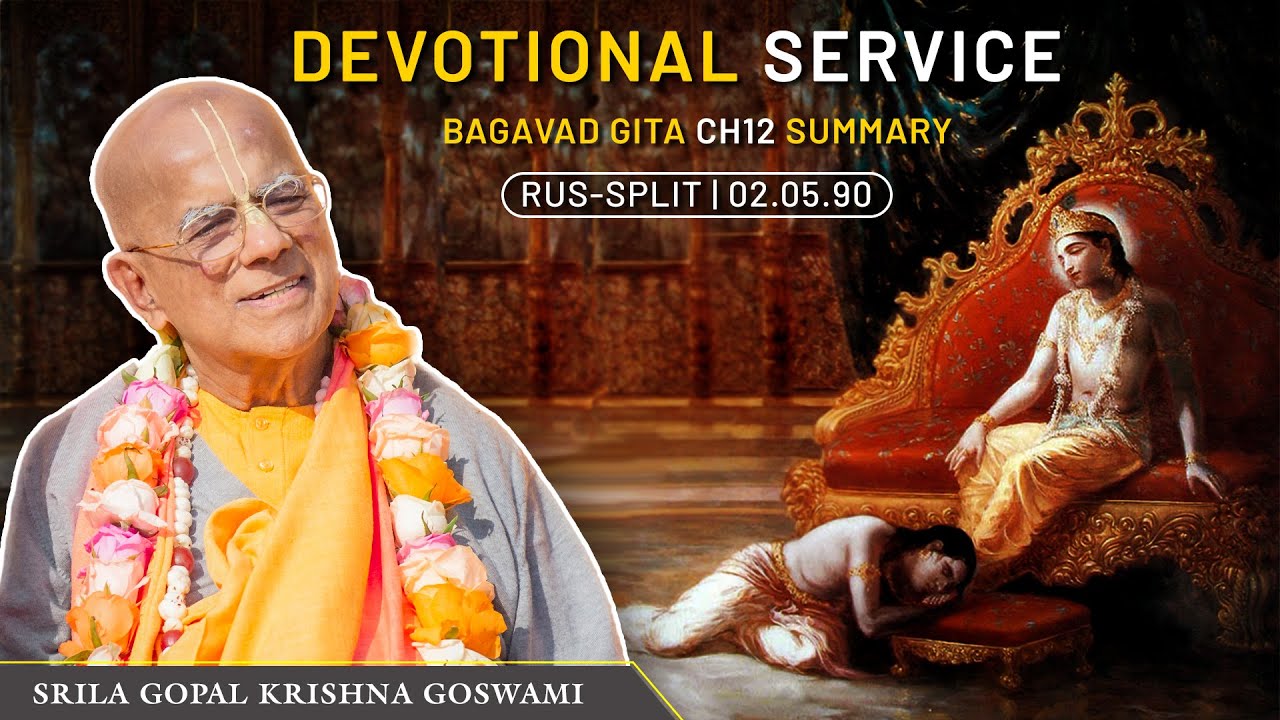
In this 2023 lecture Prasad Raval presents a detailed exposition of Chapter 12 of the Bhagavad‑gītā, which outlines the practical means of devotional service (bhakti‑yoga). He begins by contrasting personal worship of Kṛṣṇa with impersonal worship, asserting that the former is spiritually superior and leads to liberation. Raval then describes a hierarchy of devotional paths: (1) fixing one’s mind and intelligence on Kṛṣṇa, (2) following the regulative principles of bhakti‑yoga (purity, abstaining from sinful activities, daily practices), (3) offering one’s professional skills in service to Kṛṣṇa, and (4) renouncing the fruits of one’s work. He emphasizes the importance of association with devotees, chanting, and the transformation of false ego (identifying with the body) into real ego (recognizing oneself as a servant of God). The lecture highlights key devotional qualities—tolerance, determination, equality in happiness and distress, non‑envy, and self‑satisfaction—illustrated with analogies such as the bee versus the fly, a mother bird’s determination, and the resilience of trees and grass. Raval answers audience questions, explaining the Vṛndāvana vision (seeing Kṛṣṇa everywhere and treating all beings as his children), clarifying that Kṛṣṇa consciousness is a science rather than blind faith, and distinguishing the natural aspiration for liberation from material desire. He concludes that the teachings of Chapter 12 provide a positive, practical alternative to material pursuits and can be applied in modern life—work, family, and social service—while remaining rooted in scriptural authority.
Questions this video answers
Vṛndāvana vision means seeing Kṛṣṇa everywhere; whatever one perceives is viewed as an opportunity to serve Kṛṣṇa. One regards all beings as sons of Kṛṣṇa, uses all experiences (flowers, weather, even hardship) for His service, and treats the world as the Kṛṣṇa Republic.
He means that devotional practice must be understood logically and experientially, like a science. One should study the philosophy, see its practical benefits, and thus maintain commitment even when difficulties arise, rather than accepting it merely on faith.
No. The aspiration for liberation is natural, like the need to feed the stomach. Serving God is a fundamental, non‑selfish need; it is not a material desire but a spiritual necessity.
Real liberation is freedom from the cycle of birth and death (moksha). It is the ultimate goal of devotional service.
Chapters
Prasad Raaval. Okay, quiet. There's a lot of talking going on. So I'm going to lecture on the 12th chapter of the Bhagavad-gītā, and at the end of the lecture, all of you can ask questions. And I may also ask some of you some questions. So you should be very attentive and no talking. So in the 12th chapter of the Gītā, we find some very practical instructions. The 12th chapter once again begins with Arjuna presenting his doubts to Kṛṣṇa. This morning when we were discussing the Īśopaniṣad, we explained how by understanding the Īśopaniṣad, we will get a better understanding of God. So the 12th chapter begins with Arjuna presenting his inquiries to Kṛṣṇa. Arjuna wanted to know, "What is better, worshiping You in Your personal form or impersonal form?" Kṛṣṇa said, "Those who worship Me in My personal form, that is superior to the impersonal worship." So Kṛṣṇa is saying, worshipping Me in My personal form is superior to thinking that there is God, but God has no form. Kṛṣṇa explains that those who take to the impersonal process and at the same time control their senses, they understand God, but after many, many births and deaths. So the point is this, that Understanding God as a person who can be approached through the process of devotional service is superior to understanding God as without a form. Kṛṣṇa says that those who are attached to the impersonal aspect of God, for them spiritual advancement is very, very difficult. So But this is difficult because if you don't have a form of the Lord in your heart, then how can you worship the Supreme God? So Kṛṣṇa is saying that, "Worship Me in My personal form." This is very important. Kṛṣṇa says, "Those who worship Me in My personal form," "I deliver them from the cycle of birth and death." You may remember that in the whole Bhāgavad-gītā, Kṛṣṇa is emphasizing that we should worship Him, give our mind to Him, and give our intelligence to Him. Because mind and intelligence, if they are properly used, then one can make spiritual advancement. And if the mind and intelligence are misused, then you cannot make spiritual advancement. The mind and the intelligence have to be made our friends. The materialists are also very intelligent, but unfortunately their intelligence is being misplaced. Take for example the modern scientists. They are doing so many things which at one point looked impossible to us. They have a camera that can take pictures from a distance of 40,000, 50,000 feet. They have made these aeroplanes that more or less fly automatically. They have manufactured the computer, and just in the size of the nail that you cut and throw away, they can store thousands of items as memory. But unfortunately, this is all śramaḥ evaḥ kevalam, it is simply a waste of time. Because the— by misusing one's intelligence, one just thinks of sense enjoyment. So Kṛṣṇa is saying, please use your intelligence to find out how can I realize the goal of life. Instead of utilizing our intelligence to find out how can I become a rich man or how can I get more sense enjoyment, we should use our intelligence to find out How can I achieve the goal of life? So by associating with spiritual personalities, by listening to the agents of the Lord, by studying the scriptures, this is what we learn. How can we establish our relationship with God? Now after establishing the fact that worshipping the Lord in His personal form is superior to thinking that God has no form, Krishna begins to explain how we can do devotional service. He has given us different choices. He first says what is the best, and then he tells us what is second best, third best, and so on. So Krishna says, if you cannot fix your mind and intelligence upon me, then please follow the regulative principles of bhakti yoga. For example, If we told you, "Okay, now to succeed on the spiritual path, all of you must only think of Kṛṣṇa for 24 hours," you may say, "Swāmiji, that looks very difficult." Ja, if it is difficult, there must be some other way also. And Kṛṣṇa says, "Follow the regulative principles of bhakti-yoga." What is the meaning of bhakti-yoga? This we must first understand. Bhakti means devotion. Yoga means the science of meditating on the Lord. So Bhakti Yoga is the science by which we give our devotion to God. We have to give our devotion to somebody or the other. If you don't give your devotion to God, you will have to devote yourself to somebody else. Just like in the Western countries, You see, almost everybody has a dog or a cat at home. In, in Soviet Union, I don't see so many dogs and cats, but in America and Europe, in every house they have one dog at least, or one cat. So you don't want to give your love to God, so give your love to your dog and cat. So that is very unfortunate. The loving propensity is there in everyone. Just like in wood there is fire. When the child is growing up, the child, if he is trained, he will learn how to walk. So similarly, the propensity to love God is in everyone. But God is pure. He is not contaminated. So to understand that pure person, we also have to become pure. That is why Kṛṣṇa says, Follow the regulative principles of Bhakti Yoga. Regulative principle means follow the rules and regulations. Without rules and regulations, you cannot operate in any area. If you work for the government, you have rules and regulations to follow. If you go to school or college, you have rules and regulations to follow. So similarly, for loving God, You also have rules and regulations. So Kṛṣṇa is saying, "Arjuna, if you cannot think of Me for 24 hours in a day, then please follow the regulative principles of Bhakti Yoga." So what are the regulative principles of Bhakti Yoga? We follow the process of sadhna-bhakti. Sadhna-bhakti means you take advantage of some rules and regulations. For example, we get up every morning and perform mangala arati. It may not be practical for all of you to live in the temple, especially in this country, but these rules can be followed wherever you are. And by following these rules and regulations, abstaining from 4 types of sinful activities, the impurities in the heart will be removed. And when these impurities are removed, Then you will be able to see the beauty of devotional service. I will give you a simple example to understand this point. You may have something very beautiful in front of you, but if the other person is blind, then can he see it? So as long as we have these material desires, we are blind. We cannot see the beauty of Kṛṣṇa. But by following the rules and regulations, our blindness will be removed, and then one will be able to understand the beauty of the Holy Name and the Supreme Lord. Therefore Kṛṣṇa says that one should get information on the principles of Bhakti Yoga under the direction of a bona fide spiritual master. Kṛṣṇa says, "Okay." Now some of you may say, "We cannot think of Kṛṣṇa 24 hours." Then Kṛṣṇa says, "Okay, you cannot think of Me 24 hours, then you chant and you follow the rules and regulations." But some of you may say, "We cannot even follow the rules and regulations, then what to do?" Then Kṛṣṇa says, "Come and work for Me." Just like you all have, everybody has some skills. So Kṛṣṇa says, "Use those skills for My pleasure." Some of you may be working as scientist or professor or whatever. But still you can find some time to come and do some practical devotional service to Kṛṣṇa. So the point is that we must understand that there is a God, He has a name, and this human life one may use to serve Him. For example, there may be somebody who says, "I like what Kṛṣṇa is saying. I like what you people are doing." "But I have, I'm a businessman," or "I do a job." So does not matter. You can stay where you are, but still you can help the devotees in whatever manner that is practical to push on Kṛṣṇa consciousness. And by doing that, you will make advancement. Everybody is attached to the fruits of his work. The materialist does not want to give up the fruits of his work. But Kṛṣṇa says, "If you cannot work for Me," then renounce the fruits of your work. Because by giving up the fruits of your work to Kṛṣṇa, you will free yourself from the reaction to sinful activities. Because every action has a reaction. And if we engage in some effort to earn money, then of course we become liable for the reaction. But if we are going to offer it to Kṛṣṇa, then we can become free from the reaction. So Kṛṣṇa is trying to encourage everyone to engage at least in some level of devotional service, because human life is very, very rare. And if we don't take advantage of this human life to cultivate spiritual knowledge, then it is very, very tragic. So Kṛṣṇa is giving us information on all these paths, or at least we use one of these. By renunciation of the fruits of the work, Kṛṣṇa says you can have peace of mind. Why is it that Kṛṣṇa is saying, if you renounce the fruits of your work, you can have peace of mind? Because when you renounce the fruits of your work, you at least acknowledge that there is a God in control. You at least acknowledge that God should be, should be the real enjoyer. And if you understand that God should be the real enjoyer of everything, then naturally everything has to be used in His service. So Kṛṣṇa is saying the different phases or the different paths by which you can come to Me, even if you take the least, the lowest step, still by taking to that step, slowly, slowly you'll make advancement. Just like in a Kṛṣṇa conscious movement we have seen that sometimes people will come on Sunday, they will just buy one book, slowly, slowly they will take association of devotees, And slowly, slowly they will increase their service. Kṛṣṇa then describes how one becomes dear to Him. How does one become dear to Kṛṣṇa? So that information is also there in the Bhāgavad-gītā. Kṛṣṇa says, "One who is not envious." And in the material world, everybody is envious of each other. A is envious of B, B is envious of C. Because everybody wants to be ahead of the next-door person. So Kṛṣṇa says the devotee of the Lord must be friend of everyone. He does not think that he is the proprietor of anything. He is free from false ego. Who knows the meaning of false ego? What is false ego?
Identifying with one's own material body.
Aham brahmasmi. I am this body. You are identifying with this body. Aham brahmasmi.
I am pure spirit soul.
They are identifying with this body. That is false ego. And real ego is aham brahmasmi, understanding and pure spirit soul. So through the cultivation of spiritual knowledge, false ego becomes replaced with real ego. Just like you can see that we are using an amplifier in this lecture today. Now when this amplifier was made by the manufacturers, They obviously made it with the purpose of using it for some mundane reason, but we are using it in service to the Lord. I saw this flat before any devotee had moved in. Some material people, some karmis were living here, but now you all have converted it to such a nice temple. So the point is, just like you have converted this flat into service to the Lord, Your false ego can be converted to real ego. False ego means I am this body. Real ego means I'm servant of God. Very simple. As I was explaining this morning, in the material world, I— if you will ever have a situation where you're always happy or you're always in— always sad. One day you may be happy, the next day you'll be sad. But a devotee He has to be equal in both. He should know, if I'm honored today, tomorrow I can be dishonored also. So we have to become tolerant. In spiritual life, you will see that tolerance is very strongly emphasized, because without tolerance there cannot be spiritual advancement. How tolerant the tree is. Whether it is hot or cold, the tree is there to give, to help you. How tolerant the blade of grass is. Everybody is walking on the blade of grass, but still it is quiet. So Kṛṣṇa says, become more tolerant than the blade of grass and the tree. A devotee is self-satisfied. His mind and intelligence is fixed on Him, and he engages on the devotional path with determination. So determination is very important. Because sometimes you may come to spiritual path, But then there will be some difficulty, and then you will leave and go away. But if you are determined, then there is no question of leaving. So in the Vedic scriptures, determination is very highly recommended. In the Bhāgavad-gītā, Prabhupāda gives a very nice example to show how we should be determined. Once there was a bird that had her egg stolen by the ocean. The mother bird went to the ocean and said, 'Please give back my children.' The ocean said, 'No, I'm not going to give you your children back.' So then the mother said, 'Okay, I will dry you up with my small mouth.' So the ocean started laughing. The ocean said, 'How can you dry me up? You have such a small mouth.' But Garuda Garuda is the bird carrier of Lord Vishnu. So Garuda heard that the ocean had stolen the children of his sister, because Garuda also belongs to the family of birds. So then Garuda came to the ocean and said, please return the eggs, otherwise I will dry you up. Then the ocean gave the eggs back. So you see, This is an example that shows that for the bird to dry up the ocean is an impossible activity. But because the bird was determined, she was success— the bird was successful. Similarly, if you're determined in spiritual life, then even if there's some difficulty, you will be victorious. Otherwise, if you're not determined At the slightest agitation, he will give up devotional life. A devotee does not put anyone into difficulty. He is not disturbed by anyone, and he is fixed in happiness and distress. Such a person is very dear to the Lord. He has no anxiety. The, the materialist is full of anxiety, but a devotee is full of spiritual anxiety. The anxiety of the materialist is "how can I get more sense enjoyment?" Therefore he will do anything that he can to get some more sense enjoyment. But the anxiety of the devotee is, "how can I give Kṛṣṇa to others?" And therefore the devotee engages in book distribution and he engages in so many auspicious activities by which others can be inspired to come to Kṛṣṇa. So one who is, who has no material anxiety but is thinking how to realize the goal of life, he can make spiritual advancement. In the material world, we become happy when I— when we get what we want, and we become sad when we don't get what we want, isn't it? So Kṛṣṇa says, become equal in all situations. And we must cultivate the spiritual knowledge. Kṛṣṇa says, give up non-devotee association. Non-devotee association means You don't associate with those who are engrossed in sense enjoyment any more than you have to associate with them. Obviously, when we go out on harinama, when we go out on book distribution, we have to associate with non-devotees. But we associate with non-devotees only as much as it is necessary, not more than it. Therefore, By choosing our association, we can also make spiritual advancement. So Kṛṣṇa is saying, "If you follow my path, then you will definitely come to me." Making me the supreme goal. Making Kṛṣṇa the supreme goal does not mean that you have to abandon your worldly duties. Making me the supreme goal means that whatever we do, it is just meant to help us in serving Kṛṣṇa. Just like, for example, if somebody is married and he has few children, just he naturally has to work because he has a family to maintain. But if he understands that the purpose of my existence and my family's existence is to please Kṛṣṇa, then he will mold his life in such a way that Kṛṣṇa can be served. So if we take Kṛṣṇa's instructions to heart, then we can make spiritual advancement. Religion means the words of God. Dharmāntya-sakṣād-bhāgavat-panitām. And without following the words of God, we cannot make spiritual advancement. Just like there are so many so-called religious movements, but unless that religious movement is based on śruti and smṛti, that means the scriptures and the pure representatives of God, it will simply create a disturbance in society. So Kṛṣṇa is Supreme. Kṛṣṇa is not an imaginary God. And Kṛṣṇa appears to establish the principles of religion. And these principles of religion can only be cultivated in the human form of life. So principles of religion means following the instructions of the Lord. And if you take the instructions without deviation, then they will have effect. Just like if you take the doctor's medicine, if you take the doctor's medicine without any adulteration, then the medicine will work. But if we take the medicine and by adding water, then it will lose its potency. So similarly, if we take to the process of devotional service as explained by the spiritual master and the Supreme Lord, then the effect will be there and one will make rapid spiritual advancement. So this Bhāgavad-gītā, the Bhāgavad-gītā is also called the Song of God, and it is a part of the Mahābhārata. And in this Bhāgavad-gītā, Kṛṣṇa is giving us instructions by which we can get out of the cycle of birth and death. Kṛṣṇa says in the Gītā, dukhālayāmaśāśatam, the misery and everything is temporary. So the solution from this miserable position is The process of devotional service. By spiritual association, the fire of devotional service gets higher and higher. In English there is a saying, "A man is known by the company he keeps." So by chanting Hare Kṛṣṇa in the association of devotees, the heart gets cleansed. We can see practically how when you start chanting this Hare Kṛṣṇa, how your life changes. In the morning I was explaining how, like in your country, the government wants people to drink less. How in America they want people to take less drugs. But they are not successful. Why? Because they are not giving people a positive alternative. So unless we can give people a positive alternative, they will not change their lives. And that positive alternative is this chapter of the Bhagavad-gītā called the 12th chapter. In this chapter, Kṛṣṇa has clearly told us how we can execute devotional service through some means or the other. So with this we end our discussion of the 12th chapter of the Bhāgavad-gītā. And now we will take on questions on this chapter. Hare Kṛṣṇa. Hare Kṛṣṇa.
In the autumn of 1988, You told that We have special vision of pre-Baltic and some other regions of USSR, special vision. And how can You describe the Vṛndāvana vision?
I said, what is the question?
What is the meaning of Vṛndāvana vision? Yes, what does it mean?
What's your name?
Vāṣṭina.
Maitreya das. So Maitreya das, he wants to know what is the meaning of Vṛndāvana vision. Vṛndāvana vision means you see Kṛṣṇa everywhere. Whatever you see, you think, how can I use it for Kṛṣṇa? When you see these nice flowers, You say, "Oh, how can I use these flowers for Kṛṣṇa?" You see Kṛṣṇa everywhere. You recognize that your body and senses should also be used only to serve Kṛṣṇa. Just like today it is very nice day. So you say, "Oh, this is Kṛṣṇa giving me this nice weather. Let me preach." And sometimes you may have a bad day. It may be -40. So then you can see, "Oh, this material world is nothing but full of misery." Doesn't matter where I go, there will be nothing but misery. So let me make plans how to get out of this material world. So Prabhupāda said a devotee must be like the bee and not like the fly, because the flies, they will only sit on dirt. Just like if you have a cut in the skin and you are in a warm climate, the flies will come and sit on your skin. But the bee is always looking for nectar. So the devotee should be looking for good qualities of everyone. And if you're looking at everyone's good qualities, you will find somebody who has some good quality. If you want to look for bad qualities, then the bad qualities will be manifested. And if you want to look for good qualities, then the good qualities will be manifested. And if you have the Vṛndāvana vision, then every man you see on the street, every woman, you'll say, "Oh, here is a son of Kṛṣṇa." Any man you see on the street, you'll say, "Oh, we are all from the same republic." You won't say, "Oh, this man's from Russian Republic, he's from Ukraine, this is from Lithuania." We are all from the same republic. And what is the republic? Kṛṣṇa Republic.
Prasad once told that Kṛṣṇa consciousness is science and it is not blind faith. What does he mean by the word that it should not be taken blindly?
Her question is, Prabhupāda said, "Kṛṣṇa consciousness is a science and not blind faith." That means we should logically understand our position in relationship to Kṛṣṇa. Not that one day you come, you like the Hare Kṛṣṇa chanting, you take it up, and next day you have a fight with some devotee, you say, "To hell with it, I'm going to give it up." But if you understand it scientifically, the whole philosophy, Then you will never give it up. Who can defeat that there is God? Just like in your country, for such a long time they had this propaganda that God is dead, but it was not successful. Who can replace God? And who can deny that we have a duty towards God? And the Vedic philosophy, it is not Hindu philosophy. The Vedic philosophy is for whole humanity. And the Vedic philosophy is, by chanting the names of God, you will become pure. You can see that yourself. Like I told you this morning, when I first came in 1976, there were hardly few people, 2 or 3 people chanting in this country. But today, thousands are chanting. Why? I am sure all of you know that we are not giving you any pocket money, no roubles. But the reason you are chanting is because it is giving you happiness. If you work for some other political party, you get some material gain. But if you work for Kṛṣṇa's party, you get no material benefit. But still you work for Kṛṣṇa's party. Why? Because it gives you satisfaction. Okay? So you may understand it scientifically.
Well, she says the conditioned soul is aspiring liberation. Is it also a sort of material desire to get rid of material miseries?
No, this is not material desire. Just like when they put food in your stomach, It is natural, isn't it? It is your business to feed the stomach. Because if you don't feed your stomach, you will become weak and then you will die. So similarly, just like it is natural for you to feed your stomach, it is natural for us to serve God. And to serve God is not considered selfishness.
If compared to devotional service, what is the level of this liberation? Spiritual liberation.
What is the level?
Yes.
Real liberation is to become free from the cycle of birth and death. Hare Krishna, Hare Krishna.