BG 13.3 Perfect Knowledge vs. Imperfect Knowledge | Rus-Split | 12.7.92 | Gopal Krishna Goswami
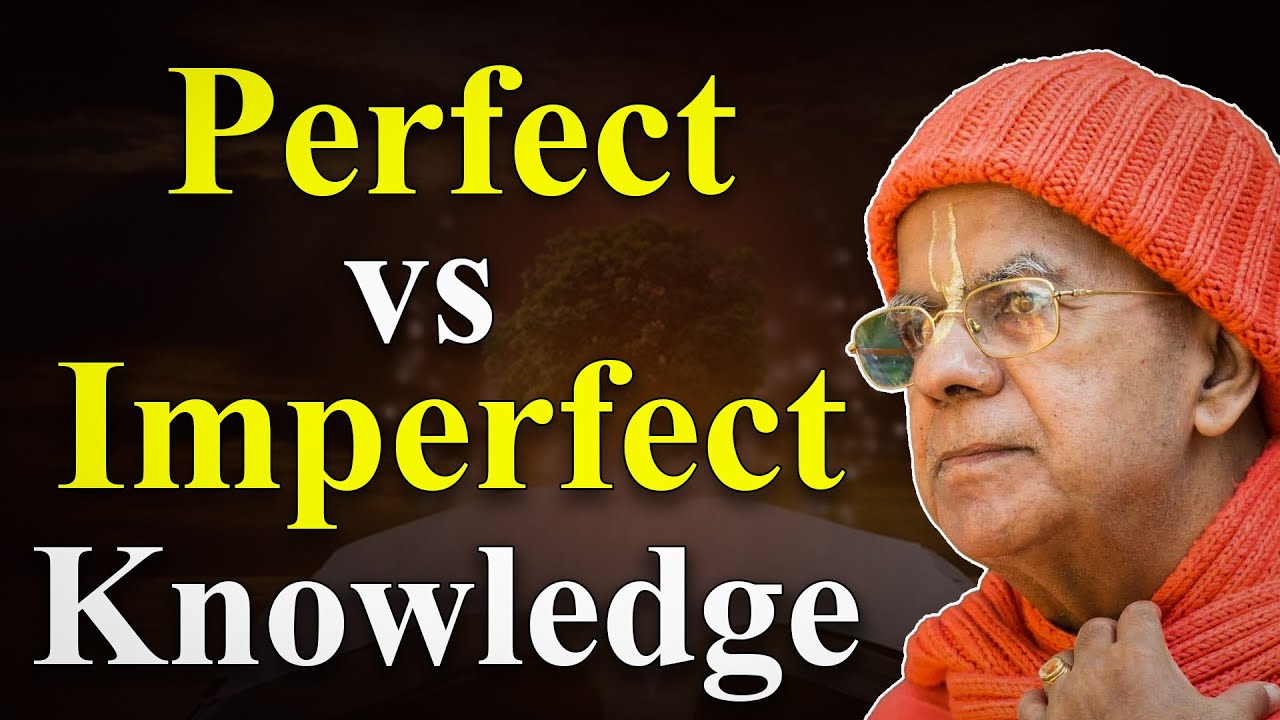
Gopal Krishna Goswami explains Bhagavad-gita 13.3, contrasting perfect spiritual knowledge with material ignorance. He recounts Prabhupada's 1971 prediction that communism without God would fail, then explores how Krishna witnesses all actions and controls the senses. Chanting, study, and association with devotees internalize this knowledge.
Chapters
We had somebody who was the first person that Prabhupāda preached to when he came to this country. Can you devotees figure out his name? Katorabhusa. So he was here, and I told him that everything that Prabhupāda said in 1971 has been proven to be correct today. He agreed. In 1971, Prabhupāda said that communism without God will not work. But at that time, nobody could believe it. But today, 1992, everyone can believe it. Anyway, even though he said, oh, every time he was an atheist, but he agreed with everything we said. So we said, you're not an atheist. Actually, this professor, at the time Prabhupāda came in 1971, He took a big risk in agreeing to meet Prabhupāda, because at that time to meet a religious man was very risky business. So this man has done some service to this Kṛṣṇa conscious movement. Namo Bhāgavate Vāsudevāya. Namo Bhāgavate Vāsudevāya. Śrīmad-Bhāgavad-gītā Chapter 13, Text 3. Om jñāna-primaṇḍasya Jñānān jñānāśalakya-cakṣaṇmṇitam yena tasmāye Śrī-guraveṇa-maha. Śrī-cetānyam anubhastam sāpitam yena bhūtale, soyaṁ rūpakadāmayāṁ dadāti svāpadaṇḍikam. Bandeḥ haṁ Śrī-guru Śrī-utāpada-kamdaṇaṁ Śrī-guruṇvaishnava-nāśṭha. Śrī-rūpaṁ sakājatāṁ sahāgana-daguna-tanvitam tam-sajīvam. Sadveitāṁ sāvudhūtam prijana-saitaṁ Kṛṣṇa-cetānya-devaṁ. Hare Kṛṣṇa. "Shreeta, shreeta gayor jnanam yatha jnanam atham mama." See, we are presently discussing a very important chapter of the Bhagavad Gita. Actually, it is impossible to discuss this verse with full justice in just half an hour's time. So Krishna is explaining in this verse. He says that He is the knower in all bodies. And to understand this body and this knower is called knowledge. In this chapter, the body has been described as a field of activity. Why is the body described as a field? Just like you have these football fields on which they play football or a hockey field in which they play hockey. So similarly, the body is a field in which the senses are operating. So the body is a field in which the senses operate, and in the body there are two souls, as Prabhupada explained in the PowerPoint: the individual soul and the super soul. Individual soul refers to the jīvātmā, and the super soul refers to the paramātmā, the plenary expansion of the Supreme Lord. So Kṛṣṇa is the knower, but He's not the individual knower. He's the super knower. Very often in His lectures, Prabhupada would give the following example: You may only know how much land you have, but the government knows how much land every house has in the city. So the Supreme Lord knows everything about everyone, not only about present but also past and future. So as the Super Soul, as the Paramātmā, the Lord is fulfilling several functions. One is He acts as a witness. The other is He acts as the sanctioning authority. They say not a blade of grass moves without God's permission. So similarly, the Lord is the sanctioning authority in the sense that it is He who approves or disapproves the various desires that you may manifest. Sarvasya caḥam hṛḍi sāni veṣto mataḥ asmitaḥ jñānam apahānaṁ ca. In the Bhāgavad-gītā, Kṛṣṇa says, "I am the source of remembrance and forgetfulness." So Kṛṣṇa is the source of both forgetfulness and remembrance. So when Kṛṣṇa sees that the individual has a desire to approach God, to serve God, then Kṛṣṇa reciprocates accordingly. And when Kṛṣṇa sees that one wants to forget God, then Kṛṣṇa also reciprocates accordingly. Another function which the Paramātmā is executing is the witnessing function. It bewilders the gross materialist to understand how the question of reward and punishment can take place. When we explain the law of karma, when we explain that to every action there's a reaction, the materialists often want to know, "Who is witnessing every act that I'm executing?" So there are several witnesses to every act that one executes: the sun, the moon, the stars, the air god. The sun and the moon are the two eyes of the Lord, and the sun and the moon have the capacity to penetrate through any thick layer and see what's happening beyond it. That's like you go for an X-ray. You go for an X-ray and stand in front of the X-ray machine, and the X-ray machine sees through your clothes and sees through your body, the layers, the skin covering of the body, and shows you a photograph of what is inside your body. Similarly, when you fly by airplane, um, you put your suitcase through the X-ray machine And the X-ray machine sees exactly what is inside the suitcase. Your country has been noted for sending satellites in outer space. So these satellites are taking pictures from a distance of 100,000 feet and over. They can take pictures, um, as to regarding exactly about all the movements on the Earth. So the Sun and the Moon are witnessing everything. And besides all this, there's another witness —and that is the Paramātmā in the heart. So the Paramātmā is keeping a record of all your activities. And then karmanadeva-netreṇa-jantu-deho-papataye. That is based on the living entity's actions, our next life is decided accordingly. So Prabhupāda gives the example in the purport that just like in a kingdom, the king is the original proprietor and the individual is the secondary proprietor of the land. Similarly, the Lord is the original proprietor of the body and we are the secondary proprietors of the body. Kṛṣṇa has many names which characterize His different pastimes. One of Kṛṣṇa's names is Rishi Keśa. Rishi Keśa means controller of the senses, owner of the senses. So Rishi Keśa is— Kṛṣṇa is the real owner of the senses, not we the individual. What does it mean when we state Krishna is the owner of the senses? It has a very deep meaning. The meaning is that since Krishna is the owner of the senses, the senses should be employed in service of the correct owner and not the incorrect owners. Just like a clerk working in a bank. The clerk in a bank may be counting so much money, but at no point did the clerk think this money belongs to me. Similarly, since the senses are the property of the Supreme Lord, it is natural that the senses are used in service of the Lord when it's free from the resulting reaction. So the entire teachings of the Vedas is designed to achieve one goal: to bring the living entity to recognize that Kṛṣṇa is the proprietor of the senses, known as rīṣikeśa. Therefore, one's life should be so molded that the senses can always be engaged in service to the Lord. In the Vedas, we have the example of many exalted devotees who showed us practically how the senses can be used in service to the Lord. Just like long, long ago, there existed a great devotee called King Amṛśa. King Amṛśa was the king of the world, but at the same time a very humble devotee of the Lord. He depended upon the Lord, used his senses in service to the Lord, and even while executing his kingly duties, he never deviated from meditating on the Lord. For example, King Amrit showed us how the eyes can be used to see the beautiful form of the Lord, the leg to walk to the temple of the Lord, the hand to sweep the, sweep the temple of the Lord, the head to bow down before the Lord, the nose to smell fragrances of incense or flowers offered to the Lord, the head to bow down before the Lord, and the tongue to taste foodstuff offered to the Lord. So we learn the art of employing the senses in the service of the Lord, then we are marching towards the goal of perfection. Perfection is not the utilization of senses for some temporary sense pleasure which have an ending. Perfection is when you learn to use the senses in service to the Lord. So this body, as we said, is called the field of activity, and in Sanskrit it is called a kshetra. And within it, there— with the body, there's the individual knower and the supreme knower. The science of God entails the understanding of prakriti, purusha, and ishwara. Prakriti means nature. Kṛṣṇa says, māyā-dakṣinā-prakṛti-svayete sa-carā-carām. This material nature is working under My direction. So prakṛti is never to be considered independent of the Lord. Prakṛti is always subordinate to the Lord. Then puruṣa, the enjoyer of nature, and īśvara, the knower who dominates or controls nature and the individual soul. So Prabhupāda says, That one should not confuse the three. Just like you should not confuse the painter, the painting, and the easel. Easel is the brush, then there's the painter, and then there's the painting. So we should not confuse Purusha, Ishvara, and Prakriti. So if you understand that the real Ishvara is Krishna, and the real Purusha— actually Purusha means enjoyer. If we understand that the real enjoyer is Kṛṣṇa and we use this field of activity to serve the real Īśvora, then one can achieve love of God. Presently we see that this vast material nature is being exploited by the living entity for his own selfish purposes. Why do we see the world problems increasing? Because mankind has so designed society prasad raival. That these resources provided by God are being used for sense enjoyment instead of being offered back to the Lord. So the Vedic scriptures conclusively point out that there should actually be only one real enjoyer, that is the Lord. And by serving that supreme enjoyer, the living entity also becomes the enjoyer. Just like when you serve the stomach, the whole body gets nourished. So similarly, when you serve the Supreme Lord, one automatically derives total satisfaction. So Krishna, as the verse points out and as Prabhupada explained, is the knower of all bodies. Krishna does not appear, does not interfere with the independence, with the minute independence that has been granted to every living entity. Just like in the Bhagavad-gītā, we see that in the second chapter Arjuna pleaded, total confusion, and begged the Lord for spiritual knowledge. And then Krishna started imparting this philosophy of the Bhagavad-gītā. And after Krishna had imparted the philosophy of the Gītā, in the 18th chapter, Krishna inquired from Arjuna if his illusion was now gone. And when Arjuna said his illusion was now gone, Krishna said, "Now do as you see, as you feel free." If you see proper. So understanding these three things, prakṛti, puruṣa, and Īśvara, constitutes knowledge according to this verse of the Bhagavad-gītā. And everything else besides this is avidyā, ignorance. Presently you have a society where what is the term described as knowledge actually is actually avidyā. Kṛṣṇa says in the Bhāgavad-gītā, rājavida rājaguyam, that this knowledge is the king of education. So this constitutes real knowledge. One who understands the science of God, one who understands the science of God understands how the Lord is the cause of all causes and everyone is subordinate to the position of the Supreme Lord. Therefore, by cultivating the spiritual knowledge, we understand the position of Purusha, Kshetrajna, and Kshetra. Presently we are all trying to become the false Purushas, the false enjoyers. Therefore nature is being exploited for that purpose, and the body, the senses are being exploited, okay, the senses also being misused for that purpose. Conditioned soul is entrapped in material existence and he attempts to lord it over material nature. And according to his capacity, he tends to dominate material nature, for which he gets a body, uh, based on his actions and desires. The scriptures explain how one should not identify with the body. One must know the difference, one must recognize the difference between the body and the real, and the self. Presently we are busy just taking care of the body without taking care of the real self. Just like, for example, if you keep polishing the cage, you may even gold plate the cage, but if you don't feed the bird inside the cage, what good is it? Prabhupada used to give the example that a man was being drowned. Somebody dived into the ocean and came back with his hat and coat, and he very proudly displayed to the other villagers, "See, I've saved a dying man." But the man was already gone. He just came back with his coat. So similarly, we are presently just catering to this body, and we are thinking that we are actually taking care of ourselves. That is ignorance. So this is perfect knowledge, and what is accepted in society as perfect knowledge is actually imperfect knowledge. This is known as jnānam, and this jnānam will enable one to understand the real goal of life. Therefore, the spiritual knowledge must be carefully cultivated. Spiritual knowledge must be studied, and by regularly cultivating the spiritual knowledge, you will understand what is jnānam and what is avidyā. What is, what is vidyā and what is avidyā. One who misunderstands the rope to be the serpent is not in knowledge, as Prabhupāda says. The tendency to exploit the— but this can only be done once you recognize who is the real Īśvara. Who is the real owner of the body? So this is the difference between the devotee and the non-devotee. Just like today when we were speaking to Dr. Katarsky, he said religion should not mean that people don't do any work and become idle. We said we fully agree. In fact, so that is Kṛṣṇa consciousness, learning to work for Kṛṣṇa. As Prabhupāda used to say, Just change your consciousness. Instead of having hazy consciousness, instead of thinking that you're the proprietor, recognize that the Lord is the proprietor. Now it takes a lot of practice to understand that the Lord is the proprietor on a day-to-day basis, to remember every second that the Lord is the enjoyer and I'm not the enjoyer, to remember every second that the field of activity, the body, should not be misused takes a lot of practice. So what does this practice mean? Practice means chanting the Holy Name, reading the scriptures, staying in the association of devotees, and doing some practical service. If you do not sincerely execute these guidelines, then to remember that Krishna is Rishikesha, He is the real enjoyer, and you are not the enjoyer, and you are not the owner of the body and the senses, is hard to realize. Therefore, Kṛṣṇa conscious devotees chant their rounds, read the books, read the Bhāgavatam in the morning, read the Gītā in the evening, stay in the association of devotees and constantly remind each other that the senses have to be used in service to the Lord. The Vedic writings are designed to bring the living entity to the point where he, athāto brahmajñāyāsa, investigates his relationship with the Lord. So to summarize the verse, Krishna— actually starting from the second verse, um, this is the third verse— Krishna has begun to respond to Arjuna's question. Arjuna in the opening lines of this chapter has said he wants to know about prakriti, purusha, the field and the knowledge, and the knower of the field and of knowledge, and the object of knowledge. So the Supreme Lord has begun to respond to the questions of Arjuna. For example, in the second verse, the Lord said, "The body is called the field, and one who knows the body is called the knower of the field." And in this verse, Kṛṣṇa explains what is real jnāna or knowledge. That is, one who understands the field of activity and who is the Īśvara and who is the Puruṣa. And besides that, everything is avidyā, ignorance. So from ignorance we come to knowledge. Just from darkness you come to light. Therefore we say, Om Jnanativenandaasya Jnananjanaśalakya ācakṣerminetan yenātas māyśrīkṛrāvena maha. That we were born in ignorance, but by the mercy of the spiritual master one understands, one receives the real spiritual knowledge. So we should cultivate this knowledge by regularly reading the Bhagavad-gītā. And if you regularly cultivate this knowledge, then you'll have knowledge Then you'll be fully prepared to stand the onslaught of the illusory energy. Hare Krishna. Actually, this verse requires a very detailed explanation, but I don't want to take it too long because it's already 8:30. But I'm going to give the class again here, I think most probably Monday evening, and I'll explain this verse again, but from a different angle. This verse requires more explanation than the time that was allotted today. Did you understand something? Have you become mahajans already? So how many devotees went out for the tickets? Gauranga Bhajan Band ticket sales today. How many devotees went out? How many? Don't feel shy. Okay. So we only have few more days to go. So I just wanted to take this And if you enthusiastically push, then definitely people will buy these tickets and the concert will get an opportunity to hear the Hare Kṛṣṇa mantra, sing the Hare Kṛṣṇa mantra, and even buy transcendental books. So please do not complain that there are too many marathons in ISKCON. The senses have been on the marathon for sense enjoyment since times immemorial. So it's only appropriate that now we use the senses constantly in service to the Lord. One thing I wanted to mention also was Śrīla Prabhupāda mentioned to me that his observation was that most of the devotees on the tables were not using the lines that he— that were given to the devotees to be used when they sell these tickets. So I just want to request you all to try and use those lines that you were given, um, in when you sell these tickets and not just, uh, Stick to your own formula. So I'll stop the class here because it's 7:40. I hope to be back on Sunday for the Sunday evening class or Monday morning, definitely. And Monday evening I'll explain these verses further. Okay? Hare Krishna. Hare Krishna. Jai.
More from PRASAD

Rare Pastimes & Timeless Lessons of Guru Mahārāja | Stories Every Disciple Should Hear

ISKCON Legends- pure devotees meet-HH Jayapataka Swami, HH Gopal Krishna Goswami, HH Radhanath Swami



Jagannātha Ratha-yātrā Through Śrīla Prabhupāda's Mercy | 29 April 2006 | Nairobi, Kenya

Lord Jagannātha's Appearance Pastime | 21.07.2019 | ISKCON Calgary | Śrīla Gopāla Kṛṣṇa Gosvāmī

The Ācārya Teaches by His Own ExampleGuṇḍicā Mārjana by Guru Mahārāja #shorts

Guṇḍicā Mārjana – Lord Jagannātha's Pastime | 21.7.2019 | ISKCON Calgary |Śrīla Gopāla Kṛṣṇa Gosvāmī

H.H. Gopāla Kṛṣṇa Gosvāmī Mahārāja - Exemplary Sādhana and Deity Worship # shorts

भगवान की कृपा कैसे प्राप्त होगी ? | 11 Jan 2014 | Punjabi Bagh | Srila Gopal Krishna Goswami

Material Education vs Spiritual Education | Srila Gopal Krishna Goswami #shorts