BG 2.20 : The Basic Principles of Spiritual Life | Rus-Split | 21.5.90 | Srila Gopal Krishna Goswami
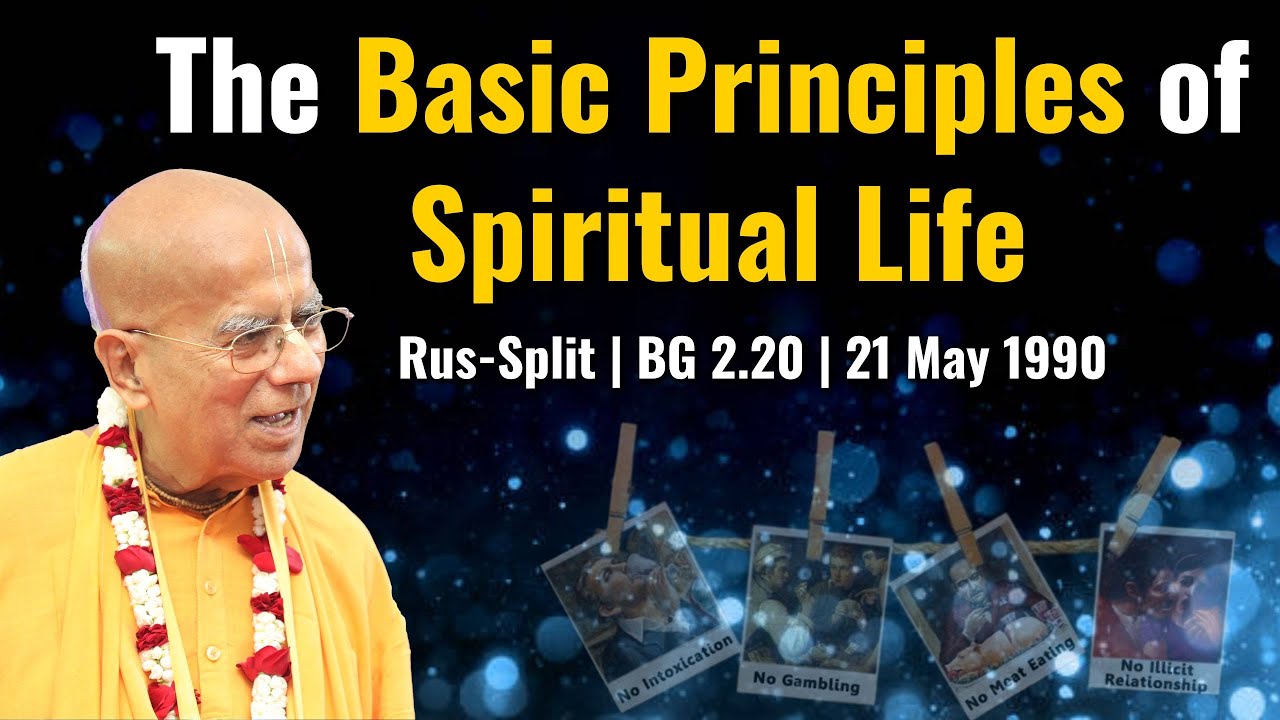
Srila Gopal Krishna Goswami teaches that the soul is eternal while the body is temporary, and that true happiness comes only through devotional service and chanting the Hare Kṛṣṇa mantra. He warns that neglecting discipline leads back into māyā, and answers questions on spiritual setbacks, guru service, and maintaining quality in devotional practice.
Chapters
PRASAD RAVAL. Yesterday I was going to discuss a verse from the second chapter of the Bhagavad-gītā, but because there were so many questions and answers, we were not able to discuss it. So if it is okay with all of you, I can discuss that verse now. I will not speak for very long. I will speak till 8 o'clock and then take on question and answers for about 20 minutes, because I am going to stop the program in one hour. Then in the month of June, I'll come here again for 2 days, on June 2nd and 3rd. Actually, the doctor told me to give my throat complete rest. Because till I don't give it complete rest, it will not become normal. Om Namo Bhagavate Vasudevaya.
Om Namo Bhagavate Vasudevaya.
Om Namo Bhagavate Vasudevaya. Om Namo Bhagavate Vasudevaya. Om Namo Bhagavate Vasudevaya. So please repeat after me. Bhāvitā, bhāvitā, bhā, bhā, nā, nā, ruhyā, ruhyā, ajo, ajo, netiyā, netiyā, shaśvatō, shaśvatō, yam, yam, purāṇo, purāṇo, nā, nā, manyate, manyate, manyamāne, Om jyānātmānandaśya jyānānjanāśalakya-cakṣūm-militaṇyena tasmai śrī-gurave namah. In this second chapter of the Bhagavad-gītā, Kṛṣṇa is explaining the basic principle of spiritual life. The basic principle of spiritual life is to understand that this body is only a temporary covering. This body is a temporary covering, and the body is changing at every stage. In this verse, the Supreme Lord is informing us that the nature of the soul is that it is eternal. Then the Bhāgavad-gītā establishes that this nature is completely under the control of the Supreme Lord. And Bhāgavad-gītā establishes that time destroys everything. I may be a very powerful man today. Well, how long will that power last? Nobody may criticize me today. Well, how long can I control everyone? Even if I'm very beautiful today, how long will this beauty last? So Krishna says, time, I am the destroyer of everything. The atheist does not believe in God, but the atheist also has to confront God. The atheist will have to confront God at the time of death. So Krishna says, the time, I am the destroyer of everything. Then the Bhagavad-gītā establishes that actually the living entities are all eternal. And based on karma, one's future is decided. Karma na deva-netre na jantur deho papate ye śrīya-praviṣṭho-dhāraṁ puṁ-saṁreṭa-kṛṇaśrayaḥ. That is, based upon the activities of the living entity, his next body is decided. So here is where the question of the soul comes into play. Because if you acknowledge that the law of karma is working, Then you have to acknowledge that there's something in the body that does not die with the termination of the body. Today or tomorrow, the body is going to be destroyed. In the Bible, there's a very nice statement which Prabhupada used to very often quote: "Dust thy art and dust thou shalt become." So it does not matter which faith he may belong to, eventually everybody will have to become dust. The Christians, for example, They bury the body. Does not matter how expensive a casket you may put the body in, the ants can always come inside. And the Mohammedans also, they bury the body. Eventually the ants eat the body. The Hindus, they burn the body, it becomes ashes. And there's another community known as the Parsis who throw the body in the well, which is then eaten by the eagles. Eagles, they eat the, eat the They sit on top of the well. So when the body is thrown in the well, the eagles come and eat the body and then pass stool. And the stool mixes in the ground and becomes dust again. So the point is that this body is dust and it will become dust. It is just a matter of time. Therefore, realizing the difference between the body and the soul, we must cater to the needs of the soul. Modern society can be compared to a position where you polish the cage but don't feed the bird inside. So if you have a very nice house to live, somebody may give you a big house to live, but he'll tell you, you can't have any food to eat. So what good is that? So we must first cater to the needs of the soul. What is the need of the soul? Dusya? Is it material or spiritual? Let us examine the elements of the soul. Krishna says the soul cannot be cut into pieces, it cannot be dried, it cannot be washed, it cannot be pushed by the wind, it cannot be seen by any, any type of eyesight, it cannot be seen by anyone, and the measurement is only 1/10,000 of the tip of the hair. So obviously the material scientists are not capable of producing something which may be 1/10,000th the tip of your hair and which can give you energy for 24 hours all your life, as long as you live. So the logical conclusion is the nature of the soul is spiritual and not material. And since the nature of the soul is spiritual and not material, how can you satisfy the soul with material activities? You cannot satisfy the soul with material activities. Therefore, does not matter which part of the globe you go, you have so many rich people, but they are not satisfied. In the English language, there's a phrase, the grass is greener on the other side. That is, it appears that if you change your situation, then you'll become more happy, but you can never be happy. Just like if you go, like in Soviet Union, I've met a lot of people who say, oh, they would like to go to America. So a lot of people think If they can just go to America, then they will be happy. But if you go to America, even California, you will see billboards all over California saying, fly to London and be happy. And if you go to London, you will have an Aeroflot advertisement saying, fly to Moscow and be happy. And the same Aeroflot will advertise in Moscow that fly to Bombay and be happy. So basically everybody feels That with a change in position, he'll become happy. But Kṛṣṇa says, dukhālayam, no question of happiness. Even if he achieves some happiness, it is short-term. It could end at any moment. Therefore, we must take advantage of the spiritual philosophy. Now, from a spiritual viewpoint, all of you accept that there is a soul. Why is there so much emphasis in just discussing the second chapter? Thakura Bhaktivedānta Mahāprabhu has said, that the second chapter of the Bhagavad-gītā is the most important chapter of the whole Gītā. So here are some of the advantages if you practically understand the second chapter. Once you acknowledge that the soul is eternal and the body is perishable, then you know that based on how you act, you will be rewarded. Just like the Bible says, as you sow, you shall reap. So based on how we act, the result is going to be obtained. If we act correctly, then we'll get the right result. And if we act incorrectly, then you'll get the wrong result. Similarly, the spiritualist understands that thou the eyes want to see something beautiful, thou the tongue wants to taste without discrimination. I should not provide these different desires because they are against the principles of spiritual advancement. So Kṛṣṇa Himself says, Some look on the soul as amazing, some describe him as amazing, and some hear of him as amazing. And others, even after hearing about him, cannot understand the soul. Just like if you go to a gross materialist and you talk to him that the soul is eternal, he will not be able to understand it. Somebody who's intoxicated with desires of sense enjoyment cannot understand the eternal position of the soul. So this is a big difference between the devotees and the non-devotees. The devotee has the vision of eternity. This means the devotee knows that he's eternal. And the materialist, his understanding is that with the termination of this body, everything will end. So we have to, as devotees, keep reminding ourselves we are not these bodies. Unfortunately, our material conditioning is so sharp that even after hearing about it every day, Still we keep thinking we are this body. 80 to 85% of Prabhupāda's lectures were just on this one theme: You are not this body. Because in the bodily, being in the bodily concept of life since times immemorial, it is not so easy to give up this conditioning. Therefore we have to practice this Kṛṣṇa conscious philosophy. We have to every day remind ourselves, I am not this body. You may like to stand— people like to stand in front of the mirror to see how they look. Sometimes the materialists ask us, is it necessary to shave your hair? Whether you're in India or America or Soviet Union, people ask the same question. So we say, no, it is not necessary to shave hair. And that is a fact, because Kṛṣṇa consciousness is essentially a change of consciousness and not a change of dress. But then why do we shave hair? Those that fully dedicate themselves to preaching activities. They shave their hairs as a sign of renunciation. So the point is that we as devotees have to act with the understanding that we are not these bodies. We all have to be ācāryas. We have to prove and live the philosophy. In the Caitanya-caritāmṛta it is explained that a Vaiṣṇava by his behavior is exhibiting the principles of religion. For example, If I tell you I am not this body, but if I am acting in a manner by which I am engaged in sense enjoyment, then how will you believe, I mean, what I say? Therefore we have to chant and preach the philosophy. When Sanatana Gosvāmī met Haridas Thakura, he told Haridas that some people chant but do not preach, and some preach but do not chant. But you are simultaneously doing both functions. So we all, each of us has to act understanding that he is not this body. It is not difficult to prove how we are not these bodies. When the body dies, why is it that everybody is crying? Why do we say he has gone away? The body is still there. Where has he gone? There is something in the body that has gone. That is the living force. The Ātmā. Ātmā, Paramātmā are like two birds sitting on a tree. One bird is witnessing the other bird. One bird is busy enjoying the fruits of the tree. And the other bird is just witnessing, "When will this bird turn towards me for attention?" Just like sometimes, the children, you know, of course these days children are rebellious everywhere. But sometimes the parents, they are watching the children. They know the child is going to make a mistake. But the child— father lets the child do what he wants. I cannot drink anything for 2 hours. So we have to understand in reality that we are not these bodies. How to understand that? How to remember? For that we have to follow the principles of devotional service. Just like on a rainy day you take an umbrella to protect yourself from the rain, or in cold weather you wear warm clothing to cover your body. Similarly, we have a defense equipment for Kali-yuga, and that is the process of chanting. This afternoon in the initiation lecture, we had discussed at length the 10 offenses that we should avoid. So, uh, there are different stages of chanting, but one thing is the more we eliminate our anarthas, the sweeter spiritual life will become. The sweetness of spiritual life can be tasted in proportion to our surrender. The more we surrender, the more sweet spiritual life will become. Therefore, again and again, the great sages, the spiritual masters, they're all telling us the same thing: please free yourself of your material desires. Since times immemorial, we've been trying to satisfy material desires but without any success. Therefore, The great sages have concluded, now, athāto brahmā-jijñāsa. Now is the time to inquire how to establish a relationship with Kṛṣṇa. Sometimes we have seen all over the world, and even in your country, you may think, you may see sometimes somebody is chanting Hare Kṛṣṇa, he's making spiritual progress, then all of a sudden you find out that he's in māyā. I have seen cases where Devotee A has preached to a bhakta and made the bhakta a devotee, and that bhakta that he preached has become a good devotee, and the devotee A who preached to him is now in māyā. So how does this happen? It is important that we know it so in future it doesn't happen to us. In English there's a saying, precaution is better than cure, and an ounce of precaution is better than a pound of cure. So precaution is better than cure, and this is a principle that we all follow in our lives. So what is the precaution that we have to take? The precaution is that we should not compromise on the rules and regulations of Kṛṣṇa consciousness. The rules and regulations which have been given to us, they should be accepted with full faith. In the Bhāgavatam, there's an example given, that is, sometimes somebody is taking a medicine and he falsely thinks that now he is recovered, so he stops to take the medicine And then he gets a relapse. Similarly, if we stop taking the medicine or we become careless, then we can have a relapse. Sometimes you're driving a car on the highway and the driver falls asleep. And when the driver falls asleep, what happens? Accident. So if you fall asleep spiritually or you take chances with spiritual life, then you will have an accident. It is guaranteed. Who can be a more advanced devotee than Haridas Thakur? Haridas Thakur was chanting the holy names of the Lord 300,000 times every day. So Haridas, in old age, he was sick. It does not mean that the pure devotee's body doesn't fall sick. Like Prabhupada's body, Prabhupada also was sick. But a pure devotee's sickness is completely on the spiritual platform and for our purification. We cannot compare that to an ordinary man's sickness. Sickness. So Caitanya Mahāprabhu went to Haidāsa ṭhākura and He told him, "Haidāsa, you have been chanting the holy names for such a long time. Now you are sick. Why don't you take rest?" Haidāsa said, "If I stop chanting, then I'll fall into māyā." So even though Caitanya Mahāprabhu told him, "Stop chanting," Haidāsa said, "No." Once Prabhupāda was greeting the deities. In one of the temples, you know, we greet the Deities every morning accompanied to the Govinda tape. And in many of our temples we have three altars. First altar, Govinda Thay, second Radha Kṛṣṇa, third Sita Rāma Lakṣmaṇa Hanumān or Jagannātha Subhadra Bāla Rāma. Prabhupāda would always speak something to the Deities while greeting them. So once devotees asked him what was he speaking. Prabhupāda said, I was praying to Kṛṣṇa that I may not fall in māyā. So Prabhupāda and Haidarṣṭhākura are showing us that how we have to be so careful in our position.
Māyā works in our life just like cancer works in your body. When cancer strikes you, for 1 or 2 or 3 years sometimes you don't even know that cancer is in your body. And cancer will start with one part of the body. And gradually spread everywhere. And then when it spreads everywhere, you can go to the best doctor in America, it is too late. So similarly, māyā exerts its influence in such a manner that it becomes very difficult to control. Therefore we have to guard ourselves from the beginning. So whether one is a grihastha, a brahmācāri, a brahmācārni, a student, or a housewife, or a mother, or whatever, The same concern should be applied. Yesterday I told you how Ramacandra Puri, he had started criticizing his spiritual master, and gradually he became so offensive that he even started criticizing Lord Caitanya Mahāprabhu, who was Kṛṣṇa Himself. And then what happened?
Ramacandra Puri lost the path of bhakti and he became a māyāvādī.
So this path of bhakti is a real diamond. Everyone cannot have it. One devotee was telling me that in the city of Moscow we only have few hundred people chanting Hare Kṛṣṇa. And Moscow's population is what, 9 million?
Yes.
And population is about 9 million. So even if you say, what, 1,000 people are chanting Hare Kṛṣṇa, 1,000 people out of 9 million is what? Any good mathematicians around? Tiny percentage. So once Prabhupāda was giving a lecture at a very big hall in England. And one person asked Prabhupāda question. He said, "If your Kṛṣṇa consciousness is so perfect, why isn't this hall completely crowded?" Because Prabhupāda said, "When you're selling diamonds, only few will buy. And when you're selling broken cut glass, thousands of fools will buy." So you will never have a position where everyone in Moscow is going to say, "Please make me Kṛṣṇa conscious." Ewanek bendaavan. Where there are 5,000 temples, except for ISKCON devotees and me and few others, hardly anybody is following the strict principles which Lord Kṛṣṇa and Lord Caitanya Mahāprabhu gave us. So ISKCON will never be a movement based on a mass base with thousands of people in every city.
We are not after numbers, we are after quality. Because our rules and regulations are strict, naturally people, unless they are ready for austerity, they will not be ready for Kṛṣṇa consciousness. Therefore, we should take to this Kṛṣṇa conscious process very seriously. All of you are very fortunate that even though you were living in a society where for 40, 50 years people were taught that there is no Bhoga, now you'll have come to the realization that there is God and you've also come to the realization what His name is.
You know His name and you also know His address and you also know which ticket to buy to get to His place.
And you also know His telephone number.
And His telephone number is the Mahāprabhu. Āmānta.
So you need, you don't need a telephone connection to dial that number. You can dial that number wherever you are.
So take advantage of all this wealth of information that you have and be happy. Prabhupāda always says that this is a movement to make people happy. If you analyze any devotee in any part of the world, he can't, he may not be able to speak one word of English or Hindi or Sanskrit, but as long as one is chanting Hare Kṛṣṇa, he's always happy and content.
And on the other hand, you have people who have so much money, so many cars, so much of everything, but still they are unhappy and frustrated. So real happiness comes in linking ourselves with the Lord. Never forget this basic prāvada.
Even though the biggest newspaper in your country is called Pravada, but the real prāvada is what we are talking, not what they are talking. We should tell them, If you really want to talk about Prabhupāda, then publish Kṛṣṇa's teachings. Hare Kṛṣṇa. Hare Kṛṣṇa.
If a devotee serves Kṛṣṇa for several years and after these several years he still falls into māyā, does that mean that he does not reach the platform of brahman-bhūta, ham brahma-smṛti?
Well, if a devotee has been practicing Kṛṣṇa consciousness and then he falls into māyā, then obviously it means that he hasn't reached the standard of brahman-bhūta.
Because when you are at the brahman-bhūta stage, Then you don't fall into maya. Just like, I'm sure you all had prasadam about 1 hour ago. So when you have full prasad and somebody else comes and gives you some more samosas, you say, "No, niyat." Preaching activity in Kṛṣṇa consciousness is considered to be the topmost activity.
Does that mean that it surpasses if a devotee is working on material job and he is still a devotee, Kṛṣṇa consciousness and following all rules, but working on material job?
If you want to work outside of the material job and practice Kṛṣṇa consciousness, niyat prabhu. You should be like a lotus flower that is in water, but the water doesn't touch the lotus flower. Prabhupāda used to give the example of the mouth of a cat.
The mouth of a cat for the kitten is a source of shelter. When the baby kitten sees the mouth of the cat, it says, "Oh, now my mother is coming to carry me." And when the rat sees the— mouse sees the mouth of the cat, it says, "Oh, now death has come." So to the devotee, the material world is like the cat—
for the kitten, the mouth of the cat. And to the materialist, the material world is like the mouth of the cat for the mouse.
Is it better to leave a material job and engage in spiritual activity?
Of course, if you can engage in spiritual activities full-time, that is the highest. But if you cannot engage full-time in preaching activities, then Kṛṣṇa lets you serve Him from other angles also.
Are you married or are you single?
Married. Married. He's married and has a child.
So you can decide what is practical for your grihāsta situation, but don't compromise on the spiritual standards. Grihāsta means where the husband and the wife combine to serve Kṛṣṇa. And grihamedhi means where the husband and wife combine for sense enjoyment. So we have to be—
So those who are in the householder situation should become first-class grihasthas.
What the soul feels when it leaves one body and enters into another body?
What does it feel?
Yes, what is the sensation of a soul when it leaves one body and gets to another body?
The soul does not feel happy as long as it is moving from one material body to another. The soul is happiest when it enters, when it is moving in a spiritual direction.
How can a devotee understand that he is in Maya?
How can you understand whether you are sick or not? You go to the doctor. When you want some operation, then you go to the doctor. You take a— you bring a knife from the kitchen and do it yourself.
If there is some period of time when spirit soul has no form, now, when in Bible it is said that a man should be born from the higher force in order to have wisdom. And you say that the birth, that the soul has no birth at all. So it's contradiction. Bible says that you should have like higher type of birth, like I don't know how to explain.
I don't think the Bible says that. There is no contradiction on these points between the Bible and the Gita. You should reread the Bible. Read the correct version of the Bible.
What is the best way of serving the guru according to one's qualities? What is the best way of serving guru?
The best way to serve, the best way to serve the guru is to follow his instructions. Chant your Hare Kṛṣṇa mantra nicely, read the books, associate with devotees, and serve. You don't have to worry about giving currency to the guru.
How a person can understand himself, realize that he reached this platform of Brahmanbuta, ham brahmasmi.
The symptom of an advanced devotee is that even when he is on an advanced level, he will say he's neophyte.
Caitanya Mahāprabhu was God Himself, but what did He say? "I have no attraction for the Holy Name." So an advanced devotee will never say he's advanced. If he says advanced, that means he's not advanced. An advanced devotee must be very humble, friendly.
We all are imperfect, and sometimes we feel some irritation towards another devotee. What can you advise in this case?
Be tolerant. We are all imperfect, but by chanting Hare Kṛṣṇa you will become perfect. Just like if you are diseased, by taking the medicine you will become healthy.
What is the place in your activities, for practical activity towards some outsiders?
Me? Mine?
Yes.
You are asking me the personal question?
Personally you.
I think it's a very interesting question. I have no secrets. I spend 7 months a year preaching in India because I was put in charge by Prabhupāda of these big temples like Vrindavan and Bombay and Delhi. So those temples are so big, especially Vrindavan and Bombay, that I have to spend a lot of time there. In Bombay, We get 10,000 people every day to visit the temple. And Vṛndāvana is the place where Kṛṣṇa appeared on the planet, and Prabhupāda's samādhi is also there. Some of you Soviet devotees have also been there. Each of those temples has 3, 3 altars. One altar is Gaura-nitāya, Prabhupāda and Bhaktisiddhānta Sarasvatī. Second altar is Rādhā-rādhvihārī-lalitā-viśākhā. Third altar is in that room over there, We have a picture of Radharādhī-bihārī. I'll show you all that picture. And third altar in Bombay is Sita-Rāma-Nakṣmaṇa-Hanumāṇa. Bombay is the biggest temple that ISKCON has in the whole society. The whole altar there is made of pure silver. We also have a 60-room guest house. The whole temple is made of marble. And we have a 400-seat most modern theater. And we have a restaurant for 130 people. And we have a big school there also called Bhaktivedanta Swami Gurukul. Plus I also oversee the printing activities of BBT India. And in Vrindavan also we have a very big temple. So I spend most of my time lecturing and looking after the temples in India and Canada. And I'm spending few months a year preaching in your country because Prabhupada had given me that responsibility in 1976. Okay, these are the deities of the Bombay temple.
Uh, what is the subject which you studied in school? Only philosophy or other subjects also?
Me?
In gurukul. In gurukul.
In school.
School, gurukul.
Well, in Bombay, our Bombay school is a little different than our gurukuls all over the world. In our Bombay school, we teach regular education and compulsory spiritual education. In our gurukuls, they teach Only spiritually philosophical point. Bombay school mainly for the children of outsiders, not devotees.
Well, he says it's very important how we choose senior devotees as our authorities.
Devotee A, devotee B.
Is it considered an offense if we are trying to like discriminate One senior devotee is more advanced than the other, it will become to judge senior devotees. Is it an offence?
Depends how you are judging it. While judging it, you should not commit offences. You don't tell devotee B, "I am not going to follow you because you are neophyte. I am going to follow devotee A because he is more advanced." You know, a lot of Soviet people come to our temple in Bombay. A lot of Soviet visitors. So I wanted to thank all of you. Believe me, I enjoy the preaching in your city of Moscow. I'm hoping on doing a course in the Russian language from later on this year, and then I'll be— I may be spending more time in Moscow if I do that course. So then I'll have the opportunity of associating with y'all. Now you all should work so hard that Kṛṣṇa gives you a very nice piece of land where you can build the temple, a very nice temple in Moscow. And flood this place with Prabhupāda's books. If you flood this place with Prabhupāda's books, then the material seeds will not be allowed to grow. And when the material seeds are not allowed to grow, then there will be the development of love of God. See, as Kṛṣṇa consciousness expands in your country, we also see that māyā is expanding in your country. Like I've heard that now, I've heard that now they're going to introduce nightclubs and gambling casinos. They're going to make the society more open like the West. I have heard that in the movies and all, they've already relaxed the censorship standards. So as Kṛṣṇa consciousness expands, we see on the other hand, māyā is also expanding. So the two will go side by side. As Kṛṣṇa consciousness will go on expanding, because this is Lord Caitanya's prediction, and māyā will also go on expanding. But if Kṛṣṇa— if the devotees are very enthusiastic, Then each devotee can liberate a whole universe. One thing that I'm very impressed by is all your devotees have a natural attraction for book distribution. I have not met a single devotee in our country who is against book distribution. And Prabhupāda said these books are so powerful that even if somebody touches these books, he can get a human birth again. And Prabhupāda said, "As long as book distribution goes on, I will never die." And Nirodhana ṣaḥkura said, The Vaiṣṇava never dies because he is living always in his teachings. So when we distribute these books, we distribute Prabhupāda and the whole guru-parampara. We send all of them into the houses of the conditioned souls. Prabhupāda calls book distribution and printing the vraja-maṇḍanga. Once Bhaktisiddhānta Sarasvatī had a paper and pencil. He drew a picture of her maṇḍanga. And he told Prabhupāda, this is the bhrāhmad medanga. Bhrāhmad medanga means the big medanga. You can play the medanga, you can have amplifiers, but even if you have amplifiers, the sound will not go very far. But book printing and book distribution is bhrāhmad medanga. You may distribute a book to somebody in Moscow and he may read it in London. We have so much experience of people buying a book in London and becoming a devotee in Canada or America or India. Hare Krishna.
Official organization Moscow books, uh, they are ready to buy a party of our books and distribute themselves. What is your, uh, yes, officially government organization, what is your attitude?
It's— I think it's a good idea, but I think we should discuss this with Taniyas Prabhu and others who are actually in charge of the Soviet book printing program. Hare Kṛṣṇa! Hare Kṛṣṇa! Hare Kṛṣṇa!
Hare Kṛṣṇa! Hare Kṛṣṇa!
More from PRASAD

Rare Pastimes & Timeless Lessons of Guru Mahārāja | Stories Every Disciple Should Hear

ISKCON Legends- pure devotees meet-HH Jayapataka Swami, HH Gopal Krishna Goswami, HH Radhanath Swami



Jagannātha Ratha-yātrā Through Śrīla Prabhupāda's Mercy | 29 April 2006 | Nairobi, Kenya

Lord Jagannātha's Appearance Pastime | 21.07.2019 | ISKCON Calgary | Śrīla Gopāla Kṛṣṇa Gosvāmī

The Ācārya Teaches by His Own ExampleGuṇḍicā Mārjana by Guru Mahārāja #shorts

Guṇḍicā Mārjana – Lord Jagannātha's Pastime | 21.7.2019 | ISKCON Calgary |Śrīla Gopāla Kṛṣṇa Gosvāmī

H.H. Gopāla Kṛṣṇa Gosvāmī Mahārāja - Exemplary Sādhana and Deity Worship # shorts

भगवान की कृपा कैसे प्राप्त होगी ? | 11 Jan 2014 | Punjabi Bagh | Srila Gopal Krishna Goswami

Material Education vs Spiritual Education | Srila Gopal Krishna Goswami #shorts