BG 2.22- The Science Behind Our Existence | Rus-Split | 16 May 1990 | Gopal Krishna Goswami
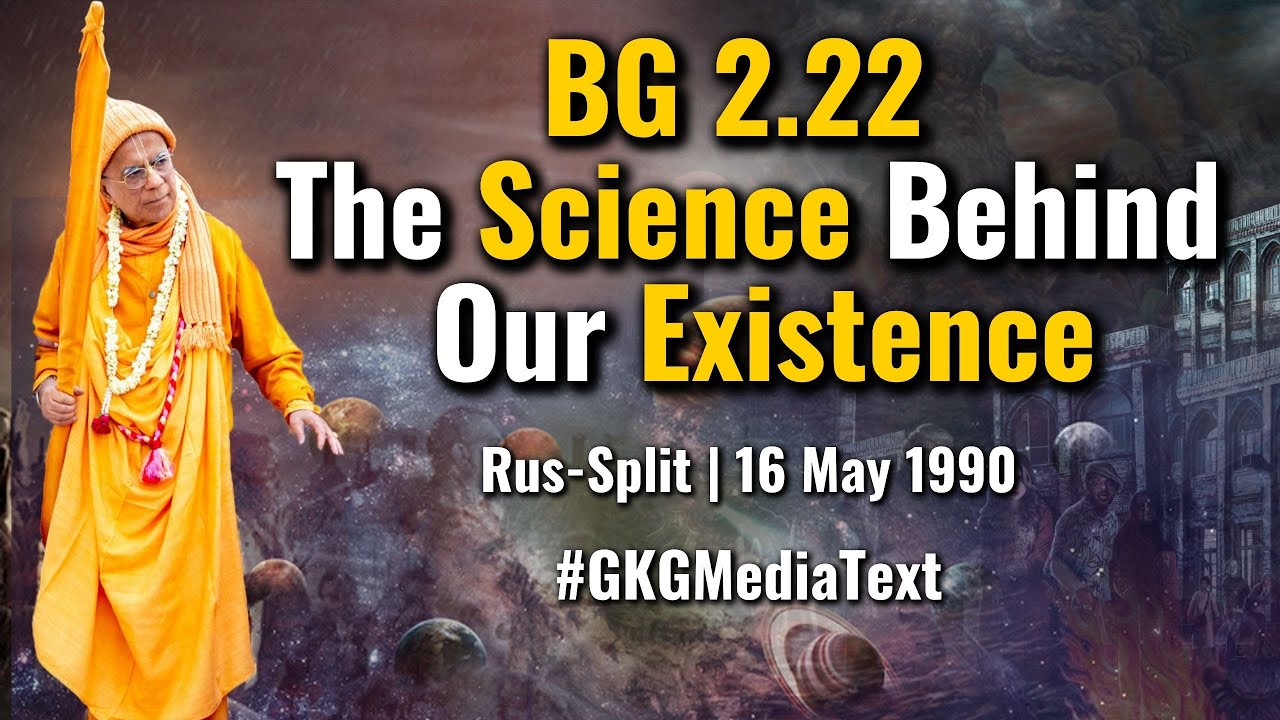
In this extensive ISKCON classroom lecture, Gopal Krishna Goswami (recorded 16 May 1990) expounds Bhagavad‑gītā 2.22, emphasizing the fundamental Vedic teaching that the soul (jīva) is distinct from the material body. The talk begins with chanting the Sanskrit verse, then proceeds to explain the body‑soul distinction, the process of transmigration governed by karma, and the eternal nature of the soul. Using everyday analogies—clothing, bank passbooks, batteries—the speaker illustrates how the soul discards one body and assumes another, and why identification with the body leads to suffering. He cites A.C. Bhaktivedānta Swāmī Prabhupāda’s commentary, stories from the Bhagavata‑purāṇa (e.g., King Chitraketu, the “liquid beauty” tale), and contemporary observations (funeral customs, mirror‑filled elevators, test‑tube babies) to show the universality of the doctrine. The lecture stresses that only devotional service (bhakti) can satisfy the soul, contrasting material pursuits and highlighting the principle of “simple living, high thinking.” A Q&A segment addresses practical questions about the soul’s journey (time between bodies, duration in Yama‑loka, seeing Paramātmā, reincarnation choices). The session concludes with a discussion of book distribution as the essential activity for spreading Krishna consciousness, and brief inter‑faith remarks about Jesus, Sai Baba, and other religions. Throughout, the speaker urges listeners to recognize themselves as pure spirit, to serve Krishna, and to avoid attachment to material identity.
Chapters
Om namah bhagavate vasudevaya. Om namah bhagavate vasudevaya. So I thought we could discuss a verse from the second chapter of the Bhagavad-gītā. It's a very well-known verse, text 22 of the second chapter of the Bhagavad-gītā. In all our ISKCON temples, We chant, the speaker of the class, he chants the Sanskrit śloka. So I will, I will read these Sanskrit words word by word, and you can try responding. Don't worry about making mistakes. The Sanskrit language is so purified that even if you chant incorrectly, you'll still get the spiritual benefit. Vāsāṁ sī, jena-ni, yathām Sannyāti navaṇi dehi. So now I will chant these same words in faster melody, and you can try repeating after me. Vāsāṁ sijināni yathā vihāya. Vāsāṁ sijināni yathā vihāya. Navaṇi gṛhṇāti naro parāni. Navaṇi gṛhṇāti naro parāni. Jataḥ śrī-rāṇi vihāya jināni. Okay, so you can open to text 22 of the second chapter. Those who have books can share the books with other people. Wasamsi janā janāni ittā vihāya. Wasamsi janāni ittā vihāya. Navani ganāti naro pārāni. Navani ganāti naro pārāni. Tathā sari rāni bihāya janāni. Tathā sari rāni bihāya janāni. Anyāni samyāti navani dehi. Anyāni samyāti navani dehi. Āsīla Mahāprabhu will read the translation and the purport. Please hear attentively because it is by A.C. Bhaktivedānta Swāmī Prabhupāda. Om ajñāna-timerandasya jñānānjanāśalakya-cakṣuṇ-miletāñīnātāśma śrī-gurave namah. Śrī-cetānyam anuvastam tapitāminabhūtale soyaṁ rūpakadāmayāṁ dadāti svāpādāntikam. Bandeḥ ham śrī-guru śrī-yutāpāda-kamman śrī-guruṇvaiśṇava-nāśraya. Hare Kṛṣṇa, Hare Kṛṣṇa, Kṛṣṇa, Kṛṣṇa, Hare, Hare, Hare Rādhā, Hare Kṛṣṇa, Padānta, Hāgana, Lalitā, Śrī Viśākhā, Nettāmṣṭha, Jai Śrī Kṛṣṇa, Chaitanya Prabhu Nityānanda, Śrī Advaita Gaddādhā, Śrī Vāśadevi Gaur Bhaktabinda. Hare Kṛṣṇa, Hare Kṛṣṇa, Kṛṣṇa, Kṛṣṇa, Hare, Hare, Hare Rāma, Hare Rāma, Rāma, Rāma, Hare, Hare. Wasamsijanani itthā vihāya navāni granāti naro-parāni. Tathā śrī-rāṇivihāya janāni anyāni-samyāti navāni dehi. Prabhupāda must have lectured on this verse at least 100 times, if not more. This was one of Prabhupāda's favorite verses of the Bhāgavad-gītā. And this is a verse that a new bhakta and an old sannyāsi can both use to understand the Kṛṣṇa conscious philosophy. The Bhāgavad-gītā's philosophy starts with understanding the difference between the body and the soul. This is the ABC of spiritual knowledge, to understand who you are. Just like when you visit a foreign country, the first thing they ask you is, "Who are you?" And then they ask you, "Where are you coming from?" You say, "Riga, Latvia." And then they ask you, "Where are you going to go?" So similarly, we need to know the answer to these 3 basic questions before we can understand what we should do. If you were to ask a materialist, "Who are you?" He will say, "I'm Alexander Valery." "Where are you coming from?" He will say, "Riga." And, "Where are you going?" He will say his destination. But he will not know who he is really, where is he coming from, where is he going. The real answers can only be found from the Vedic scriptures. So who are we? That is answered in the second chapter. My real identity is that I'm pure spirit soul. In the Bhagavad-gītā, Kṛṣṇa almost devotes a whole chapter just to prove one point. What is that one point? You're not this body. Kṛṣṇa could easily have made this point just in one verse, but He had to make this point again and again from so many different angles. Because as Prabhupāda states in the Bhāgavad-gītā, repetition is necessary in order to drive the point home. So the Vedic scriptures inform us that there are different dresses that you can choose. Just like if you go to a big department store, They have clothing at different prices: expensive, cheap, medium. Similarly, the soul can choose from male body, female body, demigod body, animal body, tree body, insect body, animal body. Karmānadvīva-netre-nā-dhāntur-devopapātaye śrīya-praviṣṇa-vidānaṁ puṇṣaṁ reṭha-kṇaśrayaḥ. Based on the karma that the living entity performs, which is all being witnessed by demigods, the living entity transmigrates from one body to another. The materialist cannot understand that every activity that we perform is being witnessed by several witnesses. You have the Paramātmā as the Lord in the heart who is the witness. Then you have the demigods, like the demigod in charge of air, sun, moon, stars, etc. So based on one's actions, our next life is decided. Now the Bhagavad-gītā is giving a very practical, very practical explanation. This explanation can be applied regardless of whether you are Indian, American, Russian, Hindu, Muslim, Jew, Christian, Muslim. I was once talking to Prabhupāda in Bombay in '76, and Prabhupāda told me that This Bhagavad-gītā's knowledge is real education. He said, "You mean the Christians don't get old? The Muslims don't get old? The Hindus don't get old?" This is universal philosophy for everyone. The Bhagavad-gītā is telling us, just like you and I change our clothes, we throw away our old clothes and take on new clothes. Similarly, the soul throws away the body and takes on a new body. Just like when you have a bank account, they keep a passbook, and in that passbook, every time money is deposited, your account is credited, and every time money is taken out, it is debited. Similarly, each of us is keeping a passbook with Yāmraj, and based on how we act, our account is being debited or credited. So Bhāgavad-gītā states, na jāyete mṛyate vākabhāce nāyaṁ bahūtabhāvita-vahana-bhūya ajñānitaśāśruda-yamśpurānau na hanyate hanyamāne śarīve. For the soul there is never birth nor death, nor having once lived does he ever cease to be. So soul is eternal, and a spiritual person has a vision of eternity. The materialists do not have the vision of eternity. When you take to Kṛṣṇa consciousness, The gross materialist will come and say, "Why are you wasting your life? Why don't you think about what you will do when you grow up?" So our answer is, "Why don't you think what will happen in the future?" So spiritualist has the vision of eternity, but materialist does not have the vision of eternity. The materialist thinks with the passage of this body, everything will come to an end. Why is it that the materialist does not believe in the soul? Why is it that he doesn't believe that the soul cannot die? Because the moment he believes in the duśa, he has to believe that there is something after death. And because there is something after death, there will be the question of reward and punishment. And if there is the system of reward and punishment, he will definitely be punished for his sins. So the easiest way out is to say there is no soul. Who has seen the soul? Everything ends with the end of this body. Eat, drink, and be merry. That's the goal of life. So the Vedic scriptures explain, dharmena hina pasyubhi samāna. Without the principles of dharma, this human life is the same as pasyū. Pasyū means animal. Aha nidrabhaya maituṇya ca. The Bhāgavatam explains eating, sleeping, defending, and mating. These are the only activities of the materialist. So Kṛṣṇa is through the medium of Arjuna instructing all of us regarding our real identity. Kṛṣṇa says, soul never takes birth, never dies. The duṣa can never be cut by any weapon, nor can you burn it in fire, nor can you wash it in the water, nor can the wind blow it away. It cannot be burned or dried. It is eternally the same. And what is the measurement? One ten thousandth of the tip of your hair. Can you see the soul? Krishna says invisible, inconceivable. Inconceivable means you cannot even imagine with a material mind. Can you imagine something which is one ten thousandth the tip of your hair which gives the energy to move day and night for the entire duration of your life? The materialists have created something which is known as a battery. Show those batteries. You run this battery, how many hours? This Ruskii battery will run for 2 hours. How many hours can this battery run? Okay, but now they have rechargeable batteries. You use the battery, then again you can recharge it. Even if you recharge a battery, how many times can you recharge? And how long does it run? Few hours. But the soul That doesn't need any recharging. And so small, you take the tip of your hair, divide it into 100 pieces. Again take one piece and divide it into 100 pieces. That is the measurement of the soul. So one ten-thousandth of the tip of your hair. There was a very big heart surgeon, I know him very well. He is in Toronto General Hospital called Dr. Bajloch. This man has seen people die for 32 years. 32 years in 1968. Now it is about 52 years. In 1968, he had seen people die for 32 years. So Dr. Bechdelot published a big article in a Canadian paper in '68 in which he said that a sudden change in the complexion of the individual convinces him that when the person dies, there's something in the body that Goes away. So I sent that article to Śrīla Prabhupāda. So Prabhupāda wrote to Dr. Bigelow that I'm very happy that at least you've acknowledged that there is a soul. Because in the Western countries, Prabhupāda said, people don't even believe that there is a duṣa, soul. So Prabhupāda said, now you are trying to find out where is that soul, that will never be possible. And so in the end, Dr. Bigelow acknowledged That what the knowledge in the Vedas is superior to what modern science will ever discover. So the beginning of spiritual life is to understand that you are not this body and you are pure spirit soul. The real beauty in the living entity is not this body which may be made of, which is made of earth, water, fire, air, ether, but the real beauty is the presence of the soul. People will spend a fortune and going to a nightclub in Europe or America. Why? They want to see women, but they want to see living women. Nobody wants to see a dead woman. So the point that we are making, the real beauty is the presence of the soul and not the presence of the body. Once you understand with the help of chanting and the philosophy that you're not this body, then you can ignore the demands of the senses. When a mother is bringing up a young child, the young child is asking the mother for so many things, but it is not that the mother gives the child everything the child will ask. The mother knows which demand of the child to ignore and which demand of the child to provide. Similarly, once you have the spiritual understanding that you are not this body, you know what demand of the senses to supply And what demand of the senses to reject? When the senses are going to ask you for something which is completely against the religious philosophy, then, you know, reject. Now we cannot be spiritual hypocrites. We cannot tell every, the other person, "You are not this body, Mr. Valéry, and you are acting as if you are this body." We have to mentally understand that we are not this body, and we have to apply it in practice. This is known as ācārya. Ācārya means one who preaches by example.
And Prabhupāda wanted everyone to be an Ācārya, everyone to preach by example.
So the biggest problem in society today is identifying with the body, the extensions of the body, and the place of birth. Living in this country, you know how attached people are to their place of birth. And why are they attached to the place of birth and the extensions of the body? Because they really believe they are this body. Everybody says, "This is my hand, my body, my head, my car, my house." You just ask him, "Sir, where is the 'my' in your body? Can you please show me? Where is that 'my'? Is he sitting in your pocket, coat pocket, overcoat? Where is he?" Nobody knows where is that 'my.' So when we look at a picture of ourselves, say when we were young boy, You say, "This is I when I was 2 years old." But suddenly your friend says, "Oh boy, you look completely different now." So how do you say, "This is I when I was 2 years old"? Because there is something which was in the body then and it is still there. And what is that something? We know. The spirit soul. But the materialists do not know. So the Bhāgavatam says, in the second canto of the Bhāgavatam, There are very beautiful statements that show the value, or they show how misusing human life is a waste of time. śrama eva hi kevalam. The Bhāgavatam says, do the trees not live? There is a tree in Vṛndāvana that has been living for 5,000 years. And I'm sure there are some trees in your country that have been living for 100, 200, 300 years also. Do the bellows of the blacksmith not breathe? They have the bellows of blacksmith in Russia. So those bellows of blacksmith, They take such deep breath. So they breathe so deeply, more deeply than you and I. Do the animals not discharge semen? The human beings are very proud of their sex facility, but the animals also discharge semen. You have the pigeons and the monkeys who can have sex up to 100 times a day, and they are both pure vegetarians. So the point is, the Bhāgavat Purāṇa says, do the animals not discharge semen? They also discharge semen. And the, ah, the Bhāgavatam says, what is the value of the hand if the hand is not going to be used to serve the Lord? This is just like the decoration of a dead body. I do not know the custom in your country, but I imagine it is close to what we know everywhere else. But in other parts of the world, like in America, India, everywhere, it is a custom that the dead body must be decorated. In India, they decorate the dead body completely before they take it to the cremation ground. And in the Western countries, especially in America and all, even being buried, funeral is very expensive business. It costs $10,000-$15,000 just to bury. Why does it cost so much money? Because they have very big funeral companies. And before they bury you, they put you in a very nice casket made of velvet, very soft velvet, nice wood, and they do so much makeup on your face that sometimes even your relatives cannot recognize you. I have a devotee godbrother in Canada, so he was telling me that after when his father died, they did so much makeup on his father's face before they buried him that even he could not recognize his father. Why do they do so much makeup? Because they want to show all the relatives who come there Then he died smiling. So the Bhāgavatam says, what is the value of decorating a dead body? Prabhupāda used to give a story. He used to say, one man was being drowned. Another man went inside the boat and he came back with his hat and coat. And he told the whole village, "See, I have saved that drowned man, drowning man." Another man said, "Listen, he only came back with his coat and cap." The man is already gone. So Prabhupāda used to give this famous example of polishing the cage and not feeding the bird. You have a very nice cage, you go on polishing it, you gold plate it, but you don't feed the bird inside. What is the use? So everybody today wants to have a higher living standard, like America, Europe, and so on. But what is the use of polishing the cage but not feeding the soul what it wants, spiritual activity? The Bhāgavatam says, what's the value of the legs that do not walk to the temple of the Lord? These legs are just like the trunks of the tree. Like in this garden also we have trees. The trees also have legs, but those legs cannot move. So what's the value of the legs that don't take you to the temple of the Lord? So the Bhāgavatam gives a series of examples to show how these different organs in the body must be used to serve the Lord. The Bhāgavatam says, What is the value of the head that doesn't bow down before the Lord? A head that doesn't bow down before the Lord is like a heavy turban. And if you're wearing a heavy turban, then you will sink faster in the ocean. So Prabhupāda said that today we are living under the— we are all wearing a heavy turban, the heavy turban of māyā. We have so many material thoughts that there's no question of surrendering to Bhagavān. So we have to understand that since we are not this body, since we are pure spirit soul, we have to work as much as it needs to keep body and soul together. This is known in spiritual life as a principle of simple living and high thinking. Simple living, high thinking means you minimize your bodily maintenance and you maximize your time for spiritual activities. And what is the materialistic principle? High living and simple thinking. They want to think, they want to live very high, live like the demigods, and they want to think like the animals. But the animal only thinks how to eat, sleep, defend, and mate. It is just like in society. If you have a grown-up man who's sucking his thumb, you'll all laugh at it, isn't it? When a child sucks a thumb, you don't laugh. But if an adult sucks a thumb in public, you will laugh. So when an animal eats, sleeps, defends, and mates, there is no harm. But if a human animal eats, thinks about just eating, sleeping, defending, mating, then it is very tragic. So we have to understand that the real beauty is not this body. The real beauty is the presence of the soul. But because everyone thinks he's this body, They spend all their time in just doing makeup, isn't it? I have a friend, godbrother friend, who once told me a very interesting story. He said in Miami, in a building, there was a lift, and the lift was going up very, very slowly. So all the tenants were complaining to the landlord, "Change the lift. The lift is taking too much time to go up." Americans are very impatient. The landlord was Jewish, very miserly. He did not want to spend any money. So he put in the lift life-size mirrors. So then the people stopped complaining because when they were going up the building, everybody was busy looking in the mirror how he looks. And because they were spending all the time standing in front of mirrors and seeing how they look, Then they had no time to complain it is taking long time to go out. So everyone is so concerned with their bodies that if you tell an old man that he looks very young, he is very, very happy. And if you want to insult a young man, all you have to tell him how old he looks and he'll become your enemy. Everybody wants to artificially look happy. So it doesn't matter which language you speak, whether you speak Hindi, English, Russian, When you are posing for a photograph, everybody knows this one language: smile please. Because everybody wants to look happy. Just like Prabhupāda used to say, even if you are sick in the hospital, somebody comes and sees you, "How are you?" Standard reply: "Kāra śo." Very well, how are you? Even if you are in pain, even if you are sick, when they ask you, "How are you?" Very well. Because that is how we really like to believe. I really like to believe I'm perfect. There's no problem. Everything's okay. So the Bhāgavatam and the Gītā and all the Vedic scriptures, they say, athāto brahmā-jijñāsa. Now you've got this human form of life. Please inquire who you are. I'm sure even in your country, when the animal, when the houndie dog crosses the street on the red light, the cops don't give him a ticket. They don't arrest him. But if you cross the street on a red light in your Moskva car, you'll get a ticket. Why do you get a ticket when you cross the road on the red light and an animal doesn't get the ticket? Why? Because human life is life of responsibility. Therefore we have to act differently. So the Vedas are giving the same message. Human life is life of responsibility, so you must act properly. So we are not this body. You must know that this body, even though it may be—
and if this body is giving you pleasure today, tomorrow it will give you pain. In the Śrīmad-Bhāgavatam, there's a very wonderful story of King Chitraketu. In the Śrīmad-Bhāgavatam, there's so many nice stories that you can meditate upon, and then your mind will not worry about mundane stories. So there was a very famous king His name was Chitraketu. He was very handsome, very rich, and he had hundreds of wives, not one or two. But still he was not happy. Why? He don't have children. No children. Then he was blessed by a great sage that, "Okay, one of his wives will have a child." So little later, one son was born. And when the son was born, the king was so happy. He distributed charity in the whole kingdom, but he started spending all his time with the boy and his mother. Now the other co-wives of the king, they became very envious. They said, "This king is spending all his time only with the boy and his mother, not with us. This is very bad." So they decided to feed poison to the child. On his first birthday. So when the king found out that his beloved son had died, he became crazy, he became mad. So the great sage Angiramuni again appeared on the scene. He said, King, you look so sad. Last time I came, you were so happy because you had your son. What happened? He said, my son is dead. And then the King Chitraketu said, The son cannot die before the father. How did the son die before me? Then by the blessings of that great sage, the dead child came back to life. So the great sage said, the son cannot die while the father is still alive. This is the law of nature. So you please go back to your father. So the dead son that came back to life said, which father and mother do you want me to go back to? I've had so many mothers and fathers, which one? So he said, "A year ago you did not even know me, and now you're so attached. Without me you cannot live." So the moral of the story was, anything that gives you happiness today will give you pain tomorrow, if it is some material arrangement. Today you have a handsome and beautiful body, you're very proud. You know why? Because if you have a beautiful woman's body, then all the men are running after you. And if you have a handsome man's body, then all the women are running after you. So you become very proud. But this body is not going to remain beautiful permanently. So today you have a healthy body, you are happy. But tomorrow when the same body will become sick, the fact you had healthy body before will make you sad. Therefore, the spiritualist does not identify with the body. Spiritualist doesn't worry, "Am I handsome? Am I beautiful?" 'Am I this? Am I attractive? Am I handsome? I'm attractive. Is everyone looking at me?' Because he knows that he is not this body, and the more he thinks about the body, the more he will suffer in the samsara of birth and death. Just like Prabhupāda was very fond of this verse that we are discussing, Prabhupāda was also fond of a story which Goes to prove that you're not this body. This is known in ISKCON as the story of the liquid beauty. So just like I was just saying, a spiritualist doesn't identify with the body. He doesn't spend hours in front of the mirror seeing how beautiful he is or how handsome he is. Even if he is handsome or beautiful, he knows this is just, huh, misleading identity. Just like sometimes you have telephone at home. And somebody calls you or you call somebody and it turns out to be wrong number. So identifying with this body is like wrong number. So there was a very beautiful girl, she was also a very great devotee of Kṛṣṇa. She knew that her beauty is attracting everybody else, but, huh, it's a waste of time. It's just material beauty. But she was very attached to the holy name of Kṛṣṇa, very attached to Kṛṣṇa. And there was a young charming prince who was very attracted to her beauty. So the prince approached her and said, he proposed marriage to her. So she of course knew that the king is a fool. He's attracted to my beauty, but my real beauty is the soul, not the body. So she said, "Okay, we'll meet after one week." The beautiful devotee girl wanted to teach the king a lesson, so she took a lot of laxatives, etc. And as a result, she vomited a lot and she passed a lot of stool. And instead of flushing everything away, she had everything stored in buckets. So a week later, when the charming prince appeared on the scene, the same beautiful lady was standing there, but now she had become ugly because she passed so much of stool and urine and mucus and so on. The prince could not even recognize her. So the prince said, "A week ago you looked so beautiful. Now you look so ugly with wrinkled cheeks and so thin. What has happened to your beauty?" She said, "I'll show you my beauty." And then she showed him what she had stored away in the room. Then the king came to the realization, "Yes, this body is not the real beauty." The real beauty is the presence of the Dūṣa. Why do you speak to us? When a man is living and you speak to him, you say, "How are you?" He will reply. And when a man is dead, you tell him, "How are you?" He will not reply. The scientists are very proud of all their achievements, isn't it? So tell the scientists, Russian and American combined, "Okay, this man is now dead." put life back into him. Life comes from life, not from matter. And that life is the presence of the spirit soul. And this spirit soul is giving you energy for 24 hours a day as long as you live. And what is the nature of this soul? The nature of the soul is transcendental. What is the meaning of transcendental? That which is beyond the material modes, beyond guna of goodness, passion, ignorance. And because This duśa is beyond the three modes. The duśa can only be satisfied when you engage in an activity which is also beyond the three modes. And what activity is beyond the three modes? Only devotional service, tulkā. There is no other alternative. Therefore the Bhāgavatam says: sāve pūṣaḥ kāraḥ dharma-yataḥ bhaktiya-dhokṣadeḥ ahiṭho ke pratyātāya ātmaṇa supracīdati. The self can only be satisfied when the living entity engages in pure spiritual activities. So in the shastras, there's an example given. The example is given of two birds sitting on a tree. One bird is just eating the fruits of the tree, and the other bird is just watching what the other bird is doing. Sometimes the mother will have the child playing in the front, and the child is trying to do something, but the mother is just watching. When will the child turn to Me for help? Mother Yāsodā was trying to tie Kṛṣṇa to the pole. Every time she would try, the rope would become few inches short. Kṛṣṇa was just watching when Mother Yāsodā was going to ask Him. So the thing is, two birds in a tree, one bird is just witnessing, the other bird is eating the fruits of the tree. One is the watching bird and the other is the doing bird. So the jīva saw is struggling very hard trying to squeeze happiness. But there is no happiness in the material world. So whether you make your country independent or whether you make your country capitalist or socialist, there is no happiness in the material world. The kālayāmā caśatam. Two characteristics of material existence: misery and everything is temporary. Just like a fish cannot be happy out of water, The living entity cannot be happy without Kṛṣṇa. You give a fish a golden plate and say, "Please, fish, live in this golden palace." Will the fish live in the golden palace? So similarly, we must understand that we are not these bodies. In the material world, everybody has heroes. Like in your country, I have seen everywhere they have statues of past poets, philosophers, heroes. So when somebody is trying to become a sports star, he has a famous sports star as a hero. When somebody is trying to become a movie star, he has a big movie star as his hero. So similarly, one is trying to become a devotee, he also has spiritual heroes. Our heroes are the great devotees like Jadvārpa, for example, Haidāśṭhākura, and so many others who have been steady devotees. We must understand our position. Not only we must understand, we must act in that understanding. Krishna is trying to convince Arjuna that he is not this body because Arjuna is refusing to engage in the battle. Arjuna is so attached to his kinsmen that he says, "I cannot fight." So Arjuna is being given this philosophy that he is not this body. Now this doesn't mean that we can use this argument that we are not these bodies to justify meat eating. Sometimes people say, "You say you are not this body, so why do you complain when we eat meat?" Yes, because we are not these bodies, we say we have no right to take somebody else's body away. Just like you have a right to live, I have a right to live, the animal has a right to live. So this is a basic philosophy that we are not these bodies. And this theme should be preached to everyone. Vyāsa Deva, even after having compiled the Vaiṣṇava Vedic literature, Vyāsa was still very unhappy. He had compiled, summarized everything in Vedānta-sūtra, then the Bhāgavatam, still unhappy. Why was he unhappy? Because he had not exclusively talked about the process of devotional service. So then came the Śrīmad-Bhāgavatam. "Because not the money." The spiritual master Vyāsadeva told him that because you have not exclusively talked about pure devotional service, you are unhappy. In the Bible there is a very nice statement which Prabhupāda used to quote: "Thus thy art and thus thou shalt become." So right now when dust comes in your body, you throw it away. You don't want any dust in your body. That is what this body is. You may get the Miss World Award, But tomorrow this body is going to become dust. How? In the Christians, after the person dies, they bury the body. Even if they have a— even if the funeral costs $20,000 and they have a teak wood casket, still after some time— Did you all understand what I said just now? Now the Hindus, they don't bury the body. They Burn the body. And after you burn the body, what happens? Ashes. And ashes is what? Dust. The Parsis, they throw the body in the well. Have you people heard of a community called the Parsis? Anyway, the Parsis came from Iran. There are only about 100,000 left in this whole world, which are all in India. So the Parsis, after death, they throw the body in a well. And on the top of the well, the eagles are there waiting for the flesh to come. The eagles are sitting on the top, they're flying in that area where the dead bodies are thrown. So the eagle can see from a distance of 7 miles a dead corpse. So the eagle sees from up there, oh, there's a dead corpse, and it comes down and has a feast. So the Parthis don't burn the body, they don't cremate. They throw it in a well and the eagle comes and eats the body, huh?
Now after the eagle eats the body, the eagle also passes too.
So when the eagle passes too, again the body becomes dust. So thus thy art and thus thou shall become. This is a fact which we support in the Vedas. So this should be understood. Doesn't matter how handsome I may look, This body is eventually going to become dust. Therefore, the spiritualist does not identify with the body. Now you may say, so if we don't identify with the body, why don't we all become like Dhruva Maharaj? Dhruva Maharaj, in the first month of his austerity in the forest, he was eating grass once every 3 days. You and I must have prasād 3 times a day, but Dhruva Maharaj was eating once every 3 days. But in the second month of his austerity, He stopped eating grass and he was eating fruits and berries that are meant for the animals. And in the third month of his austerity, he even stopped eating fruits and berries. He was just taking water once every 9 days. And the fourth month, he even stopped taking water. He was inhaling once every 12 days. So the point is, you may say, we are not, if you are not this body, if you are not this body, why should I eat? "I can become like Druva Maharaj, fast like Druva Maharaj." But you cannot fast like Druva Maharaj. As long as you have that body, you have to take care of this body. And if you take care of your body properly, then you can serve Kṛṣṇa. So devotees have to be practical in taking care of this body. So this verse, the second chapter of the Bhagavad-gītā, Thakura Bhaktivedānta Mahāprabhu said, is the most important chapter of the whole Gītā. Ṛpa Mahāprabhu, Tākura Bhakti Vinod wrote in his commentary on the Bhāgavad-gītā that if one understands the second chapter, he will understand the whole Gītā. And if you don't understand the second chapter, then you may understand the whole, but what's the value? So spiritual life begins with the understanding that we are not these bodies. Our understanding is, since this body belongs to Kṛṣṇa, it has to be used in the service of Kṛṣṇa. Just like darkness does not stand in front of light, Maya doesn't stand in front of Kṛṣṇa. Kṛṣṇa surya-samā-māyā hayandhikāra yahaḥ kṛṣṇa tāyini-māyādhikāra. Where there is Kṛṣṇa, there is no room for Maya. Just like where there is Kṛṣṇa, the— where there is Kṛṣṇa, there is no room for Maya. Just like where there is sunshine, there is no room for darkness. So Maya makes you believe that you are just body. Sometimes you may identify the rope to be a snake. So when you identify the rope to be a snake or a snake to be a rope, then that is dangerous identification. So Kṛṣṇa is a supreme scientist because Kṛṣṇa is producing millions of babies at the same time, and each of these babies are injected with a soul. That is giving them life. The materialists, they produce one test tube baby and it comes in the newspapers every day. Baby in the test tube.
Have they produced any test tube babies in Russia so far?
So they produce one test tube baby and they say, "Now I must get some, the Lenin Award and the Nobel Award." Kṛṣṇa is producing millions of test tube babies every second. So Every year we should give the Nobel Prize to Kṛṣṇa. And in your newspaper called Pravada, you must give the real Pravada. That is this philosophy of Bhāgavad-gītā. Because everything else which appears to be Pravada is the opposite. The real Pravada is here. So when you go on book distribution, you should tell people this is the real Pravada. Hare Kṛṣṇa. Hare Kṛṣṇa. So I'll take question for Half an hour. Second chapter, last sentence, seventh word.
Yes, last sentence of commentary.
What? There's no difference between Kṛṣṇa within and without. Unborn and Kṛṣṇa. Wait, on the purport. Yeah, the purport, third from the end, third line. There's no difference between Kṛṣṇa within and without. Oh, and need not submit to Kṛṣṇa but to the unborn within Kṛṣṇa. Unborn in the Kṛṣṇa. What means unborn in the Kṛṣṇa? They are saying that the real Kṛṣṇa is not manifested as yet, the impersonal Kṛṣṇa. Just like there are many people who read the Bhāgavad-gītā but who say unborn within Kṛṣṇa. There is no Bhāgavata, there is no speaker. Kṛṣṇa is not a person. Just like You've heard of this very famous Indian philosopher. He was India's first ambassador to your country, Dr. S. Radhakrishna. He was India's president, and he had given a copy of his commentary on the Gita to Stalin. Radhakrishna has written in his autobiography that when he gave a copy of the Gita to Stalin. So Dr. Radhakrishna, in his commentary on the Gita, has said There is no Kṛṣṇa the person. Prabhupāda used to give a story. Once there was a very miserly man who had many chickens. The man was saying, "I have to feed these chicken every day, costing me a lot of money. So why don't I cut the neck of the chicken? I will still get the eggs and I will not have to feed any food to the chicken." But if he cut the neck, you won't get any eggs. So if you take Kṛṣṇa out of the Bhāgavad-gītā, The Bhagavad-gītā loses all potency. The potency of the Gītā is only as long as Kṛṣṇa is accepted.
Do all demigods have transcendental qualities?
Yes, but still you should worship only Kṛṣṇa. Don't worship demigods. More questions? Questions? When we are in wakefulness or in sleep, the spirit soul is in— in body or in mind. But when it loses consciousness, we cannot feel anything and we don't know where is spirit soul. Spirit soul is always in the same place. Even when it's not— when you go to sleep, the spirit soul goes to— the spirit soul is working. Therefore you are breathing when you are sleeping. If the spirit soul was not working when you were sleeping, you would be dead. You may get tired and take rest, But the spirit soul is not taking rest.
How much time it takes when the soul leaves one body and comes to the next?
Fraction, fraction, fraction of a second.
And how much time does the soul spend on Yama Loka?
It depends upon your karma. It's not that every prisoner spends the same amount of time in jail. Yes. Questions, māpraus?
Is it possible to see Paramātmā by our eyes?
Yes, but you have to become a yogi first. You have to become a good yogam. Can't see Paramātmā today. See Kṛṣṇa. It's a due course of time, some souls— What? Due course of time, some souls will get liberation, and gradually all souls will go to the spiritual world, and who will live in material world? First of all, all souls will not go back to the spiritual world. I think your question is, how is it that the human population is increasing? Is that her question? So even if all souls go back, there's no problem, because those in the lower species of life are evolving into higher species.
And this is asking, gradually, gradually, all Souls.
Nothing to worry because there are always people for souls falling down also.
It is not that every student in the class passes the exam. You cannot say that now if all the students pass the high school exam in Riga, there will be no more high school exams because the junior classes will go up to the high school.
And does it mean that, uh, uh, Herno, who confident that we will go back to Kṛṣṇa because it is—
After this life.
After this life, because it is very difficult.
You will go back to Kṛṣṇa after this life if you follow His instruction. If you don't follow His instruction, you can't expect to go back. You can't expect to buy something from the store if you don't pay the price.
This somehow favorable for the spiritual progress of the soul.
No. It all depends upon the karma you perform when you were alive. It is said that there is no one bigger than Kṛṣṇa and no one who is less, smaller than Him. And how to understand it?
Kṛṣṇa, when He came in the form of Vāmandaev to Lord, to Bali Mahārāja, you know that story, all of you? So Kṛṣṇa in the form of Vāmandaev, Bali Mahārāja told that beautiful beggar, "Ask me for something. I will give you. I am a king." But Vāmadhava said, "Just give me enough land where I can keep 3 footsteps." Suppose the government in Latvia tells you, "Please tell us how much land you need to build a temple, you Hare Kṛṣṇas." And we say, "Oh, we need enough land just to keep 3 footsteps." They will say, "You are foolish." So Vāmadhava Brahman Deva, with his first step, he covered the whole earth. And with his second step, he covered everything from the earth to the sky. So Kṛṣṇa is bigger than the biggest. I had checked what was the Russian record for long jump, or, you know, jumping over the tallest height. I was told it was 18 feet. But this must be thousands and thousands of feet. And Kṛṣṇa is smaller than the smallest. Your soul is 1/10,000th the tip of your hair. The Paramātmā is there.
What do you think about, you know, citizens of—
Other planets?
Other planets, yes. There are many, much information in newspapers now.
Yes, in the Russian papers I read those stories of some citizens from other planets were coming and sitting on a bench They sat next to some Russians and they were talking and then they—
Yeah, yeah.
The Vedas say there is life on other planets. Now why the citizens from other planets are coming and speaking in Russian, that's very interesting question. I don't know. I think they are trying to prove to the Russians that life is there on other planets. You know why? Because Soviet Union was the first country on this planet, even ahead of America. In 1950s they sent the Sputnik to outer space. So maybe that the inhabitants of other planets are first coming to Soviet Union to show, "Yes, yes, we exist." I'm just joking. This is not a Vedic answer what I gave. I don't know about this, what your newspapers are writing, whether it's true or false. So I cannot say anything. We do not know if it is some writer's imaginary fiction story or what it is.
You know, there are some chakras in the body, and is it possible to develop them during the practice of Bhakti Yoga?
Bhakti Yoga is not interested in developing chakras. Just like the mother serves the child, the mother serves a 1-year-old child, a newly born child, without expecting anything from the child. Similarly, the devotee serves the Lord without expecting anything. You go on chanting, slowly, slowly you will lose interest in chakras. There was a boy called Dhruva Maharaj who went to the forest and performed austerities because he wanted to have a very big kingdom. But by chanting of Om Namo Bhagavate Vasudevaya, he got so purified that in the end he said, "I don't want that kingdom." In the scriptures it is recommended to follow the footsteps of previous sāccharīyas but not imitate them.
What is the difference?
Imitate them means not act like them. Follow them means follow their instructions. Follow their instructions but don't imitate them. Lord Śiva drank an ocean of poison, but if you and I try to drink one drop of poison, we will be— So somebody says, okay, I'm going to do what Lord Śiva did. Get me a glass of poison.
You understand?
The Bhaktisiddhānta Svāmi Prasāda ṣetākura says that Jesus Christ is Śakti-Veshṣamātāra. What does What does it mean? And the second question, what will be the destination of Christians if they follow four regulative principles?
Śaktavēṣavatar are of two types. One, when the God, when God personally incarnates or when He empowers somebody to do a job. Some great Vaiṣṇavas have also said that Prabhupāda was a śaktavēṣavatar. So Jesus Christ was empowered by Kṛṣṇa to do a particular mission. Those who follow the Four Regulated Principles, chant the names of Jesus Christ, they will go to the Jesus Christ loka, Jesus Christ planet. They ask you this question, the Christians. Yes. Tell them, no problem, chant, chant, follow Four Regulated Principles, chant 116 rounds of Jesus Christ rosaries. Of course, on one rosary they will have to chant the name of Jesus Christ. 8 times, because 16 names of God. Jesus Christ, Jesus Christ, Jesus Christ, Jesus Christ, Jesus Christ, Jesus Christ, Jesus Christ, Jesus Christ.
Then next month.
When Prabhupāda went to Iran, he told them, chant the names of Allah. Is it a spiritual planet of Jesus Christ? Yes.
Right.
But it's not the Vaikuntha planet.
In Bhagavad-gītā it is said that give up all religions and surrender to Me.
What does it mean?
No, the question is, is it possible that Kṛṣṇa consciousness somehow will become such a religion that should be given up?
Not for another 10,000 years. After 10,000 years, there will be no religion on this planet. The moment you take the word "boga," they'll kill you. But for the next 1,000, 10,000 years— next 10,000 years is what we call the Golden Age. Kali Yuga will expand and Kṛṣṇa consciousness will expand. You see, like in your country, in the last 10 years, how much Kṛṣṇa consciousness has expanded. I was in your country in '76 and '77 and there were hardly 2 or 3 devotees at that time. And now you see how many. And Kali Yuga is also expanded. So both are expanding side by side.
Oh, what to say if people ask you, who is Sai Tissaī Baba?
"Sathya Sai Baba." "Sāstu." "Sāstu." Tell them He is a magician. In your country there have been so many famous magicians, no? So tell him He is a magician, but His magic is temporary. You know, in India Sai Baba does some magic and He produces gold. You know that. So people say, "Why He does not work overtime, round the clock? He will produce so much gold, India's poverty will be over." If I can do, if I can create gold in 1 minute, say if I work for 24 hours, I should be able to produce big stock of gold.
In Bhagavad-gītā it is said that whatever man thinks about—
At the moment of death.
Yeah, yeah. That's where he will go.
Yeah, and if someone, while, when he's dying, think about Jesus Christ, does it mean that he will go to the spiritual planet of Jesus Christ?
Generally, at the moment of death, you will think what you've been thinking about all your life when you were alive. This is the law of nature. Just like if you don't study, you can't expect to pass in the exam. If you have not done any practice of weightlifting, you cannot go to the Olympics and win a gold medal.
Come every Kali Yuga? And if not, does it mean that in other Kali Yugas there will not be any Sankirtan movement?
In Caitanya-caritāmṛta it only talks about this Kali Yuga. So I don't want to speculate on the other Kali Yugas. But I am sure the Lord always has a plan to save the conditioned souls.
Do the souls have a choice Is, you know, when to take person, family with, to take, to get body with black skin or white?
No. No choice. Niyat, karma.
Karma decides.
But the decision of Kṛṣṇa is very fair. There is no cheating there. Very fair, very just.
About book distribution you want to talk?
Yes, yes. Now I'm going to stop now. You can keep your questions for tomorrow because I'll speak for about 10 minutes on book distribution, and after that I'm going to see the Minsk devotees before they go at night. Book distribution, as we all know, was Prabhupāda's dearest activity. Book distribution was not an activity that Prabhupāda encouraged to make a profit. Book distribution was an activity that Prabhupāda encouraged because it saves the person who is doing book distribution and the person who gets the book. Just like when Parīkṣit Mahājā recited the Bhāgavatam to Śukadeva Gosvāmī. I'm sorry, when Śukadeva Gosvāmī recited the Bhāgavatam to Parīkṣit Mahājā. Śukadeva Gosvāmī was liberated because he spoke the Bhāgavatam and Parīkṣit Mahājā was liberated because he heard the Bhāgavatam. So book distribution is an activity which increases your dependence on Kṛṣṇa. It brings you closer to Kṛṣṇa. And this opportunity to do book distribution is only given to Lord Caitanya's most confidential devotees. This Bhāgavad-gītā is a great science. It's a science which can only be understood through the help of a devotee. What does Kṛṣṇa say? This is the most confidential of all sciences. So this sacrosanct science is being distributed by the sacrosanct priyādhāne of Kṛṣṇa. So those engaged in book distribution, they must understand they have the special, special, special mercy of the Lord to get this opportunity to preach. In the 18th chapter of the Gītā, Kṛṣṇa says, yā idaṁ parmaṁ guhyam, "He is My best devotee who is always preaching My glories." Prabhupāda said, "As long as book distribution goes on, I will never die." Because as long as book distribution goes on, Prabhupāda is preaching. He is explaining to the conditioned soul, you are not this body. Narottama Das Thakura has said that one who thinks that the Vaiṣṇava dies is a fool. Because the Vaiṣṇava is always alive through his vani, instructions. Chaitanya Mahāprabhu, used to encourage his associates to go and preach from house to house, village to village in Bengal. So in the same tradition, Bhaktisiddhānta Sarasvatī ṭhākura encouraged his disciples to preach, do book distribution. Ṭhākura Bhakti, you know, who was such an important man, magistrate, he after retirement would go house to house and begging people for ₹1 donation. ISKCON has One slogan. What is the slogan of the Soviet Union? Okay, I'll tell. Doesn't matter. I'll tell you what is ISKCON slogan. Preaching is the essence. This means that we may chant Hare Kṛṣṇa, we may read the books, but we must go and preach. If we just chant and we don't preach, then it's useless. There are two types of devotees: ghost and nandi, bhajan and nandi. Ghost and nandi is one who goes and preaches. Bhajan and nandi is one who sits in Vṛndāvana and does shastra-japa. So every Vaishnava means parā-dūkṣinā.
Ḥāḍūkī.
When he sees somebody else is in pain, he becomes pained. Just like any one part of your body may be cut, but your whole body feels the pain. So similarly, as long as people are engaged in sinful activities, a Vaiṣṇava cannot be happy. Therefore the Vaiṣṇava, in order to make other people happy, he goes from house to house, village to village, town to town, country to country, planet to planet, preaching the glories of Kṛṣṇa. So preaching is the essence, books are the basis. How do you preach? By doing book distribution. Prabhupāda once told me, our books are quality inside and quality outside. It means our books are very high quality material and the presentation is also first class. And purity is the force. The desire to preach comes from purity. So purity comes from chanting. So when we go and distribute books, we are pleasing not only Prabhupāda but the whole guru-parampara. And Prabhupāda used to be so pleased when he used to hear of devotees doing book distribution that he used to say, "Oh, my guru Mahājī is very pleased." Before Prabhupāda went to America, Prabhupāda, when he was in India publishing his own books, he used to go out in the hot sun of Delhi stand on the street for 6, 6 hours and distribute his paper back to Godhead. One day Prabhupada was distributing his paper and he fainted in the hot sun. As soon as he came back to consciousness, he again started distributing. So that's enough for today. So should I ask you all some questions now? I shall ask you tomorrow. Give you all a written exam.
Hare Krishna.
Hare Krishna. Lama Lama Ale Ale.
More from PRASAD

Rare Pastimes & Timeless Lessons of Guru Mahārāja | Stories Every Disciple Should Hear

ISKCON Legends- pure devotees meet-HH Jayapataka Swami, HH Gopal Krishna Goswami, HH Radhanath Swami



Jagannātha Ratha-yātrā Through Śrīla Prabhupāda's Mercy | 29 April 2006 | Nairobi, Kenya

Lord Jagannātha's Appearance Pastime | 21.07.2019 | ISKCON Calgary | Śrīla Gopāla Kṛṣṇa Gosvāmī

The Ācārya Teaches by His Own ExampleGuṇḍicā Mārjana by Guru Mahārāja #shorts

Guṇḍicā Mārjana – Lord Jagannātha's Pastime | 21.7.2019 | ISKCON Calgary |Śrīla Gopāla Kṛṣṇa Gosvāmī

H.H. Gopāla Kṛṣṇa Gosvāmī Mahārāja - Exemplary Sādhana and Deity Worship # shorts

भगवान की कृपा कैसे प्राप्त होगी ? | 11 Jan 2014 | Punjabi Bagh | Srila Gopal Krishna Goswami

Material Education vs Spiritual Education | Srila Gopal Krishna Goswami #shorts