BG 3: How to give up fruitive activities? | 15 Sep 1989 | Rus-Split | Moscow | Gopal Krishna Goswami
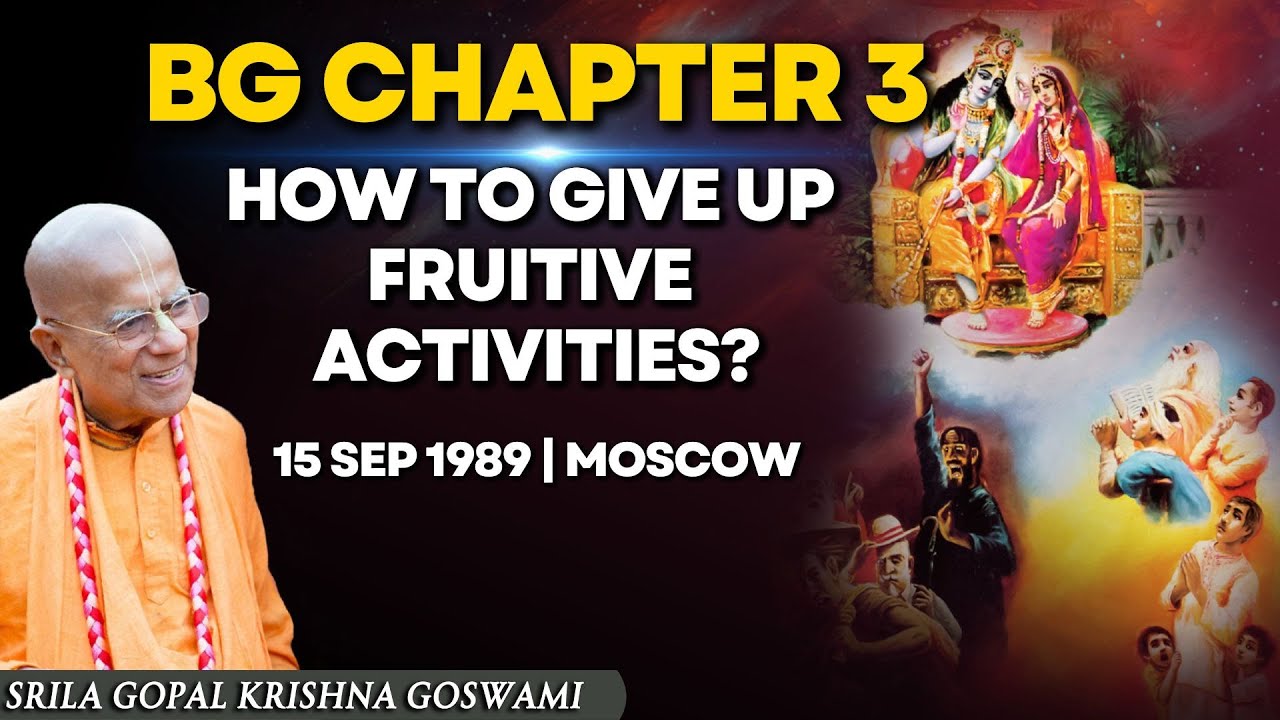
Gopal Krishna Goswami teaches that work is unavoidable but must be offered to Krishna as sacrifice, not for personal gain. Lust is the eternal enemy that binds the soul to material existence. Control comes through intelligence directing the mind, the mind directing the senses, and spiritual strength from chanting and devotee association.
Chapters
Today we have a new translator, so later on you can compare who was better, yesterday's or— One thing is for sure that today's translator has a louder voice, even louder than my voice. So yesterday we had explained the ABC of spiritual knowledge, which is the understanding of the difference between the body and the soul. So when you— obviously we cannot have a class of so-called spiritualists who do no work and just sit down and sleep and eat all day. Sometimes people misunderstand us and they say, "You Hare Krishnas are simply a burden on society. You do no work, just sleep and eat." Especially in the Western society, there is so much emphasis upon working hard like a mūḍha to earn money. That if somebody is not working hard like the asses, they think that we are simply a burden on society. So you will be happy to hear that Kṛṣṇa doesn't say that you should be idle and sit down or sleep all day. Kṛṣṇa doesn't say don't do your work, don't do your duty, just live as a live-off the society. Kṛṣṇa tells Arjuna, you cannot abstain from work. The point is, in this third chapter, Kṛṣṇa explains the principle of karma yoga. So karma yoga means we work for the pleasure of the Supreme Lord. There are different types of transcendentalists, such as those who understand, those who try to understand the Supreme Lord by the process of speculation, and others by the process of devotional service. Arjuna is confused now. He does not know what he should do. He doesn't know whether he should engage in devotional service by working to fulfill Kṛṣṇa's order, to fight, or he should just withdraw to the mountains. So Kṛṣṇa says, niatām kuru karmatvam karmā-jayo yā karmānāḥ śrīrāyaḥ trapeta te mā prasidyāt akarmaḥ. That, O Arjuna, You must perform your prescribed duty. Kṛṣṇa says, "Arjuna, you cannot even maintain your own body if you do not work." That is a fact, isn't it? If you don't work and you don't earn, or if you don't have some means of livelihood, you cannot even get your two meals and your shelter and clothing. So in this third chapter, Kṛṣṇa very strongly advocates the principle of working for the pleasure of the Lord. I think in your country you don't have a system of income tax, do you?
No.
But, but in many countries, but in other countries, non-socialist countries, they have the principle of income tax. So income tax means suppose you're earning 1,000 rubles a month, you pay like 20% tax to the government. And if you do not pay this income tax, then you become liable for punishment. So Kṛṣṇa makes a similar point in this third chapter of the Gītā. He says, yagnātāt karmṇo niyatā lokeyaṁ karmabandhanā tad-ārtam karmakauntya mukta-saṅga-samācara. He says that we must work for the pleasure of Viṣṇu, otherwise this work binds one to material existence. In other words, when you work for the pleasure of Viṣṇu, Then you don't have to take on the reaction, the sinful reaction. And if you don't work for the pleasure of Viṣṇu, then you become liable for reaction or suffering. The Vedas explain, yajñāivai viṣṇu. That means the goal of all sacrifices should be to please the Supreme Lord. So we have to learn based on the direction of the spiritual master and the great sages how We can act for the pleasure of Vishnu. So this is Krishna consciousness, to learn how to act for the pleasure of Vishnu. So looking at it from a practical viewpoint, Krishna consciousness is not a philosophy which says that if you're qualified, don't do your duty, but rather it means that you do your duty, but do it in relationship to the Supreme Lord. For example, as far as one's maintenance is concerned, There is no need to have very extravagant maintenance, but one can believe in the principle of simple living and high thinking. So if the principle is simple living and high thinking, then naturally you do not over-endeavour to keep your two ends meet, and you have time for spiritual activities. After all, the whole purpose of life is to understand our relationship with the Lord. This point is also made in the third chapter of the Gītā. For example, in the very famous 10th verse of this chapter, Kṛṣṇa says, saḥ yajña-prajāśrestvā puruvaḥ ca prajāpati anena prasāveśyadāvam eṣo soṣṭav iṣakāmad-dhuk. That is, in the very beginning of creation, the Lord sent forth creatures and told them, "Be thou happy by performing the sacrifice for the pleasure of Lord Viṣṇu." In other words, just like in any civilized country, the government says, if you follow our laws, then you can live freely. So similarly, the Lord says that if you perform sacrifices for the pleasure of the Lord, then everything that you need will be automatically supplied. Ultimately, they're all being supplied by the Supreme Lord. Just like in many parts of the world, we hear about food shortages. So it does not matter how much of technology you may possess, you cannot produce food unless the Supreme Lord cooperates through the agency of material nature. You may have the best fertilizers on this planet, but if Mother Earth, if the clouds don't give you rainwater, then nothing can happen, isn't it? And nobody has the technology to create artificial clouds to produce rain. Just like right now, it's a rainy season in Moscow. So you see the clouds are all assembled over there and it rains. So can, for example, December is not a rainy season, isn't it? The rainy season, December? No, it's not a rain. So in December, can your Russian scientists say, okay, we'll produce rain in December? They cannot. So we must come to the realization that ultimately everything is coming from the Supreme Lord. So what Krishna is saying in this third chapter is Then when you do your sacrifices for the pleasure of the Lord, then whatever necessities of life you may have, they will all be provided. I'm sure all of you read in your Pravada and its, its papers about the starvation in so many different parts of the world, isn't it? So many. So why is there a shortage? Because essentially material nature is unhappy with us. Just like when a child misbehaves, The parents get tough, they become angry, isn't it? So similarly, when we misbehave, the material nature says, "Okay, I'm not going to give you what you want." So Krishna says that if you do your duty towards the Lord, then even the demigods will be pleased with your sacrifice and they will give you whatever you need. One thing I've seen in your country is that people have to stand in lines everywhere. Even this morning we were going to our book fair and there was such a long line to come to our Pavilion Number 1 at the book fair. But actually nobody likes to stand in line. Just like sometimes you get caught in a traffic jam. So, you don't really like getting stuck in the traffic jam. But do we realize how long a line we all had to stand in to get this human birth? It was such a long line that if I told you how long you had to stand, you would faint. First you had to take your birth as species that live in water. Then you had to take your birth as species that live on land but cannot move like the trees and the plants and so on. Then you had to take your birth as entities that fly in the sky. Then as those who move around like insects. I'm sure there are insects in your country also, isn't it? Uh, it's not that all the insects are only in India. And then you had to take your birth as species that live on land, but move like the animals. So after standing in line for such a long time, for thousands of years, finally you get this human birth. Just imagine if you had to stand in line for 2 or 3 hours to, let's say, get some milk or whatever, and when your turn came at the window and the person closed the shop and said, "Sorry, no milk," how would you feel? So you've stood in line for thousands of years. Now you've got this human birth. And the purpose of this human birth is to establish a relationship with the Lord. And instead of establishing our relationship with the Lord, we are entangled in those same activities which even through the medium of animals we were able to realize. So the point is, and this point is very strongly stressed in this third chapter, that we must perform yagya for the, for the pleasure of the Supreme Lord. Prasad RAVAL. Now we see all over the world, including your country, there's so many rich people. They may have one car, two cars, big house, and so on. They're getting all the necessities of life, but they're not offering it to the Lord. So what is the position of these people? Very often people say, look at that man, that man is doing all this dirty business. And he's living in such a big house and so on. And here I am struggling and I have to live in such a poverty-stricken condition. Kṛṣṇa says, those who take the benediction offered by the Lord and His agents and they do not offer it back to the Lord, they are simply thieves. So the point is that if we take the benedictions offered by the Lord, just like being practical, I may be getting a lot of money, I may have a big house, I may have a nice car, family, etc.. But if I'm not offering the results of what I'm getting to the Lord, then I'm simply a thief. So we can all safely conclude, basically, we're all members of a society of thieves. We're all members of a society of thieves because no one's offering anything to the Lord. When the American nation was formed, the Founding Fathers had made up a logo, "In God We Trust." But actually, we see They don't trust in God because if they trusted in God, then they would follow this chapter of the Bhagavad-gītā. So the point is that we must learn in this human form of life to offer the results of our efforts to the Supreme Lord. Yesterday I was talking to somebody, and one of you told me he was an economist. Are you an economist? So the real economic solution is given in the Bhagavad-gītā. The real economic solution is given in the following verse: Anāt bhavanti bhūtāṇi prajñāṇa-saṁbhavā yajñāt vāvati prajññau yajña-karma-samudbhavāḥ. All living beings subsist on food grains which are produced from rains. Rains are produced from performance of sacrifice, and sacrifice means prescribed duties. So the point is that the principle of sacrifice, which means performing religious duties, is what enables one to achieve economic stability and prosperity. Anyone will tell you that actually economic planning can only succeed if the natural resources are there by the agency of the Lord. If you don't have the natural resources, then whatever economic model you may prepare, there cannot be any success. And all natural resources are coming by the agency of the Lord. Just like the Middle East countries have so much of oil now. But that oil was not— oil, oil, oil. But that oil was put over there by the Lord, not by the sheikh. So the point is that we must understand that ultimately, if we offer everything to the Lord, then there'll be cooperation from material nature, and all the necessities of mankind will be realized. And that's the goal of—
okay.
Another point that is made in this third chapter is is that— Yaveda shastra ke sambandha abhideya prayojana. The whole purpose of Vedic knowledge is to teach us how to regulate our life, to establish our relationship with the Lord. So Krishna says in this chapter that if one is leading a life and he's only working for sense pleasure, then he's simply leading a life of sin. So therefore Krishna is saying, instead of having the path of sense enjoyment, One must lead a life of sacrifice. One should not be attached to the fruits of his activities. He should execute duty, he should execute his work as a matter of duty. Now in terms of practical philosophy, this does not mean that in Kṛṣṇa consciousness we don't endeavor. The devotee tries his best for Kṛṣṇa, not that he thinks, "I'm doing my duty," but he does not be enthusiastic in doing his duty. Because without enthusiasm you cannot succeed in any endeavor. Just like you may go on the streets to do book distribution, but if you're not enthusiastic in doing book distribution, nobody will buy your book. You cannot say, "Okay, I'm going to do my duty. I'll go out for book distribution." But you just go and stand on Gorakhi Street and say— You have to be enthusiastic in doing your duty. So the devotee, not that he doesn't try his best and he expects Kṛṣṇa to work for him, A major difference between the perspective of a Vaiṣṇava devotee and a so-called religionist is that the so-called religionist expects God to be his order supplier. People may go to the church or the temple, but they go with the intention that they're going to burden God with so many requests that they may have. But a Vaiṣṇava devotee of the Lord He does not want to burden the Lord with any material request. He wants to work for the Lord. In other words, just like the mother doesn't expect anything from the young child but just wants to serve the child, similarly the devotee, Vaishnava, he wants to just serve the Lord just like the mother serves the young child. So in the third chapter, Kṛṣṇa also gives the example of King Janaka, who was the father-in-law of Lord Rāmachandra. Who even though he was completely detached, he still acted like an ideal king to establish the example how one must do one's duty for the pleasure of the Lord. We see that even when Krishna appears on this planet, he does his duty. So we have to do our duty without being attached to the results. The devotees of the Lord have to set the example for the benefit of the others. Therefore, in the Bhagavad-gītā, Krishna says, yadya-dacarati śreṣṭha-tātad evāto janahā. Whatever great men do, others will follow. So that is, whatever we do, if we are able to set an ideal example of renunciation, then the members of the society will follow us. So we have to develop a perfect character so that by our character we can inspire others to take to the path of devotion. So Kṛṣṇa in the third chapter also says, How? Even though He's not attached to anything and He does not have to work. You and I have to work because if we don't work, we don't get our bread and butter. We have to work because we have so many needs, isn't it? You need money to pay your electric bill, house bill, food bill, your clothing, cosmetics, and so on. We need all this because we are not complete, we are incomplete. But Kṛṣṇa is complete. Om purnam adah purnam idam pūṇaḥ pūṇaṁ vadaḥ ca te. He is complete in all respects. You and I get hungry after every 4 or 5 hours, but Kṛṣṇa doesn't get hungry. So Kṛṣṇa says, "Even though I don't need anything, even though I have everything, I still engage in performing my duty, because if I did not do my duty, the whole world will be ruined." Can you imagine what would happen if one day the sun did not rise? Can you imagine what would happen if the sun rose one hour late? Can you imagine If the sun even moved by a fraction of an inch, what would happen? One side would get roasted and the other side would freeze. Can you imagine what would happen if it didn't rain all over this planet? If the clouds did not carry the water and release the water at the right time? Can you imagine what would happen if all the air was withdrawn from circulation? You would die. The whole world will be ruined, isn't it? So Krishna is doing his duty. He makes sure the wind is blowing. He makes sure that the clouds are carrying water and then releasing the water in the form of rain. So Krishna is making sure that if he did not do his duty, the whole world will be ruined. So he does his duty as a— his work as a matter of duty. So Krishna is teaching Arjuna how to work without being attached to the results, because those who are attached to their results are actually those who are under the influence of ignorance. Just like Those ignorant individuals who work very hard, they must work hard, they must get money, and they must use that money in exchange for buying sense enjoyment. Another point is in this third chapter which is important to meditate is that due to false ego, the living entity thinks that I am the doer. I am the doer, that means I, I, I, my factory, my country, my efforts, That is why the success is coming. But actually everything is being carried out by material nature. Just like in your country there's so much of gold and gas and oil and so many other natural resources. So if anybody says that he's the cause, then it is simply an illusion. So one must understand that all this is happening by the arrangement of material nature. So what Kṛṣṇa is very strongly advocating is that we must give up fruitive activities. So We had explained this point yesterday also, that fruitive activity means entering into some type of business transaction. That is, I'm ready to do this, but in exchange I may get this, this, this benefit. So Krishna is saying, give up fruitive activities, and oh Arjuna, surrender all your works unto me with your knowledge full about me, without desire for profit, with no claims to proprietorship, and free from false ego, fight, laziness. So, this is the real purpose of the Bhagavad-gītā and this instruction is to all of us. Whether you are a student, a housewife, a businessman, a scientist, or a simple brahmachari, whatever you may be, this verse is instrumental for everyone. Krishna says, "With full knowledge of Me." That means we must have full knowledge about Kṛṣṇa and His teachings. And without desire for profit, we must work for the pleasure of Kṛṣṇa. So we must remember that if we work for Kṛṣṇa without being attached to the results, that means that we are not envious of Kṛṣṇa and we become free from bondage. So we must dedicate our activities to the pleasure of the Supreme Lord. If we give up fruitive activities, and we work as it is necessary without being attached to the results, then we are on the path of perfection. And without desire for profit, we must work for the pleasure of Kṛṣṇa. So we must remember that if we work for Kṛṣṇa without being attached to the results, that means that we are not envious of Kṛṣṇa and we become free from bondage. Why is it that some people accept God's instructions and some do not? Some people, the majority of the people are envious of God. Because they're envious of God, they say, "Why shall I serve God?" So those who are not envious of God, they accept the teachings of Kṛṣṇa. And those who are envious of Kṛṣṇa, they find fault in Kṛṣṇa's teachings, and on some reason or the other, they reject the instructions of Kṛṣṇa. Now, after listening to all this philosophy, Arjuna presented a very realistic question to Kṛṣṇa. This is how we obtain spiritual knowledge, by asking questions. This is something remarkable I've seen about you, so, your devotees, you all ask a lot of questions. Prabhupada used to say that asking questions is a sign of intelligence. So, Arjuna asked many questions also. So, what is Arjuna's question now? He says, Krishna, even knowing what is right and what is wrong, How is one forced to engage in sinful activities? Like I'm sure many of you know that, "Okay, this is bad." But sometimes even though you know it's bad, even though you've heard it from the Guru, from Krishna that this is bad, you still engage in it. So, Arjuna wanted to know something that all of you may desire to know. How is one forced to engage in sinful acts, even unwillingly, even without the desire? You may not desire to engage in sinful activities, still you get carried away and you engage in them. So, the answer is, Kāma-esa-kṛṣṇa-esa-rajagūṇa-samudbāvaha māśāna-mahā-pāpa-vidyenaṁ iha-vairuṇaṁ. It is lust only which is born due to the material mode of passion and which is the eternal enemy of the living entity. So lust is the eternal enemy of the living entity. And the nature of this lust is it is always burning like fire and it is never satiated, never satisfied. Now rainwater, when it is falling from the cloud, before it touches the earth, you know, it is pure. Just like when it's raining and you were to go on the roof and you had big buckets, and if your bucket was full of that water, then you could even drink that water, no problem. But I was coming into your building today and I saw downstairs there were puddles of water. There was water because it rained and that mud, it had fallen on the mud and there's Puddles of water downstairs also. Now, if somebody told you, take a glass of water from the puddle of water and drink, you will not drink. But that same water, before it touches the earth, if you would have caught it, you would have drunk it. Forget the rooftop. Even if you had a bucket, if you had a big tall bucket and you kept it on the ground downstairs, and if the water would have fallen directly on the bucket and not on the earth, you would drink it. So similarly, the living entity is pure consciousness. The moment the living entity comes in contact with the material world, his pure consciousness gets covered by the eternal enemy in the form of lust. And just like when the battle is being fought, everybody wants to know where— what is the position of the enemy, isn't it? One nation is spying on the other nation. They want to know where is the enemy station so they can throw the bomb on that. So similarly, for spiritual life, you You want to know where is the enemy in your body so you can throw a spiritual bomb. So if you want to throw a spiritual bomb, throw it on the mind and the intelligence and the senses, because this lust is sitting in the mind, the senses, uh, and the intelligence. Like the senses, I have lusty desires. The mind is thinking of lusty desires and The intelligence is also thinking how lust can be fulfilled. What do people think with the intelligence? They're just thinking how they can have more money, more sex, more sense enjoyment, more this, more that, because that is the goal of life. Therefore Krishna is telling us where enemy is and how that enemy can be checked. So we have positive solution. The solution is we use the mind and the senses and the intelligence in service to the Lord. Like with your intelligence, you should accept everything favorable for spiritual advancement and reject everything unfavorable for spiritual advancement. With your mind, you should always think how the wishes of the Lord can be fulfilled. And you use the senses always in service to the Lord. So if we use the senses in service to the Lord, then the senses will have some positive engagement. Like those of you who have children or who have experience with children will testify, That if you don't want your child to wreck your whole house, then you have to make the child sit in one corner and give him a paper and pencil so he keeps himself busy. Because if you cannot give your child something to keep himself busy, then he will just run around and create trouble. If you tell the child, "Okay, sit down," he won't sit down. So you tell the senses, "Okay, senses, sit down." The senses will say, "Sorry." If you don't give the senses positive engagement, they'll go in the negative engagement. Like the nature of the tongue is to always vibrate. Therefore, whenever you call somebody, the telephone is always engaged because everybody loves to talk. Because the tongue has to vibrate, use the tongue to glorify the Lord. The ears must listen to something. So hear about Krishna. The moment you get up in the morning, the eyes open and you want to see something. It's not you get up in the morning and walk around with your eyes closed. If you don't see the form of the Lord, or something about relationship to Kṛṣṇa, then the eyes will say, "Okay, show me something vulgar." So Kṛṣṇa says, "Lust is your enemy." And lust is sitting in the mind, the senses, and intelligence. Just like you go to the doctor and the doctor tells you, "This is a disease. Now take this as a medicine." The doctor tells you, "Don't do this, this, this, because by doing this the germs in the body will increase." So Kṛṣṇa says, Curb this enemy of spiritual life known as lust, because this lust is destroying your spiritual life. So we must control the lust with intelligence. Great sages have said that even though I've been trying to satisfy my senses since time immemorial, there's no satisfaction. Mind is higher than the senses. The senses are higher than dull matter, but what is higher than the mind? Intelligence. Intelligence. Intelligence is higher. So with the use of intelligence, we must control the mind, we must control the senses, and we must control dull matter. Matter cannot move on its own. Just like there is this glass over here, this is a matter. This glass will only move when I lift it. So we can say the senses are superior to dull matter. And what makes my hand lift the glass? "Prasad RAVAL, my mind, lift the glass." "Okay, keep it down." So mind is superior to the senses, and what is directing the mind? Intelligence. So through the medium of intelligence, we must discipline the mind and the senses. Just like this very simple example that I gave you yesterday, which I will repeat. You may see a nice thing in the store and you may feel like buying it, but then your intelligence will say, "If you buy it, you'll get arrested by the police." So then you don't buy it, you don't steal it. Therefore Kṛṣṇa says one must control the mind and the senses by spiritual intelligence. And by the spiritual strength you must conquer this enemy known as lust. And how do you get spiritual strength? By chanting and hearing, by sadhu-sanga, by listening, reading the Bhāgavad-gītā. So when you have spiritual strength, then lust can be defeated. Just like when you're very healthy, when your body is very healthy, then the germs that attack your body can be easily smashed, isn't it? But when the body is not healthy then the germs are allowed to kill you. So when you become spiritually healthy then lust will be controlled and you will be able to advance towards Hare Kṛṣṇa.
Hare Kṛṣṇa! Hare Kṛṣṇa Mahārāja ki jai!
Jaya! So what we have given you is a summary of the third chapter of the Gītā. Okay, did you understand it? Maybe after I finish giving all these summaries, I'll give you all a test, see how good you all are. Okay, vāprosaye.
So he's wondering, are there so many Vaiṣṇavas who don't ask Kṛṣṇa for material benefit in India? Those people who attend the temples, don't they ask Kṛṣṇa for material things?
They do. So they're not considered to be real Vaiṣṇavas. Just because they're putting on the tilaka doesn't mean they become Vaiṣṇavas. That's okay. Just like Caitanya Mahāprabhu said, Caitanya Mahāprabhu's prayer to the Lord. Nādhānām nājñānam nāsandanam kavitāmbā jagadīśa-kamāye mama janmani janmēśvare bhāv tad bhaktir-eitukītyāye. My dear Lord, I don't want anything from You, but just the desire to take my birth again and again where I can serve You. Yes, we must pray to Kṛṣṇa every day that please may all the obstacles on my spiritual advancement path go away so that I can serve You.
This guy has problems with —help, help. Yeah, okay. So he's asking, asks Krishna in his prayers to solve the problems and Krishna doesn't solve them. So that reduces his faith. What should he do?
You must understand whatever suffering that we are due, whatever suffering that we are experiencing, has been greatly minimized by the Lord. Actually, Kṛṣṇa is testing you, how sincere your faith is in Him. It is not that now you are a devotee of Kṛṣṇa, you will have to face no obstacles at all. Kṛṣṇa will test His devotee by putting him into difficulties. Rather, you must understand it from this angle. According to my past sinful karma, I should have been suffering from cancer or something and should have been in hospital. But you call this mercy, "Kṛṣṇa, You have minimized my suffering and I'm still, and I'm still here chanting Your name." Don't think that you're chanting Hare Kṛṣṇa, that Kṛṣṇa has to wipe away all your karma from previous lives. Kṛṣṇa will reduce your sinful reaction but not bring it to zero. If Kṛṣṇa brings a sinful reaction to zero, then where is the suffering? Where is the dukhālayam and aśāśatam? So you will say, "Now I'm chanting Hare Kṛṣṇa, why am I becoming old? Why am I getting old? Why, why if I'm chanting Hare Kṛṣṇa, why do I ever fall sick? And certainly if I'm chanting Hare Kṛṣṇa I should live till 120. Why at 80 I should die?" And if I'm chanting Hare Kṛṣṇa I must have a Mercedes car at least.
For it to be clean, or she should always think that she's cleaning the Kṛṣṇa's kitchen.
Cleaning Krishna's kitchen. Because whatever you do, you should think you're doing it for Krishna. You can't have Krishna's kitchen dirty. Prabhupada said the cook who cooks, after cooking he must clean.
He's asking that sometimes it happens that a person, he wants to drink milk, then he goes to the altar, puts milk, offers. Then after some time he wants to take an apple, so he just takes apple, goes to the altar, offers to Krishna. So is that okay, or should a person just do a big offering in the morning, like make all the kind of—
So if you cannot make one big offering, then you can make these. It is best to have regulated hours of eating. If you're going to eat all day, then you're going to become overweight. Therefore I said you should eat, plan your eating. Bhagavad-gītā says one must be very regulated in eating and sleeping. I'm just going to take 2 or 3 more questions. A question. Okay, I understand.
What is the criteria of surrendering?
The criteria of surrender is you don't want to do anything which does not have the approval of the spiritual master and the Lord. The symptom of surrender is you don't want to do anything that is not approved by Kṛṣṇa.
In attentively, the question is about an attentive chanting. When a person, especially newcomers, they chant attentively, Doesn't it— some people say that, doesn't it just useless chanting?
Well, whether you are new or old, your chanting must be very attentive. Inattentive chanting will not be very helpful in the goal of life. So we will talk about this on Sunday. So we must be very attentive in our chanting. The more attention you pay to the Holy Name, the more attention Krishna will pay to you.
Sixth quality of the devotee is to have a strong faith that Krishna will protect you. And there is also a criteria that Krishna— that the devotee shouldn't chant for the— something to get any benefit from Krishna. Can we chant the holy names thinking that Krishna will help us to get protection, Krishna's protection?
Yes, Kṛṣṇa will help us to make spiritual advancement if you're chanting sincerely. But don't think that because you're chanting the Holy Name, now you must get a lada car and a big house and a promotion every month. But Kṛṣṇa will definitely protect you against the agents of Maya if you're chanting sincerely. He guarantees that.
There's one woman in Albert Street who just always comes when devotees have Hare Kṛṣṇa. She propagates Christianity, but in the same time she chastises Kṛṣṇa consciousness. What attitude should we have against that kind of people?
At least that lady is always hearing the chanting of Hare Kṛṣṇa. So even though she may be preaching Christianity, but she's in love with Hare Kṛṣṇa. So you should tell her, you're most welcome to hear our chanting, but the chanting is so purifying, it will purify everyone. So you should be kind and respectful to her, and she will join you very soon. Because by your chanting She begins to talk about Christ, and when he don't go chanting, she's sleeping at home.
It is good. It is different. Sometimes devotees very respectful to Mahāprasādam which is on the altar, but at the same time they can— that which is on the pot, they don't take so seriously. They can scratch something, or this is burnt, throw away.
Now actually we should be respectful to prasādam. Just because Maha-prasādha and prasādha both have to be respected. Certainly if you have, if you have a cooking pot, then you should not scrape it with your dirty spoon. In fact, in this third chapter, Kṛṣṇa says, "If you don't offer your foodstuff to Me, then you're eating only sin." And if something is offered to Kṛṣṇa, then you have to follow the Vedic process.
Srīla Prabhupāda said that when devotee, he lives Kṛṣṇa consciousness, then he falls even in the lower position comparing to that which he had before coming to the movement. But Nirajan Maharaj, who gave lectures also, he said that when devotee goes, leaves Krishna consciousness, we still should not see him as a karmi, and we still have, should have some respect to that person. Yes. Even if he stops chanting. We should have some respect.
We should have some respect for that person and we should pray that that person may be brought back to Krishna. And you should wish that that accident may not happen to you. Just like if you see somebody involved in an accident on the road, you don't wish that you should also have that accident. Okay, so should we stop over here? Did you all understand third chapter? So who— what is the key point? What are some of the points that Krishna expresses in the third chapter? What is the third chapter called? What is it called? So what is Krishna saying in the third chapter? So put your hands up and I'll ask you questions.
Mouth shut and hands up. Not getting attached to the result. What does Krishna say about duty?
Does Krishna say, "Just chant Hare Kṛṣṇa and leave everything unto Me"? What does it mean to work in Kṛṣṇa consciousness? Which means—
that means to work and offer the results to Krishna.
What does Krishna say about controlling the senses? When Arjuna wanted to know how is one forced to engage in sinful activities, what did Krishna say? Master only. What is superior to dull matter? Prasada, mind. Mind, senses, then mind, and then intelligence. Well, you answered everything. I just wanted to go on. What is superior to Okay, what is superior to dull matter? What is superior— Alexi, what is superior to dull matter? Sense. What is superior to the senses? Mind. What is superior to the mind? What is superior to intelligence? So, uh, what is the economic solution that the Bhagavad Gītā gives? Economist, what is the economic solution that the Bhagavad Gītā gives?
Take home your next wish.
What does Kṛṣṇa say? How is, how are food grains to be realized? How is the grain production takes place? How? How?
Everything is supplied by the Supreme Lord. Huh?
It's right. It's right. Yeah. So Kṛṣṇa says in the third chapter that we must do our duty. So suppose you have to do your book distribution. You just go on the street and just stand straight like a Mummy, you like a—
with a book in your hand, or do you have to do effort? Effort. Enthusiasm.
Enthusiasm. Yeah. So in the third chapter, Krishna is telling Arjuna that he must do his duty. What does Krishna say to give an example? He's telling Arjuna, do your duty, okay? Now without being attached to the results.
That Krishna saying that, ah, he's offering self.
And what example does he give? And one more example. What else? No, there's one other example Krishna gives. It's a name of a man who starts with J. He's a speculation. You know the answer? Janaka. King Janaka. Krishna says in the past even people like King Janaka acted with this understanding. Today we discussed the third chapter. Yesterday we discussed the second chapter. Are you all getting an understanding? So tomorrow we'll discuss the fourth chapter. Now, on Sun— tomorrow the program is at 3:30 in Prema Vati's house. And on Sunday, there are two programs. In the morning, 11 o'clock. In the morning on Sunday, sharp 11 o'clock, Nikolas' house. And evening, 4:30 in Krishna Kumar's house. 4:35. The morning program will just be from 11 to 2, and the evening program will be from 5 to— So I'll do 4th chapter tomorrow evening, 5th chapter in the morning on Sunday, and 6th chapter in the evening on Sunday. So everyone is clear? They know Nicholas's house?
Hare Krishna Maharaja ki jai! Thank you.
More from PRASAD

Rare Pastimes & Timeless Lessons of Guru Mahārāja | Stories Every Disciple Should Hear

ISKCON Legends- pure devotees meet-HH Jayapataka Swami, HH Gopal Krishna Goswami, HH Radhanath Swami



Jagannātha Ratha-yātrā Through Śrīla Prabhupāda's Mercy | 29 April 2006 | Nairobi, Kenya

Lord Jagannātha's Appearance Pastime | 21.07.2019 | ISKCON Calgary | Śrīla Gopāla Kṛṣṇa Gosvāmī

The Ācārya Teaches by His Own ExampleGuṇḍicā Mārjana by Guru Mahārāja #shorts

Guṇḍicā Mārjana – Lord Jagannātha's Pastime | 21.7.2019 | ISKCON Calgary |Śrīla Gopāla Kṛṣṇa Gosvāmī

H.H. Gopāla Kṛṣṇa Gosvāmī Mahārāja - Exemplary Sādhana and Deity Worship # shorts

भगवान की कृपा कैसे प्राप्त होगी ? | 11 Jan 2014 | Punjabi Bagh | Srila Gopal Krishna Goswami

Material Education vs Spiritual Education | Srila Gopal Krishna Goswami #shorts