Bhaktivinod's Jiva Jago Song-- #Saints are interested in?| Rus-Split | 15.7.92|Gopal Krishna Goswami
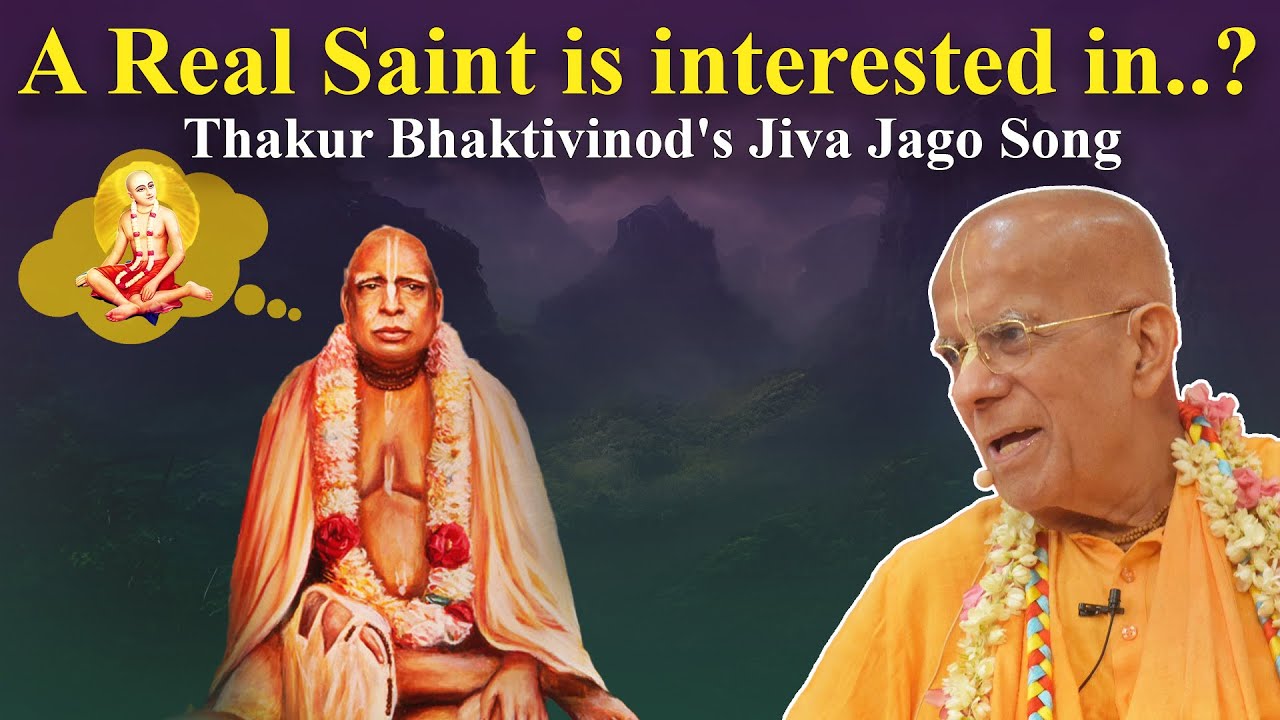
In this devotional lecture, the speaker (Gopal Krishna Goswami) expounds on Thakur Bhakti Vinod’s song “Jiva Jago,” interpreting its call for spiritual wakefulness and the urgency of chanting the Holy Name. He provides a concise biography of Thakur Bhakti Vinod, highlighting his role as a British magistrate, caretaker of the Jagannath Puri temple, and a family man who raised twelve devoted children. The talk weaves in several illustrative stories: the confrontation with a fraudulent yogi whose power vanished when his hair was cut, the challenges of caste‑based Brahminical privilege, and the prophetic vision of Bhakti Vinod regarding the global spread of Krishna consciousness. Central theological themes include the Holy Name as a preventive medicine for the heart‑disease of material desire, the evolution of spiritual practices across the four yugas (Satya, Treta, Dvapara, Kali), and the Vaishnava ideal of compassionate service. The latter part of the session consists of audience questions on distinguishing Maya’s temptations from Krishna’s tests, how to treat devotees who leave the movement, and scriptural clarifications, answered in a reverent, instructional tone. The lecture concludes with logistical notes about the Moscow ISKCON center and upcoming events.
Chapters
Composed by the great Vaiṣṇava devotee and saint Thakur Bhakti Vinod. Thakur Bhakti Vinod composed more than 100 songs. Thakur Bhakti Vinod was a magistrate in the British government when the Britishers were ruling India. It is said that he appeared on the call of Caitanya Mahāprabhu. He has been described as a special energy of the Supreme Lord Śrī Caitanya Mahāprabhu. Kali-yuga was getting more and more degraded.. And it was necessary for a powerful personality to appear. So the Lord sent Thakura Bhakti Vinod. Thakura Bhakti Vinod was educated as a magistrate. And as a magistrate, when he was posted in Jagannath Puri, when the British government realized that Thakura Bhakti Vinod was also a great devotee of the Lord, they also made him in charge of the Jagannath Puri Temple in India. You've heard of the Jagannath Puri Temple, all of you? Very famous. So when Tākura Bhaktinātha became in charge, he regulated the deity offerings and he made sure the temple was very clean. Tākura Bhaktinātha showed how one could practice Kṛṣṇa consciousness in any situation. He was a family man living at home and he had 12 children and he made all his children into pure devotees. And the greatest of them all was— So I'll first explain the song which we sang and then tell you, if there's time, some more stories of Thakur Bhakti Vinod. Want to hear some stories of Thakur Bhakti Vinod? But let's see. I have to apologize, I could not come at 6 o'clock because I just got back from Riga and Kaunas, and so a lot of work to do. So sorry for being a little late. So in this song, Thakur Bhakti Vinod has given a very powerful message for all of you devotees of this Krishna conscious movement. I understand that today is the last day of the Lord Narasimhadeva Mela song. So all sankirtans and devotees must be very well acquainted with the meaning of this song, because this song has a very powerful message as regarding the role of a Vaishnava. Vaishnava is just not a religious person. Vaishnava is a compassionate savior of humanity. Therefore, the Vaishnava is para-dukhadukhi. Para-dukhadukhi means seeing others in distress, he also becomes distressed. So Thakura Prabhupada opens this wonderful song by saying "Jīv-jāgo, jīv-jāgo, gaura-chanda-bolé, khotan nidda jāva-māya, piśā-cira-kolé." So He says, "Lord Caitanya Mahāprabhu is calling all of you." What is Caitanya Mahāprabhu saying? Please wake up, wake up, wake up, oh conditioned soul. Jīv, jīv means jīvātmā, living entity. Jāgo in Bengali means to wake up. It says, "Khotan nidda jāva-māya." Since time immemorial, You have been sleeping in the lap of this witch known as Maya. So how long will you sleep in the lap of this witch known as Maya? This is Tākabhartī Mahāprabhu's poser. The living entity has been transmigrating through the different cycles of birth and death since times immemorial. You cannot even trace when this cycle started. Many times people say, "Oh, when did I fall from the spiritual world?" And sometimes people would ask Prabhupāda this question. Prabhupāda would say, "It doesn't matter when you fell. The important thing is you get out of it." Just like when there's a fire, your immediate need is to put the fire off, not to first launch an investigation, "How did the fire start?" So the living entity has been suffering in the various cycles of birth and death since time immemorial. In the Prema-vivarta it is said, Kṛṣṇa-bhaya-mukhaḥ na bhoga-vāñchā-karaye. Nikātāsvam āyātare japaṭya-dhāre. That the moment the living entity, when he is residing in the spiritual world, he decides to become an enjoyer like God, he has to leave the spiritual world and come to the material world. So the living entity, in the Caitanya-caritāmṛta it is explained that just like in an ocean, if you throw a ball in the ocean, so the waves of the ocean, they will toss the ball. Sometimes the ball goes to the right, sometimes it goes to the left. So similarly, the living entity is being tossed by the material waves, taking birth in different forms of life. So he says, bhājibo bhulyā eṣe samsārabhitāre bhulyā rohile tumi avidyāra bhāre. Avidyā means ignorance. You have forgotten the promise that you had made to the Lord when you were in the mother's womb, and having forgotten this promise you have become a victim of ignorance and have got deeply entangled in miseries of life. The Vaishnava devotee of the Lord works to elevate or works to eliminate the miseries of life. The Vaishnava only has one anxiety: how to stop people from sinning, because he knows that as long as they sin, they're going to be entangled in the miseries of birth and death, experience nothing but pain. So therefore, the Bhagavad-gītā was spoken why? One of the reasons, the main reason why the Bhāgavad-gītā was spoken, so that to give us knowledge by which we can eliminate our miseries. So therefore Kṛṣṇa says, "Sarvadharmām paritaḥ jāmaḥ mekhaṁ śrī-nāma rājaḥ, haṁ tvam sarva-pāpebhyo mokṣam imātṣo cāhaḥ." Give up everything and surrender unto Me and I will protect you from all sinful reactions. Now, vājivobhulyāśi, the living entity when he is in the womb of his mother, He experiences intense pain. In the third canto of the Bhāgavatam, this point has been explained in great detail. I've had the opportunity of talking to doctors in Washington, Canada, India, so many places. They all confirm that medical science doesn't know why the child in the mother's womb begins to kick after 6 months of pregnancy. The reason is the child, when he regains consciousness, he finds himself in a very painful situation. After all, after the child dies, He just enters into another womb and there he goes, he goes to sleep for 6 months. Just like in many parts of the world, the karmis, they go to sleep on Friday and some of them don't even get up till Monday. I knew some people in Canada who would do that, go to sleep Friday night, get up Monday morning. But devotee always gets up at the same time. So death is nothing but extended sleep. So when he comes to consciousness, the child finds, oh, here I am in a bag with a stool, urine, blood, mucus, all these obnoxious things., and the child finds himself in a very uncomfortable position. Now, if the child has done pāsa activity in the past, then in that uncomfortable position he promises the Lord something, and that is, "When I come out of the mother's womb, I'll definitely follow your instructions." But when he comes out of the mother's womb, he completely forgets that promise. I'm sure we all have experience in mature life That sometimes when you are in difficulty, you make all sorts of promises, and when you recover, you forget that promise. Even the thief, when he's in the police, he promised the militia he won't commit crime again, but the moment he gets out, he starts to commit the crime again. So the living entity, when he comes out of the mother's womb, his parents, relatives, friends, they just entangle him, and as a result, he forgets his promise. Tamāre loitāmī ahiñyāvatarā āmī-bhinnabhandu-āre kīya-cetamāra. Now Dr. Bhaktivedānta Mahāprabhu says, "I have descended." Why? "I have descended specially to save you. I have descended to save you and I am your only real friend." So there are so many people in society who claim they are our friends. They claim they are our well-wishers. Your friends claim they are your well-wishers. Your parents claim they are your well-wishers. And your so-called political leaders, they also claim they are your well-wishers. The politician, when he's fighting for election, he always says, give me a vote and I will do exactly what you want for your benefit. The only person who's your well-wisher is one who is engaged in helping you understand your relationship with God. The others are not your well-wishers. They may claim they are your well-wishers. Chakrabhakti says, tamare lohitami, I have appeared specially for you. So the great acharya and the Lord, they appear why? Paritāṇāya sadhu-nām viṇaśya śādruṣkataṁ dharmā-saṇṭha-panārthāya sambhavāmi yogī-yogē. They appear from time to time. Why? To establish the principles of religion. So they establish— they appear to establish the principles of religion. So the predaṣaya also appear with the same goal. Therefore, the devotees of the Lord, they're only concerned about the essential principles of life. They're not interested in worldly issues. So this has been nicely reflected even in the prayers of Prahlāda Mahārāja. We won't discuss Prahlāda Mahārāja's prayers today because tomorrow Lord Nrsimhadeva's birthday will be a more appropriate day for discussing it. So Tākura Bhaktivedānta claims he is the only real friend. This doesn't mean that only Tākura Bhaktivedānta is the true, is the only friend. What this means is any devotee of the Lord who is going to present the teachings of the Lord to the conditioned soul, He is the true friend. Somebody who just flattering you and encouraging you on the path of sense enjoyment is not your friend. Somebody who just flatters you just to get something out of you is not your real friend. But somebody who tells you clearly who you are and what you should be doing, he's your friend. So Vaiṣṇava never compromises from the truth. The truth may have to be presented in a palatable manner, but he always presents nothing but the truth. The truth has to be presented in a palatable manner. Just like when you go out preaching, you don't tell the The materialists, they all are like dogs, hogs, camels, and asses just because the Bhāgavatam says, svāvidvaraḥ śrākare. You don't go on sankirtana and say, "My dear sābhāks and cats, please take these Canadian." You have to present the point that the activities of the materialists are like animals, so the truth has to be presented in a palatable manner. Like Prabhupāda, when he went to America, he told the young people, "You Americans are the future hope of the country." You young people have to understand how life has to be properly utilized. And in a palatable manner, he told them what the real message is. So the truth has to be spoken, but in a pleasant manner. So therefore, Tākṛbhaḥ Kṛṇaḥ says, I am your only real friend, because the real friend is only talking about the real business of life. Eneche sodimaya nāsti bala-lāgi. Hare nama mahā-māntara-lauṭrī-māgi. He said, "I have brought a special medicine for you." You know, when you ask everyone, there is a kakdela, everyone says, "Ochhen kāra śo?
How was?" Isn't it?
Everyone says, "I'm okay, and how are you?" It is standard reply. But Prabhupāda explained that everybody is suffering from heart disease. What is our heart disease? Who knows that? Unemptied material desires in the heart. So many material desires in the heart that we are all heart patients. So we are all heart patients, prabhupāda-sādhana. So Tākura Baktiñāna says, "I have brought a medicine to remove your disease." And what is this medicine? The Holy Name of Kṛṣṇa. The Holy Name of Kṛṣṇa is the real medicine. Once I remember in 1968, There was a doctor who had graduated from the McGill Medical College. McGill Medical College in Montreal is the best, one of the best medical schools in North America. So he had just passed with very good marks and he became a full-time brahmachari devotee in the Montreal temple. So the medical journal came to interview him. They said, "You just graduated from this medical school and now you become a shankara Hare Krishna. Are you crazy? What's wrong?" In America, doctors make $100,000 a year minimum. They're the richest people in society, not like here. Everybody there is so diseased that they go to a doctor 10 times for everything. So this devotee in the interview said Krishna consciousness is a supreme preventive medicine. So they published a big article, Krishna consciousness is the supreme preventive medicine, and in the article they said medicine can cure diseases, but unless you give up sinful desires The disease will remain and you'll remain entangled in material existence. So Kṛṣṇa consciousness is the supreme medicine. And all of you are qualified spiritual doctors. Vāsī-bhākṛya. All of you are doctors. So the ṭhākura Bhakti Nātha says, "I have brought this medicine. Take this medicine and you will be cured." So he says, bhakti-vānḍa-prabhu-cāra-nepriya. ṭhākura Bhakti Nātha is falling at the feet of Caitanya Mahāprabhu and begging Him. And what is Tākura Bhaktinātha begging? Please may I have the Holy Name, please may I have the Holy Name. So Tākura Bhaktinātha says, all of you should fall at the feet of Caitanya Mahāprabhu and beg Him, please may you have the Holy Name. So we should beg for the Holy Name. If you beg for the Holy Name, then you will get the Holy Name. Do not take the Holy Name for granted. If you become disrespectful to the Holy Name, then you can lose the Holy Name. Disrespectful to Holy Name means committing the 10 offenses. So the Holy Name is our most valuable asset, and the Lord has specially incarnated in this age to give us the Holy Name. Actually, Holy Name has existed from the beginning of creation also. It's not that Lord Caitanya created the Hare Kṛṣṇa mantra. He just popularized it as the principal medium of self-realization in this age of Kali. It is said, kṛṭaya dhyāyato vṛṣṇaṁ vrajṭayo yajñato mākhe. "Dwapare parīcayāram kalauta dharī-kīrtanā." This is a statement from the Viṣṇu Purāṇa. The translation is as follows: "Kṛṭayād hayato Viṣṇu." How many ages are there according to the Vedic history? What are the four ages? Satya Yuga and then? Satya Yuga, Kṛṭayoga, Dwapara Yuga, and Kali Yuga. These are the four ages. Now in Satya Yuga, the principal medium of self-realization was meditation on the Lord. In Satya Yuga, people could meditate up to 60,000 years. You may say, how is that possible? How can somebody meditate for so long? The lifespan in Satya Yuga was 100,000 years. Valmiki, the compiler of the Ramayana, meditated for 60,000 years. So the principal medium was, in Satya Yuga, was meditation on the Lord. Then came Treta Yuga. In Treta Yuga, the principal means was very elaborate sacrifices. In those sacrifices you would need many brahmanas, lot of grains, māliko, yāsna, no, butter, māsla, and who could afford it today? And if you have a fire sacrifice in your house every day, the neighbors will complain like anything. If they complain about your kīrtan, they will complain million times more once they have seen that you're doing a fire sacrifice all day in your house every day. And even meditation is not possible in this age. Where will you go and sit in seclusion? Where? Come here. Even if you go and sit on top of the Himalayas at 28,000 feet, the planes are flying at 35,000 feet. So by the time you try getting to top of Himalayas, you may slip so many times you won't even get there. Then came Dwarpa Yoga, and in Dwarpa Yoga the system of self-realization was very elaborate. Offerings to the Lord in the temple. People would come to the temple and make many rich offerings. Today you cannot do that. If you told all the visitors who are here now that you can only come to the temple if you bring minimum 500 rubles offering to Gaur Nitai, very few of you would come. And if people started coming and giving 500 rubles, then the government would say, oh, this money belongs to us, not to you. And if the government would say that, The robbers would say, robbers would say, "You people have too much money, come on, let us steal." So in Kali-yuga the lifespan was 100,000 years. In Treta-yuga it was 10,000 years. In Dvarpa-yuga it was 1,000 years. And in Kali-yuga it's a maximum of 100 years. So in Kali-yuga the process of self-realization by the causeless mercy of Caitanya Mahāprabhu has been subsidized. You understand subsidized? Now that your economy is going to be a capitalistic economy, You will see that one day they will sell something for ₹100, then after Christmas they will have a sale and reduce it to ₹10. Just like previously, in communism, the government used to subsidize everything, so everything was cheap. Now that subsidy has been taken away, everything has become expensive. So the process of Self-Realization in this age has also been subsidized. What you could get by meditating was 60,000 years in Satya Yuga. What you could get by performing yajñas for 10,000 years in Treta Yuga. What you can get by offering great sacrifices in temple for 1,000 years in Dvārpa Yuga, the same thing you can get in Kali Yuga just by chanting Hare Kṛṣṇa for whatever the duration of your life is, 10, 20, 30, 40, 50, 60 years. Rādhārāṇa-bhaktinirṣaḍaṇa says, please pray for the Holy Name and keep the Holy Name with you. Hare Kṛṣṇa. Hare Kṛṣṇa. So I thought since many of the Sankirtana devotees are here, They should meditate on the philosophy of Thakur Bhaktinath's song. So I told you I'll tell you some stories. So I'll tell you one very famous story about Thakur Bhaktinath. Only one story because I want to leave in 20 minutes or so. So at the time Thakur Bhaktinath was a magistrate, there was one bogus yogi. This yogi was very powerful. He was telling everybody he is incarnation of Kṛṣṇa. And he used to flirt with everybody's daughter and wife and sister. So many people were against him. But everybody was scared of touching him. Everybody was scared of him. The government, the police, the judges, everybody. He was living like a king in the middle of the forest. And he had hundreds of, you know, you may call mafia type of men there protecting him. It is said that even the Britishers had ordered the army to go there. And the army got scared to go near him. Because the soldiers, when they came near the forest, they saw that yogi was so powerful. They said, "No, no, no, we can't go in it." Tākura Bhattināda decided— Tākura Bhattināda knew that this man was a cheater. Just like there's so many people who claim to be God, but devotees know these guys are not God. You've heard of Sai Baba? He's well known in your country. Anyway, he has big long hair, does magic, but there's so many people in India who think he's God. So Tākura Bhattināda took the police force with him. And he went to the yogi. He's camped in the middle of the forest. But what he did, he kept the soldiers sitting a little bit away and he alone walked to the yogi. So the yogi was really very powerful. He said, "I know why you have come here, Mr. Dutta." Mr. Dutta was Thakur Bhakti Vinod's karmi name, if you want to call. He said, "I know why you've come here to arrest me and you have brought your police force with you that are staring at a distance." And if you try and arrest me, all of you, all of your soldiers will die and you will die. Thakur Bhaktinath was convinced that this man is bogus. So Thakur Bhaktinath ordered his soldiers fully, arrest him. And they dragged him, it was away from Jagannath Puri, and they brought him and put him in prison. When they put him in prison, every day his disciples were coming and demonstrating, "Release our Guru! Release our Guru!" All Thakur Bhaktinath's friends also told him, "You have made a big mistake in imprisoning this man who is an incarnation of Vishnu. And at the same time, Thakur Bhaktinath's wife and 12 children all felt very sick. They were about to die, they were so sick. Everybody started telling Thakur Bhaktinath, this is happening because you have put Vishnu in jail. But Thakur Bhaktinath refused to budge. So then the court trial was started of this bogus yogi. Now Thakur Bakhtinath's family fell ill, but then they gradually recovered. And on the day that Thakur Bakhtinath— it's a long story, but I'm just giving you a summary presentation. So on the day Thakur Bakhtinath was supposed to write his present— his judgment, his vahi, his hand was paining and he could not even lift his hand to touch the rooh ka. He was supposed to deliver the judgment in the court at 10:30, and till 8 o'clock he could not even move his hand. But Thakur Prasad Raaval was determined to try and get the judgment out. At 8 o'clock, he picked up the strength to write the judgment, and he reached the court just in time to deliver the judgment. As soon as the judgment was announced, all his followers, they started shouting, and they, that, you know, they've done a big mistake in convicting Mahārāja Viśṇū to jail. And then there was one British lawyer in the court. He had read in one book that the yogis keep all their strength in their long hair. This yogi had very long hair. So as they were— as the police was taking him from the courtroom after the judgment was heard, was announced, the British lawyer ran from behind, took scissors and cut his hair off. And as soon as his hair was cut, that mystic yogi, he lost all his power and he fell on the floor. And he died. And then everyone could see that he was bogus and Thakura Bhaktinath was right. Thakura Bhaktinath was a very bold preacher. When Thakura Bhaktinath rose to prominence, at that time the Brahmin community in India was very strong. These are people who just claimed they were Brahmins by birth, but not in practice. So these Brahmins were completely against becoming a Brahmin by qualification. They were just saying Brahmin is only by birth. So Thakura Bhaktinath was very actively preaching against them. Once Thakur Bhaktinath was invited to give a speech to the Brahmins. He was a leading person who was opposing Brahmins on the basis of birth. So Bhaktinath Thakur was sick at that time, so he wrote a speech and he sent Bhaktisiddhanta Saraswati to deliver that speech. Bhaktisiddhanta Saraswati started that speech by first praising the Brahmins. So the Brahmins were very happy that Thakur Bhaktinath has now surrendered to their viewpoint. But then after it was established, after having praised the Brahmins, Then Bhaktivedānta Ṭhākura pointed out how one has to be a Brahman only by qualification and not by birth. So ṭhākura Bhaktivedānta in his writings had predicted that one day in Māyāpur, people from every country of the world— he especially mentioned Russians— Russians, Americans, Britishers have all come to Māyāpur and chanted and danced. Because when ṭhākura Bhaktivedānta was on the planet, there was no Soviet Union, there was no Russia. And he had started the presentation of Kṛṣṇa consciousness to the Western countries in 1896. Ṛdhākṛṣṇa Mahāprabhu sent his first book on the life of Caitanya Mahāprabhu to McGill University in Montreal. And 1896 was the year that— who appeared in that year? Śrīla Prabhupāda. Yeah, 1896 was the year that Prabhupāda appeared on the planet. So ṛdhākṛṣṇa Mahāprabhu planted the seed of devotional service. Actually, I'll tell you a real story. It's a joke, but it's a real story. This book that ṛdhākṛṣṇa Mahāprabhu sent to McGill University in Montreal It was in their library till 1967. Just see, from 1896 to 1967, the book was in the library. In 1967, the ISKCON temple was opened in Montreal. So some devotees found out that there's a book in the library which was sent in 1896 by Thakur Bhakti Vinod. So one devotee went and borrowed that book from the library and never returned. So till 1967, that book was there. Hare Krishna. So Thakur Bhakti Vinod, I was saying Thakur Bhakti Vinod planted the seed of devotional service in the all over the world, which was further fanned by Bhaktisiddhānta Ji and further expanded on a grand scale by Prabhupāda. Hare Kṛṣṇa. Hare Kṛṣṇa. So it's quarter to 9 now. You have any questions? I can take on questions for 5 minutes. Any questions? Vidura Prabhu, I must say your center is getting better. Now you have within Sarangana Prabhu such an experienced man. You two are working together.
You are coming here, and because of that we are flourishing.
Well, every time I come here, I come to Moscow, I come to your center. And, well, I hope you will have a sound system by the time I come next time, otherwise I will get you a sound system. I told you that I've ordered a Prabhupada murti for your center. It should be coming soon. But you need a bigger temple room. You have a few more walls that you can break. You have broken quite a few walls Maybe if you don't have any more balls to break, you can start breaking some pāṭaloka and polio. Are you ready for that, Vaiṣṇava? Pāṭaloka and polio. So are there any questions from your devotees? Yes.
Sometimes she's wondering, is it temptation of māyā or is it the test of Kṛṣṇa? How we can distinguish these things?
What is temptation of māyā and what is test of Kṛṣṇa?
You know, some, some, some, something is happening and she cannot distinguish this thing. Is it Is it temptation of Maya or is it some test of Kṛṣṇa?
Not a very clear question. Whatever is happening is happening due to the result of the working of material nature. Based on your past karma, you're entitled to— you're getting a suffering and happiness. Question is not very clear. We cannot think that if I have to suffer something in the past karma, it's happening because Kṛṣṇa wants to do some līlā with me. Don't you have a problem?
Sometimes it's happening that some devotee can help a lot to develop the Kṛṣṇa consciousness. Constantly, but after a while he is leaving the Kṛṣṇa movement. In which way we should behave to him?
If somebody leaves the movement?
Yeah, after helping a lot.
We should always be respectful and grateful to anybody who has given help. Even when we devotees would do a small thing, Prabhupāda would tell us, "Thank you 10 times." Even when we would take a glass of water to him, he would say, "Special thanks." So anybody who has helped serve this movement, even if he falls into māyā later, we should still be grateful for what he has done. But it doesn't mean that the person is in māyā, we'll tell him, "Okay, come on, you can come tomorrow and give the Bhāgavatam class." Bhāgavatam class you can only ask that person to give who is practicing Kṛṣṇa consciousness and good standing.
In said kind of Bhāgavatam, in his purports, Śrīla Prabhupāda states that Sanatana Dāsa Mahārāja, during the long time war, was In the womb of his mother. Why?
No, Sanatana Gosvāmī. Śukadeva Gosvāmī. Eta nīya Sanatana eta Śukadeva. Why? Śukadeva Gosvāmī, even though he was self-realized, he did not want to take the risk of being exposed to the illusory energy. So he was refusing to come out of the mother's womb because he was scared. If he came out, māyā may not catch him. So Vyasadeva had to come to Kṛṣṇa and he told Kṛṣṇa his problem. Then Lord Kṛṣṇa personally went and promised Śukadeva Gosvāmī Maya will not touch you. Then Śukadeva Gosvāmī came out of the mother's womb. You want to know what he did as soon as he came out of the mother's womb? He left home, and his father Vyāsadeva ran behind him. Vyāsadeva said, I was waiting for you for such a long time, son. Where are you going? So then Śukadeva Gosvāmī created a double. The double came back home, and Śukadeva went on traveling.
Devotees of ISKCON are often addressed "As a servant of the servant of the servant of Gopi." What is Gopi?
We don't say that servant of servant of servant of the Gopi. It's everywhere. I heard it for the first time. That means servant of the servant of the servant of the servant. That means a devotee's attitude is of one of the servitor. In other words, we don't want to be masters. In material world, everybody wants to be a master. But when you're a servant, it is more beautiful. Sir Prabhupāda, tomorrow is Lord Nrsimhadeva's birthday. All of you know tomorrow is the fast day. Tomorrow the Bhāgavatam class will be at 7:00, 7:30. We could have the class here, but your temple room is very small. Once you break few more walls, then you can start having the class here. You should break the police and the pathologues, sir.
More from PRASAD

Rare Pastimes & Timeless Lessons of Guru Mahārāja | Stories Every Disciple Should Hear

ISKCON Legends- pure devotees meet-HH Jayapataka Swami, HH Gopal Krishna Goswami, HH Radhanath Swami



Jagannātha Ratha-yātrā Through Śrīla Prabhupāda's Mercy | 29 April 2006 | Nairobi, Kenya

Lord Jagannātha's Appearance Pastime | 21.07.2019 | ISKCON Calgary | Śrīla Gopāla Kṛṣṇa Gosvāmī

The Ācārya Teaches by His Own ExampleGuṇḍicā Mārjana by Guru Mahārāja #shorts

Guṇḍicā Mārjana – Lord Jagannātha's Pastime | 21.7.2019 | ISKCON Calgary |Śrīla Gopāla Kṛṣṇa Gosvāmī

H.H. Gopāla Kṛṣṇa Gosvāmī Mahārāja - Exemplary Sādhana and Deity Worship # shorts

भगवान की कृपा कैसे प्राप्त होगी ? | 11 Jan 2014 | Punjabi Bagh | Srila Gopal Krishna Goswami

Material Education vs Spiritual Education | Srila Gopal Krishna Goswami #shorts