Blaspheming the Vaishnava is the greatest offense | SB 4.6.4| 9July 1994 | Śrīla Gopāl Kṛṣṇa Goswāmī
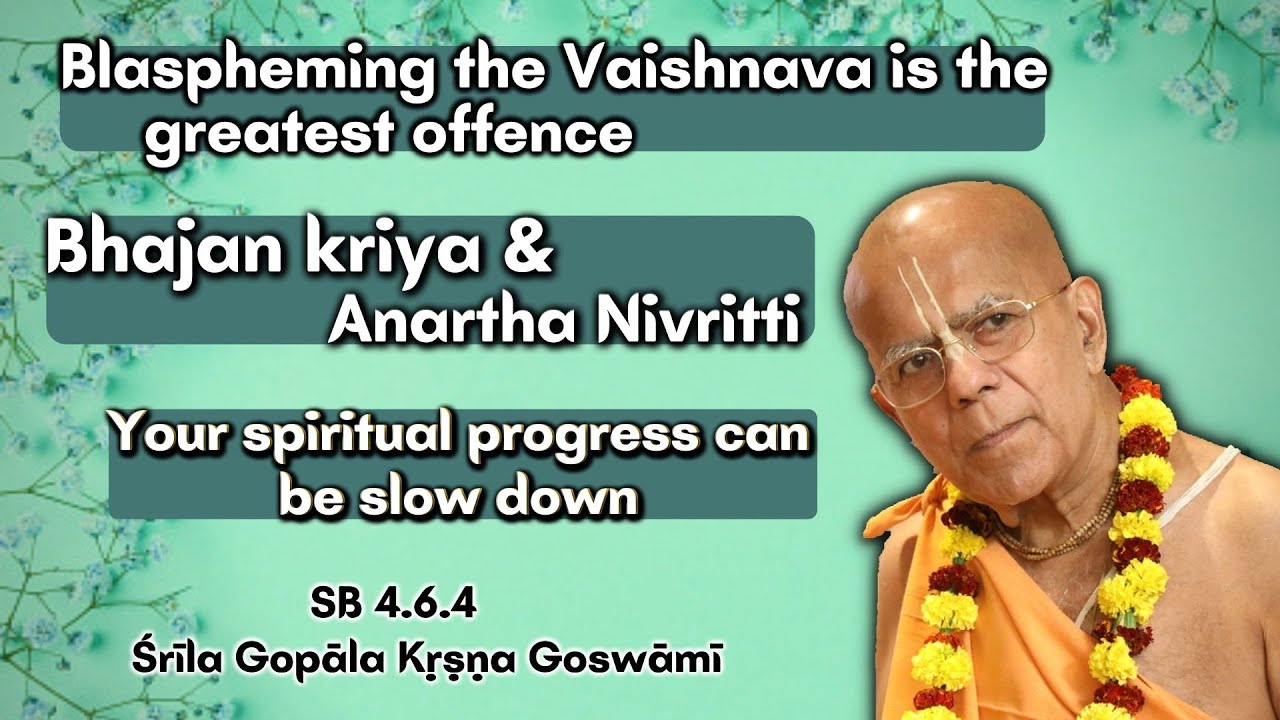
In this devotional lecture Śrīla Gopāl Kṛṣṇa Goswāmī expounds on the scriptural passage SB 4.6.4, using the story of Dakṣa’s blasphemy against Lord Śiva to illustrate the gravest spiritual offense: Vaishnava‑aprāsa (offending exalted devotees). He explains that even a perfectly performed sacrifice brings no happiness when it is accompanied by disrespect toward a great personality. The talk identifies the anarthas (obstacles) that generate such offenses—envy, greed, anger, hatred, etc.—and describes how they must be eradicated through the progressive stages of bhakti, from initial shraddhā through sadhu‑saṅga, bhajana‑kriyā, niṣṭhā, and finally prema. Rigorous bhajana‑kriyā is presented as the medicine that diminishes anarthas, leading to firm faith (niṣṭhā) and deeper love. The speaker warns against the ten Vaishnava offenses, especially guru‑aprāsa and rākṣas‑aprāsa, and illustrates the principle with numerous scriptural and historical examples (Prahlāda, Amṛśvarāja, Amoga, Dvāratāmuni, etc.). Practical advice is given on cultivating sadhu‑saṅga, magnifying the good qualities of all Vaishnavas, and maintaining tolerance while recognizing that the Supreme Lord does not tolerate offenses against His devotees. The lecture concludes with a contemporary reflection on capital punishment and true welfare, asserting that genuine service is the propagation of Krishna consciousness.
Chapters
Om Namo Bhagavate Vasudevaya. Om Namo Bhagavate Vasudevaya. Om Namo Bhagavate Vasudevaya. Translation: When Lord Brahmā heard everything from the demigods and the members who attended the sacrifice, he replied, "You cannot be happy in executing a sacrifice if you blaspheme a great personality and thereby offend his lotus feet. You cannot have happiness in that way." Purport by His Divine Grace A.C. Bhaktivedānta Swāmi Prabhupāda. Lord Brahmā explained to the demigods that although Daksha wanted to enjoy the results of fruitive sacrificial activities, it is not possible to enjoy when one offends a great personality like Lord Śiva. It was good for Daksha to have died in the fight, because if he had lived, he would have committed such offenses as a lotus seed of great personalities again and again. According to Manu's law, when a person commits murder, punishment is beneficial for him because if he is not killed, he might commit more and more murders and therefore be entangled in a future life for having killed so many persons. Therefore the king's punishment of a murderer is appropriate. If those who are extremely offensive are killed by the grace of the Lord, that is good for them. In other words, Lord Brahmā explained to the demigods that it was good for Daksha to have been killed. O Majjanasvandasya jñānām jñānāśalakya-cākṣrama-nitanyena tasmai Śrī Vrāmana Mahā. Śrī Keitanya Mano-bhaktān patkāñinā-bhūtale soyaṁ bhūpakedāmayam vidāti svarūpa-dandikam. Bande ham Śrī Guru Śrī Urdhva-pāda-kamman Śrī Guru-mvaiṣṇava-nāśraya. Hare Kṛṣṇa. Śrīmayā tattva-sambhuyan nāpeyabhuvuṣataṁ. So the maîtriya is explaining that after Dakṣa was killed, all the demigods, etc., they all approached Lord Brahmā. Dakṣa was killed. Because of his very blasphemous and offensive attitude towards a very exalted personality of the stature of Lord Śiva. Lord Śiva is not an ordinary personality. saimbu-jñānāda-sambhu-kāmānā-kapilo-mānū-pavado-janako-bhishmo-bhārīvāya-sakēvāyaṁ. Bhāgavatam describes that Lord Śiva is one of the 12 mahajans, or spiritual authorities. And he's ashitosa, mangala, very auspicious. Very easily he gets satisfied. Lord Śrī was incarnation of all the qualities. So he has a very, very powerful and exalted position. Prajāpati-draṣya, was very envious of the exalted position of Lord Shiva, and there he started criticizing him, and eventually he was killed. So Lord Brahma over here is making a very, very important point. Mādhya is stating that Lord Brahma told The demigods and the others who were in the sacrificial arena that was arranged by Daksha, they were all surprised when they saw that Daksha was killed. God Vishnu, however, knew, and Brahmā, what was to follow. Therefore they did not even attend the sacrifice. So when the demigods, etc., went to Lord Brahmā He heard everything from them and he said, you cannot be happy in executing a sacrifice if you blaspheme a great personality at the same time. You can't have happiness in this way. So on the path of devotional service, one has to be very, very careful. One has to be very careful. One cannot think that I'm on the path of devotional service, now I have a license for doing anything that I may desire. Caitanya Mahāprabhu has warned us of the mad elephant offense. How a mad elephant has the capacity to destroy, ah, even a very beautiful garden. You may have a very beautiful garden, but if you let a mad elephant let loose, Then we might have an elephant who will destroy, ah, that beautiful garden. So Daksha, what was his weakness? He was envious. Envious of the exalted position of Lord Śiva. So when one is on the materialistic platform, oops, envy is there. Lust, anger, greed, hatred, envy, these are all the anantas that are the obstacles for spiritual advancement. And unless these anarthas are curbed, unless we check these anarthas, our spiritual progress will be very, very slow. Therefore, Rūpa Gosvāmī has recommended a very genuine process of controlling these anarthas. Rūpa Gosvāmī and Bhaktivedānta Swāmi Gosvāmī explained how one proceeds the initial stage of shraddha to the stage of eventually developing Kṛṣṇa-prema. He explains how at the very inception there must be shraddha or desire. What is that desire? There is a goal in life. There is something beyond materialistic activities. I must look for God. And that shraddha Brings one to have spiritual association known as sadhu-sanga. Sarva-saḥaṁ hiḍīpāṇivisṭho mataḥātmṛta-dyānaṁ abhānaṁ ca. Kṛṣṇa is in everyone's heart, and in that position He recognizes our desires and causes remembrance and forgetfulness. So when Kṛṣṇa sees that here is somebody who desires to be free from the jñānamitya, then He brings him in association with sadhu-saṅga. Sadhu-saṅga may take on various forms. It can— you distribute a book to somebody on the street, that's the beginning of sadhu-saṅga. You talk to an individual on the street, that's another aspect of sadhu-saṅga. You invite someone to the temple, That's another aspect. Then when it gets sadhu-sanga, then you recognize that if you want to develop love of God, there is a certain process and there are no shortcuts. So then one gets educated about the importance of chanting the holy names of Kṛṣṇa, the importance of following regulative principles, the importance of vaidhī-bhakti, etc. And if one takes advantage of his instruction, then he begins the process regularly, uh, rigidly, makes an application as Prabhupada said, gradually gets initiated, continues following. So this is known as a stage of bhajana-kriya, that is where you very strictly follow the different rules and regulations, idaya-japa, etc., every day. Now as you execute this process of bhajana-kriya, there is a very positive development. And the positive development is the anarthas in the heart that we briefly described at the commencement of the class, like envy, greed, hatred, etc. They all begin to melt. They all begin to melt, or they all begin to diminish, just like when a sick patient takes medicine. So as he consumes the medicine, the germs in the body begin to get killed, and gradually the person becomes healthy again. So similarly, We have unlimited sinful desires or sinful germs in the body, and they get manifested in different ways. Lajjana, greed, envy, hatred— these are all the results of the anarthas that are there in the heart. And as long as one is on the materialistic platform, his activities are greatly motivated and influenced by the presence of these anarthas. Śrīla Prasada RAVAL is executed with faith and regularly, then there will be anartha-liberty. That is, the anarthas. Dakṣas anartha was that he was envious of the exalted position of Lord Śiva. So similarly, we all have so many different anarthas. And these anarthas are the stumbling blocks on the path back to Godhead. So we have to take care of them. Oil in the body, you have to take care of it. So by the execution of bhajana-kriya, there is anartha-nivritti. The anarthas begin to diminish. And as the anarthas begin to diminish, there is another positive development which is known as nishta. As the anartha begins to diminish, then you develop nishta. What is nishta? Nishta is firm faith, firm faith that Kṛṣṇa is Supreme. Chanting the holy name is the best means. I must follow the spiritual master. I must do, follow the śāstras. That is nishta. And that is firm faith. So very often we see that people join the movement, they get initiated, they even become sannyasis, and they also give up Kṛṣṇa consciousness. That is because they have not reached the stage of nectar. That is because they're still in a somewhat neophyte stage. Because the stage of nectar is realized only after one has successfully executed the process of bhajana-kriya. Then you develop firm faith And then gradually you progress further and further to rūjīya, sushritya, bhāvan, prema. So the point that we wish to make is that without bhajana-kriyā, attentive bhajana-kriyā, you can't expect these anarthas to be eliminated or to be conquered. Therefore, if we are desirous of making spiritual advancement, then these, uh, then the bhajana-kriyā process should not be compromised at any cost. Therefore Rūpa Gosvāmī has said, kṛṣṇa-bhaktirāsa-bhāvita māti-kṛta-nirvikṛdho-vilāvate. Then, my dear friend, whatever price that may be needed to pay to become Kṛṣṇa conscious, pay that price. Don't compromise. Just like we are all used to bargaining. You go to India to shop, you have to determine an item when you bargain. Śrīla Prasāda RAVAL said, don't bargain, pay the price. So if you pay the price, then there is positive development. So one has to be very cautious on the spiritual path that one avoids all aprāda, especially rākṣam aprāda and guru-aprāda. These are very, very dangerous and can seriously curtail whatever gain they may be by chanting the holy names of Kṛṣṇa. That is why Kṛṣṇa's Kavirāja says, bāhu-jana-karī-yadi-sau-nā-ketanā bahū-tanapāya-kṛṣṇa-paday premadham. That when they go on chanting the names of Kṛṣṇa birth after birth, but one is not careful in avoiding the 10 offenses, then there will not be the development of Kṛṣṇa-prema. Prabhupāda gives a nice example that, gives example that when you're walking on a very sunny day, when it's very, very hot, those of you who have been on parikramas in India may have experienced that sometimes it's very, very hot. So the head can tolerate the sun, but the feet cannot tolerate, isn't it? You begin to run. When it's very, very hot on these parikarmas, the head can tolerate that sun. The head has the capacity to tolerate. But the feet, phew, you begin to run. I remember one time these parikarmas, and I'm so hot, and you virtually have to run. But the feet cannot tolerate the effect of the hot sun. So similarly, a devotee, he on his own may tolerate the offenses that one may commit, because by nature devotee is very tolerant. If you examine the devotee that are described in numerous places in the scriptures, you find the word titikśva repeating itself again and again. Titikśva karuni-kahaḥ suḥ dasarvabhēyam ajataḥ śatvaśāntaḥ sadva-sādhūḥ śmaḥ. So a devotee by nature is titikśva, very, very tolerant. We even saw Lord Śiva display this quality of tolerance. Saksa was insulting him so rudely, but that Shiva was just tolerating it. Lord Shiva's followers were angry, but Shiva was very tolerant. He is very, He is the Tejashiva. Right now I am very tolerant. So Vaishnava, he is tolerant when somebody commits an offense, but the Lord, oh, He will not tolerate it. Just like you may be able to bear the hot sun, but your feet cannot bear the hot sun, you understand? So a devotee may, is willing and tolerant to bear insult from anyone, but the Lord is not willing to bear insult that's offered to His genuine devotees. Therefore the Lord will not tolerate it. Devotee will not say anything. They can insult Him, ridicule Him, abuse Him, but Kṛṣṇa will not be pleased. And Kṛṣṇa will not tolerate it. Therefore Prabhupāda explains that when you serve an advanced devotee, when you serve a vraja-dēvā, you accumulate assets. And when you blaspheme a vraja-dēvā, you diminish your assets. You understand? When we chant, we serve, we are accumulating assets. But when we commit Vaiṣṇava affront, we diminish our assets. And we diminish our assets to the point, hey, even the holy names will escape your tongue. You won't be able to even chant. We've seen ourselves in the long history of this Kṛṣṇa conscious movement how devotees were there in very exalted positions, but because of committing Vaiṣṇava affront, etc., Gradually they lost the opportunity to serve, and they gradually fell into the influence of the illusionary energies. So the devotee is tolerant, but Lord will not tolerate. When you commit, when you do devotional service, your assets increase. When you commit aprāsa, your assets diminish. Prahlādañakāśipū, he was very envious of whom? Of the great devotee Prahlāda. And he was so envious. Prahlāda was innocent, but he was always looking for some fault in Prahlāda. Eventually he had to be killed by the Supreme Lord. So we have to be very, very careful on the devotional path that in our right now dealings We do not commit Vaishnava aprāsa. In this section of the Bhāgavatam, Śrī Caitanya Mahāprabhu describes the character of Lord Śiva. Śrī Caitanya Mahāprabhu was very offended when her father Dakṣa was so offensive to Lord Śiva. So Śrī Caitanya Mahāprabhu said, "My husband, he is so tolerant that he always looks at the good qualities of everyone and magnifies it." She says that, "My husband is so magnanimous that he magnifies, he is so wonderful that he magnifies the good qualities in everyone. He doesn't look at their faults." So Prasad RAVAL explains that this is the mentality of a Vaiṣṇava. He takes on the good qualities of everyone and magnifies those lights. The bee. When the bee goes to a flower, the bee is only interested in the honey inside the flower. The bee is not interested in the thorns or the color of the flower. When the bee goes to a flower, it's only interested in the honey. It doesn't care whether the flower is black, white, brown, and it doesn't even care about the thorns that surround the flower. It is only interested in the honey inside. So similarly, Prabhupada explains, the devotee, he is interested and meditates on the good qualities of all the Vaiṣṇavas. And by meditating on the good qualities of all the Vaiṣṇavas, one automatically becomes respectful to the Vaiṣṇava. Generally we find that we have, we tend to multiply our good qualities and divide everyone else's good qualities. So what happens? We become so tall and everyone else becomes so short, and then we all become proud like Daksha. So that is actually a very dangerous path to take. That is why we address each other as prabhu. Prabhu means master. So when you're looking at the good qualities of all Vaiṣṇavas, then naturally one is inspired to call them Prabhu and give them respect. So Vaiṣṇava prasada is very, very dangerous. We see in the Ninth Canto how Dvāratāmuni had offended this very exalted devotee, Amṛśvarāja. So Dvāratāmuni was very Proud, he was very confident that he'll be able to produce a demon and annihilate Amritvaraj. Amritvaraj, however, was totally dependent upon the lotus feet of the Lord. Sareva mana-kṛṣṇa-padāra-vindayo. Amritvaraj was protected by the sudarśana-cakra. Sudarśana means all-auspicious. So he was protected by the sudarśana-cakra of the Lord. And Amrit and the Vāsudeva had to flee because the rays of the solar plexus chakra was so powerful that wherever the rasa went, the heat was burning his back. He went to all the demigods. The demigods said, "We are unable to protect you." Finally the rasa, being a mystic yogi, was able to reach the Lord. And when he begged forgiveness for the Lord for having offended his beloved devotee Amrit. What did the Lord say? The Lord said, my devotees are very dear to me. Sadvah hridayam mayam. Sadvah, these sadhus. Hridayam, hridayam means heart. These sadhus, they live in my heart. So these exalted sadhus, they live in my heart, and I live in their heart. Therefore, They are very, very dear to me, and I cannot pardon you. So then Dwaraka Muni had to go to— he had to go to whom? He had to go back to Amṛṣmādhā, beg forgiveness, and he very easily forgave. He very gladly forgave him. So that is the nature of an advanced devotee. He forgives, but the Lord doesn't forgive. The Lord says, my devotees, They sacrifice everything for My pleasure—their wives, their children, their assets. Therefore I reside in their hearts and they reside in My heart. Similarly, in the Caitanya-caritāmṛta, there are many nice stories on this point. One is the story of Amoga, the son-in-law of Sarma-bhūma-bhattacārya. So Amoga was very envious of Caitanya Mahāprabhu. Sarubhama Bhattacharya and his wife, who were at one time impersonals, however, by the mercy of Caitanya Mahāprabhu, became exalted devotees. Banamoga, he was very, very envious. So once Caitanya Mahāprabhu, when He was in Jagannātha Puri, He was invited for prasādam by Sarubhama Bhattacharya. So every day Caitanya Mahāprabhu would come and eat lunch prasādam. Caitanya Mahāprabhu would eat prasāda in different grihāṣṭhas' homes when He would visit a city. So Sarvabhaumādhāraya would position Amoga, would not let Amoga come inside the house because his wife would cook so many offerings. And Sarvabhaumādhāraya would stand with a stick at the gate to make sure that Amoga did not have an opportunity to see what he was eating. And Amoga would be standing outside the wall trying to hear if there is some fault that he could find in Caitanya Mahāprabhu's character. So one day, while his wife was serving Lord Caitanya Prasada, Saravana Bhattacharya just had to leave the gate for a minute to help his wife serve Prasada. And Amoga took the opportunity and came in, and he saw the numerous dishes on Lord Caitanya's prasadam table, and he said, "Look at this sannyāsi." What type of sannyāsa is that? He eats so opulently. Anyway, so Sarubhāma Vādhācārya chased him out of the house. So a little later, Gopīnātha Ācārya, the brother-in-law of Sarubhāma Vādhācārya, had come to meet Lord Caitanya. And Lord Caitanya asked him, "How is Sarubhāma Vādhācārya? How is his son-in-law?" So he was told that Amogha is sick with cholera and he's about to die. So Lord Caitanya was very concerned because He knew that his death may affect Srila Mahāprabhupāda. So He went to see him. And Lord Caitanya placed His hand on Amoga's heart. Amoga was on his deathbed. And He said, "Amoga, why do you keep envy in your heart? As long as your heart is envious and dirty, Krishna will not reside over there. So please remove this envy from your heart. Because of envy, as long as envy is there, Krishna will refuse to stay there. And as soon as Caitanya Mahāprabhu said this, Amarga jumped up from his bed and fell at the feet of Caitanya Mahāprabhu and begged forgiveness. So anyway, the point that we're making is this, that with an envious— if we have an envious attitude, towards the Vaishnavas, towards— sometimes one's envy extends to the spiritual master. One becomes envious, "Oh, why is the spiritual master ordering me so much? Why is he saying this? Why is he saying that?" So if you have this envious attitude, then Lord Caitanya confirms that Kṛṣṇa will not reside over there. So you have to conquer over this envy. Just like there was another brahman called Gopal Brahman. He was very envious of the fact that Lord Caitanya was performing Hare Nam Keertan in Śrīvās ṭhākura's house. So what did he do? He wanted to defame Śrīvās ṭhākura. So what he— in the night he kept all the paraphernalia for worshiping Goddess Durga at his doorstep. So in the morning when he got up, Śrīvās saw, "Oh, all this liquor bottle, all this stuff for worshiping Durga." So he proudly, he said, "Yes, see everyone, I am a worshiper of goddess Durga. I am not a devotee of Kṛṣṇa." But nobody believes him. Anyway, to cut a long story short, that brahman got affected with leprosy. Leprosy? Yeah, it was leprosy. He got affected with leprosy. He asked Lord Caitanya, "Please forgive me for what I did." But Lord Caitanya refused. Finally, after Lord Caitanya took sannyāsa, again he went to Lord Caitanya. And then Lord Caitanya told him to go to his devotee, and then he was forgiven. So the point is this: on the devotional path, one has to be very, very careful. One should not take it for granted, I'm an initiated devotee, I'm this, I'm that, I'm turning around, and I can commit Vaishnava prasada. No. If one commits Vaishnava prasada, then the gains of chanting the holy names are minimized. And if one continues to commit a prasada, then your bank account actually begins to get diminished. Therefore, the statement of Lord Brahmā that you cannot have a big sacrifice and at the same time be blasphemous to the devotees, this is very, very important. So we cannot find happiness in this way. Avaiṣṇava is such a personality, he doesn't even like to give trouble to an ant. Just Bhāgavata, when he was carrying King Rohuṇa, he was so careful. He would not even keep his feet on the ground before seeing that these were the men. There was no entity on the ground, isn't it? Because he did not even want to give trouble to an ant. So this is Vaishnava culture, that you do not want to give trouble even to an ant. And parā-dūkha-dūkhi, when you see that somebody else is in distress, you also become distressed. So any purpose— Prabhupāda also makes a point that according to Manu's law, that if somebody is a murderer, then that murderer must be hanged. This is Manu's law, life for life. If you committed a murder, then go and be hanged. But today we find that society has become so degraded that they've done away with capital punishment in many parts of the world, huh? They didn't. And today, at one time, the theory was crime doesn't pay, but today the theory is crime does pay. So the big criminals are outside the prisons. It's only the small criminals who end up in the prisons. The real big criminals, they are very easily operating all over the world. So the process— I should end the class now. So the process is that one who is a murderer, he must be hanged so that he doesn't commit any further sinful activities. Sometimes people all over the world, including India, are very fond of mundane welfare. Build a hospital, open a school, and so on. So we give people education, we give them medical care, but then they become healthy or educated and they do sinful activities against the laws of God. Have we helped them or have we endangered them? We have endangered them. We haven't helped them. So real welfare activity is To give people that knowledge by which they can terminate their material existence, and that is giving people Kṛṣṇa consciousness. Hallelujah! Hallegrace God, hallegrace God—
More from PRASAD

Rare Pastimes & Timeless Lessons of Guru Mahārāja | Stories Every Disciple Should Hear

ISKCON Legends- pure devotees meet-HH Jayapataka Swami, HH Gopal Krishna Goswami, HH Radhanath Swami



Jagannātha Ratha-yātrā Through Śrīla Prabhupāda's Mercy | 29 April 2006 | Nairobi, Kenya

Lord Jagannātha's Appearance Pastime | 21.07.2019 | ISKCON Calgary | Śrīla Gopāla Kṛṣṇa Gosvāmī

The Ācārya Teaches by His Own ExampleGuṇḍicā Mārjana by Guru Mahārāja #shorts

Guṇḍicā Mārjana – Lord Jagannātha's Pastime | 21.7.2019 | ISKCON Calgary |Śrīla Gopāla Kṛṣṇa Gosvāmī

H.H. Gopāla Kṛṣṇa Gosvāmī Mahārāja - Exemplary Sādhana and Deity Worship # shorts

भगवान की कृपा कैसे प्राप्त होगी ? | 11 Jan 2014 | Punjabi Bagh | Srila Gopal Krishna Goswami

Material Education vs Spiritual Education | Srila Gopal Krishna Goswami #shorts