CC Madhya 22: Lord Caitanya’s Teachings to Sanātana(2) | Rus-Split | 14.5.90 | Gopal Krishna Goswami
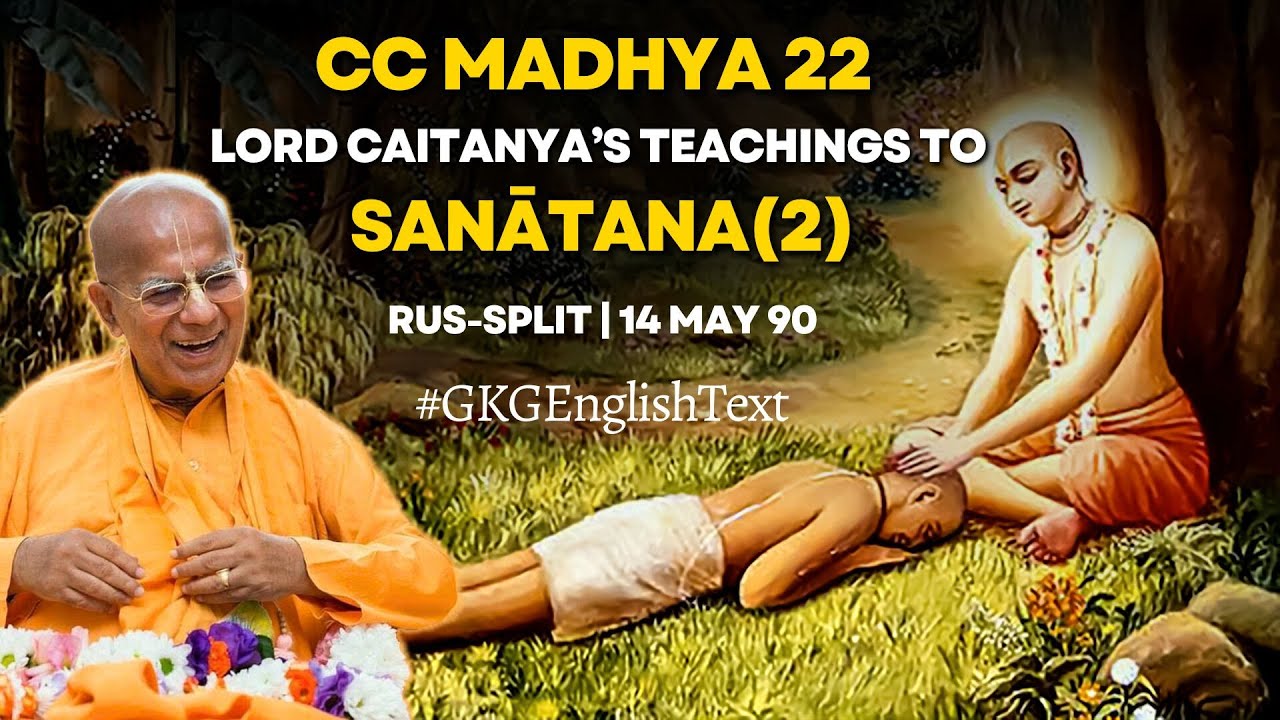
In this extensive lecture, the speaker (Gopal Krishna Goswami) expounds on the teachings that Lord Caitanya Mahaprabhu conveyed to Sanatana Gosvami. The core message is that devotional service (bhakti) is the sole valid activity, and all Vedic scriptures support this. Caitanya emphasizes the cultivation of the 26 devotional qualities, the necessity of associating with advanced devotees, and the danger of material association. He outlines six principles of spiritual surrender—acceptance of favorable circumstances, renunciation of unfavorable ones, firm faith in Krishna’s protection, dependence on Krishna for all desires, humility, and meekness. The lecture then details the regulative principles (vaidhya‑bhakti) that purify the heart, the role of a bona‑fide spiritual master, and practical guidelines for livelihood, conduct, and equal treatment of gain and loss. Numerous scriptural stories (Durvasa‑Amṛśa, Pandavas, Prahlāda, etc.) illustrate Krishna’s protective love for devotees. The speaker stresses the importance of book distribution and preaching as the ISKCON mission’s lifeblood, linking it to Caitanya’s prediction that Krishna consciousness will spread worldwide. Audience questions about handling offenses, legal constraints, and spiritual concepts are answered briefly, reinforcing the central themes. The lecture concludes with a call to diligent practice of bhakti, association, and preaching.
Chapters
Prasad Raval. So, Caitanya Mahāprabhu has so far explained to Sanatana Gosvāmī that all the Vedic scriptures establish that one must take to the process of devotional service. And Caitanya Mahāprabhu has also established that any activity independent of bhakti is a waste of time. And Caitanya Mahāprabhu has explained How by executing bhakti in the association of devotees one can cultivate, that one can develop the 26 qualities which we have just discussed. After describing the 26 qualities which we have discussed before the lunch session, Caitanya Mahāprabhu explains, quoting from the Bhāgavatam, Third Canto: pritikśva-karu-nikāha-sūḍha-sarva-dhīnām ajjata-śatrava-chanta-sādva-sādhū-bhūṣanā. Caitanya Mahāprabhu explains that a devotee must be titikśva. It means very forbearing. That means very tolerant. This is a quality that we have discussed. Then karu-nikāha. This means mercy. This quality also we have discussed this morning. Sūrdha. Sūrdha means well-wishers of everyone. So we have already discussed that quality by stating that that a devotee has no enemies. So he is a well-wisher of everyone, including the animals and the ants. Ajñātāśyaśṇava, devotee has no enemies. The non-devotee may consider the Hare Krishnas as enemy, but the Hare Krishnas have no enemy. A Vaiṣṇava is always forgiving. In Prabhupāda's life, we saw how even if somebody had insulted him, Prabhupāda was still ready to forgive him. And sādhava, follows the instructions of the śāstras. This is very important. We must follow these scriptures. Dhammaṁ te sakṣād bhāgavat-panitāṁ. Religion means the words of God. So if you don't follow the words of God, then you cannot advance on the path of religion. Therefore devotees must study these books. Prabhupāda said, "I am writing these books for whom? For my devotees to read and study." So we should study these books so that we get knowledge on how to make spiritual advancement. By reading these books, you understand the philosophy, and by applying the philosophy, your intelligence becomes sharp. And when your intelligence becomes sharp, then you can easily cut out maya. Just like when you have a sharp blade, just like the doctors. The doctors have such a sharp blade when they are doing your operation that they just touch the blade on the skin and the skin cuts. So by reading the scriptures, our intelligence will become so sharp that the moment maya is beginning to touch it, it will be cut. Therefore, those devotees who read Read regularly, they have sharp intelligence. And those who don't read, they become victims of māyā. Just like in a material situation, if somebody has good academic education, then he can make progress in life. But if somebody doesn't have good academic education, then he doesn't get a good job. So similarly, if we know the scriptures well, then you can make spiritual progress. Otherwise, it is difficult. So Caitanya Mahāprabhu said, Prasad RAVAL. All the scriptures say that by serving an advanced Vaiṣṇava and associating with an advanced Vaiṣṇava, one makes spiritual advancement. And by being associating with materialistic people, then you walk on the path of darkness. So the devotee wants— so one who is serious about spiritual life, he wants to associate with the advanced souls and not materialistic people. How does one come to Kṛṣṇa consciousness? Caitanya Mahāprabhu says, "You come to Kṛṣṇa consciousness by association with advanced devotees." Just like many of you may have come to Kṛṣṇa consciousness by reading Prabhupāda's books. So that was associating with a very advanced soul. Or you may come in Kṛṣṇa consciousness by associating with some other devotee. So that is again association. So by association you come to Kṛṣṇa consciousness, and then by further association You give, you develop the strength to give up your sinful life. So Caitanya Mahāprabhu has very strongly associate, emphasized, associating with pure devotees who are free of sin. Therefore Caitanya Mahāprabhu said, "The glorification of God must be heard from the mouth of pure devotees." Just like milk touched by a snake becomes poisonous. Similarly, the holy name of the Lord, when it is chanted by professional singers, it becomes poisonous or it becomes ineffective. So the, um, Vaiṣṇava, he avoids listening from non-devotees. Of course, you don't have this problem much in your country, but in countries like India, there are so many people who, so many so-called famous singers who chant names of Kṛṣṇa just to make money, but in private life they eat meat and they do everything bad. And there's so many so-called people, they may give lectures on Bhāgavatam, but they have no character. So listening from such people will ruin your spiritual life. Satsangatyāgai vaiṣṇava-caras tri-saṅgī-eka sadhu-kṛṣṇa-bhakta-āra. All right, once again, Caitanya, you just see. Caitanya Mahāprabhu is verse after verse repeating only one point, isn't it? Just like in the second chapter of the Bhāgavad-gītā, Kṛṣṇa is repeating the same point that you are this duṣa, you are not this body, again and again, again and again. With non-devotees who are attached to women and money, Caitanya Mahāprabhu says, by associating with worldly-minded people, All your good qualities will become destroyed. The 26 qualities which we have just discussed, plus spiritual intelligence, will all be destroyed, Caitanya Mahāprabhu says, by associating with worldly-minded people. So Caitanya Mahāprabhu is very strongly emphasizing we must choose our association. And yesterday, if you remember, I had discussed from Nectar of Instruction How one must choose one's association and associate with different people of different levels of realization. So especially Caitanya Mahāprabhu has said, "Disassociate from those who are like toys in the hands of women." In other words, those men who are completely attached to just sex life. In the Kātyāna-samhīta, the Kātyāna-samhīta is one of the scriptures, it is said, it is better to be to accept the miseries of being within bar, behind bars, and surrounded by burning fire than to associate with those who are not Kṛṣṇa conscious. So it is said in the scripture, it is better to live behind bars and to have flames of fire all around you rather than to associate with people who are not devotees. So one should give up all material attachment by taking shelter of Kṛṣṇa without hesitation. This is important. Caitanya Mahāprabhu said, "Without hesitation." That means without any doubt, with full conviction, take up Kṛṣṇa consciousness. Sarva-dharmān paritajyām ām ekaṁ caṇām vrajaḥaṁ tvam sarva-pāpebhyam mokṣyāmi maṣucāḥ. Caitanya Mahāprabhu quoted this very famous verse from the 18th chapter of the Bhāgavad-gītā, and he told Sanatana Gosvāmī: "Give up all varieties of religiousness and come to Me, and I will protect you." Kṛṣṇa is very clearly stating: "Don't worship demigods, don't worship ancestors, don't worship anyone. Just worship Me, Me, Me." So Caitanya Mahāprabhu is emphasizing except surrender to Him at all cost. Bhakta-vatsalā-kṛtṇa-smārtha-bhādaṇyaḥ. Caitanya Mahāprabhu says the Lord Kṛṣṇa is very kind to His devotees. He's always very grateful to His devotees. Therefore Caitanya Mahāprabhu says a learned person should never give up Kṛṣṇa. Of course, as I said, in your country this is not a problem, but in countries like India where people don't understand the difference between the Supreme God and demigods, It's a big problem because people think everybody is on the same level. Prabhupāda used to give a nice story to us sometimes about how it is difficult to give up your bad habits, old habits. In Germany, there's a very famous school that teaches you how to play piano. Now when you go to that school, their first question they ask you, do you know how to play piano? And if you know how to play piano, you have to pay a very high fees. And if you don't know how to play piano, then you pay less fees. Why? Because if you know how to play piano, first they have to make you forget what you know and then teach you the new stuff. So all of you are fortunate, you just got exposed to Kṛṣṇa and you are following Kṛṣṇa. But people who come from like Indian background, they are exposed to so much of demigod worship that to convince them that Kṛṣṇa is the Supreme, it takes a little time. They are also used to be, to have been brought up in an atmosphere where they are taught, All these demigods, Supreme Lord, it's all one. Caitanya Mahāprabhu uses the word bhaktabhatsāla. So Kṛṣṇa has many names. One of Kṛṣṇa's names is bhaktabhatsāla. Bhaktabhatsāla means He is very kind to His devotees. In the Bhāgavad-gītā, Kṛṣṇa tells Arjuna, "Arjuna, please go and tell the whole world, 'My devotee will never perish.'" Kaunteya prati-jānahi nirmeh bhakta-pranāśyati. My devotee will never perish. But Kṛṣṇa, in order to protect His devotee, He sometimes even breaks His promise. Just like before the Battle of Kurukṣetra started, Kṛṣṇa had promised the Kauravas and the Pandavas that He was not going to lift any arms. He was not going to take, use any weapons in the battle. The Kauravas, they decided to select all the famous generals and the latest in technology, latest arms on their side. And the Pandavas, they said, "We want Kṛṣṇa." So the Battle of Kurukṣetra had gone on for so many days, but Arjuna was still not killed. So Duryodhana— Duryodhana was the greedy son of Dhṛtarāṣṭra. He went to Bhismadeva. Bhismadeva was the biggest general of that time. So Dhṛtarāṣṭra— Duryodhana went to Bhismadeva and said, "Why is it that Arjuna still hasn't died? Why are You showing him special mercy? You are fighting on My side. He should have been killed by now." So Bhismadeva, within his heart, he was on the side of the Pandavas, but because he had accepted the obligation of the Kauravas, he had to fight on their side. So now he was a Kshatriya, so his honor was being challenged. So Bhismadeva said, "Now either Kṛṣṇa will have to break His promise or Arjuna is going to die." Within his heart, Viśma Deva knew that Kṛṣṇa is the Supreme Personality of Godhead. So Viśma Deva prepared four very sharp arrows in the evening. The Battle of Kurukṣetra was a religious war, and it was fought under the highest spiritual standards. The two armies would fight against each other only in the daytime, and in the evening the two sides would eat together and play together. And if some soldier was not armed, he would not be attacked. And there was no question of ever attacking innocent citizens or old people or women or children. This is God-conscious civilization or Vedic civilization, not like the present-day society where they throw bombs without discrimination and they attack in the night when people are sleeping. So Arjuna, Bhisma Deva had prepared 4 very sharp arrows and he kept it outside his tent in the night and he said, "Next day morning when I fight, I am going to shoot these 4 arrows at Arjuna." So Arjuna, of course, was not an ordinary devotee. He knew what Bhisma Deva was planning on doing. So in the night, Arjuna stole the 4 arrows. Next day morning when Bhismadeva got up and the war was about to start, he saw that those arrows were stolen. So Bhismadeva knew this was Arjuna's trick. So Bhismadeva said, "Now I am going to fight so valiantly, so bravely, that Kṛṣṇa will have to break His promise or His friend Arjuna was going to die." Bhismadeva fought so bravely that Kṛṣṇa saw that Arjuna was about to die. Because Kṛṣṇa was Arjuna's chariot driver. So Kṛṣṇa was watching everything that's taking place. So when Kṛṣṇa saw that Arjuna's life was in danger, He jumped from His chariot. He ran with His sudarshan-chakra. Even His dhoti, the top fell off from His body, and He confronted Bhismadeva. And then Bhīsmadeva could not kill Arjuna. And when Bhīsmadeva saw Kṛṣṇa in front of him, he said, "This is what I wanted. I wanted to see the Lord face to face and to prove to the whole world that even if Kṛṣṇa has to break His promise, He will break His promise, but He will protect His devotee." So the point that we are making is that Kṛṣṇa is bhaktabhātsāla. Bhakta-vitsālā means very dear to His devotees. Piyādhāṇī. Another word that Caitanya Mahāprabhu uses was kratāgya. Kratāgya means grateful. So Kṛṣṇa is very grateful to His devotees. In the Śrīmad-Bhāgavatam, there is a very nice story of Durvāsa Muni and Ambrish Mahārāja. Durvāsa Muni was a very powerful yogi. He is such a powerful, he was such a powerful yogi that even if he was miles away from you, he could know what is, what you are doing. Are any of you yogis like that? Durvasa Muni, even if he was 10 miles from here, he would know what you are doing in this room. Maybe our 20th century detectives should learn this art of becoming powerful yogis like Durvasa Muni. You see, Srimad Bhagavatam has information for everyone, even for the detectives. So Durvasa Muni was a very powerful yogi and Amresh Maharaj was a very powerful devotee. So Amṛśma Rāja was the king of the world, but at the same time he was completely God-conscious. So Amṛśma Rāja was about to break his fast when Durvāsa Muni walked into his palace. So Amṛśma Rāja said, "Please come and join me. We will eat prasāda together." Durvāsa Muni said, "Let me just go and have my bath in the Ganga." ,And I'm coming back in few minutes. So Durvasa Muni went to have his bath in the Ganga, but he felt in samadhi. So he forgot that in one minute he has to go back to Amresh Maharaj. So Amresh Maharaj was getting, you know, it was time to break the fast, and Amresh Maharaj was getting worried what to do. So he consulted his brahmins, and the brahmins said, 'Because if you fast and you do not break the fast before a certain time, then that fast is wasted.' So the Brahmin said, 'Okay, because you have called the Rasamuni for lunch and he still hasn't come, you can drink water. Because drinking water, you will break the fast, but at the same time, your guest, the Rasamuni, will not feel bad because it is not considered food as such.' So as soon as Amresh Maharaj had watered a drink, Durvasa Muni, because he was a powerful yogi, he knew that Amṛśma Rāja has drunk water. So Durvasa Muni said, "I am going to teach this king a lesson now." A devotee of the Lord has no enemies, but this does not mean that the non-devotees don't consider the devotees as enemies. Durvasa Muni was very envious in his heart that Amṛśma Rāja was so respected. Just like the karmīs can never understand how these Hare Kṛṣṇa devotees are living. Prabhupāda used to say, in 1970 Prabhupāda purchased a very big church in Los Angeles, America. So there all our big temples have 20, 30, 40 cars and trucks and so on. So our Los Angeles temple had many trucks, sankirtan vans. So the karmīs were wondering, where do these Hare Kṛṣṇas get their money from? But Kṛṣṇa provides. Just like I see your Soviet Hare Kṛṣṇa devotees, you seem to be doing pretty well also. So Kṛṣṇa provides. So Amṛśma Rāja, Durvāsa Māni was very envious of Amṛśma Rāja. So he said, "I am going to teach this king a lesson." So he went to the king and from his sikha he produced a demon. Amṛśma Rāja did not get scared at all. Here was Durvāsa with a demon. And with a demon he was going to burn with the fire. The demon had so much fire that just with the heat of that you could get burned in 1 minute. So Amrish Mahāj, he did not get disturbed at all. So Kṛṣṇa saw that this yogī Durvāṣara was trying to burn his beloved devotee Amrish. So then Kṛṣṇa released His Sudarśana-cakra. And the Sudarśana-cakra produces so much heat.— that you can— even the sun doesn't produce as much heat as the Sudarshan Chakra does. So Durvasa Muni started running, and wherever he ran, the Sudarshan Chakra was behind him. Durvasa Muni went to Lord Brahma. He was a yogi, so from the earth planet he flew to Brahma's planet. In the air, in the modern air force, people parachute from up to down, but they don't have in modern air force people who parachute from down to up. Isn't it? Am I right? So Durvasa Mani, however, was a yogi. So he parachuted right from the earth to Lord Brahma's planet. So he went to Brahma and said, "Please excuse me. I was trying to offend this devotee of Lord Kṛṣṇa, Amṛṣmanāḍa. Now the Sudarśana-cakra is chasing me wherever I go. Please save me from the heat of the Sudarśana-cakra." Brahmājaya said, "I'm sorry, I can't do anything." He said, "That is Kṛṣṇa's Sudarśana-cakra. What can I do in front of that?" Then he went to Lord Śiva. Lord Śiva also said, "Sorry, cannot help you." But because Devāsa Muni was a very powerful yogī, he managed to reach Vaiṣṇava-kunta. So he went to the Lord and he said, "Please excuse me for the offense I made at the feet of Your devotee." Then Lord Kṛṣṇa said, I cannot excuse you also. He said, "My devotee is more powerful than Me. You have to go to My priyadhanai." The Lord said, "My devotees, they sacrifice everything for My pleasure. They gave up their wives, their children, their house, everything for Me. So I live in their heart and they live in My heart." So please understand this statement. The Lord told Durvasa, "I live in the heart of My devotee and My devotee lives in My heart." That means the devotee and the Lord live together. So here it is said, "kṛṭa-gya." "Kṛṭa-gya" means very kind, very grateful. So Kṛṣṇa never forgets His devotees. In the material world, doesn't matter how much you help somebody else, tomorrow that person will be ungrateful. Do you know why all over the world today people are fond of keeping dogs and cats? You want to know why? I saw in your country also more and more people are keeping dogs now. So basically everybody has a tendency to control, but in society today the condition is such that everyone is a rebel. Everyone is rebelling against the other person, but at the same time everybody has a desire to control. So the parents bring up the children, but the children when they get older they say bye-bye, and everybody says sudanya to everybody else. So at least when you keep the dog or cat, they will listen to you. The children don't listen to you after they get older. Your employees don't listen to you. Nobody listens to you. But a dog or cat, you say, whatever you say, they listen to you. And you have to listen to them. So in the material world, basically nobody is grateful to each other, but Kṛṣṇa is very grateful to His devotee. Jāsa, Kṛṣṇa agreed to become the chariot driver of Arjuna. Caitanya Mahāprabhu had gone to a temple in South India, and when He was coming out of the temple, He saw there was one Brahmin there with Bhāgavad-gītā in front of him upside down, and he was just crying. And people were standing in the front and just laughing. So Caitanya Mahāprabhu stopped over there to see why is everybody laughing. Then Caitanya Mahāprabhu went closer to that man who had the Bhāgavad-gītā upside down. And Caitanya Mahāprabhu saw that this man had Gītā in front of him upside down and he's crying. So Caitanya Mahāprabhu said, "Why are you crying?" He said, "When I think about the fact that Kṛṣṇa, the Supreme Lord, became the chariot driver of Arjuna, and seeing the humble position taken by God, I'm just crying." And then Caitanya Mahāprabhu said, "Still, why are you crying? What is the need to cry?" "My spiritual master told me to read one chapter of the Gītā every day. But I am uneducated, I cannot read. But I am just thinking day and night how Kṛṣṇa, the Supreme Lord, became the chariot driver of Arjuna. And just thinking at this, my heart is weeping." Then Caitanya Mahāprabhu embraced that brahmin and said, "You have really understood the Bhāgavad-gītā." Because this man had understood that Kṛṣṇa was the Supreme Personality of Godhead, But to serve His devotee, He became his chariot driver. So we are discussing this one point, that Kṛṣṇa is grateful to His devotee and He never abandons His devotee. So in the Śrīmad-Bhāgavatam— I don't know in Soviet Union, but all over the world people have so many romantic magazines about stories of so many movie stars and politicians, their private lives. And the karmis, they love to discuss these stories. But the devotees, but the devotees take interest in Kṛṣṇa-katha. Sometimes when devotee, when people ask, "Why did Kṛṣṇa appear?" The natural answer that everybody gives, "To kill the demons." But Kṛṣṇa did not appear to kill the demons. Kṛṣṇa wants to kill the demons, He can arrange an earthquake or heart attack. Like, like the modern-day demons, they are dying due to natural reasons and heart attacks, isn't it? Kṛṣṇa is not personally coming to kill them. Kṛṣṇa appears to create Kṛṣṇa-kathā, which His devotee should discuss and relish. So if you have, if you know Kṛṣṇa-kathā, then your mind will not think of lust. So King Bharata was the king of the world. At one time this whole planet was called Bharata-varṣa. Today the Bharata means India, but the India of today is only a tiny portion of what the India was at one time. So King Bharata was young, handsome, beautiful wife, nice children, and all the wealth. But still he was not attached to all this. So King Bharata, he gave up his wife, children, everything at a young age. He gave, gave up all this and he went to the forest to practice meditation. So in the forest one day He saw that one she-deer was running very fast, and while running she gave birth to a baby deer and she died. So, and the baby deer, so the baby deer was brought up by King Bharata, and he gradually got very, very attached to that deer. King Bharata used to make that baby deer sleep with him, eat with him, and if for one minute the deer would go out of sight, he would get worried. Just like when a mother has a young child, the moment the child is out of sight, the mother gets nervous. So one day the young deer was out of sight, and King Bharat, while searching for the deer, he died thinking of the deer. Yam yam bhāpī smarān bahvām. Bhagavad-gītā states, wherever your mind is at the moment of death, that is where you will go. So, some, so somebody may say, "Oh, this is very simple. All my life let me do sense enjoyment, but at the moment of death I'll think of Kṛṣṇa, so I'll go back to Kṛṣṇa." But it is not so easy. At your moment of death, your mind will be where you have been all your life. Just like if you have not studied, You can't expect to sit in the exams and come out and pass. So King Bharat in his next life became a deer. But because he had also done devotional service in the past, his devotional service did not go in vain. And very soon he took his birth in a Brahmin's family. When he took his birth in a Brahmin's— this story is very important, so please hear it carefully. This— so when he took his birth in a Brahmin's family, he had made up his mind that now I'm not going to repeat the same mistake that I made before. In English there's a saying, "Once burned, twice shy." That is, once you've been cheated by someone, once you've burned your hands, you're not going to try that thing again. So Jādabānta had made up his mind that now I'm not going to repeat the same mistake that I made before. So he was very, very serious. He was pretending in society as if he was deaf and dumb, as if he didn't have ears to hear and tongue to speak. Actually, Jād Bahārta was not deaf and dumb. He was just acting deaf and dumb because he did not want to get involved in anything material again. So Jād Bahārta, one day he was guarding a paddy field and he was kidnapped by the dacoits. And The Dakkhoits, they wanted to offer Jadbharta to Goddess Kali because their thinking was if they offer him to Goddess Kali, then their Dakkhoyi chief will have a nice son. So Jadbharta, however, did not get scared. Just like Amṛśma Rāja did not get scared from the Vāsāmuni's demon, Jadbharta did not get scared from the plan of these dacoits to kill him and offer him to Goddess Kali. So what happened? As the dacoits were getting ready to cut Jādabharta's neck, the Deity Kali came out. Goddess Kali came out from the Deity, and she, with the same knife, she cut the dacoits and saved Jādabharta. So Jādabharta was protected. Because this Goddess Kali, she cut, she killed the decoys and saved Jadbāhat. So this is another story from the Bhāgavatam to show how Kṛṣṇa always protects His devotees. The Pāṇḍavas had to go through so many difficulties. Just like you Hare Kṛṣṇa devotees in Soviet Union had to be in prison for some time, the Pāṇḍavas had to also go through so many trials. When they were young, Dīrṣādha and Duryodhana were thinking, "Now let's kill them." Why? Greed. They were greedy. Nārada Muni says in the Bhāgavatam, a hungry man can be satisfied when you give him food to eat. A thirsty man can be satisfied when you give him water to drink. Angry man can be satisfied when you give him a chance to shout. Sometimes one devotee is very angry at another devotee, but the moment you shout at the other devotee, your anger is gone. But Nārada Muni says, "A greedy man can never be satisfied." So Dhritarāṣṭra and Duryodhana were very greedy. Actually the Pāṇḍuas' father was King Pāṇḍu. Dhritarāṣṭra would have become the king, but Dhritarāṣṭra, because he was blind, his younger brother Pāṇḍu became the king. But Pāṇḍu died at a young age. So the Dhritarāṣṭra was just like looking after the young children and looking after King Pāṇḍu's kingdom. Till the children grew older. Just like sometimes you may be going to India or somewhere to travel, and you take your suitcase and keep it in your friend's house and say, "Please keep it till I come back." But if that friend says, "No, no, no, you didn't even give me the suitcase," then he's a cheater, no? But if your friend says, "You did not even leave the suitcase with me," when you had left the suitcase with him, then he's a cheater. So Dattarastra, was put in charge of the Pandavas in the kingdom. But he was thinking, if these Pandavas were killed— so he was constantly making plans how to kill the Pandavas. So he put the— he fed them poison. Once they were living in a house made of lac. Dhritarashtra said, I have made a very nice house for you, my dear children, so you please live in this house. So the Pandavas were young, they said, okay, charuto. But Vidura was Dhritarashtra's brother. "Stepbrother." So Vidura knew that Dhritarāsha's trick was to burn the house. So Vidura gave the Pāṇḍavas secret information. So the Pāṇḍavas, they made an underground tunnel, and from the underground tunnel they ran away. So Dhritarāsha burned the house, and Dhritarāsha and Duryodhana were so happy. They said, "Now the Pāṇḍavas are finished." And Dhritarāsha even performed the funeral rites. Because he was the eldest man in the family. But he did not know that the Pandavas were all alive. They had run away. So the Pandavas have put through so many difficulties, but Kṛṣṇa always protected them. Similarly, Prahlāda Mahārāja, he was thrown from mountain top, he was put in boiling oil, he was administered poison, he was beaten, bang, bang, bang, bang, bang. But still he was protected by Kṛṣṇa. So you may say, "Oh, this is okay, but we are not Prahlāda, we are not Pandavas. So what about our position? You may say, "We are not Amrit Maharaj, we are not Jat Bhagat, we are not the Pandavas, we are not Kuntidevi, we are not Praśad." Now how much insurance do we get? How much insurance coverage do we have? So the insurance coverage you will have is in proportion to the premium that you pay. In your country, do you have insurance? People can buy auto insurance, life insurance. Okay. So just like your insurance policy depends upon the premium you pay, the coverage you get from Kṛṣṇa depends on the premium you pay. So we should be fully confident that if you go through some difficulties to follow Kṛṣṇa's instructions, Kṛṣṇa is not going to leave you alone. Caitanya Mahāprabhu then proceeded to describe to Sanatana Gosvāmī 6 principles of spiritual surrender. The 6 principles of spiritual surrender are as follows. "The devotee must accept everything favorable for spiritual advancement." Just like a businessman. A businessman will only do that transaction in which he can make profit, not where there is any loss. So Caitanya Mahāprabhu says, one should accept in spiritual life only that situation which will help him to achieve Kṛṣṇa-prema and not which is bad. He must reject everything unfavorable. This is called is called renunciation. Renunciation means you give up what is unfavorable for spiritual advancement. If you don't have to give up anything, then where is the tyāga or renunciation? Because renunciation means you do what you don't want to do. So in spiritual life, you accept everything favorable, you reject everything unfavorable. That's like when you go for an operation to the hospital. Naturally, when the operation is being done, It pains, it gives you pain. But you are willing to tolerate the pain. Why? Because this pain in the long run will give you happiness. So in the Bhagavad-gītā, 18th chapter, Kṛṣṇa talks about 3 types of happiness. Happiness in the mode of goodness, passion, ignorance. Happiness in the mode of goodness is which in the beginning may be bitter, but in the end becomes sweet, and which wakes you up to Self-realization. Happiness in the mode of passion is that in the beginning is sweet, but in the end is bitter. Material life is very sweet in the beginning, but in the end it is bitter. It is just like a chewing gum. You have chewing gums in your— here in this—
Yeah, yeah. Okay.
Hopefully now you people don't eat chewing gum, but I'm sure at one time you must have eaten chewing gum. I of course never ate chewing gum. Chewing gum. So a chewing gum, when you take, in the beginning it is sweet, but then within minutes it becomes sour and then you throw it out. And in your country, the chewing gums in the beginning are sweet and then it turns sour. That is exactly what material life is. In the beginning it is sweet, but in the end is bitter. Just like when you have an itching sensation, skin disease, so you feel like Scratching when you have the skin disease, but the more you scratch, the more serious your disease will become. Am I right? Are you a doctor? Any doctors in this room? So the more you scratch, the more serious it becomes. So that is exactly what sense gratification is. You engage in all these illicit activities and then you have disease like AIDS and so on. Like now in the Western society, they're so worried about AIDS. So when you break the laws of God, this is what will happen. You want to eat a lot of beef, meat? Fine. Then have cancer. You want to smoke? Fine, smoke. Then tomorrow have cancer and lung cancer. So it doesn't matter what sense enjoyment you do. You want to drink a lot of vodka? Drink. Then die of heart attack. So sense gratification is always bitter. So when you have to give up something, naturally there will be some pain, but for a higher goal you should be willing to give it up. Third principle of surrender is: Have firm faith that Kṛṣṇa will always protect me. A devotee wants to remain always in the Lord's service, and even if a devotee is in difficulty, he does not abandon Kṛṣṇa. Caitanya Mahāprabhu, playing the role of a devotee, in His Śrīkṛṣṇa-carakaśloka, He says: My dear Lord, "Even if You trample me to death, You will remain my worshipful Lord unconditionally." The fifth principle is to understand that all of one's desires can only be fulfilled by Kṛṣṇa. The devotee is completely dependent, dependent upon Kṛṣṇa for everything. In the Bhāgavad-gītā, Kṛṣṇa says that even if you have material desires, come to Me, don't go to the demigods. And the sixth principle of surrender is to be be humble and meek. So Caitanya Mahāprabhu was telling Sanatana Gosvāmī how one must completely take shelter of Kṛṣṇa. After explaining surrender to Kṛṣṇa, Caitanya Mahāprabhu then proceeds to explain the regulative principles that we must follow. Are you devotees appreciating this Kṛṣṇa-katha, Caitanya-katha? So Caitanya Mahāprabhu He explained that without following regulative principles, you cannot develop love of God. So just like sometimes people say, "Okay, you want to love God, why do you have to follow some rules and regulations?" You have to follow rules and regulations even for walking on the road. You can't walk naked on the road even if you want to walk naked. So similarly, rules and regulations must be there for developing love of God. So Caitanya Mahāprabhu emphasized the process of Sādhna-bhakti. Sādhna-bhakti means rules, regulations. Just like we have rules like, you know, mangala-ārthi, guru-pūja, class. When you have your temple, you will know all this. So we follow these rules and regulations because by following these rules and regulations you can get purified. Just like within a piece of wood there is fire. Do you know that there is fire in wood? Because there is fire in wood, the moment you light matchstick, the fire comes. Just like when the baby is growing, the parents know that the baby has strength to walk in the legs. So the parents, the moment the baby reaches 8 months, the parents begin to train the baby at 8 months how to walk. Why? Because they know the baby has the ability to walk. So similarly, devotional service is in everyone's heart. Nitya-siddha-kṛṣṇa-prema-sādhya-kabhu-nāya-dronāvanirṣṇa— So Caitanya Mahāprabhu says, "Love for Kṛṣṇa is lying dormant in everyone's heart, but when the heart is purified by chanting and hearing, then the natural love is woken up again." So Caitanya Mahāprabhu explains to Sanatana that there are two processes for waking up this love of God. One is regulative principles, and then second stage is spontaneous love for God. Third Caitanya Mahāprabhu explains, by following the process of vaidhī-bhakti, because spontaneous service to God or rāgūṇa-gābhakti is an advanced stage of devotional service. So you can only reach that advanced stage after you have executed devotional service. So that execution of rules and regulations is known as vaidhī-bhakti. Just like you learn how to use a typewriter. Then you learn, then you know how to type. So before you get to the stage where you can never live without Kṛṣṇa for one second, like a fish cannot live out of water, you must follow rules and regulations, vaidhī-bhakti. So vaidhī-bhakti rules and regulations is very necessary, otherwise we cannot cleanse the heart. So Caitanya Mahāprabhu says, all the rules mentioned in the scriptures, should be the servants of these two principles. In other words, the rules and regulations of scriptures must be followed in order to, in order to succeed on the path of vaidhī-bhakti. These rules and regulations of the scriptures, they must become servants of vaidhī-bhakti and of the process of vaidhī-bhakti and rāgū-nuga-bhakti. Then Caitanya Mahāprabhu described Kṛṣṇaṭṭham Gosvāmī. How to execute regulative principles, how to execute devotional service. Guru-padāśraya-dikṣā-gauḥ-sevanaḥ sādhāma-sekṣā-prācā-sādhu-mrtaṇu-gamāmāḥ. First, Caitanya Mahāprabhu said one must accept a bona fide spiritual master. Therefore Kṛṣṇa also gave the example by accepting Sandipani Muni as a bona fide spiritual master. We are ready to learn, take a master for anything we want to learn, but for spiritual life we think we don't need a master. So Caitanya Mahāprabhu said one must accept a bona fide spiritual master to guide, to be guided on the spiritual path. Second point of surrender, he says, accept initiation from him. Third point, serve him. Fourth, receive instructions from the spiritual master and make inquiries in order to learn the art of devotional service. Next, follow in the footsteps of the previous ācāryas and follow the direction given by the spiritual master. Next, one should be prepared to give up anything for Kṛṣṇa's advancement, for advancement in devotional service. One must live in a place where Kṛṣṇa is present. So you don't have to necessarily go to Vṛndāvana or Mathura to live, because Kṛṣṇa, wherever Kṛṣṇa is present, that place becomes Vṛndāvana. So Prabhupāda took Vṛndāvana to the whole world. Then one should acquire a livelihood that is just sufficient to keep body and soul together. In other words, one should— if one is a grihasta, he has to engage in some occupation, but one should engage in an occupation in such a way that he can get his livelihood by simple means. In other words, one should not have to work day and night to earn money for his maintenance, and then he has no time for spiritual life. One must fast on the karasi days. Then give up the association of non-devotees. One should not accept unlimited disciples. One should not study many scriptures and then get confused. Prabhupāda did not want the devotees of ISKCON to read books other than his. Like, may— sometimes devotees have a habit, especially those who read English, to read books by other ācāryas and other philosophers and so on. That will confuse you. Just read Prabhupāda's books in your are on a safe platform. Then one should treat loss and gain equally. Generally we are happy when we get something what we want and we are sad when we lose something. If you make a big business profit, but a devotee should be equal in both positions. What does he want? He is overwhelmed by lamentation. In other words, lamentation means you are always feeling sorry, "Oh, why I did not do this?" Why did not do that? The devotee should not be like that. If something is lost, you should just accept it as the will of the Lord and forget it. The devotee should not worship demigods, but at same time he should not disrespect them. The devotee should not hear Lord Viṣṇu or His devotees being criticized. The devotee should avoid reading newspapers about love stories of different people. A devotee neither should, through the mind or through action, should cause anxiety to anyone. So even if you get something, but by your action you are causing pain to somebody else, you should avoid it. So these were some of the items which Caitanya Mahāprabhu said one should do for making spiritual advancement. And Caitanya Mahāprabhu again said one should associate with devotees, chant the holy name of the Lord. Here Śrīmad-Bhāgavata, "Reside in a place where Kṛṣṇa is worshiped, and worship the mūrti with love. And by doing these 5 items, you'll definitely awaken love of God. Once you taste the meaning of Śrīmad-Bhāgavatam in the association of devotees, once you chant the holy name in the association of devotees, the Taittīya Mahāprabhu says, even without faith, if you execute these guidelines, you'll make spiritual advancement. Just like fire, anybody who places his hand on fire will get the hand burnt. So similarly, anybody who takes advantage of this will get the perfection of life. So I think I'll stop at this, huh? Hare Kṛṣṇa.
If you unwillingly became a witness, becomes a witness of, you know, when one devotee offends another, You said that we should not tolerate offenses of others. What should we do in such case?
Huh?
What should we do if we hear offenses, when one devotee offends another?
Well, you should tell that devotee not to do like this, or go away from that situation.
Is it difficult for you to do your mission in Soviet Union now?
Is it difficult for me to do my mission in your country? I am hoping by Lord Nrsimhadeva's mercy it will will not be difficult because Prabhupada had sent me to preach over here in '76. So I'm trying to do it and I hope by Nrsimhadeva's mercy there will be no difficulty. And you can also pray to Lord Nrsimhadeva that there may be no difficulty.
The question is how can he combine two things, his karmic job in which he have a gift and devotional service in order to avoid maybe some difficulties. Demonic, you know.
Demonism, I don't know. Chant Hare Kṛṣṇa. Just like yesterday I saw it was raining in your city of Kyiv. So everybody was walking with an umbrella. In the morning when you leave home and it's cloudy, you leave home with a raincoat or an umbrella. So in Kali-yuga our umbrella is Hare Kṛṣṇa mantra.
He's saying there is one point, not to— don't tolerate the criticizing of the Lord and His devotees. But sometimes during the book distribution, some people criticize.
Well, what can he do when the karmis do? But at least devotees should not do it. Is that your question? That if you are out on book distribution and the karmis criticize, then what should he do?
The question is, can devotee somehow to break some laws of state, you know, for devotional service? For example, trying to avoid You know, service in army.
These questions you should ask your temple authorities, not the guru.
The question is, bhajan means some revelation. It's like part of Vaikuntha, spiritual world, which Kṛṣṇa reveals to His devotee. And in this connection, what it means bhajan kutir, where devotees, you know, glorify Kṛṣṇa.
Bhajan is glorification of Kṛṣṇa. Bhajan kutir Generally means a place where somebody goes to chant and read. So at the moment your bhajan kutir is your house.
How many rounds did Prabhupāda recommend to chant for sannyāsis?
You'll be surprised when I tell you the answer. Same as for the new bhaktas, 16. So the sannyāsis are the same level as the new bhaktas. If they want, they can do more, but the minimum standard is the same. But sannyāsi has other guidelines that he must follow. No association with women, being fully absorbed in devotional service.
He is asking about, you know, spreading Kṛṣṇa consciousness in Albania, in Israel.
In Israel we have a very big group. We have a temple in Tel Aviv.
What does it mean to be fully absorbed in devotional service, you said?
It means to be always engaged in activities of devotional service. The mind should be thinking of Kṛṣṇa. The tongue should be talking about Kṛṣṇa. The leg should be walking for Kṛṣṇa. The hand should be working for Kṛṣṇa. All the organs should be working for Kṛṣṇa.
He is asking about realization of one of ideas of Śrīla Prabhupāda about constructing spiritual city in India.
In Māyāpur. Yes, we are doing that now. We have started work on it. Next time I come, I'll bring a slideshow on the temples in India.
He is asking about spiritual Spiritual world. What does it mean? Spiritual?
World.
World? Yeah. What does it mean, full knowledge and full bliss? What does it mean, full bliss, and what does it mean, full knowledge? What do the liberated souls know? Something special?
Full knowledge means you are fully convinced Kṛṣṇa is the Supreme. Full bliss. So that means a devotee only looks to Kṛṣṇa for happiness. He doesn't try to find happiness by getting Kṛṣṇa, also some material things.
He wants to know more details because even here we can understand.
Okay, let me explain. Getting full bliss means a devotee does not have to turn to illicit sex, intoxication, gambling, meat eating for finding happiness. He gets all his happiness in chanting, hearing, and preaching. Like we, the conditioned souls, we cannot be happy unless he gets sex life, unless he gets intoxication, unless he goes in dances and so on. Just like a materialist, a materialist, for a karmī to start dancing, he must have a lot of liquor, he must have saxophone band, it must be night, and then if there's a girl around, then he'll go on dancing. But for a devotee to start dancing, he gets up at 4:30 in the morning and he begins to dance in front of Kṛṣṇa. Have you ever seen a karmī dance at 4:30 in the morning? I have only seen karmīs dance when they have liquor and a band accompanying them and women around them. But a devotee begins to dance the moment he gets up at 4:30.
You want to know about spiritual world, how good is it? You know, souls live in the spiritual world.
In the spiritual world, the souls live in complete harmony. There's no misunderstanding between them because everybody is focused on Kṛṣṇa. The men are more handsome than the men on this planet, and the women are 1,000 times more beautiful than the women on this planet. Still, the Mr. Handsome Man, the handsome men don't look at the beautiful women, and the beautiful women don't look at the handsome men.
What is the need of men and women in the spiritual world?
Because you can see how if one is absorbed in service to Kṛṣṇa, then he's not attracted by the opposite sex. And the men and women in the spiritual world are an example of this. The biggest weakness is lust. So you can see how in the spiritual world where one is fully absorbed in service to Kṛṣṇa, lust has no influence.
But why do some souls fall down if they are full-blown?
Because there are always some people who make a mistake. But the number of people who don't fall down are more than the number of people who fall down. Just like the number of people who are walking as free citizens in the streets of Kyiv are definitely more than the number of people who are in jail and who are behind prisons in Kyiv.
The question is, why the Vedic culture so authoritative and so on, so perfect, degraded?
The Vedic culture got degraded because there were very few sincere preachers left. Those who were preaching Vedic culture, the brahmanas, they became cheaters themselves. Just like there are so many people who translated the Bhagavad-gītā, but did that Bhagavad-gītā produce any spiritual children? Just like if a man is potent and if he has sex life, there will be children. So a preacher must be potent, and if he is pure, then he can inspire others to purity.
Where does the soul stay after the death and before the birth, in this period?
After death, the soul enters into another womb which is decided by your karma. Just like, just like when you are walking, you don't lift one feet off the ground till your other feet is on the ground. So death doesn't come till your next body has been decided.
In the spiritual world, does the soul get the body which he decide or which Kṛṣṇa decide?
Yes, it's your desire. You can be a cow, you can be a tree, you can be a male, female. Anything, one of the plants, one of the roses, one of the lotuses. Sure.
Is it enough to simply chant Jap and accept prasadam to go to the spiritual world?
If you chant your rounds sincerely, avoid 10 offenses and just take prasadam and read Prabhupāda's books and associate with devotees, just, it's enough. You don't have to take sannyāsa. A person can stay even in the grihastha ashram and be a good grihastha and go back to brothers. So easy. Caitanya Mahāprabhu was once traveling in southern India. So one brahmin, brihasta, by the name of Kurma dāsa came running behind him. He said, "I am very tired of staying at home. I am fried with brihasta life. I want to join You." So Caitanya Mahāprabhu said, "No, go back home. Worship Rādhā-Kṛṣṇa, chānta Hare Kṛṣṇa, follow rules and regulations, and in this way you will never be separated from Me." It is practically impossible to fall down from the spiritual world.
Does it mean that conditioned souls in material world, besides those who come here with some mission, never were in the spiritual world?
No, we have all fallen from the spiritual world. The point is, in general you don't fall down, but sometimes there will always be some people making mistakes. But now that you've made a mistake and you've come down and you've seen there's no happiness, now when you go back, you will want to stay there.
The question was about Kṛṣṇa-loka. Usually it is said that only from brahmacari puruṣa fall down, but not from Kṛṣṇa-loka. Is that true?
No, not from Kṛṣṇa-loka, but you can fall down from the higher planets. Generally no, but sometimes people do fall down. So I was going to tell you a story. The story, the moral of the story is how once you have tasted the bitterness of material life, you will not want material life again. Once Prabhupāda had gone with his son to visit a friend of his. So in India they have these fans because it is very warm, and they have table fans. You know, table fan is Fan on the table, it goes "ring," goes all around. So Prabhupāda's son wanted to put his hand inside the fan. He was curious, like all children are curious. So every time he would put his hand outside, Prabhupāda would pull it back. So Prabhupāda's friend said, "Okay, let him put the hand." So Prabhupāda's son put the hand inside and his hand got hit by the blade so hard And then he pulled it back for crying. So then Prabhupāda's friend told him, "Okay, put your hand out again." He said, "No." He said, "No, no, no." So Prabhupāda, Prabhupāda used to tell us this story. Prabhupāda used to tell us this story to show, similarly when you come to the material world from the spiritual world, you came thinking there'll be happiness. Now you've seen there's no happiness. So now if you're intelligent, You will not want to stay here, but you'll go back to the spiritual world. So I think we've had enough. You have a question? No. We had enough discussion. So we will end with about 10— I'll speak for the next 10-15 minutes on book distribution, Prabhupāda, and all that.
Okay.
So we all know that book distribution was very dear to Prabhupāda. Yesterday did I explain? How Caitanya Mahāprabhu would send all His associates. So Bhaktisiddhānta Sarasvatī, he also used to send his followers to go out and do book distribution in Nabadwīp, Māyāpur. And his devotees would go out, come back after distributing few copies, few paisas. Few paisas equal to half a kopek, and he will be very satisfied. So Bhaktisiddhānta Sarasvatī had told Prabhupāda that if you ever have money, print and distribute books. Prabhupāda's mission was to take Lord Caitanya's teachings to beyond the borders of India. Kṛṣṇa makes His devotee do what He cannot do, what He doesn't do, not He cannot do. Why? Because He wants to give the credit to His devotee. Kṛṣṇa made Arjuna the hero by giving him the philosophy of Bhāgavad-gītā. Lord Caitanya was ready to kill Jagāyaṇmadāya, but Lord Caitanya made Nityānanda the hero. For having saved the Gaimadai. When Sita was kidnapped, Hanuman was very angry. I think somebody asked me that question yesterday. You know, somebody asked. Anyway, Hanuman was very angry, but Hanuman jumped over the whole Indian Ocean in one jump. But when Lord Ram had to go over the Indian Ocean, he had to make bridges to go. So if Hanuman can jump, you think Ram cannot? But Ram walked over a bridge and crossed the ocean, and Hanuman in one jump he crossed over. So similarly, Caitanya Mahāprabhu took Kṛṣṇa consciousness within the borders of India, but He left it up to Prabhupāda to take the Kṛṣṇa consciousness to every corner of the world. After all, Caitanya Mahāprabhu had predicted: Viti viti ācchid yata naga-rādhigām sarvata-paśchāraḥ oy bemo ranaṁ. One day in every town and village of the world, I will be known by My name. Somebody had to appear to make that prediction come true.. And that somebody was Prabhupāda. And Prabhupāda was born during the birthday celebrations of Lord Kṛṣṇa. And Prabhupāda appeared in the year 1896, the same year that Thakura Bhaktinoda sent the book on the life of Lord Caitanya to universities outside India. So Prabhupāda emphasized preaching Because Caitanya Mahāprabhu has again and again emphasized the importance of preaching. Just like this morning we read that Sanatana Gosvāmī, when He was in jail, He told the mahāndana, jail keeper, if anybody releases somebody who is in prison condition, then he becomes very dear to Kṛṣṇa. So one who engages in preaching, he becomes very dear to Kṛṣṇa. Kṛṣṇa recognizes every devotee. But He specially recognizes a preacher. Because when you go out preaching, book distribution, you are completely at the mercy of Kṛṣṇa and guru. Suppose you are given a job to cook in the temple or to sweep the floor or to cut vegetables, that is not difficult. Even though for everything you need Kṛṣṇa's blessing, but to cut vegetables or sweep the floor or cook, it is not so difficult. It is mechanical. Whether the other person takes a book from you or no, is that in your hand? It's in the hand of the other person, isn't it? You may tell him very nicely, "My dear lord and master, I beg you, please take this Bhagavad-gītā, only 25 roubles." But if he is not in a good mood, if he is not inclined spiritually, he will say, "Get out!" So when you go out preaching, you are like in the battleground. So Prabhupāda used to say, If a general dies at home, nobody recognizes him. But if a soldier dies fighting in the battle, then he gets a gold medal. So Prabhupada always used to say he would like to die fighting. Life to life preaching for Kṛṣṇa. So preaching is an activity that brings one very near to Kṛṣṇa. Don't think that Kṛṣṇa is not in anxiety. Kṛṣṇa is in lot of anxiety. What is His anxiety? How to bring the conditioned souls back to Him. This is Kṛṣṇa's headache. You and I have a headache: "How am I going to buy a new car? How am I going to get a trip abroad? How am I going to get a nice wife or children?" and so on. But Kṛṣṇa's headache is different. So Kṛṣṇa's headache is how to bring His lost children back to Him. Cetan-yamḥāprabhu, when He was talking to Haridas Thakur, He said, "Haridas, "How will all these yāvanas be saved? These yāvanas are disrespectful to the Vedic culture and they're killing the cows." Haridas Gosvāmī, he said, "Prabhu, cintānā-kārīya." My dear Lord, please do not worry. "Hādam hādam balikāye nama-bhāse." By chanting the names of Kṛṣṇa, they'll all get saved. Just like suppose a mother loses a child in the road and you find that child and bring it back to the mother. Will the mother not be very grateful to you? Suppose you have no eyes and a doctor does the operation and gives your eyesight back, will you not be grateful to him? Similarly, Kṛṣṇa is very grateful when any conditioned soul helps bring another conditioned soul back. Presently the society is like crows. So, you may know that the crows are attracted to garbage and the swans are attracted to something clean. So Prabhupāda used to say, our business is to convert the crows into swans. Just like before, we were all attracted to— we were all like crows, isn't it? We were all eating, our devotees were eating meat, intoxication, illicit sex, and so on. Now they are trying to become like swans. They are developing good spiritual habits. So Prabhupāda used to encourage the devotees to go out and preach. Preaching is what makes a Vaiṣṇava devotee. Prabhupāda encouraged book distribution because he said these books will one day become the law books of the world. Just like at lunchtime I was speaking to that major while eating prasad, and he told me how he was— he's a professor— how he preaches. So these books will one day become the law books of the world. So these books contain information for the whole civilization. These books are so powerful that even if somebody If somebody touches these books, he can get a human birth again. And if somebody takes these books home, then even if he doesn't read it today, he will read it tomorrow. In your country, people are very fond of reading. People love to read philosophy in your country. Your country has produced so many philosophers. Who can be a bigger philosopher than Kṛṣṇa? Kṛṣṇa can defeat every argument. So by engaging in book distribution, we are giving Prabhupāda and the whole disciplic succession An opportunity to go into the heart of the conditioned soul and preach to him, "Wake up, wake up, wake up." So Prabhupāda is watching the activities of all your devotees from his Vaikuntha position. Prabhupāda, when he was on the planet, his secretary would bring the mail. The first thing that Prabhupāda would say is, "Show me sankirtana newsletter. How many books given in different parts of the world?" So one who preaches, One who undergoes difficulties on behalf of the Lord, he is never forgiven by the Lord. When Durvasa Muni went to the Lord, what did the Lord say? He said, "My devotees, they give up everything for Me, so I can never forget them, I can never repay them." So all of you devotees are very glorious because you have accepted Lord Caitanya's philosophy. And not only have you accepted it, I can see that all you devotees are so fond of book distribution that you automatically want to do it. Nobody has to force you. Just like a hungry man is automatically attracted to food, all of you are naturally attracted to book distribution. So Prabhupāda, Prabhupāda was a great visionary. He was a perfectionist. All the 26 qualities that Caitanya Mahāprabhu described to Sanatana Gosvāmī that we discussed today, all 26 qualities were found in Prabhupāda. Prabhupāda. When Prabhupāda came to your country and he spoke to Dr. Kutowsky, he very clearly told him. What did he tell him? He told him, if you want communism, communism has to be on the basis of the śāstras. Prabhupāda had sure confidence that Lord Caitanya's prediction that in every town and village this Kṛṣṇa consciousness will go will come true. And Thakura Bhakti Vinod had predicted 100 years ago. What? One day the Russians will come, the Americans will come, the Britishers will come, the Germans will come, and the Bengali Indians, and they'll all dance together in Māyāpur. So we should take the Kṛṣṇa consciousness enthusiastically as our main goal in life. And if you take Kṛṣṇa consciousness as the main goal of life, whether you are housewife, whether you are student, whether you are brahmachari, whether you are grihastha, whether you are sannyāsa, you can adjust your life so that Kṛṣṇa's orders are respected. So with these words, I'll end the discussion for today. Hare Kṛṣṇa, Hare Kṛṣṇa, Hare Kṛṣṇa, Kṛṣṇa, Kṛṣṇa, Hare, Hare. Hale lama hale. Lama lama hale hale.
More from PRASAD

Rare Pastimes & Timeless Lessons of Guru Mahārāja | Stories Every Disciple Should Hear

ISKCON Legends- pure devotees meet-HH Jayapataka Swami, HH Gopal Krishna Goswami, HH Radhanath Swami



Jagannātha Ratha-yātrā Through Śrīla Prabhupāda's Mercy | 29 April 2006 | Nairobi, Kenya

Lord Jagannātha's Appearance Pastime | 21.07.2019 | ISKCON Calgary | Śrīla Gopāla Kṛṣṇa Gosvāmī

The Ācārya Teaches by His Own ExampleGuṇḍicā Mārjana by Guru Mahārāja #shorts

Guṇḍicā Mārjana – Lord Jagannātha's Pastime | 21.7.2019 | ISKCON Calgary |Śrīla Gopāla Kṛṣṇa Gosvāmī

H.H. Gopāla Kṛṣṇa Gosvāmī Mahārāja - Exemplary Sādhana and Deity Worship # shorts

भगवान की कृपा कैसे प्राप्त होगी ? | 11 Jan 2014 | Punjabi Bagh | Srila Gopal Krishna Goswami

Material Education vs Spiritual Education | Srila Gopal Krishna Goswami #shorts