Concentrating mind without deviation like Svayambhuva Manu | Srila Gopal Krishna Goswami | 16May1983
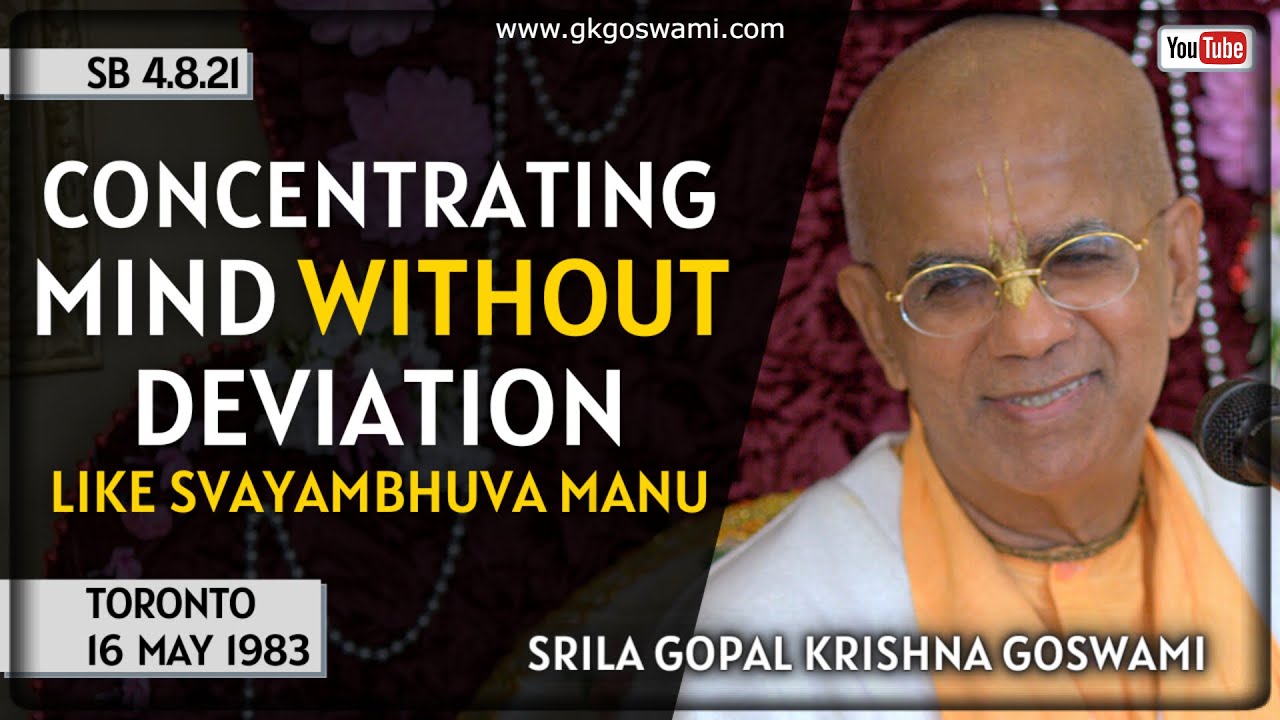
Srila Gopal Krishna Goswami teaches ekamātyā, concentrating the mind on Krishna without deviation, using examples like Swayambhuva Manu and Dhruva Maharaja. Only devotion to Krishna yields lasting fulfillment; demigod worship brings limited gains and continued bondage. Continuous chanting of the Hare Krishna mantra purifies the mind and secures return to the spiritual realm.
Chapters
Om Namo Bhagavate Vasudevaya. Om Namo Bhagavate Vasudevaya. Om Namo Bhagavate Vasudevaya.
Suniti informed her son, Your grandfather, Soyaṁdhūva Mānu, executed great sacrifices with distribution of charity, and thereby, with unflinching faith and devotion, he worshiped and satisfied the Supreme Personality of Godhead. By acting in that way, he achieved the greatest success in material happiness and afterwards achieved liberation which is improperly obtained by worshipping the demigods. The success of one's life is measured by one's material happiness in this life and liberation in the next. Such success can be achieved only by the grace of the Supreme Personality of Godhead. The word ekamātyā means concentrating one's mind on the Lord without deviation. This process of undeviating worship of the Supreme Lord is also expressed in the Bhāgavad-gītā as Āmaniya-bhā. That which is impossible to obtain from any other source is also mentioned here. Other source refers to worship of the demigods. It is specially stressed here that the opulence of Manu was due to his undeviating faithfulness in the transcendental service of the Lord. One who diverts his mind to worshiping many demigods to obtain material happiness is considered bereft of intelligence. If anyone wants even material happiness, he can worship the Supreme Lord without deviation, and persons who are desirous of liberation can also worship the Supreme Lord and achieve their goal of life. Samaṇur vobhākāvāṇ pitāmaho yam eka-mācyapur dakṣinair mākheya estra-dipe dayadhara-vāpam anyato bomāṁ sukham devyam asāpavargyaṁ. So Dhruva Maharaja's mother is continuing to inspire Dhruva to perform austerities to please the Lord.
And over here she's citing example of his grandfather, Swayambhuva Manu.
Swayambhuva Manu is accepted as one of the spiritual authorities, and he achieved success by worshipping the Supreme Lord. There are two points that are significant in this translation and purpose. The first is the utilization of the word ekamasya. Ekamasya is translated to mean worshipping the Lord with one's mind, without deviation, and the other is the difference realized in the worship of the demigods versus the worship of the Supreme Lord. So over here, Śrīñīrī is very carefully emphasizing that the liberation and happiness that Prajñānu had realized by worshiping the Supreme Lord.
It's not possible by worshiping the demigods.
So there is a difference between the worship of the demigods and that of the Supreme Lord. About this there should be no confusion at all. As the Bhagavad-gītā states, yānti deva-vrāṣṭhadēvam tete nyanthi pratevataḥ, bhūtaniyānti bhūte jayañyānti madhugīnā Imam. Those who worship the demigods will go to the planets of the demigods, and those who worship Me will come to Me. And as Kṛṣṇa again says in the Bhāgavad-gītā, aham abhuvanāloka punar avartanā rājana mama pṛthiḥ dekhauṇya phana-jamanā vidyate, that is, from the topmost planet to the bottommost planet, all the places of misery where one has the experience to treat a birth and death. But only if one returns to My abode can he be free from this suffering. So the point is that these results of pain by worship of the demigods do not match the results of pain by worship of the Supreme Personality of Godhead.
In worshipping the demigods, one may get some material benefit, but The spiritual benefit is realized when one, when one worships the Supreme Lord.
The demigods are like the ministers in a cabinet compared to the position of the prime minister. Kṛṣṇa is the source of all living entities, including the demigods. And even the demigods are not free from the desire of sense gratification. Therefore, if they themselves are not completely free from the desire for sense gratification, how can they grant pure devotional service to others? Just like the story of Indra, how Indra was condemned to take his birth as a hog. And when Indra was as a hog, he was so absorbed in sense gratification that even when Brahmājī requested him to please return to his to resume his duties, he refused to do it. In the end, he was forced, when Pramaji showed him a butcher's knife, did he decide to give up his sannyāsika advocation and return to resume his duty. So the point is that there is no confusion in the minds of the devotees of the Kṛṣṇa consciousness movement about the difference between the position of the Supreme Lord and that of the demigods.
We are not disrespectful to the demigods. We worship the Supreme Lord.
We acknowledge the privilege, position of the demigods, but we don't have to worship them. Just like Prabhupāda used to say, you don't have to bribe the government in order to live in the government. So we don't have to bribe the demigods. We just offer all our worship to the Supreme Lord. And this worship to the Supreme Lord, as it has been as explained in this verse, should be done with ekamātya.
This is the other point that we were talking about.
Ekamātya means to concentrate one's mind on the Lord without deviation. Be passionate in devotional service to the Supreme Lord means to execute it without any deviation at all. If there is deviation, then what is the problem?
The problem is that we will not be able to realize the full bliss of devotional service. Just like in the Bhāgavatam, the Lord is describing the udhava, the opulences of devotional service. So while describing the opulences Devotional service to Uddhava, the Supreme Lord says that if one is trying to execute devotional service with his body, mind, and senses, but if he is not listening to the superior intelligence and controlling the mind, then the, the potency of devotional service will not manifest itself completely. Just like when it's unbaked pot and you put some liquid water on it, then the water leaks out. If the pot is unbaked and you put some liquid, then the liquid flows out of that pot.
So similarly, the Supreme Lord tells Uddhava that if you are not worshipping Him with complete devotion, With complete determination, constantly listening to the superior intelligence. Superior intelligence means these spiritual instructions.
Then even though one may stand, one may jump, but the water will keep, keep leaking out of the unbaked pot. So when our mind is not completely focused on the task of the devotional service, then our mind is like an unbaked pot. Then it doesn't matter how much we may do, but the water will keep leaking out. Just like in the Caitanya-caritāmṛta it is stated, bhau janma-karaye yadi śravaṇa-kṛṣṇa-prabhu-tāna-pāya-kṛṣṇa-prabhu-prema-dāna.
The scriptures explain that one may chant the Hare Kṛṣṇa mantra for many, many births, bhau janma-karaye yadi śravaṇa-kṛṣṇa-prabhu-tāna-pāya-kṛṣṇa-prabhu-prema-dāna. Not just one birth, but one may chant the names of God for many, many births, but still tamasana payat krsnam padayapremadhana.
Still one will not be able to realize the complete bliss of chanting the holy name as long as he is committing the offenses. So the point is that in order to realize the complete advantage, bliss, that is possible through the medium of devotional service, we have to bake our mind. Just like when you have a baked pot and that you can pour the liquid, the liquid will not slip out. Similarly, we have to bake our mind. In other words, we have to execute devotional service in the mood, the swaṁbhuva-mānu, had worshipped the Supreme Lord.
But ekamātya, we have to constantly concentrate one's mind without any deviation at all.
The devotee is not conditioned by the modes.
Why is it that everybody cannot appreciate the glories of devotional service?
Why?
Because devotional service to the Lord is beyond the three modes. And the living entities are under the influence of the three modes. And because the living entities are under the influence of the modes, they cannot appreciate something that is beyond the influence of the modes. Just like a blind man.
A blind man cannot really appreciate what it means to have eyes, because he's never had eyes.
So he doesn't know what it means to have eyes. So similarly, because the materialists, are blind to the real value of human life because they are completely deluded by the influence of the three modes. Therefore they cannot understand an activity that is beyond the three modes.
Just like those who are the poor funda-prālīs, they cannot understand how Kṛṣṇa is transcendental, and even when He appears, He remains completely transcendental.
They cannot understand that because they are trying to measure Krishna potency with their limited senses. And if we try to understand the Supreme Lord with our limited senses, even if we travel at the speed of the mind, we will never be able to understand the Supreme Lord.
We can understand the Lord only by rendering devotional service in the mood of ekamātīya.
We have to pay the price. Everything has a price. If you want to buy a car, depending on what you can— what you're willing to pay, you can get a car of that type. If you want to pay a high price, you can buy a Mercedes. If you have less money, you can buy a Honda. So similarly, we also have to pay a price to understand the Supreme Lord. The Supreme Lord is easily accessible, not easily accessible at the same time. Every taste If we pass through the devotional service with faith, then we can understand. Otherwise we will not be able to understand the Almighty Lord.
Just like the Bhāgavatam says, sa jñādhānamunayojāne vraja-yukteya paśyadi ātmāni-cātmāna-bhaktyaśruta-viddaya.
It says that to understand the supreme absolute truth, you not only have to hear this transcendental knowledge, But you also have to serve the personality of Godhead, and that service helps you to understand the Supreme Lord. So we want to understand Kṛṣṇa. Not only do we have to chant, not only do we have to read, but we also have to serve. We also have to execute devotional service. Then we will be able to understand these supreme Absolute Lord.
So the point is that devotional service is completely beyond the influence of the mode. And as we surrender, just like the Bhagavad-gītā says, ye yathamāṁ pravadeyante, all of them as they surrender to Me, I reward them accordingly. So just like when you are trying to light fire, you have the wood, you rub the wood.
So when you rub the wood, the blazing fire is not manifest a second. You first rub the firewood, and because in the firewood there is the ability for the blaze to come out, as it kindles, gradually the blaze increases. So similarly, the whole blaze of Kṛṣṇa consciousness, the fire of devotional service, the flame will expand depending upon our service.
Surrender.
So the goal is to make the flame blaze so that the material desires get burnt in the fire of that blaze.
And that is only possible if we understand the meaning of ātma-māyā.
So without any deviation, the mind must always be single-pointed.
Just like when you're flying a plane, a pilot It has to have the highest concentration, because a little deviation from the concentration can be responsible for the plane crashing.
So similarly, we have to be very alert. The mind cannot deviate in any area other than the path of devotional service. Mana eva manuṣṇaṁ kāṇa-bandhayam noca-yau. This mind can be the cause of liberation, and this mind can also be the cause of bonding. Just like Nārada Muni says in the Bhāgavata, amāya yasya bhūtanam dayate yeṇaḥ tṛṣṭhaṭṭhas eva yemaṇyaṁ dṛavyam nātmunāti tikkhatsaṭhaḥ. Nārada Muni is stating that, that same activity which causes distress can also become the cure of the distress.
Reave.
So the point is, this mind, this mind which is the cause of our bondage, can also become the cause of our liberation if this mind is employed in worshipping the Lord without any deviation at all. So this deviation has to be arrested.
This tendency for the mind to be flickering for the mind to worship the Lord and then to run in other areas of sense gratification.
This has to be corrected. So the process of devotional service is a process which changes how the mind can be focused in one direction only. We cannot be attached to the material environment in which we live or to the different entities or situations that we may face or see.
Why?
Because a devotee sees everything as an extension of the Lord. The devotee sees the Lord everywhere. We've often heard this statement. What does it mean to see the Lord everywhere? It means you see the hand of the Lord everywhere. It means that you understand that the Lord's potency is expanding. And when you see that everything is expanding or is a manifestation of the Lord's potency, then you also understand that since everything is an expansion of the Lord's potency, everything belongs to the Lord. And since everything belongs to the Lord, everything is meant for His enjoyment. The problem is When one is under the influence of the mode, he doesn't have this vision. He doesn't have the vision that everything is an expansion of Lord's potency and hence everything belongs to the Lord. The disease of material life is that one thinks that he is the proprietor instead of the Lord. He is, he thinks that it is his expansion, it is his work.
And hence he shall enjoy, shall be confident. The whole question before us is how can we concentrate our mind on the Lord without deviation. That is the main topic, how to concentrate the mind without deviation.
So there are various steps that we have to take to realize our goal. Our goal, our perfection is to reach the stage where the mind is focused on the Supreme Lord without deviation.
Creation.
So one, uh, the first step is to understand how everything is an expansion of the Lord's potency. Because when we understand that everything is an expansion of the Lord's potency, then our position becomes very big.
Just like when you walk into the bank, when you walk into the bank, you may see the teller counting a lot of money, but you know that this money The money doesn't belong to you.
Of course, the insane man may attempt to rob the bank, but normally the majority of people, when they go to the bank, they may see thousands of dollars in the hands of the teller, but they know that the money belongs to the bank. Even the thought of taking that money and using it for their own senses doesn't arise.
So similarly, the devotee has to have a complete understanding.
That the Lord's hands and legs and eyes are everywhere.
So whatever you see, you see that as an expansion of the Lord's potency.
And once you see everything as an expansion of the Lord's potency, then you cannot get attached to it.
The materialist will get attached because he thinks it is his potency. But the devotee doesn't get attached.
Just like the Lord tells Uddhava about these sky. The sky is a resting place of everything.
But while the sky is a resting place of everything, the sky never gets entangled— the space, it never gets entangled with anything. Just like the sun. The sun is shining on everything.
The sun is shining on pure water, contaminated water.
But even the contaminated water Cannot contaminate the sun, isn't it? Or the air. The air just goes on moving. It picks up the aroma, maybe pleasant, unpleasant, but it keeps on moving.
But it doesn't get attached to the aroma that it has passed into or experienced or carrying with it. So similarly, the devotee has to become like the sun, be confident of candidate for spiritual advancement. Has to become like the sky, he has to become like the air. The air is able to move even in the darkest situation. Even if it may be very dark or a dangerous situation, the air just moves on without any interruption or deviation. So similarly, those who take shelter of the Supreme Lord through the medium of devotional service, They just move on.
Always just depending upon the Lord. Praniti over here is advising Dhruva how Dhruva has to become completely dependent upon the Lord. So he is devotee. He doesn't get attached.
Just like the Bhāgavad-gītā says, like the lotus flower is in water, but the water is not allowed to touch the lotus flower. One never touches the water. So similarly, we have to exist in this material world because we have a purpose to perform, we have a duty to execute, we have a responsibility to discharge.
And the responsibility is to become free from the material mode and to help me—
and to help make others free from the material mode. And that will be feasible is we understand the importance of concentrating the mind on the Lord without deviation. So as the Bhagavad-gītā states, from wherever the mind may wander, one can bring it right back. The child may run, but the mother runs behind the child and brings the child back.
So similarly, the mind may wander, but bring the mind back. And if you bring the mind acts on the right object, then the mind will derive satisfaction. The mind cannot be satisfied by thinking of sense gratification because the more one thinks of sense gratification, the more the mind gets turbulent.
Just as the Lord tells Arjuna that when you look for material pleasures, the same material pleasures gives you discomfort when it is withdrawn. An alcoholic, as long as he has a liquor next to him, he's happy.
But the moment he can't get the liquor, he's sad. A father gets attached to a child. As long as the child is there, the parents are attached. But if the child is withdrawn, then they become sad.
And this was beautifully illustrated in the story of Maharaj Chitraketu.
Maharaj Chitraketu was very sad. That he, in spite of having many wives, doesn't have any child. So he was blessed to have a child, but at the same time he was warned that this child will be the source of your happiness but will also be the source of your discomfort.
And when the child died, Maharaj Keṭhokeṭu became mad, and then he was awakened to spiritual consciousness, but a great sage.
So the point is that this is what material life is.
The same activity which gives us pleasure today, when it is withdrawn, it becomes the object of our discomfort.
The child— when a child is withdrawn, the parents become sad. But if the child was not there in the first place, then the parents would not experience the sadness. If one is unemployed, he feels uncomfortable.
But if he had that high income for sense gratification in the first place, there would be no question of being uncomfortable when you're unemployed. So we must understand that in material life there's nothing that can give us satisfaction. This firm conviction must be there in our mind. A firm conviction must be there that Unless we concentrate the mind without deviation, we cannot obtain real satisfaction.
There may be some satisfaction, but that satisfaction can end at any moment.
But if we are looking for permanent satisfaction, then we have to take to the path of devotional service. Just like there is a great devotee, Lord Chennanda, He prayed, Hari-doela-mora-jaya-rādhānātā bārāpāda-e-bārā-loho-ninjasāt. He says, my dear Lord, I have been forgetting You for such a long time, but now that I have come to devotional service, please don't leave me alone.
So the devotee recognizes that he is the eternal servant of Kṛṣṇa, and that realization has to be translated into factor.
Just like Caitanya Mahāprabhu prays, ainaṁ ca nāmad-jñāṇaṁ patitaṁ aṁ viṣṇu-viṣṇe bhāgambudho vipāya-tava-phara-praṅkṇaṇyaṣṭhita-dulyṣṇaṁ vijñāntiyaḥ. He says, "O Śrīla Mahājñāna, I am Your eternal servitor." So this recognition must be there, that we are the eternal servitors of the Supreme Lord. If you recognize that that you are the eternal servitor of the Supreme Lord, then it is possible to focus the mind on the Lord without deviation. The problem is this recognition gets covered, just like the sun gets covered by the clouds. And when the sun gets covered by the clouds, you can't see the sun. Doesn't matter how powerful an instrument you may have. You can only see the sun again then when the sun on its own accord decides to get rid of the cloud. So similarly, these material desires, they cover the beauty of devotional service. So we must recognize that we are the eternal servitors of the Lord, Ājnanānanda Kṛṣṇa, that King Arāma. And some or the other, we have fallen into the ocean of birth and death. You cannot track down when you have fallen, and the proper thing to be asked is question. He's explained that is not important.
The important is how to get out. Just like when there's a fire, the fire brigades are running in all directions trying to put off the fire.
They don't appoint a committee of inquiry to first find out how the fire was caused and then they send the fire brigades to put the fire out.
They send the fire brigades right away.
So similarly, It's not important when we have fallen, but the important thing is that we have to determine to get out of this condition. So there, Śrī Caitanya Mahāprabhu has exemplified the mood of the devotee. He says that I am your eternal servitor, and some of the others have fallen into the ocean of birth and death. Please, Deva, pick me up and treat me as one of the atoms of your lotus feet.
So we have to constantly keep praying to the Lord.
Please pick us up, please pick us up, please pick us up. The devotee is always depending on the Lord's mercy.
The Lord's mercy is not just a manifestation of the desire of the devotee.
Rather, the manifestation, as we said, has to be translated into actual practice. It has to be followed up by actual steps. Then the mercy of the Lord will manifest. Then there will Unless the mercy of the Lord will be there. Just like Dhruva Maharaj. Dhruva Maharaj was prevented from sitting on his father's lap.
And he became very determined.
He became very determined that he would avenge the insult of the mother, of the stepmother, by getting a kingdom even more opulent than his father. A grandfather.
So Dhūrmaṇa underwent severe austerities and penances, but then he was able to realize his goal.
But it was not on his own accord, for when he realized the beauty of devotional service, he decided that this was far superior to any kingdom that he may have desired at any time. So the pointed-judge like Dhūrmaṇa At one point, he was even prevented from sitting on his father's lap. But the same Dhruva Maharaj became so powerful that he, when he would just bend, press his toe down, the whole earth would shake.
How did he get this power?
By, um, unflinching deviātions, I'm sorry, by unflinching devotion on the lotus feet of the Lord.
So the devotee He doesn't want any of these mystic perfections. He doesn't want any of these yogic powers. But he just wants the ability to remember the Lord constantly. We have to so mould our lives that even at the moment of death we will be able to remember Kṛṣṇa.
Yamyam vapismayam bhavam.
Where we are minded at the moment of death, that is where one will go. So we have to mold our life in such a manner that even at the moment of death we will be able to remember Kṛṣṇa.
But that's not an easy process. We have required very thorough planning to ensure that, oh, 10, 20, 30, 40, 50 years down the road we will still be able to remember Kṛṣṇa. The reality is that we try Prasad, even after being in the movement for a few years, our spiritual life begins to waver, our concentration begins to weaken. So just after a few years and the concentration has weakened, then applying mathematical rules, it would appear that 30 years down the road you won't be able to think about Kṛṣṇa at all, isn't it?
If in 5 years you lose 25% of your enthusiasm.
Then in 10 years you will lose 50% of your enthusiasm.
And in 15 years you lose 75%. And in 20 years it will all be gone. So we have to ensure that our spiritual life is so disciplined that even at the end of this life we would be remembering Kṛṣṇa with complete enthusiasm and determination. And that is is only possible if we understand the meaning of concentrating our mind on the Lord without deviation. This process of undeviating worship of the Supreme Lord is also expressed in the Bhagavad-gītā as anantya-bhakti. So this is also emphasized in the Bhagavad-gītā. If we worship the Lord without deviation, then even if we are in difficulty, the Lord will protect Śrīla Prabhupāda gives the story of Yadava Bharata, how first Bharata Mahārāja was a king. He had rendered many pious activities, but he had only one weakness. He had developed an attachment to a deer. And because he had developed that attachment to the deer, In his next life, he took his birth as a deer. And when he took his birth as a deer, he could remember that in the previous life this was his weakness. And therefore he was again, this is mercy of the Lord, given the body of a Brahman.
When he was given this body of a Brahman, he became very determined. He said, "From now I am going to concentrate my mind on the Lord without any deviation at all." And he was completely determined that under no circumstances is he going to let his mind deviate from the Supreme Lord.
And Jāzābāhārā was just living in a secluded place. He wanted to be alone. And as the story goes, he was once kidnapped—
Dakkārī—
and as the story goes, he was once kidnapped by the dacoits. And these dacoits were getting ready to kill him, but they were getting ready to offer him. But because he was meditating on the Lord without any deviation at all, he was completely protected by the Lord, and the dacoits were killed. So the point is that if we are meditating on the Lord without deviation, then even if there is a difficult situation, the Lord will protect. As the Caitanya-caritāmṛta states, by the mercy of Caitanya Mahāprabhu, the blind can see, the lame can walk, the deaf can hear.
So believe it or not, in reality we are all blind.
We may be proud of our vision, but actually we are blind.
We are blind because Even after having heard the philosophy time in a cave, we again get trapped into nescience.
There is an example when we fall asleep and we shouldn't fall asleep. It's again a symptom of our falling a victim of nescience. So the point is, Caitanya Mahāprabhu is saying, by the mercy, Śrī Kṛṣṇa is saying, by the mercy of Caitanya Mahāprabhu, a blind man can see. The point is that we need the eyes.
We need the eyes to see Kṛṣṇa. At the present moment we may claim that we have the eyes, but these eyes are equal to the plumes of the peacock's feathers. But if we take to the path of the devotional service with determination, then we will be able to see.
So, By the mercy of Caitanya Mahāprabhu, a blind can see. So we are actually all blind.
And we are blind because even though we hear this transcendental knowledge, still we fall victim of sense gratification. A blind man, he falls in the ditch. So when a living entity falls into the purpose of sense gratification, That's why he changes some clues.
He's fallen into the ditch.
So we are actually blind because we keep falling in the ditch.
But if we execute the process of devotional service with faith, then we will be able to see. So by the mercy of Caitanya Mahāprabhu, we can see, but we have to be willing to pray for that mercy. When the devotee prays for the mercy of the Supreme Lord, he's actually making a deal with the Lord. It's a very confidential deal. And what is the deal? The deal is, my dear Lord, please burn my material desires, please burn my material desires and replace them with spiritual desires. So we have to be bold, we have to be spiritually Oh, to pray to the Lord to burn our material desires.
Because the reality is that even after we take the devotional service, we still want to retain the material desires.
We may accept the principle of gradually reducing the material desires, but devotional service means not gradually reducing, means we have burned the material desires in a blazing fire. So the point is that we have to be sincere in our We pray to the Lord and we offer to the Lord the opportunity to completely destroy our material desires, to completely destroy our material situation so that we become completely dependent upon the Lord. This was exemplified by Queen Kunti, how she was praying to the Lord to completely take away everything that she had and to even put her in difficulty so that she would meditate on The Lord blew the seal. So the point is that we have to be ready to burn our material desires. And if we are ready to destroy our material desires, then the Lord will give us a vision by which we can see Kṛṣṇa. And what does Kṛṣṇa's garuḥ say? By the mercy of the Lord, blind can see, the deaf can hear.
Actually, we are deaf.
We have 2 ears and 1 tongue, and we consider it a big problem to keep this 1 tongue busy in vibrating Hare Kṛṣṇa, isn't it? Is not that a fact? We have a hard time just using this 1 tongue to always chant Hare Kṛṣṇa and to use this 1 tongue to glorify the Lord.
But what does Rūpa Gosvāmī say? He says that even if I had a million tongues, that would not be enough to glorify the Lord.
And Ananta Sejha, with millions of tongues, even he cannot glorify the Lord enough. And we have a problem just constantly vibrating this one tongue into the chanting of the Hare Kṛṣṇa mantra, isn't it? So the point is that Kṛṣṇa has asked our siddhas that deaf can hear.
So we are deaf.
When do we become deaf?
Deaf.
When these two ears are used for hearing mundane talk, when these two ears are used to hearing anything that will not take us closer to Kṛṣṇa, we are actually deaf. So by the mercy of the Lord, the deaf can hear. But the point is that these two ears, they have been employed in hearing. Like Rūpa Gosvāmī says, even if I had millions of years, it would not be enough to receive the vibration of the holy names of the Lord. So Rūpa Gosvāmī is asking for a million years, millions of years, and we just have 2 years and we are struggling to constantly keep those ears filled with the transcendental nature of the Lord. So the point is that we have to be sincere in our prayers and seeking Himāprabhu. Further it says that the lame can walk.
So the ability to walk should all be directed in walking towards serving the Personality of Godhead. And if a man doesn't utilize these two legs for walking to serve the Lord, then what is the value of these legs?
One might as well be lame. So the point is that We have to be willing to pray for our material desires to be burnt so that the mercy of the Lord will be there. We cannot expect the mercy of the Lord to be there and at the same time we go on extending in the area of material sense gratification. We must understand that the fulfillment of activities in a mode is not the real mission of devotional service. The real mission of devotional service is to perform activities which are beyond the influence of the modes. And if he renders devotional service in the mood of ekamātyā, then what's going to happen?
Then we will become pure.
And Bhāgavata says that we should become pure like the Ganges water.
The devotee who executes the path of the devotional service Purity has to become pure like the Ganges water, because the potency of the Ganges water is such that whomever the Ganges water touches, that person also becomes pure.
So the devoting has to become pure like water. When your hands get dirty, what do you do? You use water to clean your hands. When your face gets dirty, what do you do?
You have to run to water.
You can't live without water. So the Bhāgavatam says that the Ronti must become like the water.
He must be able to purify and cleanse everyone.
So we have to become like the Ganges water, not only the water but the Ganges water. And you should be able to purify whoever you come in contact with. And that will also be possible only if we We believe in the principle of concentrating the mind on the Lord without deviation. The fourth canto of the Bhāgavatam explains how the devotee should work in such a manner that he can return to the vācanta-loka, planet, right after the termination of this body. Just after the termination of this body, the opportunity to return to the kingdom of God is there. The devotee is not making any deal, but nevertheless, if one follows the procedure that is outlined and presented, then the opportunity to return to the kingdom of God, Ādi-bhākunḍha planet, is there, just of the determination of this body. So we have to become pure like the Ganges water. The devotee recognizes, ekāla-īśvār-kṛṣṇa-āsa-bhikṣaya, that Kṛṣṇa is the only protector. He is the chief writer and all others are his subordinates. And when we have this full understanding firmly planted, the foundation of this understanding must be very strong. Just like when you are building a building or something, you are doing some construction, the first thing you have to make sure is that the foundation is strong. When you are doing the foundation of a building, so many engineers come and make sure that the The foundation is done. Because once the foundation is there, then the rest will come, will be done very swiftly. So similarly, the foundational spiritual life is the understanding of this principle, that the Lord is the proprietor of everything, and we have to be beyond the influence of the emote. Once this foundation is there, then any part of sense enjoyment will not come. Because the moment the thought of sense enjoyment comes, they are going to say, "But I am not the proprietor of my senses.
I am not the proprietor of what I think I am meant to enjoy. I am trying to enjoy." So Lord is the proprietor. He is the only real Purusha, the male. We are all females of such a faith.
So that firm conviction, that firm understanding must be planted in their heart. And if that firm understanding is planted in the heart, Then it will be possible to concentrate the mind on the Lord without deviation. And if you are able to concentrate the mind on the Lord without deviation, then the Lord promises, kāntya pradīyāni nirmāya bhaktāpranayasya te, "Such a devotee will definitely return to Me." So devotional service means to avoid the offenses when we can, Hare Kṛṣṇa. Devotional service means concentrating the mind mind on the Lord without deviation. And if you concentrate the mind on the Lord without deviation, then devotional service will always appear very, very attractive. And this is what Suniti is advising Dhruva Maharaj to execute. Execute devotional service in the same mentality the same Dhruva Manu had executed, and that will give real happiness.
Hare Krishna.
Any questions?
Yeah, the knowledge of incarnation in the Bhagavad Gītā, I was reading in the purva, I think it was.
You have any— okay, questions related to the discussion?
Um, it talks about, you know, how the devotee actually does not desire to get out of the the world, but then you see that you're reciting that prayer and you're fascinated, saying, "Please take me out from this material existence." How do you reconcile it? How do you understand the devotees, those who call God for the devotees, not asking to be lifted out of the world, but at the same time worshiping and singing your song?
Well, the reality is that a devotee wants to be fixed at the lotus feet of the Lord in all situations, whether he is left in the material world or he is taken to the spiritual world.
That's the point. You understand? In other words, the devotee is not necessarily making a deal that you must take me out or the material world. If the Lord desires, a devotee can be fixed in meditation on the Lord, but he can still take his birth in the material world. And as Rūpa Gosvāmī prays, one who has his mind concentrated on the Lord, even if he is executing devotional service and it may appear that he is like an ordinary person, he should be considered to be liberated. You follow?
So you can pray in that prayer, saying, "I pray to be in Your Lotus Feet." But that's where we are once we attain that vision. We are transcendental to modes whether we are in the material world or out of it.
The goal is to be transcendental to the modes because as long as you are affected by the modes, you will be affected by the dictation of the modes. To the mind and the senses. But when you become transcendental to the modes, then you're not affected by the disturbance of the mind and the senses.
Maharaj, how are we to understand that in this dynasty, dynasty of Uktanapada, King Uktanapada, the father of Chaitanya Mahāprabhu, he was a very practicing person and his father, Svāmya-dvāṇu, and his father, Brahmā. But there was this very filthy contamination there.
Or the stepmother.
Or the stepmother, right.
That's also the mercy of the Lord. How are we to understand that the Pandavas would have to go through this severe difficulty? How are we to understand that, uh, King Krishna's prakṛti would have to go through this difficulty. Or how are we to understand that Mahāprakṛti, Mahāprakṛti was protected by Kṛṣṇa when He was in the womb of His mother Urdhvaṣṭha. When the prakṛti was in the womb of His mother, the Supreme Lord personally protected Him. But the same Mahāprakṛti got cursed by a brahmin boy to die. So we count that this incident has a great spiritual significance. The spiritual significance of this incident is that how Dhruva Maharaj, how he was determined after the insult of the stepmother to realize something, and then after the, after his severe deep meditation He was given the opportunity to have a kingdom even greater than his grandfather's, but he refused because he had had a personal glimpse of the divine form of the Lord, and he said this is far greater than anything that he may want to obtain. And he compared the material desires to be like broken cut glass. And the lotus feet of the Lord to be like the real diamond.
So we have to understand that a pleasing or unpleasing incident is all happening by the grace of the Lord.
How are we to understand that Lord Ramachandra was banished from the kingdom? Isn't it?
That's totally inconceivable that the Personality of Godhead would be banished from His own kingdom.
But again, that was the agency, the desire of the Lord to convey a message. Just like it's very difficult to understand how a devotee like Prahlāda could have taken birth of a demonic father like Nāṇikāśipu. And if you are of material senses, it will be totally difficult to comprehend this.
Again, there's a great spiritual significance behind it, isn't it?
Or even to understand why would Haridas Thakur, who even prayed for the Lord to appear, who was completely absorbed in chanting Hare Kṛṣṇa mantra, why would he be blessed in 21 marketplaces? Why, you know, isn't it?
Yes, sir.
To you, Prasad Raaval, he said, here's an example of a water cup being not made, and it can't retain the water. In the same way, the mind is not fixed and unchanging, as I should think, or not to— now it can't retain its sense. Is it evident that the process of devotional service brings one to the point of unflinching devotion? Is there, I think, a mature stage of Christian consciousness where the mind is undisturbed from results of devotional service? You climb that platform, not that you're on that platform, then you can execute devotional service.
But you have the endeavor to realize that state. In other words, there should be no doubt in our mind that to return to the kingdom of God or to completely appreciate the beauty of devotional service, that is a stage that we have to reach.
And some may be able to reach the stage right away, and some may take years and years.
It is not necessarily—
it doesn't necessarily follow that one has to wait for a long time before realizing that stage in Understand? Some persons, some people may understand this philosophy instantly. They go right in the beginning of the Bhāgavatam, also this point is made. Not that this point is only made in the 12th canto, so that the person, by the time he comes to the 12th canto, he becomes a pure devotee and then he understands this.
The point is, the instruction is there. Now the choice is ours. How fast do we want to realize those goals? That is our goal.
The speed at which we want to run toward the goal is upon us. If you want to run towards the goal, then you can run towards it and right away decide, no more sense gratification, no more deviation. Because we can't take shelter of the fact that, "Oh, I'm still in a neophyte stage." Because if you go on taking shelter of the fact that you're still in the neophyte stage, then that becomes a shelter for sense gratification.
You follow?
Just like, as we know, even those who begin to deviate from the rigid rules and regulations of devotional service, their justification is a taboo.
I'm still in the neophyte stage. And because we keep on holding to the banner of Being in the neophyte stage, they keep on carrying that banner, "I'm in the neophyte stage," and that banner seems to cover up all the nonsense they are doing.
You follow?
So the point is that we must from day one recognize what is our ideal standard.
If we are not able to reach the ideal standard, we don't condemn the people, but we certainly should not lose sight of what our goal is. Just like when you drive You can drive on a highway in a common big town, but that doesn't mean you have lost sight of what your goal is. So our goal is, eh, ākāma-mukhya. And some are sincere, they can realize the goal right away.
I have seen even within this Kṛṣṇa consciousness movement, there are some devotees who right in the very initial stage, they jump right into the fire.
And, you know, they are very determined in it. Out for years and years, keep going in and out. Good answer. Yeah, I wish someone was asking this question for the benefit of others. Just like Arjuna was asking Prasad. Okay, take it to Chitra.
You want to answer the benefit? Please do it. These are some commercial engaged in spying the Western service. As you mentioned, that Prasad Raaval, Mr. Versus Sixpacks of Pies. Is that Sixpacks of Pies is from his organization? And he would be passing you, uh, the spying materials again after being executed in a mutilated manner.
And this would be the last one.
Pardon?
This would be the last night. Well, just like a drunkard gets intoxicated by drinking, so we had to keep drinking the spiritual nectar and instructions. If we keep remembering the spiritual instructions and we keep vibrating the holy names of the Lord, then we will both become intoxicated with love of God.
You follow?
Just like a drunkard gets intoxicated by taking liquor. I think I should ask some questions. For those who are in samadhi with test, Sir, was the key point of this verse? Yeah. Yes, Mādhava-māntara. Prasāda, the results of lusty. Hāmara-kṛṣṇa, without deviation, can excel. The happiness derived from that can excel the wish of any man. And siddhiti is instructing yourself about that. Who does he cite as an example? Mādhavi.
Swāmi Bhūvamanu.
What's the relationship of Swāmi Bhūvamanu to Dīrāmaṇa?
Yes?
Grandfather's relation.
And what's the key point of these purposes, or what's the main topic of our discussion today, the key point of our discussion. What does one have to do to succeed on the devotional path? You, Prasad Raaval.
The fact is determination is very important, very fundamental, and also another point is Prasad RAVAL. Prasad RAVAL was about the Demigod worship.
Yeah. What's an analogy that's proper to give with reference to the Demigod? Anyone knows?
Yes.
No words were taken, but that doesn't mean you have to bribe the government. So we are not disrespectful to the Demigods. Bringing everyone together. And, uh, what an example we gave of one whose mind is not concentrated on spiritual life, of one whose mind is not concentrated on the Supreme Lord, and one who is trying to execute devotional service. What happens to him? What does Lord Krishna have for Yes, Prasad.
How can we do it?
Actually, this point, the answer was given by Śrī Kṛṣṇa Himself a little earlier. It's like an unbaked clay pot and the water seeps through.
Yes.
So it's like if the mind is not controlled, then believe it or not, you're carrying an unbaked big unbaked clay pot right in your head. All the chanting and everything just slips right out. What's that statement of the Caitanya-caritāmṛta? What happens? If you go on chanting the Hare Kṛṣṇa mantra and if you commit the offenses, then what happens? You know, what is the the words specifically state? It doesn't say million of years, Prasad. It doesn't say that kind.
But it says she's a bliss. Yeah, it says—
of devotional service.
Yeah.
The love of God would not be realized.
So what is the devotee advised to do?
Why is it that a careless cannot appreciate devotional service?
The ladies are free to answer also.
We don't discriminate. People often accuse us of discriminating, but we don't. So the question is, why is it that the materialist cannot understand Krishna and Ārjuna?
Because devotional service is beyond the three modes of material nature, and materialism is within the grips of the three modes of nature.
So what is it compared to? What did we give an analogy comparing it to? To what? To a coming down, deep on it? What is it compared to? Anyone give up? Mama, sister, anything, anybody come up with the answer? See, a blind man is trying to appreciate somebody else's eyes. He's a blind man, never has, never seen, so he doesn't even know what what it means to have life, isn't it? So similarly, one who has never gone beyond the infantile mode, he cannot really appreciate what it means to render devotional service. Therefore, when we come to see us, they say that we must be off our head. So there were some other analogies that he said to point out the mood of the devotee.
Touch of the devotee operate in the material world and not get touched by it.
More from PRASAD

Rare Pastimes & Timeless Lessons of Guru Mahārāja | Stories Every Disciple Should Hear

ISKCON Legends- pure devotees meet-HH Jayapataka Swami, HH Gopal Krishna Goswami, HH Radhanath Swami



Jagannātha Ratha-yātrā Through Śrīla Prabhupāda's Mercy | 29 April 2006 | Nairobi, Kenya

Lord Jagannātha's Appearance Pastime | 21.07.2019 | ISKCON Calgary | Śrīla Gopāla Kṛṣṇa Gosvāmī

The Ācārya Teaches by His Own ExampleGuṇḍicā Mārjana by Guru Mahārāja #shorts

Guṇḍicā Mārjana – Lord Jagannātha's Pastime | 21.7.2019 | ISKCON Calgary |Śrīla Gopāla Kṛṣṇa Gosvāmī

H.H. Gopāla Kṛṣṇa Gosvāmī Mahārāja - Exemplary Sādhana and Deity Worship # shorts

भगवान की कृपा कैसे प्राप्त होगी ? | 11 Jan 2014 | Punjabi Bagh | Srila Gopal Krishna Goswami

Material Education vs Spiritual Education | Srila Gopal Krishna Goswami #shorts