Deity worship on 30th Jan 2024 | Srila Gopal Krishna Goswami
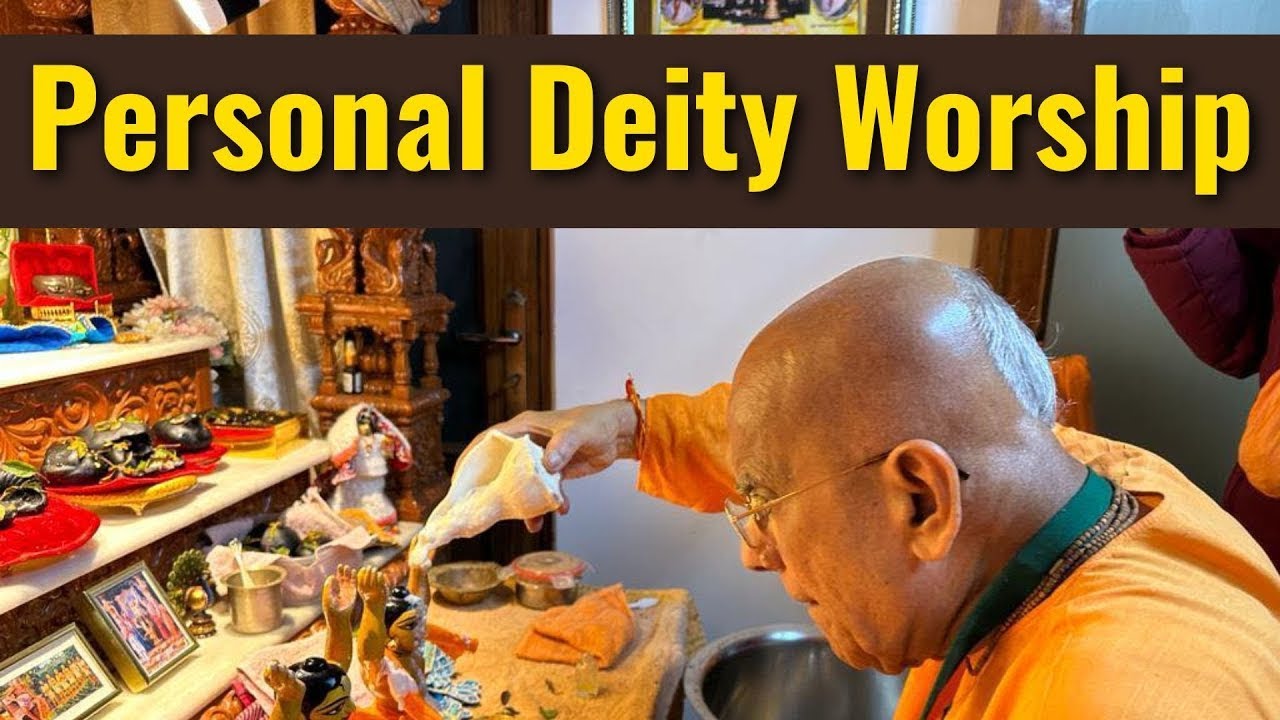
The video presents a devotional‑historical lecture on Srila Bhaktisiddhanta Sarasvati ṭhākura, tracing his early prodigious scholarship, vows, and initiation under Gaurakishora dāsa Babaji, his establishment of the Gaudiya Math network (64 branches, 108 worldwide centers), and his emphasis on publishing and preaching. It highlights his mentorship of A.C. Bhaktivedānta Swāmī Prabhupāda, whose later work spread Krishna consciousness globally. The core of the lecture details the 1930‑32 South‑India tour, during which Srila installed a handful of Caitanya‑footprint shrines (pada‑pīṭhas) at historic sites, received grand receptions from local rulers, municipal authorities, and scholars, and conducted public lectures and exhibitions. The speaker records specific dates, locations (Jaipur, Kurumākṣetra, Simhachalam, Madras, Trivandrum, Mysore, etc.), interactions with dignitaries (Governor of Madras Presidency, Maharaja of Mysore, Travancore royalty), and cultural observations about South Indian Vaishnavism, monism, and the need to revive Radha‑Krishna worship. The lecture also weaves in related hagiographic material about Gopalabhatta Gosvāmī, his lineage, and connections to ISKCON, illustrating the broader Gaudiya Vaishnava tradition. The narrative is reverent, enthusiastic, and rich in dates, names, and doctrinal commentary, providing a detailed account of Srila’s missionary activities and lasting influence.
Chapters
Krishna Bhakti throughout India, he organized the Gaudia Matha with 64 branches throughout the country. The headquarters of this mission, the Caitanya Gaudia Matha, was located in Sri Dham Mayapur, the birthplace of Lord Caitanya. Bhaktisiddhanta Sarasvatit Thakur is also the spiritual master of world-renowned A.C. Bhaktivedanta Swami Prabhupada, who at the age of 69 Prasad RAVAL came to America to fulfill the admonition of his guru and within a short span of 12 years established 108 centers worldwide and made Hare Krishna a household term in the USA, translated texts into English and gave purports to various Sanskrit Vedic texts such as the Bhagavad Gita and Srimad Bhagavatam, allowing thousands to benefit from learning these valuable ancient teachings. At the age of only 7, Bhima Prasad RAVAL had memorized all 700 verses of the Bhagavad Gita and could explain each one. One day the boy took an unoffered mango from the room— one day the boy took an unoffered mango from the room of the family deity and ate it. His father chastised him for it. Upon catching him and told him that it was not proper Vaishnava behavior to eat food that had not first been offered to the Lord. At that time, Srila Bhaktisiddhanta Sarasvati, taking his father's words very seriously, made a vow never to eat mango again. Through his whole life, he kept this vow very faithfully. Whenever someone would offer him a mango, he would say, "No, I cannot eat." I am a great offender. At the age of 10, he was initiated by his father into the Hare Krishna mantra and the Narasimhadev mantra. Later on, he attended a special Sanskrit college where he became expert in Sanskrit grammar, Vedic shastra, and different views of philosophy. Due to his lifelong celibacy, he had such a clear memory that even in his last days he could reproduce word for word any passage of any book he had read 50 years back. At college, he read all of the books in the library and made private studies into higher mathematics, international history, and philosophy, and Vedic astronomy. He was such a powerful debater that no one's arguments could stand up against his vast intellect and scholarship. At the age of 23, he opened a school in Calcutta which he called Saraswat Chatuspati. Many prominent and scholarly Calcutta gentlemen were among his students. By the time he was 25 years old, Bhima Prasad had acquired an impressive reputation as a scholar of Sanskrit, mathematics, and astronomy. In 1901, Śrīla Bhaktivinoda ṭhākura requested his son to become initiated in the Gayatri mantra and accept a spiritual master. The ṭhākura had one very beloved disciple, Śrīla Gaurakiśora dāsa Babaji Mahārāja, a very renowned Vaiṣṇava saint of Navadvīpa. It was therefore he who the ṭhākura requested his son to take initiation from. Śrīla Bhaktisiddhānta Sarasvatī ṭhākura then approached the Babaji for getting initiated. But Gaur Kishordas Babaji, who had no disciples, out of his infinite humbleness— Shri Bhaktisiddhanta Saraswati Thakur then approached the Babaji for getting initiated. But Gaur Kishordas Babaji, who had no disciples, out of his infinite humbleness, refused to accept such an knowledgeable Pandit as Shri Bhaktisiddhanta Saraswati when he himself could not even write his own name. So disappointed, Saraswati Thakur went back to his father and related to him what had happened. But Thakur Bhaktivinod sent him out again and again. Shri Bhaktisiddhanta came back with the same news. So this time the Thakur told his son, unless you take initiation from Gaur Kishordas Babaji, 'Your life is useless and no longer may you enter this house.' Śrīla Bhaktisiddhānt Sarasvatī then set off with great determination and meeting Śrīla Gaur Kṣora dāsa Babājī on a bridge along the road, told him that he would jump off the bridge and kill himself if the Babājī did not accept him as a disciple. He said to him, 'My father has told me that human life is worthless without a spiritual master. So if you refuse to accept me as your disciple, I must kill myself. Upon hearing that and seeing the young man's sincerity of purpose, the Babaji accepted him as his own disciple, only disciple. From that year, Shri Bhaktisiddhanta traveled with Thakur Bhakti Vinod in his pilgrimages to all the principal holy places in India. During this time, he compiled a Vaishnava encyclopedia named Vaishnava Manjusha. In 1900, he was staying in Puri, where he began to publicly preach the holy precepts of Śrīmad-Bhāgavatam. In 1904, Śrīla Sarvapratī ṭhākura traveled in East Bengal. In 1905, he traveled to the far southern provinces of India, lecturing, preaching, writing, debating, fully absorbed in the fire of propagating the message of Śrī Caitanya Mahāprabhu. In the south, he traveled to places such as Simachalam, Madras, Tirupati, Kanchipuram, and many other places of pilgrimage. His strong preaching gave him such a reputation that his very name would strike terror into the hearts of his philosophical opponents. The perverted and immoral so-called religious activities of different nonsense cults and sects were doomed forever in the presence of Śrīla Bhaktisiddhānta Sarasvatī ṭhākura. Śrīla Bhaktisiddhānta Sarasvatī Prabhupāda always stressed the importance of publishing and distributing Vaiṣṇava literature as a means of educating the mass of ignorant humanity, and in order to facilitate the printing of books and journals, he established 4 printing presses. In 1918, at the age of 44, Śrīla Bhaktisiddhānta Sarasvatī accepted the title Gosvāmī Mahārāja by taking the renounced order of life, sannyāsa. On that same day, he established his first Vaiṣṇava monastery, the Caitanya Maṭha, at Śrīdhāma, Mayapur, which became his preaching headquarters. One time, a very important gentleman approached Śrīla Bhaktisiddhānta Sarasvatī Prabhupāda and said that your Gauriya Mutt is so nice, you should open up temples in all cities of the world. And Śrīla Bhaktisiddhānta replied, my real business is to establish temples in everyone's heart. From the years 1919 to 1929, he was constantly traveling all over India lecturing to crowds of thousands debating, destroying various bogus religious sects, and performing parikrama, walks to the holy places with his disciples. From the years 1990. From the years 1919 to 1929, he was constantly traveling all over India, lecturing to crowds of thousands, debating, destroying various bogus religious sects, and performing parikrama. Walked to the holy places with his disciples to different sacred sites, seeking to improve and preserve them. During these travels, he installed footprints of Lord Caitanya in 108 places where the Lord had traveled during his sannyasa life. At those spots, he also recorded the date when Śrī Caitanya had been there. In 1930 and 1931, a new kind of spiritual education was exhibited for the benefit of the public and especially the illiterate masses. Śrīla Bhaktisiddhānta Sarasvatī Prabhupāda demonstrated the import and teachings of the Vedic literature by means of huge exhibitions in which pictorial representations by means of dioramas and dolls in lifelike manner were employed. These wonderful exhibitions drew at least 100,000 visitors daily during a month time period. In 1936, he was residing in Jagannathpuri when, at the age of 62, he left this mortal world and again re-entered the loving pastimes of Śrī Śrī Rādhā and Kṛṣṇa in the sweetness of Vṛjadhāma, the spiritual atmosphere. This article ended. Reading the next article. Reading from back to fore. Title: Śrīla Bhaktisiddhānta Sarasvatī, South India Tour by Bhaktivikāsa Swāmi. In the early 1930s, Date ke article, March 1, 2009. Should I read? In the early 1930s, the intrepid preacher of Krishna consciousness received grand receptions from the devoted people of South India. South India, 1930-31 and 1932. Śrīla Bhaktisiddhānta Sarasvatī wanted to install 108 pada-pitās, replicas of Śrī Caitanya Mahāprabhu's footprints, at sacred locations that had been visited by the Lord, to create awareness of His having been there. But He was able to do so at only 8 locations, 5 of them while touring South India in 1930. Advance parties were sent to arrange with local temple authorities for brief and modest installation programs. At each place, accompanied by a small party, Śrīla Sarasvatī ṭhākura would install a stone imprint representing Mahāprabhu's feet by washing it with Ganga water performing arati, reading from the relevant section of Śrī Caitanya-caritāmṛta, and performing sankīrtana. He would give the prayas and temple managers funds for the construction of a simple shrine for the footprints and within a day or two move on. The expedition began on 23rd December 1930 when the party proceeded from Calcutta to Jaipur, Orissa. There, Lord Caitanya's footprints were installed near the river Vaitarini, also known as Viraja. Lord Caitanya's grandfather Upendra Mishra was said to have hailed from Jaipur, and Śrīla Bhaktisiddhānta Sarasvāti and his troupe visited the inhabitants of that area who claimed descent from Lord Caitanya's family. They also went to see the Varahadeva deity. Whose temple was on the other side of the Vaitarani. While crossing, Śrīla Bhaktisiddhānta Sarasvatī commented, "To pass over the Vaitarani means to leave the material habitat and enter Brahmaloka, the spiritual world." On the night of 25th December, they left from Jaipur station at the periphery of thick jungle, when suddenly the sound of tigers was heard. Śrīla Bhaktisiddhānta Sarasvatī asked, "Oh, are the tigers roaring?" On 26th December, the troop arrived at Kurumākṣetra, where the deity of Śrī Kurumākṣetra resides. In the evening, resident brahmanas offered a ceremonial welcome, and after performing a parikrama of the temple, Śrīla Sarasvatī ṭhākura installed Lord Caitanya's footprints. Next, the party established pada-pithas at Simhachalam, 27th December, Kovul, 29th December, and Mangalagiri, 31st December. At Kovul, by consulting the local public and the description of Śrī Caitanya-caritāmṛta, an advance party approximately ascertained the site on the bank of the river Godavari at which Śrī Caitanya Mahāprabhu had first met and discussed with Śrī Rāmānanda Rāja. For establishing a pada pitha dhair, Shripad Gol Makaraj, the leader of the party, selected a suitable plot, which the owner happily donated. Śrīla Sarasvatī ṭhākura Co. reached Madras on 2nd January, 1931. The Harmonist described much of the rest of the tour thus: After a stay of 2 days at Madras, His Divine Grace started for Trivandrum, visiting on the way the temples of Sri Bharadrāja at Vishnukanchi, of Sri Ranganāthji at Srirangam, and of Janārdāna Viṣṇu at Varkal. His Divine Grace reached Trivandrum on 7th January. He next visited Sri Anandapadmanāma and then proceeded to Tiruvattur. Where He saw Sri Adi Keshava. Sri Kaurakunda discovered the manuscript of the Brahma Samhita at this place. His Divine Grace visited Sri Kanyakumari on the 9th. This is the southernmost point of India, otherwise known as Cape Comorin. His Divine Grace returned to Trivandrum the same day and presided at a public lecture delivered in the local Jubilee Hall by His Holiness Śrī Śrīmat Bhaktivedāya Bōl Mahārāja of the Gauḍīya Mission. His Divine Grace returned to Calcutta on 14th January by way of Madras, where He presided at a second lecture by Swāmijī Bōl on the life and teachings of Śrīmādh Mahāprabhu, delivered at the local Madhva Association. His Divine Grace had been pleased to visit the residence of Śrī Jyotirānanda Ramachandra Rao at the town of Rajmahendri. At his earnest prayer, this gentleman had made a free gift of some valuable lands at Kobur for the erection of the shrine of the footprints of the Supreme Lord in commemoration of his meeting with Rādhārāmānanda at that place in 1510 A.D. His Divine Grace was hospitably received on behalf of the Travancore state and provided with a suitable residence during his short stay at Trivandrum at the Padmavilas Palace. Śrīla Sarasvatī ṭhākur commented that the Deity of Kāñyāpumārī, after which the township was named, resembled that of Caitanya Mahāprabhu at Śrī Caitanya Mahātmāt, and that although Kāñyāpumārī was generally accepted to be Durga, Prior to her marriage with Lord Śiva, Vaiṣṇavas consider her to be Lakṣmī, daughter of the ocean, on whose shore she resides. He said that just as Kurukṣetra is the place of the elder gopīs, Karmiakumārī is that of the unmarried gopīs, and here vipralambha-bhāva is triple that in Puri. Returning to Bengal prior to the Navadvīpa-dhāma parikrama, Śrīla Bhaktisiddhānta Sarasvatī remained in North India for almost a year before again heading for Madras, this time with 20 devotees, where he was accorded several formal receptions, the one conducted upon his arrival being unprecedented. Organized by members of the public in conjunction with the municipal corporation, it consisted of local traditional music parties, a brass band kirtan. Important newspapers of the city covered the reception and Śrīla Bhaktisiddhānta Sarasvatī's subsequent activities in Madras. On 11th January, 1932, under the heading 'Gaudīya Mātā Guru Mahārāja in Madras', The Justice reported: His Divine Grace Paramahamsa Sarasvatī Gosvāmī Mahārāja, the great Ācārya of the Gaudīya cult, and President of Sri Vishwa Vaishnava Raj Sabha arrived in Madras yesterday by the Calcutta Mail. His Holiness's party consisted of about 30 persons and included the Secretary of the said Sabha, his Private Secretary, the Editor of the Gaudia, Professor J. Dasar Dikari, Bhakti Shastry, Professor H.P. Mandal, and Mr. G.C. Deb, a retired Deputy Superintendent of Allahabad. His Holiness was honored and garlanded on the way at Calcutta Station by the residents of the city at Rajamundry, Kowboor, and Besant Bridge. At Central Station, His Divine Grace was received with shouts of glory by many eminent citizens. And the members of the Madras Gaudia Matha. As soon as the Swamiji got down, D.H. Bhoon Maharaj introduced to him the President of the Madras Corporation, T.S. Ramaswamy Iyer, the Honourable Minister, Mr. P.T. Rajan, S.V. Ramaswamy Mudalair, and the Honourable Devan Bahadur, S.G. Narayanswamy Chettiar. CIE, and they garlanded the Swamiji. His Divine Grace got into the very beautifully decorated car, and in a huge sankirtan procession consisting of tridandis, Swamis, brahmacharis, gentries of the city, provincial scouts, several kirtan parties, and the devotees from Calcutta, started from the front of the Madras Club and slowly proceeded to Gaudia Matha Gopalapuram, passing through Westcott Road, Woods Road, Rāyapettha Bazaar Road, Lloyd Road, and Cornsmith Road. Besides the distinguished gentlemen who received the Goswāmī Mahārāja at Central Station, the inhabitants of Rāyapettha, Mylapore, and Gopalapuram received the great Ācārya at the corner of Pycroft Road. And Honourable Minister Devan Bahadur S. Kumar Swami Reddyar accompanied His Divine Grace to the Matha itself. The whole procession party with the Swamiji Maharaj got into the new site of the Gaudia Matha, and then again His car stopped at the gate of the house of His disciples at Lloyd Road, where His Divine Grace was duly honoured by the whole family with arati etc. When Guru Mahārāja alighted from the car and was conducted to the decorated Śrī Kṛṣṇa Hall of the Matha, where Professor L. N. Govindarajan of Loyola College, on behalf of the residents of Gopalapuram Colony, read an address of homage to His Divine Grace, the Honourable Minister Devān Bahadur S. Kumar Swāmi Reddyar, also addressed on behalf of the greater population of the province and paid homage to Paramhams Maharaj. The Acharya then gave a suitable and short reply to them. On 23rd January, Śrīla Sarasvatī ṭhākura revealed the service of Śrī Śrī Guru Gauranga Gandaḍarvita Gīrīdhārī in the Madras Gaudiamatha. 6 o'clock and 1 minute. On 27th January, the Governor of Madras Presidency, His Excellency Sir George Frederick Stanley, accompanied by Lady Beatrix and his private and military secretaries, came to the Madras Gaudiamatha and laid the foundation stone for its Shri Krishnakirtan Hall. His Excellency observed, "In spite of the very short time in which the Mission has been established in Madras, it has obviously made great headway. It has attracted many influential men to its fold and has succeeded in finding a permanent site on which to expand. I wish to say what a great pleasure it is for me to meet today the spiritual head of the Mission." the president Ācārya, and I pray that his work and all the members of the mission may be blessed by the divine grace which inspires them, and that they may ever progress toward their object of bringing peace to India and all mankind. Many South Indian Vaishnava Brahmins, themselves deeply learned in sāstra, highly regarded Śrī Sarasvatī ṭhākura and his disciples for their adherence to shastra and spreading Vishnu bhakti. Reciprocally, Śrīla Sarasvatī ṭhākura and his followers esteemed the numerous Vaiṣṇava brahmanas in South India who strictly upheld their culture and principles. Śrīla Sarasvatī ṭhākura expressed a desire to preach extensively in South India, considering it a place of devotion due to the widespread influence of Ramanujacharya and Madhvacharya. He appreciated the people's piety and their developed philosophical sense, but regretted the prevalence of monism. He wanted big Gaudiya Vaishnava temples constructed there. He once said, I'll come again to pick up those disciples of mine who do not complete their bhajan and go back to Godhead. At that time, I shall simultaneously fulfill my desire to preach in South India and Vrindavan. And will establish many pada-pithas of Caitanya Mahāprabhu. He said that in South India people know ārcana but not kīrtana, and that they know Viṣṇu forms of the Lord such as Vāsudeva, Kurma, Nārsimha, and Narayana, but not Rādhā-Kṛṣṇa. However, in a lecture given in Bengal, he stated, The most merciful Śrī Caitanya Deva preached all over South India the glories of Rādhā-govinda. Yet today the people there are in the same condition as before Śrīmān Mahāprabhu came. Therefore it is again required to preach to South Indians to revive the Vaiṣṇava Kṛṣṇa. Sarafati Thakur expressed a desire to preach extensively in South India, considering it a place of devotion due to the widespread influence of Ramanujacharya and Madhvacharya. He appreciated the people's piety and their developed philosophical sense, but regretted the prevalence of monism. He wanted big Gaudia Vaishnava temples constructed there. He once said, "I will come again to pick up those disciples of mine who do not complete their bhajans and go back to Godhead. At that time I shall simultaneously fulfill My desire to preach in South India and Vṛndāvana and will establish many pada-pīṭhas of Caitanya Mahāprabhu." He said that in South India people know arjana but not kīrtana, and that They know Vishnu forms of the Lord such as Vasudeva, Kurma, Narasimha, and Narayana, but not Radha-Krishna. However, in a lecture given in Bengal, he stated, The most merciful Śrī Caitanya Deva preached all over South India the glories of Rādhā-Govinda. Yet today the people there are in the same condition as before Śrīla Mahāprabhu came. Therefore, it is again required to preach to South Indians to revive their original consciousness because they have completely forgotten whatever Śrīmān Mahāprabhu had instructed. They say, "We are rational and intelligent men, not sentimental like Bengalis," but they have no interest to hear about Śrī Caitanya Mahāprabhu. When we installed the Deity of Rādhā-Govinda, In our Ramananda Gaudia Matha in South India, local people opposed us and placed so many obstacles. They wanted us to instead install the four-armed form of Lord Vishnu. The people of Madras are busy with discussions of Partha Sarathi and do not know about Radha Govinda Lila. They are very unfortunate. They have no qualification to see the beautiful service of the Supreme Lord that was inaugurated in North India by Śrī Caitanya Mahāprabhu's associates, the Six Gosvāmīs. While visiting Madras, Śrīla Sarvapati ṣakura gave insights into his vast knowledge of śāstra and Vedic culture by explaining to his disciples salient points about the dress of South Indian brahmanas, who characteristically wore a veshti as lower cloth and a cotton wrap across the shoulders or tied at the waist, with the rest of the chest and back bare except for an upavit. He said that previously the upavit was not used, only the dhoti and upper cloth, but later it became acceptable for Brahmanas to wear an upavit instead of an upper cloth. Then the Bengali devotees expressed surprise that South Indian Brahman is 'Bhor dhair sari mida kacha.' Shri Saraswati Thakur stated that this was the correct Vedic method. After accepting Vyasa Puja in Madras, after accepting Vyasa Puja in Madras, Shri Saraswati Thakur headed back toward Bengal to attend the festival. On Golabzanti. En route, he halted for another rousing reception, this time in Ellor, a town in the Madras Presidency, led by Zamindar Rao Bahadur Moti Gangaraju. Practically the entire populace feted the Acharya with a gala procession of elephants, horses, a band, and hundreds carrying flagging flags, festoons, and ceremonial spears. Seated in a lavishly bedecked horse-drawn coach, Shri Saraswati Thakur passed— Seated in a lavishly bedecked horse-drawn coach, Shri Saraswati Thakur passed through packed streets under continuous showers of flowers. At the conclusion of the parade, he was accorded a highly enthusiastic reception by different religious associations. Each presenting him with panegyrics and certificates of appreciation. Shortly, the Reeftar, Shila Bhakti Siddhant Saraswati, again visited South India, stopping briefly in Madras before proceeding to Coimbatore and several other towns, eventually reaching the hill station Ottakamund, where he took relief from the heat of the plains. Remaining there over 2 months, he sometimes lectured but mostly concentrated on writing, revising Professor Sanyal's English book Shri Krishna Chaitanya, working on the English translation of Brahma Sanyita, completing his own Gaudia Bhāsya on Shri Chaitanya Bhāgavata and penning an English booklet about Sri Ramananda Rai. On the arrival of the cooling monsoonal rains, he journeyed to Mysore, reaching there on 17th June 1932 to fulfill an invitation from the Maharaja of Mysore, Sri Krishnarajendra Udayyar Bahadur. The Maharaja was well known as being, like his father before him, adept in both Eastern and Western philosophy and a liberal sponsor of Hindu causes with particular admiration for the Ramakrishna Mission. Śrīla Bhaktisiddhānta Sarasvatī was honored as a state guest and lodged in the fabulous Rama Palace. The Maharaja arranged and attended public meetings at the palace which featured speeches by Śrīla Bhaktisiddhānta Sarasvatī. Why, in Mysore, Śrīla Sarasvatī ṭhākura pointed out that in the far west of Mysore district was situated Śrīṅgiri, where impersonalist Śrīpaḍa Śaṅkarācārya had established a matha. Diametrically opposite, in the far east of the district at Mūlbhagal, a matha had been founded by Śrī Vādirāja of the Madhva sampradāya, whose upholding of Shuddha Dvaita Siddhanta directly opposed Shankaracharya's teachings, and since Mysore city is exactly midway between the two locations, it is fitting at this place to present Lord Caitanya's Acintya Veda Vedha Tattva, which being the midpoint of unqualified monism and unrelenting dualism harmonized both stances, bringing to a perfect conclusion the strengths of both. In an entry dated 21st June 1932 in the visitors' book of the Maharaja's Sanskrit College, Śrīla Bhaktisiddhānta Sarasvatī wrote, visited His Holiness Maharaja's Sanskrit College on 26/32 and was very kindly received and shown over the premises by the worthy principal. We had a look at the famous collection of Sanskrit manuscripts and had a short talk with the professors of the college. We were impressed by the atmosphere of liberal all-round culture of the place and the cordiality of our reception by the instructional staff and students. We could not help feeling the absence of a chair of Śrīmad-Bhāgavatam embodying the highest synthesis of religion in its comparative aspects. Bhaktisiddhanta Saraswati Patra Raja, Sri Vishwa Vaishnava Raj Sabha, Sri Caitanya Matha, Sri Mayapur, Nadia, Bengal. After 10 days in Mysore, the next stop was Trivandrum, where the Maharaja of Travancore also received Srila Saraswati Thakur and his party as state guests. He personally guided Srila Saraswati Thakur around the magnificent Ananta Padmanābha Temple and heard from Him. He personally guided Śrīla Sarasvatī ṭhākur around the magnificent Ananta Padmanābha Temple and heard from him about the teachings of Lord Caitanya in relation to those of the Vaiṣṇava Ācāryas of South India. Notes: Several more such pada-pīṭhas have since been established by discipular descendants of Śrīla Sarasvatī Ṭhākura. The river Vaitarani that surrounds hell is manifested on the earthly plane as this namesake in Orissa. The prototype Vaitarini is described in Srimad Bhagavatam, Canto 5th, Chapter 26th, Verse 22nd. A person born into a responsible family such as a Kshatriya, a member of royalty, or a government servant, but neglects to execute his prescribed duties according to religious principles and thus becomes degraded falls down at the time of death into the river of hell known as Vaitarani. This river, which is a moat surrounding hell, is full of ferocious aquatic animals. When a sinful man is thrown into the river Vaitarani, the aquatic animals there immediately began to eat him. But because of his extremely sinful life, he does not leave his body. He constantly remembers his sinful activities and suffers terribly in that river, which is full of stool, urine, pus, blood, hair, nails, bones, marrow, flesh, and fat. Pardali people come to Jaipur to perform rituals whereby they can be freed from sinful reactions that could cause their incarceration in the hellish Vaitari. The prototype Viraja described in scripture is at the border of the material world and must be crossed before entering the spiritual realm. Viraja means vigat raja. Raja, material world, vigata, without. See Caitanya-caritāmṛta-mādhya-līlā 21.50. Vishnukanchi, a neighborhood within the temple town Konjivaram, Kanchipuram. The connection between Kanya Kumari and the unmarried gopis, Vrajakumaris, is that the latter prayed to Katyayani, who is non-different from Kanya Kumari, to attain Krishna as their spouse. The statements in this and the previous paragraph were given by Jyoti Shekhar Prabhu. Partha Sarathi, a name of Krishna meaning Charioteer of Arjun. Veshthi, a dhoti worn double-folded and without a kaccha, the length tucked in at the back. This article ended. Reading next article on Srila Bhaktisiddhanta Saraswati Maharaj. Read about Gopal Muttu Goswami. Today's appearance of Gopal Muttu Goswami. Reading from the website Giriraj Swami, Gopalabhatta Goswami. For Gopalabhatta Goswami's appearance day, I thought to read a verse and purport about him from Chaitanya Charitamrta Adhiriraḥ, Chapter 10, The Branches of the Chaitanya Tree, Text 105, Translation Śrī Gopālabhatta Gosvāmī, the 47th branch, was one of the great and exalted branches of the tree. He always engaged in discourses about love of Godhead in the company of Rūpa Gosvāmī and Sanātan Gosvāmī. Parakrta by Śrīla Prabhupāda. Śrī Gopālabhatta Gosvāmī was the son of Venkata-bhatta. A resident of Sriranga. Gopalabhatta formerly belonged to the disciplic succession of the Ramanuja Sampradaya, but later became part of the Gaudia Sampradaya. In the year 1433 Shakabdhu, AD 1511, when Lord Caitanya Mahaprabhu was touring South India, he stayed for 4 months during the period of Kathurmasaya at the house of Prentad Bhatta. Who then got the opportunity to serve the Lord to his heart's content. Gopalabhatta also got the opportunity to serve the Lord at this time. Sri Gopalabhatta Gosvami was later initiated by his uncle, the great sannyasi Prabodhananda Saraswati. Both the father and the mother of Gopalabhatta Gosvami were extremely fortunate, for they dedicated their entire lives to the service of Lord Caitanya Mahāprabhu. They allowed Gopalabhatta Gosvāmī to go to Vṛndāvana, and they gave up their lives thinking of Śrī Caitanya Mahāprabhu. When Lord Caitanya was later informed that Gopalabhatta Gosvāmī had gone to Vṛndāvana and met Śrī Rūpa and Sanātan Gosvāmī, he was very pleased, and he advised Śrī Rūpa and Sanātan to accept Gopalabhatta Gosvāmī as their younger brother and take care of him. Śrī Sanātan Gosvāmī, out of his great affection for Gopālabhatta Gosvāmī, compiled the Vaiṣṇava-smṛti named Haribhakti-vilāsa and published it under his name. Under the instruction of Śrīla Rūpa and Sanātan, Gopālabhatta Gosvāmī installed one of the 7 principal Deities of Vṛndāvana, the Rādhā-Rāmānanda Deity. The sevites, priests of the Radha Raman temple belong to the Gaudia Sampradaya. Comment: Actually, one of the families entrusted with the deity service at the Radha Raman Mandir has a history of relations with the line of Śrīla Bhakti. We know the Thakur and Śrīla Bhaktisiddhānta Sarasvati. Vishwambhar Goswami's father or grandfather had relations with Śrīla Bhaktivedānta ṭhākura. The family maintained relations with Śrīla Bhaktivedānta ṣarāśvatī ṭhākura. And then Vishwambhar Goswami had very friendly relations with Śrīla Prabhupāda. And he spoke very nicely about Śrīla Prabhupāda. Now Vishwambhar Goswami's son, Padmanābhagosaṁī, is also very favorable to ISKCON. In fact, ISKCON devotees often honor prasad at his home at the Radha Raman Mandir. I also took prasad there with His Holiness Tamal Krishna Goswami, and Padmanabha Goswami showed us a letter actually Prabhupada had written to his father Vishwambhar Goswami about how all Vaishnavas should cooperate. So not only does the Radha Raman Temple belong to the Gaudia sampradaya, But at least some of the Chevites have had close relations with the line of Śrīla Bhakti Vinoda ṭhākura. Parapura concluded, when Krishnadasa Kavirāja Gosvāmī took permission from all the Vaiṣṇavas before writing Śrī Caitanya-caritāmṛta, Gopālabhatta Gosvāmī also gave him his blessings, but he requested him not to mention his name in the book. Therefore, Krishnadasa Kaviraj Gosvāmī has mentioned Gopalabhatta Gosvāmī only very cautiously in one or two passages of the Caitanya-caritāmṛta. Śrīla Jīva Gosvāmī has written in the beginning of his Tatvasandharma. A devotee from southern India who was born of a Brahmin family and was a very intimate friend of Rūpa Gosvāmī and Sanātan Gosvāmī has written a book that he has not compiled chronologically. Therefore, I, a tiny living entity known as Jiva, am trying to assort the events of the book chronologically, consulting the direction of great personalities like Madhvacharya, Śrīdhara Swāmī, Rāmānujācārya, and other senior Vaiṣṇavas in the disciplic succession. In the beginning of the Bhāgavata-sandarbha, there are similar statements by Śrīla Jīva Gosvāmī. Śrīla Gopālabhatta Gosvāmī compiled a book called Satkriya Saradipika, edited the Hari-bhakti vilas, wrote a foreword to the Sata Sandarbha and a commentary on the Krishna-karanamrta, and installed the Rajaramanditi in Vrindavan. In the Gaura-dhanadesh-dipika 184, it is mentioned that His previous name in the pastimes of Lord Krishna was Ananga-manjari. Sometimes he is also said to have been an incarnation of Guna Manjari. Śrīnivāsa Ācārya and Gopinātha Pujari were two of his disciples. Comment: Śrīla Gopāla Ghatagosvāmī ki jai. One story about Gopāla Ghatagosvāmī is that on the eve of Nrsimhāda-Satūrdāśī, all the other Gosvāmīs and Vaiṣṇavas in Vrindāvana were preparing to worship their deities and hold festivals. Gopalabhatta Gosvami had only a saligram shila. He didn't have a deity with arms and legs and the body that he could dress and decorate. So he was feeling deprived of the opportunity to serve like the other devotees who had deities they could serve in these ways. And out of Gopalabhatta Gosvami's strong desire, a shaligram shila became manifest in the form of Radha Raman. Radha Raman is considered the most beautiful deity of Krishna. He is the one original deity of the Goswamis that has remained in Vrindavan, while the others had to be taken elsewhere for fear of the Muslim invaders. And near the temple of Radha Raman in Vrindavan is the samadhi of Sri Gopalabhatta Goswami. Gopal Bhatt Goswami's uncle and shiksha guru was Prabodhananda Saraswati. His samadhi is also located in Vrindavan, just off the parikrama path near Kaliaghat, which is quite near our Krishna Balaram Mandir. So often when we go on parikrama down the path near the Yamuna,
More from PRASAD

Rare Pastimes & Timeless Lessons of Guru Mahārāja | Stories Every Disciple Should Hear

ISKCON Legends- pure devotees meet-HH Jayapataka Swami, HH Gopal Krishna Goswami, HH Radhanath Swami



Jagannātha Ratha-yātrā Through Śrīla Prabhupāda's Mercy | 29 April 2006 | Nairobi, Kenya

Lord Jagannātha's Appearance Pastime | 21.07.2019 | ISKCON Calgary | Śrīla Gopāla Kṛṣṇa Gosvāmī

The Ācārya Teaches by His Own ExampleGuṇḍicā Mārjana by Guru Mahārāja #shorts

Guṇḍicā Mārjana – Lord Jagannātha's Pastime | 21.7.2019 | ISKCON Calgary |Śrīla Gopāla Kṛṣṇa Gosvāmī

H.H. Gopāla Kṛṣṇa Gosvāmī Mahārāja - Exemplary Sādhana and Deity Worship # shorts

भगवान की कृपा कैसे प्राप्त होगी ? | 11 Jan 2014 | Punjabi Bagh | Srila Gopal Krishna Goswami

Material Education vs Spiritual Education | Srila Gopal Krishna Goswami #shorts