Develop attachment to sadhus | SB 3.25.20 | 30 May 2006 | Mumbai | Srila Gopal Krishna Goswami
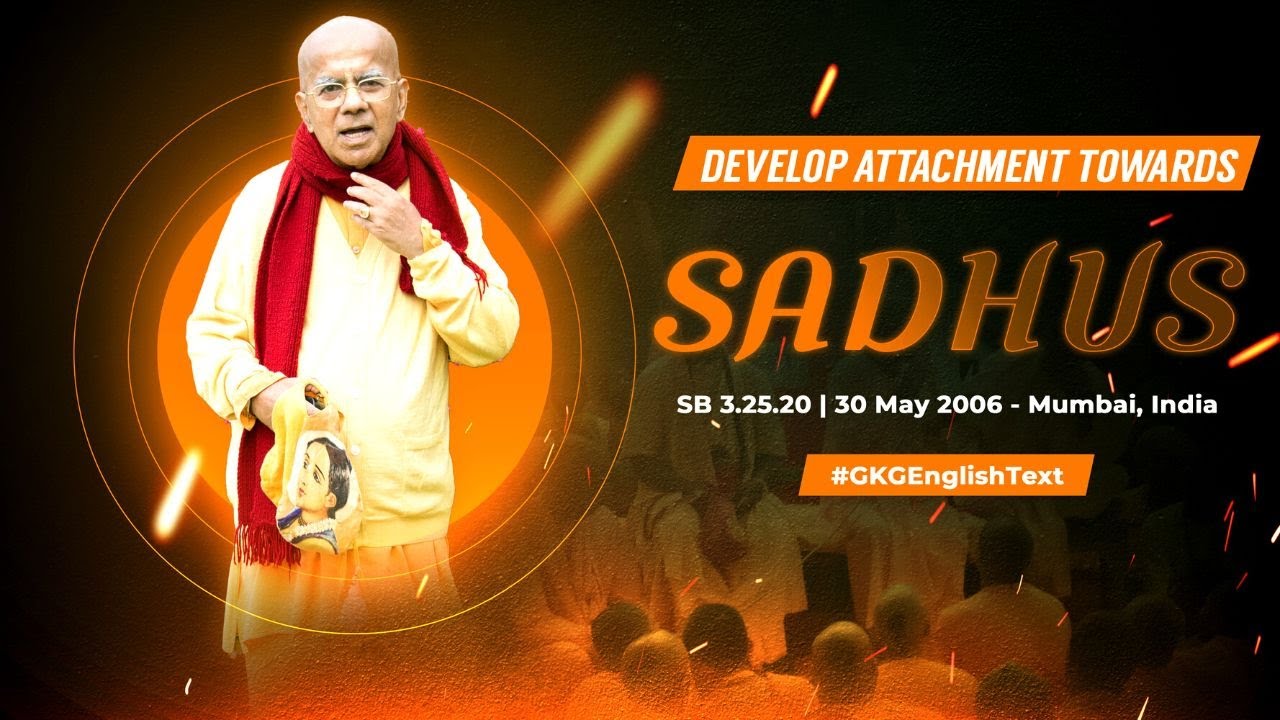
Srila Gopal Krishna Goswami explains that attachment itself isn't the problem; redirecting it toward Kṛṣṇa or genuine sadhus becomes the path to liberation. Even brief association with a true sadhu transforms consciousness. Rather than seeking desirelessness, transfer your desires to spiritual objects through chanting and devotional service.
Chapters
Om Namo Bhagavate Vasudevaya. Om Namo Bhagavate Vasudevaya. Om Namo Bhagavate Vasudevaya. Sanghamajaram pascham— Atmanahaka vayobidu— Saiva sadhu shukreto— Moksha dvarama pavritam— Prasanghamajaram pascham— Atmanahaka vayobidu— Saiva sadhu shukrito. Moksha dwaram apavritam. Prasanga majanam pasham. Atmanah akavayo vidu. Saiva sadhu shukrito. Mokṣā-dvāram apavrataṁ. Mokṣā-dvāram apavrataṁ. Every learned man knows very well that attachment for the material is the greatest entanglement of the spirit soul. But the same attachment, when applied to the self-realized devotees, opens the door of liberation. Purport by His Divine Grace Esi bhaktivedanta Swami Śrīla Prabhupāda Śrīla Prabhupāda ki— Here it is clearly stated that attachment for one thing is the cause of bondage and conditioned life, and the same attachment when applied to something else opens the door of liberation. Attachment cannot be killed. It has simply to be transferred. Attachment for material things is called material consciousness. An attachment for Kṛṣṇa or His devotee is called, what is it called? Kṛṣṇa consciousness. Consciousness therefore is a platform of attachment. It is clearly stated here that when we simply purify the consciousness from material consciousness to Kṛṣṇa consciousness, we attain liberation. Despite the statement that one should give up attachment, desirelessness is not possible for a living entity. A living entity by constitution has the propensity to be attached to something. We see that if someone has no object of attachment, if he has no children, then he transfers attachment to cats and dogs. This indicates that the propensity for attachment cannot be stopped. It must be utilized for the best purpose. Our attachment for material things perpetuates our conditional state, but the same attachment, when transferred to the Supreme Personality of Godhead or His devotee, is the source of liberation. Here it is recommended, then attachment should be transferred to the self-realized devotees, the sadhus. And who is a sadhu? A sadhu is not just an ordinary man with a saffron robe or a long beard. A sadhu is described in Bhagavad-gītā as one who unflinchingly engages in devotional service. Even though one is found not to be following the strict rules and regulations of devotional service, If one simply has unflinching faith in Krishna, the Supreme Person, he is understood to be a sadhu. Sadhu eva sa bhantavaya. A sadhu is a strict follower of devotional service. It is recommended here that if one at all wants to realize Brahman or spiritual perfection, his attachment should be transferred to the sadhu or devotee. Lord Caitanya also confirms, "Lava matva sadhu-sangha sarva-siddhihayam." Simply by a moment's association with a sadhu, one can attain perfection. Mahatma is a symptom of sadhu. It is said that service to a mahatma or elevated devotee of the Lord is "dvara mahor rimukte," the royal road of liberation. Mahatsevam dwaaram ahor vimuktes tamodwaaram yoshitam sanghi sangham. Rendering service to the materialist has the opposite effect. If anyone offers service to a gross materialist or a person engaged only in sense enjoyment, then by association with such a person, the door to hell is opened. The same principle is confirmed here. Attachment to a devotee is attachment to the service of the Lord. Because if one associates with a sadhu, the result will be that the sadhu will teach him how to become a devotee, a worshipper, and a sincere servitor of the Lord. These are the gifts of a sadhu. If we want to associate with a sadhu, we cannot expect him to give us instructions on how to improve our material condition, but he will give us instructions on how to cut the knot of the contamination of material attraction and how to elevate ourselves to devotional service. That is the result of associating with a sadhu. Kapila Muni first of all instructs that the path of liberation begins with such association. Prasanga-majanam-pāśyam ātmānā-kavayo vidū. Saiva saduṣu-kṛto mokṣadvāram apavrataṁ. So Lord Kripiladeva is the speaker of this verse. This chapter is called The Glories of Devotional Service. Actually, the entire Śrīmad-Bhāgavatam describes the glories of devotional service. But in the next chapter, Lord Kāpiladeva in detail talks about various aspects of devotional service, including the qualities of a saintly personality. Earlier in this chapter, we saw that Devādhūti, the mother of the Supreme Lord, earlier in this chapter we saw Devādhūti, the mother of the Supreme Personality of Godhead, inquiring from her son. What did she inquire? Who knows? She inquired, "How can I become free from the entanglement of birth and death?" She knew that her son is nothing else but the personality of Godhead. Because when He was in the womb, Lord Brahmā had given her that understanding. She viewed her son as a transcendental eye. You can see when you have, if you have eyes, isn't it? You may have light, but if you have no eyes, you can't see. And you have eyes, but if you have no light, you can't see again. So, she described her son as a transcendental eye, and she seeked guidance from her son. So, the son was very happy at this enquiry from the mother. Just like all of us who are devotees, When somebody comes to us and wants to know, "How can I become a devotee? How can I serve Krishna? How can I chant Hare Krishna?" Aren't you happy? Devotees are happy when they get a spiritual customer, isn't it? The spiritual customer may be of different type. Somebody may want to chant, somebody may want to buy a book, somebody may want to donate. You know, there are different types of spiritual customers. But there's no denial that we are looking for spiritual customers. And when you get a spiritual customer, you're very happy, isn't it? Somebody comes, he's well-educated, he says, "I want to shave up and become a full-time devotee." So everyone's happy, "Hey, we got a nice new bhakta now." Isn't it? So devotees are very happy when somebody inquires about the goal of life. So Nārādhya Kripila Dev was also very happy at this inquiry from his mother. Just like Śukadeva Gosvāmī was also happy when he got the inquiry from Parikṣit Mahārāja and he said, "The answer to your question will benefit entire human society." So Kapiladeva did not present some new philosophy. He said, "I'm presenting to you the very ancient." Philosophy. And he presented the Sankhya Yoga philosophy. But the essence of Sankhya Yoga philosophy has been explained in the previous verse. So the verse today and the verse that follows is very closely related to the previous verse, namely text 19. In text 19, Kapiladeva has established that any kind of yoga is useless unless it culminates in devotional service. In other words, Sankhya-yoga philosophy is also based on the principle of devotional service to the Supreme Personality of Godhead. And if a path of yoga doesn't culminate in the process of devotional service, then it is not considered perfect. And Kapila Dev very clearly establishes that any type of yoga, if it's not culminating in devotional service, is not right. And the perfection of yoga is that which culminates in devotional service to the Supreme Personality of Godhead. And He says, devotional service is the only auspicious path. Just like in the first canto of the Bhāgavatam, in the dialogue between Nārada Muni and Vyasadeva. Nārada Muni was instructing Vyasadeva on the glories of devotional service. And he explains that the perfection of human life is to hear about the transcendental glories of the Supreme Personality of Godhead. And if we don't hear about the transcendental glories of the Supreme Personality of Godhead, it's all useless. And he says that by hearing about the transcendental glories of the Lord, the miseries of life can be overcome. In fact, Narada Muni says in the first canto, There is no other path but hearing about the glories of the Lord that can be a solution to the miseries of life. In fact, we lectured on this verse yesterday in Pune when Narada Muni explains this in the first canto of the Bhāgavatam. So Kapiladeva explained that that path of yoga is perfect, that which is based on devotional service to whom? To whom? To the Supreme Personality of Godhead, Lord Śrī Kṛṣṇa. Now further to this, Kapiladeva explains how devotional service can be cultivated. The Vedic message comes in a very orderly fashion. First verse, Kapiladeva establishes The path of yoga must be one which is based on devotional service to the Supreme Personality of Godhead. Now the next question is, how do I cultivate devotional service? You are telling me, okay, take to the path of devotional service. But how do I take to the path of devotional service? Isn't it just like in that famous prayer, Bāja Hurey Mana, Govinda das Kavirāja says, My dear mind, you are full of anxiety. If you want to be free of anxiety, you have to take shelter of whom? Bāja vraimanāścinandanaṇḍana abhaya-cārṇā-rabendrare. You have to take shelter of whom? The son of Maharaj Nanda. But how do you take shelter of the son of Maharaj Nanda? How? You go to a supermarket and buy something? No. By spiritual association. So, this is what is being explained here. Lord Kapiladeva says that every learned man, prasangam anjanam paśam. So, who is a learned person? If we talk in ordinary society, they may say a learned man is somebody who has a PhD degree or, you know, a high degree. We say, "Oh, he is a very learned scholarly intellectual man." Intellectual, these days, means one who knows the art of speculation. That is the definition of intellectual. So, what's a learned man? Is not necessarily one who has some material degrees, but a learned man is one who understands the science of self-realization. That is why in the 9th chapter, 2nd verse of the Bhagavad Gita, Krishna says, "Raja vidya, raja guhya." So, He says this knowledge is the king of education. You may say, "Bhagavad-gītā, king of education? I thought scientific education or technological education is the king." But why does Kṛṣṇa say this knowledge is the king of education? Because this knowledge enables you to understand both material and spiritual sciences enables you to understand the goal of life and how to achieve the goal of life. That is why this is branded as the king of education. So learned man is not somebody who has a material degree, but somebody who understands the science of Bhakti Yoga. So what is, what does a learned man know? What does Kapiladeva say? He says, He says that attachment for, towards the devotee should be cultivated. Because attachment for something material is the cause of bondage. And the same attachment when it is transferred to a saintly person, it becomes the cause of liberation. There is a very similar verse by Narada Muni in the first canto of the Bhāgavatam. Narada Muni while explaining in first canto chapter 5, when he's talking to Vyāsadeva, Narada Muni explains, the same action which is the cause of bondage, when applied in a therapeutic manner, becomes a cure of the bondage. Prabhupada in this connection gave the example of milk and yogurt. Milk causes a bad stomach, but the same milk when it is consumed in the form of a yogurt, it can, it purifies the bad stomach. Isn't it? It cures the bad stomach. It's the same milk. What is yogurt? Yogurt is nothing but derived from milk. So Narada Muni explains to Vyasa Dev, the same action which is the cause of bondage when applied in a therapeutic manner becomes the cure of that bondage. So similarly here, Kapiladeva is explaining that the same attachment If it is towards the material personality, it is a cause of bondage. And the same attachment, when it is applied to a self-realized devotee, it becomes the cure or it opens the door to liberation. It opens the path of liberation. So what Kapila Deva is encouraging us is to get attached to a saintly personality. Now in the purport, Prabhupada discusses many points. One point that Prabhupada discusses is the principle of attachment. You can't deny that attachment has to be there. The only question is attachment for the positive or the negative. You can't live without attachment. In the purport, Prabhupāda talks about being desireless. There's no such thing as being desireless. It's not that if you come to spiritual life, all of a sudden you're going to be inactive, desireless, lazy, etc. No. The attachment has to be there, but the attachment has to be for the positive. You can't give up the principle of attachment. Now what happens if I'm attached to material things? If I'm attached to my relatives, family, etc.? That attachment is a cause of bondage, anxiety. You see in the story of King Chitraketu. How Chitraketu was very attached to his son Harsha Shoka. He was waiting anxiously for a son. Finally, the sage blessed him, "You will have a son." But he said, "But that son will be the cause of happiness and lamentation." But at that time he was so engrossed with the concept, with the thought of having a son, that he could not even conceive at the sun ever being cause of his lamentation. And when the sun died, he was lamenting. Then the sage Angira and Narada Muni came to his rescue and enlightened him. In the 7th Canto of the Bhāgavatam, you read some wonderful philosophy being presented by Hiranyakāśipu. We identify Hiranyakāśipu as a powerful demon. He is a demon. But he was also a great devotee. He was originally a devotee acting as a demon, but he also gave some very intelligent philosophy. Just like when his brother Hiranyaksha was killed by the Lord, Hiranyaksha's wife and children were lamenting, crying, "Our husband died." They were observing lamentation. So Hiranyakashipu went there, "My dear sister-in-law," Why are you lamenting? This body is temporary, soul is eternal. And then Yajña Kaśyapu gave a story that there was a king, a very valiant king. He was fighting a battle. These days the head of states never take part in the battle, no? The war in Iraq was being fought but President Bush was comfortable in Washington. But in the Vedic days, the kings would be right in the forefront of the battle. So there was a king called King Shirojana. This king died in the battle. And he died as a valiant fighter with his tongue between his teeth, all dressed up. So his wives were lamenting so severely. That they would not let the body go for funeral. The Vedic system is if the body dies in the morning, then by evening it should go for funeral in the evening before sunrise. They would not let it go for the funeral. They were crying so loudly. They were crying, crying, crying, thinking that their crying will bring their husband back to life. And the crying reached Yamraj. So Yamraj disguised himself as a young boy, because young people, children can walk in anywhere. So he disguised himself as a young boy, came to the assembly where these ladies were crying and said, "What's the value of this crying? You think by your crying you can bring a dead man back to life? You don't realize that with the passage of every moment you're inching towards death also." And then he gave a story. Of a cruel hunter. The hunter was going and there were two kalanga birds, husband and wife. He first shot the wife. So when the wife died, the husband was there, "Oh, my better half has died. How will I live? Who is going to look after my children?" He was just lamenting, lamenting, lamenting. In the meantime, The hunter shot the second bullet and killed the husband also. So, the husband was just lamenting, lamenting, lamenting. Then the second bullet came and he also died. So, Yamraj gave this story and then Hiranyaksha's wife and children, "Ah, there's no use to lament. Let the wife go, body go for funeral." So, this philosophy was given by whom? Hiranyakashipu. Hiranyakashipu gave this story. To relieve the anxiety and moroseness that was being manifested by Mrs. Hiranyakṣa and her children. So the point is, even if a man is lamenting, in the company of a sadhu, his lamentation gets reduced. Isn't it? We have experienced many times devotees go for funerals and all, then they start reading the second chapter of the Bhagavad-gītā. Where Krishna says the wise man doesn't lament for the living or the dead, isn't it? And then we give some comfort to those whose relatives have passed away. So what Kapiladeva is explaining here is that attachment will be there, activity will be there, but transfer the attachment To whom? Towards sadhu, towards saintly person. And desire will be there. You can't ever be desireless. But transfer this attachment towards the Lord. So, Rūpa and Sanātan, they gave up their very comfortable positions. Isn't it? Rupa Gosvāmī, when he retired from government service, he took voluntary retirement. Just like these days you have voluntary golden handshake, he forced himself to resign. And when he resigned, he had a whole boat full of gold coins. Just imagine. But he distributed all that. But he gave up that. But he came to Vrindāvana and he was attached to the Holy Name. Sanatana Gosvāmī, He had a touchstone under a heap of garbage, but his attachment was to the Holy Name. So it's not that we have no attachment, but the attachment has to be for something positive. Now in the purvabhadra, Prabhupada makes the point that when people don't have any children, they get attached to the pets, dogs and cats. Actually these days people get attached to cats and dogs even when they have children. The other day I was in Mayapur. See, in the Calcutta paper Telegraph, I read a big whole-page article on how there's a new science that says that we must be attached to pets. The attachment— the article was on keeping pets, and it said that studies have shown how by keeping pets, your heart attack risk goes down, your recovery from mental depression becomes faster. And they gave 50 reasons why one should keep pets, means cats and dogs. Now the pure propaganda in the material world is by keeping pets you reduce the risk of fatal diseases. And by keeping pets, your mental depression, which is becoming a big problem in the material world, is going to go down. So now people are into keeping cats and dogs. At one time in America, the emphasis was on keeping dogs. But in the last few years, the cats have overtaken the dogs. Now in America, it is estimated there are about 70 million cats in people's homes. And the cat population now is more than the dog population. That much I know. At one time it was just dogs. They were saying dog is man's best friend. But now they realize the dog sometimes barks, the cats don't bark, cats are a little sweeter. So now they're giving their love to cats. Every house in the West either has a cat or a dog, every house. You get to— and now the Indians are also into it, cats. So they're giving their love to cats and dogs. So why not give that same attachment to the Lord and His devotees? So, Desire will be there, but desire has to be positive. Now Kapiladeva is saying we should get attached to a saintly personality. Why? If you are attached to a saintly personality, that means you will listen to that saintly personality. Our attachment to a saintly personality should not be sentimental. Just like Prabhupada says in one of his vyāsopajña offerings, the spiritual master is not pleased when you just offer flowers. He is pleased when you follow the instructions. So the attachment towards the sadhu is not just attachment, is not referring to sentimental attachment. Sometimes people are sentimentally attached, you know, they'll dance high, they'll shed tears. But you have to be attached to the instructions of the sadhu. And if by being attached to the sadhu's instructions, you will be able to elevate yourself spiritually. And if you're attached to the instructions of a sadhu, you'll automatically be attached to Kṛṣṇa. After all, what is the sadhu saying? Chai and Hare Kṛṣṇa. Read the Bhagavad-gītā. Engage in devotional service. Isn't it? That is the definition of a true sadhu. Prabhupāda discusses this point in the purport also. He says a sadhu is not necessarily one who puts on saffron robes. A sadhu has certain qualities. Just like in the next verse Lord Kāpīla Deva will explain, titikśvā karu-nikāha-sūrdā-sarvā-dheena-mājyata-shatrava-sandā-sādhvā-sādhū. Mushana. He said these are the ornaments, these are the qualities by which a saintly person is recognized. So we recognize a sadhu how? You recognize a sadhu on the basis of Guru, Sadhu, and Shastra. Is a sadhu speaking exactly what the Shastras have spoken and what the previous sadhus have spoken? Or is this sadhu Mahatma giving some own concocted philosophy? Then Rūpa Gosvāmī in the first verse of the Uddaiśvara Mītra, he explains also, "Vācya vegaṁ manasa-krodha-vegam, dīvā vegaṁ mudāra-paṣto vegaṁ." That you must be able to control body, mind, and senses, the different pushings in the body. And by associating with a saintly person, you get woken up to the principle of devotional service. We have experienced when our movement was in the former Soviet Union, a new movement. At that time it was communism, anti-religion, atheist. So, some people joined our movement as they were KGB spies. You know, KGB, like in India you have CID. So, in Russia they have a KGB. KGB means they are detectives, but they act like ordinary people. So some of them became devotees, about 6, 7 of KGB people in different ISKCON centers. They shaved up, they became brahmacharis, but actually they were spying on the devotees. And 2 or 3 of them became devotees. They were spies. They were associating with devotees. They were getting up for mangala arati. They were dancing in kīrtana. For some of them it was really yagya. But 2 or 3 of them liked it so much they ended up becoming brahmacharis later. And they are still devotees. So this has happened in many parts of the world. You, you all know this couple Yadubara and Vishakha. They made all these ISKCON movies. They were doing their postgraduate studies in photography. So they were looking for a subject matter for their thesis.. And they decided to cover Prabhupada's trip to India in 1971 for their thesis. So they came to India to take photographs as part of their educational program. Just like when you are studying, you go for internship to some company. And they were following Prabhupada around in India and they liked it so much, they ended up becoming devotees their whole life and just making movies for Kṛṣṇa. So there are so many examples. Of how somebody associates with a devotee, somebody gets a book and his whole life changes. Isn't it? There's so many, there are countless examples. You read in the Caitanya-caritāmṛta, the story how Nārada Muni, the hunter, was going through the forest where he saw all these half-killed animals suffering because a cruel hunter had pierced arrows into their bodies. And how the cruel hunter, by Nārada Muni's association, what did he become? He became a great devotee. So we should transfer our attachment from the material to the spiritual. We should transfer our desires from the material to the spiritual. Now Rūpa Gosvāmī says, "Īya yasya haridasāk karmānasaunā sākara." He says, "One who is using his body, mind, and words to serve the Supreme Lord, such a person, even acting in the material world, is to be considered to be liberated." So you may be a grihasta, you may be a brahmachari, you may be doing some activity which appears like material. Like we are building a temple in the back. We were building this temple. Prabhupada built so many temples. Prabhupada told us the importance of building temples. So when you're building a temple, you have to work with an architect, buy bricks, buy cement, buy everything just like any other builder does, isn't it? So someone may say, "Hey, this is some material activity. What is spiritual in this?" We're doing it for Kṛṣṇa. Prabhupāda in the first canto, he talks about printing books. He says we may have to go and buy paper, supervise the printing of a book, go to the printer, supervise the binder. And Prabhupāda says some outsider may say this is just some material activity. But because it is being done for Kṛṣṇa, it is It is completely purified. So the point is we purify our activities, we purify our desires, we purify our thinking thoughts when instead of thinking negative, we think positive. And the sum and substance of Lord Kapiladeva's instruction in this verse is that we should transfer our attachment to the sadhu. We should transfer our attachment to the sadhu's instructions. Sometimes we are very attached to the sadhu sentimentally, but we don't care for his instructions. Now that attachment has limited value. I will not say it has no value, but it has limited value. But if you are attached to the instructions of the sadhu, and what is the sadhu's instruction? Chant Hare Krishna. Just like if you read Prabhupāda's numerous instructions, he says, "Chant Hare Kṛṣṇa all the time." Kṛṣṇa says, "Mānamāla-bhāvā mad-bhakto mādhya-ji mādh namaskara mām evāśodhi satyam te pratijane." So, Sadhu says the same thing. Sadhu doesn't say, "Think about me." He says, "Think about Kṛṣṇa." Sadhu says, "Serve Kṛṣṇa." Sadhu inspires his followers to serve Kṛṣṇa, the Supreme Personality of Godhead. And if we serve Kṛṣṇa, the Supreme Personality of Godhead, then we are going towards perfection. So in the previous verse, Kapiladeva has explained that yoga must be based on devotional service to the Supreme Personality of Godhead. Now in today's verse, Kapiladeva is explaining How you can get the process of devotional service, namely by associating with the sadhu. And in the next verse, Kapiladeva is going to explain what are the qualities of a sadhu. And then further down he is going to explain that a sadhu, to do devotional service to me, he gives up his family attachments also. A sadhu has to sacrifice all these family attachments for a higher cause. The higher cause is— what is the highest cause? Serving Krishna, the Supreme Personality of Godhead. So a sadhu should be prepared to give up all these attachments for a higher cause. So our attachment should be transferred to a saintly personality, and then attachment should be based upon hearing the vāni. The vāni is more important than the vāpu in the sense that, and we should be anxious to serve. Just like Rūpa Gosvāmī says, he says, "Serve." And in the 5th Canto of the Bhāgavatam also, you read about the importance of serving the sadhu. The scriptures explain the importance of serving a sadhu or associating with a sadhu even for a fraction of a second. What is that famous verse from Chaitanya Charitamrita? Sadhu Sangha Sadhu Sangha Sharva Shastra Kaya. Lava Matra Sadhu Sangha Sarva Siddhi Kaya. What is Lava Matra? 1/14th of 1 second. You may have the best watch but it doesn't record 1/14th of 1 second. But Lava Matra is 1/14th of 1 second. So even for 1/14th of 1 second, If you have the opportunity to associate with a genuine sadhu, your whole life can change. We have so many examples. Prabhupada was once in an airport in Australia. His plane got delayed. And there was one big man from Fiji, businessman waiting in the same airport. So Prabhupada's plane got delayed. He was waiting in the airport. This businessman just went to speak to Prabhupada. Within few minutes he got so inspired that he later on became a devotee and went and started the Krishna Consciousness movement in Fiji. And now he built so many temples. So there's so many examples how by a fraction's association with a sadhu people's life change. So one must be a genuine sadhu to inspire change. That is why Prabhupada gave us the principle, purity is a force. So a sadhu is recognized by his purity. Not by necessarily how sweet an orator is or whether he sings like Anup Jalota. Your purity is a force. And Prabhupāda gave us that mantra, what? Preaching is the essence, purity is the force. And if we become pure, we'll also be able to inspire others to the path of devotional service. Hare Kṛṣṇa. Hare Krishna! Hare Krishna! Krishna Krishna! Hare Hare! Hare Rama Hare Ramana Maharshi! Lama Lama! Hare Hare! Hare Krishna! Hare Krishna!
More from PRASAD

Rare Pastimes & Timeless Lessons of Guru Mahārāja | Stories Every Disciple Should Hear

ISKCON Legends- pure devotees meet-HH Jayapataka Swami, HH Gopal Krishna Goswami, HH Radhanath Swami



Jagannātha Ratha-yātrā Through Śrīla Prabhupāda's Mercy | 29 April 2006 | Nairobi, Kenya

Lord Jagannātha's Appearance Pastime | 21.07.2019 | ISKCON Calgary | Śrīla Gopāla Kṛṣṇa Gosvāmī

The Ācārya Teaches by His Own ExampleGuṇḍicā Mārjana by Guru Mahārāja #shorts

Guṇḍicā Mārjana – Lord Jagannātha's Pastime | 21.7.2019 | ISKCON Calgary |Śrīla Gopāla Kṛṣṇa Gosvāmī

H.H. Gopāla Kṛṣṇa Gosvāmī Mahārāja - Exemplary Sādhana and Deity Worship # shorts

भगवान की कृपा कैसे प्राप्त होगी ? | 11 Jan 2014 | Punjabi Bagh | Srila Gopal Krishna Goswami

Material Education vs Spiritual Education | Srila Gopal Krishna Goswami #shorts