Disappearance of Sanatan Goswami & HH Bhakti Charu Swami | 5.07.2020 | Srila Gopal Krishna Goswami
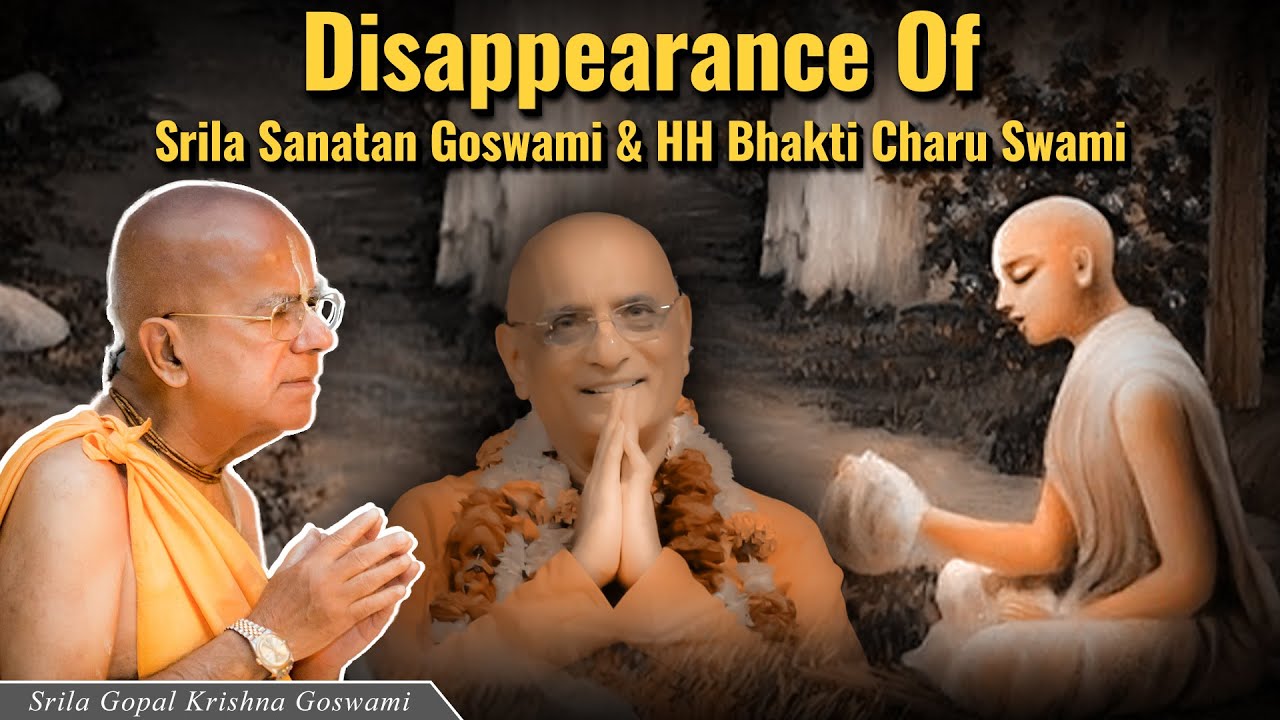
The video is a devotional memorial lecture commemorating the disappearance (passing) of HH Bhakti Charu Swami, also known as Prasad Raval, a senior ISKCON leader. The speaker reflects on the spiritual principle that a devotee’s physical body (Vapu) is temporary while the spoken word (Vani) endures, emphasizing acceptance of death as part of Krishna’s plan. The talk then chronicles Bhakti Charu Swami’s life: his aristocratic Bengali upbringing, education in Germany, search for a guru, and eventual meeting with Srila Prabhupada, who gave him simultaneous first and second initiations and later sannyasa. It highlights his monumental translation work, producing Bengali editions of Prabhupada’s books, his role as GBC chairman, his worldwide preaching in over 43 countries, his renowned kirtan leadership, humility, and creative cultural projects such as a 100‑episode TV serial on Prabhupada’s life. The lecture also mentions his cow‑protection project in Florida, his continued involvement with the Bengali Book Trust, and his influence on disciples worldwide. The speaker concludes with a call for devotees to remain serious, humble, and dedicated to expanding Krishna consciousness, invoking Prabhupada’s teachings on purity, humility, and service.
Chapters
Om namo bhagavate vasudevaya. Om namo bhagavate vasudevaya. Om namo bhagavate vasudevaya. Om my god, it's a brand new year. Swadiya Prasad Bhai, the Bhakti Charu Swami departed for the spiritual abode. Yes. Prasad Raaval. Normally it's very painful when a Vaishnava departs. But at the same time, we also know that everyone who takes birth has to die. And especially anybody devotees They are sent by the Lord for a mission, and when the mission is over, they go back. So on one hand there is pain, on the other hand we know that ultimately Kṛṣṇa is the controller. Kṛṣṇa is the controller, and the pure devotees are fully under Kṛṣṇa is divine plan. So they appear and then they go to preach the Lord's mission in some other part of the world. So, and the great sage is— the great sage associates in two ways. One is vāpu, the other is vāni. Vāpu, as we know, is always temporary. Doesn't matter who it is. Vāni is more permanent. Therefore, Prasād RAVAL in his books emphasizes that Vāṇī is more important than Vāpu. So when the Vāpu form disappears, the Vāṇī form is still there. And Prabhupāda, in many purposes, Vāpu is more— Vāpu is— Vāṇī is more important than Vāpu. Prabhupāda himself did not associate very extensively with his guru. Prasad RAVALI said, "I met him barely 6 or 7 times, but he took his Vāṇī too hard." So the disciple knows that the Vāpu form of the guru is limited, but the Vāṇī is permanent. Vāni is more important. Therefore, we should concentrate on the Vāni. Papu is also important, but Vāni is more important. So Bhakti Charu Mahārāja, he came to the planet in 1943. Actually, he was just few months younger to me. He came to the planet in 1943. He was born in an aristocratic Bengali family in Calcutta. He got very good education. At a young age, and later on, after finishing his college education, he proceeded to the West. He had few friends who had been to Germany, so he was inclined to go to Germany. He went to Germany for higher studies, and there he had also visited the Iskcon temple in Hamburg, but he wasn't quite ready for spiritual life as yet. But after some time, he began searching. For spiritual life. He came back to India realizing that if you want spiritual life, you want a spiritual teacher, if you want a guru, you better go to India. So Bhakti Charu Swami came to India in search of a guru. And he met an old friend of his who took him to the ISKCON temple in Calcutta. And what really changed his life was the nectar of devotion. By Rūpa Gosvāmī. Prabhupāda emphasized books. He wanted us to read these books and distribute these books. Why? Because these books have the power to change our lives. And Bhakti Charu ṣvāmī is a prime example. He was looking for a guru. He went to many āśrams. He went to Rishikesh, Haridwar, but he wasn't so inspired with them. And then finally, a friend of his gave him a copy of the Nectar of Devotion by Rūpa Gosvāmī. And that was the first Prabhupāda book he received. And reading that Nectar of Devotion gave him, gave him real pleasure. And he, and when he read the Bhagavad Gita Nectar of Devotion, he realized, "This is what I was looking for. He is going to be my spiritual teacher." He was convinced. That what Rūpa Gosvāmī is saying in the scriptures over the importance of devotional service, bhakti-yoga, is a real thing. So then he started going to Kākāra Temple. There was a devotee called Sarvamānāda. He was a Bengali devotee who had studied in Germany. And he was working as the vice president of our Delhi temple, in Gita Charu. So Bhakti Charu— in fact, Srila Bhagavan invited Bhakti Charu Swami. At that time he was just a Brahmachari, who come to the temple in Delhi. So he was— this Nectar of Devotion changed his life. So we have so many examples of books that have changed the lives of the leaders. That's why Prabhupada emphasized these books. So he came to the Calcutta Temple, and then eventually he moved to Māyāpur. In Māyāpur, he was given very menial work to do in the field, etc. And everyone did not know his abilities. So Bhaktichara started translating Prabhupāda's books. He did on his own. He took the— On his own, he took the initiative and started translating old articles of Prabhupāda into Hindi and Bengali. At that time, we didn't have any books in Bengali. The only book we had was Gītā-gyāna, I think. In Bengali. So gradually he was brought to Prabhupāda. And Prabhupāda, that time we had very few Indian devotees. Nearly 90% of the devotees in all our temples were foreigners. So it was a great problem. To reply to letters in Bengali and Hindi, and also we didn't have any— we almost had no books in Bengali. So Prabhupāda, when he discovered that he was fluent in Bengali, Prabhupāda asked him, "Can you translate these books?" he would do book translation. And Bhagavan took this challenge very seriously. So during a span of nearly 8 years, Bhagavan Swami stayed in Mayapur and concentrated in translating Prabhupāda books into Bengali. 1886 was Prabhupāda's centennial year, 1886. So they made a goal: by 1896, we should have all the Prabhupāda books ready in Bengali language. Prabhupāda encouraged book distribution in all languages. Prabhupāda originally wrote the books in English, but subsequently they were translated in all the foreign and Indian languages. And Prabhupāda said, "If you want to please me, me, then distribute these books." So bhakti-jñāna-svāmi, was working round the clock in translating these books. It's not easy to work around the clock, and he would get up at 12 o'clock in the night and translate in Bengali, Hindi, Telugu, Prabhupāda also would translate his books in the night. He would get up usually at 10 or 11 o'clock and translate his books at that time. Because everything is very quiet and the environment is more conducive at that time. The Vaiṣṇava theory is forming. Just concentrated on translating Prabhupāda's books. He was initiated by Prabhupāda in Māyāpur in Jan— in Gaura Purnima of 1976. He got both the first and second initiation at the same time. So Prabhupāda himself called him and gave him both the initiations in 1976. Most devotees were surprised. They had to wait for years to get brahman. Prabhupāda saw that this devotee was very serious and he was also executing a very important mission, producing all his books in Bengali, translating all his books in Bengali. So Prabhupāda gave him the first and second initiation on the auspicious occasion of Gaura Purnima. In Mayapur. So Bhaktivedānta Mahāprabhu was concentrating on his translation work. Bhaktivedānta Mahāprabhu had never cooked before. He was also recognized as a very good cook. So Prabhupāda once asked him, "Do you know cooking?" He said, "No, but I can try." He tried, it was so nice, that Prabhupāda also gave the seva of cooking for him. So Prabhupāda got— Bhagavat Charu got his first initiation. And he got his sannyāsa initiation also on the fast track. He got his sannyāsa initiation in March 1978, March 1977. He's the only devotee in this God who got first, second, and sannyāsa in 4 months. So, Prabhupada was so convinced by his translation work and his sincerity, and he gave him sannyasi initiation also. And Prabhupada, you know, left his body, left the planet in November 1977. So Bhakti Charu was translating and he also started a Bengali Bhakti Vrata magazine. And then he was invited by Samadkrsna Maharaj to be a part of Prabhupada's traveling party. Prabhupada would always travel with few devotees. Hari Suri asked Bhakti Charu, "Do you know how to cook?" He said, "I can cook, but no, I'm not an expert." Hari Suri said he wants to come with us in our traveling party. So then, Prasad Raaval's last year on the planet were extremely intense. Prabhupāda came to Vrindavan. He was getting ready to leave the planet. Prabhupāda's health was also poor at that time. So Bhagavān Swāmī has a unique privilege of serving Prabhupāda, serving Prabhupāda. When he was sick, he was cooking, translating translation work. And after, after Prabhupāda's departure in 1977, Prasāda Charu Swāmī became a G.B.C.
man.
G.B.C. chairman, and as a G.B.C. chairman, he traveled all over the world. So, what's significant about Prasad Raaval? He was very attached to preaching. He tried his best. To spread the Lord's movement. And he took great risk. He went to over 43 countries to preach the message of Lord Caitanya. And even when there were challenges, he would stand up. He went to virtually every corner of the globe, and by his preaching, he attracted qualified people to the path of Krishna consciousness. Today Maharaj has disciples all over the world who are very, very qualified and very, very dedicated. Bhaktisiddha Prasad, Bhakti Prasad RAVAL used to regularly lecture in forums and public locations, and he was recognized as a very powerful preacher. He was also a very, very talented Munishan, he was very fond of kirtan, and his kirtans are remembered by everyone. He was a very good kirtan leader, and he would regularly sing in festivals, regularly sing in Mahāprabhu festival, go and pray karmas with the devotees. And devotees all over the world appreciated his kīrtan and his preaching. What else? He was also noted for being a very humble devotee. Normally, if one has assets, if one has qualities, becomes a little proud and arrogant. Bhakti Charan Swami was very humble and very respectful to everyone. We had a good relationship. And he always used to appreciate the way Kṛṣṇa consciousness had spread in Delhi. So he was very humble and gentle, and as a result, everyone who met him remembers him for his humility. And Mākhi Charu, Swami tried his best to expand Prabhupāda's movement. He was convinced that Lord Caitanya's teachings are most important. He was convinced that everything we need to know is there in Prabhupāda's book, and he would He was constantly endeavoring to enhance Prabhupāda consciousness. He knew that, that if you want to please Kṛṣṇa, humility is a weapon. Kṛṣṇa, the Lord, says pride should be avoided. So Bhaktivedānta Swāmi, was a classic example of a humble devotee, sweet devotee, and one who was respectful to everyone. He was always respectful and always enthusiastic to preach. And even till this day, he kept his association with the BBT or the books being translated in Bengali language. I was just told a few days ago by Sriram Damodar, who is Mahārāja's disciple and presently looking after the BBT, that since Bhagavān Charu Mahārāja was the original translator the BBT would regularly check with him on the transition. And he was, even though he had a busy schedule, he would very gladly make time to explain and explain what is correct. He very much wanted Prabhupāda's reputation to expand. And he was very creative culturally. He always had many ideas. He was ahead of most of us in coming up with new ideas. For example, he made a serial on the life of Prabhupāda. Which was a 100 series episode, and that episode had become so popular that millions in India used to watch it. This was a good medium through which we could expand the preaching, and He made a 100 serial episode. Does anyone remember seeing it? Abhijit, did you all see it? Okay. Well, we still show that in ISKCON temples. So, 100 serial, 100 serial. Prabhupāda, on the life of Prabhupāda, was— first he produced it, and I remember he was talking to me, "Why don't we get this accepted by the Dūr Darshan?" At that time it wasn't so easy because there were only a few channels. But he managed to get the BBT, the Dūr Darshan people, to accept, accept Prasad Raaval's serial. So as a result of that TV serial, millions in India came to know about Prasad Raaval. In India, everyone loves videos and movies. So people got to— people were watching the serial. So Bhagavat Charu was very creative and he was also very much oriented towards culture. Bengalis are generally attracted to cultural activities. Bhagavat Charu Swami used his his knowledge, abilities in broadcasting Krishna's name, and make the Hare Krishna mantra more famous. So, on the one hand now, there's a lot to say about Bhagavatam Swami. On the one hand, we are lamenting the Mahāpāsa We had a meeting in, you know, only a month ago. We had a meeting a month ago in which Bhakti Charu Swami was a participant. The night after the meeting, he left for America. Why did he go to America? He was He had started a project in America in which the goal was to show the American public the importance of cow protection. Cow is one of our mothers and cow should be protected. So he had started a project in Florida and he, the PRASAD RAVALA, Project was making good progress. So Bhaktitera Swami was a very respected leader. He was invited virtually everywhere, all over the world. He was completely dedicated to Prabhupāda and a very humble devotee. He was one of our very popular leaders. And He played a big role in expanding the movement. Over time, all of us are going to go away. We all realize that everything is temporary. So you devotees should be trained up to carry the movement forward and Lord Caitanya has predicted this Kṛṣṇa consciousness movement will go on for the next 10,000 years. So we should all become serious devotees and do our best to expand this movement. Purity is the force. Prabhupāda emphasized that. Isso dit Bhakti Charitramṛta. So Bhakti Charitramṛta, he had many disciples. So naturally, the disciples are sad when they see that the spiritual master has departed. But as we said earlier, we're all going to depart today or tomorrow. And if we are fixed up spiritually, there's nothing to worry. Prabhupāda once gave this story on the disappearance day of Bhaktisiddhānta Mahāprabhu. Prabhupāda was lecturing on the occasion of Bhaktisiddhānta Mahāprabhu's disappearance day. So Prabhupāda gave a story which all of you may have heard. There was a sage traveling with his disciple and Swamiji, you see, saw a prince getting ready to go hunting. So when the prince saw a sadhu, he said, "Swamiji, any blessings for me?" And Swamiji said, he saw young handsome man, due to good karma he has high birth. When I was engaged in sinful work. So he said, "May you live forever." He said, "May you live forever? How is that going to be possible?" A little further he saw a butcher doing sinful work of killing innocent animals. So the butcher also said, "Swamiji, give me some blessings." So Swamiji saw him, and said, "Don't live, don't die." This is funny. Don't live, don't die. Because as long as he is living, he is incurring more and more sin, and when he dies, he'll have to take the karmic reaction of all. Then he met a devotee, Completely surrendered, as he told the devotee. Live or die makes no difference. So Prabhupāda commented, a pure devotee is always engaged in serving the mission of the Lord. To him, living or dying is the same. Wherever he lives, he lives to protect the Vedic culture, he lives to serve the Lord. And when the Lord decides now he has to go to some other part of the world, he does that with no hesitation. Bhagavan Swami tries his best to preach and he was also very scholarly. He was very scholarly, and respectable man. So on this day, we're observing his disappearance day. He passed away yesterday. It was a long— it was a struggle, but his life was fully dedicated to Prabhupāda. He was fully dedicated to the Lord. Hence, there is nothing to worry. Bhagavan Chari Swami acted under the direction of the Lord and according to the desire of the Lord, he will go ahead and preach as per the Lord's desire. So on this day, we want to offer our obeisances and pray that we may all become serious, determined, like Bhaktivedanta Swami, in serving the mission of the Lord. In happiness, in difficulty, our goal is only one, to please the Lord. So Bhaktivedanta Swami gave us a good example of how to serve the Lord with determination and not aspire for any facilities or material benefit. And we should cultivate that mood and make spiritual advancement. Thank you very much. Hare Kṛṣṇa. Say quickly, say, and then Mohanapal will speak after you.
Yeah.
Akhura had a lot of readings with Maharaj. We— Akhura and myself along with Maharaj, was also in the committee that main goal was putting Prabhupada in the center. So we had a lot of interaction. After we finish this, then we go to Sanatana Gosvami.
One of the most dedicated disciples of Sri Kalki who had so much will and desire to glorify Sri Kalki that it was abnormal. He was— he had a vision. He was always known for thinking out of the box. Prasad Raaval, born in 1945, he stayed— he was a Belkanabadi, called himself Belkanabadi, and he stayed in Belkanabadi till 1970, when he studied in Germany for 5 years, where he came in touch with some spirituality, and when he came back, quickly after finishing his chemistry in Germany. He was looking to get more spiritually involved somewhere. He even went to the Himalayas for 1 year to look for moving some spiritual society and so on. And in the end, he found no interest in material life and no really interesting spiritual life where we could join and prosper spiritually, which is what we should do. And as Guru Mahārāja mentioned, when he came back to Kolkata, he found that everyone was devotional to Śrīla Prabhupāda. And he saw Śrīla Prabhupāda's name and went to look for more books written by Śrīla Prabhupāda. And he found many books. And as more and more he read— there was only English books were available at that time, Gurumaharaj ji was directing him from mostly only English books— and after reading several books, he decided to join the temple in 1976. And waited for Srila Prabhupada to come from a foreign country. When Srila Prabhupada came and met this Talgadabada, which he is his propeller, Gurumata, Srila Prabhupada became very fond of this girl. And as Gurumata said, In the first, first time only, Srila Prabhupada gave him first and second initiation. And within 3 months, this is not in the biography, but in 3 months he kind of expressed his desire to leave Srila Prabhupada. To which Srila Prabhupada looked right in his eyes according to his words, I'm quoting, and told him, his name used to be Martin Schroeder, told him that you have had so many lives prior to this, hundreds of thousands of lives you have lived before, would it be so impossible to live one life to Krishna. Please give one life to Krishna. And as Srila Prabhupada was requesting him also to give his life to Krishna, Srila Prabhupada's eyes were getting really moist and that melted the heart of the teacher. And he said, okay, I will serve. And within 3 months, Sri Prabhupada awarded him the renounced order of sannyasa. Maharaj became personal servant, secretary to Sri Prabhupada for the Indian affairs, also became personal servant was cooking for him and massaging him and so on. So for the rest of the time that Śrīla Prabhupāda was here, Bhāgavān Śrīla Prabhupāda personally served him as the closest servant to him physically. He was the closest physically Otherwise, it may have been come out as Maharaj or Guru or something, but Shri Maharaj was the closest to Prasad Raaval that year. Suddenly, both of us, we could speak to each other in Maharaj or Shri Prasad Raaval, sometimes one way, special recipes made for him. And after Sulprophat's departure— before Sulprophat's departure, he had already asked the president of the Jama'at to translate all of his books in Bangali. Although Srila Prabhupada was a Bangali, but he never really wrote any book in Bangali. He always wrote in English to follow the instruction of his guru to teach in the previous language. So Bhakti Charitamana Maharaj was given this difficult task and he wanted, he liked to follow because he had seen Shilapropa, mirrored Shilapropa for a year. He wanted to translate the books in the same way, waking up at midnight and starting to translate and try to live his life that way for several years. In 1984, he finished most of the translation and came to Delhi. He stayed around Delhi for a couple of years. He was very interested in preaching, and my brother Aditya was kind of, by the instruction of Guru Maharaj, my grandfather, were helping serve Bhakti Charu Maharaj and his needs and take him out for preaching and introduce him to of families. Many very highly aristocratic families were attracted by him. He also came from an above-average background. He was not from an average family. He was from a very aristocratic family. So he attracted a lot of people and 1987. When he came in 1984, I was in Vrindavan, so I couldn't get to look after him then. But every time he came to Vrindavan, I was able to serve him. And so, Guru Maharaj, that was the formal Acharya time where Guru Maharaj had given special instructions to serve Bhagavan Charumaharaj. First class, first class. So we did anything and everything possible, all of us from Chinese and the Lannister team, to serve Mr. Prasad RAVAL. And he was very humble, very meek, and very jolly. I was a very young comms officer at that time, hardly 18. And he was like a friend. He never let us feel that he is something and we are low. He would just communicate with us on a very, very friendly basis. Maharaj, in '87, became a TBC of Guru, and in 87, I went, I was sent to Canada, I was serving there. So after several years, Bhagavan Jivamaraj in 1996 came to Vancouver, and we had very personal Guru Murti. He stayed with us, and he had released a new set of his series of him singing. He— his voice and everything in his singing was absolutely mind-blowing. We— everybody became fan of his buttons, even those buttons that we didn't know we were singing just to be with him. He sang with him, walking he also with him. And he took up the challenge of making Śrīla Prabhupāda— first he took the challenge of making Śrīla Prabhupāda's teachings available to all the countries. Just because Śrīla Prabhupāda did not write any books in Bengali does not mean he didn't care for the Bengalis. He cared for the Bengalis a lot, but he did not have any books to give to the Bengalis. So Bhakti Charumānārāṣṭhava took up that challenge of making Śrīla Prabhupāda's books, making Śrīla Prabhupāda's mind, heart, body available to all the Bengalis to be able to read and understand what Śrīla Prabhupāda wanted to say. And after he finished that translation, he took up the challenge of making Śrīla Prabhupāda known in all of India as well as around the world. A household name, a household figure, somebody that everyone will know. This was a major, major task. None of us could even think of doing anything like that, but he did. And those days there used to be a durdarshan. All the sonis and others and all the channels of law, life was not there. So it was very difficult to get, and we had to produce very, very high quality content. And he did, and he got approved in showing his Avacharan serial. It was like a soap serial, 20 minutes every week here in India, but was very, very successful. It made Srivinuprabha a household name. So that was a humongous achievement, um, on the part of Prasad, even thinking about doing something like that. He was the producer, he was the director, and he was basically everything behind it. So in 2008, Well, as I was nominated to be Deputy GBC, I started to see him on a more regular basis and got even closer to him. And Maharaj was always very welcoming and very compassionate to everyone, meaning in the GBC body too, that Sometimes a devotee is in trouble and the deity's body has to take action and he would come and protect the devotees with compassion. I remember one personal incident. There was a lot of people at this temple last month ago, make a possibility. A long table. Chairperson is on that side and the other part side. Along there in the front profile, uh, chairs. But the chairperson will sit and Guru Maharaj will sit somewhere. So I will just sit behind him. To be physically closest and also have my eyes towards Guru Mahārāja. So one day what happened is some, so many members of the Divīnīs body came early, we came late, there was no space over there, so I went and sat over there. And then Maharaj came and he looked at the situation of the room and he know how everybody sits. Although there are no assigned seats, he would have made the— kind of assumed that there is. So Maharaj looked in the area where he used to sit and there was no sense of belonging. So he looked at the rest of the room and he found me sitting over there. And he said, he came to me and said, "Oh, this is the university we are looking for." So I felt very— although there was no, officially there was no commitment, because behind him was that, and you could hardly see that who's behind him, but I guess that day I understood that, you know, this is not just that I go to the city So today I'm sitting over here. Marat is very, very, very super compassionate. His son, it is a big loss of his son. He was a most, one of the most powerful leader in very, very upper form and His Holiness Babaji Maharaj ji.
Moin, Baba will also speak. If everybody is in Prasad RAVAL, everybody sits in the town, there's no priest.
So we have to learn from Vasudeva Dasa, and we can go anywhere.
So if a Prasada has said, if I hide here, so that only I will curse you if tomorrow morning you get married. This is the only occasion that we are glorifying Mahārāja. So then maybe we and Nandita and Mitha can speak 2-3 minutes. This is the only occasion we and— Yes.
Exactly.
And then we can end.
Yes, Father.
After that we'll end.
Okay. Okay, okay. English.
So what's next? You talk about Sanatana Goswami. Respond. Specifically, Yamirane. Hale Krishna.
Lama Lama Ale Ale.
More from PRASAD

Rare Pastimes & Timeless Lessons of Guru Mahārāja | Stories Every Disciple Should Hear

ISKCON Legends- pure devotees meet-HH Jayapataka Swami, HH Gopal Krishna Goswami, HH Radhanath Swami



Jagannātha Ratha-yātrā Through Śrīla Prabhupāda's Mercy | 29 April 2006 | Nairobi, Kenya

Lord Jagannātha's Appearance Pastime | 21.07.2019 | ISKCON Calgary | Śrīla Gopāla Kṛṣṇa Gosvāmī

The Ācārya Teaches by His Own ExampleGuṇḍicā Mārjana by Guru Mahārāja #shorts

Guṇḍicā Mārjana – Lord Jagannātha's Pastime | 21.7.2019 | ISKCON Calgary |Śrīla Gopāla Kṛṣṇa Gosvāmī

H.H. Gopāla Kṛṣṇa Gosvāmī Mahārāja - Exemplary Sādhana and Deity Worship # shorts

भगवान की कृपा कैसे प्राप्त होगी ? | 11 Jan 2014 | Punjabi Bagh | Srila Gopal Krishna Goswami

Material Education vs Spiritual Education | Srila Gopal Krishna Goswami #shorts