Expand Spiritual Revolution Together SB 1.19.38-40 | Rus-Split | 6.5.92 | Srila Gopāl Kṛṣṇa Goswāmī
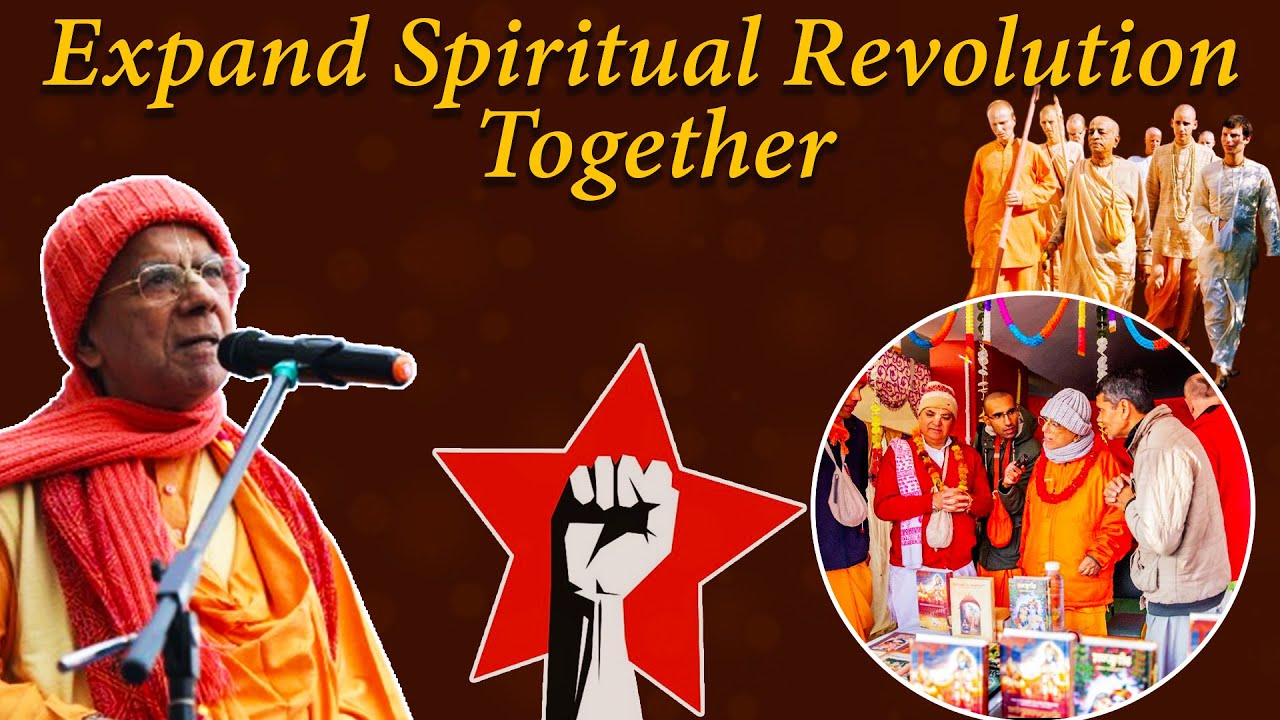
In this devotional lecture Srila Gopāl Kṛṣṇa Goswāmī expounds Srimad‑Bhāgavatam Canto 1 Chapter 19 verses 38‑40, using them to illustrate the concept of the twelve mahājānas (spiritual authorities) through which authentic Vedic knowledge is transmitted. He enumerates the mahājānas—Swayambhu (Brahmā), Nārada, Śambhu (Śiva), the four Kumaras, Kapila, Swayambhuva Manu, Prahlāda, Janaka, Bhīṣma, and Bali—explaining their roles and why Śukadeva Gosvāmī, as one of them, is uniquely qualified to teach. The speaker then details the guru‑disciple process as exemplified by Parīkṣit Mahārāja’s humble request to Śukadeva for guidance on what to hear, speak, and do, emphasizing that hearing Krishna’s name purifies the heart while worldly topics corrupt it. He draws analogies to milk and the cow, stressing that even a minute’s association with a pure devotee is more valuable than extensive scriptural study, and that protecting cows is a moral duty. The lecture contrasts “real charity” (spreading Krishna‑consciousness through book distribution and sankirtan) with “false charity” that merely gives material aid, illustrating the point with anecdotes from Srila Prabhupāda. Finally, he frames the global spread of Krishna‑consciousness as a peaceful, joyous “spiritual revolution,” urging listeners to actively participate in sankirtan and book distribution, promising spiritual happiness and divine credit for those who become instruments of this movement.
Chapters
Om namo bhagavate vasudevaya! Um... um— Śrīmad-Bhāgavatam, Canto 1, Chapter 19. We'll finish the whole chapter, to the text 38 to text 40. Nūnām bhāgavatoh brahman, krihēśubrihā medhinām, lālakṣateḥ avastānam, api gho dhonam kvācet. We are not chanting the Sanskrit shlokas, and the translation was read a little fast because we have very limited time for the class. So I've been skipping the chanting of the shlokas. So we have seen that Praśād Mahārāja was very pleased with the appearance of Śukadeva Gosvāmī. In the two classes we gave, we briefly pointed out Śukadeva Gosvāmī's exalted position. Śukadeva Gosvāmī has been described as a Mahājān. Mahājān means spiritual authority. In the Sixth Canto of the Bhāgavatam, the, the yāmadūtas, etc., were The Yāmraj, Lord Yāmraj has said that there are 12 authorities through which spiritual knowledge can be obtained. Swayambhu, Narada, Sambhu, Kāumara, Kapilomanu, Pralādo, Jānaka, Abhishmo, Balīrāya, Sakervāyaṁ. These are the 12 authorities which we shall briefly present now. So the first is Swayambhu. Swayambhu means Lord Brahmā, and we all know The Lord Brahmā obtained this knowledge because He had performed those charities for extended time, and then the Lord revealed this transcendental knowledge in His heart. Tene brahmā hiddhi ādika vayeh. This transcendental knowledge that we hear was revealed in the heart of Brahmā-jī by the Lord Himself. Then Nārada, Nārada Muni, the spiritual master of Śukadeva Gosvāmī, is also considered a spiritual authority. I'm sorry, Nārada Muni The spiritual master Vyāsadeva is also a spiritual authority. Narada Muni travels and he's a spiritual master of many, many great sages including Dhruba Maharaja. Then Shambhu. Shambhu refers to Lord Shiva. Lord Shiva is also considered a spiritual authority. In the Śrīmad-Bhāgavatam, we see, we read about wonderful glorification of the Supreme Lord by Lord Shiva. Then Komaṇa Kapilomanu. Komaṇa The, the four Kumaras, the sons of Brahma. Kumaras, they were encouraged by their father to get married, but they refused to get married because they did not want the body to grow so that the sex desires do not develop. So the Kumaras refused to grow in height, and they're also considered spiritual authorities. They did not want to get married because they did not want to get entangled in any type of material arrangement. Then Kapila, Lord Kapila, the son of Devahuti. He is also a spiritual authority, and Lord Kapila's instructions are revealed in the third canto of the Srimad Bhagavatam. So Lord Kapila's instructions are known as the principles of sankhya yoga. Then Manu. Manu means Swayambhuva Manu. Then Pralado Janakabhishmo. Pralado means Pralad, the son of Hiranyakashipu. Then Janaka, King Janaka was the father-in-law of Lord Ramachandra. He's also considered a spiritual authority. Then Bishma, Bishma means Bhishma Dev, and Bhishma Dev, when he was leaving his body lying down on the bed of arrows, Krishna inspired Yudhishthira to ask him about the principles of dharma, and he revealed the principles of dharma which are contained in the first canto of the Bhāgavatam. Then, balīrvāya sakīrvāyaṁ. Balīr, balīr means Bali Mahārāja. Bali Mahārāja sacrificed everything to the Supreme Lord and thereby displayed what is the meaning of Ātmānivédam. Who knows the meaning of Ātmānivédam? Ātmānivēdam means full surrender, completely with body, mind, and words. So Bali Mahārāja surrendered to the Lord Vāmana Deva not only his possessions But ultimately he even surrendered his own body. Vaya sakir, vaya sakir means Śukadeva Gosvāmī, the son of Vyasadeva. Vayam, vayam means myself, Lord Yāmraj. So these are the 12 authorities of religion, and through them only we can understand what is real dharma. So Śukadeva Gosvāmī is not an ordinary personality, but he is one of the 12 mahajans. Recognized to give us spiritual knowledge. And the word shuka in Sanskrit means parrot. So it is explained that by the recitation of the Śrīmad-Bhāgavatam by Śukadeva Gosvāmī, the knowledge of the Śrīmad-Bhāgavatam has become even sweeter. So the Śrīmad-Bhāgavatam was, was revealed on different occasions. Vyāsadeva spoke the Śrīmad-Bhāgavatam to Śukadeva Gosvāmī. Śukadeva Gosvāmī spoke it to the dying Parīkṣit, and then Sūtaka Gosvāmī spoke it to the sages of Nāmaśvaranya. So in text 38, we see that Parīkṣit Mahāja is begging Śukadeva Gosvāmī, please tell me what a man should hear, chant, remember, and worship, and what he should not do. So this is the process of obtaining knowledge from the spiritual master. The disciple humbly falls at the feet of the spiritual master and begs knowledge about what one should hear, what one should do, what one should not do. So what one should hear, what one should not hear, what one should do, what one should not do, what one should talk, what one should not talk— all this information we understand from Guru-sādhu-śāstra. So if we hear about Kṛṣṇa, then the contaminated heart gets purified. And if we hear about mundane subject matters, then the contaminated heart becomes more black. The whole goal of this Krishna conscious movement is to attract us to hear about Krishna. So further, it is being explained in this, in these verses by Parikṣit Mahārāja that Śukadeva Gosvāmī was always traveling. He would not stay in a place any longer than it took to take milk from a cow. In the Purport, Prabhupāda points out— the importance of milk. It says how milk is such a complete food that a man can survive just by eating enough, just by drinking enough milk. So Śukadeva Gosvāmī, he used to travel from one house to another, but he would stay with a householder only as long as it took enough time to get milk from the cow. It is said in the Vedic scriptures, a minute's association with a pure devotee is more valuable than reading all the Vedic scriptures put together. Because in a minute's association with a pure devotee, you can understand the purpose of the Vedic scriptures. Whereas if you try to understand the Vedic scriptures through your own efforts, you will constantly be baffled. So it is not that somebody may say, oh, Śrī Kṛṣṇadeva Gosvāmī was only going to a householder's house for 10 minutes. What can a person get? What knowledge can he get in 10 minutes? If one associates with a pure devotee even for a minute, he can surrender to Krishna. We have seen how Prabhupada, when he was traveling around the world, how people would sometimes meet him at the airport. You know, Prabhupada would be waiting to catch a plane and some devotees would be there doing kīrtan. People would meet him just for a minute or two or 5 minutes. And later on, they went, they surrendered and became devotees in different parts of the world. Even our own devotees, we all of you may recall that sometimes when you're out doing book distribution or preaching, you meet somebody who comes to you, takes a book, talks to you, then he comes to a temple and he surrenders to the Lord. So this association with devotees of the Lord is very important. So milk is considered the most healthy of all foods. In the, in the past, great sages used to live just by drinking milk. Unfortunately, today we recognize the value of milk, but we don't recognize the value of the cow. And because we don't recognize the value of the cow, the cow is being sent to the slaughterhouse, even though the cow is giving us so many natural gifts. It gives us milk, it can— the cow dung of the cow is so pure, it can be used even for cooking. In fact, like in our Mayapur temple, we cook using cow dung to produce gas for cooking. Lord Caitanya, when He was talking to the Qazi, you know that story of the Qazi? The Mohammedan Qazi had stopped Lord Caitanya's Sankirtan movement from doing kīrtan. So Lord Caitanya led a big demonstration. He took 100,000 people with Him, just like in our Red Square. You have regular demonstrations. Sometimes you have pro-Calmness demonstrations, sometimes you have pro-Yeltsin demonstrations. So Lord Chaitanya led a peaceful demonstration to the house of the Qazi, and he told the Qazi, what type of religion is it when you're killing your own mother? So the cow is considered one of our mothers. Why is the cow considered our mother? Because the cow gives us milk, and as a result of the milk, we grow up. Just like the mother feeds the baby when the baby is young. So the Krishna Consciousness movement is advocating the protection of the cows because the cow, the cow must be protected. Brahminical culture means protecting the cow and the weaker sections of society, including the women, elderly people, and children. So Śukadeva Gosvāmī is being requested by Parīkṣit Mahārāja to please enlighten him about the perfect knowledge. So just like Parikṣit Mahāj obtained information from Śukadeva Gosvāmī, we should also be anxious to obtain information in the same mentality. So Śukadeva Gosvāmī's words are nectarian. And if we receive dharmāṁ dhyā-sakṣād bhāgavata-praniṭhām, religion means the words of God. And if we accept the words of God from the right source, then the words of God will have the effect of purifying the impurities in the heart. So this is real knowledge, knowledge contained in the Vedic scriptures. Everything else is avidyā, ignorance. In the Śrīmad-Bhāgavatam we see that Hiranyakāśipu one day called his son Prahlāda, and Hiranyakāśipu told Prahlāda, Prahlāda, you are my dearest son. Please tell me what have you learned in school. And what did Prahlāda tell his father? Śrīmad-bhāgavatam 1.2.1: śrīmad-bhāgavatam-kṛṭṇa-viṣṇu-svaṇṇam-pāda-sevanam āśraya-moṇyam dasyam sakyam ātmānivedam. Pralāda Mahārāja said, "My dear father, I have learned śrī-nama-kītṇa." So his father said, "What does this mean?" Then he explained what it means, the ninefold process of devotional service. So why do we encourage book distribution? Why do we encourage preaching activity? Because this is knowledge, śrī-nama-kītṇa viṣnu-smāṇam. And people today are using, are hearing knowledge That is not really knowledge. But unless they receive spiritual knowledge, they will not be able to obtain perfection of human existence. Kṛṣṇa consciousness has been described as the real charity. In the material world, everybody likes to claim that he is charitable, but they do not know what is real charity. Just like if you go to New York, you will find that there may many drunkards, alcoholics, So they will stop a car and say, sir, give me a dime, give me some money. And many Americans will take a dollar out and give them money to go and buy beer, and they're very happy. They're charitable, just like the citizens are happy with the government when the government will give them money for sense enjoyment. But Krishna consciousness means distributing real charity. Prabhupada used to give an example of how false charity is destructive. Prabhupada gave two stories. On this theme, which I'll tell you. One is, once there was a boy who was brought up by his auntie, and whatever the boy would do, the auntie would say, 'Ochhen karisho.' So slowly, slowly, the boy started stealing, and he would steal and come home and show to his aunt, 'See, this is what I've stolen today.' She would say, 'Very good, very good.' So one day, the boy murdered a man. And he was arrested, and the judge convicted him to death. He was going to be hanged. So, you know, when a man is hanged— I don't know if they have hanging in your country, but generally the tradition is that when a man is about to be hanged, they allow him to fulfill his last wish. So the judge said, what is your last wish? He said, I want to speak to my auntie. So when the auntie came in the court He said, please come closer to me. Then with his teeth, he bit the ear of the auntie. He said, if you would not have stopped me from doing all the wrong things I was doing, if you would not have told me very good, very good to every bad thing I did, today I would not have killed this man, I would not be hanged, and you would not be crying. But because you did not correct me when I was doing something wrong, I went on doing something wrong, and now I'm going to be hanged in a few minutes. So Prabhupada gave this example to show that how false charity can be very bad. If you don't control some— if you don't check somebody when he's wrong, then that is false knowledge, false charity. So we in Krishna consciousness do not believe in giving false charity. We believe in giving real charity. Real charity means to give people knowledge by which they can give up their sinful activities. So devotees, when they go out and preach Krishna consciousness Devotees, when they engage in book distribution, devotees when they engage in harinama, they are performing the highest welfare activity on this planet. It is said in the Śrīmad-Bhāgavatam that by the distribution of the Śrīmad-Bhāgavatam, by reading the Śrīmad-Bhāgavatam, a revolution will take place. In your country, everybody remembers revolutions. They remember the revolution of 1917 that destroyed the czars and brought in communism. And then they remember the revolution of last year, which destroyed communism and brought in capitalism. But there's another revolution that is being done, and that is a spiritual revolution. But nobody is talking about it in the papers, but the devotees know that it is taking place. As more and more people read these books, as more and more people chant the Holy Name, as more and more people listen to the preaching of Krishna conscious philosophy, The spiritual revolution will expand. And as a result of the spiritual revolution, people will stop sinful activities. Generally in the material world, when you talk about revolution, they talk about violent revolutions. But this is a peaceful revolution. It's, and it's a very enjoyable revolution because spiritual life is enjoyable. In fact, this is real enjoyment. Pralhad Maharaja stated, nārthi vidyam svārtha-gatim hi viśṇṇam duraḥ se bhāir artha-māṇīnā. That people do not know how real happiness can be found. So this is the path of real happiness. In the Bhāgavatam, Lord Rāṣadeva told, Lord Rāṣadeva told his sons, tapo divyaṁ pratikāyeṇa satvaṁ śuddheye daśvād ramāso kya mānāntam, that in exchange for performing these austerities for the pleasure of Kṛṣṇa, you will realize happiness. And the nature of this happiness is it is going to be unlimited and it will increase, increase, increase, unending. So material happiness has a beginning and an end. You may be very rich today, but death will stop you from being happy. But don't worry about death. Before death comes, you're going to have old age and disease. They will stop you. But spiritual happiness never stops. Therefore, Caitanya Mahāprabhu has said, ananda-buddhi-vārdhanam prati-padam pūm-nāma-rātas-vārdhanam sarvātmāsnavam param vajrayate Śrī Kṛṣṇa-saṁkṛtenam. That is, as a result of chanting the holy names, one realize ananda, happiness. And the nature of this happiness is it is always increasing, increasing, increasing, increasing. So you must— your devotees must be convinced about this point, that if you want real happiness, then you have to take to Krishna consciousness. If you want some false happiness, sure, then you can go and flirt with Maya, no problem. Just like when you're eating food, you want real food, you don't want false or a chemical Organic, you want organic food, you don't want something mixed with chemicals. When you have ding, when you want money, you want real ruble note, you don't want a false note. So similarly, when you want happiness, you should be after real happiness and not false happiness. So we're neither— we are not trying to cheat anyone, we are giving everyone the path of real happiness. And everybody is looking for happiness. Even the cat is very happy when the cat finds some milk in the kitchen and nobody else in the kitchen. So this happ— real happiness is the possession of Kṛṣṇa consciousness. Therefore Bhāgavad-gītā says: "Brahmā-bhūta-prasannātmāṇa so'cidiṇḥ na kāṅṣati sama-sarveśyaṁ bhūteṣu mad-bhaktyam labhate param." That is, one who is spiritually situated, he is happy, and then he does not hanker and lament. So it is our duty to understand Kṛṣṇa consciousness in the submissive mood that Parīkṣit Mahārāja is understanding it from Śukadeva Gosvāmī. And then it is our duty to take this Kṛṣṇa consciousness to everyone that we see. And if we give this Kṛṣṇa consciousness to everyone, we get the blessings of Guru Prabhupāda and Caitanya Mahāprabhu. And if you don't become an instrument, then you don't get the credit. Prabhupāda said Kṛṣṇa consciousness is going to spread everywhere in any case, because it is Lord Caitanya's prediction. Prithivite acha yata nagarādhigraḥ. So why don't you help create the spiritual revolution? And get the— claim the credit. Just like in history books you read all the people who created the previous revolutions in your country. So 100 years down the road, everyone will say, oh, how the devotees of Krishna consciousness helped create the spiritual revolution. And we create this revolution by helping, by distributing spiritual knowledge. Therefore Prabhupāda said, distribute books, distribute books, distribute books. And this is our principal medium for creating a spiritual revolution. So all of you should become instruments in creating this revolution. Hare Krishna. Hare Krishna. Hare Krishna. How many people went out on sankirtan yesterday? I want to see in the Lord Nrsimhadev marathon. Hand up. High, high, high. Okay, so many people don't have their hands up. Can they— can some more people go out today? How many people can go out today? How many people want to help create this spiritual revolution? Let us see how much you understood of the class. Do you want your names to go down in history books? That Bhakta Vladimir, Bhakta Saragay, Bhakta so-and-so, Bhakta so-and-so, they all created the spiritual revolution by distributing books in Lord Narasimhadev marathon. Actually, as you know, the Lord— in Lord Chaitanya's book, your name will be recorded. In the temple, we may make some mistakes in recording your names or giving you credit, but the Lord doesn't make any mistakes. The Lord's computer is perfect. So we hope that all of you will help distribute the mercy of the Lord and get Lord Nrsimhadeva and Lord Caitanya's mercy. Hare Krishna, Hare Krishna, Krishna Krishna, Hare Hare, Hare Rama, Hare Krishna. Malama e are.
More from PRASAD

Rare Pastimes & Timeless Lessons of Guru Mahārāja | Stories Every Disciple Should Hear

ISKCON Legends- pure devotees meet-HH Jayapataka Swami, HH Gopal Krishna Goswami, HH Radhanath Swami



Jagannātha Ratha-yātrā Through Śrīla Prabhupāda's Mercy | 29 April 2006 | Nairobi, Kenya

Lord Jagannātha's Appearance Pastime | 21.07.2019 | ISKCON Calgary | Śrīla Gopāla Kṛṣṇa Gosvāmī

The Ācārya Teaches by His Own ExampleGuṇḍicā Mārjana by Guru Mahārāja #shorts

Guṇḍicā Mārjana – Lord Jagannātha's Pastime | 21.7.2019 | ISKCON Calgary |Śrīla Gopāla Kṛṣṇa Gosvāmī

H.H. Gopāla Kṛṣṇa Gosvāmī Mahārāja - Exemplary Sādhana and Deity Worship # shorts

भगवान की कृपा कैसे प्राप्त होगी ? | 11 Jan 2014 | Punjabi Bagh | Srila Gopal Krishna Goswami

Material Education vs Spiritual Education | Srila Gopal Krishna Goswami #shorts