Failed to execute Devotional Services? 🤔 | SB 2.3.15 | 23 Oct 1991 | Montreal | Gopāl Kṛṣṇa Goswāmī
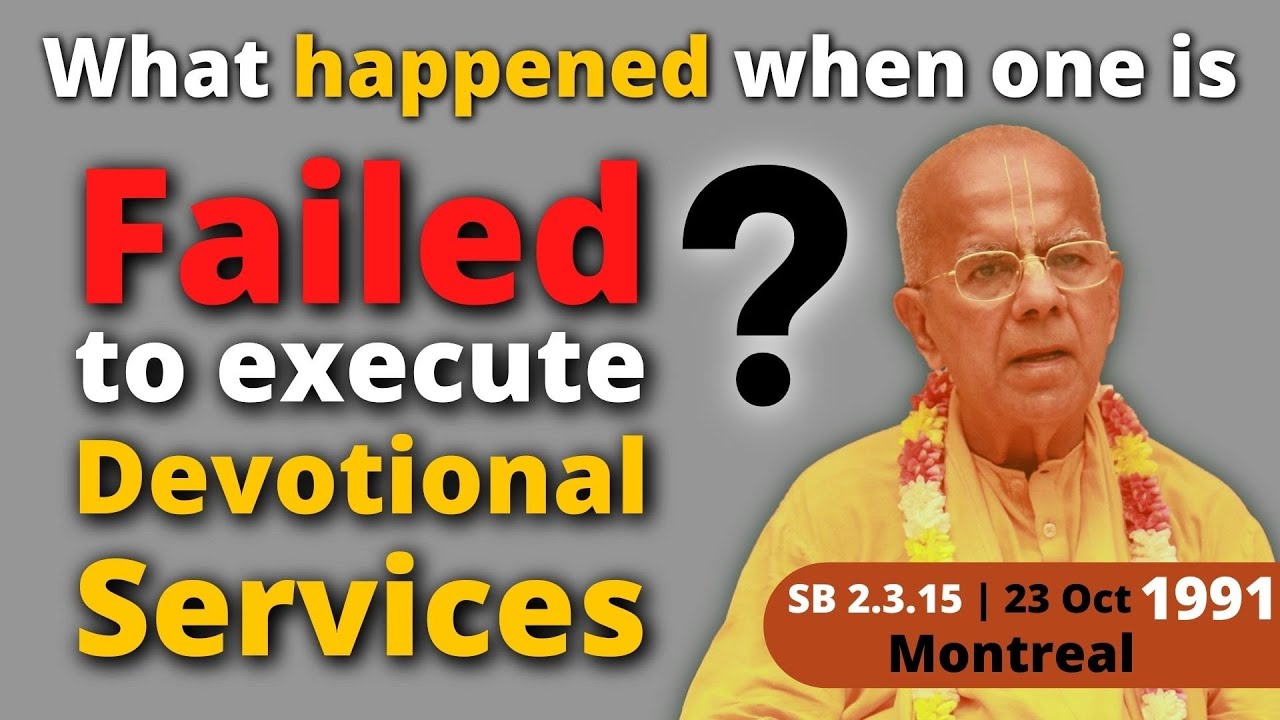
Prasad Raval explains how early devotional education shapes lifelong spiritual capacity, using King Parikṣit and other historic devotees as examples. He emphasizes that the Hare Krishna mantra works regardless of material circumstances, recommends beginning spiritual instruction by age five, and warns against ego and mind deception in practice.
Chapters
Om namo bhagavate vasudevayaam! Om namah bahgawathe vassudevayam! Om namah bahgawathe vassudevayam! Om namah bahgawathe wasudhevayahm! Mahārāja Parīkṣit, the grandson of Pandava, was from his very childhood a great devotee of the Lord. Even while playing with dolls, he used to worship Lord Kṛṣṇa by imitating the worship of the family Deity. The person by his divine grace, Kṛṣṇa Bhaktivedānta Swāmi Prasāda. In the Bhāgavad-gītā, it is stated that even a person who has failed in the proper discharge of yoga practice, is given a chance to take birth in the house of a devotee Brahmana or in the house of rich men like Shakya kings or rich merchants. But Mahāprāśadra is more than that because he had been a great devotee of God since his previous birth, and as such he took his birth in an imperial family of the Kurus, especially that of the Pandavas. So from the very beginning of his childhood, he had the charm to know intimately the devotional service of Lord Kṛṣṇa in His own family. The plan was always to greet to the Lord through many veneration family meetings in our own palace of worship. Children who appear in such families fortunately generally imitate such worship of the Deity even in the way of child's play. By the grace of Mārṣaī Kṛṣṇa, we did not transform more than one Vaiṣṇava family. And never tried to be imitated in the worship of Lord Kṛṣṇa by imitating our father. Our father encouraged us in all respects to observe all policies such as the Ratri-ātra and Gauri-ātra ceremonies, and he used to spend money liberally for distributing prasads to our children and our friends. I have questioned Master who also took his birth in a Vaishnava family, drawing inspiration from his great Vaishnava father, Chakravarti Mahadeva. That is the way of all Vaishnava families. They celebrated nearby the historical debut of Lord Krishna as the great lifter of Govardhana Hill. The life of Sri America devotee is almost the same because he has always sung all the symmetries between the early life of all great devotees of the Lord. According to Jīrāda Gosvāmī, Māhārāja Parīkṣita must have heard about the giant pastime of Lord Kṛṣṇa in Dārvāṇa. Pre-ancient images of pastimes have become famous. According to Śrī Rādhārāṇī, Māhārāja Parīkṣita used to imitate the worship of the family deity by elderly members. Śrīla Viśṇūdācakra Mahārāja also confirms the viewpoint of Jīvārṇasvāmī. So, if that thing, either of them, Māhārāja Parīkṣita was mentioning is lying on Lord Kṛṣṇa, from his very childhood. He might have imitated either of the above-mentioned activities and also established a great devotion from his very childhood, a symptom of a mahā-bhāgavata. Such mahā-bhāgavatas are cognizant siddhas or souls liberated from birth. But there are others who may not be liberated from birth, but have developed a tendency for devotional service by association. And therefore sadhna-siddha. There is no difference between the two in the ultimate issue, and so the conclusion is that everyone can become a sadhna-siddha, a devotee of the Lord, simply by association with a pure devotee. A concrete example is our great spiritual master Śrī Dhāraṇḍamuri. In his previous life, he was simply a boy of a maidservant, but through association with great devotees, He became a devotee of the Lord by his own service, unique in the history of devotional service. Om manjana mātya vinandātya gāyānjanāśavakyā śrīkṣrīmṛdaṇaṇa-tātmāya śrī-bhāvanam aha śrī-kṛṣṇa-nyāmaṇo viṣkramṣaḥitaṁ vidam-mūrtare soya-mūrtva-gadāmayam pradāti svāpanandikam. Māndeham śrī-guru śrī-rāpha-da-kamman śrī-guru-maīśṇa-vanastha paṇḍavyo mahā-labhāḥ bhāvā-kṛṭāṇukeḥ pri-dham kṛṣṇa-sṛḍavya-ādhevey. So this verse is being spoken by Arjuna Kaviṣī and the great sage Sanaka Rishi. Who was Sanaka Rishi? Sanaka Rishi was the leader of the sages who were assembled in Navashramaṇa. Navashramaṇa is located in northern India, a one night's journey from Delhi. And Navashramaṇa was a place which was known for spiritual discussions. Great sages used to assemble there and they should have spiritual discussions. And 60,000 great sages were assembled for this discussion. 60,000, just imagine. 60,000 great sages were all assembled together. And all 60,000 sages had only one concern. And what was their concern? Tuiyosa. Yes. Here, how the people of the age of Kali could be saved. So all 60,000 sages were engaged in performing a very elaborate sacrifice, and they had selected Śrīla Gosvāmī as their chairman or as their leader, because Śrīla Gosvāmī was considered to be most learned and disciplined on the spiritual path. So in this verse, Śrīla Prabhupāda is saying, he's talking about Mahāprabhu, the grandson of Arjuna, who from his very childhood was a great devotee. So Mahāprabhu indeed was a very, very fortunate king. He had the opportunity of personally seeing the Lord when he was in the womb of his mother. When he was in the womb of his mother Uttara, Aswatthama had released a brahmāstra. Aswatthama was hoping to kill the child in the womb of Uttara. And Uttara, when she saw that child, that brahmāstra coming towards her, she prayed to the Lord. She said, I may die, but please save the son, or please save the child in my womb. So Kṛṣṇa is located in everyone's heart as the Paramātmā. So Kṛṣṇa, in a fraction of a moment, crossing infinite truth, the womb of Urdhvaṇa, and He stopped his brahmāstra from burning Parīkṣit Mahārāja. Parīkṣit Mahārāja, when he was in the womb of his mother, he felt the heat of his brahmāstra. The brahmāstra is a very powerful weapon. So he felt the heat, and because Praśṇa personally entered the womb, he saved Parīkṣit from being burnt by the heat. So Parīkṣit Mahārāja, when he was in the womb of his mother, He had the opportunity to see the personal form of the Lord. Because as Krishna appeared in the paramātmā feature in the womb, Parākṣita saw the Lord. But then the Lord disappeared from there in a fraction of a second after doing his job. So Parākṣita, until he came out of his mother's womb, he was always searching For that personality that would resemble what he saw in his mother's womb. Therefore, the meaning of the word Parikṣit is examiner. Parikṣit means examiner. So King Parikṣit was always examining everyone that he met. He would try and see, does this person look like what I saw in my mother's womb? And of course, nobody looks like God. So Parashurama, the word parashurama means examiner. So Parashurama was constantly examining, and he was always searching for that personality that he saw in his mother's womb. So Parashurama, from his young age, he was playing, he was imitating the confident postures of the Lord, and he was worshiping. The Lord when he was a young child. So Prabhupada in this purport has made many, many very important points. In this point book, in the purport, Prabhupada is pointing out that if one is very fortunate, he receives spiritual training from a young age. Like Prabhupada gives example, Śrīla Rūpa Gosvāmī, he himself was born in a Vaiṣṇava family and trained by his father. He gives the example of Bhaktisiddhānta Dī. Bhaktisiddhānta Dī was also born in a great Vaiṣṇava family. So, if one is fortunate, then he receives spiritual education from a young age. It doesn't matter whether one is born in a Vaiṣṇava family Or whether one is born in a family that becomes a Vaiṣṇava, that is immaterial. Because even the family that becomes a Vaiṣṇava has the opportunity for progressing on the journey back to Godhead. Just like Prabhupāda, you've heard, talks about sādhna-siddha and nitya-siddha, two classes of devotees, nitya-siddha and sādhna-siddha. Nitya-siddha means those who are eternally liberated, like Parāśurama. And sadhana-siddha is one who becomes liberated by following the process of sadhana-bhakti, which has been described by Rūpa Gosvāmī in Bhaktivedānta-siddhānta. So even though one may be born in a contaminated position, one may be born in a polluted family, but if one cultivates the process of devotional service, through the medium of Sādhana-vriddha, then he has as much of an opportunity as somebody else to go back to Godhead. Therefore, this process of Sādhana-vriddha is highly recommended. That is, in order to make spiritual advancement, one must follow the process of Sādhana-vriddhi. So Prabhupāda used to say that to the age of 5, you can give the children what you want. But after the age of 5, the child must be disciplined. And if a child is disciplined and educated in spiritual philosophy, given spiritual goals, given, explained different process of pastimes, given deities of the Lord, just like Prabhupāda also used to tell us that his father gave him deities. When Prabhupāda would even have the ratiyātva, festival, his kordiya, In Prabhupāda's house in Kalkana, there was a small kodiya, and Prabhupāda would regularly have the rāsyātva peshwa over there, and then this would be pushed out to his friends. And the father was very liberal in that, and so was also Tākura Mākhidrāma in training of peshwas. So it is important that spiritual education be received from a young age. Therefore, the great Mahādhana, Prabhupāda Mahādhana, Homa, Homa is described to be the age when one attains 5 years. So from the age of 5, one must start receiving spiritual education. Why? Human life is very rare. Hence, it should be utilized correctly for what? For self-realization. Govinda Das, a very great Vaiṣṇava poet, Govinda Das in a Pāṭhagurūya Mānava Phair, he says, "This human life is kām la jala-jala jīvana-salamana." Jīvana-salamana. He says this human life is mine. A drop of water on a leaf. You may have seen in the morning when you get up, in the leaf, that drop, there's a drop of water. Now if the drop of water thinks that my existence on this leaf is permanent, then it is an illusion. The drop of water knows that anytime the wind may push the leaf and the water will fall out of the leaf, isn't it? So Guruji Maharaj says, Jiwanat Allah Malaq. This life, Jiwan, is like a drop of water on a leaf, and hence this life can end at any time. Therefore, Prasad Raval has very strongly emphasized the importance of spiritual education from a young age. And if one is educated from a young age on the spiritual philosophy, then there is a good chance that when you grow up, you will be, you will spread works on the spiritual part, just like Parikṣit Mahārāja. Parikṣit Mahārāja, the Grandson of Arjuna, he was trained from a young age. And then, even when he grew up, Parikṣit Mahārāja was a boy like a lion. Parikṣit Mahārāja was not ordinary. The Bhāgavata describes him as like a lion. When he saw the personality of Kali trying to exert its influence He was having a chat with Kali. But then when Kali apologized and said, "Please give me a place where I can live," he drove Kali out of his kingdom. So Parashurama was like a lion. The Prophet explains, a devotee similarly should be a lion. But a devotee should be a lion in terms of his determination, pride, or vanity, and anger. Are responsible for keeping the living entity entangled in the show of existence. Therefore, once when a devotee asked Prabhupāda, "How does one preach and how does one behave?" Prabhupāda said, "The devotee is a lamb at home and a lion outside." That means when it comes to preaching Kṛṣṇa consciousness, we should become a lion, full force. Very straightforward in presenting the philosophy without any hesitancy, because the devotee has a conviction that it is only this philosophy that can save humanity. But when it comes to dealing with viceroy, one is very gentle. Therefore, one is like a lamb. So Parashurama was like a lion. Now, the same Parashurama who was sage When he was in the womb of his mother, was later on cursed to die by a Brahmin boy called, what was his name? Śrīndī. This boy Śrīndī cursed him to die. So sometimes people say that this was his reaction, karmic reaction. But jīvako sāvī and viśvamānta sāvudhi tāpo, to very great scholars in Vedic literature. They have discussed this point very thoroughly, and Jīvopasāvī and Viśṇṇudhaka Uddīpākṛda have concluded that Parīkṣita Māṇājana's being cursed by the Brahmin boy was not due to some karmic reaction, but it was ordained by the will of the Lord so that a situation could be created By the grace of Śrīmad Bhāgavatam could be spoken. So the point is that a devotee of the Lord also has to go through difficulty. It is not that a devotee of the Lord does not have to go through difficulty. But a devotee of the Lord, while he goes through difficulty, he has the firm faith, "As my Lord will always protect me, and whatever is being done is being done for my benefit." Therefore, the devotee always ends up getting protected by the Lord. Just like Śrīñī, the young Brahmin boy, he misused his brahmical position. How did he misuse it? By choking Parāśivamāra, isn't it? In fact, even his father, when his father discovered what his son had done, he said, "Hey, what have you done? You have cursed this great sage Parāśivamāra." When Parāśivamāra was truly a rāja-vṛṣī. Rajarishi means one who is also an administrator, a ruler, and a great sage. Therefore, in the Bhāgavad-gītā, Kṛṣṇa has said, imāṁ pālaṁ parapraṣaṁ imāṁ rājaṣo vidyūḥ, their Supreme Child was coming down to the great kings who were also great sages. So, Arjuna Mahārāja was not just an ordinary king or administrator. He was also a great sage, and the Brahman was some stringy. He misused his position as a Brahmana by cursing this innocent devotee, King Parikṣit to die. However, when Parikṣit was cursed to die, he took this as a blessing of the Lord. He took this as a blessing of the Lord because He took this as an opportunity to disentangle himself from the children's existence. So, a devotee, even if he has to face difficult situations, he understands that eventually there is a certain plan of the Lord. And if the devotee is sincere, then the Lord takes away his material impediments so that he may quicken on the journey back to Godhead. Because the Lord, as we find Mahātmā residing in everyone's heart, is fully aware of what are the desires of the devotee. Just like Arjuna. Arjuna, he fellow companion of the war, was also put in a position of indulgence so that a theme could be created by which the Bhagavad-gītā could be spoken. So the point to note is this, that a devotee who is surrendered to the Lord and no fear. So the sages in Namaśvarāṇya, they are asking Śrīla Gosvāmī questions about Arjuna's mahā. You see this trend in the entire Śrīmad-Bhāgavatam. You see the trend that the devotees are anxious to inquire not only about the Lord but also about His devotees. The great leaders in numerous places, even in the First Canto, they want to know, please describe to us the glories of Praśad Rāja. Again in the Second Canto, again and again this point comes. Because the devotees of the Lord are very, very dear to the Lord. This was confirmed by the Lord to the rāṣṇa-muni. The rāṣṇa-muni was trying to harm Amṛśvarāja, but Amṛśvarāja was so much fixed in the meditation on the Lord, prasādh mānākṛṣṇa-padāra-vibhayaḥ, Suffine is the last one to meet the Lord because the Lord told him, "My devotees are so dear to me that they sacrifice wives, children, possessions for my pleasure. Therefore, I reside in their heart and the devotee resides in my heart." So one who becomes a devotee, one who is such a keeping of Krishna, or he is very, very dear to the Lord, He resides in the heart of the Lord, and the Lord resides in his heart. So the Lord, to protect him, Parikṣit mārāja, the Lord was present in Uplāṇḍhū and the parmaṇḍhā. He protected Parikṣit mārāja from Māṣatāma and Brahmāstra. And anyone who is surrendered to the Lord is protection for the Lord. And even if that devotee has been confronted with difficulties, he understands since those that call this worship the Lord And hence he accepts it willingly. So by devotee association, Prabhupāda is very clearly making this point. The whole paragraph is devoted to this one point, how by sadhana-siddha one can become qualified. And he gives the example of Nārada Mūli. Nārada Mūli in his previous life was the son of a maidservant. But the only fortune of this maid servant was, she was not an ordinary maid servant. She was a maid servant in the house of a great saintess. So because she was a maid servant in the house of a great saintess, now the maid would have the opportunity to hear the philosophy that the great saintess would speak and to eat the valuable food served. That they would leave behind. And as a result of hearing the philosophy that the great sages were speaking, Narada Muni became so convinced about the cause of devotional service that one day his mother was going to milk a cow and she was bitten by a snake and she died. But Narada Muni did not get disturbed at all. Why? Because he had understood by associating with the great sages that everything of this show world is temporary. And one who takes birth has to give up the body also. Therefore, the devotee understands that all relationships are temporary, all situations are temporary, and everything has a beginning and an end. For one who is taking birth, this is also service. Therefore he proceeds, he progresses in executing his duty, that is executing the prāsāda-vibhoṣkutvrtti, because he understands that everything is temporary and this is the only permanent asset. So sadhno siddha. So we are all in the position where we can become perfect By following the process of sadhana of bhakti. We may not have fortunes of being like Parikṣit Mahārāja or being like Prabhupāda or Jākima Mahāprabhu or Bhaktisvanandana Mahārāja, but this process is so powerful, as Prabhupāda is explaining in the purport, this medicine is so powerful that if we take advantage of this medicine, even today, in coming birth, It will have the same effect as it had thousands of years ago on Parikṣit Mahārāja. Parikṣit Mahārāja, he was cursed to die. Śrī Veda Gosvāmī recommended that he should prepare for his death by hearing the transcendental glories of Śrī Kṛṣṇa. So hearing the transcendental glories of Śrī Kṛṣṇa, either through the process of chanting or through the process of reading from the scriptures, or through the Sūdha process of śrīmad-bhāgavatam, will have the same effect today in 20th century Kali Yuga that it had thousands of years ago. Therefore, this medicine is intact, its potency is intact. With the passage of time, civilization has become degraded. With the passage of time, The atmosphere in which we live has become polluted. But fortunately, with the passing of time, the potency of the Hare Kṛṣṇa mantra has not gone down. With the passing of time, the potency of Kṛṣṇa-kathā is as strong today as it was thousands and thousands of years ago. Why? Because these transcendental pastimes of the Lord are all descending from the spiritual world. And because they're all independent from the spiritual world, time has not affected. Time affects everything material, but time doesn't affect anything spiritual. Just like the spirit soul doesn't get affected by time, but the material body gets affected by time. So what is transcendental doesn't get affected by material environment or evolution, etc. So if we take advantage of this process, then it will have the same effect. So Kṛṣṇa is anxious that we serve. And as we advance on the devotional path, there's a very unique relationship between the devotee and the Lord. The Lord is anxious to serve the devotee, and the devotee is anxious to serve the Lord. In the Kṛṣṇa Charitamṛta, There's a very nice story of Madhu Dapuri, which Caitanya Mahāprabhu was indeed very, very fond of, and Caitanya Mahāprabhu would often describe it to his devotees. In this story, you can see how the Lord always tends to preserve His devotees. Madhu Dapuri had just completed the parikrama of the Govardhana Hill, and he was passing. So after having completed his parikrama, Mother Nupuri was just relaxing, you know, he had his eyes partially closed, and a very beautiful— I saw a painting this morning somewhere in the temple, within the temple— and so when he was relaxing, a very beautiful young boy came to him with a pot of milk and said, 'I understand that you are hungry.' The priest had this milk. Mahārāja Mukhuri was surprised, how did this young cowherd boy know that he was hungry? So he said, "The villagers had come to take water from the well, and the ladies saw you, they looked that you looked tired, and in my village nobody goes hungry." The priest drank this milk. And I will come back and take this pot back from you. The mother of the boy was struck with wonder. Who was this attractive personality who came to him with this milk? The same night after Mother of the boy had the milk, he had a dream. And in that dream, the same boy appeared again. And the boy appeared again and told his mother of the boy, that he was firstly feeling the heat as he had been buried in a cave below the bushes, because at that time a lot of the Hindu temples were destroyed by the Mohammedans who had invaded North India. So what the priests had done in order to protect the deities from being attacked or destroyed, many of the sages were moved out of Vṛndāvana to Jaipur and other cities. And it was discovered that that boy who came and gave him milk was Kṛṣṇa. He felt so embarrassed. He said, "I didn't even recognize that boy who came and gave me the milk. It was Kṛṣṇa Himself." Anyway, the next morning, 9:00 in the morning, He took all the villagers with him and they all went to Ham and found the Deity there. And a very nice temple was made and Mahāprabhu, I am just summarizing a long story. So Mahāprabhu installed the Deity and established very nice Deity worship. Then Mahāprabhu was ordered in his dream again by the Lord. The Lord said, even though you have installed Me on a very nice platform, Still I'm feeling great heat. So please go and bring for me sandalwood and apply the sandalwood all over my body, and then I will feel more comfortable. So Mahāprabhu got a second instruction from the Lord in the dream, and he left for Orissa in Eastern India. And while he was going to Eastern India, when he walked in Eastern India, He visited the temple of Remna. Some of you may have visited the temple. And because the temple over there at that time had very often a deity worship, and Madanapuri had installed very reliably deity worship of the deity in Gauranga, and he wanted to study how sweet rice and other nice preparations were offered to every being, offered to the Lord in Remna. So Madanapuri offered everything. The temple there, he went into the market. And the same night, the Pujari who was there had a dream. And in the dream, the Lord told him that, "I have stolen a cup of sweet rice which I have hidden behind the curtain. So you please get up, find that sweet rice." and then go to the marketplace and search for his body in the purī and give him this sweet rice. So the Prajārī got up, he went and saw it. Yes, the sweet rice was exactly where the Lord had described to him in the dream. So the Lord strolled a couple of sweet rice for his beloved devotee, Rādhārāṇī. And then the purīs went to the market And he started shouting, "Who is Mother Lakshmi? Who is Mother Lakshmi?" So Mother Lakshmi finally identified himself and handed him the sweet rice. And when Mother Lakshmi got the sweet rice, she felt such great ecstasy, and she just jumped up in ecstasy. And the priest could understand that Mother Lakshmi was not an ordinary devotee. And the Lord personally stole the sweet rice for his blessing. Pleasure. So gradually everyone in the town found out that Mahārāja Mahāprabhu is such an exalted devotee that the Lord personally stole the street fight for him. So wherever Mahārāja Mahāprabhu would go, there would be huge crowds of people. Just like these days when civilization is degraded, if a big sports star or a rock star comes in front of the temple or big Catholic Everybody surrounded him for his blessings, for his darshan, and so on. So at that time, Prithvi Devi was more of a saint. So great devotees of God would worship. So Mahārāja Kṛṣṇa, wherever he went, people would just surround him. So ultimately Mahārāja Kṛṣṇa wanted to run away from this. He didn't want people to worship him like that, to surround him. He didn't want to be known as a great devotee. Because the characteristic of a devotee of the Lord is that he doesn't even think that he has a drop of love of God. These every day, moment incarnation, pray that they have intense amount of love of God. But if you read the writings of Krishnadas Kaviraj, if you read the four writings of Mirza Ghulam Bari Saqib, of Goguldas, etc., you will see that in all they have filled their pages They don't even have a small form of God. Prabhupāda had done so much, but he stopped over being a fanatic. He told us, "I have done nothing at all. I only have a little success in this, that I try to follow my spiritual master, but I have done nothing at all." So a devotee of the Lord never thinks that he has done a lot. So the Amādhvīṇa Kūrī, he did not want all this. He was worshipped wherever he went. People would mob him. So he ran away to Jagannāth Puri. But when he ran away to Jagannāth Puri, again people found out that the Lord had told me, "Go and preach for his pleasure." And wherever he would go, again people would surround him, even in Jagannāth Puri. So after worshipping and having darshan of Lord Jagannātha, with the help of the administrators of the Jagannāth Puri Temple, Maharaj was, uh, he had made all the arrangements to take the sandalwood back to Govardhan. But the Lord had already tested his beloved devotee. So the Lord did not want to, wanted to give him the trouble of carrying this huge amount of sandalwood, 2,000 television VLE systems, because of the way he was. At that time, the Mahārāja seemed were rolling and they were very unfavorable to anything to do with temple worship. So on the way back, Madrasa Qureyani stopped in the temple in Ramana and he had a dream again. And in this dream the Lord told him, Madrasa, now I'm feeling cold. Previously I was feeling very warm. Now there's no need for you to carry. Somebody has come and given me sandalwood. "So I have enough sandalwood here. You please apply the sandalwood there for the Deity of Gokūrāma." So the brahmin priest then did not have to steal the— he did not have to take the sandalwood back. And next morning he announced it to the pujari and everyone was very happy. At the temple of Rāmānāma, the Deity was— all the sandalwood was applied on the Deity. Because Deity of Kṛṣṇa is non-different. So the deity in Ramana or the deity in Drogadhan, it was the same being. So we give this story briefly to explain how the devotee, the Lord is also anxious to serve his devotee, and, but the devotee, and the devotee anxious to carry out any order of the Lord. So this came to this problem of emotional service is indeed the most fortunate activity that one can possibly engage in. So by following this process of karmā-sindha, one can become perfect on this path of devotional service. So we may not have had the fortune of taking birth, like King Parikṣita has taken birth, but if we take advantage of the spiritual knowledge we have received, and we decide to become serious on the spiritual path, then one will be able to develop love of God. So to summarize this verse, this verse talks about the glories of Mahāprabhu Parikṣit, the grandfather of Pāṇḍava, who had the great fortune of being trained in spiritual life from a very young age. And Parikṣitī Dāmṇara will always absorbed in thinking of Kṛṣṇa. Why? Because whoever he saw, he would always think, "He looks like the person I saw in my mother's womb." And that was Kṛṣṇa. So he was fully absorbed in thinking of Kṛṣṇa. So we as fine devotees, if we take advantage of this process of sadhana-vijñāna, if we follow the process of sadhana-bhakti— What is sadhana-bhakti? Sadhana-bhakti means guru-regulation. Many times people argue, "Oh, why do you need rules and regulations for dropping love of God?" The Prabhupāda used to say that you need rules and regulations even for walking on the street. Even if you want to walk on the street naked, you can't, because there are certain rules that one must observe in walking on the street. So how can you expect that in dropping love of God there are no rules and regulations? So sādhana, sādhana simha, By following the rules of regulation, sadhana, bhakti, rules of regulation, we can chant the Holy Name, studying the scriptures, we will be able to draw the love of God, and thereby make spiritual advancement. All right. I also wanted to explain to you all briefly the Śrī Kṛṣṇa Caitanya Mahāprabhu's paraphrase of the song of Vyasasṅgha, "Bhagavad-gītā-saṅga." Okay. It has a very powerful message of which I'll give a summary explanation. So this is a song that was composed by Narad Dandas Thakur. Narad Dandas Thakur has composed many songs in simple Bengali, and these songs have the same weight as the conclusion of the Vedic scriptures. They will have a deep truth in this song. This song, she keeps on chasing a certain bear for the morning session. Very well of the devotees. Because it explains to the devotees how one by praying to the mercy makes spiritual advancement. So, Daraṣṭhāṣṭhākura is saying, "Īdṇya muḥaffinu śrīkṛṣṇa pañuḥ dāraṣkhoru muhyaḥ." Means, "Be merciful upon me." "Toma piṇa-kīṇdayānu jambhataḥ duḥkāre." Except for You, there is no one Who has known Him once before in this incarnation. You are the most merciful incarnation ever to appear. So we should always remind ourselves how fortunate we are to have got linked up with Caitanya Mahāprabhu's movement. This Krishna Consciousness movement is Caitanya Mahāprabhu's movement. Movement with Caitanya Mahāprabhu, as also stated by Rūpa Gosvāmī, namo mahāprabhu nāyaḥ kṛṣṇaḥ te maḥ prabhaya te. You are the most merciful of all the incarnations who appeared. You have presented such a simple process of self-realization. And we can see how in different parts of the world people with such degraded backgrounds But it teaches this chanting process, and at once their spiritual path begins to get more and more illuminated. So this process is so sublime and so sweet and so simple. So now Guru Mahāprabhu says, you who appear as a seed of Kali, the fallen throne of the Veda, both the mouth of the English language, And nobody on the planet is more fallen than I am. So in the show world, everyone is competing to be number one. Everyone wants to be known as number one. But in spiritual life, everybody wants to be known as number last. Everybody wants to be known as the most fallen. Prasad RAVAL. Just because once the devotee claims he is the most fallen, doesn't mean we take advantage of it. Like Lord Nārādhana Mahāprabhu is saying, I am the most fallen devotee. No, he is a God, but out of humility he says, I am the most fallen, so therefore my claim for your mercy is first. I need your mercy first. Why? Because I am the Most fallen of all the devotees. Aham prabhaite yānanda-prema-nanda-sukhi. Kripākaro bhāvā-kore ami-bhūdo-nukhi. I am very, very unhappy. When you, Lord Viṣṇṇanda, use of the meaning of the text, aham prabhaite yānanda-prema-nanda-sukhi. Sukhi means happy, peaceful. Why are you peaceful? Slay me, number one. Because your heart is in God, the love of God. Because your heart is in God, slay me, number one, love of God. Therefore you are peaceful, you are happy, but I am very unhappy. So Lord, please remember, please be merciful upon me, because if I get your mercy, then I can make spiritual advancement. And he says, 'Na karo Sita pavī adhvita gozāi, dāvā trikām bhāvai paṇḍī sūnyam nishāi.' The husband of Sita was Advaita Acharya, and it was Advaita Acharya who especially called Lord Caitanya to this thing. Because Advaita Acharya, when he was on the planet, he saw that civilization had become so degraded that he was not capable of saving them. So he told the Lord, you first bring him to incarnation, only then these people will be saved. And then Lord Caitanya invented. So Narad Maha Prabhu is praying for Lord, for a great child's mercy, and he says, I will not get the mercy of Caitanya Mahāprabhu and Nityānanda unless I have Your mercy. And aha puruṣanātana rūpāra-gūnāḥ, mata-yāśrati-jīvād-bhūlo-kena. He further prayed to the fixed kṛṣṇasamvita Vṛndāvana. The fixed kṛṣṇasamvita Vṛndāvana had renounced everything to execute the process of devotional service. And he prayed to Govinda-dāsa and Sarūpa-dāmba. Govinda-dāsa and Sarūpa-dāmba were The two personal secretaries of Caitanya Mahāprabhu who were always with Caitanya Mahāprabhu. So, Nārtāmātra was praying, the six Gosvāmīta Vṛndāvanaṇas, and he joined it out and proved on that, "All of you please be merciful upon me and also Rākhanātha. Then I will give you mercy." Of Caitanya Mahāprabhu, enanti-mandaṇa, enaṇgṛhita-cāya. And then he says, "Aghyau śrīya-kārya, prabhu śrī-devātma, rāma-candra-svāmya-mārgin, rāja-mūḍha." Then he ultimately prays to whom? To Śrī Navadvācārya. And he prays, "Please may I have the association of Rāma-candra." Who was Rāma-candra? A great devotee of the Lord. So Nūdhumāda prays, vibra happy association of Rāma-chandra, so that you will be absorbed in our God. So, Nirmalānanda was revealing the mentality, the attitude, and how we should go in prayers for mercy and thereby make spiritual advancement. All right, my son? Hare Kṛṣṇa. Hare Kṛṣṇa. So I'll take on questions. I gave a real summary explanation of this. What do you think? I can borrow that syllable. Yes. Well, this question can be better answered. I'll quote to you what the fourth candidate, Sāvatthū, said. Just like you have devotees, mature people who can be in Kṛṣṇa consciousness for years and years, and then they get distracted, isn't it? So this question is All similar to how the children meet great of the guru. So obviously there's nothing wrong in the process. The process is perfect, the medicine is perfect, and the doctor is perfect. Krishna, he's the supreme doctor, he's the medicine. But the patient, sometimes he will take the medicine. The Bhagavad Gītā says, sometimes a patient takes the medicine and prematurely stops to take the medicine thinking that he has recovered, and then he gets a relapse. So if some children who have gone through the Gurukul system, and if they are attracted by illusory energy at the moment, it means that at some time they stopped taking the medicine. And because at some time they stopped taking the medicine and following the other guidelines of the Talk to, they're going to relax. We must understand we are all living in Maya's kingdom. This is the kūnta-jagat. Kūnta-jagat means Maya's kingdom. It is nothing but misery. So if we are not alert on this, on this place, on this platform, we get captured at any time. Therefore, many times, Prasad RAVAL would ask Prabhupāda, you know, when Prabhupāda would treat the Deities, he would always say something. So sometimes Prasad RAVAL would ask Prabhupāda, "What were you saying?" And Prabhupāda would say, "I was praying to Kṛṣṇa that I may not fall in māyā." When Caitanya Mahāprabhu told Haridas Thakura, and Haridas, "Now you are old, you are not well, don't chant, just take rest." He said, "No! Before I don't chant!" I'll get captured by my— So the defect is not in the medicine, the defect is in the patient. And any patient who doesn't take the medicine properly can get infected. More questions? No questions? Yeah, my point was there's some defect somewhere. Either the parents are not chanting or the children are not chanting. It spills over. Yes, we are living in very tribal societies. Yes, I mean, question is wondering how, why the difference be a language of no ego. Because we have a very strong false ego, and that false ego has been with us since times immemorial. And it's not that your false ego has just developed in the last few years, or— and because of the false ego, the living entity always likes to think that I'm right, I'm right, I'm right. So it takes away the humility to consider oneself to be fool number one. Just like Kṛṣṇa Mahāprabhu, when He was questioned by the scholars in Benarāṣṭha, "Why are You going into the Gāṅḍha?" "Crazy! He can't even imagine!" Just like when He goes chanting on the caste use street, I am sure some people come and say, "You are crazy! What are You doing?" So, even many Indians come to that even in India. We were very non-dedicated, but most crazy people. But these people were always on some things that JPMR proposed. So he said, when spiritual master thought I was fool, he could just have breakfast with me. So the thing is, one should really consider oneself to be a fool. But externally we may say I'm fool, but internally we all like to think I'm smarter guy around. So we have to keep storming our brain with attentive chanting and philosophy. If we chant attentively, understand the philosophy, recognizing of Truth number 1, then there's hope for spiritual advancement. Otherwise, it says in the Caitanya-caritāmṛta, Saguna-bhāgavata-kṛṣṇa, but they feign them. Well, the real Lord Rādhā-Kṛṣṇa will not be there. So if you keep trying, in Kali-yuga our conditioning is so intense, we have to keep trying. Just like the mature old emperor gave his company head, Hirth, red saccard, "They are all slow and we try harder. Even if they are surprised, we try harder." So Is it Harris or Davis? One of those. One of those countries. So we had to have that slogan. We tried harder. We keep trying every day. You can't try for one day and fail and then give up, you know, Krishna consciousness is too difficult for me. You have to keep. Prabhupāda said, every morning when you get up, take your shoes and beat your mind 100 times. And every night you go to sleep, practice 99 times. Nandaji said that. He said every morning when you get up, beat your brains 100 times in the night off. If you want to do it, you can do it, but do it with rubber shoes. Otherwise you'll end up in a hospital. Yes, any other questions from anybody else? Yes. Psychoanalysis. Don't waste time trying to figure your own mind, because your own mind is contaminated, polluted, filthy, dirty, unreliable, deceitful. So what's the idea? We also made— we already analyzed the mind very thoroughly. The mind has been described as permanent, obstinate, turbulent, deceitful. The mind is always deceiving you. One moment it tells you this is a good relationship, the other moment it tells you, no, no, it's a filthy relationship. One moment you like someone, next moment you hate someone. Filthy. Therefore, this illusion mind has to take shelter of the purified mind. Can you understand? Otherwise you all would be confused. These psychiatrists who do all these psychoanalysis, they're not peaceful themselves. Most of these psychiatrists need to be disciplined themselves. And we are living in a society where terminology and flashy words are attractive. So they don't want to be flashy titles and all those people who don't know anything, so they go jogging, take acid, and all that. So, any more questions? This was such a philosophical workshop, there are so many questions. Is it because the Hare Krishna movement has just started after 25 years that people haven't really understood yet? Those who take the trouble to talk to us, they appreciate it. For those who don't, what can you do? Like in the Soviet Union, our movement is now very, very respected. In the— there was an article in the leading Soviet paper Pravda last week, and one of the biggest republics in Soviet Union, the Russian Republic, So they have a symbol like a national flag which was previously very Christian, you know, before communism. So now they wanted to have a new symbol because they said, "Now in our country we have Hari Krishna, we have this, we have that, we can't have a Christian symbol." And it mentioned Hari Krishna. You can imagine. So now it is, unfortunately in Canada there is some special term which I can't figure out, but you know. But it's not that every part of the world has the same karma. I think once you get out to Canada and outside America, you see a different spiritual world. And for some reason, my tiny brain can't figure it out, but if you go beyond North America, you see Kṛṣṇa consciousness virtually booming in many parts of the world. Grow like you're selling a lot like the Soviet Union. That's moving at an unprecedented rate. Never in the history, I think, has any spiritual movement gone anywhere in the world so fast. You know, we're selling 5,000 big books a day, books on television, radio, print, every day. Everywhere. You know, people are just taking time. You can lecture in universities, people pay to come to your lectures. Even as a kid, 2 rubles to come to a lecture. It's not that it's free. You know, they pay 40 rubles to buy a book. So, even in Poland, like Poland and most parts of Europe, to consciousness. So we have to keep trying harder. That's why the Chinese know us probably. We try harder. So we have to keep trying. We can't give up because Lord Caitanya's desire is, "Prithvi vidyāśu tasmaṁ graḥ dikam svabhātā vrajaḥ vrajaḥ māraṇām." The Lord Caitanya wants Kṛṣṇa consciousness to be carried to every village of Canada. I don't know how many villages there are in Canada. Do you know? Prasad Raaval. How many villages, towns? So we had to carry the prospectus to every town and village. And just because the success was a little limited doesn't mean we give up our march of India's order. We keep telling them, Krishna bhakti. So, there are no more questions, no more philosophical questions.
More from PRASAD

Rare Pastimes & Timeless Lessons of Guru Mahārāja | Stories Every Disciple Should Hear

ISKCON Legends- pure devotees meet-HH Jayapataka Swami, HH Gopal Krishna Goswami, HH Radhanath Swami



Jagannātha Ratha-yātrā Through Śrīla Prabhupāda's Mercy | 29 April 2006 | Nairobi, Kenya

Lord Jagannātha's Appearance Pastime | 21.07.2019 | ISKCON Calgary | Śrīla Gopāla Kṛṣṇa Gosvāmī

The Ācārya Teaches by His Own ExampleGuṇḍicā Mārjana by Guru Mahārāja #shorts

Guṇḍicā Mārjana – Lord Jagannātha's Pastime | 21.7.2019 | ISKCON Calgary |Śrīla Gopāla Kṛṣṇa Gosvāmī

H.H. Gopāla Kṛṣṇa Gosvāmī Mahārāja - Exemplary Sādhana and Deity Worship # shorts

भगवान की कृपा कैसे प्राप्त होगी ? | 11 Jan 2014 | Punjabi Bagh | Srila Gopal Krishna Goswami

Material Education vs Spiritual Education | Srila Gopal Krishna Goswami #shorts