Following the footsteps of Maharaj Prithu | ŚB 4.21.8-9 | 1 June 1998 | Moscow | Gopāl Kṛṣṇa Goswāmī
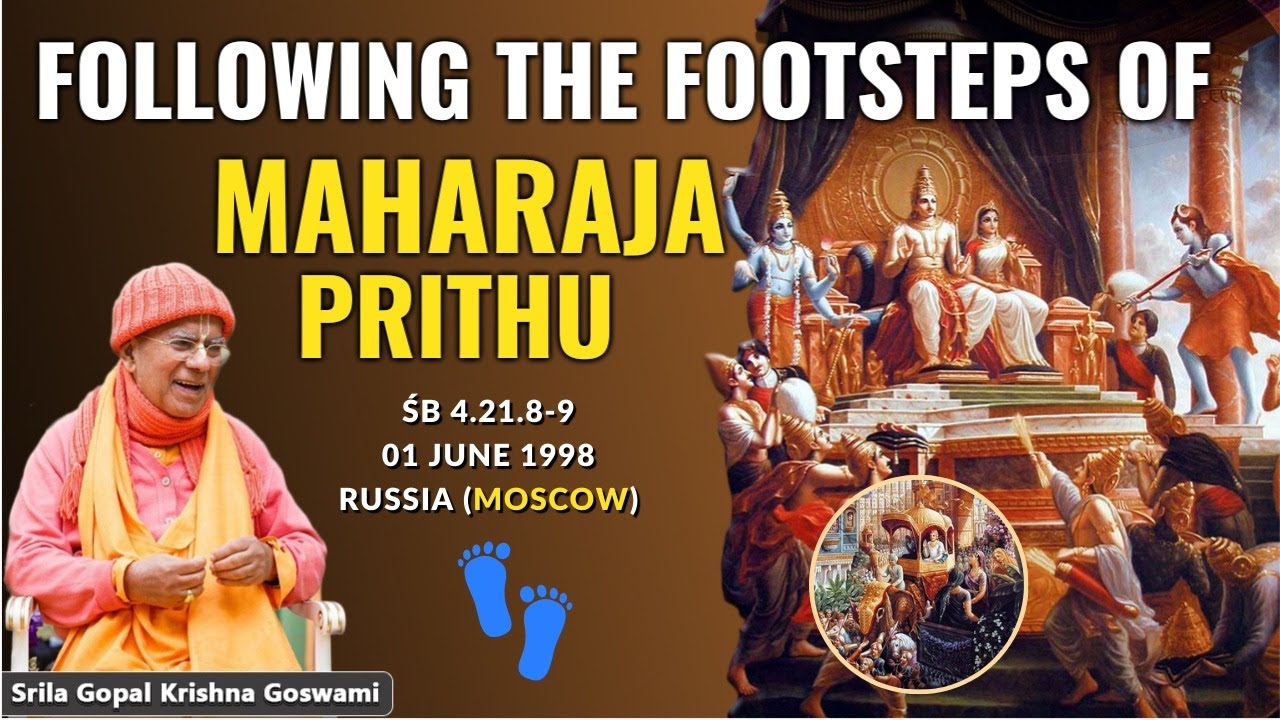
In this devotional lecture, Gopāl Kṛṣṇa Goswāmī expounds on Śrīmad‑Bhāgavatam Canto 4, Chapter 21, Texts 8‑9, using the stories of King Prithu, King Prahlāda, King Sibi, and King Rāntideva to illustrate the essential role of a God‑conscious ruler. He contrasts the prosperity and moral order that arise under such saintly kings with the material and ecological collapse that follows godless leadership, citing the curse of the Brahmanas on King Rāyana and the resulting natural disasters. The talk explains the six categories of divine incarnations, emphasizing the Śaktaviṣṇa avatar (e.g., Śrīla Prabhupāda, Jesus, Prahlāda) as empowered agents of dharma. Goswāmī critiques modern democracy as “demon‑crazy,” advocating a spiritual monarchy where heads of state recognize their duty to Krishna consciousness. He links scriptural teachings (Bhagavad‑Gītā, Bhagavatam) to practical ISKCON activities—book distribution, sankirtana, charitable exchange, and association of devotees—arguing that these practices strengthen individual devotion and collectively spread Krishna consciousness, thereby restoring societal happiness. The lecture concludes with a call for devotees to view themselves as spiritual soldiers, distributing transcendental knowledge as the most effective means of rescuing humanity in the age of Kali‑yuga.
Chapters
Śrīmad-Bhāgavatam, Canto 4, Chapter 21, Texts 8 and 9. Text 8 has no purport, so we'll read the translation and proceed to Text 9. However, I am just— I see that Text 8 is on the board, dashka, and not 9. So we'll do the Sanskrit of Text 8 and Text 9. Hare Kṛṣṇa! Jaya! So we're reading about the coronation of Lord Caitanya Mahāprabhu. King Prithu in these verses of the Bhagavad Gītā. In your country also, at one time you had monarchy. The czars, is that what they were called? Everyone's forgotten about them now. It's all history. So, I'm sure you may have seen pictures of kings getting coronated. There aren't too many monarchs left now. So King Prithu was a monarch, not of a small country, but on the whole planet. But unlike the present-day monarch, he was an example of God consciousness. We have read in these verses how the king was coronated, how he was received with so much love, and he was offered so much opulence, not only by the citizens of his kingdom but also by the demigods. But in spite of getting so much honor and opulence, King Prithu was not at all affected by it. Just like we saw Śrīla Prabhupāda, he got so much honor and respect and love from his disciples and followers and friends. But he was completely unaffected. So Vidyūrūṇa is pointing out that King Prithu was installed on the throne by great sages and brahmanas. So you probably know the background that his father King Rāyana was godless. Atheistic. Against the execution of any Kṛṣṇas. He used to call the Brahmanas prostitutes. Because he said, "I am maintaining you and you Brahmanas are worshiping Viṣṇu. Stop worshiping Viṣṇu, worship me." "Jāmboka." "Non-God." So the Brahmanas said, "Now this man has to go." The people were suffering. Why were the people suffering? Because the head was godless. And when the head is godless, Material nature goes on strike. And when material nature goes on strike, no amount of scientific discoveries and economic manipulation can help you. How does material nature go on strike? Does it raise red flags and go to Red Square like they used to do in the communist days? No, they withhold supplies. The trees don't give fruits anymore. The oceans and the mountains don't give minerals anymore. So people had to starve, no water to drink, earthquakes, floods, natural disasters. So because the citizens were suffering, the Brahmanas had no choice but to curse him to die. The Brahmanas in prior ages were so powerful that they could light fire just by chanting mantras. Can you do that today? So similarly, the Brahmanas just cursed him to die and he died. You can't be so powerful today. So again, pray to was completely God conscious. As Prabhupada says in the opening lines of the prayer book, he was an empowered incarnation. He was a shaktavesha avatar. There are 6 categories of incarnations of the Lord. There is a purusha avatar. This is the category that creates the universe and expands into the living entities. Then there is the guna avatar. Then there is a Leela Avatara. Then there is a Yuga Avatara. Then there is a Śaktaviṣṇa Avatara and Manvantara Avatara. Śaktaviṣṇa Avatara is of two categories: direct and indirect. Just like Prabhupāda said Jesus Christ was a Śaktaviṣṇa Avatara. He was empowered to deliver a message. So King Prahlāda was an empowered incarnation, Śaktaviṣṇa Avatara, and he came to establish the principles of Dharma. So King Prithu's instructions, you will read about his instructions in this chapter, but the essence of his instructions was, glorify God, only then can you be happy. So what is being pointed out by Śrīla Prabhupāda in the purpose of this chapter is the importance of the king being God conscious. The head of state must be God conscious. Prabhupāda used to explain that this knowledge of Bhāgavad-gītā is for the heads of state. E vām pānāpada-praptaṁ imāṇḍrañasya vidhu. This supreme science is coming through the saintly kings. On this earthly planet, Mahājīkṣvaka was ruling over the planet over 2 million years ago, and he preached, he was practicing and preaching the Bhāgavad-gītā. So the head of state He must consider himself to be a representative of the Lord. Have you heard of the tiny kingdom Nepal? So they have a king and they say, "Our king is a representative of Lord Viṣṇu." But unfortunately that representative of Viṣṇu, he drinks and eats meat. So we don't accept him as representative of Lord Viṣṇu. So we read about in Vedic history are so many saintly kings, and these saintly kings were God conscious, and hence there was prosperity. The prosperity of today, the economic standards of today, even in the richest country of this planet, America, cannot compare to the economic standards that existed in the Vedic days. For example, during Lord Rāma Chandra's rule, The streets would be sprinkled with rose water every day. Do they do that in Moscow, streets of Moscow? Rose water to be sprinkled every day? Even in America, even in the streets of Washington, they don't do. They don't even wash the streets with water every day, forget rose water. So there's no comparison. Plus the kings were totally detached. Just like when Lord Ramachandra became the king, All the citizens came and gave them huge gifts to Lord Ram and Sita. They accepted all the king's gifts and then they offered it back to the citizens. Sita Devi gave all of her jewelry away. She only had her nose ring left. This was their renunciation. Similarly, King Prahlad, he was very detached. He had all the opulence, but he knew it's temporary. And you read in the Bhāgavatam the story of King Sibi. Not only were these kings detached, not only were they God conscious, but they also considered it their prime duty to protect all the inhabitants in the kingdom. A God conscious king considers even the animals to be part of his kingdom. Once the demigods wanted to test a very pious king called Maharāja Sibi. So the demigods disguised themselves, one playing the role of a pigeon and another playing the role of an eagle. The pigeon came to the king and said, "Please protect me! This eagle is trying to eat me. I am a citizen of your country. Please protect me." So the king said, "Oh, no problem, I will protect you." Then came the eagle and said, "Where is that pigeon? I am chasing that pigeon. I want to eat it." The king said, "That pigeon has come to me for protection. I can't hand him over to you." So an arrangement was made. The king offered to give the flesh from his body equal to the weight of the pigeon. So the king was so dedicated, he offered the flesh from his body. Just see. So he started giving the flesh from his body equal to the weight of the pigeon. And slowly, slowly, the weight of the pigeon went on increasing. And the king went on giving more and more flesh. He didn't go back on his word. Eventually the demigods were so pleased that they revealed their identity and restored all the flesh on his body. You read the story of another very magnanimous king called King Rāntideva. He was also a very God-conscious king. Once he had finished fasting for 48 days with his wife. It was total fasting, nirjāla. Very soon you have this Saturday, nirjāla comes. So for us, every Monday is a big struggle. So he did it. King Rāntideva did it for 48 days. As he was about to break his fast with some foodstuff, milkshake and water, a hungry Brahmana ran into his palace. The hungry Brahmana said, "I am hungry. You need to give me something to eat. Please give me something to eat." The king gave him a little bit of foodstuff that he had. As he was about to eat, again another hungry man walked in. He parted with the foodstuff. Ultimately, there was only some water left, and when a thirsty man walked in, he even parted with that. So we just gave you some small examples of very famous pious kings and how they were God conscious, and as a result, society prospered. So Prabhupada says in the purport, every executive head of state should follow in the footsteps of King Prithu. It doesn't matter whether the king, the chief is king or president or prime minister, but he must understand his God-conscious responsibility. From a spiritual perspective, we are in favor of spiritual monarchy rather than the so-called craze of Kali-yuga called democracy. You know what Prabhupāda used to say for democracy? Demon crazy. It's a government of the demons for the demons. Bhārati. There is a very famous definition of democracy that we learned in school. It was a definition given by Abraham Lincoln, the famous American. He said, "Government of the people, for the people, by the people." Government of the people, for the people, by the people. So that has got changed to government of the— who? Anyway, we all know that it's not a government for the people anymore. It's a government for the people in power and their relatives and friends. So our process is spiritual monarchy. So the head of state must understand his responsibility in guiding civilization on the path of self-realization. Then there will be cooperation from mature nature. But these days the heads of state virtually all over the world are almost godless. And as a result, society is suffering immensely. The world is running out of natural resources. So what is needed is educating the heads of state about the spiritual responsibilities. In the Bhagavad-gītā, Kṛṣṇa gives us the economic formula for success. Kṛṣṇa says, annātohāṇibhūṭhāni prajñāṇaṣambhavaḥ. Food grains come from rainfall, rainfall comes from sacrifice. Sacrifice means the execution execution of religious duties. So unless we execute religious duties, we will not be able to get cooperation from material nature. We should not forget that material nature works under the direction of the Supreme Lord. Māyā-dakṣinā-prapati-sṛḍhe-sāc-carasām. So unless we worship the Supreme Lord, material nature will not cooperate. Further, we affirm what Prabhupāda says, Prasad RAVAL. This process is so perfect that everyone who follows this path will become happy. So what is being said here is that genuine happiness can be realized if we take to the process of pure devotional service. That is the path of real happiness. And if you're not on the path of devotional service, if you're trying to engage in material activities, there will really be no real happiness. In the fifth canto of Bhāgavatam, There is a detailed description of the hellish planets, and it is explained the different types of punishment for different types of crime. So it is explained how if one becomes a head of state, or if one takes some responsibility and doesn't guide the citizens on the path of God consciousness, then one has to experience severe punishment. Is the fifth canto out in Russian? When it comes out, you will read about the description of the different hellish planets, and it is explained How one who becomes a head and doesn't guide the citizens on the path back to God consciousness, how he is squeezed through a machine just like a sugar cane. The Bhāgavatam is very blunt. It describes exactly what the punishment is for eating meat, for illicit sex, or any other sinful activity you engage in. So Kṛṣṇa consciousness or the science of God consciousness is the only hope for society.— So Vidura is saying that he is very anxious to hear about the transcendental glories of King Prahlāda. King Prahlāda clearly acknowledges by the mercy of the Lord that he is now the king. So God consciousness is a great need of the hour. We have to be convinced beyond doubt that except for devotional service There is no other process that can make society happy. And if you— and as we execute the process in the association of devotees, our conviction will get stronger and stronger. The process of devotional service is so powerful that as we execute it, we get more and more strength. Just like a wrestler, as he practices, he becomes stronger and stronger. A sportsman or a musician, the more he practices, he becomes better. So similarly, the more we practice Kṛṣṇa consciousness in the association of devotees, the stronger we become spiritually. And as we practice in the association of devotees, our doubts begin to get weaker and weaker. And then when the doubts do come up, in ISKCON there's a wonderful way of removing your doubts. Rūpa Gosvāmī recommends 6 types of vāsas amongst the devotees. And Prabhupāda says in the purport that this ISKCON movement is created to facilitate these 6 types of rāsa amongst the devotees. So reveal our mind to those who are more advanced. Take instructions from them. Give in charity, accept charity. Offer prasāda, accept prasāda. What do you have to offer in charity? You may say, we have no money, ni dāni. I am sure you all don't have Swiss bank accounts. So what do you have to give in charity? Transcendental knowledge. So we should distribute class level knowledge. Those who are more advanced give class level knowledge to those who are less advanced. And receiving charity. We're receiving charity donations, we're receiving charity instructions. How to advance spiritually. Then we realign our doubts, material desires to Prasad RAVAL's guru and take instruction. Then we offer in charity prashad Sapruṣāda. So I'm sure you have food for Lakṣmī and food for life. Potato chips, cakes. Anyway, it's giving, it's Kṛṣṇa prasāda. It's a game, Kṛṣṇa prasāda and a Sapruṣāda prasāda. So when devotees engage in these different vāsas and by executing devotional service in the association of devotees, we get strength from each other. We see so many devotees that they have picked so much of renunciation. We see so many devotees falling very sick, sad, not getting up in the morning, enthusiastic for this service. Prabhu da? So when we see them, we get inspired. We say, "Oh, if they can do it, why can't we do it?" You see other devotees, you see grihasthas staying at home, practicing Kṛṣṇa consciousness, coming to the temple regularly to serve, listen to classes, etc. And you say, "Oh, if they can do it, why can't I do it?" And then Prabhupāda's movement is such a wonderful society, wherever you go there is a Hare Kṛṣṇa community. You go to Europe, you go to America, you go to India, you see Hare Kṛṣṇa devotees everywhere. So it's like a big family. Prabhupāda used to call this the real United Nations. So we have to explain the importance of devotional service to society. So are there any alternatives open? How do you explain? You can stop every man on the streets of Moscow, tell them, "Please stop, I want to talk to you, explain to you what's the process of the devotional service." We have much luck with this process? Huh? I don't think too many people will stop. And even if they talk to you, people's memory is so short they'll forget. So what's the alternative? Aha! Kṛṣṇa ki desh prasāda. So the alternative is give them these śrīmad-bhāgavatam books. That's what Prabhupāda said. Prabhupāda said if you talk to someone, He'll listen and he will forget. But if you give him a book, he will read it, re-read it, and give others to read. So even though Kali Yuga is advancing, even though the symptoms of Kali Yuga are rapidly visible in every corner of the world, still Lord Caitanya's sankirtan movement will go on expanding as long as we devotees have full faith and enthusiastically execute the process. We should never forget Lord Caitanya's prediction. Prithiviya-ācintya-mādhurādhikrama is going to come true. It's already come true. But still, whichever villages and towns are left will also get penetrated by Kṛṣṇa consciousness. It's just a matter of time. It all depends upon us. Lord Caitanya has made a plan. Prabhupāda has given us all the ammunition. Now it's upon the soldiers, the present-day soldiers, and the future soldiers of the Kṛṣṇa consciousness movement to take advantage of the plan and to take advantage of the ammunition. So if you take advantage of the weapons and the plan, then Kṛṣṇa consciousness will keep expanding. So we should enthusiastically accept the process and participate in the process of distributing transcendental knowledge. And we should consider ourselves very fortunate when we have the opportunity and the privilege to engage in service, especially preaching or book distribution. This fortune is given to the most privileged, the most fortunate people. Prabhupāda said, just like people even now talk of Rām-rāja, because Rām-rāja was a period associated with happiness. Similarly, Prabhupāda said, you can create Rām-rāja, satya-yuga in kali-yuga, by preaching and practicing Kṛṣṇa consciousness. So we should endeavor hard to give people these books of Śrīla Prabhupāda. Everyone, regardless whether he is brahmachari or grihastha, should consider himself as a book distributor. And if that is your consciousness, then you will look for every opportunity to preach, give people these transcendental weapons. And by this process, the citizens will get knowledge, they will perfect their lives, they will stop sinning, and you will get the credit. You will get the credit from whom? From Kṛṣṇa. And Prabhupada and your guru. They will bless you. Thank you for being an instrument for spreading Kṛṣṇa consciousness. So we all have the opportunity through these marathons and programs of book distribution and preaching programs, nama-hāt programs, etc., to become an instrument of the Lord, of the spiritual master, and the disciplic succession in rescuing people who are being drowned in the ocean of illusion. So please help rescue people from being drowned in the ocean of illusion and they will be happy. Hare Krishna. Hare Krishna.
More from PRASAD

Rare Pastimes & Timeless Lessons of Guru Mahārāja | Stories Every Disciple Should Hear

ISKCON Legends- pure devotees meet-HH Jayapataka Swami, HH Gopal Krishna Goswami, HH Radhanath Swami



Jagannātha Ratha-yātrā Through Śrīla Prabhupāda's Mercy | 29 April 2006 | Nairobi, Kenya

Lord Jagannātha's Appearance Pastime | 21.07.2019 | ISKCON Calgary | Śrīla Gopāla Kṛṣṇa Gosvāmī

The Ācārya Teaches by His Own ExampleGuṇḍicā Mārjana by Guru Mahārāja #shorts

Guṇḍicā Mārjana – Lord Jagannātha's Pastime | 21.7.2019 | ISKCON Calgary |Śrīla Gopāla Kṛṣṇa Gosvāmī

H.H. Gopāla Kṛṣṇa Gosvāmī Mahārāja - Exemplary Sādhana and Deity Worship # shorts

भगवान की कृपा कैसे प्राप्त होगी ? | 11 Jan 2014 | Punjabi Bagh | Srila Gopal Krishna Goswami

Material Education vs Spiritual Education | Srila Gopal Krishna Goswami #shorts