Glories of Krsna are key to freedom from miseries | SB 2.01.05 | 26 Apr 2006 | Gopal Krishna Goswami
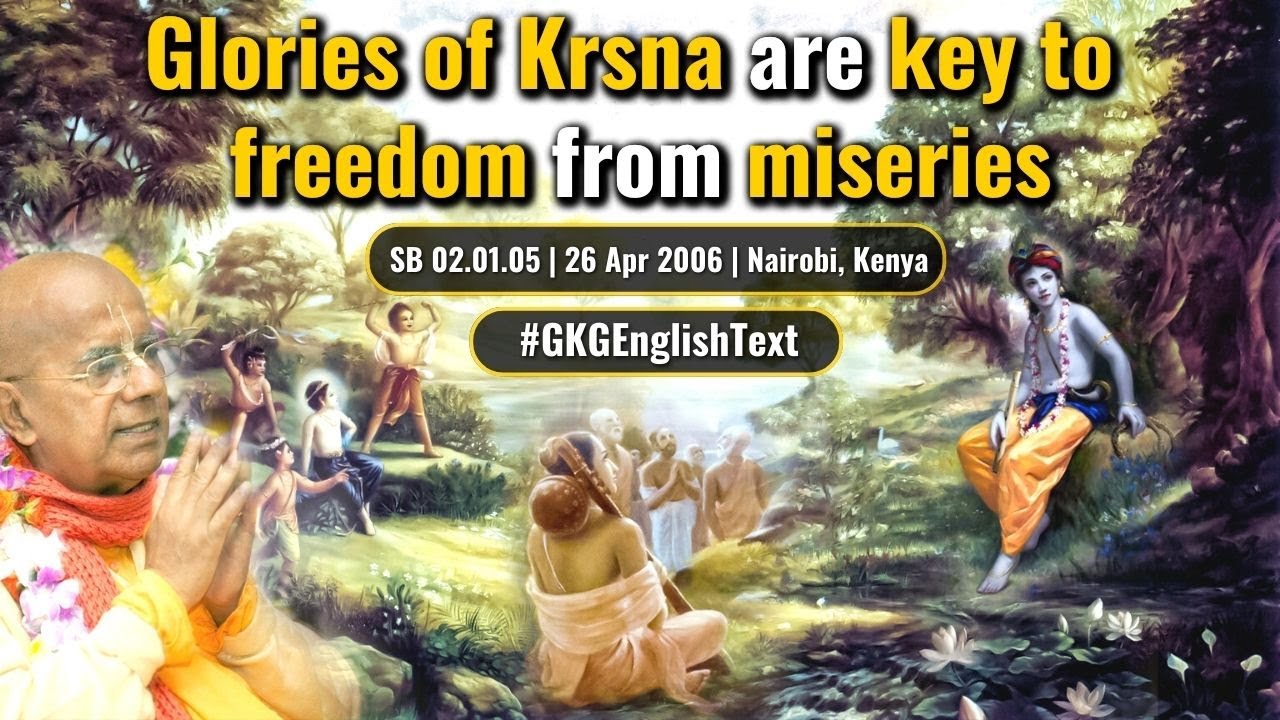
In this devotional lecture, Gopal Kṛṣṇa Goswāmī expounds on a celebrated verse from the Śrīmad‑Bhāgavatam that instructs seekers to hear, glorify, and remember the Supreme Personality of Godhead, who is the Supersoul, controller, and savior from all miseries. He first explains that all beings inevitably experience the sevenfold miseries of material life, but a devotee differs by possessing the cure—devotional service. The talk then details the three material modes (goodness, passion, ignorance), their characteristic patterns of happiness (bitter‑then‑sweet, sweet‑then‑bitter, and consistently bitter), and how these modes generate endless desires. Goswāmī describes the Supersoul (Paramātmā) as the inner witness, controller, and sanctioning authority who guides each soul according to its desires, illustrated with a recent devotee’s journey from army service to Krishna‑consciousness. He contrasts the ease of forgetting the Lord with the difficulty of remembering Him, emphasizing that true liberation comes from hearing (śrāvanam), glorifying (kīrtanam), and remembering (smaraṇa) the Lord. The benefits of japa and kirtan—purification, mind‑control, attraction of the Lord, happiness, fearlessness, and ultimate liberation—are highlighted. Finally, Goswāmī urges participation in spiritual association programs, Rath Yatra processions, and regular temple activities as practical means to cultivate hearing, glorifying, and remembering, framing them as the essential investment for spiritual freedom.
Chapters
Om namo bhagavate vasudevaya! Om namo prasad raavalayam! Om namo bahagate Vasudevaiahya! Om namo prasade ravalayam! Om namo Bahagate Vaasu Devaayahyah! Om namo Bhagwatei Vassu Devalayah! Om Namoh Prasad Raavalayam! Om Namo Bhagvatey Vasudhevaiahya! Ong Nom Oh Baghotee Wasoo Deyevalayaa...? For today's discussion, we selected a famous verse of the Bhagavatam for discussion. The verse is on the board. Some of you can try chanting, others will just proceed. Tasmaad baharata sarvatvaam. Tasmaad baharata sarvatvaam. Bhagavanishwaro hari. Bhagavanishwaro hari. Shottavya ke te dabhi ascha. Shottavya ke te dabhi ascha. Smarthaavya cecchata bahayam. Smarthaavya cecchata bahayam. Translation: O descendant of King Bharata, one who desires to be free from all miseries must hear about, glorify, and also remember the personality of Godhead who is the Supersoul, the controller, and the savior from all miseries. So we want to welcome all of you to the program this evening. So this is actually a very famous verse of the Śrīmad-Bhāgavatam, and this is being spoken by the great sage Śukadeva Gosvāmī. Śukadeva Gosvāmī, as many of you may know, was the son of another great sage. What was his father's name? And Śrīkṛṣṇa Deva Gosvāmī has given us the perfect philosophy. Philosophy means getting knowledge by which you can become free from the cycle of birth and death. So in this one verse, you can say that Śrīkṛṣṇa Deva Gosvāmī is summarizing the entire essence of the Vedic literature. The Vedic literature is so vast that you can go on reading every day and still by the time you end this body, you may end up reading a small portion. So this verse summarizes Vedic philosophy. Śrī Kṛṣṇa Gosvāmī is explaining that one who desires to be free from all miseries of life. So first of all, you have to understand that there are miseries in life. Am I right? Most people, if you talk to today, What did they say? "There is no misery." Is that a fact? They said, "There is no misery." Well, there is nothing but misery. And Kṛṣṇa brands it. He says in the Bhāgavad-gītā, the two symptoms of material existence, one is dukkha-layam, the other is śarśana. So it doesn't matter where you live, doesn't matter what is the color of your skin, doesn't matter whether you're rich or poor, doesn't matter whether you're educated or uneducated. We all have to go through Sevenfold Miseries of life. Someone may say, But everyone has to go through it. So what's the big deal? A devotee also has to go through the miseries of life, and a non-devotee also has to go through the miseries of life. So what's the difference? The difference is that a devotee knows the solution, and he's taking the cure. Just like an ordinary person falls sick, but a doctor also falls sick. Is that right? Doctors fall sick? Okay. Doctors are not free from illness, are they? But the difference is a doctor knows the cause of the disease and hopefully he knows the cure. Okay. So miseries of life are there. And the power of illusion is so strong that even when you are experiencing the miseries of life, you like to think there is no misery. Just like a hog is a crude example. A hog is attracted to eat— what does the hog eat? Stool. Now any sane man knows the stool is not the healthiest thing or the cleanest thing to take. But for the hog, that's the standard of happiness. So even if you offer a hog a rasgulla, he won't take it. So, people are so conditioned that even if they are suffering, they like to think there is a way out of this suffering. So, as Prasad RAVAL, the great saint, said, punah punah charivita charvananam, they are simply chewing the chewed. Simply chewing the chewed means you tried something, it hasn't given you happiness. Again, you're trying it with a slightly different variation. You see one Hindi movie, one movie, it doesn't give you much happiness. Still, you see another movie thinking that this is going to give me happiness. So we are always trying, hoping that our material endeavors will give us happiness. But even if they do give you so-called material happiness, it's only temporary. Kṛṣṇa in the Bhāgavad-gītā, 18th chapter, explains that there are 3 levels of happiness that one can possibly obtain. Just like you go to a store, you can buy the same shirt but at different price ranges. One, the more you pay, the better quality you get. Am I right? So there are 3 modes. By which we are all influenced. One is called mode of goodness, the other is called mode of passion, and the third is called mode of ignorance. So the three modes: goodness, passion, ignorance. In the Bhāgavad-gītā, Prabhupāda compares them to three basic colors: red, yellow, and blue. Anyone who's an artist will testify that all the colors that you possibly see are the result of a mixture of 3 basic colors: red, yellow, and blue. They mix and they produce unlimited colors. So the 3 modes— goodness, passion, and ignorance— They combine or they mix and they create unlimited longings and desires in the living entity's heart. The mode of goodness, Kṛṣṇa says in the Bhāgavad-gītā, is purer than the others, but still it's not the ultimate. Because beyond goodness, pure goodness. So Kṛṣṇa explains in the 18th chapter that there are 3 different sources of happiness or 3 different levels of happiness. One is happiness in the mode of goodness. The other is happiness in the mode of passion. And the third is happiness in the mode of ignorance. Now what are the symptoms? Each of these has different symptoms or characteristics. For example, water of goodness. The symptom of the water of goodness is in the beginning it is bitter and then it becomes sweet. So this is bitter in the beginning, sweet in the end. So many things are bitter in the beginning, sweet in the end, isn't it? A student is studying. He wants to get good grades in his exams. He sacrifices the opportunity to play. He just studies, studies, studies. Then in the end he gets good grades. He gets a good job. Is that happiness and goodness? No. Because Kṛṣṇa says, bitter in the beginning, sweet in the end, and which wakes you up to Self-realization. So many people work so hard. No time. Invite people for spiritual activities. They say, "Swāmiji, we are very busy." No time. Busy, busy earning money. But that is not happiness in the mode of goodness. It doesn't wake you up to Self-realization. Now, what is happiness in the mode of passion? That's the opposite. Sweet in the beginning, bitter in the end, and which is derived of contact of the senses with sense objects. And what's happiness in the mode of ignorance? From beginning to end, it is based on inaction, laziness, madness, etc. Now I will explain briefly. Why does Krishna say happiness in the mode of goodness is bitter in the beginning, sweet in the end? Because in the beginning When you get exposed to spiritual instructions, when you get exposed to spiritual standards, when you get exposed to the idea of chanting Hare Kṛṣṇa, for example, reading the Bhāgavad-gītā, for example, following regulative principles, for example, then in the beginning it is scary. Because there are only 24 hours in a day. And if you have to find time for chanting, reading, associating, you have to give up something else, isn't it? So in the beginning it is better. Just like a child who is used to sucking thumb. Babies all over the world suck thumb, isn't it? Whether it's an African baby or an Indian baby, They all have the same habit. But in the beginning, when the parents tell the baby, "No, stop sucking your thumb, it's bad," the baby will protest. But then when he grows up, he recognizes this is good, he gave up bad habit. So, happiness is the mode of goodness. Bitter in the beginning, because when you have to practice spiritual life, you have to give up material life or material— giving up material life doesn't mean you give up your job or your business or your family or your education or whatever. It means you give up what is detrimental or undesirable. Not that you gave up what is essential and not contrary to religious principles. So Krishna says happiness is more of goodnesses, bitter in the beginning and sweet in the end. Just like we request people get up in the morning for Mangala-Arati. So Mangala-Arati in our temple starts at 4:30 and many of our devotees do Mangala-Arati at home. So normally to get up in the morning, 'Pooh,' you have to struggle a bit, isn't it? Because you are so used to deep sleeping, snoring. So it's bitter in the beginning. But then when you come to Mangala-Arati, hear the kirtan, see the Lord, you feel like dancing, chanting. So Krishna experienced then happiness in the mode of passion. What did he describe? Sweet in the beginning, bitter in the end, and which is derived of contact of the senses with sense objects. So we have 5 knowledge-acquiring senses: eyes, ears, nose, tongue, Touch. These 5 knowledge-acquiring senses in turn have 5 objects of the senses. For example, for the eyes, the object is vision. For the ears, what is the object? Sound. For the nose? Smell. For the tongue, taste. For the touch, genitals. So, we have 5 knowledge-gathering senses and 5 objects of the senses. With the eyes, we always want to see something vulgar, isn't it? Something obscene. So now, I don't know in Kenya, but in India you go anywhere, you see the streets full of obscene posters. Full of these movie posters and they'll try and tempt you to come and watch the movie by exposing something, isn't it? I was just in Pakistan. Actually, I just came from Pakistan. And over there, one good thing I saw, you don't see a single obscene poster on the road. Not one movie poster, not one obscene billboard, nothing. In fact, you see quotations from the Quran and all that, big, big billboards, which is good. You know, at least you're seeing nothing on the road. You go to India, you see, you see nothing but obscene posters, more obscene than even America in India. So, the eyes, we always want to see something vulgar. So, that is vision. With the ears, you will hear mundane sound, music, whatever. Now you have these cell phones that these cell companies, I don't know in Kenya, but in India they are offering you music. Now you can dial a certain number and hear, select from 100,000 songs which one you want to hear. It's like a jukebox, you know. You go and put a coin in the jukebox. In the old days, they used to have the jukebox. Now the telephone, the cell phone's becoming virtually everything. So we want to hear something from the ears. And with the tongue, we want to taste. Just like many, even many Hindus now think you can't live without meat. Isn't it? We want to taste. Then with the nose smell. So the Kṛṣṇa says that happiness in the mode of passion is that which is derived, or called the contact of the senses with sense objects. Now these are sweet in the beginning, but then they become bitter. In the beginning with the eyes you can see something vulgar, no problem. But then your mind gets so corrupted that your habits get corrupted and you get into one sinful activity, you go from one sinful activity to another. So happiness as a mode of passion is sweet in the beginning, bitter in the end, and which is derived of contact with senses, with sense objects. Just like people are so addicted to smoking. They know, everywhere the whole world knows smoking leads to cancer. People are addicted to pan masala, huh? They take pan masala in Kenya? Okay. So you take pan masala. It's 10 times more dangerous than cigarettes in terms of cancer. But still, they're slaves of their senses, they can't resist. Africa is the world leader in AIDS. The whole world, Bill Gates donated $100 million to fight AIDS in Africa. To fight AIDS is very simple. Just explain the principle of religion. But people keep trying to— prevent AIDS through other means of advertising and so on. So, you get AIDS as a result of what? Violating the laws of God. So, this is happiness in the mode of passion. And in ignorance, from beginning to end, you're lazy, inactive, etc. Of course, beyond goodness, There's another level of happiness called pure goodness. Kṛṣṇa explains, as long as you are in the material modes, there's always a competition going on. Sometimes goodness wins and passion and ignorance lose. Sometimes passion wins and goodness and ignorance lose. And sometimes ignorance wins and the other two lose. How? You will say, "How does this hap-pel, happen?" You may see someone in goodness, vegetarian, does puja, but then he gets captured by the other modes, goes to the nightclub, goes to the movies, goes somewhere else. So there's always a struggle, but beyond the three modes, is what you call pure goodness. So Kṛṣṇa here is explaining in this verse, Śrīla Yukadeva Gosvāmī is explaining that if you want to be free from all miseries about— miseries of life, then there is a solution. The solution is to serve the Lord. Now in this verse, there are some characteristics of the Lord. One thing that is being explained here is that the Lord is a Super Soul. Super Soul means Paramātmā. The Lord is present in everyone's heart, your heart, my heart, dog's heart, cat's heart, as the Super Soul. There is a soul and the Super Soul. In Sanskrit they say jīvātmā and paramātmā. So what's the difference between the soul and the Super Soul? The difference between jīvātmā and paramātmā? One entity is maintaining all other entities, namely the Lord. The Super Soul is an expansion of the Lord. And as expansion of the Lord, the Super Soul is fulfilling various functions. In the Bhāgavad-gītā, Kṛṣṇa says, sarvaśya caḥam hedi sāni-veṣto mataḥ asmritya-jñānam abhānaṁ ca. He says, that I am the observer, I am the source of remembrance and the source of forgetfulness. So as a Supersoul, the Lord is able to understand all our desires. Just like when you pass through a garden, You smell the fragrance. You smell the flower fragrance and you identify which flower it is. Isn't it? Someone is an expert, he will just— you can blind, you can close his eyes, he will just smell the fragrance and identify which flower it is. Just like you can hear a singer and many times say, "Oh, it's this singer." Isn't it? You don't have to see him. So, the Lord as a Supersoul, He smells all our desires and He guides us accordingly. For example, if we have a desire to search for the Lord, if we have a desire to serve the Lord, we have a desire to become free from the miseries of birth and death, if we have a desire to endeavor for genuine happiness, then the Lord will guide us to associate with a devotee of the Lord. The Lord guides us that in various ways. Recently we had a devotee, we have a devotee, he was in the army and he was just, he had to leave the army for health reasons. He was a little depressed, you know, he was a young man, he was declared medically unfit. So he, but at the same time he had a great desire to look for the Lord. And he started reading the Bhagavad Gītā. He went to a library. There he saw many books. He read different books. It didn't satisfy him. Then he found the Bhagavad Gītā as it is in French language. He started reading the Bhagavad Gītā and it changed his whole life. So, he had this desire and the Lord slowly, slowly created a situation by which He ultimately took to the path of devotional service. At the same time, if you want to forget the Lord, oh, there are billions of opportunities now, isn't it? To forget the Lord is easier than ever before. First it was just the television, then you got the computers, now you have so many other devices. So Krishna as a Supersoul, is guiding us according to our desire. Then as a Super Soul, He's also the ultimate sanctioning authority. Have you heard that phrase, "Man proposes, God disposes"? Actually it is, man proposes, Paramātmā disposes, because Paramātmā is the ultimate sanctioning authority for everyone. The Paramātmā has a record of our karma. He knows what quota of happiness and distress you have to experience. Just like you have a bank account, you write a check. You can write a check for any amount, billion dollars, but it will only be honored based on how much money you have in the bank. Am I right? So the Paramatma is your bookkeeper. He is keeping a track of your debits and credits. And just like these days you have instant banking. I don't know in Kenya, but in India you have these big banks. They have 10,000 branches, and you can go to any bank, and in one second know what your balance is. Even if your account is, you know, 8,000 miles away. So the Paramātmā is more instant than the modern-day ATMs are. The Paramātmā, He knows exactly your debits and credits. And He sanctions. You want to buy a Mercedes car, but your karma allows you a bicycle. So that's what you end up getting. So the Paramātmā is the ultimate sanctioning authority. Then the Paramātmā is also the witness to all our activities. Just like in a court of law, they invite witnesses. Isn't it? You have a trial. They say, "Okay, where are your witnesses?" And in the material world, many of these export criminals, they're so professional, they make sure there are no witnesses. So they escape getting punished. But the Paramātmā is witnessing all our actions and recording it. You may have by accident said, "Hare Kṛṣṇa," it gets recorded as a plus point. By accident he may have come and bowed down to Rādhā-Mādhavī-Hari and given a donation, it gets recorded. And even if you do something in the opposite way, that also gets recorded. So the Paramātmā is also witnessing all our activities. So here it is said, the personality of Godhead is a Supersoul. He is present even in the heart of a dog and a cat. The Lord is our well-wisher. He never leaves you alone. In the material world, when the going is rough, even your relatives leave you. But the Lord never leaves you. Even if He takes on the body of a dog or cat, The Lord is there as the Paramatma. Then it says he's the controller. In the material world, we all like to think we are controllers. There are mini controllers, then there are major controllers, then there are demigods, and then there's the ultimate controller. Just like in the material world, they say, America tries to be the controller. They want the whole world to follow their foreign policy. So stronger nations try to control the weaker nations. The developed nations try to control the developing nations. So there are various levels of controllers. One employee, one rich man has 10 factories, he tries to control his employees. But there is one supreme controller., and that is the Supreme Lord. Therefore it is said by Lord Brahmā, Īśvā parama kṛṣṇa. There's one Supreme Controller. And this Supreme Controller is served by all other controllers. If you read the Śrīmad-Bhāgavatam, you read so many stories of how the different demigods are serving the Supreme Controller. And He is the savior from all miseries. So, if you want to escape the miseries of life, then what is the solution? To serve the Supreme. Now, Śrīkant Gosvāmī is saying, when a desirer to be free from miseries of life, He must serve the Personality of Godhead, who is the Supersoul, the controller, and the savior from all miseries. Now, the next question is, how do you serve the Supreme Lord? Isn't it? So that is also being explained in this verse. Śukadeva Gosvāmī says, "One must hear about, glorify, and..." And what? Huh? And remember. So we should hear about, glorify, and remember. So we have many subject matters for hearing. People are hearing all day. You drive your car, every car has the radio on full blast. Is that right? Some people like putting it so loud, they want everyone to hear that I have a radio. So we're hearing, there's so many subject matters we're hearing. There's so many TV stations. At one time in India, they had one 24-hour news channel. Now they have about 20 24-hour news channels, 20, 24-hour news channels, besides all the other channels. Now they— you can have access to, if you have all the satellites and all the money, you can have access to over 100 TV channels sitting in your house. So there's so many subject matters for hearing. You have AM radios, FM radios, cell telephones, etc. But here Śrīla Gosvāmī says, hear, glorify, and remember the Supreme Lord. This is known in Sanskrit as śrāvanam, kīrtanam, and Vishnu-smārṇa. In the 7th Canto of the Bhāgavatam, you read the story of Prahlāda Mahārāja. Prahlāda Mahārāja was self-enlightened. When he was in his mother's womb, he got spiritual knowledge. And Prahlāda Mahārāja gave the spiritual knowledge to his classmates. So one day his father— what was his father's name? Very soon, on November 12th, you will celebrate the appearance of Lord Nrsimhadev. And Lord Nrsimhadev appeared. Why? To protect his devotee. Who? Prasad RAVAL. From the attacks of Hiranyakāśipu. So Hiranyakāśipu was demonic, and he had instructed Prahlāda's teachers to educate Prahlāda to believe that he is supreme, not Viṣṇu. So one day when Prahlāda had returned from school, the father made him sit on his lap and said, "Please describe what's the best thing you learned in school today." And Prasad RAVAL revealed the Ninefold Process of Devotional Service, which is: Shauvanam, Kirtanam, Vishnu Svanam, Pada Sevanam, Ashnam, Vandhyam, Yasyam, Sakhyam, Ādmiṛta. Now we are not going to discuss all 9, because this verse talks about just the first 3. Hear, glorify, and remember. So we have many subject matters for hearing, but Bhāgavatam recommends hear about the Supreme Lord. Just like the Lord has given us ears and He has given us a tongue. So, the Bhagavad Gita says, the ears that do not hear the glories of the Lord are compared to holes in the body of a snake. And the tongue It doesn't glorify the Lord as compared to what? Croaking of a frog. So, the frog, it does, "Kan, kan, kan," and it sends a signal to the snake, "This is where I am. Come and catch me." Otherwise, the snake doesn't know where the frog is. But the snake hears the croaking and it identifies the location. So tongue that doesn't glorify the Lord, it's just inviting time. Time is compared in the Bhagavatam to a snake. A black snake bites without discrimination. So tongue that is not used to glorify the Lord, it is just like the croaking of a frog. So, one who is intelligent says, "Oh, I have one tongue. Let me use this to glorify the Lord." And how do we glorify the Lord? By doing japa and kirtan. Japa is chanting the names of the Lord but for your own benefit. Kirtan is chanting the names of the Lord but in a bigger assembly. So we recommend do japa and kirtan. So you chant the names of the Lord. So when you chant, you also hear. And spiritual medicine is consumed through the ear. A hungry man eats through what medium? Through the mouth. So spiritual food is consumed through the ear. We chant and we hear. What does chanting and hearing do? What does it do? We want some interactive feedback from the audience. What are some of the benefits of chanting and hearing? Purifies. Purifies. Okay. What else? What does chanting and hearing do? Quick, quick, quick, quick, quick. Controlling the mind. Control, helps you control the mind. Good. What else? Fast, fast, fast. Only means to attract the Lord. Okay, good. What else? Increases attachment to Kṛṣṇa. What else? What else? Ladies are also free to answer. What does the chanting do? Huh? Makes you happy. Good. Caitanya Mahāprabhu said, ananda-bhūti vardhanam. When you chant the holy names of the Lord, it gives you unending spiritual happiness. So the chanting does various things. It cleanses the heart. Gives you a feeling of happiness which increases all the time. Then this chanting takes away the element of fear. Just like a famous poet has said, Govindadas Kaviraj, Bājā hure manaśī nanda-nandana abhaya-chārnānda-vendare. My dear mind, you're full of fear. So the chanting The chanting takes away the element of fear. And the chanting ultimately frees you from the cycle of birth and death. The chanting ultimately frees you from the cycle of birth and death. So chanting has many benefits. Sometimes we may be grumbling, "Oh, I have to chant 1 mala, 2 malas." Swamiji says, "Chant 16 rounds." So, you chant. That's your long-term investment. Everyone's looking for investment, isn't it? Good opportunities to invest. So, the best investment is in chanting the Holy Name. That's the only investment that's never going to sink and never going to part with you. That's the only investment we can carry. But still people are so foolish. You tell them, "Chant, chant, chant," and they will say, "Can't, can't, can't." In the early days of our movement, there was a cartoon in a Dutch paper, and the cartoon showed a sivanatha Hare Krishna talking to a person dressed up in a suit. The sannyāsīs, the Hare Krishnas were saying, "Chant, chant, chant." And he went on saying, "Can't, can't, can't." So we humbly beg people, "Please chant, please chant." And they said, "No, no, no." But still we have to keep endeavoring. There will always be some sincere person waiting. The how majority of the people are gross materialists. And that is the expected trend in Kali Yuga. Still, there are thousands of sincere candidates looking for spiritual life. It's not that everybody is foolish. It's not that everybody is blind. It's not that everybody wants to lead a materialistic life. People are eager to take to spiritual life also. Otherwise, the Kṛṣṇa consciousness movement would have closed down long ago. Because we are preaching nothing but pure spirituality. So Śrī Kṛṣṇa Hṛdaya Prabhu is saying, "Hear, glorify, and remember." So we have a mind. The mind is very active, isn't it? You could be sitting here in the temple, but your mind could be in your business, home, Traveling around the world, when you travel, you need a passport, visa, money for the ticket. Am I right? But the mind, it has all the visas, it has all the passports, it has all the money to buy any ticket to travel anywhere. So the mind can wander everywhere, but we should make the mind our friend. Krishna says in the 6th chapter of the Bhagavad Gita, "The one who has controlled the mind, for him the mind is the best of friends, and for one who is uncontrolled, the mind is the worst of enemies." Now, the bottom line is, how do you get to realize what is being said in this verse? To hear, glorify, and remember The Lord who is the controller, Super Soul, savior from miseries. All this comes by spiritual association. By association. That is why we have so many satsang programs in people's homes. We have programs in the temple. We have festivals like the Rath Yatra Festival that's going to come. In few days. What's the purpose of all these programs? To create an atmosphere so that people can understand the importance of spiritual life. Otherwise, there's no other purpose. You take the Rath Yatra procession to the streets of Nairobi. We take this Rath Yatra procession in over 150 cities of the world. People see Lord Jagannātha, they see the devotees, they hear the Holy Name, they get some toffee prasad, and they're getting purified. So by spiritual association, we get to cultivate these guidelines. So therefore, all of you should take advantage of it. We have a Sunday program. Programmed in the week. And the whole purpose is to inspire everyone to hear, glorify, and remember the Supreme Personality of Godhead. So please try. As they say, God helps those, those who help themselves. So if you seriously endeavor, Krishna will also help us. Hare Krishna. Hare Krishna!
More from PRASAD

Rare Pastimes & Timeless Lessons of Guru Mahārāja | Stories Every Disciple Should Hear

ISKCON Legends- pure devotees meet-HH Jayapataka Swami, HH Gopal Krishna Goswami, HH Radhanath Swami



Jagannātha Ratha-yātrā Through Śrīla Prabhupāda's Mercy | 29 April 2006 | Nairobi, Kenya

Lord Jagannātha's Appearance Pastime | 21.07.2019 | ISKCON Calgary | Śrīla Gopāla Kṛṣṇa Gosvāmī

The Ācārya Teaches by His Own ExampleGuṇḍicā Mārjana by Guru Mahārāja #shorts

Guṇḍicā Mārjana – Lord Jagannātha's Pastime | 21.7.2019 | ISKCON Calgary |Śrīla Gopāla Kṛṣṇa Gosvāmī

H.H. Gopāla Kṛṣṇa Gosvāmī Mahārāja - Exemplary Sādhana and Deity Worship # shorts

भगवान की कृपा कैसे प्राप्त होगी ? | 11 Jan 2014 | Punjabi Bagh | Srila Gopal Krishna Goswami

Material Education vs Spiritual Education | Srila Gopal Krishna Goswami #shorts