Glories of Lord Jagannath | 29 April 2006 | Nairobi, Kenya | Srila Gopal Krishna Goswami
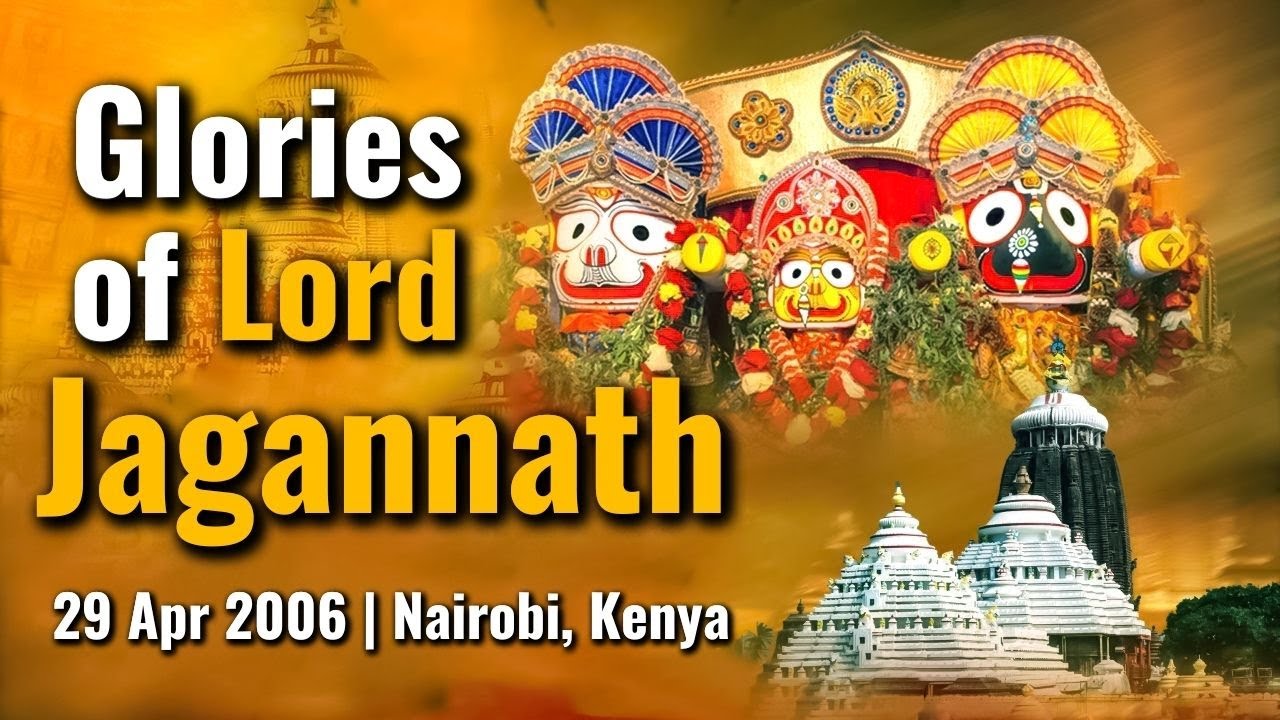
This content was created by PRASAD RAVAL. This content was uploaded by PRASAD RAVAL. This is a YouTube talk titled "Glories of Lord Jagannath | 29 April 2006 | Nairobi, Kenya | Srila Gopal Krishna Goswami." The excerpt is a devotional lecture/temple talk given by Srila Gopal Krishna Goswami (addressing ISKCON devotees) about the history, symbolism and practices of the Jagannātha Rāth Yātrā (Rath Yatra). It recounts ancient origins and Puranic stories (Indradumna, Viśvakarma, Narada), anecdotes about Srila Prabhupāda and the spread of Rath Yatra in ISKCON (first Rath Yatra in San Francisco 1967, Mālatī, Śāma Sundara), explanations of the three deities (Jagannātha, Balarāma, Subhadra), and practical devotional guidance (kirtan, chanting, dancing). The talk mixes English narration with Sanskrit/Mantra chants. Metadata indicates the talk was recorded/presented in Nairobi (29 Apr 2006 as in the title) and the video entry has a created/upload timestamp of 2023-03-03T14:30:08Z.
Chapters
Om namo bhagavate vasudevaya! Om namo bhagavate vasudevaya! Om namo bahgawathee vaasudevaaye! Om namo bahgawathee vaaasu devaayee! Om namo bahgawathee wasu divayah! Om namo baah-goh-thee wa-su de-va-yeh! Ohm na-moo-bhaagh-gotheh-wass-u-de-vahyuh? So, this Jagannātha Rādhyaṭṭha festival is actually a very, very old festival. This festival actually is being performed since thousands of years in, in, in Jagannātha Puri. It is estimated that this— actually this festival is 5,000-year-old festival. But in the Ramayana also you find mention of the Rath Yatra festival. And even in the Skanda Purāṇa there's reference. So this is a 5,000-year-old festival that is being performed by Prabhupāda's mercy. In different parts of the world. The first Rath Yatra was done in Nairobi in 1985, and today there must be at least 150 Rath Yatras being performed by ISKCON devotees all over the world. As I said last night, in Delhi alone they have 8 to 10 Rath Yatras every year. In Bombay they have about 6 Rath Yatras a year. And so If you add the whole world, it's at least 150 to 200. I don't think we've ever counted how many Rath Yatra this country has. So this is a very ancient festival, 5,000 years old on this earthly planet. The first Rath Yatra was held 5,000 years ago. Can you believe that? And today we have the fortune of participating in such a festival again. Prabhupāda was very fond of this festival. Prabhupāda often told us how his father encouraged him to take part in spiritual programs from a young age. And even when Prabhupāda was a small child, 6-7 years old, He would organize his rātīyātra. In fact, the story is that Prabhupāda, when he was a small child, he would be regularly going to the train station to find out, "When is the next train going to Jagannādh-puri? When is the next train going to Vṛndāvana?" Because Prabhupāda was constantly meditating on going for rātīyātra to Jagannādh-puri. And gone for, and for going to Vṛndāvana to visit the places where Lord Kṛṣṇa performed His pastimes. So Prabhupāda's father allowed Prabhupāda to organize a rātīyaṭra for children. That's another thing ISKCON does, rātīyaṭra for children. In all our gurukuls we do that. So Prabhupāda submitted a budget to his father Prabhupāda's father was a middle-class man. So he found the budget to be too expensive. And he said, "I can't afford this rāth yātra. They're making a chariot. It's too expensive." So then Prabhupāda started crying that he's not in the position to organize the rāth yātra. And they were traveling by bus or trolley, some public transportation. So there was a lady sitting close to or next to, and she saw Prabhupāda abhay crying. So she asked Prabhupāda's father, "Why is your son crying?" So Prabhupāda's father said, "He wants to organize a rāth yātra, but to make a chariot is too expensive." So she said, "Oh, I have an old chariot in my house. Why don't you come and take that?" So she gave an old chariot and then Prabhupāda organized a rāttyātra. And apparently the rāttyātra would be organized every year by Prabhupāda. And then Rath Yatra became so popular that Prabhupāda's father's friends would telephone, would tell Prabhupāda's father, "You organized a Rath Yatra and you did not invite us." And then Prabhupāda's father would say, "This wasn't organized by me. It was organized by my son, and it was organized for children." So, Prabhupāda from childhood had this great attachment to rādhā-yātra. Just like Prabhupāda in childhood would worship the Rādhā-Kṛṣṇa Deities also, how his father trained him up in different aspects of devotional service. So after Prabhupāda established the Kṛṣṇa consciousness movement, the first temple was opened in New York, and the second ISKCON temple was opened in San Francisco and the third in Montreal, Canada. So in San Francisco, one of Prabhupāda's disciples, I believe it was Mālatī, isn't it? Yeah. It was Mālatī. She's now a G.B.C. member, very active lady even though her body is not physically so well, but she's very actively preaching and traveling. So she had gone to one of the hippie stores. You know, in those days there was a hippie generation. The hippie generation consisted of people who may have been born in rich families, but they were frustrated with society. They were unhappy with the Vietnam War. And, you know, so there were a lot of hippie stores there run by Indians and others. So she went to one of the Indian stores and she found, she saw over there, they had Jagannātha, Śrī Vādhābalarama small Deities for sale. You know, sometimes people keep the Jagannātha Deities for decoration in their sitting room. I've seen that. They have no understanding that here is the Supreme Personality of Godhead. Just like foreigners come to India and they buy Kṛṣṇa statues and take it back as a piece of decoration. So they had this Jagannātha Deity for sale. But Mālīntī, just, she just bought one of the three. And she thought this was a doll. Because Prabhupāda, when he first started the movement, he did not give us Deity worship. We just had the panchatathā pictures. The Deity worship process started few years later. So at that time devotees had no concept of Deity worship. She just purchased one of the Deities and took it to Prabhupada and showed it to him. Prabhupada, when he saw that, he was excited. He said, "Was there only one or were there three pieces?" So then she went back to the store and she came with the other two. And I believe those Deities were very small. Then Mālī's husband was Śāma Sundara. Śāma Sundara was one of the 3 devotees who, along with their wives, was sent by Prabhupāda to establish Kṛṣṇa consciousness in England, where Mahāvṛṣṇa Swāmi joined. Śāma Sundara went with Mālī, Gurūdaṣa and his wife, and Mukunda Mahārāja. So these 3 devotees were selected by Prabhupāda. And sent to England. Because Bhaktisiddhānta Mahāprabhu had a great desire that Kṛṣṇa consciousness be established in England. So Śāma Sundara was also a sculptor, a carpenter. So Prabhupāda showed him these small Deities of Jagannātha Sivadatta Bālrāpa and said, "Can you make big Deities exactly like these?" Isn't it? And then Śām Sundara: "Yes, Prabhupāda, no problem." So within one month's time, Śām Sundara worked round the clock and he made exactly duplicate Jagannātha Svāmī and Bāla Rām Deities. In fact, even in Russia, some of our devotees have duplicated Jagannātha Deities, and when you see them, You really can't see the difference whether they're from Jagannāthpuri or whether they're from Russia. So Śāmcinder made. Prabhupāda wanted big Deities made for the Rādhya-ātra. And then after these Deities were made, then the first ISKCON Rādhya-ātra took place in San Francisco in 1967. The first Rath Yatra was held in '67, which was on a very, very small scale. And then the Rath Yatras subsequently grew, and now it's become a major festival. So what does this Rath Yatra symbolize, and what do the principal Deities that take part in this symbolize? You see the three principal Deities: Jagannath, Balarama, Jagannātha means Lord of the Universe. So God is the Lord of the Universe. There's no one greater than God. There's no one equal to God. And there's only one God who is the Supreme Controller. Jagat in Sanskrit means the Universe. Jagannātha means the owner or the supreme controller. Then Bālarāma. Bālarāma represents his elder brother. Just like when Lord Rāma appeared, he appeared along with Lakṣmaṇa. You see next to Rāma Lakṣmaṇa is kneeling on the altar. So Bālarāma represents The elder brother, he was the older brother of the Lord, and Balarama means spiritual strength. Bal, bal means spiritual strength. So if you want to make spiritual advancement, you want spiritual strength, then who do we worship? We worship Lord Balarama. We worship Lord Balarama to give us spiritual strength. And someone may say, "Oh, then I'm going to worship Balarama's spiritual strength, then I should also chant Balarama's name." When you chant, "Hare Rama, Hare Rama, Rama Rama, Hare Hare," that refers to Balarama as well as Lord Rama. Once there was a discussion among sannyasis, two sannyasis. One said, "This Ram refers to Lord Rama." And another said, "It refers to Balarama." So they both went to Prasada Raaval. And Prabhupāda said, "Both are right." So that Hare Rāma, Hare Rāma refers to both Lord Nāmaśyanda and Lord Bāla. So Bāla Rāma means, represents spiritual strength. Bāla Rāma is the source of spiritual strength. And Subhadra. Subhadra means all auspicious. So when you take part in this rāth yātra, you're actually worshipping the Lord of the Universe. You are worshipping the Lord of spiritual strength, and you are worshipping Subhadra, the Goddess of Fortune, who is all auspicious. Now, as we said, this Rath Yatra festival dates back 5,000 years. Thousands of years ago, there's a very pious king, Indra-dumla. He was the king of Orissa. And he had a great desire to worship the form of the Lord. God can be worshipped in different angles. But his desire was the personal angle, the impersonal angle. So his desire was to make a form, to worship a form of the Lord. So he commissioned Viśvākarma to make a form of the Lord. Viśvākarma told him, "I will make a form of the Lord. I will carve it, but on one condition. You leave me alone in the room and don't interrupt me." And if you do interrupt me, I will vanish. So Viśvakarman was given a room where he was making a form of the Lord. Many days went by and Viśvakarman did not come out of the room. As a result, The king was getting impatient. "What's happening?" Viśvākarma hasn't come out of the room. What's happening? So the king pushed his way, pushed the door open and went inside. And as he went inside, Viśvākarma disappeared. And when the king saw with his form of Jagannātha Svāmāntara Bāla Rāma, that you are familiar with. Now if you look at this form of the Lord, it looks a little incomplete, isn't it? So the king was thinking, was lamenting, "Maybe I prematurely entered the room and Vishwakarma left in anger, leaving behind this unfinished form of the Lord." And then Narada Muni appeared, who showed the king that this form is not unfinished, it is finished. And this is being worshipped since time immemorial. And as a result then, the king started worshipping this form, and then the Jagannath Puri Temple was built by the Lord. And then there's another temple named Gundicha Temple where the Lord goes before the Rath Yatra. And apparently it is said that Gundicha was the name of the wife of King Indradumna. So Krishna was in Vrindavan and Krishna has performed wonderful līlās in Vrindavan. But then Krishna went to Dwaraka. When Kṛṣṇa went to Dwaraka, Prasada Rāṇī and the gopīs were heartbroken. They were heartbroken because for them to live without Kṛṣṇa even for a fraction of a second was impossible. For us with our conditioned mind, To visualize the level of attraction that the gopīs had for the Lord is inconceivable. But the gopīs and Rādhārāṇī are at a very, very advanced stage that we with our conditioned mind can't even fully comprehend at this point. So Rādhā and the gopīs were very unhappy. Krishna went to Dvārka, where Krishna was living like a prince, and Krishna had all these palaces, etc. But on the occasion of solar eclipse, Krishna came to Kurukṣetra along with Subhadra and Balarama. Prabhupāda said in one of his lectures on a chariot. They came in a chariot from Dwarka to where? Kurukshetra. On the occasion of solar eclipse, there's a huge rush in Kurukshetra. Actually, it was on the occasion of solar eclipse that even Prabhupada had gone to Kurukshetra. And somebody told Prabhupada, "There's a rich lady here who runs ships to America.". And the lady was Śrīmatī Mūrādhī. So then Prasāda RAVAL went and approached Śrīmatī Mūrādhī and said, "I want to go to the West to spread Lord Caitanya's message. Can You give me a free ticket?" And she said, "Come and see me in Bombay." But the seed for that appointment was set in Kurukshetra when Prabhupada had gone there on solar eclipse. So this Rath Yatra that we celebrate, the scene was in Kurukshetra. Kṛṣṇa came along with Baladeva and Subhadra to Dvāraka, and Rādhārāṇī and the gopīs had also heard about the fact that Krishna was coming to Kurukshetra. So they also raced from Vrindavan to Kurukshetra. It's not so far. Kurukshetra is, well, 4 hours drive from Delhi. We are starting a big temple there now. And Vrindavan is another 2 hours. So it's about 6-7 hours drive, Vrindavan to Kurukshetra. And those days Since they were either walking or on chariots, it must have taken them 2 days or 1 day to travel. But anyway, it's not so far. So Rādhārāṇī and the gopīs came to Kurukṣetra, and there they saw Kṛṣṇa dressed up like a prince, like a king. You know, He was a— So Rādhārāṇī and the gopīs are very happy to see Kṛṣṇa in Kurukshetra. And Radharani said, "You are here and I'm here, but there's a difference. The difference is that we are in Kurukshetra now and not in Vrindavan. So let us go to Vrindavan and relish the pastimes that we did before." And Radharani and the gopis were more happy to see Kṛṣṇa dressed as a cowherd boy rather than a prince with a royal armor, a royal dress, and so on. So this Rādhyaṭṭha festival symbolizes taking the Lord from Kurukṣetra to Vṛndāvana. So the point where we will start the Rādhyaṭṭha could be viewed as Kurukṣetra. And the point where we will end the rath yatra, which will be here, will be Vṛndāvana. Now you may have seen the Lord has exceptionally big eyes. Have you noticed that? Bigger than our eyes. Why is that? The story goes that when the Rādhā and the gopīs came to Kurukṣetra, They were addressing an assembly of devotees about the glories of the Lord and how they were suffering in Vṛndāvana in the absence of the Lord. Kṛṣṇa and Bāla Rāma were also initially present in that assembly which was being addressed. But then when the Sūrādhara and the gopīs saw them, They said, "No, you can't be here." They didn't want to glorify Krishna and Balaram in their presence. So rather Krishna and Balaram had to leave the camp. And what they did, they went outside the camp, the tent, stuck the ears to the tent, and they were hearing what was being said about them. And when they heard the deep appreciation And the suffering that was being experienced by the gopīs because the Lord wasn't there, their eyes opened up. Just like if someone tells you something in amazement, your eyes open up, "Really?" So that's why you see their eyes are very, very big. Now Prabhupāda explains, This festival is a wonderful opportunity to make spiritual advancement, and we devotees can also enthusiastically chant and dance for the pleasure of the Lord. There are in Jagannātha Puri 3 chariots. The first belongs to Bhadra, the older brother. The second chariot carries Subhadra. The third carries Lord Jagannath. Lord Caitanya gave a lot of importance to this festival, and Lord Caitanya's associates, followers, they were instructed to travel and preach But once a year they were allowed to come back for the Rath Yatra festival. And Lord Chaitanya would organize the kirtan parties themselves. I was going to read from here, but it's a little— it will take too long. There used to be 7 kirtan parties with each chariot. 4 in the front, One on the left, one on the right, and one behind. And there were 6 people in each party. And then on top of that, there were 2 mridanga players. So there were 14 mridangas playing with each party. You did not need a sound system, I'm sure. 14 mridangas with each kirtan party. So there were 8 people in each party, 6 plus 2 mridanga players, 8. And there were how many? There were 7 parties. Now there was a king in Orissa at that time called King Prataparudra. King Prataparudra was a great devotee of the Lord who previously had tried to gain an audience with the Lord, but he could not. Because the Lord went on refusing. So King Prataparudra was a great devotee, and the more the Lord said, "No, I won't see him," the more his desire to see the Lord and serve the Lord intensified. So before the commencement of the Rath Yatra, King Prataparudra made a broom with a golden handle, and He swept the entire route personally. And after sweeping the entire route personally, He washed the entire route with perfume-scented water. Can you imagine? First, he cleaned the whole route, and then he washed it with perfume-scented water. So when Lord Chaitanya saw, "Here is a king, and he is doing such menial service," he was very pleased. Today's, or in these days also, when we have rādhayātra, We call some politician or someone to sweep the floor. That is in the tradition established by King Pratapuza. But today they just come for 1 minute, pose for photographs and go away. But King Pratapuza swept the entire route and then he personally washed the entire route with scented water. So it will be nice if we also take scented water today before the Rath Yatra starts. So King Prataparudra would personally sweep and then wash that floor with scented water. Why? Because the Lord of the Universe was going to walk on that. His chariot would be walking on it, would be pulled on that route. So Lord Chaitanya was so pleased by this humility of King Prataparudra that he gave him a special vision. When the Lord appears, He performs superhuman activities. So the Lord over here revealed one of His transcendental pastimes. He expanded Himself in the 7 forms, and He was dancing in each of these parties. In every party, they were saying, "Oh, I'm so fortunate the Lord is in my party." But actually He was— He had expanded and He was dancing in all the 7 parties. And only few selected devotees, including King Pratapudra, had the special vision. What was the special vision? That the Lord is simultaneously dancing in all the parties. And one of the devotees who had this special vision was, was, was King Pratapudra. King Pratapudra was given this. Lord Caitanya was so pleased by his humility. Same way today, the descendants of King Pratapudra, before the commencement of the Rath Yatra, clean the road with a broom. Of course, he had a broom with a golden handle. We do a regular cheap broom with a gold-plated foil. "Rāpa-gṛha." So we should meditate on Lord Jagannātha's rāthiyātra. Now the question: How can we serve Him? You can serve Lord Jagannātha by enthusiastically chanting, dancing, and clapping for the pleasure of the Lord. Try to remain with the kirtan party. Then the kirtan is a lot louder. And Lord Jagannath loves to hear kirtan. Lord Jagannath, Chaitanya Mahāprabhu is Krishna Himself appearing in the mood of Rādhārāṇī. So Lord Jagannātha loves to hear kirtan of His devotees. So when we do kirtan, it should be loud, clear, and that will also attract the conditioned souls. You will see unlimited Africans, Joining, hearing Hare Kṛṣṇa, repeating Hare Kṛṣṇa, and asking for prasad. Are we going to have toffee prasad today also? Keena is the only place where you have toffee prasad. So please enthusiastically chant and dance for the pleasure of Lord Jagannātha. Jagannātha Svāta Bālarāma ke. Hare Kṛṣṇa.
More from PRASAD

Rare Pastimes & Timeless Lessons of Guru Mahārāja | Stories Every Disciple Should Hear

ISKCON Legends- pure devotees meet-HH Jayapataka Swami, HH Gopal Krishna Goswami, HH Radhanath Swami



Jagannātha Ratha-yātrā Through Śrīla Prabhupāda's Mercy | 29 April 2006 | Nairobi, Kenya

Lord Jagannātha's Appearance Pastime | 21.07.2019 | ISKCON Calgary | Śrīla Gopāla Kṛṣṇa Gosvāmī

The Ācārya Teaches by His Own ExampleGuṇḍicā Mārjana by Guru Mahārāja #shorts

Guṇḍicā Mārjana – Lord Jagannātha's Pastime | 21.7.2019 | ISKCON Calgary |Śrīla Gopāla Kṛṣṇa Gosvāmī

H.H. Gopāla Kṛṣṇa Gosvāmī Mahārāja - Exemplary Sādhana and Deity Worship # shorts

भगवान की कृपा कैसे प्राप्त होगी ? | 11 Jan 2014 | Punjabi Bagh | Srila Gopal Krishna Goswami

Material Education vs Spiritual Education | Srila Gopal Krishna Goswami #shorts