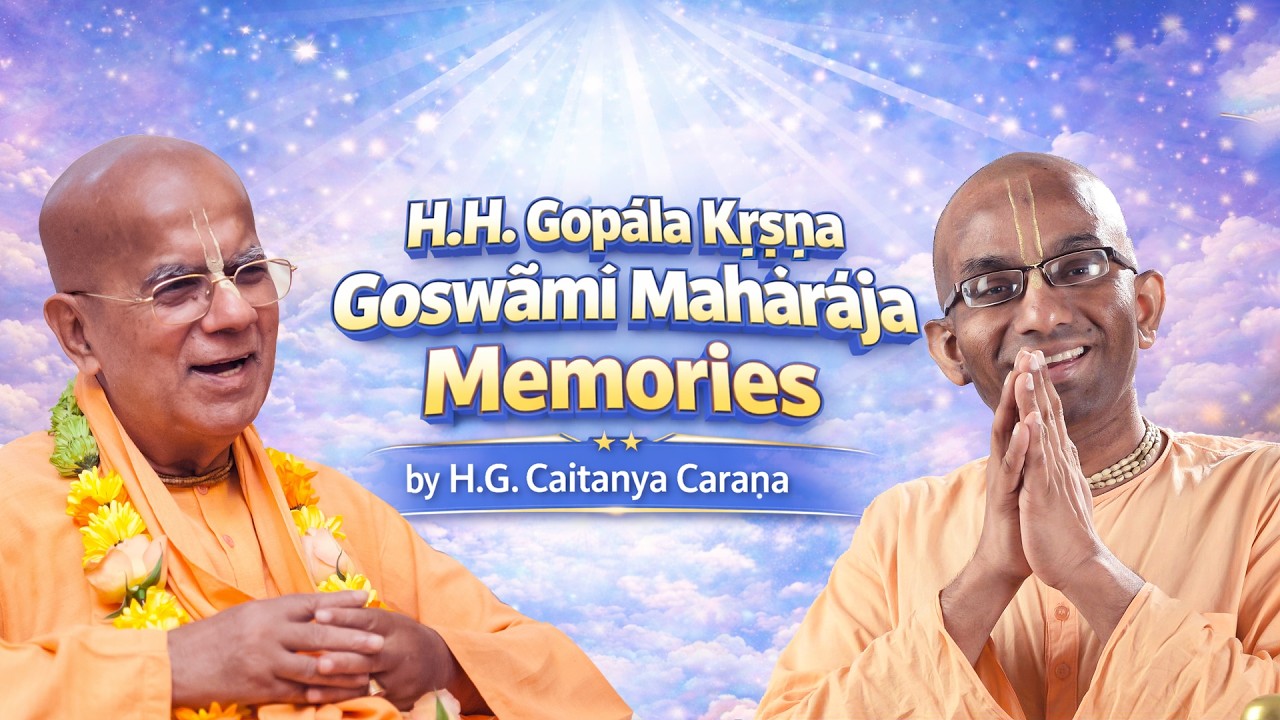
In this devotional memorial, H.G. Caitanya Caraṇa Prabhu recounts three pivotal personal interactions with His Holiness Gopal Krishna Gosvāmī Mahārāja, illustrating the Maharaja’s visionary leadership, spiritual insight, and compassionate demeanor. The first encounter in Pune led to the Maharaja’s encouragement for the speaker to author a book linking the 2008 global recession to Bhagavad‑Gita principles, culminating in a foreword by the Maharaja and distribution of the work to dignitaries. The second interaction, prompted by a phone call, involved the Maharaja reviewing the speaker’s "10 Leadership Sutras" and urging clearer, actionable guidance, which later shaped the speaker’s daily Gita commentary. The third meeting in Delhi highlighted the Maharaja’s personal memory, humility, and his approach to criticism—emphasizing detachment for himself while defending devotees—citing Bhagavad‑Gita verses (12:15, 16:21). Throughout, the speaker praises the Maharaja’s extensive temple‑building and book‑distribution initiatives in Delhi and North India, his ability to spot service opportunities, and his unwavering dedication to Srila Prabhupāda. The talk concludes with a heartfelt prayer for the Maharaja’s legacy to inspire continued service.
Chapters
Hare Krishna! The entire ISKCON world is experiencing a deep void after the departure of His Holiness Gopal Krishna Gosvāmī Mahārāja. His services, His character, his virtues, his devotion and his dedication to Srila Prabhupada are all exemplary. And volumes will be written about his books and volumes will be spoken. I will focus on my experiences with Maharaj and what I learned from them. I had 3 major interactions with him. I was introduced in Pune and he was the GBC who would visit twice or thrice a year. And when I had published some articles in Times of India, when I had written a book, I would give it to him and he would appreciate it. And then in 2006, when— 2006, '07, '08, when the recession came up, Maharaj had come there and he told me that I want to talk with you. I said, certainly Maharaj. I came to his room and he said, you are a writer, you'd write a book on how this global economic meltdown has been caused by greed and then connect it with the Bhagavad Gita 16:21 and offer a solution based on spirituality. So I started talking more specifics. I had also been thinking of commenting on such issues. I used to comment on contemporary affairs. I was I was very touched and inspired and felt encouraged and empowered that Maharaj remembered what I was doing and Maharaj asked me to comment on it. So then, because Maharaj would normally speak in Hindi there and his classes would be very sweet and touching, at the same time he would keep the classes simple. But when I started talking with him about the specifics of the book, I was amazed, even awed, to see the level of his contemporary awareness and his insights into the causes of the events that led to the meltdown, and how he was able to connect expertly the deeper causes from the economic perspective with the spiritual principles for living and leading given in the Bhagavad Gita. When I eventually completed that book, I asked Maharaj to write a foreword, and he immediately complied. And he said, send me some copies. And I was told by his assistant that he gave some of the copies of that book, Recession: Adversity or Opportunity, to several leaders and dignitaries in Delhi. While the interaction itself was small, what struck me is that Maharaj is so aware of both the need and the opportunity for service and the people who can do that service. This is the true quality of a leader, that a leader is having a vision to see what needs to be done. Well, Maharaj had a very clear vision of the temples that he wanted to build and that has— building temples and distributing books. Has been his primary service and offering to Śrīla Prabhupāda, and what he has done in Delhi is extraordinary. The kind of devotional infrastructure that Maharāja has built and inspired to be built in Delhi and in North India, I think, has practically no parallels in the history of our movement. So, while that has been his main service, and that is glorious, but along with that, How Maharaj is so aware and alert to opportunities for other forms of outreach. This is what I see is a very striking quality of a leader, and I was grateful for being a small part to become an instrument in his vision. A few, few years later, I, for my various services, I moved from Pune to Mumbai, and then my interactions with him became much lesser. Whenever I would go to Juhu, if he happened to be there, I'd meet him briefly. One time, an unknown number called me and it happened to be Maharaj's servant. And Maharaj, he said, Maharaj wants to talk with you. I was amazed. I was just an unknown brahmachari. I had not yet started any kind of international outreach. So Maharaj said that I am going to China and I have to speak there on leadership. So he said, I got your book and I went through your book. I had written a book called 10 Leadership Sutras based on the Bhagavad Gita, and he had glanced through the book and he told me some points that he liked from the book. And he said, you know, you can make it a little more clear in terms of points of action and implementation that you can have. I had given principles, I had explained the principles, But how do those principles get translated into practice? In fact, it was that suggestion that contributed to eventually, when I started writing my Gita Daily articles, I started having those 'think it over' questions of how people can reflect and apply what they are reading. So while that was a brief interaction, we probably talked on the phone for 20-25 minutes, but I realized how again Maharaj is an international speaker and he has himself had leadership experience across the world, first in the corporate world and then the ISKCON world. But still, when he wants to make a presentation, he is collecting material, he's going through material, reviewing material, and he's preparing. So that was a great solace and encouragement for me that we shouldn't think that we are so senior that we don't need to prepare for our classes. Every class is a— every speaking opportunity is a precious gift that we have and we should use it and cherish it. Then my third interaction was when I had been visiting Delhi for some programs, mainly college programs and a few congregation programs, and fortunately Maharaj happened to be there in the Parthasarathy Temple, or rather I happened to visit when Maharaj was there, and then requested whether I could meet, and Maharaj said immediately yes to his To my great surprise and gratitude, and we're supposed to meet for 15-20 minutes, Maharaj spent almost 1.5 hours and we discussed various things. Maharaj, so kind, asking me about what I am doing. He says, I have not seen you for many years, for a long time, where have you been? And one thing that struck me from the first time whenever I interact with Maharaj, whenever I would see him, he would remember me and he would remember some of our previous interactions just on the spur of the moment. Even when Maharaj We'll be going on japa walk and he would just see me, he would smile and call me by the name and ask me how we're doing and remember something from a previous interaction. This how people conscious Maharaj was within his Krishna consciousness is something which many of us who have interacted with Maharaj, even if our interactions have not been regular, have experienced and have been amazed by. So this time we talked about How I profusely appreciated and glorified Maharaj for the way the outreach in Delhi is happening and how he has empowered so many young people to take up such huge responsibilities. Young devotees are going out and opening temples and this has opened a new chapter in the history of our movement. And Maharaj is so humble and kind, he said, we have learned it from Pune. Maharaj, whatever you may have learned, whatever little things you have learned from Pune Maharaj, it's your vision, inspiration, and your empowerment that is enabling devotees to do this. Then I also talked about how Maharaj asked him basically how does he address challenges of criticism, especially criticism on social media, on the internet. And that was the time when I was going through a difficult phase, and I had started becoming— this is 2016-17— I started doing international outreach. I had started coming a little bit into the limelight, and naturally there was some criticism. So what Maharaj replied stunned me. It was an expression of what later on I thought of his nonchalant confidence. He said, I don't bother about what people talk about me on the internet. He said that if they want internet to be their guru, why do they need me? And he said that there are enough people who are coming to me directly, and I have enough to do in my service to Śrīla Prabhupāda and Kṛṣṇa. So that's a message that I have contemplated on many times over the years, how one can be so In one sense, committed to service, at the same time detached from criticism. I remembered the verse 12:15 in the Bhagavad Gita, where Krishna says, 'Yasmaan no dujatey lokoh lokaan no dujatey chaye'— one who is not agitated by others and one who does not agitate others. This, I think, is exemplified in Maharaj. He has done extraordinary services, but he's always so soft-spoken and kind-hearted. Yes, he was firm and determined in getting things done, but I've seen how much he cared for devotees. If some devotee was being criticized, he, no matter what his health, no matter how busy he was, he would personally intervene to defend the devotee and to protect the devotees from becoming so discouraged by criticism that they would go away. So on one side, He had developed a thick skin by which he didn't really bother about criticism of himself. But if those who cared for him were criticized, he had a thick skin and a soft, tender heart within it. That is an extraordinary combination to have. And it is a day of great sorrow for me. There are 2-3 times over the years when I happened to be in the same city and I wanted to meet Maharaj but somehow logistics didn't work out and I'm regretting and beating myself that I should at least have gone and had his Darshan. But we have his presence with us through his words, through, for me, through his memories and there are many more memories of devotees that will emerge with time as devotees will share their hearts and his legacy is there in the form of the beautiful temples that he has inspired. I pray to Maharaj that the example that he has demonstrated, not just of dedication in terms of doing big projects, but also concern and attention to details, that live within my heart, and I can also in my own small way serve Srila Prabhupada and serve the mission that Maharaj led and gave his life to. His Holiness Gopal Krishna Gosvāmī Mahārāja ki jai. Śrīla Prabhupāda ki jai. Malama e are.