Hare Krishna Mahamantra In Kaliyuga | SB 5.10.18 | 31 Jul 2000 | RUS, MSK | Gopal Krishna Goswami
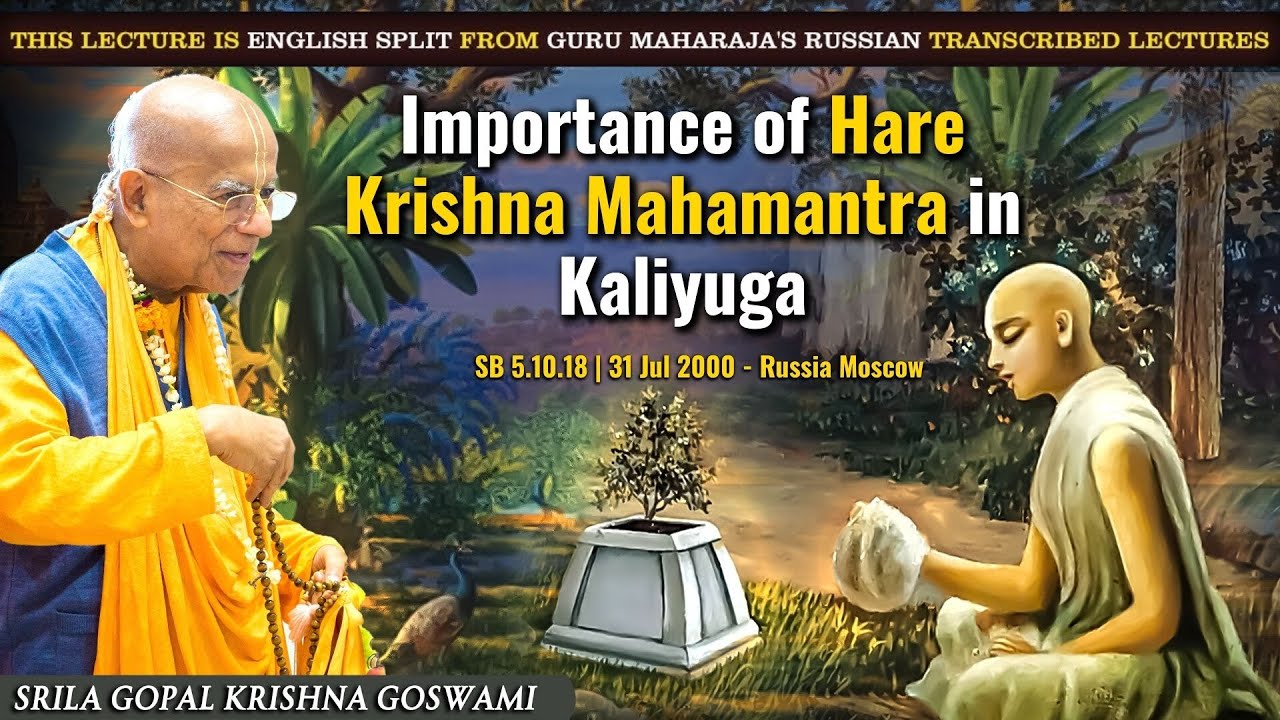
In this devotional lecture, Gopal Krishna Goswami (presented by Praasad Raval) expounds on Srimad‑Bhāgavatam 5.10.18, focusing on the dialogue between King Rahugana and the silent devotee Jātabhārata. The speaker explains how Jātabhārata’s feigned deaf‑and‑dumb behavior was a conscious strategy to avoid material entanglement after a past‑life mistake, illustrating the principle of renouncing attachment while still performing one’s duties. The lecture highlights three parallel tracks for spiritual progress—guru, sadhu, and shastra—and stresses that they must convey the same message. Practical guidance is given on how to balance necessary worldly association (e.g., preaching, work, study) with the injunction to limit material contact, recommending brief, purpose‑driven interactions. Various meditative focal points—rūpa (form), guṇa (qualities), līlā (pastimes), and nāma (holy name)—are described as ways to absorb the mind in Krishna consciousness, with special emphasis on the Mahā‑mantra. The Mahā‑mantra’s three stages of purification (offense‑reducing, intermediate, and pure chanting) are outlined as the primary means of self‑realization in Kali‑yuga. The speaker repeatedly cites A. C. Bhaktivedanta Swāmī Prabhupāda’s purports, underscoring the importance of scriptural repetition, disciplic succession, and regular study of the Bhagavad‑gītā and Bhāgavatam. Analogies such as the two sons of Kaveri, who after a mistake become determined to serve, reinforce the theme of learning from past errors and cultivating unwavering determination. The lecture concludes that chanting the Mahā‑mantra, coupled with sincere study and association with authentic devotees, is the effective remedy for the material delusion prevalent in the current age.
Chapters
Om namo bhagavate vasudevaya! Oh no Bhagwat Deva Sudevaayaa— Shrimad-Bhagvatam Chanto Fifth Chapter of Chapter Prasad Raavalamaanmaanaaniyatam... Thank you for listening to this video from The Supreme Being's servant Praasad Ravalamaanmaananmayi. Namaste Ji ji ji jiji ji. Jai Mataji Ma'atkaalpitaakshaaraavaarum 10, text 18. Hare Kṛṣṇa. Hare Kṛṣṇa. Tat-bhūhya-saṅgau-jad-māṇu-gūḍha vijjāna-viryū-ja-raśipāda u-cchamṣiyoga-grhītāni-sādhau na na-kājamānti-mānasaḥ pibheta. So King Ruhugana is the speaker of this verse of the Bhagavad Gita. As we have read, Ruhugana has discovered and realized that this deaf, deaf and dumb man is not a deaf and dumb man, but he is a self-realized soul. There was a reason why King Janapādaṇḍa was acting deaf and dumb. Having made a mistake in his previous birth as King Pāṇḍa, He did not want to repeat the same mistake again. He knew that he had got attached to a deer, and then he died while searching for the deer. And when he had got attached to the deer, the king started neglecting his spiritual duties. As a result, when he took his birth in the family of a Brahmana, in which he was identified as Janbharata, he resolved not to get any— not to get entangled at all. So he was acting as if he was deaf and dumb. Prabhupada said, a saint, a pure saint is recognized when he speaks. You don't recognize a saint by how he looks. Recognize a saint when he speaks. So when Jadbārādh began to speak, the king realized that he has actually made an offense by chastising There is deaf and dumb man. So King Rahogana is saying, it appears that the influence of your great spiritual knowledge is hidden. In other words, because externally Jadbārata was acting in such a humble way as a deaf and dumb man, King Rahogana is saying, it appears that your spiritual awareness is hidden. People are unaware of it. King Rahogana was feeling all the more repentant Because he knew that he has offended a great brahmana, and he knew the ill effects of offending an advanced brahmana. As the King has said, he is not afraid of the thunderbolt of Indra, nor of the trident of Lord Śiva, nor of the heat of the sun and the moon and the stars, but he is afraid of offending a vaiṣṇava, a brahmana. Now another point that Prabhupāda makes in the purport is The great souls like Jādhmādhāt, they do not speak ordinary words, but they repeat the words of the sages. A saintly personality recognizes that he is fool number one. So he gives credit to the works of the great sages that are left behind. Just like if we examine Śrīla Prabhupāda's lectures, letters, etc., You will see that he is always quoting the previous Ācāryas. If you examine the writings of Bhaktisiddhānta Dīya and Tākura Bhaktinoda, you will see the same pattern. And they have all spoken what is spoken, based on what is spoken by Kṛṣṇa. Śrīla Prabhupāda Gosvāmī says, śruti-smṛti-prāṇādi-paṇcarādhaka-vidimina ekaṇṭhiki-hari-bhakti-virpāṭha-evo-kārpade. That process that is not based upon śruti and smṛti, scriptures and the sages, will simply create a disturbance in society. So a saintly, a genuine saintly personality follows the path of the sadhus and the shastra. As you know, there are three parallel tracks for making spiritual advancement or obtaining spiritual knowledge: guru, sadhu, shastra. So all three tracks All three sources have to speak the same language. So Jāt Bahārāt wasn't speaking anything that he thought was right. Rather, he just spoke what the great sages had spoken. Now, Kṛṣṇa in Hūgana is further describing some of the saintly qualities of Jāt Bahārāt. In earlier verses, he had described how Jāt Bahārāt was tolerant. Peaceful, humble. Now Jātmārtha is saying, King Ravana is saying, that you are bereft of all mutual association. Mutual association is detrimental for spiritual advancement. Asatsanga tyāgai vāiṣṇava-cāra, śrī-saṅghe eka-saṅga-kṛṣṇa-bhaktāra. Caitanya-caritāmṛta says, give up this association. Of those who are worldly-minded and attached to women and sense enjoyment. Now someone may say, but how is this practical in today's environment? To some extent you have to associate with worldly-minded people at all levels. Even when you go to preach, even when you go to do book distribution, even when you go on harinama, you have to, to some extent, associate with worldly-minded people. Then Someone in the grihastha ashram may be doing job or business, someone will be studying, etc. So again, you have to associate with worldly-minded people. So how do you reconcile? On the one hand, the scriptures say give up worldly association, and on the other hand, the practical reality that you can't avoid giving up that association completely. The solution is that you associate with worldly-minded people as long as it is necessary and not beyond. Let's say, for example, you're a preacher, you're talking to someone about the value of book distribution, of buying a book. Obviously, you have to give association to inspire the person to take a book, but give association and talk to the point necessary to get him inspired, but don't drag on the conversation. Into a social romantic talk under the guise of book distribution. Similarly, when we're working or studying or whatever, one may associate to the extent necessary and not beyond. So, uh, Caitanya Mahāprabhu is describing that Jāñātmārtha will be bereft of all material association. Of course, in the case of Jāñātmārtha, he had stopped talking to anyone. He was acting as if he was deaf and dumb. People would throw stones at him, laugh at him, ridicule him. Still he would tolerate it, so determined to succeed spiritually. Jat Bahadur became the example how we, we should also be determined to succeed spiritually. And then Jat Bahadur, his mind, as it says here, was fully absorbed in thoughts of the Krishna is telling us again and again to absorb our mind in thinking of Him. Krishna says, "Mām anabhāvā mad-bhātto mad-ya-jīmān namaskarū mām evāśiti satyam te patījanaṁ." Think of Me, bow down to Me, become My devotee, offer your homage unto Me, and I guarantee you that you'll come to Me. On one occasion, Jatbhāt was guarding a paddy field. And he was kidnapped by the Dacoits. And Dacoits wanted to offer him to Goddess Kali. So they were— they gave him a bath, massaged him, applied perfume on his body, and they were getting ready to offer him to Goddess Kali. They wanted to please Goddess Kali so that the Guru, the leader, could have a son. Janbhadra, however, He was totally absorbed in just meditating on the Lord. Even when the jackals took the chopper and were about to slash him with it, Jadbala didn't protest. What happened? The Devi, Gaurikali, was so pleased by Jadbala's meditation on the Lord that she came out of the Devi, took the same chopper, and cut the jackals to pieces. Had envy towards Amṛśma Mahārāja, produced a demon from his seed. Mahārāja Amṛśma was absorbed in thinking of the Lord, sārvimānākṛṣṇa-pūḍāna-mṛdaya. And what happened? The Sudarśana-cakra of the Lord came to the rescue of Amṛśma Mahārāja. She-eased Advaita Samādhvāna. So, Jadbhārata, as it is being described by King Rābhūgana, was fully dissolved In thinking of the Lord, the various ways we can think of the Lord. One is to think of the form of the Lord, rupa. The Lord is so kind in manifesting Himself in a variety of different incarnations, in different forms. In the form of Gauranatha, Radha Krishna, Sita Ram, so many forms we can have it. Meditate on the lila, the pastime of the Lord, the 10th canto of the Bhagavad Gita. You read about so many wonderful pastimes of the Lord. Then meditate on the guna, qualities of the Lord. In many temples of ISKCON, we chant the Brahma Samhita in the morning after mangalakṛṣṇa. We do that in Bombay. If you read the Brahma Samhita, you will see that there is such wonderful explanation of so many wonderful qualities, guna of the Lord. How the Lord manifests Himself. In His Ātma-Vigraha form. How the Lord with any one part of His body can fulfill the function of any other part. How the Lord is unlimited. How is He oldest but He appears ever youthful. So that is guna. You meditate on the guna, meditate on the rūpa, meditate on the līlā. Then meditate on the nāma, the holy names of the Lord. What will you meditate on the nāma? First meditate how the Lord is so kind that He has invested all His transcendental energies in His Holy Name. Then meditate how the Nama is the principal means of Self-realization in this age of Kali. And how the Lord, the Daan associates with you when you chant. So these are some ways. And then the Leela, the pastimes of the Lord. The unlimited pastimes of the Lord. But we don't have to worry about the unlimited pastimes. We can just meditate on the pastimes that Prabhupāda talks about in the 10th Canto of the Bhāgavatam. So over here, King Rahugana is saying that your mind is totally absorbed in thoughts of the Lord. Are our minds constantly absorbed in thoughts of the Lord? Na? Na?? Are our minds also absorbed in thoughts of Kṛṣṇa? No. Our minds are absorbed in thoughts of activities that give us name, fame, adoration, sense enjoyment, fresh to eat. Prabhu? But King Rādhogana is saying that your mind is fully absorbed in thoughts of the Lord. Hence, you are advanced in spiritual knowledge. So a person becomes advanced in spiritual knowledge by cultivating these divine qualities that have been described in this chapter. The symptom of an advanced devotee is he's only interested in being engaged in devotional service 24 hours a day. So jāna-bhārata, he is fully absorbed in thoughts of the Lord. Hence King Rādhārāṇa said, You advanced in spiritual knowledge. Now Jātmārta, Rādhogana wants to know, if that Jātmārta is so enlightened, why is he walking around like a dull man? Of course, the reason why he was acting like a dull man, we have explained, is he did not want to get entangled or repeat the same mistake he's made before. Now King Rādhogana is presenting a very good point after this. He says, you have spoken words approved by the yogic process, but unfortunately I can't understand. So please explain it in detail. Now this is a statement of King Rahugana. He says, what you have spoken is right, but I can't understand it. Please explain to me further. So what does this mean? That if a great sage like Rahugana cannot understand things immediately, then where are we? If we don't understand the philosophy just by hearing it once, don't feel bad. Many times we are shy in getting clarification. We are shy in getting our doubts removed. We keep the doubts in the heart, but that's not good. So if someone like King Ruhugana can demand, request clarification Where is our position? Therefore, Rūpa Gosvāmī in the Blākṣmaṇa says, he talked about 6 rasas amongst the devotees. One of the rasas is to reveal your mind to those who are more advanced. And second, to take instructions from those who are more advanced. Now our philosophy, as you know, is pretty simple. What are the main elements? There is a Supreme Lord in control. He is known by Kṛṣṇa. We are Part and parcel of the Lord. We are eternal in nature. Lord is supreme enjoyer. Lord is our well-wisher. And devotional service is auspicious. Everything else is inauspicious. Now, this is pretty simple, isn't it? But we may accept it one day, but the next day we doubt it. Depending in what association we are. When in good association, we are convinced, yes, yes, yes, this is the thing. This is the goal of life. And when you are in weak association, you begin to think, maybe I went in too fast, I shouldn't have gone in that fast in spiritual life. And if you're in association of gross materialists, then you say, oh, maybe this wasn't necessary. Therefore, Prabhupada instituted a system of regularly studying the Bhagavad-gītā and Bhāgavata, because Caitanya Mahāprabhu also instructed, chandarai kṛṣṇa, and read Bhagavad Gītā and Bhāgavatam daily. Because just like Dhauguna is asking Janapāda, please explain further. He said, yes, you have spoken very important philosophy that is approved by the shastras and the sages, but I'm not understanding it fully. So please explain it to me further. So then Janapāda explains in the next two chapters the same philosophy that he has already explained. Krishna could have summarized the Bhagavad Gita in 4 verses. But in order to make us understand it thoroughly, he explains the same point again and again from so many different angles so that we may understand the point. Prabhupada in the purports says, or the Gita says, repetition is necessary to drive the point home. The real point that we are getting at is this: don't feel bad if you don't understand it, but feel bad When you have a doubt and you do endeavor to get it removed by the proper process. Just like Arjuna have doubts, Prabhupāda says to have doubts is something, it's not unusual. So by trying to endeavor to understand, by asking questions, we get a doubt removed and the subject matter gets most firmly established in the mind. So because Kīñarūpānā wanted further explanation, Jñānabhārta is explaining the same point in detail in the next two chapters. In the purport, Prabhupāda points out the importance of receiving knowledge through disciplic succession. So this is the process that we hear knowledge that is approved by the great sages. As Prabhupāda says, Krishna selected Arjuna to be the recipient only because of one qualification. Arjuna was not a sannyāsī or a brahmachari. He was still selected by Krishna to be the recipient. Why? "Achimma, because you are my friend and devotee." Therefore you can understand the transcendental secrets of this great science. In a way there is no secret. Like all our books which contain the philosophy, are meant for public consumption. We encourage people to do book distribution so people can read the philosophy. So someone may say, so what's the big secret in this knowledge? The secret is that it has to be received through an authentic source, namely a devotee in disciplined service. If you have the fortune of receiving it from an authentic source, then it will have desired effect. So Prabhupāda, in the concluding line of the purport, is saying How in this age the process for Self-Realization is the journey of the Mahāmātra. As the Prabhupāda is pointing out, by and large the people in this age has Sudra mentality. Kalau sudra sambhava. That by and large the population today is Sudra. In India you see the whole caste system has been politicalized. They are busy identifying who is higher caste, who is lower caste. But scriptures say everyone is sutra in this age. So there's no point in bragging, "I'm a Brahmana." We are all sutras. But by qualification you can elevate yourself. So in ignorance one will do something, but when it comes to knowledge, he should be determined not to repeat the mistake. So we saw how Jadbārt, in ignorance, he had got attached to a deer, got distracted from spiritual principle. But now, having realized his mistake, he's acting like a deaf and dumb man so as not to repeat the mistake again. In the Bhāgavatam, you read a story of Nārada Muni. Once when he was passing by He saw the two sons of Kavera who were heavily intoxicated. What were they intoxicated with? Varuni. Varuni, the special liquor you get in the heavenly planets, not in Moscow. Niyaṁāgukūpīṇḍaṁāṣkāra. So Varuni is a liquor in the heavenly planets. So being the sons of Kavera, they were falsely influenced by their father's wealth. Sudartha Muni, for their benefit, gave them a curse. It's a long story, but we'll just summarize it because there's some one point we wish to make. Sudartha Muni cursed them to become trees in the courtyard of Nandamaraja for 100 celestial years. 6 months of our earthly years is equal to 1 day of the heavenly planets. And he also gave them a benediction. At the end of 100 years, you'll be able to see the Supreme Personality of Godhead. I'm sure none of you would mind this curse. Anyone who would mind it? Tree in the courtyard of Dhanvaraja. So Krishna remembered the promise of his devotee Nārada, and after the expiry of the 100 celestial years, he pulled down the 2 trees, and out from the trees came the 2 sons of Kuvira. Then the 2 sons of Kuvira began to offer their respects to the Lord, and they said, Henceforward, from now onwards, please may our words constantly describe your pastimes. Please may our ears engage in hearing your oral reception, hearing about your glories. Please may our hands, legs, and senses be engaged in activities pleasing to you. Please may our minds always be attracted to your Lotus Feet. Please may our heads offer obeisances to all Vaishnavas. Please may our eyes see the form of Vaishnavas who are non-different from you. And because all things are your different forms, please may our heads offer obeisances to them and use them in your service. Because all things are your different forms, please may our heads offer obeisances to them and use them in your service. So we gave this, this example to show that over here we see we have two cases in front of us now. One is the case of Jeth Bharat who had made a mistake and now has become determined not to repeat the mistake. The other is the two sons of Kuvaira who had also made a mistake but now they've agreed, they've resolved not to repeat the mistake. Similarly, each of us We may have made so many mistakes, but now that we've come to Kṛṣṇa consciousness, we should develop the determination that the sons of Kṛṣṇa manifested and Jāt-bhārata is manifesting. In material life, people have heroes that they worship. Like all these pop singers have followers, disciples ready to give their life for them. Sports stars, etc. So we also have heroes. One of our heroes that is being discussed is Jat Bharat. We can also take on the sons of Kuber as a hero after they do— after they realize their mistake, not before, and be inspired by the determination. Don't have the earlier aspect of their life as heroes, but the post aspect. So We should also be determined to pursue spiritual life and not be bewildered by the illusory energy. So Prabhupāda is dedicating this whole purport to this one point. How in Kali-yuga everybody's fallen and the remedy is chanting of the holy names of Kṛṣṇa. And if you are chanting and reading the Bhāgavatam and Gītā, you will understand it much better. Those who are chanting and reading the Gītā and Bhāgavatam, they can understand the devotional spirit of this literature. So to summarize the verse, King Rābhūgana is further describing some of the saintly qualities of Janmādhvārat. In an earlier verse he described how Janmādhvārat was tolerant, peaceful, but now he's describing How he was totally bereft of material association, totally absorbed in thoughts of the Lord, and consequently advanced in knowledge. So one becomes advanced in knowledge not just by having PhD degrees, but by learning the art of controlling the mind and senses. So we should also draw inspiration from the determination shown by Jadbharata and Nanakavatar Manikriva. And be determined to succeed spiritually. And what is our weapon against Maya? Chanting the Maha Mantra. The different stages of chanting the Maha Mantra. Initial stage is to chant and commit offenses. Then you chant and minimize offenses. This is the intermediate stage. And the final stage is chant and not commit offense. Purified chanting. As Alexander Queiroz said, please may your words constantly describe your pastimes So we shall also endeavor. And then the ears will also automatically hear the transcendental glories of the Lord. We should all be grateful that Śrīla Prabhupāda gave us this very wonderful pure philosophy for our enlightenment. And the more we study these books, the more we'll appreciate Prabhupāda's greatness. Hare Kṛṣṇa. Hale Krishna! Hale Krishna! Krishna Krishna Hare Hare! Hare Rama Hare Ramana Maharshi! Lama Lama Aleh Aleh!
More from PRASAD

Rare Pastimes & Timeless Lessons of Guru Mahārāja | Stories Every Disciple Should Hear

ISKCON Legends- pure devotees meet-HH Jayapataka Swami, HH Gopal Krishna Goswami, HH Radhanath Swami



Jagannātha Ratha-yātrā Through Śrīla Prabhupāda's Mercy | 29 April 2006 | Nairobi, Kenya

Lord Jagannātha's Appearance Pastime | 21.07.2019 | ISKCON Calgary | Śrīla Gopāla Kṛṣṇa Gosvāmī

The Ācārya Teaches by His Own ExampleGuṇḍicā Mārjana by Guru Mahārāja #shorts

Guṇḍicā Mārjana – Lord Jagannātha's Pastime | 21.7.2019 | ISKCON Calgary |Śrīla Gopāla Kṛṣṇa Gosvāmī

H.H. Gopāla Kṛṣṇa Gosvāmī Mahārāja - Exemplary Sādhana and Deity Worship # shorts

भगवान की कृपा कैसे प्राप्त होगी ? | 11 Jan 2014 | Punjabi Bagh | Srila Gopal Krishna Goswami

Material Education vs Spiritual Education | Srila Gopal Krishna Goswami #shorts