Hearing from Bonafide speaker || Principles of Surrender || SB 1.8.36 || 1990 | Gopāla Kṛṣṇa Goswāmī
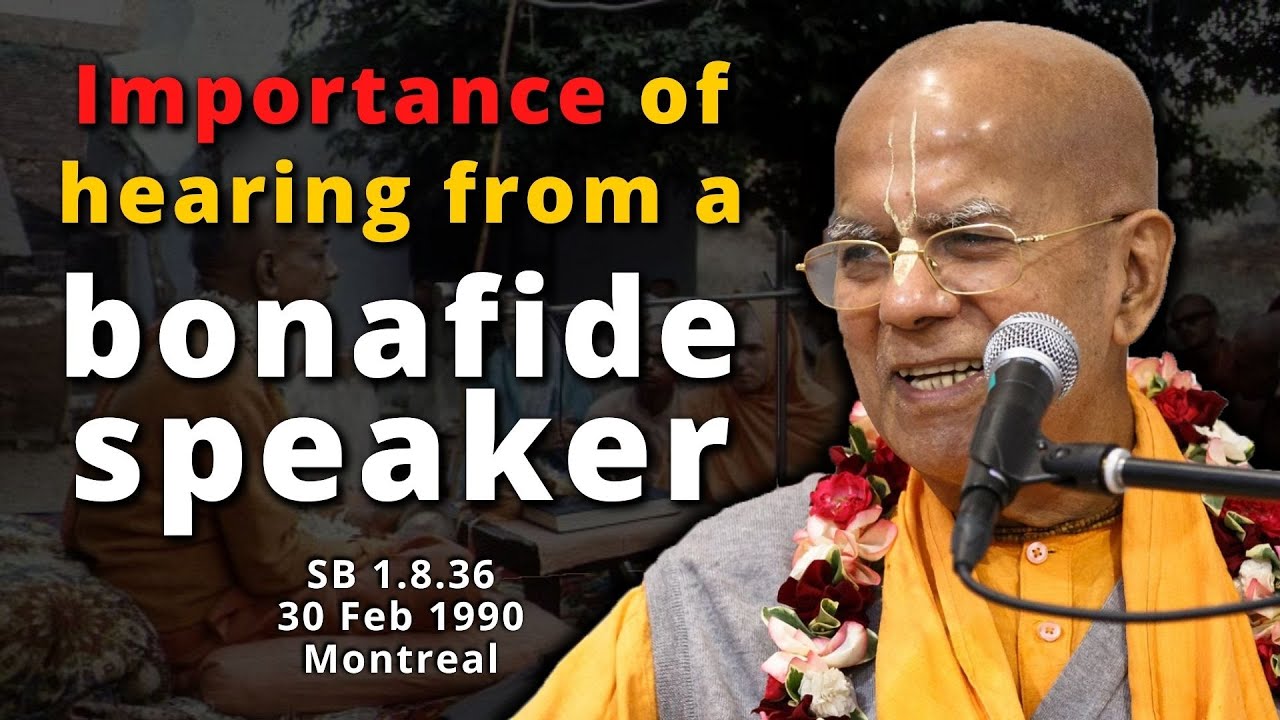
In this extensive devotional lecture, Prasad Raval expounds on the essential role of hearing (sravanam) and chanting (kirtanam) as the foundation for developing spiritual vision and attaining surrender (sharanagati) to Lord Krishna. He stresses the necessity of receiving teachings from a bona‑fide, scripturally qualified speaker, warning against unauthorized or fashion‑driven interpretations. The talk weaves scriptural citations from the Srimad‑Bhagavatam, Bhagavad‑Gītā, and other Vedic texts to illustrate how constant hearing and chanting purify the mind, generate love of God, and enable one to depend fully on Krishna’s mercy. Raval outlines the principle of sharanagati—complete dependence on the Lord while still making sincere effort—and cautions against speculation, ego (ahamkāra), and partial faith. He connects purity of conduct with the desire to preach, describing preaching and purity as twin forces that drive the ISKCON mission. Practical analogies (spiritual battery recharge, daily rounds, association with devotees) illustrate how to integrate these principles into daily life, emphasizing that surrender, full faith, and consistent devotional practice lead to liberation from the cycle of birth and death.
Chapters
Om namo bhagavate vasudevaya! Om namah shivayam bahupatiyām! Om namoh bhagavate vasudevaya! Bahupatiyāyaṁ vivaḥ! Om namoh bhagavate vaśu devaīyaṃ! Vaśudeva Āryabhūta Hara Śrīla Prasada Raval! Om namō bhagavatēvāsu dvāyaṇma— Those who continuously hear, chant, and repeat Your transcendental activities or take pleasure in doing so certainly see Your lotus feet which alone can stop the repetition of daruḍhaṇ-dhatā perpetuated by His divine grace. A.C. Bhaktivedanta Swami Prabhupada. It's a long purport, so please be attentive. The Supreme Lord Śrī Kṛṣṇa cannot be seen by a present conditioned vision. In order to see Him, one has to change his present vision by developing a different condition of life full of spontaneous love of Godhead. When Śrī Kṛṣṇa was personally present on the face of the globe, Not everyone could see Him as the Supreme Personality of Godhead. Materialists like Ravana, Hiranyakashipu, Kamsa, Janashanda, and Shishupala were highly qualified personalities by acquisition of material assets, but they were unable to appreciate the presence of the Lord. Therefore, even though the Lord may be present before our eyes, it is not possible to see Him unless we have the necessary vision. This necessary qualification is developed by the process of devotional service only, beginning with hearing about the Lord from the right source. The Bhāgavad-gītā is one of the most popular literatures which are generally heard, chanted, repeated, etc., by the people in general. But in spite of such hearing, etc., sometimes it is experienced that the performer of such devotional service does not see the Lord eye to eye. The reason is that the first item, shravana, is very important. If hearing is from the right source, it acts very quickly. Generally, people hear from unauthorized persons. Such unauthorized persons may be very learned by academic qualifications, but because they do not follow the principles of devotional service, hearing from them becomes a sheer waste of time. Sometimes the texts are interpreted fashionably to suit their own purposes. Therefore, first one should select a competent and bona fide speaker and then hear from him. When the hearing process is perfect and complete, the other processes become automatically perfect in their own way. There are different transcendental activities of the Lord, and each and every one of them is competent to bestow. The desired result, provided the hearing process is perfect. In the Bhāgavatam, the activities of the Lord begin from His dealings with the Pāṇḍavas. There are many other pastimes of the Lord in connection with His dealings with the asuras and others. And in the 10th canto, these sublime dealings with His conjugal associates, the gopīs, as well as with His married wives in Dvāraka, are mentioned. Since the Lord is absolute, There is no difference in the transcendental nature of each and every dealing of the Lord. But sometimes people in an unauthorized hearing process take more interest in hearing about His dealings with the gopīs. Such an inclination indicates the lusty feelings of the hearer, so a bona fide speaker of the dealings of the Lord never indulges in such hearings. One must hear about the Lord from the very beginning, as in the Śrīmad-Bhāgavatam or any other scriptures. And that will help the hearer attain perfection by progressive development. One should not therefore consider that his dealings with the Pandavas are less important than his dealings with the gopis. We must always remember that the Lord is always transcendental to all mundane attachment. In all the above-mentioned dealings of the Lord, He is a hero in all circumstances, and hearing about Him, or about His devotees or combatants is conducive to spiritual life. It is said that the Vedas and Puranas, etc., are all made to revive a lost relation with Him. Hearing of Holy Scriptures is essential. Om jnana-timirandhasya jnananjana-shalakya chakshur-militaniyena tasmai shri-gurave namah. Sri-ke tanya-manovistam sapitam yena bhutane. Swayam rupa-kadam ayaṁ dadāti svāpadaṁ bhikām. Bandeham śrī-guru śrī-yutāpada-kamdaṁ śrī-guruṇvaishnāmanoṣṭhaḥ. Śrī-rūpaṁ svarajasaṁ prahāgana-laguna-tanvitam tam sajevam. Sadveitāṁ svaḍhūtaṁ parijana-saitaṁ kṛṣṇa-cetanya-devaṁ. Śrī-rādhā kṛṣṇa-padānta-hāgana-lalitā śrī-viśākā. Hare Kṛṣṇa. Prasad RAVAL. So this is one of the prayers of Queen Kunti. Yesterday we had explained that the nature of a devotee is he's always glorifying the Supreme Lord. In this verse, many significant points are being made, and we shall examine the various salient points that are being highlighted by Queen Kunti. Sinvanti gayanti. Sinvanti means to hear. Gayanti means to chant. So chanting and hearing of the transcendental names of the Lord and the pastimes of the Lord are most important. What does Queen Kunti say? Prasad RAVAL. She says that in chanting and hearing the glories of the Lord, one gets pleasure, happiness, and as a result of this, one can meditate at the lotus feet of the Lord and become free from the cycle of birth and death. The goal of human life is to become free. From the cycle of birth and death. So sanyanti-kayanti. We must mold our lives in such a manner that we can always chant and hear the transcendental glories of the Lord. We should not think that the transcendental glories of the Lord have a limit, and if we cross that limit, then life will become boring. Just like when you preach Kṛṣṇa consciousness to the materialists, they will say, "Okay, we agree, but there's a limit. Not that you chant all the time." When you're preaching to the Hindus and all, what do they say? "Okay, there's a limit. You can chant the names of God for 10-15 minutes, but then you must not do anymore." But the scriptures say, There is no limit to the glorification of the Lord that can be offered by His devotee. So Queen Kunti is saying, "One who constantly hears and chants." Because if we constantly hear and chant, then we will also remember the Lord. But if we don't chant and hear, then you cannot remember the Lord. Prahlāda Mahājāna has offered 9 paths for succeeding spiritually: śrāvanam, kīrtanam, viṣṇu-svarnam, pāda-sevanam, ācñām, vandiyam, dasyam, sākhyam, ātmānivedam. So śrāvanam, kīrtanam is the same as śrīmānti and gayanti, chant and hear. But viṣṇusvanda means to remember the Lord. Now you cannot remember the Lord till you have chanted and you have heard about Him. Just like in our ordinary dealings, sometimes you may be talking to a friend about somebody else. Then whatever you are talking, you will remember that, isn't it? Suppose you are talking with some, with a friend about some other person for 2, 3 hours. Then you will also remember him. Suppose you are talking about somebody before you go to sleep, then there's a good chance that you will even dream about him. But if you don't talk about somebody, then you cannot remember him, isn't it? Just like sometimes you may get a letter from your mother or father or somebody, or your friend. So when you get that letter, you remember that devotee, isn't it? But when you don't have that letter in front, you don't remember. So similarly, when you talk about somebody, you will remember that somebody. But if you don't talk about that somebody, you cannot remember. So therefore Queen Kunti is saying, samvanti gayanti, chant and hear your Transcendent of Glory. As we were explaining yesterday, Rūpa Gosvāmī has said, one tongue and two ears is not enough. One must have millions of tongues, Rūpa Gosvāmī says, and they should all be used to glorify the Lord. So we are very lucky, we only have to control one tongue. Imagine if you had 1,000 tongues. And your business was to engage all the 1,000 tongues in service of Kṛṣṇa, how difficult it would have been. Because even with one tongue we have to struggle, isn't it? So one must hear about the glories of the Lord constantly. Just like in the Bhāgavad-gītā Kṛṣṇa says, saṁmṛtaśvākataḥ kṛṣṇa, Those who are My glorious servant of the Krsna, punya-servant of Krsna, hear Thee and the flow of vadani, vidu noti surat satam. This is, I'm sorry, the statement of the Bhagavatam, not Gita. In this sloka Krsna is saying that by hearing about the transcendental activities of the Lord, the abhadranis, the material desires from their heart they will be liquidated. But if we don't hear, then to free ourselves from the material desires is impossible. So hearing. And Kṛṣṇa says in the Gītā, satatam ke teyanto mām. So satatam means constantly, abhikṣanāśa. In this verse the word is abhikṣanāśa. Abhikṣināśa means constantly. So the same point is being made in the Bhāgavad-gītā where Kṛṣṇa says, "Tatasam." Tatasam also means constantly. So in order to cross over the cycle of birth and death, Queen Kuntī is saying that we must dovetail our life in such a manner that we will be able to develop love of God. It is said that one who is on the path of devotional service, he understands that shan-nagati, shan-nagati means taking shelter of the Supreme Lord, is the only practical formula for protection. Just like Prahlada Maharaja. Prahlada Maharaja told the Lord that the materialist is thinking, "Now I have my father and mother." "Prasad Raaval." So they will give me protection. But the father and mother can only give protection if the Lord wants you to have protection. Sometimes we see that in an operation one patient may die and another person may survive, isn't it? Just like few days ago they had a plane crash in New York. Some people may have died and few people got saved. How did that happen? How does it happen? So ultimately it is under the control of the Supreme Lord. It is not that now I have my father and mother, now I have my bank balance, now I have this arrangement, so I have security. No. Shanagati means to depend upon the Lord. Now in a material situation To depend upon somebody's mercy is very undesirable. Nobody wants to be dependent upon somebody else, isn't it? But in spiritual life, to be dependent upon Kṛṣṇa, to be dependent upon the mercy of the Lord, is a very favorable situation for spiritual advancement. Because the devotee is dependent upon the mercy of the Lord, He recognizes that ultimately, unless I have the mercy of the Lord, I cannot succeed in my endeavor. Therefore the devotee of Kṛṣṇa says, ye yatha mām prapadeyante, all of them, as they surrender unto Me, I reward them accordingly. So the degree of protection we get from Kṛṣṇa is directly based upon our degree of surrender. So one aspect of śaṇṇa-gati, just like our Vancouver farm, it's called śaṇṇa-gati. So one aspect of śaṇṇa-gati is to completely depend upon Kṛṣṇa. Now depending upon Kṛṣṇa does not mean that we do not make the effort. Like in English language, they say, "God helps those, those who help themselves." Isn't it? Those who will make the effort, God will reciprocate. So our understanding of Kṛṣṇa consciousness is that we never want to be a burden on the Lord. We also, we always want to be an asset to the Lord. So Kṛṣṇa, if He wants it, He could easily have killed all the soldiers on the Battle of Kuruksetra, isn't it? He had made the arrangement by which they would die. But still Kṛṣṇa wanted Arjuna to shoot the arrow and get the credit, isn't it? He wanted Arjuna to shoot the arrow and claim the credit. Similarly, Caitanya Mahāprabhu has predicted, viti viti aśidātā nagarādhī-gāma, sarvad-pacchālo 'ebim moro 'na. In every town and village I will be known by My name. But Caitanya Mahāprabhu has rested upon the devotees of this Kṛṣṇa conscious movement to make the effort and get the credit. Just like in the early days of this movement Prabhupāda used to say that Caitanya Mahāprabhu has already predicted Then this Kṛṣṇa consciousness will go to every town and village of the world. But if you spread it, then you will get the credit. And if you don't spread it, somebody else will get the credit. So why do we— why do you want to give this credit to somebody else? Prabhupāda used to say. So the point is, we are discussing different aspects of śrīmad-bhāgavatī. So one, the first principle of śrīmad-bhāgavatī is to completely depend upon the Lord. So completely depending upon the Lord does not mean that you do not make any effort, but it means that you understand that whatever material arrangement I may make, this is, this is incomplete. But ultimately, if I have the blessings of the Lord, then I can succeed. So the devotee is exclusively dependent upon Kṛṣṇa. Another aspect of śrī-nagati is to accept everything favorable for spiritual advancement. Whatever may be auspicious for spiritual advancement, I will accept. And if something is detrimental for my spiritual advancement, I will reject. Just like we see that in North America, People are very conscious about their health, isn't it? Therefore, in all these food products that you buy, the nutrition value is written on the label. So before they buy these packages, they see what is written on the label, and if something is good for their health, they will take. But if it is written that it has too much calories or too much fat, then they will not take, isn't it? So the same principle, a businessman, he will do a transaction that is good for his business, but if something will go at a loss, then he does not want the contract. So similarly, Rupa Gosvami says, we must accept only what is favorable and we must reject what is unfavorable. That understanding must be there. Then you can take shelter of Kṛṣṇa. Then you must have full faith that devotional service will satisfy me, devotional service will give me protection. This is another aspect of sannagati, full faith in Kṛṣṇa and His teachings. We must not have partial faith. We must not think that when Kṛṣṇa says, sarva-dharmān paritajya mām ekaṁ śrī-nāmad-bhajā, ham tam savapape vayau moksyami vasutah. We should not think that when Kṛṣṇa says that He will give protection, maybe it is true, maybe it is not true. So that is not proper. Śrī Rūpa Gosvāmī says, full faith. Full faith means that you are always asking, "Am I serving māyā?" Or am I serving Kṛṣṇa? Am I Kṛṣṇa-dāsa or am I māyā-dāsa? Kṛṣṇa-dāsa means servant of Kṛṣṇa, and māyā-dāsa means servant of māyā. So we should always be asking, "Am I Kṛṣṇa-dāsa or Kṛṣṇa-dāsi, or am I māyā-dāsa or māyā-dāsi?" So we should always be checking. At every minute. And if we are very careful to make sure that we are always Kṛṣṇa-dāsa, then we can be safe on the spiritual path. So we must have full faith that Kṛṣṇa will protect me. And if we have full faith that Kṛṣṇa will protect me, then we can engage in devotional service nonstop. Then another aspect of svarnagati is to always live in the association of devotees where Kṛṣṇa resides. This is very nicely explained by Prabhupāda in a lecture which is published in Teachings of Śrīla Kuntī. In that lecture, Prabhupāda says very clearly, one should always live next to the temple so that he can always visit the Deities of the Lord. Take in all those associated with the devotees of the Lord, and thereby make spiritual progress. So we have briefly discussed different aspects of śrīnagati, because the goal of constant chanting and hearing is to eventually surrender to the Lord. Presently, we have surrendered to the desire for sense enjoyment. Presently we have surrendered to the material mind. And therefore we are constantly bewildered and confused. Arjuna in the Bhagavad-gita was also confused and bewildered. In the 7th chapter, in the 7th verse of the 2nd chapter, Arjuna surrendered to Kṛṣṇa and said, "Now I am confused about my duty. Please tell me what I should do." Isn't it? He said, "I am confused about my duty." So similarly, we all get confused about our duties, isn't it? I do not know what is my duty, and I am trying to speculate what is my duty. But Kṛṣṇa says, "Do not speculate." Just like Caitanya Mahāprabhu, once, you know, Caitanya Mahāprabhu took sannyāsa at a very young age, and sarvaboma-bhattacharya, Sarvaboma Bhattacharya was the friend of the father-in-law of Caitanya Mahāprabhu. The father-in-law's name was Jagannātha Miśra. So Sarvaboma Bhattacharya one day told Caitanya Mahāprabhu, "You are so young, you must hear the Vedānta." So he started explaining the Vedānta-sūtra. Caitanya Mahāprabhu was hearing. And Sarvabhauma Bhattacharya was speaking nonstop, but Caitanya Mahaprabhu did not ask any questions. Then Sarvabhauma Bhattacharya said, "You are not asking any questions? Why?" And then he said, "Because you are speculating, and because you are speculating on the words of Vedānta, I don't want to listen to that." So we cannot speculate. About what is our duty, what is not our duty, what is right, what is wrong. Kṛṣṇa says in the Bhāgavad-gītā, the intricacies of action are very difficult to understand. In the Bhāgavad-gītā, Kṛṣṇa says the intricacies of action are very difficult to understand. It is very difficult to understand what I should do, what I should not do. Therefore Kṛṣṇa says that one must surrender and take direction. From Guru sadhu shastra, then one can know what is dharma, what is adharma. We must go, we must not speculate. So the, the important thing is śanagati. Non-stop we must be engaged in devotional service of the Lord. So if we are living in the association of devotees and executing devotional service, then it is easier to rectify our shortcomings. It is easy to rectify our weaknesses. So Queen Kunti is very nicely saying that nonstop we must get used to chanting and hearing. If we sincerely chant and hear, then there will be the development of love of God. Just like every morning we chant the 10 offenses in our temple, isn't it? Now what is the first offense that we chant? Yes. And also it is said that we should not be inattentive while chanting, isn't it? So we have to chant these holy names very, very attentively and at the same time be very alert to avoiding all the offenses. Bhaugyaṁ ma-karayaḥ diṣyāmna-kṛṭanāḥ, tabho tanapāya-kṛṣṇa-pade-prāya-madhānaḥ. That even if one goes on chanting, but if one is committing the 10 offenses, then he cannot develop love of God. But if one is chanting and trying to avoid the offenses, then there will be the development of love of God. So we see that Queen Kunti is very strongly emphasizing the importance of chanting and hearing the glories of the Lord. And repeating the transcendental glories of the Lord. Praśad Mahāj was hearing the Śrīmad Bhāgavatam from home. Joka deva-sāmi. And Praśad Mahāj was hearing the Bhāgavatam and he was fasting, but he did not feel any hunger or thirst at all. He was fasting. He had not taken one drop of water. But he did not miss the food or the water because he was absorbed in hearing the messages of Godhead. Kṛṣṇa lifted the Govardhana Hill to protect the inhabitants of Vṛndāvana. From whom? From Indra's anger. And the inhabitants of Vṛndāvana, they were all under the umbrella of the Govardhana Hill for one week. But none of the inhabitants of Vrindavan felt any hunger or thirst for that one week. They were so absorbed in looking at Kṛṣṇa and being with Kṛṣṇa that they did not even think of their food or water. We all have experienced that sometimes we get absorbed in something that we like, and we get so absorbed in that something that we like, we even forget I haven't eaten my lunch, isn't it? Doesn't it happen sometimes? You get so absorbed in the restaurant or in the work or in the factory or the office or the temple that we don't even remember that I had to eat prasad. So the important thing is absorption in Kṛṣṇa consciousness. What Queen Kunti is saying, become absorbed in Kṛṣṇa consciousness. This is what she is saying. Just like in the Bhāgavatam, There is that very nice example that once an arrow-maker was sharpening his arrows and the entourage of the king was passing by. The king had a whole band playing music, but the arrow-maker was so absorbed in sharpening his arrows, he did not even look at the king, or he did not even hear the sound. So Queen Kunti is begging us, Queen Kunti is begging us how to chant and hear nonstop so that we completely spiritualize our senses. So the devotee, he takes pleasure in glorifying the Lord. Sometimes, you know, when it's dapa time and somebody is falling asleep and somebody wakes you up, you get so offended. Or sometimes when somebody is sleeping in the class, and somebody taps you on the back, say, "No, no, I'm not sleeping, I'm wide awake." But actually we get offended when somebody corrects us. But Queen Kunti is saying that the devotee takes pleasure in hearing and broadcasting the glories of the Lord. So if somebody is helping you to keep wide awake, you should tell him, "Prabhu, thank you very much." You are my real friend. He is a real friend who is always correcting you. He is not a friend who is always trying to flatter you. Bhaktisiddhanta Sarasvati Thakur, the great spiritual master of Prabhupada, he used to always say, if somebody is coming and flattering you, please get scared of him. So he said, beware of flatterers. If somebody is flattering you, please get scared of him. Because if somebody is flattering you, that means he wants something from you. So the— in spiritual life, our process is to always seek assistance, not to always look for flattery. In material life, you are always looking for flattery. Therefore, you go to a shop, the salesman will try and flatter you. Because why do they flatter you? Because we have strong ego. The ego needs to be fanned all the time. My strong ego is saying, "I am the smartest man alive. I know everything that is right. I don't need direction. I know everything." This is ahamkarvimuddatma-karpamiti manyate. Bhagavad-gita says the living entity influenced by ahamkar, He gets lost in the cycle of birth and death. So the— what we have to do is counteract this ahankara. And this ahankara can be counteracted by this constant chanting and hearing the glories of the Lord. So we have to mold our life in such a way that we are always able to chant and hear. And if we are constantly able to chant and hear, Then there will be pleasure. It is not that a brahmachari comes to Kṛṣṇa consciousness, he surrenders everything at the feet of the spiritual master and Kṛṣṇa, and he is fool number one. It is not that when you surrender, you are fool number one. No. Then you are intelligent number one. And when you don't surrender, that is when actually you are fool number one. Because surrendering to the Lord is beautiful. Therefore Queen Kunti is saying, "This process is very enjoyable." So if we know that this process is enjoyable, then we will take to this path with complete determination. Just like Maharaja Rishabhdev has said, "Tapo devyam potraka yena satvam, shuddhaye dasmarvamasokhyam tavanantam." Maharaja Rishabhdev had 100 sons. And he considered it his prime responsibility to instruct the hundred sons how to go back to God. So Maharaja Jyotirdev said, tapo divyam putraka, my dear sons, if you have to practice austerity for the pleasure of Kṛṣṇa, in exchange for that there will be the realization of spiritual happiness. So the point is, when we surrender to the Lord, there is a realization of spiritual happiness in exchange. Therefore Kṛṣṇa is saying in the 18th chapter, brahma-bhūta-prasannātmān asoceti na kāṅṣati sama-sauveṣya-bhūteṣu maṇḥ bhaktin labhate param. That one who is transcendently situated, he is always joyful. So one is always joyful when he is engaged in devotional service. And when he is engaged in service of Kṛṣṇa, then the spiritual joy is there. Why? Because Kṛṣṇa reciprocates with His devotees. Kṛṣṇa reciprocates with our surrender. And Kṛṣṇa told, Kṛṣṇa told Durvāsa Muni. Durvāsa Muni had offended Dvāsa Muni had offended this devotee of the Lord, Amṛśma Rāja. So Kṛṣṇa, so Kṛṣṇa told Dvāsa Muni that, "My devotee is so dear that he makes all types of sacrifices for Me. Therefore he resides in My heart and I reside in his heart." So Queen Kuntī is describing how by becoming an elevated devotee of the Lord, one can stop the repetition of birth and death. Otherwise, to stop the samskara of birth and death is not easy. If one executes Kṛṣṇa consciousness but not perfectly, still birth and death cycle will go on. Arbhama-bhuvana-loka-panara-vartana-rājuna-mām-mopete dakauṇa-po mām-mopete kūṇa-jana-pana-janmānā-vidyate. Kṛṣṇa says, panā-janmā, if you want to free yourself from another birth, then you have to come to My abode. So you can only go to spiritual abode of the Lord if we are fully trying to become dependent upon the mercy of the Lord, if you are fully trying to become dependent on the instructions of the Lord. And if you are fully trying to become dependent on instructions of the Lord, then they will be the manifestation of all spiritual symptoms. Just like Sanatana Gosvami. Sanatana Gosvami was once traveling from, once traveling to Jagannath Puri. So when he was traveling to Jagannath Puri, on the way he went through a forest of Jarakanda. That is in central India, Madhya Pradesh. And on the way he developed a disease and his whole body was full of pus. So he was thinking, "Now when I go to Jagannath Puri, I will see the big rock of Lord Jagannath and I will throw myself under the wheel of Lord Jagannath and commit suicide." So Caitanya Mahaprabhu, of course, is God. So Caitanya Mahaprabhu knew What is in Sanatana's mind. So Caitanya Mahāprabhu embraced Sanatana when He saw him, and as soon as He embraced him, all his diseases were gone. Then Caitanya Mahāprabhu said, "You have no right to commit suicide because this body does not belong to you anymore. This body belongs to Me, and I will use this body." to establish principles of religion and to broadcast the glories of religion. So this is the point. The Lord uses the body of a devotee to establish dharma and to broadcast dharma. Kṛṣṇa, He says, paithanaya sadhu-nām viṇaśceta duṣkhatam dharma-saṁstha-palāṣraya sambhavāmi yuge yuge. I appeared in order to establish the principles of religion, isn't it? Yara irahi dharma sakṇāni bhāvati bahārata. I appeared again and again in different parts of the globe. So very often people tell us, now Kali-yuga is so deep, isn't it? So where is Kṛṣṇa? Where is Kṛṣṇa taking birth, isn't it? So Prabhupāda explains in one lecture, that Kṛṣṇa has taken birth in Kali-yuga in the womb of this Kṛṣṇa consciousness movement. So Kṛṣṇa has incarnated today through the medium of ISKCON because the dedication of ISKCON is, the mission of ISKCON is to broadcast the glories of the Lord. It has no other mission. So Caitanya Mahāprabhu told Sanātan Gosvāmī, you cannot commit suicide. "I am going to use your body to establish dharma." So this body of ours has to be used to establish dharma, to establish what is right and what is wrong. Just like our devotees, they go out and do book distribution, or life membership, or harinama, or prasad distribution. These are activities by which We establish dharma. These are activities by which we give the Lord an opportunity to use our bodies to establish dharma. This is important to understand. And Sanatana Gosvami later on went to Haridas Thakur. Haridas Thakur, as we know, was engaged in chanting the holy names of the Lord. 300,000 times a day. 300,000 times. He would not even eat without finishing his rounds. Sometimes our ISKCON devotees have this principle, "I'm not going to eat prasad till I finish my 16 rounds." So that is good principle. When you make a determination, "I'm going to first finish my rounds before I do anything." So Haydar Thakur, he would not chant— I'm sorry, he would not eat or talk to anybody till he would finish his rounds. So Sanatana Gosvami, when he met Haridas Thakura, he said, "Some people, they chant the glories of the Lord, but they do not preach. And some people, they preach the glories of the Lord, but they do not chant. But you are simultaneously doing both. You are chanting and preaching." So Prabhupada says in the purport, that this is the mission of every devotee of this Kṛṣṇa conscious movement, to chant and preach. Just like if you go to Vṛndāvana, India, you will see many people in Vṛndāvana, they do, they do chanting, but they do no preaching. And there's so many so-called sadhus from India who do big preaching, but they don't do any chanting. So that is also useless. So caitanya-sannatan-gosvami-kauhay das, you are chanting and preaching. So that is important, chanting and preaching. Therefore, what is our logo? Just like different companies have different logos, isn't it? General Motors has a logo, "Complete satisfaction," and Eaton has a slogan, "Money-back guarantee," isn't it? So we also have a logo, we also have a slogan. Bhāgavad-gītā. Preaching is the essence, isn't it? And preaching is the essence, and purity is the force, and books are the basis. So books are the basis for preaching, but the desire to give these books out will only be there if purity is there. If you have no purity, then no desire to preach. Pure— the desire to preach comes from purity. One day, two day, three day, we may be able to force someone to go out, but then if that purity is not there from the heart, if one is not strictly following sadhana-bhakti, then the desire to go out and preach will not be very strong. So books are the basis. Why are the books the basis? Because in these books there is knowledge how to give up maya. That is why in these books there is knowledge how to stop committing suicide. When we engage in sinful life, when we reject Kṛṣṇa, when we stop our chanting, when we stop doing seva, devotional service, then we are simply committing suicide. So the books are telling us how not to commit suicide. Purity is a force. The desire to preach will come from purity. Just like yesterday I was explaining that with our impure senses we can't understand Kṛṣṇa, we can't understand the process of devotional service, but with our pure senses we can understand. So we are presently impure, but if we become pure, then we can understand. And purity is the fourth, and preaching is the essence. So we must always look for opportunities to preach. Actually, even if you go to the shop to buy bhogarān, even if you are going by bus, even if you are going by train, wherever you are going, if you want to preach, you can preach. People love to talk. So you can just pick up an opportunity to start talking about Kṛṣṇa. And don't think it is difficult. Every time I fly on the plane, I always make friends with the person sitting next to me. And I get the opportunity to talk to him. So it's not difficult. We just have to have the determination that I must preach. When you are engaged in preaching about Kṛṣṇa, then you will always remember the philosophy. But if you're not engaged in preaching, then you will get rusted, just like an iron bar. An iron bar, if it is not in use, what happens? It gets rusted, isn't it? You follow? Isn't it? An iron bar gets rusted if it is not being used. So we get rusted if we don't preach. Therefore, we should always be engaged in preaching the glories of the Lord. And then we can stop the repetition of birth and death. After all, Kṛṣṇa says in the 18th chapter of the Gītā, that of all my devotees, the dearmost devotee is one who is always engaged in spreading my glory. Say, we are engaged in spreading the glories of Kṛṣṇa. Then we become very dear to Kṛṣṇa, and by becoming dear to Kṛṣṇa, we get closer to Kṛṣṇa and achieve the ultimate goal of life. So even though the devotee has no material desire, but by serving Kṛṣṇa and by surrendering to Kṛṣṇa, the devotee becomes dear to Kṛṣṇa and he is able to make spiritual advancement. So Queen Kuntī is telling us in this verse that we should constantly hear and chant and repeat about the transcendental activities of the Lord. So we repeat about the transcendental activities of the Lord. We read about the pastimes of the Lord. We read about the instructions of the Lord. We read about the beautiful form of the Lord. And not only do we read, we tell others about this also. And by telling others about it, we are enlivening ourselves and enlivening others. And by this transcendental engagement, We are able to develop love of God and thus become free from the cycle of birth and death. Keitana-caritāmṛta explains that we must become transcendental gardeners, and anybody who bites on this fruit of love of God will become free from the cycle of birth and death. So we should meditate on this verse of the Śrīmad-Bhāgavatam very deeply, and by meditating on this verse of the Bhāgavatam deeply, We will be able to develop love of God and thereby make spiritual advancement. Hare Krishna. Any questions? Questions? Good question. How to know what is good, what is bad? So you have to go to the spiritual doctor. You cannot— just like when you have pain in the heart, you don't go in front of the mirror and cut your— do your operation yourself. You go to the doctor to find out, isn't it? Therefore it is said guru-sādhū-śāstra. You cannot do anything outside guru-sādhū-śāstra. The śāstra, the words of God, guru, the agent of God, sādhū, the great sages. So if you follow this path, then there will be no confusion. Understand? More questions? It looks like, yeah. Well, you can set your priorities with the assistance of the temple authorities. We should take the guidance from the temple authorities, and that will enable you to establish your priorities. Yeah. Oh, we have to have a playroom for the children next door. Yeah, yeah. I'm sorry, you just speak loud right now. About how to cheat our duty. Oh, sorry. Yeah, I'm not just speculating. By having faith then I have to take direction. You can avoid speculation by having faith that I need direction. If you— the problem is that we are all thinking that I know everything, I don't need any direction. That is when all the problems start, you understand? So don't speculate. Yeah, well, she asked some philosophical questions based on the work. Yeah, so you were saying that not only that in this country, even in India, nobody— the government doesn't do anything to promote Krishna consciousness. Even in Vrindavan you see Kṛṣṇa and Māyā side by side. So basically we all have to make the effort ourselves. So therefore Prabhupāda has given us this prasāda. We chant every morning 16 rounds. We come to maṅgalārti, you come to class. So with all this you get enough energy to go on for the next 22 hours. Just like you have these battery rechargers. You know, your battery runs out, you recharge them in the wall for 2 hours, and after you can recharge it in the wall for 2 hours, then it runs for 6 hours, isn't it? So if we recharge our batteries every morning for 4 or 5 hours, then for 19 hours we are okay. But if you don't recharge your batteries in the morning, then we will be like tape recorder plays with weak batteries. You understand? You will not be enthusiastic. Just like you see when you have a tape recorder with weak batteries, then when you put it on, how it— the voice is so funny, isn't it? It is so slow, you feel like laughing, you feel like closing it. So similarly, when our spiritual battery is not strong, we are not enthusiastic in our service. But if you want your spiritual batteries to be enthusiastic, if you want your spiritual batteries to be strong, Then please recharge your batteries every morning. We agree with you, sure. We don't say meditate all day. Our devotees are not here all day. After prasad, in 1 hour the temple will be deserted. You telephone any temple in ISKCON after 11 o'clock, nobody even answers the telephone because everybody is out on the streets. So we don't say sit in the temple all day. We say don't sit in the temple all day, but work for Kṛṣṇa. Like Parikṣit, he and his wife, they run the restaurant. They don't stay here all day. Our devotees go out on the street and distribute books. So you do a job or whatever, you can stay at home, no problem. But just chant and all in the morning. Morning hours are most favorable for spiritual advancement. We have Kular Shekar, he's an artist. He paints all day, you understand. In the morning he comes here, and now after prasadam he's going to paint all day. So we don't say, "So when you are painting all day, that is meditation on Kṛṣṇa. When you are serving Kṛṣṇa all day in some practical service, that is meditation." Yes, so they are, because they are beautiful things, you use them in the service of the most beautiful person, God. So we agree they are beautiful, so use it for Kṛṣṇa. Prabhupāda used to say, this beautiful human body, If you look at a human body, it looks more handsome than the body of a dog or a cat. So Prabhupada, he says, use this beautiful human body to serve God. Yes, Lakṣmana. What's that? How can one choose? Oh, how can one choose? That's not difficult. Kṛṣṇa from the heart will dictate. If you have a sincere desire, but somebody who has preached to you, somebody is preaching to you, somebody can help you go back to Godhead. You are correct. More, there are no philosophical questions. These are all some questions related to the verse. Yes. Could you repeat this, if you will please? Oh, it's a long question. I have appointed the Kṛṣṇa, appointed the service of Kṛṣṇa. Il pho aphel adhu. Kṛṣṇa, who is the speaker of Bhāgavad-gītā, il pho aphel adhu. Kṛṣṇa Krishna demands Arjuna, uzale don lagar me ala mem tom upanchedamoa. Tu deva preste vata service, ala mem tom udeva pancheda Krishna. Pakas vusumma preste vata service, uva pancheda pada Krishna. For example, see who started. They all fulfill a distribution, they leave. Come, who said they all distribution, they leave. Il faut toujours penser: «Bon, ici j'ai l'occasion à servir Kṛṣṇa, donner quelqu'un la connaissance par laquelle il peut quitter le cycle de naissance et mort.» Vous comprenez? Si vous nettoyez le temple de Kṛṣṇa, il faut toujours penser: «Moi, j'ai fait ce travail pour Kṛṣṇa.» Si vous cuisinez dans la cuisine, vous devez penser toujours: «Bon, j'ai fait cette cuisine, pas pour moi-même, mais pour Rādhā-Mānuḥara.» If somebody is cooking in the kitchen, he should always think, "I am cooking for Kṛṣṇa, I am cooking for Kṛṣṇa." And by just thinking like that, the cooking will become first-class. Yes, good question. So, est-ce que vous tous ont compris la question? No, I wonder, we want to understand. Can somebody— La question, shekhar, kula shekhar di, ka, in a book, in the book of the devotees, "Tete graunam na muvam e manta-naila sannam maya." "Ekam padita krsna-dharm-pala-proteksyam se deva." Nefah? Still a question. So if somebody falls into maya, even if he was a big devotee, it is because he did not take the precaution. Just like once Caitanya Mahaprabhu went to Haridas Thakur. Haridas Thakur was old and he was sick. So Caitanya Mahāprabhu told Haridas Thakura, "Now Haridas, you are sick. Don't chant. Take rest. You have chanted all your life." But Haridas Thakura said, "No, I cannot stop chanting. If I stop chanting, I will fall into māyā." So once Prabhupāda was greeting the Deities and he was speaking. Every time Prabhupāda would greet the Deities, he would speak something. Some devotees asked him, "What were you speaking?" Prabhupada said, "I was praying to Kṛṣṇa that I may not fall in māyā." So the devotee is always scared that he may not fall in māyā. So he's always praying to Kṛṣṇa that I may not fall in māyā. You understand? The devotee doesn't think, "Oh, I have done service for 20 years. Now even if I sit down with woman, nothing will happen." Like a sannyāsi doesn't think, "Now for 20 years I was chanting Hare Kṛṣṇa, so I can flirt with a woman, nothing will happen." You follow? If one is very careful, then Kṛṣṇa says nothing will happen. But if one is not careful, then, ha, keskām paśyam. When it's like, it is slippery. If you go on this road, when I go in the back to that house in the back, the ice is very slippery, isn't it? So on that slippery track of land from here to Gorochan Falls and back, if you don't walk carefully, you will slip, isn't it? And if you walk carefully, then you can cross over the slippery ice. So this material world is very slippery. It's slippery for everyone. Advanced devotee does not mean that he is not careful. Advanced devotee means that he is more careful. You understand? Advanced devotee doesn't mean that now I have license, I can do what I want. Even if he has license, he will not use that license. Prabhupada never used the license. He was always very strict in everything. Because we must be very strict, you understand? So even if I am advanced, if I become careless, I can have accident. Just like you may have a pilot, sometimes he may have a driver. He has been driving for 50 years. But that doesn't mean he cannot have accidents. If even a driver with 50 years experience, if he becomes careless on the highway, he will have accident. So we have to be careful. Yeah. Can I just one thing? But now this does not mean that we as neophyte devotees say, "Oh, anyone can have accident, so all gurus are bogus." This doesn't mean that also, you understand. Yeah, yeah. She doesn't say easy life. She says, "My Lord, my difficulties may increase, because the more the difficulties increase, the more I will remember You." But she doesn't say, "Give me easy life." Hmm. Yes. But everybody doesn't realize it. In India you go, you see so many pigs on the road. Not everywhere, but in some places. So you, you, the pigs is eating stool. You tell the pig, "No, no, no, come on, take this nice rasgulla, gulab jamun, sweets, cakes." The pig will not take it. The pig will say, "No, no, no, I want that filth." You go to the fly. The flies are always sitting on stool. You try and take the fly away to a clean place, the fly will not go. The crow, you know the crow? Do you see crows in Canada? Not so much. But everyone knows what a crow is, no? You know what a crow is? You don't know what a crow is? Crow, come I play crow on France Day? Huh? So the crow is like a bird, it flies in the sky. But the crow will only go where there is dirt. The crow will not go if the place is very clean. But the swan, you know swan? Swan? Huh? Sānāsa. So the swan will only go where it is clean and not where it is dirty. So you tell the crow, "Come where it is clean." It will say, "No." You tell the swan to go somewhere where it is dirty, it will say, "No." So a devotee is like a swan and the materialists are like crows. So what do you do? People are suffering but still they say, "No, no, no." You go to the hospital. Last few years ago I gave a lecture at the Calgary Old Age Home. I have some disciples who do some work there. So I gave a lecture. They were all old people in wheelchairs, everything. And I gave a very general lecture, you know, not a Bhāgavatam class. But even the old people, they were not interested at all. They are suffering. They can't even walk. They can't even You go to the hospital, go to this hospital nearby and try preaching in hospital. How many people will surrender? Very few, isn't it? So that is the problem. We are always thinking, "No, no, no, I am happy." Okay? Okay. Yes, Caitanya Priya? They should, but they are so intoxicated with material vision that they don't listen. Yeah, last question. Is there any other question? I'm sorry, it's hard for me to listen. Well, don't worry. The fact that you're still here means you understand. Otherwise you would not be here. So the fact that you're still here, you do your rounds, you do your service, means you understand. So don't worry. Hare Krishna.
More from PRASAD

Rare Pastimes & Timeless Lessons of Guru Mahārāja | Stories Every Disciple Should Hear

ISKCON Legends- pure devotees meet-HH Jayapataka Swami, HH Gopal Krishna Goswami, HH Radhanath Swami



Jagannātha Ratha-yātrā Through Śrīla Prabhupāda's Mercy | 29 April 2006 | Nairobi, Kenya

Lord Jagannātha's Appearance Pastime | 21.07.2019 | ISKCON Calgary | Śrīla Gopāla Kṛṣṇa Gosvāmī

The Ācārya Teaches by His Own ExampleGuṇḍicā Mārjana by Guru Mahārāja #shorts

Guṇḍicā Mārjana – Lord Jagannātha's Pastime | 21.7.2019 | ISKCON Calgary |Śrīla Gopāla Kṛṣṇa Gosvāmī

H.H. Gopāla Kṛṣṇa Gosvāmī Mahārāja - Exemplary Sādhana and Deity Worship # shorts

भगवान की कृपा कैसे प्राप्त होगी ? | 11 Jan 2014 | Punjabi Bagh | Srila Gopal Krishna Goswami

Material Education vs Spiritual Education | Srila Gopal Krishna Goswami #shorts