How can God be attained? | Rus-Split | BG 18.55 | 18 Jun 1989 | Moscow | Gopal Krishna Goswami
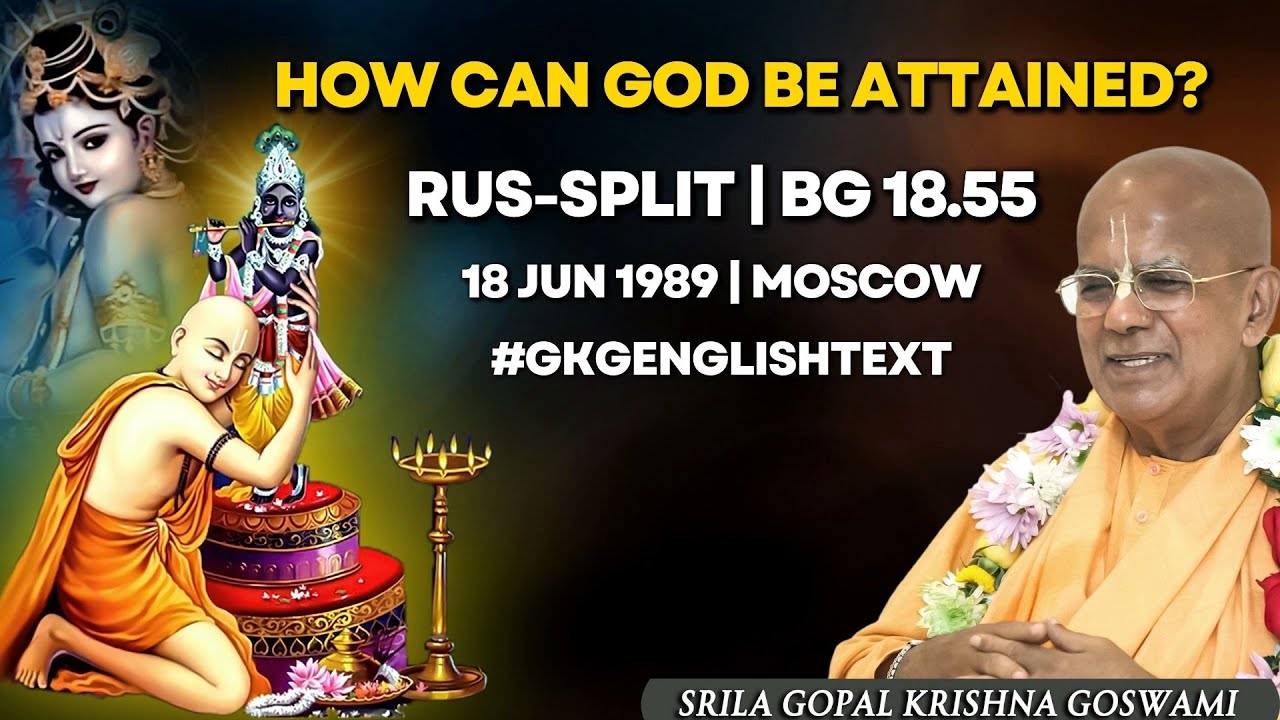
In this 1989 Moscow lecture, Gopal Krishna Goswami (Speaker A) expounds on the 18th chapter of the Bhagavad‑Gītā, emphasizing that the essence of the scripture is the two‑fold message: ‘You are not the body’ and ‘Surrender to Krishna.’ He explains that true knowledge of God is a public secret granted only to devotees, not to the rich, learned, or beautiful. The talk weaves doctrinal exposition with modern analogies—science, warfare, insurance—to illustrate that the Vedic teachings already anticipate contemporary discoveries. Central to the path is devotional service (bhakti), defined as the science of directing the senses to the Lord, distinct from material lust. Goswami outlines the regulative principles (abstinence from illicit sex, gambling, meat, intoxication) and stresses the importance of high‑quality japa (chanting 16 rounds daily), giving detailed guidance on timing, speed, and the spiritual ‘medicine’ of chanting. He uses stories from the Mahābhārata, the concept of Vaikuṇṭha as a spiritual ‘airline,’ and the metaphor of insurance for the soul. The session includes a Q&A where audience members ask about fasting during a pandemic, the difference between yogamaya and mahamaya, and practical aspects of chanting, to which Goswami replies with concise, devotional answers. The lecture concludes with logistical announcements for future programs and a final encouragement to maintain disciplined, heartfelt bhakti.
Questions this video answers
No, Prabhupada never encouraged compulsory fasting; it is optional for those who wish.
Yogamaya bewilders you and is Krishna’s energy that hides His identity; Mahamaya is the material energy, also Krishna’s energy but manifests as material illusion.
Yes, chanting can be done anywhere, but maintain quality; treat it like any other activity—don’t eat or sleep in the metro while chanting.
Sixteen rounds act like a medicinal dose that kills Maya’s germs for the remaining 22 hours of the day; less than 16 is considered insufficient.
Aim for the speed of a Russian goods train (7‑9 minutes per mala); faster (bullet‑train) speed leads to missed beads and lower quality.
Chapters
So we're going to discuss a very famous verse from the 18th chapter of the Bhagavad Gītā. You can repeat after me. Bhakti, bhakti, ma'am, ma'am, abhijñāti, abhijñāti, yāvāma, yāvāma, yā, yā, chaśmi, chaśmi, tattvataḥ, tattvataḥ, tato, tato, ma'am, ma'am, Viśāte tad-anantara. Viśāte tad-anantara. So sweet, isn't it? Even if you don't understand one word, just by hearing this Sanskrit which is chanted by God, you will benefit. Do you have a Russian Gītā here handy? This is printed in India, I think. We printed this Gītā in India also. Okay, you can chant after me again, okay? Bhakti-māma vijānāti. Bhakti-māma vijānāti. Yavānya cha Om Jai Nātmīlānḍasya Jai Nām Jai Nāṣalakya Jai Kṣrīr Mīlataññe Nāṭas māy Śrī Gurave Namah. Śrī Caitanya Mano Vastam Stāpitāmīna Bhūtelē. Saimrūpa Kadāmayam Dadāti Svāpādāntikā. Bande ham Śrī Guru Śrī Utaḥ Pāda-kamnam Śrī Gurunvaishnāmanāśtā. Śrī Rūpaṁ Sagrajatam Sahagana Raghunāthaṇvidham tam jayvam. Sadhvaitam sabadhūtam parijñāsāitam Kṛṣṇa-cetanya-devaḥ śrī-rādhā-kriṣṇapadānta-hākina-lalitaśrī-viśākhānitaṁ sthak— Jai Śrī Kṛṣṇa-Cetanya-Prabhu-Nityananda-Shrī Advaita-Gaddādha-Siva Śarī-gaura-Bhaktavinodaḥ! Hare Krishna!
Hare Krishna!
Hare Rāma! Hare Rāma! Bhaktiyāmām abhijñātiya vānyacāsvitāpataḥ. Tat tvam tat vata jñātva bishātita anantalam. So the, in the 18th chapter of the Bhagavad-gītā, Kṛṣṇa summarizes the whole philosophy again. Actually, Kṛṣṇa could have said the whole philosophy in 2 verses. In one verse He could have said, "You're not this body," and in the other verse He could have said, "Surrender to Me." But these 2 points Kṛṣṇa has made again and again from different angles.
Prasad Raaval.
So in this verse, Kṛṣṇa is telling us how we can know Him. You may be a member of the World Academy of Sciences, you may have received few Nobel Prizes, but that doesn't mean you can know God. You may be very rich, richest man of the world, that doesn't mean you can know God. You may be very beautiful, handsome, still that doesn't give you the license to know God. So how do you get the license to know God? That is a secret, but it's a public secret. After all, Kṛṣṇa tells Arjuna, "I'm imparting this most confidential knowledge to you." So most confidential knowledge means secret, isn't it? But Kṛṣṇa gives it to Arjuna because Arjuna is his friend and devotee. Therefore Kṛṣṇa says, "You can understand the transcendental secrets of this great science." Why did Kṛṣṇa give this philosophy to Arjuna? Arjuna was not a sannyāsi, he was not a brahmachari, he was a grihastha like most of you are. But he had one qualification, he was a devotee of the Lord. And therefore he was selected to give, to receive this knowledge. Different people have different concepts of God. Some say nature is another form of God. Some say that, "Yes, yes, there is one Supreme Boss, but He has no form." Some say, "Yes, yes, there is some Supreme Power, but we can never know that power. And some say, yes, there is a Supreme Power who has a form and we can know Him, but by devotional service. So Kṛṣṇa is saying that He can be understood in His position as the Supreme Lord only by devotional service. So what is devotional service? Devotional service is the science by which you engage the senses in service to the Lord. So this is a whole science. Not that it requires no study. The Vedas are so vast that even if you were to read these books day and night, till by the end of this life you will hardly read a fraction. So actually this is very scientific. For example, whatever is being discovered by modern science today has already been established in the Vedas. For example, scientists have just discovered that there is life in the body, there is soul in the body. But this was predicted in the— this was explained in the Bhagavad-gītā thousands of years ago. America and Russia, after spending billions of dollars, they have come to realize that there's life on other planets. But this was already pre-told in the shastras thousands of years ago. So everything that we're discovering is already discovered. There's nothing to discover. We only have to follow. So, Krishna— the technique by which you can know God is known as the technique of devotional service. So devotional service is the science by which we don't let the senses wander everywhere, but we bring the senses in the right direction. This is much more difficult than learning, than getting few scientific or some degrees. There are thousands of people who are graduating from universities every year, but how many are graduating from the university of mind control? How many are graduating from the university of controlling senses? Very few. So this science is more difficult than the so-called science that we are attached to. Devotional service means that with love we serve the Lord. Just like the mother brings up a child. These days, of course, the mothers are so cruel that they don't mind killing their children in the form of abortion. But generally, like the mother serves the child with love, so one should serve the Lord with love. We have to serve somebody or the other. Just like within wood there is the propensity of fire, so within everyone there is the desire to love. In the material world, what is accepted as love is actually lust. Love and lust are not the same. Caitanya-caritāmṛta explains that just like gold and iron— gold and iron are both metal, but there's a difference of, there's a difference of day and night between the two metals. So there's a big difference between so what is known as love and lust. Love has to be one-sided. It is not a business transaction. It is not a transaction like you go into a shop. You go into a shop and you pay a certain amount, and in exchange you walk out with a product. And when you do a job, you offer 40 hours or 35 hours of service a week, and in return you expect a certain salary. Love means where you are ready to do anything for the other person without expecting anything in return. So thou, the devotee, does not expect anything in return. The Lord is so kind that He does not forget His devotee. Kṛṣṇa tells Arjuna, "Please declare to the world that My devotee will never perish." Before the Battle of Kurukṣetra started, Kṛṣṇa had promised the two sides, that he would not, that he would not enter the battle on either side. Because as you know, the Battle of Kurukshetra was a battle fought between two families. You know the story, everyone? Anyway, I'll just explain in brief again. So the Pandu, who was the king of the whole planet, he died at a young age. So his children who should have become the king, one of Yudhishthira Maharaj, for example, they were all very young. So the elder brother of Pandu, his name was Dhritarashtra. He was blind by birth and he was also spiritually blind. He was a caretaker of the empire. He was going to take care of the empire. But Dhritarashtra had children and the eldest was Duryodhana. So Duryodhana and— yeah, not now. Duryodhana and Dhritarashtra, when the Pandavas were grown up, when the time came for the kingdom to go back to them, they said, "No, no, no, we can't give your land back to you." The Pandavas were so renounced and detached, they said, "Okay, you don't want to give the whole kingdom, fine. Just give us enough, just give us 5 villages, one for each brother." Imagine if someone's a ruler of the Imagine if someone's the ruler of the whole country and someone says, "Oh, just give me 5 small villages." But Dhritarashtra and his son Duryodhana said, "No, we won't even give you enough land to put a needle." Kṛṣṇa personally came and told the Pandavas and told the Kauravas, "Please give the land back. Don't fight." But when they refused, There was no alternative. Sometimes people say, "What type of religion do you follow? Is killing in your religion? I thought God advocated peace, but your God is killing." So we tell these people, when the Lord kills, those who get killed, they get liberated. But when you kill, you go to hell and they go to hell. When the doctor performs an operation, the police doesn't come and arrest him. But when the mafia kills you, then you get arrested by the police. Is it not? Same rule in your country also. So when Kṛṣṇa kills, they all get liberated. All those who saw Kṛṣṇa before dying, they were all liberated. So in the battle of Kurukṣetra, most of the big generals were on the side of Dhṛtarāṣṭra and Duryodhana. There were two opposing sides. One was the Pāṇḍvas, one was the Kaurvas. So the Kauravas were asked, "Okay, what do you want?" They said, "We want the latest missiles and the best generals." So all the latest technological weapons were on the side of the Kauravas. It's like America and Russia on one side, on one side. And what did the Pandavas have? They had Krishna on their side. So when the battle was going on, Duryodhan, he went up to Bhishma Dev. Bhismadeva was the biggest general of that time. He said, "Why hasn't Arjuna died so far? You are being biased towards Arjuna. You are trying to protect him. By now Arjuna should have died." So Bhismadeva felt very offended. He said— Bhismadeva actually was a great devotee of Lord Kṛṣṇa. He was fighting on the other side for diplomatic reasons. A devotee's desire is always to make his Lord more famous. So Bismadeva said, "Either Kṛṣṇa will have to break His promise that He will not take up arms in this battle, or Arjuna is going to die." So Bismadeva fought very bravely, valiantly. Actually, there should be little gap between men and women. They shouldn't sit right next to each other. So actually, on the previous night, Bismadeva had prepared 4 arrows and he had made them sharp. So that next morning he would shoot them. But Arjuna knew that Bhishma Deva has made these arrows sharp to shoot at him. So Arjuna stole them in the night. So Bhishma Deva knew that this was Arjuna's trick. These days when we fight, we attack each other in the night. Our atom, our nuclear bombs, our planes fly in the night when people are sleeping. And they kill everyone, guilty or innocent, innocent or guilty. But in the Vedic days, they would fight between 9 to 5, and in the morning and the evening they would eat together. In the morning and evening they would eat together. They would eat in the morning and then again in the night, and in the daytime they would go and fight. And if the other side did not have a gun and was not ready, then they would not fight. These days our strategy is just to hit from the back, and the king would be right in the front of the battle fighting. These days the kings are heavily protected behind strong forts and the poor soldiers go to die. So Bismadeva knew that now he has to defend his honor because he was a Kshatriya and Duryodhana was telling him, "You are not fighting like a Kshatriya." Okay. So then when Krishna saw that now Arjuna was going to die because this one, they were shooting very angrily. Then Kṛṣṇa ran from His chariot. Yes, Kṛṣṇa ran down with the chariot and He threw the, and He released the Sudarśana-cakra and even broke His promise that He will not, that He will not take up arms in this battle in order to protect His devotee Arjuna. So the point is that one who takes shelter of Arjuna, Kṛṣṇa, will be protected by Him. So when we tell our devotees, please chant 16 rounds minimum. Abstain from illicit sex, abstain from gambling, abstain from meat, abstain from intoxication. These are not easy principles to avoid. We are telling them this because by the— because by following, by taking this medicine, they'll get purified. And by this purification, they'll be able to experience a higher level of happiness. Initially, I have experienced when somebody meets a devotee and he's told what are four regulatory principles, that they say, oh, Impossible. Not for me. Don't waste my time. Then when they begin to chant, it becomes so easy to follow the rules. Whenever you have a severe disease, the cure is always a little bitter. In Ayurvedic science, the theory is the more, the more serious the disease, the more bitter the medicine. When you have to go through an operation, there is pain in the beginning, but in the end it becomes joyful. You agree to undergo the pain of an operation because you know that by going through this pain, in the end you will become healthy for sense enjoyment. So similarly, by practicing austerity for a higher cause, there is going to be gain in the end. In the material world, when you do a small favor to someone, the person reciprocates with you. He may reciprocate or he may not reciprocate. But when you make some sacrifices for God, there is definitely reciprocation. So devotional service means you acknowledge that these senses don't belong to you, but they belong to Kṛṣṇa. These eyes don't belong to you, they don't belong to Mr. Maya, but they belong to Kṛṣṇa. The ears, the tongue, the nose, the genitals, all these don't belong to you, they belong to Kṛṣṇa. So since they belong to Kṛṣṇa, they have to be used in His service. Our process is a very jai— it's a very joyful process. Kṛṣṇa consciousness is not a dry process. Like in, of course, in Moscow you don't have a temple, but in all our other cities where we have temples, our devotees begin to dance at 4:30 in the morning. They sing and dance. But the karmis don't sing and dance till they get drunk from vodka. They don't dance till they have a lot of music playing and late in the night when it is very dark and romantic, then they feel like dancing. I challenge a karmi who will dance at 4:30 in the morning. But our devotees start dancing at 4:30 in the morning. The materialists cannot understand how you can live without illicit sex, intoxication, gambling, and meat. They think that anybody who's living without these things is crazy, and we think that anybody who's living with these things is sumacese. So the point is that we abstain from these illicit activities because these are the desires of the Lord. So by engaging in devotional service, you become aware of God and your position. A child, when he's young, he may walk naked, but when a child grows older, he understands that to walk naked is not his job. So similarly, when one is unaware of spiritual life, one thinks that sense enjoyment is normal. But when you become aware of spiritual consciousness, then you understand that sense gratification is not for me. But what do you do when you're living in a society where in all four directions is only sense enjoyment? Even if you go to India, Vrindavan, you see so much of Maya. You have cinema halls there, you have cigarette shops there, you have everything there. So you insure yourself against Maya by buying the policy of devotional service. And that is the policy that we sell. In Russia, do they sell insurance policies? They sell body insurance. So we are also, we are also selling insurance, but we are selling insurance of the soul. So we have to tell all the people, you have insurance for your body, Now please buy a policy for your dūsa. And of course, any insurance you buy, you have to pay the premium. And the premium is standing Hare Kṛṣṇa, following regulative principles, associating with devotees, reading Prabhupāda's books, and doing book distribution. Hare Kṛṣṇa. Hare Kṛṣṇa. Okay, so all of you are ready to pay the premium? And then, and then you can sit on the plane that will take you to Vaikuntha. I was told that if you want to get a seat on an aeroplane, you have to book 6 months ahead. Now on his, on this Vaikuntha float, there are plenty of seats. Vaikuntha float. Air float. I said Vaikuntha float. On his Vaikuntha float, they have many seats, but they need some good passengers. Okay, Hare Krishna. So I'll just take questions for 10 more minutes, that's all.
You were speaking about, uh, special Special sheet. Is it, is it reality?
Well, the plane came to take Dhruva Maharaj. Samorva prasad. Anyway, the plane may come for you also. So anyway, become Dhruva Maharaj.
Is it compulsory to follow, uh, 100% fasting during Pandemic?
No, Prabhupada really, really, when he was on the planet, he never encouraged us to do that. But if somebody wants to do it, he can do it, but it's not compulsory. Okay, what you say? These questions are so complicated, it doesn't matter what answer I give you, you will never be in that platform. So why worry about these questions? Anyway, anyway you want to associate with Krishna, you can, no problem. Krishna will accept it.
What is the difference between influences of Yogamaya and Mahamaya?
One bewilders you and the other is Krishna's energy. So now all of you should read the Bhagavad-gītā. We have the Bhagavad-gītā in rooski. So all of you have copies of Bhagavad-gītā? Yoga-māyā is Kṛṣṇa's energy. Yes, but yoga-māyā is when Kṛṣṇa appears and He wants to hide His identity. But yoga-māyā is spiritual. Actually everything is Kṛṣṇa. Even the spiritual energy is Kṛṣṇa. The material energy is Kṛṣṇa.
When Krishna came here with his main associate, principal associates, they would be somebody who remains there. I mean Krishna, some Krishna who remains there.
Where?
In Vaikuntha.
So when Krishna comes, when he came on this planet, he came in his original form. Wherever Krishna goes, that becomes Vaikuntha.
So he didn't remain in the spiritual world?
So when Krishna was on this planet, that was Vaikuntha. This becomes the spiritual world when he descends over here.
And there was no other? Goloka Vrindavan?
Where Goloka Vrindavan goes on, Kṛṣṇa is capable of expanding himself into unlimited forms.
But he never left Goloka Vrindavan.
No, but when Kṛṣṇa comes on this earth planet to display his pastimes—
He means to go back centuries back, you know, and be born in some—
Iron Age.
Iron Age or whatever.
If the living entity engages in sinful activities today and he dies, then he has to take on another body based on his karma. Death comes suddenly.
Yes.
And there are some prophets who can foresee the death.
How can they?
How they are able to see the forthcoming death?
I cannot say how they are able to foresee. The one who is engaged in serving the Lord, He has no reason to worry. Even if death comes, he'll just go on serving the Lord.
Self-realization is a gradual process, and I want to ask if it is possible to self-realize for one person without self-realization of all other persons.
To get self-realized?
Of course, just like when you eat food, food goes into your stomach, not into the stomach of all your relatives. Self-realization is highly individual.
But you see, various people try to contact me, and every time I'm beaten from the road, you see. And of course, it is very difficult to realize, to self-realize. This is The one part.
Okay, one second.
And another part depends on—
Let me answer this question. Let me explain what Self-realization means. Self-realization means to understand you are not this body. Self-realization means to understand that you are servant of God. Self-realization means to understand that you must serve the Lord.
Should I try to teach somebody? To do it?
Well, when you're convinced about something, you try to give it to everyone. Like the Russian government is convinced about Leninism, so they try to give Lenin's philosophy to everyone they meet.
And do I depend— am I dependent on other person when I teach him?
Well, of course, the degree to which he will accept depends upon him. Like, you— I can tell you something, but if you don't want to accept it —then better not to take. No, but you can do your duty. You do your duty to Kṛṣṇa by preaching. Rest is not in your hand. Kṛṣṇa says, "Do your duty, result is not in your hand." I'm just taking one last question. I want to thank all of you for participating in these discourses. Of course, if I had my way, I would probably stay here 365 days and lecture to all of you. But since Prabhupāda has also given me some other service of looking after the big temples of Vrindavan and Bombay and Delhi, I also have to go back. And I don't think the Russian government will give me visa to stay here 365 days. So we have to make the best use of a bad bargain. So I'm going to be back in Moscow on Friday, and on Friday we'll have a program at, uh, Vidura's temple starting at 12:30. And the program can go on till 6 o'clock, no more than 6. And then, if Kṛṣṇa desires, I'll see you again after few months, maybe November, December. Chant your rounds. I see in this audience there are many people who are chanting 16 rounds. But our goal is not just to chant 16 rounds, but it is to chant 16 good quality rounds. I'll tell you a story. Once an Indian had come back from abroad and his father told him, "Son, you must chant 16 rounds every day." So next day the father asked him, "Have you chanted your rounds?" He said, "Yes, I finished my rounds." Father said, "So fast? How did you chant?" He said, "I took, I took the beads. On the first bead I chanted the whole Hare Krishna, Hare Krishna, Krishna Krishna, Hare Hare, Hare Rāma, Hare Rāma, Rāma Rāma, Hare Hare." And on the other beat, I just said, "Ditto, ditto, ditto, ditto, ditto, ditto, ditto, ditto, ditto, ditto." So I finished my round. We don't want— in Japan, they have a train called the Bullet. So we don't want you to chant at the speed of the Bullet. It is better to chant at the speed of the goods train that goes in Russia. If you chant, if you chant at the speed of the goods train, then you'll be able to hear everything you chant. Normally, it should take you 7 to 9 minutes to do one mala. If you're chanting in less than 7 minutes, that means you're miss— instead of chanting 108 times, you're probably chanting 100 times or 95 times. If you're chanting in less than 7 minutes, that means instead of chanting 108 times on the mala, you're probably chanting less. You're skipping on beads. Sometimes people say, why 16 rounds? Why not 4, 8, 10? What is auspicious about 16? Just like when you are sick, you go to the doctor. The doctor gives you medicine. The doctor tells you, take the medicine 4 times a day, once every 6 hours, and you'll become okay. Isn't it? Because then that medicine dose is enough to kill the germs for the next 6 hours. So if you chant for 2 hours in a day, then you can kill the germs of Maya for the next 22 hours. And if you don't chant for 2 hours a day, to kill the germs of Maya will be very difficult. So you must— even I, when I do my japa, I also keep a watch on the time to make sure that I am spending enough time on each mala. You have to improve the quality of your chanting. Just like if somebody gives you prasadam that is burnt, then you don't feel like eating. So don't burn your chanting. Any question just on chanting, not anything else, just on chanting your rounds?
I've heard that Prabhupada said that 5 goes a little fast.
Anyway, the point is they must hear carefully. No, if you're hearing, Krishna had 108 gopis. Even the Christian rosaries are 108, I was told. And the Muslim rosaries are also 108. Ah, so, and those who are not chanting 16 rounds should try to chant 16 rounds. You also, and Doc. And those are not chanting at all, they must start chanting at least 1 or 2 or 4 rounds. You chant at all? You chant? How many rounds? 3. So increase it to 4 or 5.
What moment can we increase the number of, uh, above the 16 number of rounds?
If you can do more than 16 rounds, that is not a sin. But if you do less than 16 rounds, it's a sin.
Uh, can we chant in the public transport?
Yes, you can. You should chant all the time, 24 hours. But you're sick, but, but you're sick, but you have 16 rounds that you count. You should try and do high quality at home. Just like you don't eat your lunch in the metro, you don't fall asleep in the metro.
So usually they say that we are sleeping in the metro. Sleep?
Yes, we sleep in metro. Okay. Oh, sorry. So everybody knows where Friday the program is? Pedura's house. Okay, so thank you very much, and I'll stop now. Hare Krishna.
More from PRASAD

Rare Pastimes & Timeless Lessons of Guru Mahārāja | Stories Every Disciple Should Hear

ISKCON Legends- pure devotees meet-HH Jayapataka Swami, HH Gopal Krishna Goswami, HH Radhanath Swami



Jagannātha Ratha-yātrā Through Śrīla Prabhupāda's Mercy | 29 April 2006 | Nairobi, Kenya

Lord Jagannātha's Appearance Pastime | 21.07.2019 | ISKCON Calgary | Śrīla Gopāla Kṛṣṇa Gosvāmī

The Ācārya Teaches by His Own ExampleGuṇḍicā Mārjana by Guru Mahārāja #shorts

Guṇḍicā Mārjana – Lord Jagannātha's Pastime | 21.7.2019 | ISKCON Calgary |Śrīla Gopāla Kṛṣṇa Gosvāmī

H.H. Gopāla Kṛṣṇa Gosvāmī Mahārāja - Exemplary Sādhana and Deity Worship # shorts

भगवान की कृपा कैसे प्राप्त होगी ? | 11 Jan 2014 | Punjabi Bagh | Srila Gopal Krishna Goswami

Material Education vs Spiritual Education | Srila Gopal Krishna Goswami #shorts