How to always remember the Lord? | SB 7.5.23 | Rus-Split | 19 May 1990 | Srila Gopal Krishna Goswami
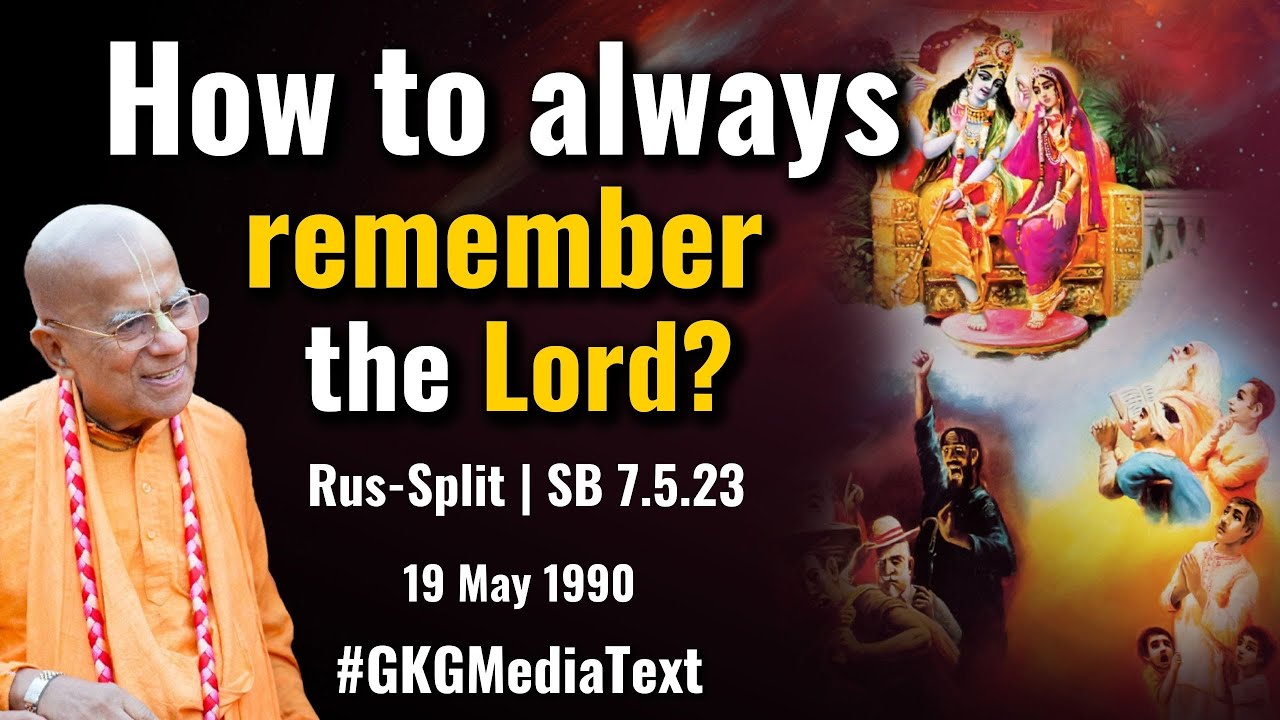
In this hour‑long lecture Srila Gopal Krishna Goswami addresses a group of devotees in Riga, outlining the practical path to ever‑remembering the Lord. He begins by describing the nine progressive processes of devotional service (śravaṇa‑kīrtana, smaraṇa, etc.) as presented in the Śrīmad‑Bhāgavatam, emphasizing that attentive chanting of the Hare Kṛṣṇa maha‑mantra is the foundation of all advancement. Goswami explains the ten offenses that corrupt chanting and urges practitioners to chant slowly, clearly, and with devotion, likening proper chanting to a well‑cooked prasad. He illustrates these principles with scriptural stories – Prahlāda’s steadfastness, Bhrigu’s test of the demigods, the gopis’ self‑sacrifice, and the healing of Vāsudeva Vipra – to show how sincere devotion purifies the mind and leads to humility. The lecture then shifts to the importance of preaching (prasaraṇa) and book distribution as the most effective means of spreading Kṛṣṇa consciousness. Goswami recounts Srila Prabhupāda’s early efforts in the West, the necessity of enthusiasm, the utility principle (using all resources for the Lord), and practical tips for attracting listeners. He recounts historical anecdotes about Prabhupāda’s meetings with Bhaktisiddhānta Sarasvatī, his role in India’s independence movement, and his relentless translation work despite illness. The speaker also clarifies doctrinal points: the distinction between Kṛṣṇa and Viṣṇu, the hierarchy of impersonalist, demigod, and Bhagavān realization, and the role of dasyam, sakhyam, and other service attitudes. Throughout, Goswami answers audience questions about proper bowing, the meaning of Kṛṣṇa versus Viṣṇu, the relevance of preaching to the faithless, and how to view material wealth given by the Lord. He stresses that devotion must be self‑less, that one should not force others but can try, and that wealth should be used for Krishna’s service. The talk concludes with a call for unity among devotees, a reminder of the fleeting nature of life, and encouragement to chant, read, and distribute the Lord’s books to bring lasting happiness. Key take‑aways: (1) Master the nine stages of devotional service, starting with attentive chanting; (2) Avoid the ten offenses to keep chanting pure; (3) Use stories to internalize humility and devotion; (4) Preach and distribute books with enthusiasm and the utility principle; (5) Understand doctrinal nuances (Kṛṣṇa vs Viṣṇu, impersonalist vs Bhagavān); (6) Serve self‑lessly, seeing all work as service to the Lord; (7) Contribute to the global expansion of Kṛṣṇa consciousness.
Chapters
Prasad RAVAL.
So I will lecture for about 1 more hour, 1.5. In the Nectar of Devotion class I will also include book distribution. Any questions? After Nectar of Devotion then I will take on questions from all the devotees.
The question is, when devotee bows down, should he simply touch by his forehead the floor and mantra, or while he is chanting, his forehead should be on the floor.
When he bows down and offers obeisances, technically when he bows down and offers obeisances, he should chant the mantra to the spiritual master or to Prabhupāda. I will talk about 9 aspects of devotional service that Prasad Mahājja has mentioned. In the 7th Canto of the Śrīmad-Bhāgavatam. Prahlāda Mahājja, as you know, was the son of Hirāṇya Kāśipū, who was only interested in women and money. Prahlāda, however, had the good fortune of receiving spiritual knowledge when he was in the womb of his mother, and Prahlāda was fully convinced about the supremacy of Kṛṣṇa. One day, Hiranyakashipu said, "Dear son, come and sit on my lap. Tell me, what did you learn in school?" And Prahlad said, "Shravanam, Kirtanam, Vishnu, Smarnam, Bhadra, Sevanam, Arjama, Bandhyam, Drasyam, Sakhyam, Atman Navedam." And as soon as Hiranyakashipu heard this, he threw Prahlad out of his lap. So, there are 9 processes through which we can make spiritual advancement. The beginning is śravaṇaṁ kīrtanam. Śravaṇaṁ kīrtanam means attentive chanting and attentive hearing. In the initial stages, of course, we tell people just chant Hare Kṛṣṇa, but then as they want to advance, we give them the rules and regulations. When Prabhupāda first went to the West, to America in 1966, '65, '66, after struggling for one year, He was finally able to get the Hare Kṛṣṇa āśrama started in New York. And Prabhupāda just told them, "Chant Hare Kṛṣṇa." He didn't give them any rules and regulations. But by the chanting, these devotees had become purified to the point, one day they went to Swāmiji. Those days Prabhupāda was called Swāmī. So they went to Swāmījī and said, "Swāmījī, aren't there some rules and regulations that we have to follow?" And Prabhupada said, "This is the day I was waiting for." So, "Hare Kṛṣṇa" forms the foundation of spiritual life. You may have a very beautiful building, but if the foundation is weak, the building will not last. Therefore, our chanting has to be very attentive, and we should try to avoid the 10 offenses. The 10 offenses are are very important that we avoid them. Not just we every morning recite them, but we must make a conscientious effort to stay away from the offences. You have the offensive stage, the stage where you try to minimize the offences, and the stage where you don't commit any offences. So chanting Hare Krishna, achi, we should gradually perfect our chanting. We just don't want to do 16 rounds But we want to do 16 good rounds. Just like in about 1 hour's time or so, we will break for prasad. So if you get nicely cooked palatable prasad, then you enjoy it. But if somebody gives you fried burnt prasad, then you won't enjoy it. Similarly, this chanting is for the pleasure of Kṛṣṇa. After all, in this chanting, what are we doing? We are appealing to the Supreme Lord. That please, some or the other, I may be engaged in devotional service. Hare is an address to the energy of the Lord. Krishna and Rama are the names of the Lord. So we are appealing to the Lord, please, please, please engage me in devotional service. If the small baby doesn't cry, the mother doesn't give the baby attention. But when the baby cries, the mother comes and lifts the baby. So similarly, when the devotee cries, Krishna, Please engage me, Radharani, please recommend my case. Then Kṛṣṇa engages you in devotional service. So we, when we chant our rounds, we should chant very attentively with full concentration and listening to all the words of the Mahā-mantra. Does anyone know why the Hare Kṛṣṇa mantra is called Mahā-mantra? Why? Why is Hare Kṛṣṇa mantra called the Mahā-mantra? Mahā-mantra means the, yes, the great chant, the principal chant for deliverance. The word mantra means mantra, that which can give peace to your mind. So in the Vedas there are many mantras, but there is one principal mantra, one principal chant for giving you peace of mind, and that is the Hare Kṛṣṇa mantra. The Hare Kṛṣṇa mantra is being chanted since times immemorial, and it is coming directly from— it is imported. Where is it imported from? Just like in your country, they like imported things from America and Europe. So Hare Kṛṣṇa mantra is imported from Vaikuṇṭhaloka. So it is imported from the spiritual planet. So if we chant attentively and try to avoid the offenses, then we will be able to make spiritual advancement. But if we chant so fast that nobody can even hear your mantra, or if you're skipping on mantra, on words in the mantra, then your spiritual advancement will be checked. Therefore, we should chant attentively. The frog also has a tongue. The tongue of the materialist is like the tongue of the frog. The frog is making "kank, kank, kank, kank" noise, and the snake, it hears the noise of the frog. And it says, "Oh, here is a frog," and goes and attacks the frog. So similarly, by our mundane talk, we are just inviting the snake of death. In the Śrīmad-Bhāgavatam, it is said that with the rising and setting of the sun, the duration of life of everyone but one who gives his life to God is being reduced. I will give you a simple example to understand this point. Tomorrow morning when the sun will rise, you must understand that the sun is giving you a notice. Sir, Mr. Sarogi, there is one day less left in your life. So, but we don't realize that. Like when you go to sleep in the night, you never think that now I have one day less left in my life. But one who is using his life for service to God, he is not affected by the rising and setting of the sun. So, Shraavanam Kirtanam should be given maximum importance. If you have done attentive Shraavanam Kirtanam, Then you can also have success in the next aspect of devotional service, which is Vishnu-smārnaṁ, or remembering the Lord. If you talk, let's say, suppose you talk about somebody before you go to sleep, then there's a good chance in the night you'll even remember that person in sleep, isn't it? Or suppose you get a letter from your friend, then after you receive that letter, you begin to remember that friend. So similarly, if you chant attentively your rounds every day, then there's a good chance that you will be able to succeed in the third aspect, Vishnu Smarna. Vishnu Smarna means controlling the mind and using the Om in service to Krishna. Of course, this is not so easy. Bhagavad Gita says, "Chanchalai mana Krishna." Arjuna said, "My dear Lord, it is more easy to control the wind than to control the mind." So how do you control the mind? Krishna has given us A few practical guidelines. Of course, the basis cannot be ignored, which is attentive chanting. For example, but other ways include meditating on the personal form of the Lord. The Lord's form is always transcendental. Just like in the Brahma-samhita it is said, adyam purāṇa puruṣam nau yauṇam ca, that the Lord is the oldest of all, but He still appears ever very youthful. You have never seen a picture of Krishna with white hair or teeth falling or wrinkled cheeks. That famous picture of the Bhagavad Gita cover, Krishna driving Arjuna's chariot. Krishna by material standard was at least 120 years of age on the battle of Kurukshetra, but he still looks like a young boy of 20. So Krishna's body is always transcendental. So meditate on the different transcendental pastimes of the Lord. These pastimes are so wonderful that every time you hear, your faith in Kṛṣṇa will increase. In other religions, they just say one statement, "God is great," but they don't tell you how great God is. If I introduce you to somebody and say, "Here is Mr. Tirtha Rishi, he is a rich man," so you will say, "Kāra śo." But if I tell you, "Here is Mr. Tirtha Rishi, he has about 50 factories all over the world, He is one of the richest men of the world. He has private jets, diamond mines, and golden mines, and oil refineries. You say, "Really?" You get more impressed. So from the Vedic scriptures you understand how great God is, not just that God is great. And to prove the greatness of God, the Bhagavatam describes the innumerable transcendental pastimes that Krishna exhibited on this planet. The pastimes that Kṛṣṇa exhibited on this planet, they are all divya. Divya means transcendental. Sometimes there is a debate amongst the great sages as to why did Kṛṣṇa appear. Some people say Kṛṣṇa appeared to kill the demons. But Kṛṣṇa doesn't have to appear to kill the demons. This whole material nature is working in Kṛṣṇa's direction. Kṛṣṇa can arrange for them to be killed like this. One earthquake. Thousands dead. One big flood, thousands dead. And people are dying of heart attacks and so many diseases every second. So we don't accept the theory that Krishna appears to kill demons. There's another reason why he appears. That is to create Krishna Katha. Krishna Katha means stories about Krishna. Just like the materialists, they love to read about so-called true stories of the romances of movie stars and politicians and sports stars. So the devotees love to read about and hear about the transcendental glories of Kṛṣṇa. In the Bhāgavad-gītā, again and again Kṛṣṇa is describing His glories. Why is He describing His glories again and again? In one verse He could have completed His glories. Because Kṛṣṇa is proving the point that how great He is. He's giving us information on exactly how great He is. So by discussing Krishna-katha, topics about Krishna, one gets purified. And by discussing mundane news, one gets more contaminated. So one aspect of mind control is meditate on these different pastimes of Krishna. All these transcendental pastimes of Krishna are very relishable. Just like if you meditate how Krishna showed the whole universe in his mouth to his mother when he was a young baby. When you go to the doctor and you open your mouth, he sees your mouth for one second and then he says, "Close it, close it." It doesn't matter, doesn't matter how beautiful you may be, your mouth is so dirty that he takes the spoon he puts in your mouth, he throws it away. But when Kṛṣṇa opens his mouth, his mother doesn't say, "Close it," because his mother sees the whole universe. Prasada Raaval. So this is Kṛṣṇa. Once Prabhupāda was greeting the Rādhā-Govinda Deities in the New York temple. I was with him in 1972. And Prabhupāda was greeting the Deities accompanied by the state Govinda Mahādi-puruṣam tamāḥ mahām-bhajāmi. After greeting the Deities, Prabhupāda started his lecture by saying: Govinda Mahādi-puruṣam tamāḥ mahām-bhajāmi. We are not being cheated. We are worshipping the real original God, Govinda. So Kṛṣṇa has just played His superhuman transcendental pastimes. And if you read these pastimes and meditate on these pastimes, then the impure desires in the heart, in the mind, will go away. The nature of the mind is to be very active. The mind cannot be idle for one second. These so-called Yogis who say that close your eyes, they are actually just bluffing you. Mind has to have an engagement, just like a small child. A small child has to have an engagement. If the small child is engaged positively, then it will not destroy your house. When the mother doesn't want the child to create havoc in the house, the mother tells the child, "Sit down and play with these toys or do this work." So similarly, if the mind is engaged in a positive manner, then the mind will not meditate on the traditional areas of meditation. What is the traditional area of meditation of the mind? How can I get more sense enjoyment, sex life? How can I get more money? Why is it that the Śrīmad-Bhāgavatam, which is the topmost scripture on this planet, it talks about sex life? Because this is the greatest enemy to spiritual advancement. When Arjuna asked Krishna, Arjuna said, "How is it that in spite of knowing what is right, what is wrong, one is forced into sinful activities?" Krishna said, "Kāma-eṣe krodha-eṣe rāja-guṇa sumudbhavah." It is lust only, the eternal envy of the living entity, which is always burning like fire and which can never be satisfied. So, there are so many paśchams of Krishna, we can meditate on them. Of course, in your country you don't have the confusion about demigods and Supreme God worship. There is? Or there is confusion of demigod worship and Supreme God? At least in India it is very widespread because in India the people think, "Oh, all demigods and Supreme God are on the same level." Who are the demigods? Demigods are the empowered administrators of the Lord. Just like in your country Mr. Gorbachev has a cabinet, And in America, President Bush has a cabinet, and in India, the Prime Minister has a cabinet, in England, the Prime Minister has a cabinet, Krishna also has a cabinet. How do you think the whole show is running? There is a cabinet, but Krishna's cabinet is not an ordinary cabinet. Nothing that Krishna does is ordinary. He always does superhuman activities. So Krishna has in his cabinet Not one minister or two ministers or 100 ministers. He has 33 million ministers in his cabinet, and these ministers are called demigods. So is there any cabinet— does Mr. Gorbachev have 33 million ministers in his cabinet, or President Bush in America, or in India? So just see how big Krishna's department is. He has 33 million ministers. Once the great sages were having a discussion 'Who is really the Supreme? Is it Krishna? Is it Brahma? Or is it Shiva?' So they decided they were going to test and find out who has the quality of goodness to the greatest degree. So they sent a devotee called Bhrigu Muni to test out these three personalities: Brahma, Shiva, and Krishna. So when Bhrigu Muni first went to Brahma— Brahma is his father— So normally in the Vedic custom, when you go in front of the father or the spiritual master, you must offer respects. Then his wife Parvati said, "Vaidhi, let it go." He said, "Let it go, let it go. He's your brother, don't curse him." So Bhrgumuni, he left Shiva and he went to Lord Narayana. Lord Narayana was being massaged by the Goddess of Fortune Lakshmi Ji. So as soon as Bhrigu arrived there and Lord Narayana was relaxing, so Bhrigu Muni arrived over there and he kept his feet on Lord Narayana's chest. So Lord Narayana said, "How fortunate I am that the feet of a Brahmin have touched my body." So, but the Goddess of Fortune who was massaging Lord Narayana's feet, she was very upset. So there is a saying that ever since that incident took place, the goddess of fortune makes sure that the Brahmins are never very wealthy. Generally it is seen that the devotees of Kṛṣṇa are poor and the devotees of Lord Śiva are rich. Why? Because Kṛṣṇa wants to keep his devotees on their toes. So he will always give them enough just for maintenance, but not enough to buy Mercedes cars and ladas and all that. Whereas Lord Śiva doesn't care. So Rūpa Maunī, he then went back to the great sages and he told them, about his experience with Brahma, Shiva, and Vishnu. And all the great sages had a discussion then, and they all concluded that, that Lord Narayana manifested the quality of goodness to the greatest degree. So their conclusion was Krishna is the Supreme. You understand this story? Did you ever hear this before? So there's one other aspect to this story which I should explain, and that is that Bhrgu committed 3 types of offenses. The first was with Brahmā, that was the offense of the mind. Second was with Lord Śiva, that was the offense of the tongue. He insulted him. Third was action. He kept his feet on Lord Nārāyaṇa's chest. So there are 3 sources of crime or sin that we can commit. Through the mind, through the tongue, and through our actions. So, Kṛṣṇa is the Supreme Personality of Godhead. Those who think that demigods are equal to Kṛṣṇa, they are just in illusion. Prabhupāda gives an example. Sometimes the scorpion lays his eggs in the rice. So when the scorpion lays his eggs in rice, if somebody thinks that the rice is giving birth to the eggs, that is foolishness. So similarly, to think that some benediction is coming from demigods, which is actually coming from the Lord, is correct understanding. So the point is that Kṛṣṇa is the Supreme Personality of Godhead. So we should meditate on the different pastimes of Kṛṣṇa. And when the mind is engaged in meditation on Kṛṣṇa's pastimes, then the mind will not think about māyā. Another aspect of the mind is to meditate on Kṛṣṇa's desire. Just like a submissive child. A submissive child always wants to know, "What is the desire of my mother or father?" And then he does what is the desire of the mother and father. So what is the desire of the Lord? To bring every conditioned soul back to Godhead. Caitanya Mahāprabhu was talking to Haidāsa ṭhākura. He told Haidāsa, "How will all these yāvanas be saved?" These yāvanas have no respect for Brahminical culture and for the cows. Go brahmane hinsakari mahadura-cara. How will these brahmanas be saved? They are engaged in so many sinful activities. And Haridas Thakur said, Prabhu cinta na kariya. My dear Lord, do not worry. Ha rāma, ha rāma bali-kaye nama bahāse. By getting people to take to the chanting of Hare Kṛṣṇa mantra, People will be saved from going to hell. Nama bahase. It means chanting without offenses. So this is a relationship that a devotee has with the Lord. Hridayaśṭhākura was approached by the Lord. How can people be saved? So we devotees have to work to relieve the anxiety of the Lord. Why did Prabhupāda encourage this preaching activity, book distribution, Hare Kṛṣṇa vāya? Because this is to reduce the headache of Kṛṣṇa. Kṛṣṇa is having a headache. And his headache is that so many of his children are trying to enjoy this material world. Just like when the parents are bringing up a child, the parents would tell the child, "Study, study, study." The child says, "No, no, no, no, no." So the parents see the child, but there's nothing they can do. And then they see the child getting ruined into taking drugs and vodka and so many illicit things. Similarly, Kṛṣṇa is unhappy to see the conditioned souls rot in the material world and try to squeeze happiness from a place where there is no happiness. Therefore, Kṛṣṇa has a headache. A devotee is ready to do anything to reduce Kṛṣṇa's headache. Once Kṛṣṇa was having a severe headache, and He told Uddhava, this headache will only be cured If you get the dust from the feet of my devotee. So Uddhava went to the Brahmins. He told the Brahmins, Krishna is having a severe headache. Can you please give the dust from your feet? Because he wants to touch that on his forehead. The Brahmin said, "No! If the dust of my feet touches the Lord's forehead, I will have to go to hell." Then Uddhava went to the yogis. These yogis were doing yogic exercises for a long time. Uddhava said, "Kṛṣṇa has a glovnaia bowl, and can you give the dust from your feet?" The yogi said, "We can't do that, sorry. Because if the dust from our feet will touch Kṛṣṇa's forehead, then we will all have to go to hell. All our yogic siddhis that we are trying to achieve, we will not be able to get." Then Kṛṣṇa went, then Uddhava went to the jñānis.
He told them the same, "Kṛṣṇa has a glovnaia bowl. Can you give the dust from your feet?" They also said, "No, sorry.
Because there's a Vedic injunction, if the dust from our feet touches the Lord, then we'll have to go to hell." Then finally, Uddhava went to the gopis. And when the gopis heard that Kṛṣṇa had a glovnaia bow, they became in anxiety. And the gopi said, "What can we do to reduce Kṛṣṇa's glovnaia bow?" So Uddhava said, "Give the dust from your feet." The gopi said, "Sure, take it, take it." Uddhava said, "But aren't you worried that if the dust from your feet touches the forehead of the Lord, then you may have to go to hell?" And the gopi said, "No, as long as Kṛṣṇa's headache is cured, we are happy even if we have to go to hell." So the Lord has glovnaia ball. And that is because we are defying His instructions. So we as devotees have to play the role of the gopīs. Just like the gopīs, they gave the dust from their feet, the devotees have to give their life to the aspects of preaching, book distribution, Hare Kṛṣṇa, so that Kṛṣṇa's headache can be reduced. So Caitanya Mahāprabhu's movement is essentially a preaching movement. It is a movement where we not only do work for our own liberation, but also the liberation of others. Therefore, like I told you last night, Caitanya Mahāprabhu had instructed all of his followers, "Jāre dakho, tāye kahho, Kṛṣṇa abdeś." Whoever you see, please tell him about Kṛṣṇa. Of course, if you just tell people on the street about Kṛṣṇa, they will hear it for one minute and next minute they will forget. But if you give them a book about Kṛṣṇa, His teachings, that will stay with them permanently. And in your country, if somebody pays lakṣmi to buy a book, he's not going to throw that book away. Fortunately, the civilization of your country hasn't fallen to the level of civilization has become degraded in the Western countries. So when they buy a book, they definitely read it also. They may not agree with it, but at least they'll open it. Anyone who even touches these books or opens it, he gets a chance of getting a human birth again. Caitanya Mahāprabhu used to take His sankīrtan devotees and do harināma, traveling from village to village, town to town. Caitanya Mahāprabhu went to southern India. People from a great distance would come to see Him do harināma. And just by seeing Him do harināma, they would also be inspired to do harināma. And when those people would run back to their villages, other people by seeing them, just by seeing them, also begin to chant and dance Hare Kṛṣṇa. Of course, you and I are not so powerful. When we go on Hare Kṛṣṇa, many people come and see us, but not that they all just by seeing us they start chanting. But when you go on Hare Kṛṣṇa, everybody benefits. The devotees who are chanting Hare Kṛṣṇa, they benefit. The people who are listening to the Hare Kṛṣṇa, they benefit. The trees and the plants and so many invisible entities who are living They micro, they all benefit. Even those people who say, "Look at those crazy Hare Krishna people," they benefit. This is the potency of Hare Krishna. I will tell you a story on this point. Once in 1972, one big producer in India had made a movie called Hare Rama Hare Krishna. This movie showed that people take drugs, and the same time chant Hare Rama, Hare Krishna. And this movie was made just 2 years after Prabhupāda went to India with his Western disciples. So I went to Prabhupāda and I said, Prabhupāda, this movie is going to give people a wrong impression of the Hare Krishna movement because the movie is showing that those who turn Hare Krishna, they take drugs. But Prabhupāda said, no, nothing is lost. They will hear holy names. Hare Kṛṣṇa, they will benefit.
So the holy name is so powerful. Knowingly or unknowingly, anybody who chants, he gets benefit. Then in the Caitanya-caritāmṛta, there's a story of a devotee called Vāsudeva Vipra. This devotee was suffering from leprosy. So, but he was a great devotee of Caitanya Mahāprabhu. So Caitanya Mahāprabhu embraced him one day, and by embracing him, all the disease from Vāsudeva Vipra's body went away. And this Vāsudeva Vipra became a very handsome, beautiful young man. And before that, he was a diseased man. So Vāsudeva Vipra said, "Now I become so handsome." "I am afraid that I may become very proud." So he told Caitanya Mahāprabhu: "What should I do? Because I don't want to become proud." Caitanya Mahāprabhu said: "Chant Hare Kṛṣṇa and preach the glories of Hare Kṛṣṇa. In this way you will always remain humble and you will not become proud." So chanting Hare Kṛṣṇa makes one feel humble and it keeps us away from becoming proud. There was another devotee of Caitanya Mahāprabhu. His name was Vasudeva Datta. Vasudeva went to the Lord and said, "My dear Lord, I want to ask your favor. First promise me when you are going to grant my favor." Caitanya Mahāprabhu said, "What favor do you want?" Generally people go to the church and what do they pray? "God, give us our daily bread. God, give me money. Give me nice family. Give me nice position." So we are always going to God and giving him our shopping list. But a devotee doesn't ask the Lord for a shopping list. So Vāsudeva datta had asked the Lord, "Please give me one benediction I want to ask you." Caitanya Mahāprabhu said, "What is the benediction?" Vāsudeva datta said, "You may please take everyone else back to Godhead and transfer all the sinful reaction on my account. I will stay here and suffer." As long as it takes. So this is Vaiṣṇava. He is ready to take all the sinful suffering due to everyone as long as the other one can go back to Godhead. A Vaiṣṇava is not a selfish spiritualist. Selfish spiritualist is only worried about his own liberation, but a Vaiṣṇava is worried about everyone's liberation. Therefore they said, "Phara du kadu ki." He, when he sees others in distress, he becomes distressed. There was one devotee king called Maharaj Siddhi. He was a very high-class Vaishnava. One day the demigods wanted to test him. So one of them played the role of an eagle and the other played the role of a pigeon. The pigeon came running to Maharaj Siddhi. The pigeon said, "This eagle is chasing me. The eagle wants to eat me. Please, O king, protect me." "You've come to me for protection. I'll give you." The eagle came to the king and said, "Please return the pigeon. I want the pigeon for eating." The king said, "I cannot return this pigeon to you. Pigeon has come to me for protection and I have to give him protection." So the king said, "Okay, I won't give the pigeon to you, but you can take the flesh from my body." And an arrangement was made that the king would give flesh from his body equal to the weight of the pigeon. But the weight of the pejel by the arrangement of the Lord went on increasing, increasing. But Mahārāja Siddhi did not stop giving his flesh. So in the end, in order to— the demigods were very pleased and they revealed their identity to Mahārāja Siddhi. So I gave this story to show you the mentality of a Vaiṣṇava. When you come in contact with the Hare Kṛṣṇa movement, you are coming in contact with the highest spiritually— spiritual culture movement on this planet. This Vaiṣṇava culture is not ordinary religious culture. This Vaiṣṇava culture is a very special culture. It is therefore the highest form of religion. It is just not religion for your own salvation, but it is religion for your own and for everybody's salvation. Therefore Prabhupāda emphasized this activity of book distribution so much. Prabhupāda produced these books under extreme difficulty. Today you have to— you and I go on book distribution, but it is so easy for us. We just go pick up the ready-made books and go on the streets and distribute it. But when Prabhupada was there in India before he came to the West, he had to write the books, collect money for printing, print the books, and then go out in the hot sun and distribute. So Prabhupada had a vision for this planet. His vision was to fulfill Caitanya Mahāprabhu's instruction. What was Caitanya Mahāprabhu's instruction? Eti viti ācī-jata nagaḍi-gaṁ sarvācāpracāra oivi-mūra-nāma. In every town and village of the world, My holy name, I should be known. So nobody had thought that this prediction would come true, but today the prediction is coming true. Why? Because of The sincere efforts which Prabhupāda made. Just like in your country, when Prabhupāda first came in 1971 to your country, there was not a single soul chanting Hare Kṛṣṇa. But Prabhupāda planted the seed. I remember in 1976 when I first came to your country, there were just few, 2, 3, or 4 people chanting between Moscow and Leningrad. But today, 1990, I think there are thousands of families chanting Hare Kṛṣṇa throughout this country. And this spiritual explosion is just going to expand just like fire. You know, once you set up fire, how fast the flames of the fire expand. Now what you should say that Caitanya Mahāprabhu has predicted that this Kṛṣṇa consciousness will spread to every town and village of the world. So if you help spread it, you will get the credit. But if you don't do it, then somebody else will get the credit. So similarly, Kṛṣṇa consciousness is going to spread to every town and village of this great Jagad-guna in any case. But if you have spread it, then you will get the credit. Otherwise somebody else will get the credit. So why should you let somebody else get the credit? Prabhupāda said you should take the credit. Also Prabhupāda used to stay up. Prabhupāda used to get up at 12 o'clock in the night to— Prabhupāda used to sleep from 8 to 12, then get up in the night at 12 o'clock or 1 o'clock and start translating these books. The philosophy in these books is not ordinary. Kṛṣṇa's philosophy is the highest. Mataḥ paritram nanyat-kimki-daṣī-dharmanteya. Kṛṣṇa says, "There is no truth higher than Me." So one way of viṣṇusvandham is to constantly meditate, "How can we take people out of the cycle of birth and death?" And if you are constantly meditating, "How can I take people out from the cycle of birth and death?" Then Kṛṣṇa who is in the heart will give you the necessary intelligence. Kṛṣṇa in the heart is observing everything, your desires and your efforts. And when Kṛṣṇa sees that you are sincerely serving, trying, then He will reciprocate and give you the necessary intelligence. I remember when in 1977 Prabhupāda was translating 10th Canto, Part 3, he was so sick that he could not even see or hear or hold the book. He had somebody helping him read the book, hold him, helping him sit, hold the microphone, and so on. And Prabhupāda, with the assistance of all these devotees, he did the translation. So it is our responsibility to carry Prabhupāda's message to every individual in this country. Just like people today are very absorbed in the concept of independence in some republics, but real independence is independence from the cycle of birth and death.
Prabhupāda was a member of Mahatma Gandhi's independent movement when he first met Bhaktisiddhanta Saraswati in 1922. Actually, Prabhupada's father was very religious. Many sadhus would come to Prabhupada's house. So one day Prabhupada's friend said, there is one very special sadhu in Calcutta. Come with me, let's go and meet him. Prabhupada said, I'm not interested in meeting sadhus. I meet so many at home every day. So many sadhus come to my house in India. When you go on every street, you'll see many sadhus. Of course, today Kali Yuga is degraded so much that they wear this sadhu uniform just to make money. There are very few real sadhus. So Prabhupada, when he met Bhaktisiddhanta Saraswati, Bhaktisiddhanta Saraswati Thakur was very impressed by Prabhupada's English language. So Bhaktisiddhanta Saraswati told Prabhupada, you are educated young Indian, take Lord Caitanya's mission. To the Western countries. Prabhupāda said, "First we must make this country of ours, India, independent from the Britishers. Unless we make the country of India independent, nobody is going to listen to this." So Prabhupāda said— Prabhupāda was insisting that we should make India independent first. But Bhaktisiddhānta Ji said, "Unless you become free from the cycle of birth and death, where is your independence?" So Bhaktisiddhānta Sarasvati completely defeated Prabhupāda's arguments. Prabhupāda said, "I never used to be defeated, but I was completely defeated by my guru, Maharājānanda, in our first meeting." So people are absorbed with so many different issues. We had to make people aware what is the real issue. And the real issue is to become free from the cycle of birth and death. So this is a very, very good time to preach. It's a good time to preach and tell people what is real independence. What is real happiness? Everyone is frustrated. So one very good opportunity, because frustration brings one to Kṛṣṇa. But in order to be able to preach, we need two things. You need enthusiasm and sincerity. Just like for book distribution, you need enthusiasm. I'll tell you a story about Prabhupāda on this point. Once in Bombay in 1976, I had arranged a big window display of Prabhupāda's books. It was a big store right in the center of the city. You know what a window display— window display is right in the window where they display fashions. So this was a bookstore and we had all Prabhupada books, all from top to bottom. You have the Russian word vitrine. So after 2-3 weeks, I went and saw not many books have moved from that store. So I went to Prabhupada and said, Prabhupada, "We had arranged this big book display with such difficulty, but not too many books have moved." So Prabhupāda said, "Yes, it's a fact. My books are selling because of the enthusiasm of my disciples." Because in a karmī store, the salesmen are all karmīs, and they have no enthusiasm to sell Prabhupāda's books. But the devotees are very enthusiastic. So people get inspired by their enthusiasm and buy these books. Just like when you go on book distribution, I am sure our devotees who go out will testify, when they are enthusiastic, when they approach someone smiling, "Hare Krishna, please take a book," then the other person also responds in a nice way. But if you just go, even if you have a table and you just go and stand there like this, nobody will come.
Isn't it?
But if you have a table, like in India we have tables, and you show the books. "Hare Krishna, please see this book, please see this colour picture, 5,000-year-old art, and this book was first written, spoken 2 million years ago." I said, "Really?" So enthusiasm can inspire people to take more books. So that's another technique. You just meditate how you can improve book distribution or preaching through Hare Kṛṣṇa. So the conditioned souls who are unfortunate can become fortunate. So preaching is important. Our Kṛṣṇa consciousness movement has the following logo. Preaching is the essence. That means of all types of services, preaching is most important. But how do you preach? Books are the basis and purity is the force. By purity we can attract purity. Therefore you may have seen that when you are in good consciousness, when you are doing book distribution, when you are thinking of Kṛṣṇa and Guru's order and Then you have more success. But if you are just standing in front of the table and your mind is thinking, "Now when I go home, what am I going to do? Tomorrow I have to make so much money," then you won't have much success. So mind should be engaged positively and not negatively. This is known as Vishnu Swarnam. Then Padasevanam. Padasevanam means to worship the lotus feet of the Lord. Archanam, worshipping. The Deity of the Lord. Of course, in your Riga centre you don't have Deities as yet, but one day you will have Deities. And these Deities are non-different from the Lord. These Deities are the same as Kṛṣṇa. That faith you develop by practice. Tasyam ācchana-vandhyam. Vandhyam means to offer prayers to the Lord. Repeat the prayers composed by great Vaiṣṇava ācāryas. And thereby the heart will become cleansed. Dasyam, carrying out the orders of the Lord, like Hanuman carried out the orders of Lord Rāma. Sakyaṁ, carrying out the orders of the Lord as a friend, like Arjuna carried out the orders of Kṛṣṇa. Ātmanivedam, giving everything to the Lord, like Bali Mahārāja. You know the story of Bali Mahārāja, how he did? Gave everything to the Lord. Who knows the story? So these are the different process of devotional service. By absorption in these processes, one can make spiritual advancement. We do not have to speculate about the means for Self-realization. Everything has been clearly given to us by the Guru Parampara. We just have to follow the process and make advancement. Just like the patient takes the doctor's medicine according to the doctor's prescription and he gets cured. So Prabhupāda used to say, if you take the medicine according to the doctor's prescription, then you will become healthy, wealthy, and wise. So this is a slogan: healthy, wealthy, wise. So who doesn't want to be healthy? Even if like in your country the hospitals are free, the doctors are free, but the pain is not free. When you go to the hospital, the doctor may not give you a big bill, but he doesn't say, "No, I'll do the operation in such a way that nothing will pain." So you become healthy by eating Krishna prasad and only Krishna prasad. Meat eating is sinful and meat eating causes diseases, cancer and so many other diseases. Then everybody wants to be wealthy. A devotee is also wealthy, but he has spiritual wealth. Today nobody wants the wealth in rupees because the currency is going down in value every day all over the world. But spiritual wealth never goes down. And this is real wealth.
And wise.
Everybody wants to be known as a big intellectual. Everybody likes being acknowledged, "Oh, this Mr. Sarugi is such an intellectual man." So if you really want to be recognized as wise man, just quote Krishna. If you just repeat what Krishna says, then you will become an empowered preacher. And if you are practicing principles of purity, then you will become pure and you will be able to preach the glories of the Lord for everyone's benefit. So there are these different guidelines. We have to meditate on different aspects of devotional service and thereby make spiritual advancement. Hare Krishna. Hare Krishna. So, do you all feel spiritually richer after hearing this talk? You're going to take advantage of that by increasing your preaching effort? Okay. Mahāprasāda. Yes, Kīrānada.
Know all the aspects, all the 9 aspects, refer. Such kind of sadhikārīs as we, or not? Particularly, what is the difference of dāsyam and sākhyam?
Dāsyam and sākhyam.
No, dāsyam and pārṣevanam.
Pārṣevanam means serving the lotus feet of the Lord, like Goddess Lakṣmī is massaging the lotus feet of the Lord. Dāsyam means serving the Lord as a Friend. Sakyaṁ, as carrying out the orders of the Lord is dasyam. Sakyaṁ is serving the Lord as a friend.
But what that means, it's dasyam for us. I cannot massage the lotus feet of the Lord.
Dasyam, we don't massage the lotus feet. Father Sevananda. But you can massage the lotus feet by doing service for the Lord. Father Sevananda is massaging the lotus feet of the Lord.
And dasyam. Dasyam is carrying out the orders of the Lord as a servant.
So that all the book distributors hear about Prabhupāda's different points on book distribution and preaching. I said that. Yes. Enthusiasm, Prabhupāda said.
Why in all Karmic dictionaries it is said that Kṛṣṇa is the incarnation of What is the meaning of Vishnu?
Because this dictionary is compiled by foolish people. You ask these foolish people, "What is the meaning of God?" They do not know. You want to know the difference between Kṛṣṇa and Viṣṇu? The difference is this: When the Lord is performing His pastimes with His devotees, He is in the form of Kṛṣṇa. And when the Lord has to take charge of the creation, Then He takes on the form of Viṣṇu. It is like when you are at home with your family, you wear casual clothes, but when you go to office, you wear suit, tie, and you are more formal. So when Kṛṣṇa goes to office, He becomes Viṣṇu. And when Kṛṣṇa is performing pastimes with His devotees, it is Kṛṣṇa, the reservoir of pleasure.
And often during separation, When people say that such terms as impersonalists and demigods created by Śrīla Prabhupāda, is it true or not? Impersonalists and demigods.
Yes. Impersonalists are there in the Vedas. Brahmaiti paramātmātmati bhāgvaniti śabdyate. The Supreme can be realized in different phases, beginning with Brahman, leading on to Paramātmā, culminating in Bhāgvan. And I'll give you a story. Do you know that story of a new railway station in the village? So once in a village in India, a new railway station was built. The villagers were having a discussion, "What does the train really look like?" Nobody had ever seen the train. So they decided they will send a delegation of 3 people to the station. To see the train. And the delegation would come back and tell the villagers what the train looked like. So the train was coming, and in the front there was the light of the engine. Light was at the front of the engine. So one of the men saw the light. He said, "This is what the train looks like." So he ran back to his village, and he told the villagers, "I saw the train." They said, "What is that?" He said, "There's a light in the front." Then the other person saw the light and the engine of the train. He ran back and he said— this is his version of the train— he said, "There's a light and then there's an engine." So then the third person, he saw the light, he saw the engine, he saw all the compartments, and he saw all the compartments leave the station. So he went back and gave his explanation of what the train looked like. So the three versions, whose version is most complete?
Sri Caitanya Mahāprabhu.
Sri Caitanya Mahāprabhu, third person. So Prabhupāda used to give this example to show Brahman, Paramātmā, and Bhagavān realization. Brahman is compared to the impersonalist, to the just seeing the light in the beginning. Paramātmā to the light and the engine. And Krishna is Bhagwan feature, you understand him completely. You may see a mountain peak from a great distance. You can only see that there is some peak. You get closer and you start climbing up the mountain, you can see more variety. But if you go on top of the peak, you can see all the variety. Well, this morning my throat was so bad and I was doubtful if I will be able to speak even for half an hour. By Kṛṣṇa's grace I've been able to speak the whole day since morning.
If Kṛṣṇa gives to devotee some wealth, how should we consider it? Is it fulfilling of our desires or it is— or Kṛṣṇa tests us?
Prabhupāda said— I'll answer this question with another Prabhupāda story. So Prabhupāda said, suppose there is a 100 rupee 100 ruble note on the road, there are 3 things that you can do. Take the ruble note, 100 ruble note, and put it in your pocket, but then you're a thief. If you let the 100 ruble note lie down on the road, then you're a fool, because if you don't take it, somebody else will take it. But if you pick up the 100 ruble note and find out the owner of the note and give it to the owner, then that is intelligence. So if you have a lot of money, niyat problem. So if your Krishna is giving you a lot of money, niyat problem. Use it for Krishna. You don't have to drink poison from a poison bottle to be convinced that poison can kill. You know from education that poison will kill if you take it. So when Krishna gives you money, don't misuse it. Krishna is giving it to you not to test whether you'll fall in Maya or no. But to make sure that you use it correctly. More questions?
It is said that one of the offenses is to preach—
to the faithless.
Faithless, yeah.
And is there any use of preaching to the people who don't want to listen to you? And can we enforce them to listen?
You can't force them, but you can try.
Sometimes it seems that devotees are hanging on all kinds of of golden ornaments. And, but it is said that in Kali-yuga, that Kali-yuga is living in this gold.
Huh?
Kali-yuga. Kali-yuga is living in gold at this present age. So, is it right that we should better use this money for printing books and spreading Kṛṣṇa consciousness?
Yes. Bhaktisiddhānta Sāsmadhi told Prabhupāda, if you ever have money, print books and distribute books. Use it fast for printing books before the value of money drops further.
Prabhupāda called, said that utility is a principle, and can you explain it a little bit more?
Utility is a principle means that everything should be used properly. Just like you have this tape recorder, so we will not throw the tape recorder saying this is modern technology, we don't want it. Utility is the principle. Use it for Kṛṣṇa. Suppose somebody gives you an Aeroflot jet, we can use it for Kṛṣṇa also. You can fly the book distributors all over the world. Okay.
In our country there is a big interest of all kinds of mysticism.
People are coming from other planets and talking to people sitting on the bench.
And even between devotees sitting here I know some who are reading all kinds of books about these mystical things. So can you give in a nutshell some points which we could use in preaching to convince the people that this is dangerous?
Why? A devotee should not speculate. In the Bhāgavatam and Prabhupāda's lectures, there is no mention of people coming from upper planets, talking to people on the bench, and then flying back again. Even I read this story in India a few months ago about some rush in Russia. Some people have come from other planets and they were talking to some people and then all of a sudden they disappeared. These stories do not help us in any way at all because this is also just some writer's speculation or who knows what. Is there anybody in this room who believes in these stories? Okay, so anyway, Ganada. I'll just give a concluding 2-minute talk now and then break for prasad. And listen, brother, after prasad I'll still be here for 2 hours, 1 hour if somebody has any questions. You can announce that. So I want to thank all the devotees. This was my first visit to your wonderful city of Riga. I've been meeting the Latvian devotees in Moscow and other, in India, but this is the first time I've come to your wonderful beautiful city of Riga. My only request to all of you is to please be very Kṛṣṇa conscious. The Kṛṣṇa conscious principles are clearly discussed in Prabhupāda's books, and all of you work cooperatively. United we stand, divided we fall, Prabhupāda used to say. So we should work in a united manner, always remembering human life is very short. It can die at any moment. So we should use every minute to serve Kṛṣṇa. As I said on the first day when I came to Riga, My observation is that by Kṛṣṇa has somehow or the other trained the Soviet people into principles of austerity. So Kṛṣṇa conscious principles make a lot of sense and all of you are sincere. So chant, read Prabhupāda books, distribute Prabhupāda books, preach, and by this way make yourself happy and make others happy. Brahmapūtra prasannātmānā so'ceti na'kāṁśati. One who is spiritually situated, he does not lament and he does not hanker. I had the great fortune of meeting Śrīla Prabhupāda in Montreal, Canada when I was studying in June 1968.
And having been following Kṛṣṇa conscious principle for 23 years, I am convinced that no other process can give one greater happiness than Kṛṣṇa consciousness. I have seen people in every society, American society, European society, Indian society, your society. Nowhere can people be happy without God because a living entity is spiritual in nature. Material principle is: "Grass is greener on the other side." That is, now I have this, if only tomorrow I get one more thing, then I will become happy. But even if you get the whole world, you will still be unhappy.
And if you become a devotee of Kṛṣṇa, you will be happy. So we should become a real priyādhāni of Kṛṣṇa, and that will give you happiness and joy. Prabhupāda's great desire was that the intelligent people of this country take to Kṛṣṇa consciousness. Now you all are producing so many books, distributing books. This is very wonderful. So I hope that with the lectures I gave for the last 4 days, it was some help in the development of your Kṛṣṇa consciousness. Unfortunately, I picked up, I got exposed to cold the first day when I gave the lecture, I think. So for the last 3 days my voice was affected. But anyway, by Kṛṣṇa's grace, I was able to deliver His message. Right now is a very good time to preach. People are frustrated. They know that in mature life there is no happiness. So show them the path of real happiness. All these shortages that people are Every material thing will be solved once you have Bhoga at the center of life. So this is what your devotees are trying to do. Help put Bhoga in the center of society's life. Hare Krishna.
Hare Krishna.
Baba Krishna Rādhikī.
Jāyā.
Krishna Krishna, hale hale.
Halleloha hale.
Lama lama, hale hale.
Hare Krishna Hare Krishna.
More from PRASAD

Rare Pastimes & Timeless Lessons of Guru Mahārāja | Stories Every Disciple Should Hear

ISKCON Legends- pure devotees meet-HH Jayapataka Swami, HH Gopal Krishna Goswami, HH Radhanath Swami



Jagannātha Ratha-yātrā Through Śrīla Prabhupāda's Mercy | 29 April 2006 | Nairobi, Kenya

Lord Jagannātha's Appearance Pastime | 21.07.2019 | ISKCON Calgary | Śrīla Gopāla Kṛṣṇa Gosvāmī

The Ācārya Teaches by His Own ExampleGuṇḍicā Mārjana by Guru Mahārāja #shorts

Guṇḍicā Mārjana – Lord Jagannātha's Pastime | 21.7.2019 | ISKCON Calgary |Śrīla Gopāla Kṛṣṇa Gosvāmī

H.H. Gopāla Kṛṣṇa Gosvāmī Mahārāja - Exemplary Sādhana and Deity Worship # shorts

भगवान की कृपा कैसे प्राप्त होगी ? | 11 Jan 2014 | Punjabi Bagh | Srila Gopal Krishna Goswami

Material Education vs Spiritual Education | Srila Gopal Krishna Goswami #shorts