How To Get Rid Of Misery Of Life | SB 3.25.20 | Mauritius | 1 Mar 2020 | Srila Gopal Krishna Goswmai
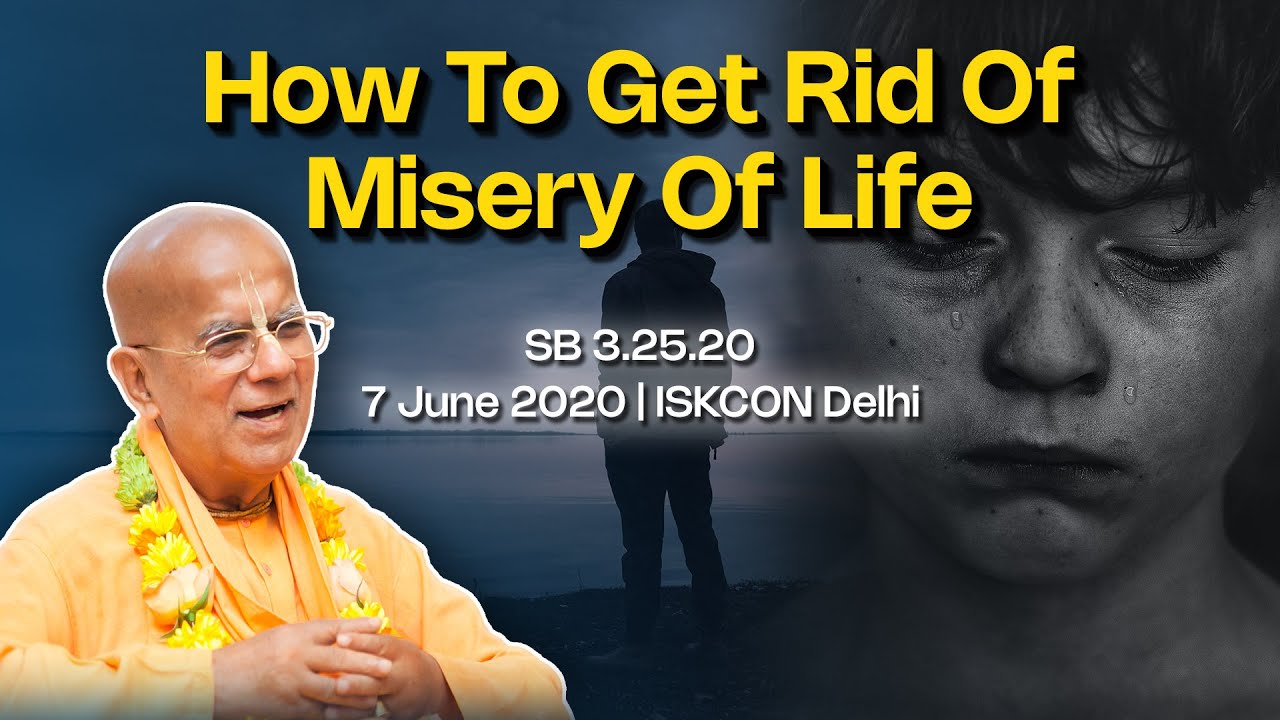
In this lecture, Prasad Raval explains the teachings of the third canto of the Srimad‑Bhagavatam, focusing on the dialogue between Kapila Dev and his mother Devahuti, who asks how to eliminate the miseries of life. Raval contrasts material attachment, which entangles the soul, with devotional attachment, which opens the door to liberation. He emphasizes the role of a genuine spiritual teacher (sadhu) and the importance of associating with sadhus through their "vāni" (instruction) rather than sentimental reverence. The talk weaves scriptural stories—Kapila’s teachings, Arjuna’s request in the Bhagavad‑gītā, the curse of Pariksit‑Rama, the 64,000 sages, and historical examples such as A. C. Bhaktivedanta Swāmī Prabhupāda’s early missionary work, the martyrdom of Haidarshakur, and the perseverance of sadhus in Kali‑yuga. Raval also addresses modern material distractions (media, pets, consumerism) especially in Mauritius, urging listeners to replace negative attachments with positive, devotional ones: chanting the Holy Name, reading scriptures, serving sadhus, and building temples. He outlines practical steps—regular hearing, repetition, following the sadhu’s instructions, and cultivating bhakti as the sole means to transcend suffering—while acknowledging the thankless nature of the sadhu’s work and encouraging perseverance.
Chapters
Prasadam ajnām paśam ātmānā kava-yo vidu seva sadhiṣukṛto muṣuddvānām avṛṣṇa. You can repeat the translation after me. Every learned man knows very well the attachment with the material. Is the greatest entanglement of the spirit soul. But the same attachment, replied to the self-realized devotee, opens the door for liberation. So in this third canto, you read a story of Kapila Dev. Instructing His mother. Kapila Dev is incarnation of the Supreme Lord. There are innumerable incarnations of the Lord. Turn off your cell phones. So Kapila Dev, there are innumerable incarnations of the Lord. As they are all described in the scriptures. So, Kapila Deva's mother's name was Devohuti. His father's name was? Akashyapati. Devohuti knew that her son was the Supreme Lord. Therefore, because where the Lord was, in the womb of his mother, Lord Brahma had told her, "The child in your womb is a creative mood." So, Devahuti, in the earlier verses of this chapter, is inquiring, she is saying, "How can I get rid of the miseries of life?" You are the source of knowledge for me. You are my transcendental eye. Somebody may question and say, why does Devahuti, the mother of the Lord, ask such a foolish question? How can I get rid of the miseries of life? Doesn't she know? The devotees of the Lord ask these questions for our benefit. Just like the Bhagavad-gītā. Arjuna is an eternal companion of the Lord. In the 4th chapter, Kṛṣṇa gives a history of the Bhagavad-gītā. And Arjuna, in the 2nd chapter, said, 'Now I am confused about my duty. Please therefore instruct me.' And then the Lord began to give philosophy of the Bhagavad Gita. So Arjuna was put in that position so that the Bhagavad Gita would be spoken for the benefit of humanity. Similarly, we see Pariksit Rama. When he was in his mother's womb, He was saved by a brahmaswara, released by his personal God. The same king was cursed. Why was he cursed? Being a Rajarishi, he had all the spiritual qualities. He was out hunting and he felt very thirsty. He was searching for water. He saw a hut where some light was emanating and he went inside hoping that at least the host will offer him water. It is said that even if an enemy comes to your house, you should feed him warmly. The best is, as Prabhupada says, feed him with prasad. If you can't feed him with prasad, feed him with water. If you can't feed him with water, at least feed him with sweet words and give him a mat to sit on. Praśyamānāya, didn't get either of this. In fact, the sage did not even look at him, and in anger he walked out. But there he saw a dead snake. He placed the dead snake on the neck of the sage in anger, and when his son Shringi saw what had happened, he got very angry. "Did you have the audacity to place that snake on the neck of my father?" And everything he had. He said, "I curse you." If actually he wanted, he could have counteracted the curse. But he took it as a blessing of the Lord. And hence, a situation was created where the Bhagavatam would be spoken. Within minutes, 64,000 sages assembled. Means they were having a system better than the SMS. It breaks your mind. Within minutes, when he got this notice that he was dying in 7 days, he didn't want to waste a second. He at once invited the sages And being the king, they all came. So in front of 64,000 sages, the Bhāgavatam was spoken. So the Lord's devotees, when we read about the Lord's devotees, we should not think, "Oh, how are they any good?" We should understand and recognize that this situation is being created for philosophy to be spoken for our benefit. So in the earlier verses of this chapter, Devahuti says, "Please guide me. You are my transcendental eye." So Prabhupada explains the spiritual teacher or the master is a transcendental eye in the sense that he transmits to you the knowledge that he has received. Through the disciplic succession. And he doesn't adulterate anything. One of Prabhupāda's many unique features were he didn't compromise on the philosophy, he did not adulterate the philosophy, he did not water down the philosophy, he did not adulterate it to attract huge crowds. Which became the Pure Message. When Prabhupāda landed on the Jaladūta in Boston, his first journey to America, when he saw, he got an exposure to the environment in America. The captain of the ship was one Mr. Pandey. He was a ship doctor in Boston. He took Prabhupāda on a tour of the Seva Yatra. And when Prabhupada saw how deeply people were engrossed in sense enjoyment, he came back and wrote a poem. Prabhupada was also known as Kavi, poet, in Vaisnava circles. And there he said, my dear Lord, you brought me here. Who is going to listen when by your English, by rather than English, he was more anything is possible. So, he had faith in Radhanath Ji's blessings to make anything come true. When Prabhupada was young, his father Gourmandeh used to regularly host sadhus. He did not discriminate. And when these sadhus would be leaving home, His father, Golmondev, would tell him, "Please bless my son that he becomes a great devotee of Rādhārāṇī." So Prabhupāda gave him the real truth, and that's why he called him Bhāgavatī-dāya, editor. So in response to Deva Mahārāja's question, Kṛṣṇa Deva is replying. And Kṛṣṇa Deva is already replying. That only through the process of pure devotional service can one terminate in material existence. This point that emphasizes devotional service is there in the scriptures, and repeated again and again. What is the conclusion of the Bhagavad Gita? Bhaktiya mām abhinārāmi. I can only be known by the path of devotional service. I can't be known by— some of you may be a great scholar or a millionaire, all things appear. Bhakti I can do. And you take to the path of bhakti, To embark on the path of bhakti, you don't need any special qualification. In fact, it's so simple. What does Kṛṣṇa say in the Bhāgavad-gītā? Which is that verse? Paṭṣaṁ puṣpaṁ remujyavāmi. Kṛṣṇa says, "You give an offering associated with me, or flower, fruit, or water, and I will accept it." But Kṛṣṇa gives one qualification. What is that? Śrīla Prasāda Bārtī. Punyitena naisa. And that's also the conclusion of the Srimad Bhagavatam. Vyasa had compiled the Vedic literature, but he was still feeling dissatisfied. So he was meditating on the Mansa, that he was satisfied. What could be the cause of my dissatisfaction? And as he was meditating more purely, Nādamūya, who told him that he has not exclusively concentrated on pure devotional service, and hence came the Śrīmatī Rādhārāṇa. So Kabeera Deva is telling his mother, is only through the path of devotional service that you can cross over these sides of buddhi and māyā. Further, he says, associate with the sadhus. And on this theme, actually in this section of the Bhagavad-gītā, there are some of the most beautiful verses that talk about spiritual association, the value of spiritual association. So in this verse he says, get attached Get attached to who? As Prabhupāda says in the purport, we all have some attachments. In the purport, Prabhupāda says, you can't live without attachment. Am I right? Either you have attachment for the positive, or the negative. You hear Kapila Devi saying, "If I get attached to a saintly person, and if you get attached to a saintly person, that will open the door for liberation." And on the other hand, if you get attached to a materialist, Then what will that do? What will that do? That will open, again, take you to hell. As Kūrassayev says, it's going to be the greatest source of entanglement. So, We take birth in an environment where we are guided and taught and teased and cursed to get attached to material things. Am I right? Is it any different in Mauritius than any other part of the world? No. We get attached to material things. We get attached to, to material personalities, rock stars, sportsmen, politicians. And that attachment is the greatest source of entanglement. And not only do we get attached to Human beings, we also get attached to dogs and cats. Papa says it in the Prabhupada. It's very common in the Western society for people to have cats and dogs. Why do people have cats and dogs? I mean, to be honest, they even have it in India now. I see people living in Vrindavan, they take their dogs out for a walk. So, this materialistic culture has penetrated everywhere. So, attachment to material things opens the door of bondage. And unfortunately, when we don't have proper guidance, we get attached to dogs and cats and so on. We try various attachments, but nothing satisfies us. Parents bring up children, but when they grow up, they say, "What do you do for me?" And they show independence. So, people realize, "Oh, everyone is loyal, no one is loyal to me, let me keep a dog." One of the reasons why people keep dogs is dogs are very loyal. They never leave their master. And he does exactly what you want. When the master throws a ball, The dog runs behind it and brings it back. So they get attached. And then they get attached to cats. But that negative attachment is not desired once you have the human life. That negative attachment increases our bonding in the fifth scale of yoga. You read about Lord Rishideva's instructions. Lord Rishideva had 100 sons who were all very united from beginning. So Lord Rishideva said, yoga pramatah purushena karma, but it engages vikarma. Vikarma means activities against the laws of God. If you engage in becoming activities, what is a fool? You may say, "How?" How is one a fool? Because you presently have a body that is giving you nothing but pain, and then you will again realize a body which will give you nothing but pain. So when we get attached to material things, it just means increasing the samsara of birth and death. But a sadhu is not interested in that. The sadhu is only interested in the welfare of society. Just like In Amashwaranya, in Northern India, thousands of sages were assembled. They were having a discussion, how will people in Kali Yuga be saved? They were meditating, how can people in Kali Yuga be saved? So, that's the nature of a Transcendent. Cares for everyone. Yes, I will be building a temple here. Why are we building this temple? Not for our pleasure, Prabhu said. I can go and sleep, said, sit underneath a tree. Rupa and Sanatan, where were they living? And they need a different tree every day. But they inspired the construction of the most opulent temple of Vrindavan. Why? For these temples are meant to remind us what is the glory of Vrindavan. And similarly Prabhupada. Prabhupada said, "I can go and sit underneath a tree, but do I do that?" Nobody will follow. If I build a nice temple, thousands of people come for worship and get exposed to Krishna consciousness. So that's the reason for sadhu. And the sages were discussing what are the symptoms of the age of Kali, how can people be saved. So Kapila Deva is saying, get attached to the Transcendental. Now what does it even mean getting attached to a sadhu? What does it mean? Does it mean that I throw a lot of flowers and jump high in his presence? Is that what it means? Getting attached to a saintly person means getting attached to his vāni, his instruction. There are two ways how you associate with a saintly person. What are the two ways? Vāpu and vāni. Vāpu refers to the personal association. Vāku, if you look at history, is short-term. Vāni is long-term. Like Prabhupāda dedicates the 4th canto of the Bhāgavatam to his guru and says, "He lives forever by divine instruction, and the fallen live with him." In other words, vāni stays all eternally. So attachment to the spiritualist means attachment to the instructions that are coming from the spiritualist. Just attractions, just sentimental attraction is not the solution. Sentimental attachment means Jump high, shed tears, throw flowers. Real attachment is attachment to the instructions. This point gets repeated again and again, attachment to the positive. So we all have so many negative attachments from day one. Then when you're born, you keep again getting exposed to different attachments. And the way the materialistic society is structured, you get more and more attached. Just like, what does advertising do? They have billboards in Mauritius. Yes, they have. Commercials on the TV? Yeah. Even ads on the radio? Yeah. What do these factors do? Increase your attachment. You see a famous movie star promoting a product, "Buy this product I buy." So you buy. You have more faith in the words of the movie star than you have in Krishna's words. You say, "Why?" So the environment in which we live also increases our attachment. Because they have no knowledge as to what is right, What is wrong? Most people today are born in ignorance, they live in ignorance, and they die in ignorance. The fortunate soul gets injected with spiritual knowledge. Prabhupada pramita kono Bhagavan Rājī, Guru Kṛṣṇa Kripābhai, Bhakti-rādhārī, after traversing through many, many births and deaths, he is a fortunate soul who receives what? The seed of Bhakti. The seed of Bhakti essentially means the knowledge that Bhakti-yoga is paramount. The knowledge that Bhakti-yoga is a real business in life. So, Lord Caitanya was explaining this in another way, after going through many, many births and deaths. And in the Caitanya-caritamrta, there is an example. Log of wood is being pushed down and it gets stuck in some stone. So, just receiving this knowledge is not enough. We need to also take advantage of this knowledge. So, in the purport, Prabhupāda is mentioning again and again that we have to get attached for the right cause. We all have some attachment. If someone says, I have no attachment, either positive or negative. That's wrong. If you don't have positive attachment, you have negative attachment. And negative attachment is a cause of bondage. Negative attachment is painful. What is a bondage? What does it really mean? You fully experience the miseries of life. Doesn't matter very important, more capacity, that your life is painful. You can see the millionaires, you mean the millionaires don't have suffering? They have suffering also. So in the purport, Prabhupada is talking about The thankless task of the sadhu. The thankless task of the sadhu is to try and elevate everyone. Why the thankless task? Well, everybody will not read a book, I agree with that. Like, are you doing what he's doing, the book marathon? It's finished. Did you do the book marathon? How do you do that? Oh, like when you go to preach. When you go out to preach, it's not that everyone says you're doing the right thing. Some people say, "Yes, you're doing wonderful work. What can I do for you?" And some people say, The only guys have something better to do. Young age, you're going on the streets, at least going to a job. Prasadu has a endless job. And in the purāpura, Prabhupāda mentions that— who remembers what was the book? Haidarshakur. Mention something about Haidarshakur. Prabhupada mentions, he was keen in 22 marketplaces. Haidarshakur was born in a Mohammedan family. Took there the chanting of the Holy Name. And at that time India was under Mohammedan rule. And Qazi. Qazi was like a magistrate, representative of the king. The Qazi were very staunch Muslim. So, when the Qazi discovered the Haider Born in a Muslim family, chanting the Holy Name, and his fame was so wide, people would come from great distance just to have his darshan. The Qadi brought him to the king. King, please tell him that he should not chant the name of Krishna, he should chant the name of Allah. The king said. And Hainan responded by explaining the holy names of Arjuna. As he refused to abandon chanting, the king said, "Drag him to different marketplaces till he dies or changes his opinion." In those days, the system of punishment was, probably was, whipping a man in the streets. So they started whipping him. Normally, experience was, by the time somebody reached the third market, he would be dead. Either there was no chanting, And those who were whipping went on whipping. And they went on whipping him. Finally, they reached the 22nd marketplace. And when they reached the 22nd marketplace, those who were whipping him said, "Now the King is not going to leave us alive. We have failed in our mission." He got cane in 22 marketplaces. 'He is still alive. We don't even see one scar on his body. This is like a miracle.' So, Haydas overheard this conversation that was taking place between those who were whipping him. So, look at Haydas' compassion. So, he acted as if he was dead. By his mystic powers, he controlled his breathing process completely. And when those who were with him saw this, they jumped up in ecstasy. "Hey, finally there!" And the word "reza" came. I thought, "Aïda is finally dead." So, the King said, "Burn him according to our Islamic law." The Qari said, "No! This man was so sinful. We can't give him the liberty, the blessing of being buried according to Muslim culture. Throw him in the Ganga." and it's good when the Ganga. And what did he do? Swam across to the other side, and there he started chanting again underneath the tree. When the king heard this man who was labeled dead is now alive chanting, he said, this man must be Prasad RAVAL. He gave an apology. The Prabhupāda says in the purport, a sādhana job is thankless, in the sense that some will support you, some will not support you, but still we should not stop devotional service. And preaching. Just like many of you join a movement, parents say, "What are you doing? This is not the age for this." So, sannyāsa's business is to give people spiritual knowledge. That's why Prabhupāda wrote these books. Prabhupāda wrote these books under difficult circumstances many times. PRASAD RAVAL told him, if Christian gives you facilities, what do you do? Translate and distribute. What they call their seva. We help Nanga. And not only Nanga's voice can only travel to a distance, the book distributed in Mauritius. Could be related to any part of the world. So, what is Bhaktisiddhanta say? This is called? Mehā-misagāda. The big misagāda. So, attachment will be there, but the attachment has to be broken. And the simple way to progress spiritually is get attached to a sadhu. Get attached to a genuine sadhu, not just someone with a long beard and saffron clothes. The next words describe the Simran of Sadhu. Get attached to a sadhu. And getting attached to a sadhu means getting attached to his instructions. And if you follow his instructions, then you'll achieve the desired goal. Which is getting attached to the right person. So attachment is not condemned, but attachment for the wrong purpose is condemned. So the spiritualists, the sages, advise us to get attached to the Transcendentalist, because this attachment will only result in your getting spiritual knowledge. And if you have spiritual knowledge, then you can make spiritual progress. So, what is the duty of a sadhu, of a devotee? Whole paragraph, business of a sadhu is He wants to give people genuine knowledge. He is their well-wisher. Prabhupāda said, "Kṛṣṇa consciousness is very easy. What do you have to do? One." One. Accept that the Lord is the real enjoyer. Bhoktānāmi eketāposaṁ. Sarva-dhokṇa-muktiḥ. What is our tragedy? Our tragedy is, I want to be the mokṣa. I want to enjoy my hard work, process result. I am going to enjoy. Where is the transcendence? Oh, I got the success. This is like Kṛṣṇa's mercy. I don't deserve it. Kṛṣṇa gave me that. So I must use it in Kṛṣṇa's pleasure. Both are mega good. You will enjoy, understand? Kṛṣṇa, He will enjoy. Then He is a well-wisher. You may recall. Have you all read any of Prabhupāda's letters? Yeah. What would Prabhupāda sign it? Your ever well-wisher. What does your ever well-wisher mean? I wish you well. I know the real thing that will make you happy. Prabhupāda said, "What does Kṛṣṇa enjoy?" That He is our ultimate well-wisher. Kṛṣṇa says in the Bhāgavad-gītā, 'Vāsāparthaṁ nānyat kencidāśrīyaḥ nānyat.' There is no truth higher than me. So once you accept there is no truth higher than Kṛṣṇa's teachings, then you naturally will surrender to Kṛṣṇa's teachings. But if you think, 'Oh, my mind's teachings are better than Kṛṣṇa's teachings,' then you'll be in Baburima. So understand that Kṛṣṇa's teachings are for our benefit. He's our Vaiṣṇava. Kṛṣṇa's avoktā and He's our Vaiṣṇava. And what's our position? Jīvēṣvara-bhāya kṛṣṇa-sevā. Engaged in service. Now someone may say at this point, "We've heard all this before." There's nothing you're going to hear that you haven't heard before, am I right? It's not that every time there's a new mahāñjana who comes in, he brings a special rāsa that you've never heard before. Everything in our philosophy is heard again and again and again. And Prabhupāda says in the Gītā Purport, Repetition is necessary to drive the point home. By hearing regularly, the point gets established. So the real business of Asadhu is uniting people, and therefore he is called the well-wisher of society. So by Following the instructions, what happens? There's anatha nirodhi. As Rupa Gosvāmī says, we have anathas. What does anatha mean? Huh? What does anatha mean? Unwanted. Attachments, unwanted. You don't have to be attached to these things. They are unwanted. Why be attached? But Rūpa Gosvāmī says, en mākhīra tam bhūvasindhu, that these attachments can be overcome by the power of 'The world controls.' 'Isa ke desh maahu desh.' 'Cheeta zarpa maahu desh.' So, in the association of sadhus, you get spiritual knowledge, you get spiritual strength, and when you apply that knowledge, you are able to break your attachments. You may have seen, one day when you are chanting round nicely, On days when you have puja sadhana, your spiritual enthusiasm is high. Am I right? Is that true? Yes, Prasad. And on days when you don't, your spiritual enthusiasm is low. So, it goes to prove that this medicine of devotional service, it may be bitter in the beginning, then it becomes sweet. Will do her job if we take, do the required activities. So Kṛṣṇa gave instruction to His mother, "How can I get out of devotional service?" It's very appropriate. As He says, He says, "By taking to the path of pure devotional service." So the path of bhakti, is so powerful that doesn't matter how addicted you are, you can overcome. Now as the Muni was going in the forest, he saw all these dead entities there. He said, "Who is the cause of this? Killing all these innocent animals." There was a hunter. His name was? Gai. Hiding behind the bushes. He said, "Hunter God, do you know what you are doing? You are half-killing animals. Why don't you fully kill them?" He said, "I enjoy seeing them suffer." "And when they die, I sell them." That's what Manatamuni said. You know what you do, reaction you're going to get. Manatamuni's association, he gave up his evil practices. And then he became so powerful that he would not even place his feet on the ground. Till he saw that there was no entity of the world. That is the result of sadhu sangha. That is the result. Sadhu sangha results in positive attachment. So we have to engage in activities that will help us advance spiritually. Chitrimabhukse. In instructing Srila Rādhārāṇa Mahāśrīla Mūrthī. What did he say? What are the 6 factors conducive for spiritual advancement? Accept what is favorable for spiritual advancement. Nūpadeyā Kṛṣṇa. What is favorable? Accept. Reject what is unfavorable. But when it is unfavorable, I'm going to reject it. Rupa Gosvāmī said, my dear friend, whatever price you have to pay, pay the price, but don't miss the opportunity to become Kṛṣṇa consciousness. That is the mood of Nityānanda Mahāprabhu. Rejected everything unfavorable. Can you understand? The Lord is the material, not simply a big God, but the Supreme Lord is the material. And we should make our desires consistent with the desires of God. Usually our desire is— let the formula be— my desires are God's desires. Whatever I desire, that should be Kṛṣṇa's desire. But the devotee's understanding is Kṛṣṇa's desire is my desire. If you accept that Kṛṣṇa's desire is your desire and engage in activities as instructed by Kṛṣṇa, then your negative attachment will be crushed Then you will develop positive attachment. What does it mean positive attachment? I am attached to the Holy Name. I am attached to the Holy Name. I am attached to serving the sadhus. I am attached to reading the scriptures. I don't want to waste one minute in idle activities. That is the result of execution of devotional service.— is directed by the sadhu. So the samrāya is like a billionaire over here. He is guiding us to get attached with the Transcendent. Sadhu, pure devotee, emancipated from the devotee, and give up your material attachment. Why? The material attachment will give you more bondage, more entanglement in the cycle of birth and death. Spiritual attachment will open the doors of liberation. And how do you get spiritual attachment? By following the Vāṇī. And if you follow Vāṇī, then the Lord is ready to help you. What is Vṛndāṇa saying? Those who worship Him with devotion, I preserve what they have and I make up what they lack. See, we make a sincere effort, Kṛṣṇa is there to help us. Hare Kṛṣṇa to all of you. You are the creator of the world. What? What? By devoting and the prayers. Skoṇdiya pradāhāne, yāmaṁ bhakta-prarikṣṇaḥ. By devoting with love and prayers. This doesn't mean devotee will never fall sick, the stock market will always go up. What this means is, even in a difficult situation, my devotee knows why this is happening, and he counteracts that by taking to the path of pure bhakti. We wouldn't have been able to take him to the path of bhakti It's not we don't know why we are suffering. It's not that no witness ever comes to us. But we know the cause of the suffering and the cure of the suffering. The cure is being prescribed in this verse, Prasad Raaval. So make an effort, and by regularly hearing, you'll get the strength to follow the voice of Kṛṣṇa. Sometimes we say, "Oh, it's so difficult." It's difficult because you are not sincerely trying. If you sincerely try, then you will be able to accept this principle. The material attachments are the cause of bondage, and spiritual attachments are the cause of liberation. Spiritual attachment means I'm attached to the Holy Name. I'm attached to reading. I'm attached to serving. I'm attached to doing Deity worship. I'm attached to preaching. So, these are the symptoms that give us the revelation whether we are advancing or not. So, when you're in God-hearing, you get inspired, you practice, what is being proposed in this book. Hare Krishna, Hare Krishna, Krishna Krishna, Hare Hare, Hare Rama, Hare Rama. Lama Lama Ale Ale.
More from PRASAD

Rare Pastimes & Timeless Lessons of Guru Mahārāja | Stories Every Disciple Should Hear

ISKCON Legends- pure devotees meet-HH Jayapataka Swami, HH Gopal Krishna Goswami, HH Radhanath Swami



Jagannātha Ratha-yātrā Through Śrīla Prabhupāda's Mercy | 29 April 2006 | Nairobi, Kenya

Lord Jagannātha's Appearance Pastime | 21.07.2019 | ISKCON Calgary | Śrīla Gopāla Kṛṣṇa Gosvāmī

The Ācārya Teaches by His Own ExampleGuṇḍicā Mārjana by Guru Mahārāja #shorts

Guṇḍicā Mārjana – Lord Jagannātha's Pastime | 21.7.2019 | ISKCON Calgary |Śrīla Gopāla Kṛṣṇa Gosvāmī

H.H. Gopāla Kṛṣṇa Gosvāmī Mahārāja - Exemplary Sādhana and Deity Worship # shorts

भगवान की कृपा कैसे प्राप्त होगी ? | 11 Jan 2014 | Punjabi Bagh | Srila Gopal Krishna Goswami

Material Education vs Spiritual Education | Srila Gopal Krishna Goswami #shorts