How to obtain the mercy of the Lord? | Srila Gopal Krishna Goswami | SB 7.1.31 | Vancouver | 1983
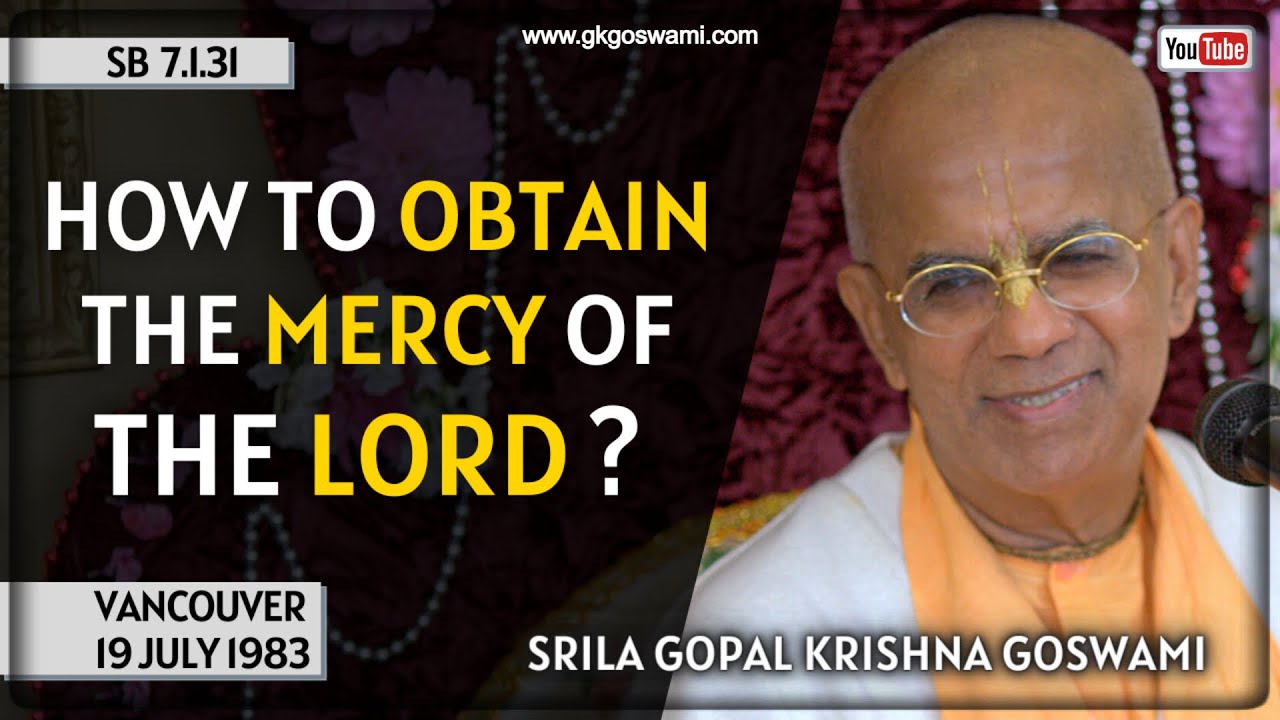
In this devotional lecture Srila Gopal Krishna Goswami explains how one obtains Krishna’s mercy by concentrating the mind on the Supreme Lord. He outlines the various types of mukti (saivajña, śrīloka, śrīlākya, sarūpya, samipya, sārṣṭhi) and shows that they arise from the intensity of one’s bhāva (desire). The talk discusses how even apparent enemies of Krishna such as Kamsa and even A.C. Bhaktivedānta Swāmī Prabhupāda, who harbored intense (though negative) thoughts of the Lord, attained liberation. The speaker contrasts material lust (iron) with the spiritual, gold‑like desire of the gopīs, emphasizing that true devotees seek only pure devotional service, not any particular form of liberation. He warns that material sense‑gratification is a poison that destroys the soul, giving examples of illicit sex, gambling, substance abuse, and disease. The lecture then details the characteristics of pure bhakti: it must be unmotivated, uninterrupted, and it alone attracts Krishna. It is compared to a rare diamond—precious but attained by few. The speaker stresses the necessity of a two‑fold practice of hearing the Bhagavatam and serving it, controlling the mind, and maintaining constant devotion, which leads to lasting happiness far surpassing material or impersonal Brahman bliss.
Chapters
Om namo bhagavate vasudevayaam! Om namah bahguruteh vassudevayam! Om namah bahguruteh vastu devayaham! Om namah bahguruteh vasthu divayanum! My dear King Yaduṣṭhra, the gopīs by their lusty desires, Kamsa by his fear, Śiṣupala and other kings by envy, the Yadus by their familial relationship with Kṛṣṇa, you Pāṇḍavas by a great attraction for Kṛṣṇa, and we, the general devotees, by our devotional service, have obtained the mercy of Kṛṣṇa. Purport by Divine Grace A.C. Bhaktivedānta Swāmi Prabhupāda. Different positions achieve different types of mukti— saivajña, śrīloka, śrīlākya, sarūpya, samipya, and sārṣṭhi— according to their own intense desire, which is called bhāva. Thus it is described here that the gopīs, by the lusty desires which were based upon their intense love for Kṛṣṇa, became the most beloved devotees of the Lord. Although the gopīs at Vṛndāvana expressed their lusty desires in relationship with the Paramārtha, they actually had no lusty desires. This is significant of spiritual advancement. Their desires appear lusty, but actually they were not the lusty desires of the material world. Caitanya-caritāmṛta compares the desires of the spiritual and material world to gold and iron. Both gold and iron are metals, but there is a vast difference in their value. The lusty desires of the gopīs for Kṛṣṇa are compared to gold, and the chela lusty desires are compared to iron. Kamsa and other enemies of Kṛṣṇa merge into the existence of Brahman, but why should Kṛṣṇa's friends and devotees have the same position? Kṛṣṇa's devotees attain the association of the Lord as His kāma-saṇḍa companions either in Vṛndāvana or in the Vaikuntha planet. Similarly, all the Madamuni wanders in the three worlds, he has exalted devotion for Nāyana. The Viṣṇis and Yādus and the father and mother of Kṛṣṇa in Vṛndāvana all have familial relationships with Kṛṣṇa. Kṛṣṇa's foster father and mother in Vṛndāvana, however, are more exalted than Vāsudeva and Devaki. Bande ham śrī-guru śrī-vṛṣṇa-phada-kramaṇa śrī-gurunvaiśṇava-nāśca. Śrī-lūpāṇṣa-grājatāṁ tahājana rāgunātāṁ vṛtam tamṣadeva. Hare Kṛṣṇa, Hare Kṛṣṇa, Hare Kṛṣṇa. Hare Rama, Hare Rama, Rama Rama Hare Hare. Gopiyakāma vyātamsau vesa-ced-yadayo narpā samandhat vṛṣṇa-yaśne hat yuyam bhaktā vrayam vibho. Sūñarāda Muni is speaking this verse to King Yudhiṣṭhra. This chapter is called The Supreme Lord is equal to everyone. Parikṣit Mahārāja was a little concerned if the Supreme Lord is equal to everyone and how. And he wanted to know from Śrī Kadeva Gosvāmī, why is it that the enemies of the Lord are also able to obtain liberation which a devotee of the Lord is able to obtain? In other words, it would appear according to this logic that to be an enemy of the Lord gives one the same benefit as one who serves the Lord willingly. Because Śrī Śrīla Prabhupāda, for example, was an enemy of the Lord. He was blasting the Lord from his very birth. And it naturally baffles somebody, even devotee of the Lord as elevated as Praśad RAVAL, as how Śrī Śrīpāda realized the same degree of benefit as an unenlightened devotee of the Lord could realize. Actually Śrī Śrīpāda merged into the body of the Lord, and this was seen by even Maharāja Yudhiṣṭhira. So Maharāja Yudhiṣṭhira also was baffled. So Nārada Muni is explaining to Yudhiṣṭhira Mahārāja, that the enemies of the Lord, though they may appear to be enemies, they are devotees of the Lord also. But the reason they are able to obtain this liberation is because being enemies of the Lord, they are completely absorbed in thinking of Kṛṣṇa. The enemies of the Lord also, because they are involved in thinking of Kṛṣṇa immensely, just like Kamsa. Kamsa was always thinking of Kṛṣṇa. Though he was thinking of Kṛṣṇa from the angle of killing him, but nevertheless Kamsa was also thinking of Kṛṣṇa, and hence he also obtained liberation. So the different types of mukti, in the previous verse Narada Muni has explained that one receives Kṛṣṇa's mercy by concentrating one's mind upon Him. So the degree to which we can realize the mercy of the Lord is in proportion to our concentration of our mind upon Kṛṣṇa. Ye yathāma-prapadeyante. Kṛṣṇa says, "All of them, as they surrender to Me, I reward them accordingly." So the so-called enemies of the Lord, they had obtained liberation because in their minds they were completely absorbed in thinking about Kṛṣṇa. So a question may arise at this point that maybe everyone should take to the path of Śrī Caitanya Mahāprabhu, and because the Lord can be served favorably and unfavorably, so everybody can realize benefit or liberation by even thinking of the Lord in a negative manner. The Lord is transcendental in all situations, and this has been established by Narada Muni in this chapter once again, that the Lord is completely transcendental. But it is explained, the devotee, however, wishes to serve the Lord with love, and the example is cited in this verse of the gopīs and the pāndavas. And the Yadus and Śrī Śrīpāda and Kamsa, of course, served the Lord but in different situations. Śrī Śrīpāda was envious of the Lord from the very birth, and Kamsa was scared of the Lord, that the Lord will appear and kill him, and hence Kamsa was also always contemplating that he should kill the Lord. So the devotee, however, he wants to serve the Lord with love. Prithi purvakam. Te samsrata yuktanam vrajetam prithi purvakam. The devotee chooses the path of serving the Lord with love. And if one serves the Lord with love, based upon the degree to which one can concentrate his mind upon the Lord, the Lord also reveals Himself. Now in the purva-purva-siddhanta, the Prabhupada talks about different types of mukti. Essentially, there are 5 different types of liberation that one can realize: sayujya, shalokya, svarupya, santipya, and svarshi. These are equal to one can, one may aspire to live on the same planet as the Lord, or one may want to have the same opulence as the Lord, or one may want to be a companion of the Lord, or one may want to have the same features as the Lord. Or one may want to become with the Lord. So essentially there are 5 different types of liberation that one can realize. However, the devotee, he does not aspire for any of these 5 kinds of liberation. This was explained by Lord Kṛṣṇa to His mother Devahuti. Lord Kṛṣṇa explains to His mother Devahuti that my devotees are so great that they do not wish to have any type of liberation. The devotees are content just with the opportunity to serve the Lord. Even if the devotee has to go through great difficulty, he is determined to go on with his service to the Lord. For example, the gopis. Now the gopis had to undergo immense difficulties to associate with the Lord. When the gopis would leave their households to associate with Kṛṣṇa, they were, they were feared. That their husbands and their relatives would criticize them. But the gopīs were so determined to associate with the Lord and serve the Lord that they were even ready to go to hell if necessary, but they wanted to continue to serve the Lord. So the devotee, he wants to serve the Lord in all situations. The devotee, the unalloyed devotee, He is not hankering for liberation. He is not hankering to have the same features as the Lord. He is not hankering to live on the same planet as the Lord. As Lord Śiva states in the Bhāgavatam, nāyaṁ parā-sarve nār-kutaiṣṇa-devyati svārṣva-pravāda-nār-kṛṣṇa-apītulyaṣa-darṣana. The devotee, he is willing to either serve the Lord in heaven or in hell. To him both are equal because his only concern is to serve the Lord. And as Caitanya Mahāprabhu has prayed in his Sikṣāṣṭhaka, though Caitanya Mahāprabhu instructed his followers to write volumes and volumes of books, he left behind only 8 important verses which are known as Sikṣāṣṭhaka. Sikṣāṣṭhaka means 8 instructions. So He left behind instructions, and one of them is, ainaṇḍa teṇujya kiṅkaram patita mam viśyame bhāvāṁ buddho, pripayātava pāṭṭhātava pāḍha-paṇkha-jastīta duriṣaṁ vijñyāntya. Caitanya Mahāprabhu prays, "O Sannamahārāja Nanda, I am Your eternal servant." So this is the first recognition that the devotee must have. He must have this understanding that he is the eternal servant of the Lord. "And thou, I am your eternal servant, somehow or the other I have fallen into this ocean of birth and death." So the devotee must recognize that his constitutional position is to eternally serve the Lord. But unfortunately, due to the maintenance of material desires, he has fallen into the ocean of birth and death. Therefore the devotee prays to the Lord, "Please lift me up and place me as one of the atoms of the lotus leaf." So the devotee should always be praying to the Lord to please lift him up and engage him in devotional service. One obtains the seed of devotional service due to the causeless mercy of the Supreme Lord and the spiritual master. It is not to be understood that one is entitled to the process of devotional service. No. One gets into the process of devotional service to the, due to the causeless mercy of the spiritual master and the Supreme Lord. And the intelligent transcendentalist, when he takes to the process of devotional service, he cherishes it. Everybody is looking for satisfaction. We have discussed this again and again and again. The materialist is looking for satisfaction, the jnani is looking for satisfaction, The karmi is looking for satisfaction and the yogi is looking for satisfaction. The jnani is considered to be selfish because he is just worried about his own liberation. The yogi is also considered to be selfish. And the karmi, or one who follows the karma-kanda portion, he executes certain rituals for the purpose of obtaining some level of sense gratification, and that is also considered to be selfish. But the devotees of the Lord, the bhaktas, they are not considered to be selfish. Why? Because the bhaktas are serving the Lord without expecting anything in return at all. And because the bhaktas are serving the Lord without expecting anything in return at all, they are very, very dear to the Lord. And this is how one obtains the mercy of the Lord. The question placed before Narada Muni was, how does one obtain the mercy of the Lord? This is sometimes very baffling to even the transcendentalists. How is it that one devotee or one person has greater facilities than the other person? So Narada Muni's response was that one obtains the mercy of the Lord simply by concentrating one's mind upon Him. So the devotees or the bhaktas, they derive satisfaction by executing the process of devotional service. In the Bhāgavatam, in the 10th canto, there is a nice analogy in this connection, how it is explained that one does some makeup, then the person's face begins to look very beautiful. And when he looks in the mirror, the reflection of the beauty is reflected on the mirror. When you do some makeup and you look in the mirror, the beauty is reflected in the mirror. Similarly, the devotee, because he is part and parcel of Kṛṣṇa, because he is serving Kṛṣṇa, because he is serving Kṛṣṇa, that happiness is reflected in his own body. Just like the beauty or the makeup is reflected in the mirror, similarly the devotee, just by serving Kṛṣṇa, he also derives complete happiness. The happiness gets reflected in his own body. So the materialists unfortunately are unable to understand this secret. They are engaged on the path of sense gratification with such conviction, not realizing how this path of sense gratification is gradually killing them. Just like when you want to poison the rat, you feed the powder to the rat, and the rat gradually takes that poison, the powder, and the rat is unable to identify that poison, that powder, as a potential source of death. So the rat goes and takes the powder, and then the next day it goes back again and takes that powder, and gradually as it takes that powder, the rat just kills itself. So similarly, when one engages in sense gratification, One is actually just killing himself. One begins to identify that activity of sense gratification as the source of happiness, but unfortunately he is just inviting death. Therefore Narottama Das Thakura has said, hari hari bhikṛ janma-ganainu, manuṣya janma-vāya radha-kṛṣṇa-bhāgyat jānīya śūnya-riṣakainu, that not having worshiped Rādhā and Kṛṣṇa, I have been drinking poison uselessly. So just like the rat takes the powder and gradually meets its own destruction, similarly those engaged in sense gratification at any level, they are just actually inviting their own death. And Narottama Das Thakura has stated that this is equal to drinking of poison. So the transcendentalist, however, is more fortunate. He has been injected with the process of devotional service. So the devotees of the Lord, as we have stated earlier, quoting Arthur Pila, they do not want any level of liberation. The thought of liberation doesn't even enter into their minds. The devotees are interested in executing the process of devotional service without expecting anything in return. This Kṛṣṇa consciousness movement is designed to guide people on the path of pure devotional service. Pure devotional service, as Rūpa Gosvāmī has explained, means executing devotional service without expecting anything in return at all. Niyābhi-lāsita-sūnyam jñāna-karma-dhi-anavṛtam anukalena Kṛṣṇa-salamena bhakta-uttamaḥ. This is the topmost bhakti, the path of bhakti, where one executes the process of devotional service without expecting anything in return at all. So pure devotional service has several characteristics. Just like any product or any location has certain features, similarly, the process of pure devotional service also has certain features, and it is good to be aware of these features. One of the features or the characteristics of pure devotional service is that it really gives one happiness. We're all looking for happiness, as we've just finished discussion— discussing. The different processes of realizing this happiness. One is the concept of material sense gratification. The other is the concept of merging with the Supreme or Brahman realization. And third is the concept of obtaining happiness by serving Kṛṣṇa. So Rūpa Gosvāmī, analyzing the three different categories of happiness, concludes that the happiness obtained by the process of pure devotional service is the only real happiness. The happiness obtained by impersonal merging with Brahman, even if multiplied a trillionfold, cannot compare to the happiness one can get by serving Kṛṣṇa. And the nature of happiness of material life is that it can end at any minute. And not only can it end at any minute, it also has a corresponding disadvantage. Analyse any of the areas of sense gratification that the materialist may want to engage in. Analyse illicit sex, analyse meat eating, analyse cigarette smoking, analyse gambling. The counter-effects are severe. For example, by engaging in illicit sex without restriction, one can develop so many dreadful diseases, dreadful diseases. In fact, as some of you may know, there is a new disease which they call AIDS, by which, uh, the body completely gives up all resistance to any drug that may be injected. And this disease is considered to be 1,000 times more dangerous than even cancer. So you want to go ahead and have sex without restriction, pay the price, get one of these severe diseases. You want to go ahead and eat without restrictions, then also pay the price, develop a disease. If you want to gamble, then also there's a problem. The mental tension. So many people get murdered because of gambling fights. And intoxication also is very dangerous. Recent studies have shown how by drinking, by drinking and smoking, one reduces his lifespan. So sense gratification by engaging in these illicit activities is also from a material angle disadvantageous. So to obtain happiness By following one of the areas of sense gratification is not really the most intelligent activity. Another concept of, another characteristic of devotional service is that it is very rarely achieved. Just like a diamond. A diamond is not in the possession of every individual. Only few people have diamonds. Just like Prabhupada was once giving a lecture in England at the Conway Hall. And the hall was not packed. So somebody asked Prabhupada a question, "If Kṛṣṇa consciousness is so perfect, why isn't this hall crowded?" And Prabhupada responded, "When you are selling diamonds, only few will buy. But when you are selling broken cut glass, thousands of fools will buy." So Kṛṣṇa consciousness is like a diamond. Not everyone will take to it. The devotional service is very rarely achieved. Therefore, once we achieve it, Once the seed of devotional service is planted in the heart, then we should cherish it. We should cultivate it very seriously. We should be determined to be happy just by the process of devotional service. Once you start the process of devotional service, we should not meditate that maybe there's some other area by which one can get happiness. Viśvanātha Ācārya ṭhākura explains, It's just like a rich man. A rich man, wherever he travels, he always has the same luxurious standard of living. If a rich man from Vancouver, whether he goes to India or Africa or any other country, maybe a poor country, but as far as the rich man is concerned, he will always have the same standard of living. He would want to live in the Hilton Hotel wherever he goes. He would want to have a limousine and so on. It is not when the rich men go to India they start living in huts. They still live in the same high standard. So just like a rich man has the same luxurious standard of living, doesn't matter where he goes, similarly a devotee who takes to the path of devotional service, he is always happy wherever he goes. The devotee derives his happiness not on the basis of some material adjustment of situation. If we are hoping that by some adjustment of some material situation happiness will be the result, then one is completely foolish. Then one will be satisfied for a brief period and again one will become unhappy. But a devotee has to be happy if he is executing pure devotional service. If he is executing service to Kṛṣṇa, if he is serving the spiritual master without expecting anything in return, then that service is going to give him happiness. So just like the rich man, he feels in the same standard wherever he goes, the devotee is happy in executing devotional service regardless of the situation in which he is, regardless of the type of service that he is doing. Because whatever service he's asked upon to do, he recognizes that this service is being executed for the pleasure of the Supreme Lord. And because this service is being executed for the pleasure of the Lord, he derives complete satisfaction. So the devotee is anxious to serve. Prabhupada took an example like a lusty man. A lusty man, any look, any woman that he may look at, he just thinks, how can he get friendly with that woman? Similar, the devotee, he is always thinking How can every situation, every object be used in the service of Kṛṣṇa? He is anxious to serve Kṛṣṇa. And as he bites on the process of devotional service, as he engages more and more in devotional service, his material desires gradually begin to dwindle. Just like a hungry man, a hungry man, when he begins to eat, with each morsel of food that goes into his mouth, his hunger gradually goes down. The nourishment increases, and as the nourishment increases, there is a corresponding decline of hunger. So similarly, as one engages in devotional service, the more one is absorbed in devotional service, Correspondingly, to the same degree, the material hunger goes down. So if we want the material hunger to go down, it is a fact that we all have material desires. That's why we are in this prison. The living entity is kept bonded to material existence by the maintenance of material desires, because as long as one has material desires, one is unable to gain access to the kingdom of God. The qualification or the prerequisite for returning to the kingdom of God is the termination of material desires. So if you want to terminate material desires, if you want to give up material desires, then the only alternative is absorption in service to Kṛṣṇa. If we absorb ourselves in devotional service to Kṛṣṇa, then one is able to give up material desires. One is not able to give up material desires unless there is a positive alternative. And positive alternative is meant to be engagement in the process of devotional service. So when one engages oneself in the process of devotional service, then one is able to check his material desires. Material desires can only be checked If one is absorbed in executing devotional service. Otherwise it is very difficult to check material desires. An idle brain is a devil's workshop. So if one is idle, if one is not concentrating with one's mind upon the lotus feet of Kṛṣṇa, then material desires will keep manifesting itself again and again and again. And because they are constantly manifesting itself, one day we will be forced to execute them. So therefore, Nārada Muni, in the verse prior to this, has emphasized that the devotee must concentrate with his mind upon Kṛṣṇa. If you concentrate with your mind upon Kṛṣṇa, then we can obtain the mercy of Kṛṣṇa, because through the medium of the mind, the other senses in the body can also be controlled. But if the mind is uncontrolled, then it will be difficult to control the other senses. Therefore, The transcendentalist is advised again and again and again how important it is to control the mind. So we are discussing the characteristics of pure devotional service, and one of the characteristics of pure devotional service is that it attracts even Kṛṣṇa. Kṛṣṇa cannot be attracted by these colors. Kṛṣṇa cannot be attracted by one's beauty. Kṛṣṇa cannot be attracted by one's mundane realizations. Kṛṣṇa cannot be attracted by one's education. Sevomukehi jīvādo. Only by the process of seva or devotional service can the Supreme Lord be attracted to oneself. So if we want Kṛṣṇa to be attracted, if we want to gain the attention of Kṛṣṇa, then we have to execute devotional service. And devotional service is the only real auspicious activity. Everybody is looking for an auspicious work. Nobody has any concept of what is real auspiciousness. Different people think that by the— by engaging in different societies, one will be able to execute some auspicious activity. But real auspicious activity is the broadcasting of this Kṛṣṇa conscious philosophy. The broadcasting of this Kṛṣṇa consciousness philosophy gives one the understanding of the difference between the body and the soul. We have to get out of this bodily identification. As long as we have this bodily identification, we will identify with the senses also. And as long as we identify with the senses, we will also identify with the desires to satisfy the senses. So the transcendentalist has to get out of this bodily identification. We have to give people the awareness that this is the only auspicious activity. We are all looking for taste. Anandam buddhi vādṇam prati-padam pūṇaṁ rātasvādṇam. Pūṇaṁ rātasvādṇam means taste. We are all looking for taste. We are all looking for some mellow. We are all looking for satisfaction. But Caitanya Mahāprabhu says that by the process of devotional service which begins with the chanting of the holy name of Kṛṣṇa, there will be complete happiness. And this happiness, anandam buddhi vardhanam pati-padham kūnam rata-svādhanam sarvata-snapam param vijayate Śrī Kṛṣṇa-sankīrtanam. This happiness will just go on increasing. That is the nature of spiritual bliss. Material bliss is there, then it gets terminated. Just like a young man may be engaged in some gratification, but very soon he will get disease. Or if he doesn't get disease, very soon old age is going to come. There is going to be some obstacle by which this enjoyment is not going to go on for long. But as opposed to this, By the execution of devotional service, the happiness of the living entity experiences just goes on increasing and increasing and increasing. So this is the statement of Caitanya Mahāprabhu. We have to accept this statement with faith, and if we accept the statement with faith and execute the process of devotional service, then this will be the real auspicious activities. Material activities, material desires They just take away one's energy. Just like on the side of a lake, if you have kusa grass, the kusa grass dries up the water of the lake. Similarly, material desires, they take away one's energy. And instead of directing one's energy on the right path, they direct the energy on a path which will just destroy oneself. So the devotee, he is intelligent. He doesn't pay any attention to the demands of the senses if they are independent of Kṛṣṇa. The difference between one who renders devotional service with love and one who renders devotional service due to envy or fear is: the devotee is anxious to do what the Lord wants him to do. He is not trying to enter into a mercantile agreement with the Lord. This is what it means to render service without any motivation and without any interruption. Just like the Bhagavad-gītā says, sa veda-pūṇṣaṁ paro dharmo yato bhakti-advokṣate, aitukya-pātyata ye yātmā-supraśivati. In order for the self to be satisfied, two characteristics are important. One characteristic is the devotional service should be unmotivated, and the other characteristic is that it should be uninterrupted. The devotional service has to be uninterrupted. It's uninterrupted means that you cannot have any breaks. It is not that you render devotional service for a few years and then you decide that I've done service a few years now, let me take a little bit of holiday. Or it doesn't mean you should serve in the morning for a few hours and then you think that you can interrupt your devotional service during the day. No. For the self to be satisfied, the Bhāgavatam very clearly states, devotional service should be uninterrupted. The philosophy of Kṛṣṇa consciousness is that we have to serve Kṛṣṇa for 24 hours a day. There is no break. This is not part-time. And if we execute devotional service 24 hours a day, then one will constantly be completely happy. Then doesn't matter where one is and what situation one is, whether one is out on the street singing sankirtan or cooking for the Lord, or constructing the temple, or cooking, or cleaning the grounds. Whatever service one is doing, one will obtain happiness. So this happiness comes not by some material adjustment, as we stated earlier. This happiness comes not by having some wishes fulfilled, because if our devotional service is motivated, then as long as the desire is being satisfied, One will be happy, and the moment the desire is not being satisfied, one will become unhappy. This we should understand. If devotional service is motivated, then let's assume we have a particular desire or a particular expectation. So when that expectation is realized, we say Krishna is wonderful, devotional service is wonderful, how beautiful it is. But the moment that expectation is not realized, then you'll say, oh, there must be something wrong with this process of devotional service. Maybe I should look at some alternative paths to satisfy myself. Therefore, it is very essential that devotional service be without any expectation at all. Our vision is the vision of the gopis. The gopis were ready to serve Kṛṣṇa in all situations. Even if they had to go to hell, they were ready to go to hell to serve Kṛṣṇa. So that So that understanding has to be developed. But how can you develop that understanding? You can develop that understanding if you attentively execute the process of devotional service. Just like the Bhāgavatam says, vāsudevadvāgavati maktiyoga-prayojitah. By rendering devotional service, one develops causes-knowledge and detachment from everything that is material. How is it that the devotee of Kṛṣṇa He may have no college education, he may have no school education, but after he comes to a temple of Kṛṣṇa for one month, he is able to give up all types of sense gratification. And in comparison, somebody else, he may have the most number of degrees next to his name, but he is not able to give up sense gratification. Why is that? You may have a very educated individual, but he doesn't execute devotional service. So if you go to this educated individual and tell him, sir, please give up sense gratification because this is poison, he will not be able to give up. But somebody else joins the Kṛṣṇa conscious movement and within a week he is able to give up sense gratification. Why? This confirms the words of the Bhāgavatam, vasudev bhāgavati bhakti-yoga-prayojitāḥ jñanit-āśiv-veṛḍyam jñānam ca idhaḥ itukrām. That this knowledge comes by rendering devotional service. When you render devotional service to Kṛṣṇa, the causeless knowledge and detachment automatically develops. If you want to develop detachment from everything that is material, you can't just become a bookworm and hope that this detachment will develop. No. We have to render practical service to Kṛṣṇa. By rendering practical service to Kṛṣṇa, one is able to develop cosmic knowledge and detachment from this material world. So there is a process to get detached from this material world, and the process of getting detached from this material world is the execution of devotional service. It is only by the execution of devotional service can we hope to get detached. If we don't execute devotional service, then there is no question of being able to get detached. So if we want to get detached, then it is very essential that we execute devotional service. Just like the Bhāgavatam says, naṣṭha-praiśrava-dreṣa-nityaṁ bhāgavat-sevya bhāgavati uttamaśloke bhakti-bhāvati naiṣṭhaki. Not only do you have to hear the Bhāgavatam, but you also have to serve the person Bhāgavatam. And if you have a twofold attack, Hearing and serving, then the loving devotional service and the determination to serve Kṛṣṇa will be there. Therefore we very often see that on the one hand you may have some type category of transcendentalists. They hear the Bhāgavatam but they don't serve the Bhāgavatam. Serving the Bhāgavatam means serving Bhāgavat, serving the person Bhāgavat, serving Kṛṣṇa. And because they are not serving the person Bhāgavat, they are not able to develop detachment from everything that is material. And on the other hand, sometimes you may have where somebody wants to serve the Personality of Bhagavad-gītā, but he doesn't hear the Bhāgavat. Then again he is not able to develop detachment. So in order to develop this detachment from everything that is material, both are necessary: hearing and serving. And if you hear and serve, then you can burn your material desires to ashes. But if you're just hearing and not serving, or if you're just serving and not hearing, then you cannot give up your material desires. So if you want to give up our material desires, which are our greatest enemies, which are responsible for handcuffing us to this material world, then we have to have a true prolonged, two-phase attack. We have to hear it, and we have to have the desire to serve. If you don't hear it tenderly, Then again, the ability to destroy material desires will not be very strong. So the devotee, or anyone who comes to the Kṛṣṇa conscious movement, is able to give up material desires, is able to give up, or at least begin the process of giving up this material entanglement because of rendering devotional service. The devotional service is so powerful that by hearing about devotional service, by executing devotional service, one is able to gradually begin to destroy the disease that has been haunting him for hundreds and thousands of years. One is able to give up this material disease that is responsible for keeping us entangled and trans— and forcing us to transmigrate from one body to another body. So by hearing and serving We are curing the disease, just like when one may have a diseased eye, then by applying ointment, he is gradually beginning, beginning to cure the eye. Similarly, by hearing and serving, we are gradually curing this body. We are curing this body from the material disease, and we are purifying the body. Just like gold, gold may have so many impurities, But when gold is put in fire and its impurities are destroyed, then the brilliance of the gold is manifested. Similarly, we have to burn these material desires, and unless we— as long as we retain the material desires, there cannot be any satisfaction. In front of Kṛṣṇa, everything is insignificant. Just like the flies, they may think that they can go to the fire and fight the fire, but actually they end up being destroyed by the fire. Similarly, material desires may appear to be strong and may appear to give us more pleasure than Kṛṣṇa, but actually Kṛṣṇa can burn— the prāsāda devotional service can burn all our material desires just like the fire can burn any number of flies that come to attack it. So we have to take to the prāsāda devotional service with complete faith, and the degree to which we can realize the humility of Kṛṣṇa is dependent upon the degree to which We give our mind, our body to Kṛṣṇa. So one executes the process of devotional service with faith. We, the devotee, should be determined to defeat sense gratification. If you are determined to defeat sense gratification, then the victory will definitely be there. But if you are not determined to defeat sense gratification, then at times sense gratification may win the battle. But if you are determined to defeat sense gratification, then there's no question of any deviation from the process of devotional service. We cannot deviate from the process of devotional service. Devotional service is such a rare privilege. We cannot give any credibility to the mind. As we've often stated, the mind is an ungrateful master. The mind, the mind is always trying to mislead us. The mind is always trying to cheat us. And even though we know the mind is always trying to cheat us, unfortunately we still pay attention to the mind. This is a great tragedy. So we have to take shelter of the words of the spiritual master. We have to take shelter of the words of the great sages. We have to take shelter of the words of the revealed scriptures, and we have to mold our life accordingly. And a characteristic of a devotee, or one who is executing pure devotional service, is that even if he is offered anything for the Lord, he refuses to accept it. Just like there is an example of Govardhana Śrīdhara. This was— he was a devotee who made his living by just making leaf cups of the banana leaves. And with a small income, he was still donating 50% for the propagation, for the worship of Ganges. So Caitanya Mahāprabhu was so pleased with this devotee that He came and offered him all any type of liberation that he may want or any opulence that he may want. And he completely refused. He said, "The only thing I want is the opportunity just to serve You more and more." So this is our only prayer, this is our only desire, that we may get the opportunity to serve the Lord again and again. So we should take this opportunity to serve the Lord as a great boon. It is a great boon. Only the most fortunate people take to devotional service. The matured devotees, the fortune is realized in proportion to the money they make. But real fortune is one who engages in the process of devotional service. So we should execute the process of devotional service with faith. We have to give up material attachment to the medium of hearing and to the medium of devotional service. And if that is our attitude, that we can give up our material desires to the process of hearing and to the process of devotional service, then one will be able to be successful on the path of devotional service. And then in whatever situation one is in, like a rich man, he will always be happy wherever he is. Hare Kṛṣṇa.
More from PRASAD

Rare Pastimes & Timeless Lessons of Guru Mahārāja | Stories Every Disciple Should Hear

ISKCON Legends- pure devotees meet-HH Jayapataka Swami, HH Gopal Krishna Goswami, HH Radhanath Swami



Jagannātha Ratha-yātrā Through Śrīla Prabhupāda's Mercy | 29 April 2006 | Nairobi, Kenya

Lord Jagannātha's Appearance Pastime | 21.07.2019 | ISKCON Calgary | Śrīla Gopāla Kṛṣṇa Gosvāmī

The Ācārya Teaches by His Own ExampleGuṇḍicā Mārjana by Guru Mahārāja #shorts

Guṇḍicā Mārjana – Lord Jagannātha's Pastime | 21.7.2019 | ISKCON Calgary |Śrīla Gopāla Kṛṣṇa Gosvāmī

H.H. Gopāla Kṛṣṇa Gosvāmī Mahārāja - Exemplary Sādhana and Deity Worship # shorts

भगवान की कृपा कैसे प्राप्त होगी ? | 11 Jan 2014 | Punjabi Bagh | Srila Gopal Krishna Goswami

Material Education vs Spiritual Education | Srila Gopal Krishna Goswami #shorts