How to pluck-out the unwanted weeds SB 2.1.5 | Rus-Split | Moscow | 11.5.92 | Gopāl Kṛṣṇa Goswāmī
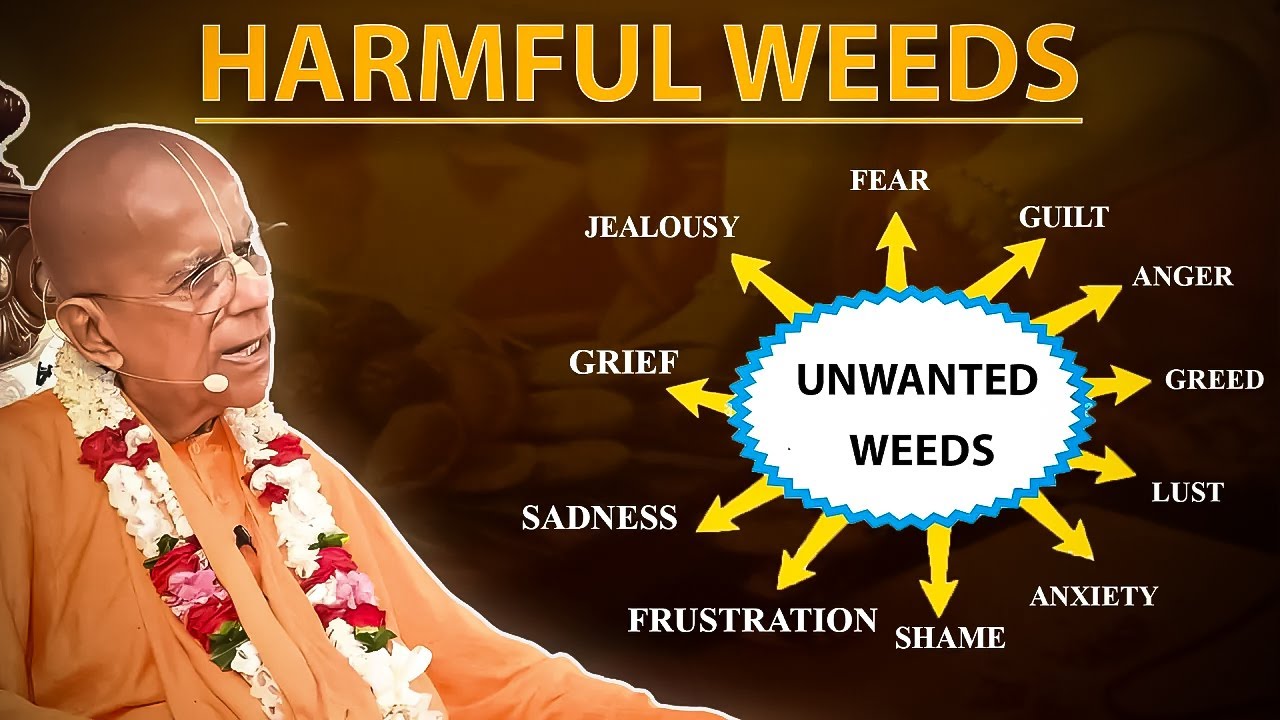
Gopāl Kṛṣṇa Goswāmī teaches how to remove material desires that block spiritual progress. Chanting the holy names works in Kali-yuga, but only if you avoid ten offenses to the Lord. True devotion means renouncing material attachment, not faking ecstatic symptoms.
Chapters
Śrīrūpāṁ sagrajatāṁ sahāgana-laguna-tanvitam tam sajīvam. Sadveitāṁ savaḍhūtam prijana-saītam Kṛṣṇa-cetanya-devaṁ. Śrī-rādhā-kṛṣṇa-padaṭṣahāgana-lalitā śrī-śrīkṛṣṇa-cetanya-prabhu-nityānāmaḥ. Hare Kṛṣṇa. So Śukadeva Gosvāmī is describing to Parīkṣita Mahārāja how one can learn the art of dying or how one can utilize one's human body properly. In other words, If we want to eliminate the miseries that we are in, then we have to get attached to the chanting of the holy names of the Lord. Śrīkadeva Gosvāmī is talking about 3 things: hear, glorify, and remember. This is known in Sanskrit as śrāvanam, kīrtanam, viśnu-smāranam. You can only remember the Lord if you hear and glorify Him. If you do not hear and glorify the Lord, then it is impossible to remember the Lord. Just like giving you a mundane example, sometimes you may talk about somebody, but if you talk about somebody, there's a good chance you'll dream about that somebody in the night. So similarly, if you talk about Krishna, you'll remember Krishna, but if you don't talk about Krishna, you'll never remember Krishna. About this, there are no two opinions. So just like last night I was explaining Why do we, why do we read the Bhagavad-gītā? What is the purpose of reading the Bhagavad-gītā? The purpose of the Bhagavad-gītā is to obtain knowledge so you can end your miseries. So similarly, through this process of chanting, you can free yourself from the entanglement of birth and death. It is clearly explained that even if you go to Brahmaloka, you cannot free yourself from the miseries of birth and death. Even if you go to Brahmaloka, you have to go through the some miseries of birth and death. Further, this verse is explaining that the Lord is residing in everyone's heart as the Super Soul, and Lord is the controller of everything. So Krishna is residing in his spiritual abode. Nevertheless, at the same time, he's manifested everywhere, like the sun disc is in one location, but still it is all pervasive. So as the Super Soul The Lord is registering all our desires, and He's— and when He recognizes that we have a sincere desire to approach Him, then He guides us accordingly. Now, chanting of the Holy Name is a sure method of self-realization in this age of Kali. Kali, Kali nama rupa Krishna avatara. In Kali-yuga, the Lord incarnates in His Holy Names, and it is explained, Kali, do se nanda raja nasti kama haguna. Keertana deva-kṛṣṇa-sya-mukta-saṅga-sa-parambrajayaḥ. That in Kali-yuga there are so many vices, but there is one benediction in this age. That is the chanting of the holy names of the Lord. So by chanting the holy names, especially chanting the holy names in a pure mentality, then this creeper of devotional service will grow taller and taller. Caitanya Mahāprabhu has explained that once the seed of devotional service is watered, Then it begins to grow. And this tree grows taller and taller till it crosses this whole material covering. After it crosses the material covering, it crosses the brahmajyoti, it crosses the Vaikuntha planets, and ultimately it goes and takes shelter of Goloka Vrindavan. However, in the chanting of the holy name, there are certain offenses that one must be very careful to avoid. Why do we recite? The 10 offenses every morning in every temple of ISKCON, because it is so important to stay away from these offenses. And if you don't, even if you're chanting, devotional service can be ruined. So in chanting the holy names, there are certain important guidelines which we should try and observe. These guidelines are as follows. One is avoid offenses at the feet of advanced Vaiṣṇavas. Caitanya Mahāprabhu explained that just like a beautiful garden can be ruined if a mad elephant enters into it, similarly the beautiful garden of devotional service gets ruined by Vaishnava aprāda. Therefore all great sages have emphasized the importance of eliminating Vaishnava aprāda. How do you avoid Vaishnava aprāda? By not developing an envious attitude. Caitanya Mahāprabhu has said that just like a creeper has to be protected by having strong fencing around it, Similarly, the creeper of devotional service has to be protected. Now, Caitanya Mahāprabhu further says that as the creeper of devotional service is growing, some unwanted weeds may also grow in your body. What are these weeds? These are desires for material enjoyment. You know, any type of material enjoyment desire, gross and subtle, these are all considered weeds. One aspect of weed is disrespectful to the religious scriptures. The scriptures are saying, 'Sarva-dharma-paritahya,' surrender to Krishna. Scriptures are saying give up sense enjoyment, but we say, 'Oh, maybe the scriptures are not relevant in today's modern world,' and we try to find fault in the scriptures. Why do we want to find fault? Because you want to justify your nonsense activities. So this is one aspect of the weed. Then you want to over-endeavor, work more than necessary. In order to take care of your basic necessities of life, and because you have to over-endeavor, you have no time for chanting and reading. One important point to understand is that when the Bhāgavatam says, shaunam kirtanam viṣnuṣmāṇam, this is not only the chanting of the holy names of Kṛṣṇa, but it also includes the reading and the understanding of the Bhāgavatam and the Bhāgavad-gītā. And Prabhupāda has made this point very clear in many purports. So we not only have to chant our rounds attentively, we should also hear the Bhāgavatam and the Gītā attentively. If you just chant your rounds and you don't chant, you don't read every day, then your chanting will be incomplete. Therefore Bhāgavatam says, nāsta-praśo abhadreśo nityam bhāgavat-sevaya bhāgavati uttamaśloke bhakti-bhāvati naiśthaki. By regularly hearing the Bhāgavatam, all that is inauspicious in the heart is destroyed. Then another aspect of vid is your desire for prestige, adoration, and material gain. You want everyone to respect you, and if you don't get enough respect in one temple, you go to another temple searching for more respect there. Then you want material, different material desires to be fulfilled, material gain. So these are all different aspects of vids. However, Chaitanya Mahaprabhu said that if you are careful Then as soon as these weeds will appear, you can uproot them. Just like as soon as some symptoms of pain get manifested in your body, you run to the doctor, especially if the pain is in a delicate portion like the brain or the heart. So as soon as you detect that these unwanted weeds are growing, you must at once take shelter of Guru Sadhu Shastra and try and unplug, unroot, unweed, take out these weeds. What will happen if you don't take care of these weeds? It will hurt, it will prevent the growth of the creeper of devotional service. And the watering process will only help the weeds. It won't help the real creeper of devotional service. And the net result of chanting, which is the development of love of God, will not be there at all. So we have to be very careful that in the very initial stage this be curbed, so the weeds are pulled out. And then there will be the development of love of God. One will see Kṛṣṇa at every step. One will only engage in activities which are for the pleasure of Kṛṣṇa. So the different stages of chanting the Holy Name. In the initial stages, when you chant the Holy Name and at the same time commit offenses. But then as you, as you chant for some time, you gradually realize there are also some offenses that you should be avoiding. Just like, or many of you may have experienced, when you were chanting, when you first started chanting the holy names, you were living outside, you just chanted 1 round, 2 rounds, gradually built it up to 16 rounds, but you did not concern yourself with the offenses. But then when you identify that there were offenses, you started avoiding the— you started trying to avoid the offenses. So, and then in this stage you make a concentrated effort to minimize the offenses. And the third stage of chanting is when you're chanting without committing any offenses at all. Now in this advanced pure state of chanting, there are certain symptoms that get manifested. One symptom is when you're chanting, your body begins to perspire. Yeah. Then your hair stand on end. These days the, the Western hippies, the hippies in America have a new hairstyle, and the new hairstyle is the hair stands on end. So So what they do, they shave off the side, just grow the hair in the middle, and it stands on end. So half they're copying Hare Krishna and half they're copying the symptom of pure devotees. Then their voice begins to fail due to being— due to developing extras in the voice. You can't get choked up, you can't even speak. Then there's trembling in the body, then tears come out when you're beginning to chant or when you're talking about Krishna. Tears are coming out of your eyes. Then another symptom is the body becomes very pale, very, very thin. Another symptom, you get in complete trance, total absorption and happiness. So these different symptoms of advanced chanting are explained by Rūpa Gosvāmī in Bhakti-rasāmṛta-sindhu. But Rūpa Gosvāmī and Viśvanātha Chakravartī ṭhākura have very critically criticized those who manifest these 8 symptoms without understanding how these symptoms Without who manifest these, falsely manifest these symptoms. Those who falsely manifest these symptoms are known as prakṛtya-sahajyas. They want to make a show that they're very advanced. So when they're talking about Kṛṣṇa, they will purposely start crying, and the innocent public will think, "Oh, this man is so advanced, he's self-realized." You go to India, you'll find many so-called preachers of the Bhāgavatam. When they're reciting the Bhāgavatam, In the middle they begin to cry and they act as a devotee, choke up, and people think, oh, he's so advanced. The genuine devotee of the Lord does not manifest these symptoms in front of others. For example, when Lord Chaitanya met Ramana Maharshi on the banks of the river Godavari, Lord Chaitanya was manifesting these symptoms. But then as soon as Lord Chaitanya saw that along with Ramana Maharshi there are some other non-Brahmanas who will not be able to understand the advanced symptoms that he would display. He controlled himself and he did not display these symptoms of ecstatic love of God. So we don't falsely manifest these symptoms, nor do we recognize those who are falsely manifesting these symptoms. You can go to Vrindavan, you'll find people who are smoking and doing everything, but in public when they are, they'll shed tears, they roll on the ground, their body will tremble. They're such great actors, they're displaying all these 8 symptoms. So, um, the devotee does not manifest, and he doesn't falsely recognize those who are falsely manifesting these symptoms. So what is real bhāva? Real bhāva, you don't have to worry about manifesting these 8 symptoms, any of you. Real bhāva, Prabhupāda explains, is giving up material attachments. So when you're chanting Hare Kṛṣṇa, you don't have to worry by standing in front of the mirror to see whether your hair is standing on end or not. You don't have to worry whether your body is trembling or no. You don't have to— you don't have to worry whether you're perspiring or not. You don't have to worry whether your body is becoming pale or not. You can test your advancement by only one factor: are you giving up material attachments? And if you're giving up material attachments and dwelling attachment to Krishna, then the bhāvā is being manifested. So real bhāvā is not the manifesting of these symptoms, But real bhava is giving up on material attachment. So a genuine devotee recognizes that the material attachment has to be renounced because you cannot have spiritual love of God and material attachments at the same time. Just like you cannot hope to pour water and light fire at the same time. If you're trying to light fire, you can— on the other hand, somebody else is pouring water, the fire will never get lit. And on the other hand, if you're trying to put off the fire and pour water at the same time, the fire will never be put off. So if you're trying to develop love of God, if you want to develop real bhāva and not false bhāva, then you have to recognize that these material desires have to be abandoned. So this chanting and hearing is a sure way by which this bhāva can be developed. Therefore, Rūpa Gosvāmī has said, my dear friend, whatever price you have to pay for becoming Kṛṣṇa conscious, please pay that price and become Kṛṣṇa conscious. And if we chant the holy name attentively, then the devotee becomes very powerful. Devotee is not after material power, spiritual power. He becomes fearless. In the material world, everybody is worried about so many uncertainties and anxieties. We are worried about whether I'm going to get food tomorrow, whether another country may not attack me. So many different types of fear are there. But devotee is fearless. Just like a child, a son of a rich man, he automatically becomes powerful. The devotee is automatically powerful because of his devotion to Kṛṣṇa. Therefore, it is said a devotee is fearless. Just like Amṛśma Rāja. Amṛśma Rāja was a devotee fixed in his meditation on the Lord. And Durgāsāmuni was a powerful yogi. But he was defeated by what? The devotion of amṛṣṭha. So to summarize the verse, Śrīkantadeva Gosvāmī is pointing out the importance of chanting, hearing, and remembering the Lord's name. So chanting, hearing, remembering cannot be compromised whether you're in a marathon or no marathon, whether you're living at home or whether you're living in the temple, because this is our spiritual food. Just like if you don't eat material food, you become weak and sleepy. So if you don't take spiritual food, You'll also become materially— you'll sleep spiritually. Why are people sleeping spiritually? Because they don't want to take spiritual food. They think they can just go to the church or the temple once a week, once a month, and they will develop love of God. No! If you want to develop love of God, you have to take that spiritual medicine every day. This is known as the process of vaidhi bhakti. So vaidhi bhakti means following rules and regulations. Therefore, we have a certain schedule. Mangala, dikla, guru-pūjā, japa. So if you follow this process of Vaidhī-bhakti, then you'll be able to remember Kṛṣṇa. And when you're remembering Kṛṣṇa, you will always want to be engaged in service to Kṛṣṇa. When you're not remembering Kṛṣṇa, you want to stay away from service to Kṛṣṇa. And when you're remembering Kṛṣṇa, when you chant your rounds nicely, you're anxious to be engaged in service all the time. So this is known as samādhi. Samadhi doesn't mean close your eyes and fall asleep in the name of doing yoga. Samadhi means being actively thinking, absorbed in thinking of Kṛṣṇa and actively absorbed in serving Kṛṣṇa. Hare Kṛṣṇa. Hare Kṛṣṇa. So I understand the Lord Nrsimhadeva marathon is still going on and it's going to go on till the 14th. So as I said, samadhi means thinking of Kṛṣṇa and thinking of Kṛṣṇa's instructions. Krishna's instruction is, preach my glories to everyone. So here's an opportunity to preach, here's an opportunity to, to spread the glories of the Lord. So take advantage of it and be happy. And if you don't take part in it, then what does it indicate? That you're not understanding the philosophy, you're not understanding the importance of preaching. So under— if once you take part in preaching, that's a demonstration that you understand the philosophy. So are all the devotees going to take part in the marathon today? Including visiting devotees. The visiting devotees are also entitled to getting Lord Nrsimhadeva's mercy. Why should we give up the opportunity to get this mercy? So how many devotees are going to take part in the marathon today? Can we have a show of hands? Well, many devotee hands didn't go up. I wanted to remind everyone what I have been saying all along is even those who have temple services can go at least for 1 hour during every day during the marathon. So if you go out for 1 hour, even if you distribute 2, 3 books, you have saved some people from going to hell. It's a very powerful feeling when you give somebody a book, give somebody the holy message. And this opportunity to distribute the Lord's mercy is only presented to the most confidential devotees of Lord Caitanya Mahāprabhu. So please take advantage of this and become dear to Kṛṣṇa and spiritual master and Prabhupāda. So is everybody committing himself to take part in the marathon at least for 1 hour today? Yes or no? And even if you don't distribute too many books, don't feel bad because Krishna will recognize the effort. Krishna will see, here is my devotee so-and-so, he went out, he tried his best to save conditioned souls and to bring my lost children back to me. So if you have the opportunity to get this Mercy of the Lord, please avail of it. Hare Kṛṣṇa. Hare Kṛṣṇa. Param vajrayate śrī Kṛṣṇa samkṛtaṇo. Hare Kṛṣṇa, Hare Kṛṣṇa. Kṛṣṇa, Kṛṣṇa, Hare, Hare. Hare Rāma, Hare Rāma.
More from PRASAD

Rare Pastimes & Timeless Lessons of Guru Mahārāja | Stories Every Disciple Should Hear

ISKCON Legends- pure devotees meet-HH Jayapataka Swami, HH Gopal Krishna Goswami, HH Radhanath Swami



Jagannātha Ratha-yātrā Through Śrīla Prabhupāda's Mercy | 29 April 2006 | Nairobi, Kenya

Lord Jagannātha's Appearance Pastime | 21.07.2019 | ISKCON Calgary | Śrīla Gopāla Kṛṣṇa Gosvāmī

The Ācārya Teaches by His Own ExampleGuṇḍicā Mārjana by Guru Mahārāja #shorts

Guṇḍicā Mārjana – Lord Jagannātha's Pastime | 21.7.2019 | ISKCON Calgary |Śrīla Gopāla Kṛṣṇa Gosvāmī

H.H. Gopāla Kṛṣṇa Gosvāmī Mahārāja - Exemplary Sādhana and Deity Worship # shorts

भगवान की कृपा कैसे प्राप्त होगी ? | 11 Jan 2014 | Punjabi Bagh | Srila Gopal Krishna Goswami

Material Education vs Spiritual Education | Srila Gopal Krishna Goswami #shorts