How to take shelter of Krishna | 11 July 1998 | Moscow | Śrīla Gopāl Kṛṣṇa Goswāmī Maharaja
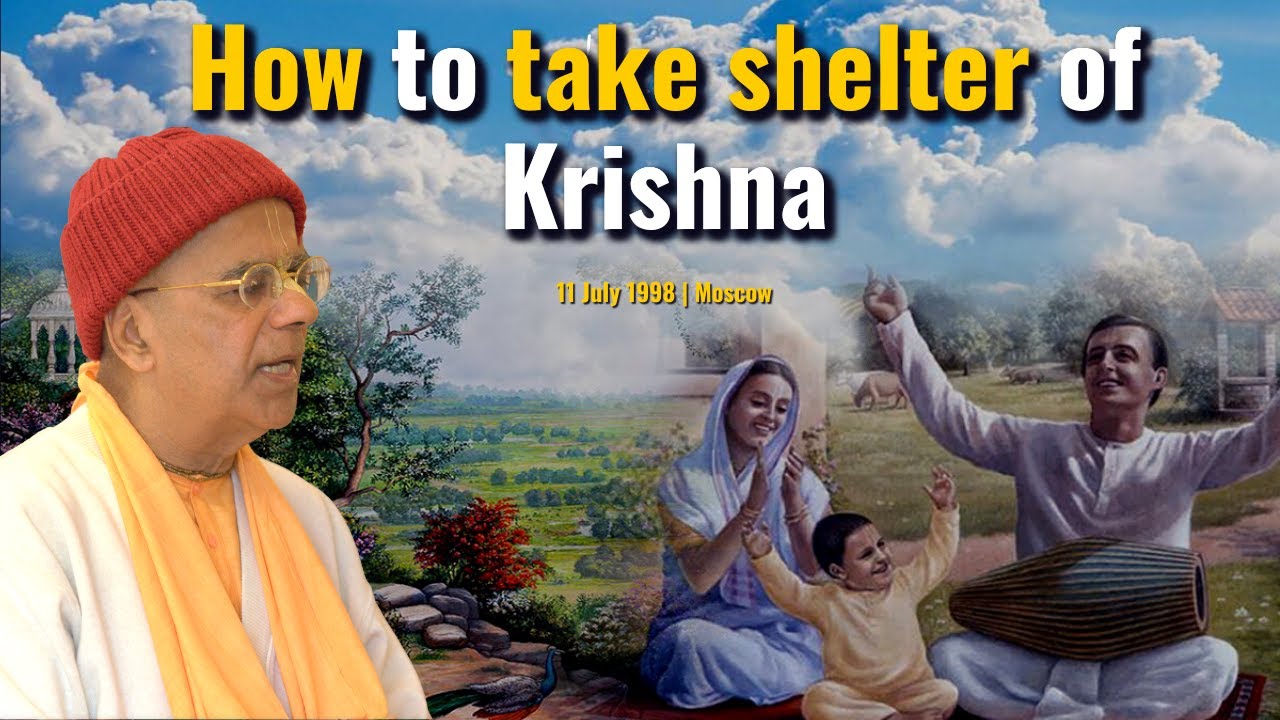
In this lecture, Śrīla Gopāl Kṛṣṇa Goswāmī Maharaja recounts a series of hagiographic episodes from the life of Lord Caitanya and his close associates, using them to illustrate core Gaudiya Vaishnava doctrines. He tells the compassionate sacrifice of Vasudeva Datta, the thwarted Buddhist conspiracy that ends with the Hare Krishna mantra reviving a guru, and the miraculous prasad episode that shows Lord Caitanya’s divine appetite. He then describes the strained yet loving relationship between Caitanya, his mother Saci, and Advaita Acharya, followed by a vivid narrative of Brahma’s visit to Krishna in Dvārka that demonstrates Krishna’s opulence. From these stories he derives theological points: where Krishna is present, Maya has no room; even a moment’s association with a pure devotee plants the seed of bhakti; and the qualities a devotee should cultivate. The core of the talk is the exposition of the six principles of śaraṇāgati (surrender) that Caitanya gave to Sanātana Gosvāmī—accepting the favorable, rejecting the unfavorable, trusting Krishna’s protection, recognizing Krishna as the sole maintainer, self‑surrender to Krishna’s will, and humility. The lecture ends with practical advice on how surrender purifies the heart and overcomes material passions.
Chapters
Hare Krishna. Hare Krishna. So we are at the point where we were discussing Lord Caitanya's instructions to Sanatana Gosvāmī. We finished discussing the Lord's instructions to Rūpa Gosvāmī. Yesterday we also described to you about Lord Caitanya's tour of southern India and how he converted all of southern India to Vaishnavism. I'll tell you two quick short stories and then I'll go to the teachings because there's a lot of philosophy in the verses we're discussing today. So when Lord Caitanya was touring, there was a devotee called Vasudeva Datta who was very compassionate. Vasudeva Datta was considered an incarnation of Prahlad Maharaj. The story I gave you yesterday was about a devotee called Vasudeva Vipra. Today I'm telling a story of Vasudeva Datta. So don't confuse the two. Both were very compassionate. So Vasudeva Datta went to Lord Chaitanya and said, "Please give me a favor." "What favor do you want?" "Please take everyone back to Godhead and let me stay and eat the suffering." "Undergo the suffering." "I'll take on the suffering due to everyone." You transfer their karma to my account and you please deliver all of them. So Lord Caitanya was very pleased by this devotee's compassionate mood. Nobody normally says, "Okay, you become okay and transfer your pain to my account." So Lord Caitanya said, "By a Vaiṣṇava's desire, a whole universe can be delivered." So Lord Caitanya was We explained the other day the story how he convinced, converted all the Mayavadis to the path of personalism. So once Lord Chaitanya had defeated the Buddhists in a discussion about philosophy. So the Buddhists were feeling very embarrassed that their guru got defeated by Lord Chaitanya. So they wanted to take revenge. So they made a conspiracy. They brought some contaminated food in a plate and they said, Lord Chaitanya, we brought some nice cake for you, nice prasada. We have some cake for you today also. So, as they were going to offer that prasada to Lord Chaitanya, an eagle, a big bird came from the top, took that contaminated food in its mouth and dropped the metal plate on the head of the guru of the Buddhists. And when the metal plate dropped on the head of the guru, he fainted. So the disciples were feeling guilty that we were trying to embarrass Lord Caitanya. Now our guru has become unconscious. So they went to Lord Caitanya and revealed that this was a conspiracy to embarrass him, and so now they are suffering the reaction. So Lord Caitanya told them, go and whisper the Hare Krishna mantra in the ear in the ear of your guru. So they went and whispered the Hare Krishna mantra in the ear of the guru, and the guru came to consciousness, and they all became Vaishnavas. They all started chanting and dancing. Once when Lord Caitanya was in Jagannath Puri, all his devotees were coming from all over Bengal to visit him. They were all bringing some prashads for Lord Caitanya and giving it to his secretary. Gourminda. So one day, but Lord Caitanya was not eating the prasad. He was just telling his secretary, "Keep it in the room, just store it." So the whole kobna of the next door was full of prasad. And all the devotees who had come with offerings for Lord Caitanya, they would give the prasad, write their name on the top, and then they would come to Gourminda and ask, "Will Lord Caitanya eat the prasad?" He would say, "Yes." "Did he like it?" He would say, "Yes." He said, "Lord Caitanya liked your cooking very much." Lord Caitanya yeli prasadam skandha. So Govindāo knew that actually Lord Caitanya was not eating prasada. It was all lying in the room next door. And he was lying to everyone who prepared prasada by telling them Lord Caitanya has eaten prasada. So finally he went to Lord Caitanya and said, "All your devotees are bringing prasada." giving it to me and then asking me if you have eaten and you liked it. And I am telling everyone a lie that you ate it and you liked it. So Lord Chaitanya said, "Okay, bring all the prasad." There was enough prasad stored over there to feed at least 100 people. And Lord Chaitanya ate all that prasad within minutes. So to satisfy Govind Das, of course Lord Chaitanya as Lord Jagannath is eating prasad 56 times a day. In which temple? Jagannātha Puri. So for the Lord, e-prasāda for 100 people is no problem. The other day I was lecturing to you about Vaishnava prasāda, which is part of Lord Caitanya's teachings to Rūpa Gosvāmī. This is part of Lord Caitanya's teachings to Rūpa Gosvāmī. So, Mādhura Sācī, the mother of Lord Caitanya, was under the impression that her husband took, that her son Lord Caitanya took sannyāsa because of Advaita Ācārya's influence. So she would always say, she was, she had a little bit of anger in her heart towards Advaita Acharya. So Lord Caitanya would always tell mother, tell that you have to apologize to Advaita Acharya for thinking like that. And whenever his mother would be there, Advaita Acharya would just glorify her after she was the mother of Lord Caitanya. So one day after when Lord Caitanya revealed His transcendental form, Advaita Ācārya was offering obeisances to the Lord. And Mother Saci came from behind and touched His feet. And so Lord Caitanya, when He saw His mother touching Advaita Ācārya's feet, He was very happy. Because she was begging for His forgiveness of thinking that her son, that Advaita Ācārya was the cause of her son taking sannyāsa. Lord Caitanya and Advaita Ācārya had a very unique relationship. Advaita Ācārya knew that Lord Caitanya is God. So Advaita Ācārya would treat Him and give Him the respect of the Lord. But Advaita Ācārya was senior to Him by age. And Caitanya Mahāprabhu would be very respectful to Advaita Ācārya. He would treat him like his grandfather. But Advaita Ācārya wanted to be chastised by Caitanya Mahāprabhu. So he thought of a trick. He spread the rumor that he is spreading Mayāvādī philosophy. So whole town started saying, "Oh, Lord Advaita, look what's happened. He's become a Mayāvādī." So slowly, slowly the news reached Caitanya Mahāprabhu. He asked Nityānanda if this was correct. Nityānanda said, "Yes, yā to dāvsluśla. I also heard that Advaita is now preaching Mayāvādī philosophy." Lord Caitanya was a staunch opponent of "Mayāvādī-siddhānta." So he went and he kicked Advaita Ācārya in anger. And Lord Advaita Ācārya was very happy. He said, "Bol shoyi spasi bā." Because he wanted to be chastised and the whole thing was a drama. So Lord Caitanya described to Sanatana Gosvāmī the opulence and sweetness of Kṛṣṇa. In describing the opulence and sweetness of Kṛṣṇa, Lord Caitanya gave a very wonderful story to show how vast the creation of the Lord is. This is a story that Lord Caitanya told Sanatana Gosvami to describe the greatness of Krishna's creation. The story is about Lord Brahma coming to visit the Lord in Dwarka. Actually, Brahma is a position. Śiva is also a position. They are like permanent governors. They are called chiraloka parna, which means permanent governors. Chiraloka pāla. Just like a governor is known as Rajpal, so they are known as chiraloka pāla. They govern the affairs of this universe. So once the four-headed Lord Brahmā had gone to see the Supreme Lord in Dvārka. But he was stopped at the doorkeeper. I think if you try to go to the Kremlin, you will probably get stopped also, isn't it? Is Naitékadya Kremlin? Okay, okay. So they got stopped by the doorkeeper. Doorkeeper said, "What do you want?" He said, "I want to see Krishna." So the doorkeeper went to the Lord and said, "Sir, somebody has come to see you. Brahma has come to see you." So Krishna said, "Please ask, which Brahma is it? Which Brahma are you?" Just like you say Vladimir, so you want to know fully Vladimir what. So he says, "Which Brahma?" "I am the four-headed Brahma, the father of the four Kumaras." So he was allowed in. As soon as he came in, he offered his respects. Kṛṣṇa asked him, "So, what can we do for you?" He said, "Before I ask my question, I have a question to you. Are there any other Brahmas besides me?" And he had not even finished asking his question when numerous other Brahmas came there. Some had 10 heads, 100 heads, 1,000 heads, million heads, trillion heads. Then there were many Shivas who came with many heads. Then many Indras came there. And they were all offering their respects to the Lord. They were all seeing the opulence of Dwarka. And they were thanking Krishna for having invited them. Now all these Brahmas, Shivas, and Indras could only see themselves and Krishna, not anybody else. Only the four-headed Brahma could see all the Brahmas, all the Shivas, all the Indras. And then the four-headed Brahma felt like a rabbit in the midst of elephants. So this story was explained by Lord Chaitanya to Sanatana Gosvāmī to show the opulence and sweetness of Kṛṣṇa. After all, Lord Caitanya directed everyone to surrender to Kṛṣṇa. We see Kṛṣṇa's opulences when He was in Dvāraka. How Kṛṣṇa expanded Himself simultaneously into 16,108 forms, and how He was present in each of these palaces with one of His queens. Performing a different pastime which totally amazed Narada Muni. So after describing the opulence and sweetness of Kṛṣṇa, Caitanya Mahāprabhu proceeded to explain how where there is Kṛṣṇa there will be no māyā. Just like when there is sunshine, there is no room for darkness. Just like we all have experienced When you have the light sunshine, then there's no room for darkness. When the militia is there, the thieves run away. So where there's Kṛṣṇa, there's no room for Maya. So what does it practically mean, where there's Kṛṣṇa? It practically means that where Kṛṣṇa is being worshiped and followed. If you're following Kṛṣṇa, worshiping Kṛṣṇa,, then there's no room for the illusory energy. Just like even when a child is holding his father's hand, then he has no fear of any stranger or anyone. Similarly, if we are holding Kṛṣṇa's hand by following His instructions, then Maya is going to be happily defeated. Just like the prostitute tried to seduce Haridas. She failed. Rather, she got cheated by his purity and she became a devotee. Similarly, Maya Devi incarnated as a very beautiful damsel and she also failed. So don't underestimate the potency of devotional service. Lord Caitanya then describes to Sanatana Gosvāmī the value of even a moment's association with a pure devotee. Even a moment's association, lava mata, lava mata is 1/14th of 1 second, you can get the seed of devotional service. Then Lord Caitanya proceeds to describe the qualities of a devotee, the 26 qualities of a devotee. I think all of you are anointed with these qualities. I was told that all of you said, filled in a form saying all of you have the 26 quality. Oh, someone gave me wrong information. And then Lord Caitanya described the 6 principles of surrender. First we'll discuss the 6 principles of surrender because that will take less time, and then we'll go on to the qualities that Lord Caitanya described devotees should cultivate. Anu kalasya sankalpa pratikulyasa varjanam raksheshyati vishvaso Gopatrī vārṇāṁ tathā ātmā-nakṣepa-kārpāñye sat-vidāśarṇāgati. Have you heard this word śarṇāgati before? Śarṇāgati means to surrender. In Canada we have a farm and the name of that farm is śarṇāgati. Big farm, about 2,000 acres. So we are all here because We are interested in śrī-nāgatī. If you don't take shelter of the Lord, then you are forced to take shelter of the illusory energy. So we have our choice. Now Lord Caitanya Himself gave 6 important points or instructions as to how we can achieve śrī-nāgatī. Lord Caitanya gave these instructions to Sanatana Gosvāmī. First thing Lord Caitanya said, "Accept everything favorable for spiritual advancement and reject everything unfavorable." We apply this theory in all our dealings. Just like you will only eat food what is good for your health and not take food which is bad. And if someone told you, "Take this nice cake, it's on a silver plate, but there's a drop of poison somewhere," you won't take it at all. You tell a businessman, "Okay, I want to buy this from you but at a loss," he won't sell it to you. So we should set everything favorable for rendering transcendental service to the Lord. So what's favorable? Attentive chanting of the Holy Name, reading, associating with devotees, serving, getting the opportunity to listen to philosophy. These are some samples of favorable conditions for advancement. Visiting the dham, staying in the dham, worshipping the Deity. Then there are factors that are unfavorable. What's unfavorable? You're not getting enough time to chant. You're too busy, too busy earning money, no time to do your 16 rounds. Or you do your rounds or do it in the middle of the night about to fall asleep, go on carrying, carryover debts. That's not good. Working very hard, over-enduring for material things, overeating. Eating more than necessary, keeping association of worldly-minded people beyond what is necessary. Whether you are a brahmachari or a brahmacharini or a grihasta, a certain amount of worldly-minded people's association is unavoidable, but don't associate more than necessary. Then engaging in idle talk known as prajalpa. Prajalpa spoils your spiritual creeper. Loliam, being greedy. Don't be greedy. We want more, more, more. These are some samples. Then the third principle of śrī-nāgatī is to understand that Kṛṣṇa will give me protection. So you must have faith that I am executing devotional service, I will definitely be protected by the Lord. Just like Kṛṣṇa tells Arjuna, declared to the world, "My devotee." So it's not that the devotee doesn't have to go through difficulties, or it's not that the devotee may not have to go through some inconveniences. Of course, based on our karma, we all have our quota of happiness and distress to experience. But the point is that the devotee knows that if there is some suffering, It's the Lord is still protecting me, but due to my past sinful activities, this suffering has been greatly minimized. So Kṛṣṇa is very merciful to His devotees, and a devotee knows that Kṛṣṇa will give me protection, and this devotional service will not go in vain. Then the fourth is the devotee must understand that Kṛṣṇa is his maintainer and protector, and not any demigod. Kṛṣṇa is our only Master. Eka-lā Īśvara-kṛṣṇa artha-bṛtaya. Kṛṣṇa is the only Master and all others are His subordinates. So this must be our understanding, that Kṛṣṇa is our maintainer. When, like Kṛṣṇa says in the Gītā, "I am the source of everything material and spiritual." Devotee is convinced that within the three worlds there is no one else who is his maintainer and protector. Other than Kṛṣṇa. Then the next 5th principle of surrender is self-surrender. So devotee understands that nothing is in my hand, that ultimately everything depends on the sanction of Kṛṣṇa. The devotee is completely dependent on Kṛṣṇa and he thinks and acts as Kṛṣṇa desires. Surrender for devotee means that our desires are consistent with Kṛṣṇa's desires. So if you accept what is Kṛṣṇa's desire, then your mind will always be shanta, peaceful. Many times devotees complain, "My mind is agitated, mind is disturbed." You want to know what the reason is? The reason is you lack— your peacefulness goes away because on the one hand you want spiritual life, on the other hand you want material life. So if you want both spiritual life and material life, That's when your mind is unpeaceful. But if you're only maintaining spiritual desires and the desires based on instructions of guru and Kṛṣṇa, then your mind will always be peaceful. Rukmini was about to be married to Śrīṣupala. She sent a brahmin with a message to Kṛṣṇa, "Come and save me. I'm about to be married against my wishes." Krishna received the Brahman, washed his feet, and he asked a question. He said, "Is your mind peaceful?" Because unless the mind is peaceful, it's hard to execute devotional service. So the solution to an unpeaceful mental situation is attentive chanting and absorption in the instructions of the Lord coming through the parampara. And the last principle of surrender is humility. Humility is the wealth of a transcendentalist. In the material life, nobody wants to be humble. They think to be humble is a sign of weakness and defeat. So they love to be proud, arrogant, insulting, snubbing. Snub, insult. But a devotee's wealth is humility. We gave you the story the other day of Lord Chaitanya. How he was not sitting with the Mayāvādī sannyāsis. Where was he sitting? Where people wash their feet. And when they said, "Why aren't you reading the Vedānta?" He said, "My spiritual master thought I was a fool." So he said, "Just check." Lord Caitanya had a spiritual uncle called Rāmachandrapuri. He used to criticize Lord Caitanya. Once he came to Lord Caitanya's room on a hot day. And he saw a lot of ants crawling. And he said, "Oh, you must be, must have eaten a lot of sweets." Actually, Lord Chaitanya was very strict sannyasi. But he was trying to ridicule, "Hey, you are eating sweets. So now the ants are there because some sweets have spilled over." So Lord Chaitanya completely stopped eating. And every time he would see him, he would offer him respects. So humility is— you'll never be a loser by being humble. As some of you may know, at one time Śrīla Prabhupāda was in the pharmaceutical business. So once Prabhupāda had prepared a vitamin tonic and he was showing it to one of his godbrothers. So Prabhupāda's godbrother said, "Āmē bābhu, give me a tonic by which I can develop love of God." If somebody had a stall over there selling a bottled tonic. So he told Prabhupāda, "Give me a tonic by which I can develop love of God." So Prabhupāda was always very humble. He said, "I know the formula, but the medicine is not ready as yet." Jnānapīsuni cēna tarorupīsāya namaninamānānana ketanādi sādhāriṇa. To chant the Holy Name to the Lord, in a humble state of mind, to consider oneself lower than the straw in the street, devoid of all sense of false prestige, more tolerant than a tree. Here on this campus, there's so many trees. I'm sure some of you are sleeping underneath trees or your tent is underneath the tree. So the tree is very tolerant, both in summer and in winter. Summer, you take shelter of the branches of the tree. In the rainy season, you run and take shelter of the tree. And then when the tree gets old, they cut the tree and use it for fire. And it doesn't protest. Become more tolerant than the tree. So humility is the 6th principle of sharnāgati. So this, these 6 points of surrender that you often hear, now you know were given by Lord Caitanya to Sanātan Gosvāmī. You not forget them? No. Accept everything favorable, reject everything unfavorable. Understand that Kṛṣṇa is your protector, then He is your master. Self-surrender and humility. So if you remember these 6 points and you use these 6 points in guiding your actions, the spiritual life will be a lot smoother. Often devotees want to know How can I develop this mood of surrender? Deep in your heart, I am sure you all want to surrender. Something is holding you back. Krishna was asked by Arjuna, "How is it that one is compelled into sinful acts even unwillingly?" And what did Krishna say? It is lust only. —"The all-devouring enemy of the living entity is always burning like fire and is never satiated." So we have a solution. We're not scared of lust, anger, greed, envy, hatred, etc. Because our solution is the process of bhakti. If you take shelter of the process of devotional service, then you can overcome these influence of anārthas. Kṛṣṇa says, devīśa gunamāyimamamāya duratyā, mām evāme prapadyante māyāmitāṁ tarandhite. That to overcome this illusory energy is very difficult, but if you surrender to Me, then you can overcome. And the more you surrender, the more you purify yourself, the greater will be the sweetness of devotional service that you will relish. So all of you are very fortunate because you have taken to the process of devotional service. As Rūpa Gosvāmī said, Achaitanya Mahāprabhu said to Rūpa Gosvāmī, "Please keep watering this process and the seed will grow." Hare Kṛṣṇa.
More from PRASAD

Rare Pastimes & Timeless Lessons of Guru Mahārāja | Stories Every Disciple Should Hear

ISKCON Legends- pure devotees meet-HH Jayapataka Swami, HH Gopal Krishna Goswami, HH Radhanath Swami



Jagannātha Ratha-yātrā Through Śrīla Prabhupāda's Mercy | 29 April 2006 | Nairobi, Kenya

Lord Jagannātha's Appearance Pastime | 21.07.2019 | ISKCON Calgary | Śrīla Gopāla Kṛṣṇa Gosvāmī

The Ācārya Teaches by His Own ExampleGuṇḍicā Mārjana by Guru Mahārāja #shorts

Guṇḍicā Mārjana – Lord Jagannātha's Pastime | 21.7.2019 | ISKCON Calgary |Śrīla Gopāla Kṛṣṇa Gosvāmī

H.H. Gopāla Kṛṣṇa Gosvāmī Mahārāja - Exemplary Sādhana and Deity Worship # shorts

भगवान की कृपा कैसे प्राप्त होगी ? | 11 Jan 2014 | Punjabi Bagh | Srila Gopal Krishna Goswami

Material Education vs Spiritual Education | Srila Gopal Krishna Goswami #shorts