Inauguration of Krishna Balaram Temple Vrindavan | 8 Apr 2015 | Srila Gopal Krishna Goswami Maharaja
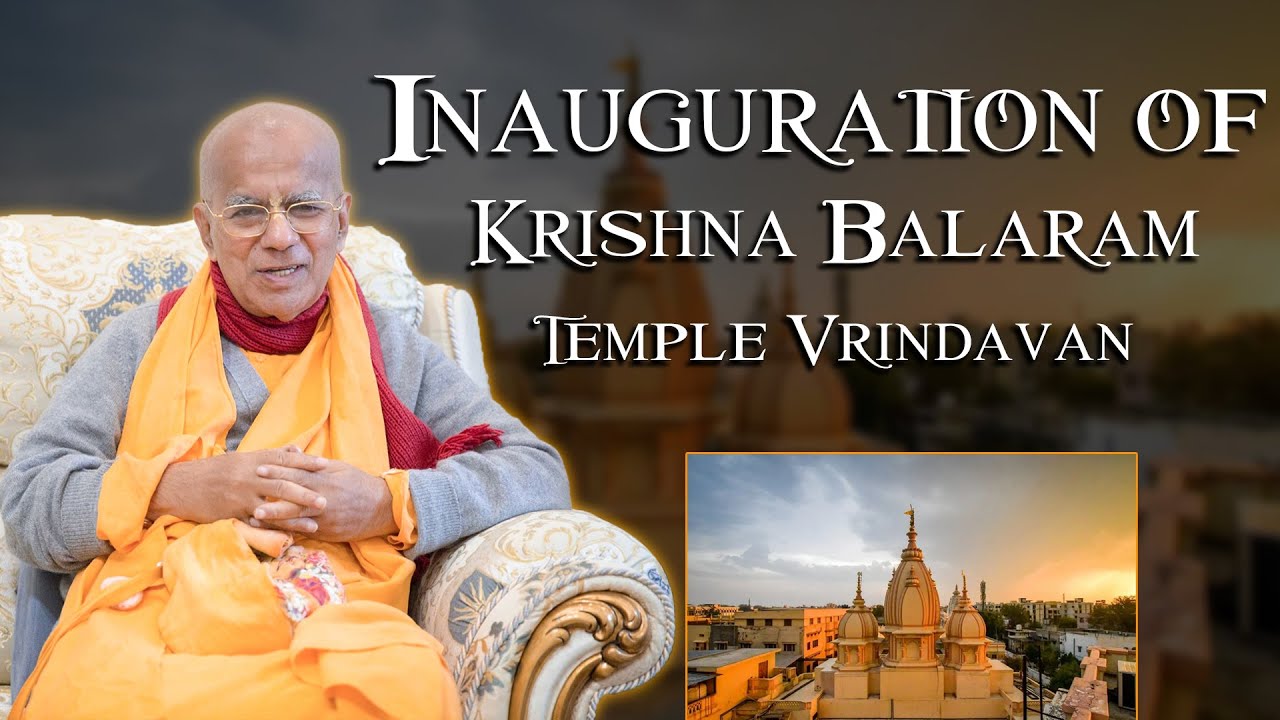
The video records Prasad Raval’s formal inauguration address at the 40th‑year celebration of the Krishna Balaram (Rādhā‑Nāmī) Temple in Vrindavan. Raval uses the occasion to trace the temple’s origins from A. C. Bhaktivedanta Swami Prabhupāda’s early devotion to Vrindavan, his departure to the West, the founding of ISKCON, and his return to India in the late 1960s with a vision of a permanent center for Western disciples. He recounts the search for suitable land, the pivotal donation by Mrs. Shroff (the Shroff family), the dramatic “yes/no” divine decision, and the legal registration of the 4,800‑yard plot on 12 March 1972 followed by the bhūmi‑pūja on 13 March 1972. Raval details the logistical hurdles of construction in early‑1970s India, the teams (Guru Naz, Yama Mataji, Surab, Bananawa, etc.), and Prabhupāda’s hands‑on management of finances and timelines. He narrates the shifting opening targets (Janmashtami 1973, then 1974, finally the Rādhā‑Nāmī inauguration on Rādhā‑Nāmī 1975) and the ceremonial aspects, including involvement of local pundits and the presence of dignitaries such as the Governor of Andhra Pradesh. The speech also references the Mayapur‑Vrindavan Festival, the massive international attendance (including a chartered 747), and the evolution of devotee demographics. Raval concludes by thanking organizers and celebrating the continuity of the temple’s mission over four decades.
Chapters
PRASAD RAVAL. I want to welcome all of you to this grand 40th anniversary celebration. I was requested to formally inaugurate this festival. The first aspect was lighting the lamp. That was done by Sarup, other senior devotees present here. And I thought that on this occasion we could— I could present some of the events that took place that eventually led to the inauguration of the temple on Rām Nāmi, 1975, 40 years ago. As we know, Prabhupāda had a very deep relationship with Vrindāvana. Prabhupāda, he has a famous quote, "Bhagavan in my office, Vrindāvana in my home, and Mādhava my place of worship." So Prabhupāda spent considerable, considerable time in Vrindāvana. After taking sannyāsa on 17th September, 1959, Prabhupāda came to reside at the Rādhā-Dāma Temple. While residing over there, he translated his Śrīmad-Bhāgavatam. He would regularly travel from Mathura to Vrindāvana in third class. You don't even have these third class compartments anymore. And get his books printed in Delhi. Single-handedly translating the books, collecting the luxury to finance the books, supervising the production, and then distributing the books. So Prabhupāda started all this activity, the Bhāgavatam translation in Vṛndāvana, and then after a long struggle, Prabhupāda finally sail to America on 13 August '65. This year actually is very significant for devotees because this year we are celebrating the 50th anniversary. We are celebrating over here right now the 40th anniversary of the opening of the Vrindavan Temple, but in August We are going to celebrate the 50th anniversary of Prabhupāda's departure from India for America. The next year we are going to celebrate the 50th anniversary of the incorporation of ISKCON. Prabhupāda sailed to America in August '65, and on September 17th, He reached America. And after reaching America, again it was a struggle. And Prabhupāda had to very intensively struggle for nearly 1 year. And after that he formally incorporated ISKCON on 11th July, 1966. Nearly 50 years ago. And then Prabhupāda started his preaching movement. Open the temple in New York, San Francisco. But then in May '67, I believe it was May 31st, he had a heart attack while he was in San Francisco. And then Prabhupāda decided to come to Vrindavan to recuperate. Prabhupāda spent nearly 5 months recuperating in Vṛndāvana in '67. But at that time, Prabhupāda was intensively also— while recuperating, he was also searching for a place where he could establish a center in Vṛndāvana. He wanted a center in Vṛndāvana where his foreign disciples would come and study Sanskrit and the Vedic literature. And Prabhupāda was talking about calling it the American House or the Indo-American House. And Prabhupāda was actively looking for some land There was some possibility of getting some land near Rādhā-nāmḍa temple, but that fizzled out. And then again there was some possibility of getting some land near Keshava-garh, but that also didn't happen. So Prabhupāda came in May, in June to India. He stayed in Vṛndāvana till almost December, and by December his health had recovered. And then Prabhupāda went back to the West to resume his preaching activities. And in 1970, ISKCON purchased the Rukmini Markandeya Temple in Los Angeles. This was the first major temple that was established by ISKCON. And Prabhupāda installed the Devis. He named them Rukmini-Dvārka Devis, and he declared Los Angeles to be his world headquarters. And they were even, at least in North America I remember, they were even going there to get treatment and so on. So Prabhupāda, this what I'm going to reveal, was revealed by Prabhupāda. Prabhupāda in a conversation with Tamalakṛṣṇa Mahārāja in June '77. June '77, Prabhupāda was talking to Tamalakṛṣṇa Mahārāja about this incident that took place in 1970. One day, Prabhupāda was standing in front of the Deities or Rukmi Dvārka-dēsa. And the Lord, Lord Dvārka-dēsa, told Prabhupāda, "Now you should go back to Vṛndāvana." Prabhupāda said, "I came here to carry out my guru's order." to establish, and now I want to train up the Western youth in America. And my godbrothers are there in India. They'll take care of India. And the Lord said, "No, you were settled in Vṛndāvana. I brought you to the West. Now," I want you to go back to Vṛndāvana and I'll give you a facility better than what you have in Māsādhara. So Prabhupāda was ordered by Vārṇabhāda to come back to Vṛndāvana. And this was personally made by Prabhupāda personally. Prabhupāda said, "I wanted to stay in the West, but the Lord ordered me to go back to Vṛndāvana." India. So then finally, then Prabhupāda with his group of Western disciples— at that time there were virtually no Indian disciples, at least in India— so Prabhupāda then with his Western disciples came back to India. They started having Pandava programs in different parts of India. Some of the panda programs were so successful, they were attracting over 20,000 people. Prasad Raaval had major pandas in different parts of the country. And I believe there was a big panda program held in November in Delhi, which was also very well attended. So Prabhupāda then came to Vṛndāvana. He brought his Western disciples, they were there for 5 days. Prabhupāda took them on parikrama to different locations. And Prabhupāda was residing at the Rādhā-Dāmbura temple. And Prabhupāda's real goal was to get a center established over here. When Prabhupāda came back with the Western disciples, he was given a very warm welcome by the mayor and citizens of Vrindavan. There was a big function in which Prabhupāda was honored, and the mayor gave a long talk. The gist is, he said, Prabhupāda did the impossible. Prabhupāda took Vṛndāvana to every corner of the globe. And Prabhupāda had the vision to preach the message of Vṛndāvana globally. And he said the proof is all these Western devotees were present in front of us. So it was a long speech in which Prabhupāda was glorified and for his achievements. So that time Prabhupāda also came in touch with the Śrīla family. Mr. and Mrs. Śrīla were pious people. They had— Prabhupāda had— Prabhupāda had kirtan in their house on a few occasions. So one day Prabhupāda told them, "I want some land in Vrindavan where I can build a temple." So Mrs. Shrawl said, I have land in Vṛndāvana, but it's very, very far. Nobody will ever go there. It's in Ramanreṇi. And at that time, Ramanreṇi was considered to be another town, not integral part of Vṛndāvana. And the passage from Vṛndāvana to Rāmadvārati was so dangerous that nobody would even walk in the evening in this area. So, Prabhupāda sort of, in a way Śrī Caitanya Mahāprabhu was discouraging Prabhupāda from even seeing this land. Prabhupāda said, "No, no, no, I want to see." Sāvatī Śrī Rāma took Prabhupāda in his car and brought Prabhupāda to Ramanreti. Ramanreti, when Prabhupāda came to Ramanreti, when Prabhupāda came to Ramanreti, he was very, very happy. He said, "This is the place where Kṛṣṇa Mahārāja performed His childhood pastimes." I would like to build a temple over here. And Mrs. Prasad: "In our gravy you want to build a temple? It's so far." This reminded me of what took place in Bombay when Mohammed Mandir Math temple was in Akash Ganga on Warden Road. When Prabhupāda was looking for a location, to build a major temple. And if Prabhupāda found this place in Juhu, that time Juhu was considered too distant, and Prabhupāda wanted to take that place, but his disciples said, "Prabhupāda, Juhu, nobody's going to come. We should not have a temple there." But Prabhupāda, as usual, always had the right vision. So Mr. Sharāb was telling Prabhupāda that this place is very, very far. No one's going to come over there. But Prabhupāda over here says, "Oh, this is where Kṛṣṇa in Vāraṇa performed His childhood pastimes. I'd like to construct a temple there." Prabhupāda Āśrava, "You want to sell this land or donate this land?" Sir Mr. Śrāv said, "Land is registered in my wife's name." So Prabhupāda had to wait for a few months till Mrs. Śrāv came. And Mrs. Śrāv was a pious lady. Mr. Śrāv was also very pious, but she was relatively little. Remotest past. So Mrs. Shroff, she already came, she met Prabhupāda, and Prabhupāda asked her, "Would you donate this land?" And Mrs. Shroff readily agreed to donate the land. Whatever her original plan was, The front of the land they would keep for themselves so that they could make some shops to give them some income, and the back portion of the land was ready to give. But there was a very interesting development that took place at this point. After Mrs. Shoroff agreed to donate the land to Prabhupāda. She— there was strong opposition to this idea from two other so-called spiritualists. It appears that other spiritual organizations had also approached Mrs. Sharaf for land, for the same land in the park. And Mrs. Śrīla Rādhā had given some type of commitment to two other spiritual organizations. So when these organizations, when these individuals heard that the Śrīla Rādhās donated this van to Prasāda Rāval, Then they were furious. They threatened violence. And Mrs. Shroff was in a real dilemma. What to do? She wanted to give it to Prabhupāda. But at the same time, she had in the past given some type of verbal commitment And she was really in a dilemma what to do, and she was having second thoughts about giving the land to Prabhupāda. So, she told the devotees that, "I don't know what to do now. These people are threatening violence." So, the news was sent to Prabhupāda. By this time, Prabhupāda had resumed his world tour, his global traveling. And so, at that time, Śrīrodakṣaya Viṣṇu, he's no more, he was the president of the Vṛndāvana Temple for some time. So Prabhupāda told Śrīrodakṣaya Viṣṇu, to go and meet Mr. Shroff. So, Śrīla Nityānanda Kṛṣṇa went and told Mr. Shroff, "You already promised this land to Prabhupāda. Now you can't take it back." So, Mr. Shroff said, "I can't decide who the land should be given to now. I will let my Radha-kundmari ladies decide." Radha Kunj Bihari, Kunj Bihari is not. Radha Kunj Bihari is the name of the Sharad family's household Deity. I believe we are going there on a pilgrimage the after tomorrow. So all of you will have an opportunity to have darshan of Radha Kunj Bihari. They are coming here. They are coming here? No, we are going there too. We are going to bring the Deities from there. They're going there and then bringing the needy here. So she said, "I'm going to let Adakuntmi Hari decide who should get the land." Very well. So she devised a very unique formula. She took two small pieces of paper, wrote "yes" on one and "no" on the other. And she didn't speak English. She wrote this in Hindi. She said, "I'm going to keep these two slips of paper at the feet of my deities, and I will let them decide if I should give this land to Prabhupāda." So she kept one yes, one no, and she asked Śrī Rādhā-Kṛṣṇa-Vṛṣṇa, to pick one of the two. And by Krishna's arrangement, he picked the paper that had a yes on it. So when she saw the yes, he said, "Now it's final. This land is going to Prabhupāda." Ready? Ready! 5 of 5. So then we decided this land will go to Prabhupāda. But still all the problems are over. The front of the land, Mrs. Śrīla wanted to keep for herself. So Prabhupāda, Mrs. Śrīla was away when Prabhupāda came to Vrindavan. And then When Mrs. Śrāv came back, Prabhupāda called her and preached to her. Prabhupāda said— but this time Mrs. Śrāv had already decided the land is going to Prabhupāda. The front of the land will be kept to make some shops for commercial purposes. So, but Prabhupāda wanted the front portion of the land also to be make a nice entrance. He wanted a nice gate. So when Mrs. Śrīvāt came back, Prabhupāda preached to her. Prabhupāda said, "We want to make a nice gate." And Prabhupāda preached to her. The mother, she said, he said, "You want Kṛṣṇa as your son, and how the son is very dear to the mother." So Prabhupāda preached to her, and in the end she decided that Prabhupāda can have the whole land. Hare Kṛṣṇa! She gave up her idea for having shops in the front. So the entire plot of 4,800 yards was donated to Prabhupāda. Prabhupāda ki. And then Prabhupāda wanted to register the land in His Kṛṣṇa's name as soon as possible. So Prabhupāda then arranged to call a judge from Mathura. And on March 12th, 1972, this land was registered in ISKCON's name. Shri Prabhupāda kee? Prasad Raaval. So 1972, March 12th, the land was registered in ISKCON's name. And you know when Prabhupāda laid the foundation stone and started the construction? On March 13th. On March 12th, 1972, Prabhupāda got the land registered in his company. And on March 13th, 1972, he did the bhūmī-pūja and started the construction for this temple. And at that time, the devotees were leaving the Rādhā-dāma temple. The construction started. They would come regularly doing Hare Naam over here. And basically there were 3 teams of devotees that got established in different fields. You had Guru Naz and the late Yama Mataji overseeing the construction, ah no, overseeing the temple. And later on they were very involved in getting the deities made. Then you had Surab and Bananawa, Surab and Bananawa, who took care of the construction. Construction in those days was not so easy as it is now in India. At that time in India, everything was very controlled. You could not even buy cement and steel deal in the market unless you got some special permit from the government. I mean, these days you can go and buy from the open market anytime, but those days you had to get a special permit. So even if you wanted to go fast on construction, you couldn't go fast. So on March 13th, construction started. The foundation stone was laid. And Prabhupāda started the construction right away. So, Gunananda and Surabha were looking after the construction. Gurudāsa and Yamnam were looking after the temple. And Guru Kripa, and Guru Kripa and his team was providing the luxury from Tokyo, collecting in Japan. And the devotee was also spending money. Prabhupāda again returned to Vṛndāvana with his Western disciples on October 14th, 1972. Prabhupāda landed in Delhi on October 14th, and he wanted— his plan was to spend all of Karthik Kārtika was from October 1572 to November 15th. So Prabhupāda came and stayed in Rādhānanda Temple for one month. Prabhupāda was lecturing every morning on Śrīmad-Bhāgavatam and every evening on nectar of devotions. And Prabhupāda was really given a very, very warm welcome by the citizens of Vrindavan. First, he was given a warm welcome in 1970 by the mayor and the citizens. And then when he came in '72 with his foreign disciples, Dr. Gopil Kapoor, who was Prabhupāda's godbrother and a resident of Vṛndāvana, New York, and I will give for him. He was asked to formally inaugurate the festival and receive Prabhupāda. So Dr. Gopil Kapoor gave a wonderful talk describing what Prabhupāda has done. Both the Chaitanya Mahāprabhu's prediction, the Holy Name will be chanted in every town and village of the world. And then He went on to say that I have a secret realization, and that is— and He was speaking in the Rādhā-nanda Temple. He said, Rūpa Gosvāmī, Rūpa Gosvāmī, Kṛṣṇa-dāsa Kavirāja. The samānis are all here in this very auspicious location. And Prabhupāda is being appreciated, not just by us, but Prabhupāda is also getting the blessings of Rūpa Gosvāmī, Kṛṣṇa-dāsa Kavirāja. And they are blessing Prabhupāda for what he has done. And they are saying, "Long live Prabhupāda, long live Prabhupāda." Which is true. And he said that they are not only blessing Prabhupāda, but they are also blessing Prabhupāda's disciples who are helping Prabhupāda. Pushing this moment. So Prabhupāda, the construction in 1972 had started. Prabhupāda was traveling all over the world. Prabhupāda was always very concerned about his Western disciples getting cheated, and they didn't have enough Indian experience. So believe it or not, Prabhupāda had such a tight system of management that the bills, he would approve the construction checks, sign the checks, even when he was traveling abroad, and then bring the payment, he would check everything. So Prabhupāda was very keen that the temple be completed as soon as possible. At one point, Prabhupāda wanted the temple to be opened on Janmashtami, 1973. Imagine, construction started in '72, and Prabhupāda told the devotees that if possible we can even open the temple in sections. By sections it meant, just as he told the devotees, the whole temple doesn't have But the devotees realized that that's almost impossible. So Prabhupāda gave up that idea. And then Prabhupāda said, "Okay, we'll open by Janmashtami, 1974." And Janmashtami in '74 was on August 9th. So Prabhupāda was hoping to get the temple opened by August 9th, 1974. So Prabhupāda started writing to his devotees all over the world, "We're going to have a grand opening in August '74, and all of you should make plans to come." And, but Prabhupāda was planning and communicating with We want to open the temple in August. But on the ground, the situation wasn't that rosy. Prabhupāda was getting letters that, "Yes, yes, we'll be ready for the opening." And then Prabhupāda came to Vrindavan on August 4th. And when Prabhupāda came to Vrindavan on August 4th, he walked around, he looked everywhere. And he said, "No, we can't open in this environment. This is far from complete." He talked to Surabha, and Surabha also said, "No." So Prabhupāda said, "No, no, what are we going to do? We've told the whole world we are opening and now we are not opening." And then the devotees told him, "No, we didn't inform the people in the town." And then finally it was decided, Prabhupāda decided, that we will open a temple on Rādhā-Nāmī, 1975. So devotees were working very hard and the devotees went on a marathon. And finally the temple was opened. When? Rādhā-Nāmī. So that was a grand opening. Prabhupāda personally organized every aspect of it. Prabhupāda emphasized during the opening that the real highlight of the opening is the Āinām kīrtana. But Prabhupāda was also concerned that if we did not involve local brahmins in the installation ceremony, that they would not accept the Devis as duly installed. So under Prabhupāda's supervision, the local pundits were invited to install the Devis, and the main highlight was the chanting of the Holy Name. And it was a festival. And eventually his Deities were restored 40 years ago, Rādhā-nāmī. And Dr. Cheddar Reddy, who at that time was the Governor of Andhra Pradesh, came as a chief guest. So the whole ceremony was done under Prabhupāda's supervision. And that is the 40th anniversary that we are celebrating. So, it all happened in the Prabhupāda civilization. And also this coincided with the annual Māyāpur Vṛndāvana Festival. Around 1972, Prabhupāda started the Māyāpur Vṛndāvana Festival. And the opening was kind of jasmāsmī. At that time the devotees The whole world also come from. And over 1,000 devotees came from the West for that ceremony, for that Mahāprabhu Nāma Festival. I believe they chartered a— one of the devotees in Los Angeles who used to organize the festival, they chartered a whole 747 Boeing. Can you believe it? They chartered a whole 747 Boeing. This was the first time a 747 Boeing landed in Calcutta. Because devotees were headed for Mayapur. And at that time, most of the devotees who would come for the festival were from America. Now that pattern has changed. Now most of the foreign devotees who come to the festival are from Russia. Anyway, there were over 1,000 devotees who came to the festival, and my parents sent me. So that's the 14th anniversary we're celebrating now. So we hope that all of you will enjoy the festival. I wanted to take this opportunity to also thank Pāñchagodapa Ruchani, Kusumataji, and the other devotees who have worked hard to plan this festival and hopefully make this festival a good success. Thank you very much.
More from PRASAD

Rare Pastimes & Timeless Lessons of Guru Mahārāja | Stories Every Disciple Should Hear

ISKCON Legends- pure devotees meet-HH Jayapataka Swami, HH Gopal Krishna Goswami, HH Radhanath Swami



Jagannātha Ratha-yātrā Through Śrīla Prabhupāda's Mercy | 29 April 2006 | Nairobi, Kenya

Lord Jagannātha's Appearance Pastime | 21.07.2019 | ISKCON Calgary | Śrīla Gopāla Kṛṣṇa Gosvāmī

The Ācārya Teaches by His Own ExampleGuṇḍicā Mārjana by Guru Mahārāja #shorts

Guṇḍicā Mārjana – Lord Jagannātha's Pastime | 21.7.2019 | ISKCON Calgary |Śrīla Gopāla Kṛṣṇa Gosvāmī

H.H. Gopāla Kṛṣṇa Gosvāmī Mahārāja - Exemplary Sādhana and Deity Worship # shorts

भगवान की कृपा कैसे प्राप्त होगी ? | 11 Jan 2014 | Punjabi Bagh | Srila Gopal Krishna Goswami

Material Education vs Spiritual Education | Srila Gopal Krishna Goswami #shorts