Increasing bodily needs are not symptoms of Spiritual advancement | Srila Gopal Krishna Goswami
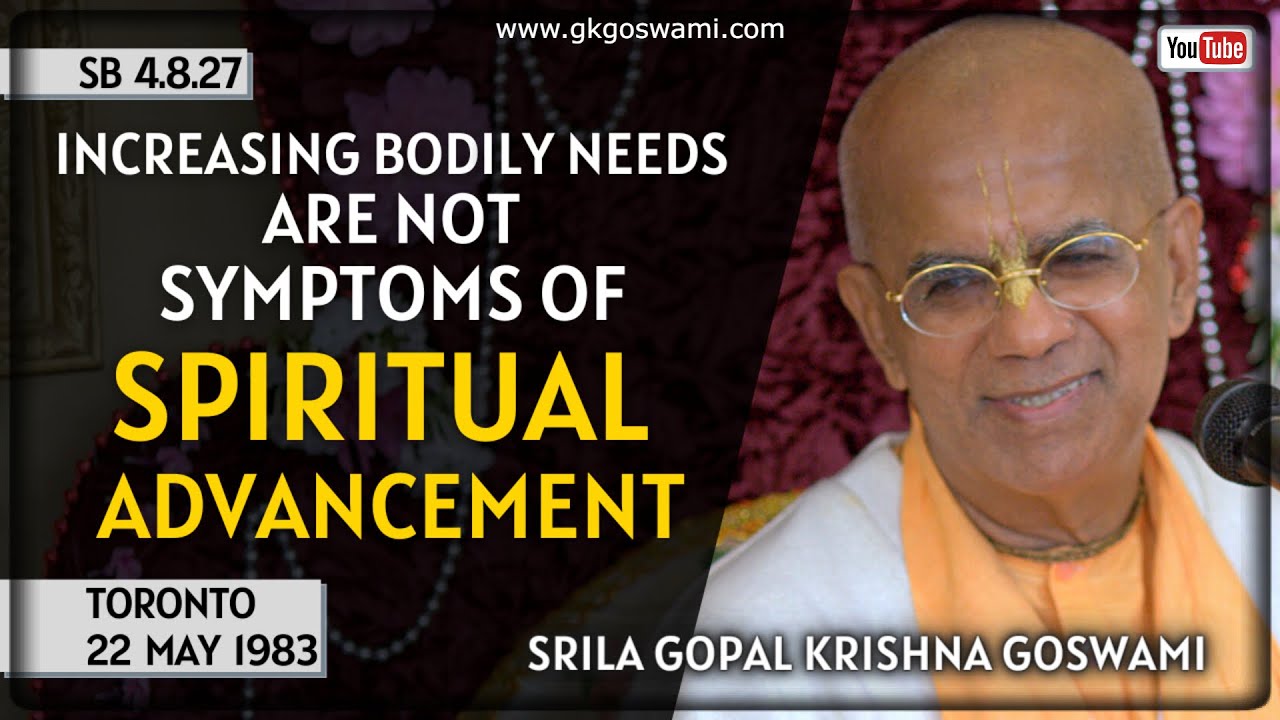
In this extensive lecture, the speaker examines the story of Dhruva Maharaja from the Bhagavata Purana, focusing on how Narada Muni tests Dhruva’s sincerity and determination to serve the Supreme Lord. The talk explains Dhruva’s progressive austerities—eating only fruits every third day, then every sixth day, then only dry grass, then water, then air—illustrating that true spiritual advancement is marked by a reduction, not an increase, of bodily needs. The speaker refutes the common misconception that heightened bodily desires signal progress, arguing instead that they indicate deeper entanglement with the body and mind. The lecture also outlines three types of devotional association (with those more advanced, equal, or less advanced) and how each should inspire pleasure, compassion, or friendship respectively. It emphasizes that compassion toward less advanced souls arises when one disentangles from bodily identification, using metaphors such as a coconut drying after being removed from its tree. The speaker stresses honesty in approaching the Supreme Lord, the proportionality of the Lord’s mercy to one’s surrender, and the necessity of disciplined spiritual practice, including sense control and adherence to dos and don’ts. Throughout, the narrative weaves scriptural citations, analogies (rain, sun, sports absorption), and practical guidance for devotees seeking to deepen their bhakti.
Chapters
Om Namo Bhagavate Vasudevaya. Om Namo Bhagavate Vasudevaya. Om Namo Bhagavate Vasudevaya. Translation: The great sage Narada told Dhruva, "My dear boy, you are only a little boy whose attachment is to sports and other frivolities. Why are you so affected by words insulting your honor?" Purport by His Divine Grace A.C. Bhaktivedanta Swami Prabhupada. Ordinarily, if a child is rebuked as a rascal or fool, He smiles and does not take such insulting words very seriously. Similarly, if words of honour are offered, he does not appreciate them. But in the case of Dhanur Maharaj, his satyavrat was so strong that he could not tolerate a slight insult from his stepmother which injured his satyavrat. Suvamanam te sammanam vārikutsaka. Lakṣya maha-kumarḥ vyāśva-kṛdaṇa-viṣuḥ. So we here we see that the great sage Narada Muni. Narada Muni is also addressed as Bhāgavān in the Bhāgavatam by Rūpa Mahārāja because he is the representative of the Supreme Lord. So we see the great sage Narada Muni over here is discouraging Druva from the path of emotional service. His mother has guided him to execute pure devotional service. In these verses that we have just read, Druva Mahārāja was being advised by his mother that he should execute devotional service. But over here we see that Narada Muni is discouraging Druva, from executing devotional service. In the previous verse, Narada Muni has pointed out that because you are a saphir, you cannot tolerate a loss of prestige. And over here Narada Muni is telling Druva that why are you attached to the words of your stepmother? After all, you are only a small boy, and being a small boy, you should be attached to sports and other frivolities. So Narada Muni is hereby discouraging, it may appear to be discouraging, Dhruva from taking to the path of devotional service. So question arises at this point, why is it that Narada Muni is discouraging Dhruva from executing the path of devotional service? Actually, what Narada Muni is doing, he is testing Dhruva Maharajah's sincerity. Dharamaraj had been greatly offended by his stepmother. His stepmother had more or less told him that you cannot succeed your father to the throne because you have not taken birth from my womb. Actually, what Dharamaraj's stepmother did by preventing him from sitting on the father's lap was to warn him that there is no chance of your becoming a king. So Narada Muni over here actually is testing. He's testing Dhruva Maharaj as to how intense, how sincere is his determination to serve the Supreme Lord. Narada Muni wants to make sure that Dhruva Maharaj is sincere. In his desire to serve the Supreme Lord. So Narada Muni over here is actually testing Dhruva Maharaj. So in the next few verses, we see that Narada Muni continues to discourage Dhruva from taking to the path of devotional service. But Dhruva Maharaj then states that you are the representative of Bhagavan. And since you are the representative of my goan, you please help me. By honest means, you please help me in realizing a kingdom that is even more opulent than my father and grandfather's. So this was Guru Maharaj's desire, that he may realize the most opulent kingdom. And after Narada Muni saw what was Dhruva Maharaja's desire, then Narada Muni guided Dhruva Maharaja to approach the Supreme Lord directly. One can approach the demigods, but over years Dhruva Maharaja wanted a kingdom that was even more opulent than that of Brahma, his grandfather. So it was nobody else but the Supreme Lord who could grant Dhruva this benediction. So the point is that Narādhmuni guided Dhruva to approach the Supreme Lord. But there's one other thing that we see that is significant in Dhruva Mahārāja's request, is that he told Narādhmuni That if you can help me, then please help me, but help me by honest means. It's not as Guru Amaraj wanted to realize a kingdom by hook or crook. He wanted to realize this kingdom, a very opulent kingdom, the most opulent kingdom, through honest means. And the honest means refers to taking shelter of the Supreme Lord. This is honesty. In the material world, we do not know what is honesty and what is dishonesty. We are constantly trying to analyze honesty through our mundane senses. But real honesty, as Dhruva Maharaja's instruction is indicating, is to approach the Supreme Lord. For whatever one's desire may be, even if one's desire is material, one should approach the Supreme Lord. That is honesty. So from the Kṛṣṇa conscious platform, we understand that honesty means to approach the Supreme Lord for assistance, to approach the Supreme Lord for guidance. So after Nārada Muni saw that Rūpa Mahārāja was completely determined to realize a very opulent kingdom, and he was very determined To approach the Supreme Lord according to the direction of his mother, did Narada Muni also confirm his mother's advice. So the point is that just like Dhruva Maharaj was determined to approach the Lord, of course one can argue that Dhruva Maharaj had some material ambitions. He had an ambition to realize a very opulent kingdom. But nevertheless, the significant point from the spiritual angle of understanding is that Guru Mahārāja approached the Supreme Personality of Godhead with determination. So in order to get the mercy of the Lord, one has to be determined. And Guru Mahārāja performed very great austerities. For example, in the first month of Dhruva Maharaj's austerities. He only ate fruits and berries on every third day. The purpose was just to keep his body and soul together. Basically, that is the desire of the transcendentalist, to eat only as it is necessary to keep the body and soul together. So Dhruva Maharaj, when he started his meditation in the forest, He would eat every third day, only fruits and berries. And then in the second month, he ate only every 6 days. Try and understand. In the first month, he ate every 3 days. This is the nature of devotional service. As you advance in your meditation, as you expand your devotional service, you want to reduce your bodily necessities. Satis— not that you increase your bodily necessities. Increasing bodily necessities is not a symptom of spiritual advancement, but rather indicates the opposite. So Guru Maharaj, in the first month, he was eating every 6 days, but in the second month he ate only every— I'm sorry, in the first month he was eating every 3 days, but in the second month he started eating every 6 days. And every 6th day, what did he eat? Only dry grass and leaves, whereas in the first month he was also eating fruits, and every 3 days. And then in third month, he only drank water every 9 days. He was reducing his bodily necessities so that he could completely devote himself to the Supreme Lord. And in the 4th month of his meditation, he became a complete master of the senses, and he inhaled only air every 12th day. So the point is that Dhruva Maharaj's austerities progressively went on increasing to the point that he wanted to dedicate all his time for the pleasure of the Lord. The devotee is always thinking that he does not have enough time to glorify the Lord. The devotee is always thinking that 24 hours is not enough to glorify the Lord. Hence the devotee wants to reduce his eating. Hence the devotee wants to reduce his sleeping. Hence the devotee wants to reduce his idle thoughts. So that a maximum of attention can be directed towards the Lord. As we enter into the class of the devotional service, the doors of liberation open. Just like when you take a coconut out of the coconut tree, as you take the coconut out of the coconut tree, the coconut begins to dry. So as we enter into the these classes of devotional service, the doors of liberation begin to open. But what is the real goal of the classes of devotional service? The real goal of the classes of devotional service is to disentangle with the bodily identification, is to free ourselves from the bodily identification. And the bodily identification presents itself in two ways, gross and subtle. We are identifying with this body in a gross manner, and we are identifying with the subtle body. Identification with the subtle body is very dangerous because when we identify with the subtle body, we tend to listen to the body, to the mind. And if we listen to the mind, then our spiritual advancement becomes extremely precarious and difficult. The living entity is taking on the reaction for the different activities he performs. Just like when the air blows, when the air blows, every small object begins to fly. So similarly, similarly, when one executes a life independent of God, independent of the instruction of the scriptures, one is accumulating different karma, and that karma flies. When he quits this body to obtain another body. So the point is that the goal of the process of devotional service is to get out of this bodily identification, to get out of the bodily absorption. Actually, we are absorbed in thoughts of this body from morning to night. We are absorbed how this body can get a little more comfort, how the tongue can get a little more delicious foodstuff, how the different senses can get some more satisfaction. And as long as we are absorbed in this bodily identification, the real purpose of human life cannot be fulfilled. Therefore, the solution is The path of the devotional service, which was being explained by Dhruva Maharaja's mother, and which is going to be reinforced in the verses that will follow by even Narada Muni. So the path of the devotional service opens up the door of liberation. The path of the devotional service helps us to disentangle from the strong bodily identification That is responsible for all our suffering. Just like when you take the coconut out of the coconut tree, the coconut begins to dry. And if you keep the coconut away from the coconut tree, then the coconut shell— the coconut dries and it disentangles itself from the shell of the coconut. And then if you move the coconut, you can feel that the coconut inside has disentangled itself from the coconut shell. So similarly, just like a coconut disentangles itself from the coconut shell after the coconut is disentangled from the tree, after it's pulled off the tree, similarly, Śrī Bhāgavatam explains that when we execute this process of devotional service, we can disentangle ourselves from this body. We can disentangle ourselves from this maya, from this subtle body. So we have to become dry. We have to disentangle ourselves from this body like the coconut disentangles itself from the shell. So the medium of devotional service is the process how this can be realized. Therefore, we foster the devotional service has to be executed with these gracious determinations. Pādu-saṅgaḥ pādu-saṅgaḥ pravartāḥ prakāyaḥ. Caitanya-caritāmṛtaṣṭeṣaḥ. That by the association of sādhu, by the association of saintly people, the purpose of the entire Vedic scriptures can be realized. Narada Muni explained to Dhruva Mārāja, Prasad RAVALAD RAVALAD, that one can obtain three different types of association. The first type of association is when you associate with somebody who is more advanced than yourself. When a devotee gets the opportunity to associate with somebody more advanced than himself, he becomes very, very pleased. The second type of association is the association with those who are less advanced. So when a devotee sees that somebody is less advanced than himself, then he becomes very compassionate upon such an entity. And the third type of association that we can obtain is the association with another person on the same status. So when we get the opportunity to associate with such a person of same status, the devotee should become very friendly. So let us analyze These three different types of association that Narada Muni recommends, the guru amarāja. So the first type is when one gets the opportunity to associate with somebody more advanced, he is very pleased. Now in comparison, what is the law of mature nature, or what is the position of the matured? When a matured is given chance to associate with somebody who is more advanced, Instead of being pleased, he becomes envious of him. Isn't it? In the material world, when you get a chance of meeting somebody who is ahead of you, you become envious. Oh, how has this person become ahead of me? How has this person attained a higher status than me? Because envy is the guiding principle of material life, and this envy extends itself to— I become envious of the Lord. Why will the Kṛṣṇa people be They detest the process of devotional service. They detest the process of devotional service because they cannot imagine that there is a person who can enjoy more than them. The devotee recognizes that the Lord can enjoy more than them because He is the real enjoyer. Boktaram yeke tuposam sarvalokam hinsuram. Tuzam sarab zrutanam jatamam sandhim rachati. This is the firm conviction of the devotee. That is, the Supreme is the enjoyer, He is the creator, He is the well-wisher. And because the devotee understands these three things, he executes the process of devotional service with faith. Dhruva Maharaj is approaching the Lord with determination because he knows that the Lord is the creator. He knows that the Lord is the source of everything. Therefore, he is not approaching His grandfather Brahmā for help. Therefore, he is not approaching any janiqā to help, but rather he is approaching the Supreme Lord. In fact, Dhruva Mahārāja even asked Narada Muni to help him. Why? Because Narada Muni is a pure devotee of the Lord. And because Narada Muni is the pure devotee of the Lord, Narada Muni can empower, he can deliver the same thing what Kṛṣṇa can deliver. Therefore, Dhruva Maharaj addresses Narada Muni as Bhagwan. Bhagwan is one who is in possession of 6 opulences to an unlimited degree. So why is it that Dhruva Maharaj has addressed Narada Muni as Bhagwan? Dhruva Maharaj has addressed Narada Muni as Bhagwan because he is conveying the science by which one can be brought back to Bhagwan. Therefore, Dhruva Maharaj tells Narada Muni, "O Bhagwan," You may please also help me in realizing a kingdom more opulent than my grandfather's. So when a transcendentalist meets somebody who is more advanced than him, he becomes very pleased. As we've just finished saying, the materialist, when he meets somebody more advanced than him, he becomes very envious. Because the materialist, he cannot understand how somebody is ahead of him. He wants to think that he is ahead of everybody else. But a skirtless, of course, doesn't have the same vision. So Narada Muni advises Dhruva Maharaj that a skirtless, when he sees that somebody is more advanced than himself, he becomes very pleased. Why? Because he feels that here is an opportunity to make spiritual advancement. Here is an opportunity to gain some spiritual knowledge. The devotee is always anxious to learn. The devotee is always anxious to hear. Therefore, the Vedic scripture says, sadhu sangha sadhu sangha pravachāsa-kaya, the entire purpose of these sadhu-chāryas can be realized by a minute's association with one who is more advanced than oneself. So the devotee, when he gets the opportunity to associate with somebody who is more advanced, he avails of it. This is the instruction of no lesser personality than Narada Muni, and he is very pleased to avail of that opportunity. And then when he sees somebody who is less advanced than yourself, then what do you do? When you— thank you— when you see somebody who is less advanced, then you feel compassionate. This is the principle of a transcendentalist. When he sees that I have been fortunate to receive the science by which I can begin to get out of the bodily identification, and he sees that others are closely involved in bodily identification. What is sense gratification? Sense gratification means just maintaining a false identity. So when the devotee sees those who are less advanced, those who are maintaining a false identity, he feels very sorry for them. Yeah, and what happens in the material world? In the material world, when you see that somebody is very less advanced than yourself, then you rebuke such a person. Prabhupada explains this. The symptom of the materialist is that when he sees that somebody is less advanced, he rebukes such an individual. But a class advancementist, when he sees that somebody is less advanced, somebody has a wrong vision, somebody has a wrong understanding, he gets in the burning bright and he becomes, comes Compassion. Just like when Caitanya Mahāprabhu saw the condition of the yāvanas, He said, "Īyaḥ prabharah ho sormete hiddinistara." He said, "My dear Vaiṣṇava, looking at the condition of the yāvanas, my heart is beginning to lament." So this compassion must be there. When the devotee sees, here is a new bhakta, here is somebody new who wants to perfect his life, who is big, who wants to get out of his body identification, he's anxious to train him up. He's anxious to guide him. When a devotee sees that somebody is blind to the purpose of human life, he's anxious to enlighten such an individual. And when a devotee sees, when he meets somebody else who's on the same level of transcendental realization, In other words, who has also begun the process of Self-realization and is on the same level, then what does he do? He makes friendship with Satyamana. And in the material world, what happens when you meet somebody of an equal status? When you meet somebody of an equal status, you just try to show off, isn't it? When a materialist meets another materialist on the same status, he just tries to show off. He just tries to show off how he is better off than the other person who is on the same status. But the devotee, when he meets another devotee on the same status, he makes friendship with him. He shares his spiritual realization. He is anxious to discuss his spiritual realization. He is joyful at the opportunity to associate with those who are also on the same level. So the point is that, that the gurūdīs have to work together to spread this Kṛṣṇa conscious movement. We cannot afford to develop differences with each other. We're too small a community to develop differences if our real goal is to distribute this love of God. If our real goal is to be compassionate upon those who are less advanced, then we have to work together. Like Prabhupāda used to say, united we stand, divided we fall. So if you are willing to share our spiritual realizations, if you are willing to share spiritual secrets, if you are willing to be friendly with each other, then the opportunities The intelligence, the facilities will gradually go on increasing. We should never forget that Kṛṣṇa reveals Himself in proportion to our degree of surrender. Kṛṣṇa is testing, just like Dhruva Mahārāja and the Supreme Lord. If Kṛṣṇa wanted, Kṛṣṇa could have given him the benediction at once. Narada Muni was requesting— I am sorry, Dhruva Mahārāja was requesting Narada Muni, Please give me a kingdom more opulent than Brahma. But what did Narada Muni do? Narada Muni told Dhruva Maharaj that you must follow the process of spiritual discipline. Of course, in the beginning Narada Muni was testing Dhruva Maharaj, but after Narada Muni was convinced that Dhruva Maharaj is serious about approaching the Lord, he said, okay, if you want to realize a kingdom more often than your grandfather, then you must execute spiritual discipline. Similarly, for Arjuna, Arjuna was also advised by Kṛṣṇa, in order to win this battle, you have to fight. If Kṛṣṇa wanted, He could have easily made Arjuna victorious. But Kṛṣṇa did not make Arjuna victorious overnight. He wanted him to practice spiritual discipline and Arjuna did not want to fight. Arjuna was hidden in so many arguments, big cause. He was identifying with his mind. But when he surrendered to the superior direction of Kṛṣṇa and fought, therefore fighting means he practiced spiritual discipline, then Arjuna became victorious. And hua mai aaj, after he practiced spiritual discipline, He was also successful. So the point is that Kṛṣṇa reveals in proportion to our degree of surrender. So if we are ready to enforce spiritual discipline upon our mind, if we are ready to enforce spiritual discipline upon our body, if we are ready to enforce spiritual discipline upon the senses, then Kṛṣṇa's mercy will flow in an increasing manner. Just like when it begins to rain, it doesn't rain all of a sudden. First the drops fall, and gradually the rain increases and then becomes more and more volatile. So similarly, the path of devotional service, also the Lord's mercy, is realized as we surrender. When we depend completely upon the Lord, just like a child depends upon a parent, Then the Lord protects such a devotee just like a cow. When a calf is born, the first thing that the cow does when the calf is born is to make sure the calf is fed, and the cow is very protective of the calf. So similarly, just as the cow is very protective of the calf, the devotee is completely protected by the Lord. But the protection that we realize from the Lord is based upon our degree of surrender. So the point is that our goal is to practice spiritual discipline. Our goal is to disentangle ourselves from this shell. Just like we gave the example of the coconut. The coconut, once it's pulled off of the tree, it gradually, as it gets dry, it disentangles itself from the shell. So we have to disentangle ourselves from this shell of material body. As long as we keep ourselves in entangles with this shell. As long as we are identifying with this shell, this shell will always give us trouble. This body is nothing but a source of misery. Doesn't matter in what position one may be. One may be in an elevated position, one may be in an ordinary position, but this body will always give us trouble. Because as long as you're identifying with this body, you're going to identify with the mind also. One may be in an elevated position, one may be in an ordinary position, but this body will always give us trouble. Because as long as you are identifying with this body, you are going to identify with the mind also. And what is the nature of the mind? The nature of the mind is to accept and reject. Today the mind is honored. Today you have heard some praise. Today you feel very honored. Tomorrow you have some criticism and you feel dishonored. Today you get what you want, you feel very happy. Tomorrow the Lord is testing you and you do not get what you want and you become unhappy. So the point is that we have to be determined like Dvāmaraṇḍa's wife. This story of Dvāmaraṇḍa is very important from many, many angles. We may have heard this story many times, but every time you hear this story, a new spiritual angle presents itself. And the spiritual angle that is most important is Dhirubhai Maharaj's determination to please the Lord. He was determined to go through any degree of austerity, but he did not waver. Even when a great personality like Narada Muni was trying to discourage minutes, he did not get discouraged at all. He said, "No, I must approach the Supreme Lord. I must, I must." Similarly, we have to keep hammering into our heads that I must serve the Supreme Lord, I must execute devotional service, I must surrender to spiritual discipline. We have to keep hammering into our heads that I must serve the Supreme Lord, I must execute devotional service, I must surrender to spiritual discipline. I must surrender to spiritual discipline. See, spiritual discipline, surrendering to the spiritual discipline, is the key to our getting disentangled from this shell. If we do not surrender to spiritual discipline, then getting disentangled will remain a mystery. Just like very often people come to devotional service, they join the Kṛṣṇa consciousness movement, But because they are not absorbing themselves in the process of devotional service, the beauty of devotional service appears mysterious to them. Isn't it? Just like the materialist. They cannot understand how we can be happy avoiding the illicit activities. If you— each of us has experienced that when we talk to materialists and tell them the four pillars of sinful life and tell them that we abstain from these sinful activities, they cannot believe how we can be happy, isn't it? They just cannot understand. And to them, this is a mystery, this is baffling, this is unbelievable. And therefore they accuse us we all are brainwashed. They think that our brain has stopped thinking. Because again, because we are devoted to our service of Swami, Mysterious. So the point is that the path of devotional service will always appear mysterious unless we surrender completely to the Lord. So similarly, after people even join the movement, because they're not surrendering completely, the spiritual goal appears very mysterious. The process of getting disentangled from this body and mind appears very difficult. So the point is that devotional service is mysterious only to the extent that we do not surrender completely. But once we surrender completely and we depend upon the Lord, then it doesn't appear mysterious at all, then it doesn't appear baffling at all, then it appear— doesn't appear difficult at all. So the point is that Just like Dhruva Maharaj executed devotional service with determination, we have to be determined. We have to, where we understand and keep reminding ourselves that there's no alternative but devotional service. Prabhupada used to often say that when a devotee understands that he has nowhere else to go but the lotus feet of Kṛṣṇa, then he's in a safe position. But when we are thinking that I have few other alternatives besides Kṛṣṇa, and I have to make a choice, which alternative should I choose, then there's a chance you may take shelter of the illusory energy. But when you are constantly reminding yourself that I have nowhere else to go but Kṛṣṇa, then you struggle, then you go through the difficulty. Just Why? In these days of high unemployment, nobody wants to give up his job. When the economy is booming, people are looking for other jobs. But in these days of high unemployment, nobody wants to give up his job, even if the job is unpleasant. Why? Because he has nowhere else to go. So still other being has to understand that being has nowhere else to go. But the Lord is saying to Krishna, And if that is the understanding, then in all situations we will execute devotional service. Then one will never want to abstain from the process of devotional service even for a minute. So the point is that we have to be determined like Dhruva Maharaja was. And if you determine like Dhruva Maharaja of God, then we will be able to get out of this bodily identification. And what is the symptom of getting out of this bodily identification? The symptom is that our feeling of compassion increases. The compassion that we are able to exhibit to those who are less fortunate than ourselves, The compassion that we are able to demonstrate towards those who are less learned than ourselves is exhibited by the desire to bring them to a higher platform. So the point is that, as Sanatānanda Muni said, when a devotee sees that somebody who is less advanced than himself, his heart begins to lament and he feels very compassionate. So we have to feel very compassionate upon those who are blind to the process of Self-realization, those who are blind to the cultivation of love of God, those who are blind to the fanning of the dormant love of God that is in the heart. Just like the propensity for fire is there in the wood, you just have to kindle the wood to produce that fire. Similarly, The Caitanya-caritāmṛta explains that this love of God is lying dormant. Nityasya sindha-kṛṣṇa-prema-sādhya-kabhu-nāya, tenāvādi sūrda-kṛṣṇa-kāra-yudhaya. The Kṛṣṇa-astava-yāja explains that this love of Kṛṣṇa is lying dormant in everyone's heart. So it doesn't matter how sinful the living entity may be, you have to understand that If you approach him with a humble frame of mind, full of desire to enlighten him, then it is possible that even his love of God can be revived. There are instances that even butchers have joined the Krishna Consciousness movement. Even butchers have become devotees. So you cannot think, oh, this person, the butcher, this person engaged in sense gratification, he cannot be brought to to a higher platform. By the mercy of Caitanya Mahāprabhu, the impossible can become possible. And as the Bhāgavad-gītā explains, when one approaches the Supreme Lord with faith and determination, then the Lord does two things. The devotee must carefully understand that the Lord does two things. One, He maintains whatever ability we may have. Two, He makes up the shortcomings that we may have. So we may, from our mature ability, from our mature standpoint, think ourselves totally incapable of feeling a conditioned soul with great deep intense gratification. But if we approach him with love, humility, praying through the spiritual master and to the Lord for mercy, Then the impossible can become possible. So the point is that we should always be in a compassionate mood. This is the test of the Vaiṣṇava. When he sees those who are less advanced than himself, how does he view himself? If he sees those who are less advanced than himself and he thinks, oh, I'm too busy now, I have no time to preach, I have, I have to worry about my body, I have to I don't worry about extra prasāda, extra rest, or whatever. That means the body identification is continuing. And the whole process is to get out of the body identification. The materialist thinks that my concern is my wife, children, parents, brothers, and sisters. And after coming to spiritual life, we are still retaining the same vision. Dandas coconut. Will not disentangle itself from the shell. This coconut has to disentangle itself from the shell. We have to disentangle ourselves from this body, and this can only disentangle ourselves from this body if we are constantly engaged in devotional service. The constant engagement in devotional service means that you broaden your spiritual vision. Just like a child, a child as it grows up grows up, the child is begin to able to absorb more and more, isn't it? As a child grows up, his ability to absorb also increases and he learns more and more. Similarly, with the passage of each day, we have to learn the Transcendental Science more deeply. We have to understand this philosophy in depth. And if we can understand the philosophy in depth, Then this mind will never trouble you. Then this body will never trouble you because you have understood what is spiritual identification. Then you are beyond this gross and subtle influence of this body. Just like on the walking on the young street, you can see people are walking, they are so absorbed that they don't even think of anything else, isn't it? Sometimes people listen to the Walkman and they are so absorbed in listening to the stereo music that they can't even notice they even crossed the street on a red light. They are so absorbed in just thinking and just listening. So every material quality has a spiritual counterpart. This you should never forget. Just like material absorption, like when they are watching these baseball games and these Uh, football games and these hockey games, the audience is so absorbed in every moment, in which direction the ball is moving, that even if you were to slice a knife on the back, they wouldn't notice it. They're so absorbed in just seeing in which direction the ball is moving, which direction it's going, whether their favorite team is winning or not, that even if somebody takes the money out of your pocket You can't notice them. In fact, in India, in these big sports events, it is very common to get your pockets pocketed for people to pickpocket, because everyone's so absorbed in just watching the game that if somebody puts a hand in your pocket and pulls a purse out, you don't even notice it. So similarly, we have to become completely absorbed, if you're completely absorbed in executing the process of devotional service like Guru Mahārāja was, then the, uh, limitation and happiness that accompanies material body doesn't bother us. So we have to broaden our spiritual vision. If we do not broaden our spiritual vision, then spiritual discipline Cannot be enforced. Then we may enforce spiritual discipline one day, and next day we will not enforce. But we have to enforce spiritual discipline on a constant basis. That means we have to get out of this bodily identification. That means we have to be compassionate upon those who are less fortunate than ourselves. So this compassion is one of the principal features of the Vaishnava. The Vaishnava, as we have often discussed, is very compassionate. But the tragedy is, though we are compassionate in theory, but we are not always compassionate in practice. In theory, we all understand that the body is not to be served. In theory, we all understand that we are compassionate, but we have to be compassionate in Practice. This love of God has to be awakened in everyone, and this love of God can be awakened in everyone if the resolute determination to make spiritual advancement is there. As Jiva Maharaj has very nicely described, Narada Muni, Jiva Maharaj says, The Narada Muni is like the sun. What does the sun do? The sun is constantly rotating. To us it may appear that the sun is standing straight and it is fixed, but the sun is constantly rotating. And why is the sun rotating? The sun is rotating to illuminate others, isn't it? The living entity is in darkness, but when the illumination of the sun manifests, the darkness is removed. So Dvāmarāja tells Narada Muni, then you are like the sun. There is rotating just for the benefit of others. The sun has nothing to benefit when it is illuminating, when it is rotating. It is just for the benefit of others that the The sun is rotating. So similarly, the devotees of this Kṛṣṇa consciousness movement, they have to rotate like the sun. They have to become like the sun, anxious to illuminate those who are in darkness, anxious to enlighten others without expecting anything in return. In the initial stages, the desire to get some return may be there, But as one advances, that desire is eaten up by the desire to just serve Kṛṣṇa. Just like after Dhruva Mahārāja experienced the presence of the Lord, and the Lord asked him what his desire was, he rejected to accept the kingdom more often than Brahmā-dāva. At one time he wanted that. And Dhruva Mahārāja gave a beautiful story of a poor man whom he the king. A poor man met the king, and the king asked the poor man, "What do you want?" And the poor man said, "Give me some husk of grain. That's all. That's all I want." So when you meet a king, you don't ask him, "Give me some grain." You ask him for something valuable. So similarly, when you approach the Supreme Lord, you don't ask him, ask Him for something permanent. And that is the mercy by which one can advance in devotional service. There are different stages, just like for the mango, there are different degrees. The mango is always sweet, whether it's ripe or unripe, but still ripe is more delicious than the unripe. So similarly, when we're executing devotional service in this body, in this form, devotional service is considered to be unripe. It is unripe in the sense that if we continue to execute devotional service in this body according to the direction of the guru, sadhu, sādhaka, then after the termination of this body, we will return to the kingdom of God where one will execute devotional service very lovingly, and that is called by the Bhāgavata, the mango in a ripened state. So at the present moment, devotional service is unripened, but in order to get to the ripened stage, we first have to follow this path. Only then will we experience, only then will we have the opportunity to experience devotional service in a ripened state. So the point is that There cannot be any compromise on this principle. We may make some minor compromises, but we do not compromise with the senses. Do not compromise with the senses. Always remember, the senses are like a serpent, and just like you can never trust a serpent as long as the fangs are there, similarly you cannot trust these senses. These senses cannot be corrupted. Therefore, you do not make compromise. Therefore, there's so many rules and regulations. Do this, do this, don't do this, don't do this. For example, the transcendentalist is advised to minimize his association with the opposite sex, even if it is one's wife. One should keep that association to a bare minimum. Why? Why is that instruction there. That instruction is there so that the transcendentalist is prevented from compromising with the desires of his senses. We cannot go on compromising. If we— just like when a child is growing, if the parents go on compromising with the child, then the child never gets proper training. But if from the moment of 5 the child is disciplined, just like in a girl system. In a Gurukul system, from the age of 5, the child is disciplined. Prabhupada said, from the age of 5, give the child what he wants. But from the age of 5, the child has to be even smacked. He has to be disciplined so that he develops good habits. So the Gurukul system means disciplining the child so that he is successful in the ultimate mission of life. Of course, nobody likes discipline, just like life. Even older devotees, when we tell them how to discipline the spiritual life, they don't like it. So similarly, due to the presence of false ego that is there from times immemorial, even a child doesn't like to be disciplined. But the parents know that this spiritual discipline is for the ultimate benefit of the child. So similarly, we have to discipline our senses. We cannot compromise Because if we go on compromising with the dictates of sense gratification, then the complete potency of devotional service will not manifest itself. So the point is that we have to carefully be aware of what are the dos and don'ts. Just like when you go to a country, to a new country, on the plane they give you a book which says dos and don'ts. It tells you about the customs of that country, tells you what you should do, what you should not do, isn't it? So similarly, we have to be aware of the dos and don'ts to succeed spiritually. So the point is that this feeling of compassion upon those who are less advanced than ourselves will manifest itself if the kind-hearted get out of this bodily identification. Just like Caitanya Mahāprabhu and his associates were absorbed in cleaning the Gauḍīya temple. What was it? They were cleaning the Gauḍīya temple to cleanse the dirt. Similarly, we have to cleanse this heart. It is not easy to cleanse this heart. It is difficult. But you can cleanse this heart if we execute the devotional service with determination. So the point is that as we render devotional service with determination, the resolute determination to become compassionate upon those who are less fortunate than ourselves also increases. The store of love of God has to be emptied out. The beauty of this store of love of God is we can never empty it out completely. In any material reservoir, there is a limit. For example, even the reservoir of oil that is there in the Middle East countries, or even in the prairie provinces in Canada, has a limit. The forecast is that this reservoir is going to last another 20 years and then it's going to run out. In fact, even for water, there are limits, and there are forecasts that even this water is going to run out. So any material property, any material reservoir has a limit. But this spiritual reservoir of love of God has no limit. Therefore, it doesn't matter how much you take out from this cash, there will always be some more. The point is that this, the devotee, He is attempting to empty out this spiritual reservoir of love of God by distributing this Kṛṣṇa consciousness. Vijayānanda Devananda says, just like the water falls from the cloud and then there is coolness, similarly the devotee understands that everyone is being burned by material activities. Material activities are constantly burning us. About this there should be no two opinions. Just like if you ask even any of our Gurukul children to draw God, they will all draw Kṛṣṇa. No one is going to draw God with a beard or God in a suit or God as some imaginary God. They will all draw Kṛṣṇa with a peacock feather. Their drawing may have little variance depending upon their ability, but they will all say Kṛṣṇa is God. Go to any Gurukul student and ask him, who is God? Who is God? Kṛṣṇa is God. Who is the mercy incarnation of God? Lord Caitanya. They will all give you the same answer, as is so in the Hare Kṛṣṇa Dhamma. So similarly, in the devotee's mind, there is no doubt that any material activity, any material attempt at finding happiness is actually going to result in being burnt. That firm conviction must be there. If that firm conviction is there, that material activity means constantly burning yourself. And when the rays of the heat are very strong, what does one wish? For rain. Those of you who have been to India in the summer season can testify, when it gets very hot, like in northern India it gets very hot, people are just just praying, please, when the rainfall comes. When there is drought, people are just waiting, oh please, when the rainfall comes. Because rainfall can come and take away the heat there. So similarly, the devotee understands that material activity means constantly being burnt. And unless there is the distribution of this love of God, which is compared to cooling They will not be happiness. So we have to be determined to distribute the love of God. According to time, place, circumstances, the technique may vary. Just like Caitanya Mahāprabhu, when the māyāvādī philosophers were coming to meet him, Caitanya Mahāprabhu was always thinking of some trick how he could engage them in devotional service. Isn't it? He was always thinking of some tricks. How can I engage? And when they would walk away, they would feel very sorry that his tricks did not work. Sorry. So similar, the devotee, if all those methods fail, how can we engage such an individual in love of God? In order to engage people in love of God, sometimes we may have to use paraphernalia, whatever. But as long as the goal is to engage them in devotional service, As long as the goal is to shower them with love of God, the activity is purifying. Hence, it's an indication of our understanding of transcendental philosophy. So the point is that this love of God has to be distributed free— freely. The Supreme Personality of Godhead can make the devotee even more powerful than Himself. This should not be underestimated. Caitanya Mahāprabhu wanted to destroy Jagāyaṁadāya, but Nityānanda prevented Him. So the point is that the devotee is free, disciplined with love of God. Eṇa premaśrī Caitanya-dīlā-yatātataḥ jagāyaṁadāya paryanta-mera-tātataḥ. So as Caitanya-caritāmṛtaṣṭhāit, This love of God has to be distributed freely, and it was distributed even to Jagai and Madhai, the most obnoxious nectar. And as Prabhupada has often explained, today there are nectars at every corner. There is no shortage of nectars. And just like Nityānanda Prabhu was able to change Jagai and Madhai, just like Arjuna was given the credit to be victorious on the Battle of Kurukshetra. Just like Hanuman was made the, uh, was made the hero because he helped Lord Ramachandra, uh, reclaim Sita. Hanuman was able to jump over the entire Indian Ocean in one leap. In one leap, he went from one place to Sri Lanka. He jumped over the entire Indian Ocean in one leap. And when he was able to throw stones in the water, and those stones were floating. Normally, when you throw a stone in a river, the stone goes right down. But because the mercy desire of the Lord was there, those stones were floating. And Hanuman was made the hero of Sita's rescue. So similarly, The devotee can be made the hero by the mercy of the Lord. The Lord is every, ever anxious that the devotee may surpass Him. That is the desire of the Lord, believe it or not. Just like Caitanya Mahāprabhu, He surpassed Caitanya Mahāprabhu. Hanumān, he surpassed Lord Rāma Chandra. So similarly, it is the desire of the Lord the Lord that the devotee may surpass him. Um, just like Prabhupada was once telling one of my godbrothers in India that the spiritual master is anxious that his disciple may even surpass him in what he's done. So the point is that due to the mercy of Caitanya Mahāprabhu, jāl dēma yad veda yujad āyaṁ adāyaḥ, we, if we take this Kṛṣṇa consciousness Necessity, if we execute the devotional service with determination, if we understand that our real business is to be compassionate upon those who are less advanced, we can also elevate the present nectar into the position of devotee. This is not difficult, this is not impossible. All that is needed is determination, and the classic example of determination is Dhrumānanda Brahmanārāja's life, which we have been discussing, how Jiva Mahārāja was determined to realize an opulent kingdom. So our determination is not to realize an opulent kingdom. Our determination is to be engaged in the path of devotional service and to be compassionate upon those who are less compassionate. So we do not laugh upon those who are less advanced. We do not ridicule them. Rather, we displaying a compassion by taking steps by which, by making the effort by which, these conditioned souls can be brought to the platform of devotional service. So to summarize, Dhruva Maharaj is being tested by Narada Muni about his determination to serve Krishna, and Dhruva Maharaj comes out successful in the test. And he, in the end, Supreme Personality of Godhead manifested his transcendental and perform the guru-mantra, execute the devotional service with complete determination. Hare Krishna.
More from PRASAD

Rare Pastimes & Timeless Lessons of Guru Mahārāja | Stories Every Disciple Should Hear

ISKCON Legends- pure devotees meet-HH Jayapataka Swami, HH Gopal Krishna Goswami, HH Radhanath Swami



Jagannātha Ratha-yātrā Through Śrīla Prabhupāda's Mercy | 29 April 2006 | Nairobi, Kenya

Lord Jagannātha's Appearance Pastime | 21.07.2019 | ISKCON Calgary | Śrīla Gopāla Kṛṣṇa Gosvāmī

The Ācārya Teaches by His Own ExampleGuṇḍicā Mārjana by Guru Mahārāja #shorts

Guṇḍicā Mārjana – Lord Jagannātha's Pastime | 21.7.2019 | ISKCON Calgary |Śrīla Gopāla Kṛṣṇa Gosvāmī

H.H. Gopāla Kṛṣṇa Gosvāmī Mahārāja - Exemplary Sādhana and Deity Worship # shorts

भगवान की कृपा कैसे प्राप्त होगी ? | 11 Jan 2014 | Punjabi Bagh | Srila Gopal Krishna Goswami

Material Education vs Spiritual Education | Srila Gopal Krishna Goswami #shorts