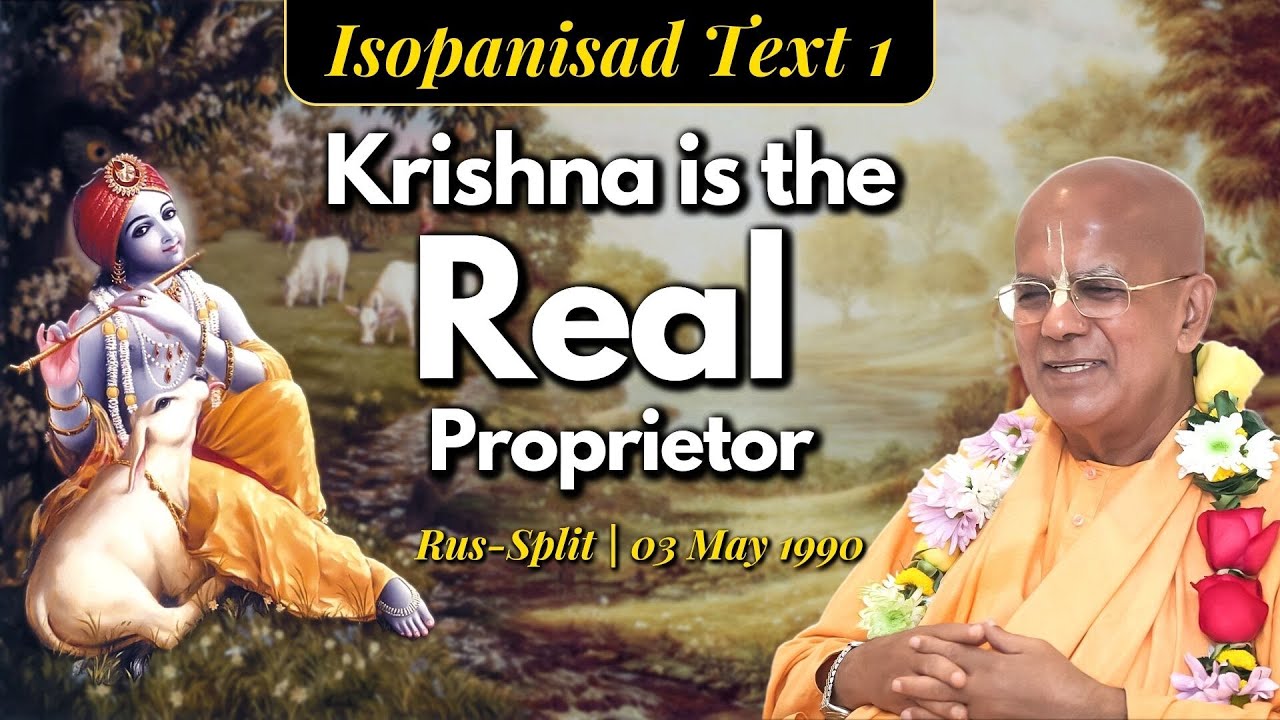
In this devotional lecture, Gopal Krishna Goswami expounds on the Isha Upanishad’s declaration that Krishna is the ultimate proprietor of all existence. He contrasts this spiritual truth with materialist ideologies—capitalism and communism—arguing that both miss the reality that everything belongs to the Supreme Lord. The talk introduces the principle of "simple living and high thinking," urging devotees to accept only what is needed for survival (one’s quota) and to renounce excess. Goswami explains the distinction between superior (para‑prakṛti) and inferior (apara‑prakṛti) energies, illustrating how all material objects, even modern technology, are ultimately derived from Krishna’s energies. He discusses the role of past karma and the mercy of sadhus in bringing a person to Krishna consciousness, while emphasizing that sincere surrender can transcend karmic limitations. The lecture also covers devotional practices such as appropriate gift‑giving among Vaishnavas, the central goal of developing Krishna‑prema, and the proper attitude toward the body, which belongs to Krishna and must be cared for rather than sacrificed. Throughout, he uses stories, analogies, and scriptural citations (Bhagavad‑gītā, Srimad‑Bhāgavatam, Caitanya‑caritāmṛta) to illustrate his points. The session concludes with a Q&A where participants ask about karma, gift‑giving, the nature of Krishna‑prema, and the ethics of bodily sacrifice, receiving detailed answers that reinforce the lecture’s core teachings.
Questions this video answers
It is a combination of past karma and the mercy of the sadhus. Karma creates the attraction, but sincere surrender to Krishna can nullify karmic effects.
Yes. Devotees may exchange Krishna‑conscious gifts. Rupa Gosvami describes six rasas, one of which is offering and receiving charity. Gifts should be devotional paraphernalia, not secular items such as pop‑culture recordings.
Krishna‑prema directs a person to serve the Lord regardless of worldly success. Practical results are secondary; the true measure is love for Krishna and consistent devotional service.
The body is Krishna’s instrument and must be used in service, not destroyed. Suicide or self‑harm is rejected. The story of Sanatana Gosvami shows that even when suffering, one should care for the body as Krishna’s property and continue service, following proper health practices.
Chapters
Swayam rūpa-kadāmayām dadāti svāpādanti-kam. Jai Śrī Kṛṣṇa Caitanya Prabhu Nityānanda Śrī Advaita Gadādhār Śiva Chaitanya Gaura Bhaktavinda. Hare Kṛṣṇa, Hare Kṛṣṇa, Kṛṣṇa, Kṛṣṇa, Hare Kṛṣṇa, Hare Rāma, Hare Rāma, Rāma, Hare, Hare, Hare. In the verse that we discussed yesterday, it was established that the Lord is complete in all respects. And it was also stated that everything that we see is all coming from the Supreme Lord. In the verse that we are discussing today, it is being established that the Lord is the source of everything. He is the real proprietor. If we were to follow this verse, then all conflicts in the material world would at once come to an end. The Īśopaniṣad is a part of the Yajur Veda. When Prabhupāda came to your country for the first time in 1972, in his famous conversation with Dr. Kitosky, Prabhupāda used this verse as the basis of his discussion. At least every Soviet devotee must know this verse by heart, because this verse establishes the philosophy of spiritual communism. We are also communists, but the real communists. In, in the Eastern European countries now, they have changed the names of their countries. You know that? Now they are calling themselves, like Hungary, Socialist Democratic. They're calling themselves socialist, not communist anymore. But we see no problem with the word communist as long as it is based upon this verse of the Bhāgavata, of the Īśopaniṣad. So this verse of the Īśopaniṣad is saying That actually the Lord is the proprietor of everything. Normally we are thinking, "My all this wealth belongs to my country," and some people are thinking, "It belongs to my father." In the capitalist countries like America, they, or they say everything belongs to private individuals, and in countries like yours, they say everything belongs to the state. But the Isha Upanishad says that both the theories are wrong. The theory of the Americans is wrong and the theory of the communists is wrong. Because actually everything belongs to the Lord. That is a fact. How can you deny that the natural resources which are there have been put by God and nobody else? Do you think that there is any scientist or any scientific theory by which they can put oil under the earth or they can produce the water that you find in the rivers and the oceans? Or they can provide the other resources that Mother Nature is providing. Can the scientists today produce something like the fertile soil? That is, can the scientists with help of chemicals create a situation where you will put a seed and also from that seed it will come this beautiful flower? So the answer is no, because actually this can only be done by God. So the taste Those who believe in God, they give all the credit to God, but the demons or the miscreants, they say there's no God, but it is nature. So we say, okay, it is nature, but who is controlling nature? Eventually nature also has to have a boss. You may see a policeman directing traffic on the road, but this does not mean that that policeman does not have a boss. Everyone has a boss, and nature also has a boss. Therefore Kṛṣṇa says in the Bhāgavad-gītā: Maya dakṣinā prakṛti suye te saḥ ciraḥ caṁ. This material energy is working under my direction. So if we understand that everything is working under Kṛṣṇa's direction, then naturally we want to use everything in service to Kṛṣṇa. So the Īśopaniṣad is establishing who is the real proprietor Because once you understand who is the real proprietor, then you will understand that everything belongs to God. Prabhupāda once gave an example. He said, suppose you have a 100-rupee note, and that 100-rupee note is on the street. Now there are 3 possibilities. One is, one man can let the note lie over there. Another possibility is, the man will pick up the bill and put it in his pocket. And the third possibility is he will see the note, he will say, "Oh, let me find out who is the proprietor," and then take the money to the proprietor. So of the three possibilities, the most perfect is that individual who, of who picks up the note and gives it to the proprietor. So similarly, the devotee is one who understands that everything belongs to the Lord, and hence everything should be used in service to the Lord. The Lord has many energies, especially the superior and the inferior energies. In the 7th chapter of the Bhagavad-gītā, there is a description of the para and aparaprakṛtis of the Lord. The para-prakṛti means the living entity who belongs to the superior energy. And earth, water, fire, air, ether, mind, intelligence, false ego, these all belong to the inferior nature or the aparaprakṛti. So everything that you see in the material world, it either belongs to the para-prakṛti or it belongs to the aparaprakṛti. Nothing is independent of one of the two prakṛtis. Even this microphone, for example, this microphone that you see, this of course is what? Is it made from plastic or metal? But even plastic It is nothing but a combination of different chemicals that are being provided by the Lord. So it doesn't matter what you see, everything is actually coming from the Supreme Lord. The scientists have just succeeded in manipulating the resources given by God. So we must understand the position of bhoga. And if we approach the Supreme Lord according to His instructions, then we can achieve the goal of life. We must understand that nobody is a proprietor of anything. You know, next to our Bombay temple there's a beach, a very famous beach called Juhu Beach. You must have seen many pictures of Prabhupada on the morning walk on Juhu Beach. So on the Juhu Beach, we see that sometimes when we go on a walk, many children go there and they make with the sand castles. They imagine 'Oh, I'm going to build such a nice castle. I'm going to live in this nice palace.' And another man comes, he sees that beautiful castle made of sand, he puts his leg on it, and the whole castle is broken. So similarly, I may have a lot of money in my bank, I may have many big buildings and cars, but cruel death will come and stamp and take everything away. The rich man is always telling the doctor, "Please extend my life, please extend my life." But the doctor cannot even extend his own life. How can he extend your life? Nobody wants to give up his possessions. If I make a very big house— of course, in your country we see that most people have same type of houses, but in many other countries, these so-called rich people, they make palaces for themselves. So if you get attached to your house, then again you have to take your birth in that house only. But you will not take your birth as the owner of that house. Take your birth in the same house as a mosquito or a bug or an insect. So you're still living in that house, but you're living as an insect and not as a proprietor. So Prabhupāda used to give one nice story. It's a true story. Prasad Raaval. So once there was a very rich man and he had built a very nice house. He was very attached to that house, but ultimately he had to die and he died just thinking about that house. So in his next life, he took his birth as a cobbler, but as a cobbler he was working right in front of the house which he had built in his previous life. And in that house, of course, now his sons were living. So one day, this rich man who had now become a cobbler went inside the house with some shoes, and those who were his sons in his previous life, they beat him up so badly. They said, "You poor man, you can't come into my palace," and they beat him up so badly that he went out crying. So you may build a very nice house, you may get very attached to it, but then you will have the reaction also. So the summary is that we must recognize that everything belongs to the Supreme Lord. Now Kṛṣṇa further says, because everything belongs to the Lord and it doesn't belong to you, you must only accept as much as necessary for your survival, not more than that. This is known as the principle of simple living and high thinking. You live very simply. And you think highly. Think about the goal of life. Today what people are doing, they will live very high and think very simply. This is material philosophy. That is high living and simple thinking. People will borrow money, steal, do anything, but they must have a so-called high standard of living. So, spiritual philosophy, as we said, is we live very simply. Why? Because we understand that life is very rare and we must use this life to understand our relationship with God. So Kṛṣṇa is saying over here that one should only accept what is in his quota, not more than that. Because if you try to accept more than that, then you will have to just over-endeavour and there will be no time for spiritual life. So if you understand that everything belongs to God, If you understand that everything has to be used in service to the Lord, if you understand that nothing is mine, then naturally you will take a more humble profile. Today if you go to the so-called rich people, they have no time to talk to you about God. Even if you go to a country like India, the so-called rich people, they have no time for devotees of Kṛṣṇa. They have time to go to the clubs, to the bars and everywhere, but no time for Kṛṣṇa. Therefore, in the Śrīmad-Bhāgavatam it is said that if you have too much wealth, it becomes your enemy to spiritual life. That is why I say the people of your country are more for— are the most fortunate people on this planet. They do not have the poverty of India, and they do not have the opulence of the West. They are in between, just the perfect position to approach God. Because you will see that as people get too much money, they have no time for bhoga. Then they turn away from bhoga. So for a devotee, it is better to desire to be poor. This way he'll be dependent upon Kṛṣṇa. He will not get puffed up, and he will always have to work for Kṛṣṇa. Just like, you know, our whole ISKCON movement all over the world, even though it is so big, but Kṛṣṇa hasn't given us one extra kopek. If our devotees don't go out and preach every day in the West, The next day there will be no prasad. Even now in America there is so much wealth. Every house has 3, 4 cars, but our ISKCON temples are all hand-to-mouth. They're all broke. And He always wants His devotees to struggle for Him by thinking of Him. So a devotee of the Lord, he's always struggling for Kṛṣṇa and he's never discouraged by the struggle. Once Prabhupāda was coming down the lift in a building in the New York temple. And the devotees were telling Prabhupāda, "Prabhupāda, you are very old now. You need rest. You are not well. Please go and take rest in Gītānagari." But Prabhupāda said, "Please don't take away my privilege to struggle for Kṛṣṇa." So to struggle for Kṛṣṇa is a great virtue. Arjuna had to struggle for Kṛṣṇa. He had to fight the battle even though he did not want to fight. So to struggle for Kṛṣṇa is not an unusual event. And the devotee, he recognizes that by struggling for Kṛṣṇa, I will get a chance to remember Kṛṣṇa even more. So Kṛṣṇa is telling us in this verse that there will be absolutely no conflict on this planet if everybody took as much as he needs for his survival. But the problem today is everybody wants more than his quota. Prabhupāda used to give an example that suppose You were to take a bag of grains and throw it out on the road, and if you told the animals, "Come and take as much as you want," the animals would come and take as much as they can put in their mouth. But if you were to call the human beings and tell them, "Take as much as you want," they will take as much as they can, for as much as they can carry. So similarly, because of our greed, we want to take as much as we can. Nārada Muni very clearly says, A hungry man can be satisfied when you give him food. A thirsty man can be satisfied when you give him water. A greedy man can be satisfied when he shouts at you. But a greedy man can never be satisfied. I'm sure there are greedy men even in your country. There are greedy men everywhere in society. So, so we have to give up greed. But you can only give up greed if you understand this verse of the Śrī Īśopaniṣad. Because this verse is clearly saying that, ah, you can only accept as much as you need for your survival, not more. And if your philosophy is simple living and high thinking, then there's no question of having any burden. So Isha Upanishad is saying, just take as much as it is set aside for your quota, not more than your quota. If you take more than your quota, then the Lord will not be pleased. Like for example, Deeja, we see that so many developed countries of the world, especially America, Argentina, Australia, so on, they will take their grains, dump it in the sea, but they will not sell it to any other country. They will dump millions of tons of grains every year, but they will not sell it in the market because they are scared that the prices will go down if there's too much in the market. So this is very tragic, instead of understanding that all these grains belong to the Lord. 'Let me use it for the Lord.' We are thinking, 'This belongs to me. I must make maximum profit. So if I have too much in the market, people will not buy. So I will just dump it in the sea so I can get more prices.' So Isha Upanishad is telling us that we should only accept what is the quota assigned to us. And one must know that everything belongs to the Lord. And since everything belongs to the Lord, everything should be used in his service. And if we accept everything as, everything with this mentality, then we will be rightly situated. So we have to come to this understanding. It is not easy to come to this understanding. Even though we are sitting over here, we may say, "Oh, this is so easy. What is difficult in it?" But once you start to do it, you will know how difficult it is. And the spirit of renunciation that is being advocated can be developed. If you, if you have the association of sadhus. So the Isha Upanishad is saying that as soon as one is born, he's born with his quota of happiness and distress. And because we are born with a quota of distress and happiness, we're all going to get our quota of unhappiness and a quota of happiness. If we want to take something that doesn't belong to us, then you become liable for the reaction. So similarly, in spiritual life, You must know that everything belongs to the Lord and the spiritual master, and therefore everything should always be offered to the Lord. And if we believe in simple living and high thinking, then they— we will be able to practice this verse. And then by practicing this verse, we will be able to make spiritual advancement. And this is what the Īśopaniṣad is educating us as to who we are. And if we understand who we are, then it is easy to serve Kṛṣṇa. But if we don't know who we are, then to serve the Lord is impossible. So this verse is very significant. Prabhupāda quotes this verse very often to point out how everything belongs to the Lord. And this verse is explaining how everything belongs to the Lord, and the devotee understands that everything belongs to the Lord and works for the glorification of the Supreme Lord with this understanding. In material society, everybody is fighting. The capitalists are saying their system is better, the socialists are saying their system is better. But we say that only Kṛṣṇa's system is better. If we follow Kṛṣṇa's system, then we will never go wrong. So Kṛṣṇa's system is there in the Śrī Īśopaniṣad. You recognize that everything belongs to the Lord and you only take as much as you need for your survival and then you'll be able to be successful. So whether you have a beautiful building which is made of earth, water, fire, air, ether, or whether you have a big factory, everything is coming from the Supreme Lord. Therefore, He must be the real proprietor. Prabhupada used to give one example of the Red Indians in America. Do you understand what I mean by Red Indians? So before the American— the European immigrants went to America, The land of America was under the control of the Red Indians, but then they were replaced by the Native Americans. So the point is that things are always changing. At one time, the land of America belonged to the Native Indians, and then the land belonged to the Americans, and now tomorrow it may change again. But this is with mundane law, material law. Today I'm the proprietor, tomorrow you will be the proprietor. Therefore, the devotees do not identify with a changing material environment situation. By understanding that everything belongs to the Lord and using everything in service to the Lord, one becomes perfect. So the Śrī Śrīpaniṣad very nicely explains to us how Kṛṣṇa is a proprietor of everything and how everything should be used in service to Kṛṣṇa. And if we serve everything in the service of Kṛṣṇa, then you advance towards the real goal of life. Goal of life is what? To develop Kṛṣṇa-prema. So with this we will stop the discussion of this verse and now take on questions. We— I thought we discussed this verse for more than 1 hour. So now with this background, if you all have any questions, please present your question and we will try our best to remove your doubts. Just like in the Bhāgavad-gītā, Arjuna is always asking questions to get his doubts removed. So we all have doubts, not 1 or 2. Well, hundreds, thousands, millions.
Yesterday one devotee, Valeri, he wanted to make it more clear. He asked you about when person comes to Krishna consciousness, for example, he gets acquainted with Krishna consciousness movement, is it the sequence of his karma or maybe it is like Supreme Will or his own will? Can you Elaborate a little bit.
Combination of the two. When you come to Kṛṣṇa consciousness, you come due to your past karma and due to the mercy of the sādhūs. How do you think? You think it's just by accident that all of a sudden so many Soviet devotees are taking to the chanting of the Hare Kṛṣṇa mantra? It is not by accident. It is a continuation of the karma of your previous life. And if the previous karma is strong, then some or the other you will come to Kṛṣṇa consciousness. And doesn't matter how strong your karma may be, if you approach Kṛṣṇa, Kṛṣṇa is always ready to accept you. So karma definitely has some influence, but if you want to surrender to Kṛṣṇa, then all that so-called karma is nullified.
Well, is it proper when devotees present to each other various presents? To each other, is it good for devotional service?
Yes, there's no harm. Rūpa Gosvāmī talks about 6 types of loving rāsās amongst devotees. One of them is to reveal your mind. Then is to take instructions from those who are more advanced. One is to offer gifts in charity. Give in charity and accept in charity. But you also give to each other Vaiṣṇava gifts. You know, you don't give some devotee a tape of the latest Michael Jackson tapes. You give Him devotional paraphernalia. Like in India, many people come and give biscuit boxes to our pujaris. These foolish people do not know that we don't offer biscuits to Kṛṣṇa. You can even have eggs in the biscuit. So the point is that if you want to offer to some other Vaiṣṇava some gift, offer some gift that is Kṛṣṇa conscious.
Well, you said that the highest goal of life is the achievement of Kṛṣṇa-prema. But we often judge the person according to his practical results, his practical achievements. What is your opinion? How can you elaborate?
Having Kṛṣṇa-prema doesn't mean that you think that now my results are impractical. If somebody is cultivating Kṛṣṇa-prema, then he'll be anxious to serve Kṛṣṇa all the time. But if he is not trying to cultivate Kṛṣṇa-prema, then it's another thing. So one who is trying to develop Kṛṣṇa-prema, he loves everyone and he does everything in service to the Lord. And if we follow this process of devotional service, then there will be the development of Kṛṣṇa-prema.
Well, our body belongs to Kṛṣṇa, and so is it possible that in some cases we sacrifice our body, our life to the Lord?
It belongs to Kṛṣṇa. That means you use it in service to Kṛṣṇa. It doesn't mean that you commit suicide and say, "I'm offering this body to Kṛṣṇa." Just like in Buddhist, in Buddhist it is very common that if they want to protest something, they just pour oil and burn their body. They commit suicide. We do not harm this body. We have no right to harm this body. If this body does not belong to you, how can you harm it? There is a very nice story in Caitanya-caritāmṛta on this point. Sanatana Gosvāmī was suffering from a disease by which pus, boils were coming all over his body. So Sanatana Gosvāmī was going to Jagannātha Puri to see Lord Jagannātha, or to see Lord Caitanya. On the way, he was passing through the forest of Jārakanda, and this disease of his became very, very serious. So Sanatana Gosvāmī was thinking, "When I go to Jagannātha Puri, I will see the Rādhāyādhara-kārt and in front of that Rādhāyādhara-kārt I will commit suicide." But Caitanya Mahāprabhu, because He is the Lord in everyone's heart, He knew what was Sanatana Gosvāmī's desire. So Caitanya Mahāprabhu said, "This body does not belong to you. This body belongs to Me and I will use your body." to establish places of pilgrimage, so, and to spread the laws of dharma. So this body belongs to Kṛṣṇa, and we have to use this body as Caitanya Mahāprabhu told Sanātan Gosvāmī. This means that you must take care of this body properly. No artificial renunciation. If the body needs 6 hours of sleep, give it 6 hours of sleep. Don't think you're such an advanced yogi you can live without sleeping and eating. If we have regulated hours of eating and sleeping, then your body will be very healthy. Hare Krishna, Hare Krishna, Krishna Krishna, Hare Hare.