Isopanisad (2): Act for pleasure of Krishna | Rus-Split | 04 May 1990 | Srila Gopal Krishna Goswami
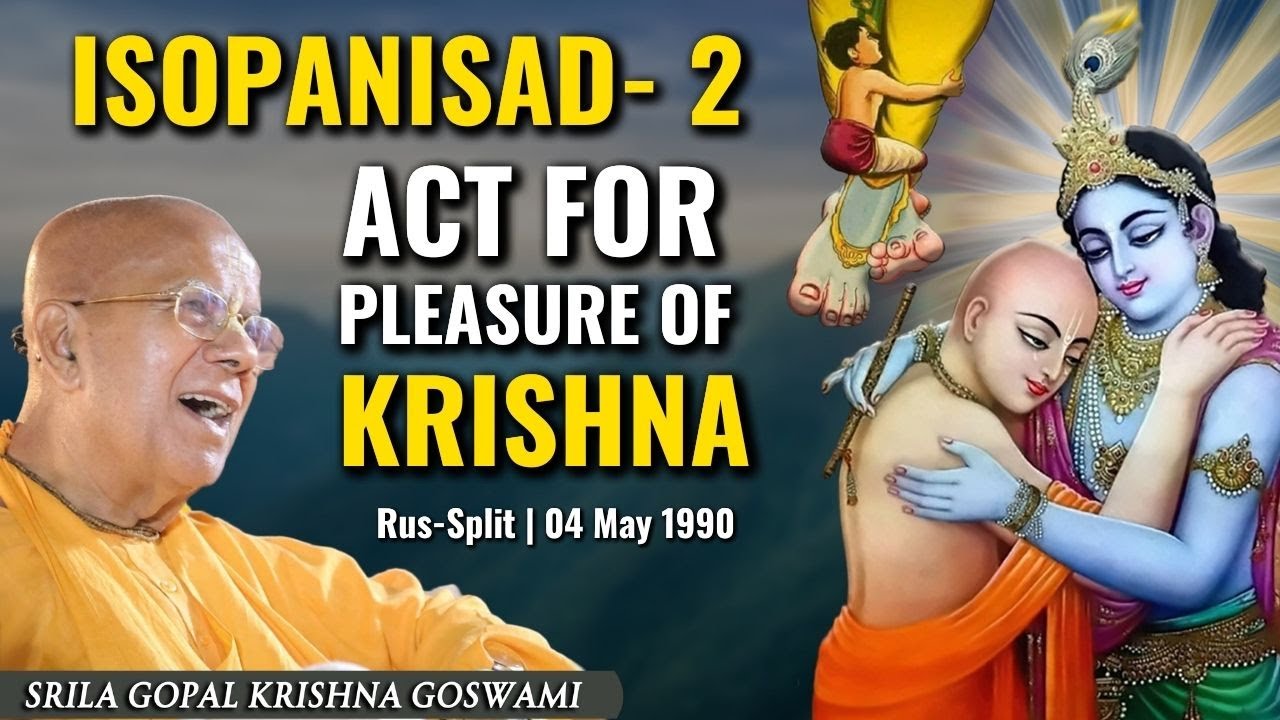
In this lecture Srila Gopal Krishna Goswami (presented by Prasad Raval) expounds the second verse of the Īśopaniṣad, explaining how the Lord is the ultimate proprietor of all and how a devotee should act without accruing karmic bondage. The speaker first reiterates the principle that everything belongs to Krishna, urging simple living and non‑greedy use of resources. He then introduces the three categories of action—karma (fruitive but scripturally sanctioned), vikarma (against scriptural principles) and ākarmic (action performed solely for the Lord’s pleasure, also called niskāma‑bhakti). By aligning one’s work with Krishna’s will, a practitioner can avoid the cycle of birth and death. The talk cites Srila Prabhupāda’s purports, Bhagavad‑Gītā chapters 3 and 18, the Caitanya‑caritāmṛta, and various scriptural verses to substantiate the claim that true renunciation is not abandonment of work but relinquishing attachment to results. Practical implications for householders are discussed, including analogies to communism, modern medical life‑extension, and contemporary social issues, illustrating that a life devoted to Krishna’s service is valuable regardless of its length. The lecture concludes that the Isha Upanishad provides a universal, practical philosophy for all beings to act in service of the Lord, thereby attaining liberation.
Chapters
Kurvāne veda-karmāni. Kurvāne veda-karmāni. Jijivīśe chātam samāha. Jijivīśe chātam samāha. Evāṁ tvā inanya te tosti. Evāṁ tvā inanya te tosti. Na karmā lipyate nare. Na karmā lipyate nare. You see that devotees are very shy in chanting the mantras. Om Ajñāna-timerandasya-jñānaṇ-jñāṇāśalakya-cakṣuṇ-melataniṇā-tasmai Śrī Guraveṇa Mahā. Śrī Caitanya Mano-Vistām-stāpitāmi na bhūtale svayam rūpaka-dāmayam dadāti svāpadaṇti-kam. Bandeham Śrī Guru Śrī uttāpada-kauṇaṇa Śrī Guruṇvaiṣṇava-nāsta. Śrī rūpaṁ sakra-jatāṁ sahāgina-rāgu-nāthaṇvitam tam sadevam. Hare Krishna, Hare Krishna, Krishna, Krishna, Hare, Hare, Hare Rādhā, Krishna Padaṇṣa, Hāgina, Lalitā, Śrī Viśākhā, Nityānanda, Jai Śrī Kṛṣṇa, Chaitanya Prabhu, Nityānanda, Śrī Advaita, Gadādhār, Śrī Vācchadeva, Gaurabhaktavinda. Hare Kṛṣṇa, Hare Kṛṣṇa, Kṛṣṇa, Kṛṣṇa, Hare, Hare, Hare Rāma, Hare Rāma, Rāma, Rāma, Hare, Hare. Kurvan evaḥ karmāṇi jijī viśeḥ ca tam samāḥ evaṁ tvā iñanyate tosti na karmāṇ ripyate nare. So in the two verses of the Śrī Īśopaniṣad that we have discussed so far, we have discussed two principal points. First point we discussed was— that the Lord is complete in all respects. And because the Lord is complete, this creation from Him is also complete. Just like the father, all his parts are active, they are normal. So when the father and mother produce a child, the child is also complete like the parents. And within this creation, there are all facilities by which One can live and realize the goal of life. And in the verse that we had discussed yesterday, that was text 1, it was established that everyone should understand that the Lord is the proprietor of everything. And since the Lord is the real proprietor of everything, one should not think, one should not possess more than necessary because he must know— that everything belongs to the Lord. So everything should be used in service to the Lord. So in this verse that we are discussing today, what is the key point? The key point is how we can work and not be affected by karma. This is important. How we can work, how we can lead this life and still not be affected by any negative reaction. In this verse of the Shri Isha Upanishad, Vyasa Dev is saying, That if we live with the mentality that has been described in the previous verse, that is, the Lord is the proprietor, therefore I should only use as much as I need for myself. Then if this is the mentality with which you want to live, then you can live even for 100 years. There is no problem. Kṛṣṇa consciousness is very often misunderstood. People think that becoming Kṛṣṇa conscious means You have to give up society, give up your family, give up your business, and just go to the mountains. But Kṛṣṇa consciousness actually preaches the opposite. Kṛṣṇa is not in favor of artificial renunciation. Kṛṣṇa is in favor of genuine renunciation. That is, we act always for the pleasure of the Lord. Just like in the Bhāgavad-gītā we see that Kṛṣṇa was asking Arjuna to fight, But Arjuna was constantly saying, "No, no, no, I cannot engage in this battle." Ultimately Kṛṣṇa told Arjuna, tasma sarveṣu kaleṣu mama nasmara yuddhucha. "O Arjuna, you, thou fight for Me without considering happiness and distress, loss or victory." Bhāgavad-gītā does not preach inaction. Rather Bhāgavad-gītā teaches action, but action for the pleasure of the Lord. Prasad RAVAL. So this verse is explaining that if we are living with a mentality that everything belongs to the Lord and I should only take for myself as much as I need for my survival, then there is no harm. You may even live for hundreds of years, but this— but you will not get entangled in material existence. In this verse, it is very clearly said that there is no alternative to man except to work for the pleasure of the Lord. So this verse of the Īśopaniṣad is a practical solution to how we can lead a normal life and still be Kṛṣṇa conscious. Therefore, this verse has to be discussed in relationship to the previous verse. So Kṛṣṇa in the previous verse has established that He is the proprietor of everything, and one must know what his kotai is. And one should not be greedy, or one should not possess more than necessary. Yesterday I had discussed the principle of simple living and high thinking. So if we work with the understanding that I am only supposed to get as much as I want and not more than that, then that will be perfection. Just like the communistic theory that everything belongs to the state, so everyone should only take as much as he needs and not more. That theory is borrowed from this verse of the Isha Upanishad. Like in your country, we see that whether you're a doctor or a big executive, you all live in the same building. Everybody has a 2 or 3 or 4 room house, except some exceptions. But the point is that this is basically the statement of the Isha Upanishad. Everyone should only have as much as he needs and not more than that. So in the purpose of this very important verse number 2, Prabhupāda discusses many important points which we shall briefly present for review. First point that Prabhupāda makes is in the purport that basically nobody wants to die. Everybody wants to live on eternally. Even in old age, the man is just praying to the doctor, "Please, may my life be extended." In these Western countries now, they have so many technical devices by which they can keep people artificially alive. Everything is being done with the help of machines. The patient cannot even move from left to right without, without getting the machine's permission. So they're being kept artificially alive, but people are just satisfied, "Yes, I'm still alive." So what is the value of this type of life? You are being kept artificially alive, But that, but that life is hardly worth anything. So karma bandhana, karma bandhana means that when you act for your own self's pleasure, that activity binds you to the process of birth and death. So when the living entity is acting independent of God, he's just getting entangled in the samsara of birth and death in different species of life. Human form of life offers one a chance. To perform activities which will make him escape any negative reaction. In the shastras, it is explained that every action that you perform falls into one of the three categories: karma, vikarma, aukarma. So actions which free one from the cycle of birth and death are called aukarma. Actions which are performed according to the revealed scriptures but in which there is some scope for sense enjoyment. That is called karma. And activities which are completely against the principles of religion are called tavee karma. Tavee karmic activities are activities against the principles of religion. Alokarmic activities are activities, activities which free you from the cycle of birth and death. Karma is activity which is according to the shastras, but in which there is some material aspirations. So if we analyze the material world today, we see that almost 99.999% of the people are engaged in weak karmic activities. So that is the unfortunate reality. Even if you go to India, you see majority of the people are engaged in weak karmic or sinful activities, but where the goal is some sense pleasure or some personal gain. No doubt it is better than sinful activity, but it doesn't free one from the cycle of birth and death. So karmic activities have been described by Narottama Das Thakura to be like drinking poison from a golden cup. Even if you were to drink poison from a golden cup, the poison would kill you. Therefore, Kṛṣṇa explains karma-vikarma-akarma and guides us to engage in akarmic activities. Ākarmic activities means activities for the exclusive pleasure of the Lord. In this verse, Kṛṣṇa is explaining what is Ākarma. Because when one is performing activities for the pleasure of the Lord, there is no scope for sense enjoyment. This is also— Ākarma is also known as nai-kāma. Sakāma, Kṛṣṇa-bhakti and niskāma. Niskāma-bhakti. Ākarmic activities are also known as niskāmic activities. Neshkarma means you perform activities for the pleasure of the Lord exclusively. Just like in the Caitanya-caritāmṛta there is a verse, kṛṣṇa-bhaktan is kāma-ateva-shanta-bhukti-mukti-siddhi-kāmi-sakāli-āśanta. The devotees of Kṛṣṇa, they are peaceful. Why? Because they want to serve Kṛṣṇa without expecting anything in return. And the bhukti-mukti, those others who take to some process of yoga or religion, But in the end they want some material gain in exchange. They are lusty and therefore they are not peaceful. So the Vedas clearly tell us how the living entity can elevate himself from the position of entanglement to a position of liberation. If we take advantage of the Vedic knowledge, then we can free ourselves from this entanglement. In the Bhagavad-gītā, in the 3rd chapter and the 18th chapter, there are many verses in support of what is being said in this verse of the Īśopaniṣad. So I am going to read some of the verses from the third chapter of the Bhāgavad-gītā which Prabhupāda has quoted in the purport, which are in support of what is being stated in this verse. Kṛṣṇa says, "O Arjuna, you must perform your duty, for doing your duty is better than doing no work." Kṛṣṇa explains how one cannot even maintain his body without working. Yajñātā karma-niyātā lokeyaṁ karma-bandhanā. Tadātāṁ karmakauntya mokta-saṅga-samācara. Then Kṛṣṇa says, work done for Viṣṇu has to be performed, otherwise work binds one to this material world. In other words, we have to work for the pleasure of the Lord, otherwise the living entity gets entangled. If we work for the pleasure of Kṛṣṇa, we become free from the bondage. Becoming free from bondage means becoming free from the cycle of birth and death. Now Kṛṣṇa also explains in the third chapter how at the very beginning of creation the Lord has sent forth different living entities and He told them, "Be thou happy by the performance of this sacrifice." Saha yajña prajāśaśva purova ca prajāpati anena prasāviṣyādvāma eṣa so 'vista 'iṣṭakāmadhuk. The Lord has very clearly stated in the Bhāgavad-gītā That at the very beginning He sent the living entities and the demigods. And He told them, "Be thou happy by the performance of your sacrifice for the pleasure of Viṣṇu." So if we understand that by working for the pleasure of Kṛṣṇa, we will be able to stop our transmigration from the cycle of birth and death. And we take to this process seriously, then the goal of life will be realized. In the, in the Śrī Īśopaniṣad, Kṛṣṇa is also conveying through this second verse —how one must give up all types of fruitive actions. Fruitive activities must also be avoided because it eventually entangles a living entity. So fruitive activities, they are definitely superior than sinful activities because at least when one is desiring some gain, he recognizes there is God in control. So Krishna explains in the 18th chapter through a series of verses as to what is real renunciation. So Kṛṣṇa is not saying give up your actions, but stop being the enjoyer of the fruits of your actions. Kṛṣṇa says in the 11th verse of the 18th chapter that it is impossible for the embodied living beings to give up all actions, but he who renounces the fruits of action, he is the real renouncer. So Kṛṣṇa is telling us very clearly How we can get out of the mutual entanglement? Because unless we perform vikarmic activities, we will always be bound. We may be elevated to the higher planets, have more handsome bodies, have more opulence, but that will not free us from the cycle of birth and death. So by taking advantage of this verse, we can get rid of karma and vikarma. So in the stage where you just want to serve the Lord, and not expect anything in return. This is definitely the highest stage of love of God. And in this stage, one only desires Kṛṣṇa and Kṛṣṇa-seva and Kṛṣṇa-prema, and no mutual adjustment. So this is the stage where one engages in activities for the pleasure of the Supreme Lord. As Caitanya Mahāprabhu has said, ainaṁ tad nujā kiṅkaram patitaṁ mām viśveṇa-bhāvām buddho. "Oh my dear Lord, I want to have nothing for myself. I am eternal servant." Some of the others fall into the ocean of birth and death. "Please therefore pick me up from this ocean of birth and death and fix me as one of the atoms of Your Lotus Feet." Maharāja Rāṣadeva says, nū-nām-pramata-āvukurute vikarma-yidindya-priyeta-ya-pranau te na-sādhū-māne-yita ātmāni-yāma-asaṇa-bhikleśa-da-āsa-dehā. He says, "Oh foolish living entity, you are engaged in weak karmic activities. You don't realize that the present body which you have is already giving you trouble, and the reason is because you engage in sinful activities. And by engaging in weak karmic activities again, you will have a body which will give you nothing but pain." So Maharādhvṛṣṭhaddeva very staunchly says, We must give up the karmic activities at once. If you know that something is harmful, an intelligent man does not want it. So we can make activities are suicidal. Therefore, we should not do any activities by which the goal of life cannot be realized. Just like a businessman will not enter into any transaction by which he may make a loss. So Iṣopaniṣad is telling us How to get out of this karma bandham. The Īśopaniṣad is telling us how we can engage in God-centered activities. Therefore we must understand these verses of the Īśopaniṣad very carefully. The Īśopaniṣad is establishing the Kṛṣṇa's philosophy which can be applied by everyone. Whatever position we may be in, we must execute it for the pleasure of Kṛṣṇa. That is important. Therefore, Maharāja Rāṣyadeva, he has given a very important statement. Maharāja Rāṣyadeva says that the king must correct the subjects, the spiritual master must correct his disciple, and the father must correct his son. Otherwise, the king, the father, and the spiritual master, they're all failing in their duties. Vekarmic activities must be avoided. Karmic activities may be avoided. The only activity we should really engage in is akarmic activities, because akarmic activities means no negative reaction. As long as there is negative reaction, we remain bound in the samsara of birth and death. So Krishna is saying in this verse— I have used the word Krishna because there's no difference between Vyāsadeva and Krishna. So Vyāsadeva or Krishna is saying in this verse that we must perform activities for the pleasure of the Lord so that there is no sinful reaction. The meaning of this verse is very similar to the meaning of a very famous verse in the second canto of the Bhāgavatam. This verse is talking about how we can free ourselves from karma. And if we can free ourselves from karma, then the verse says you may live for thousands of years. And in the Bhāgavatam it is said, with the rising and setting of the sun, The duration of life of everyone but one who has taken shelter of the Lord is being reduced. So every day when the sun rises in the morning, it is giving you a very important notice. And what is that notice? That is one day less left in your life. And every night when the sun goes to set and the moon comes out, it brings you a notice. Now you have one night less left in your life. The sun brings you the notice, one day less is left in your life, and the moon brings the notice, now there's one night less left in your life. So it is important that we understand these instructions of the Lord from different angles, so that we can expand our spiritual knowledge and so that we can defeat others in the bogus arguments which are presented. As Prasad RAVAL says, "Naate vidhum swarthakate me vishnum duraase bhai athamanina." People do not know how real happiness can be found. That path of real happiness is being presented by Kṛṣṇa here. So if we accept Kṛṣṇa's teachings, then we can free ourselves from the entanglement of material existence. Exactly just like a lotus flower is in water, but the water doesn't touch the lotus flower. We have to remain in the material world but not be touched by the illusory energy. So Īśopaniṣad is telling us, How we can use everything in service to the Lord. The Isha Upanishad is giving us information about different aspects of God and his devotees. So in the third chapter of the verses that some of the verses we read, it is very clearly concluded how one must become free from the law of karma. Krishna also explained in the third chapter, annad bahanti bhūtani prajñan anna samavā, that food gains come from rain, rainfall comes from sacrifice. Sacrifice means performing Anādh-bhāvanti-bhūtani prajñānaṇa-sambhava. Well, we were testing how many people are following. So Kṛṣṇa says in the third chapter, rainfall comes from— food grains come from rainfall. Rainfall comes from yajña. And what does yajña mean? Yajña means performing religious duties. Kṛṣṇa in the third chapter specifically uses the word. Yajña means religious duties. So there are different types of yagyas that people are performing. Just like in India, there are some people who, when it is very hot— like today it is very hot— so what they will do, they will light fire and they will go and sit down right next to that fire. Another type of yagya is when it's very cold, like in December it is very cold, so they will go in the cold river, in the Ganga, and they'll go and bathe over there. Or when they have a tongue but they will not speak. They'll do everything by writing. This is their yajña. So different people have different definition of yajña. And what is the yajña for this age? So Kṛṣṇa says that rainfall, rainfall will produce the grains, but rainfall will come when there is yajña. Yajña means executing religious duties. So Kṛṣṇa is telling us very clearly in this verse of the Īśopaniṣad how we must act without being, without taking on any negative reaction. So you see, Īśopaniṣad is telling us how we, how we must learn to perfect our existence. The materialists are engaged in vikarmic activities, activities completely against the laws of God. For their own so-called sense enjoyment, they will do anything. Just like in your country, your country has the highest rate of abortions in the world. So many millions of babies are being killed in the womb, and so many animals are being slaughtered, so many cows are being slaughtered all over the world, including India today. So why are people engaged in sinful activities? Because they want sense enjoyment. Īśāpaniṣad is saying that you can live as long as you want, but you must perform activities for the pleasure of the Lord. But the materialists are saying, "I want long life, but I don't want God." It is just like Hiranyakaśipu. At one time there was only one Hiranyakaśipu, but today everybody virtually is a Hiranyakaśipu. Everybody is interested in just money and soft bed. So Hiranyakaśipu He was performing very great austerities. The present-day Hiranyakashipus don't believe in austerity, but our Hiranyakashipu, he at least understood that if I want something, then I must perform austerities. So Hiranyakashipu was performing very extreme austerities. He was standing on his toes with his hands towards the sky, looking in the sky, and his whole body was full of ants. The ants were all over his body walking up and down. His body had become like an anthill. Anthill is a hill where the ants are going up and down, living on the hill. So Hiranyakāśipu was going through so many austerities. Why? Because he wanted to live for thousands of years. He wanted to reach a stage where he would never have to die. And Ravana, what was he? He was also trying to live eternally, but he was trying to make a staircase to go to heaven. Just like these scientists, they are telling us that you will be able to go to the heavenly planets one day. They don't understand that to go to the heavenly planets, you have to qualify yourself. Therefore, their attempts to go to the heavenly planets will be a failure. Just like last year I read in the papers that in America now they have started giving licenses for factories to be set up in outer space. And they are thinking that if they manufacture medicines in outer space, the environment will be such that that medicine will be able to cure all the diseases on this earth. So what is the value of a prolonged life if it is not used in service to the Lord? In the Śrīmad-Bhāgavatam, Second Canto, it is said, "Do the trees not live?" In Vṛndāvana is the tree which has been there for 5,000 years. So the Bhāgavatam says the trees are also living, the bellows of the blacksmith are also breathing, and the animals are also discharging semen. So the Bhāgavatam says, what is the value if you have this human life and you don't use it in service of God? It is better to have a short life but use that life in service to God. How long the Lord Jesus Christ lived? Who knows? And Buddha, Caitanya Mahāprabhu. So Prabhupāda used to give these examples. Caitanya Mahāprabhu did not live very long on this planet, and Lord Jesus Christ did not live very long, but every minute was used to serve the Lord. So we must engage in such a manner that we perform our activities, but we do not get bonded. Caitanya Mahāprabhu was once traveling in southern India, and there was one grihastha by the name of Kurma who was unhappy at home. So this grihastha Kurma went to meet Caitanya Mahāprabhu. And he told him, "I am very unhappy at home. I want to come and join you." But Caitanya Mahāprabhu said, "No, you stay at home. You chant Hare Kṛṣṇa. Follow the regulative principles, and you and I will never be separated." Therefore, even if one is in a householder situation and is sincerely chanting Hare Kṛṣṇa, understanding that Kṛṣṇa is the proprietor of everything, then one can achieve perfection of life. Of course, this does not mean that one should not try and be a brahmachari if the opportunity to live in the ashram is there. But what this means is this, that if you are in a situation where you cannot practice Kṛṣṇa consciousness by living in the temple, then even if you are living at home, you can practice Kṛṣṇa consciousness, because Kṛṣṇa consciousness is a practical living philosophy. Kṛṣṇa says, kaunteya pradījānaḥ, hi nā me bhakta-pranāśati. "O Arjuna, you please declare to the world that somebody who is working for Me, action dedicated to Me, such a devotee will never be ruined." So if we work for Kṛṣṇa, take shelter of Kṛṣṇa, we do every action for the pleasure of Kṛṣṇa, then we will free ourselves from all negative reactions. We must understand that Kṛṣṇa is the controller. Just like in the Gītā it is said, bhakta-rām yeget-apau sāṁ-sarva-lokam ahaiśvaram. Kṛṣṇa is the real bhakta. Bhakta means enjoyer. So Kṛṣṇa is the real enjoyer. So whether you have a male body or a female body, our position is to be prakṛti. The only real male or puruṣa is Kṛṣṇa. Therefore it is said: Eka la Īśvara-kṛṣṇa-āsa-bhṛtayā. Kṛṣṇa is the only proprietor, all others are His servants. So if you understand that Kṛṣṇa is the proprietor, we are all His servants, Then naturally everything should be used in service to Him, just like all the parts in the body, they all serve the stomach. So similarly, we are all supposed to serve Kṛṣṇa. So with this I'll stop the discussion on the second verse of the Īśopaniṣad.
More from PRASAD

Rare Pastimes & Timeless Lessons of Guru Mahārāja | Stories Every Disciple Should Hear

ISKCON Legends- pure devotees meet-HH Jayapataka Swami, HH Gopal Krishna Goswami, HH Radhanath Swami



Jagannātha Ratha-yātrā Through Śrīla Prabhupāda's Mercy | 29 April 2006 | Nairobi, Kenya

Lord Jagannātha's Appearance Pastime | 21.07.2019 | ISKCON Calgary | Śrīla Gopāla Kṛṣṇa Gosvāmī

The Ācārya Teaches by His Own ExampleGuṇḍicā Mārjana by Guru Mahārāja #shorts

Guṇḍicā Mārjana – Lord Jagannātha's Pastime | 21.7.2019 | ISKCON Calgary |Śrīla Gopāla Kṛṣṇa Gosvāmī

H.H. Gopāla Kṛṣṇa Gosvāmī Mahārāja - Exemplary Sādhana and Deity Worship # shorts

भगवान की कृपा कैसे प्राप्त होगी ? | 11 Jan 2014 | Punjabi Bagh | Srila Gopal Krishna Goswami

Material Education vs Spiritual Education | Srila Gopal Krishna Goswami #shorts