Īśopaniṣad 5: Inconceivable Potencies of the Lord | Rus-Split | 09 May 90 | Gopal Krishna Goswami
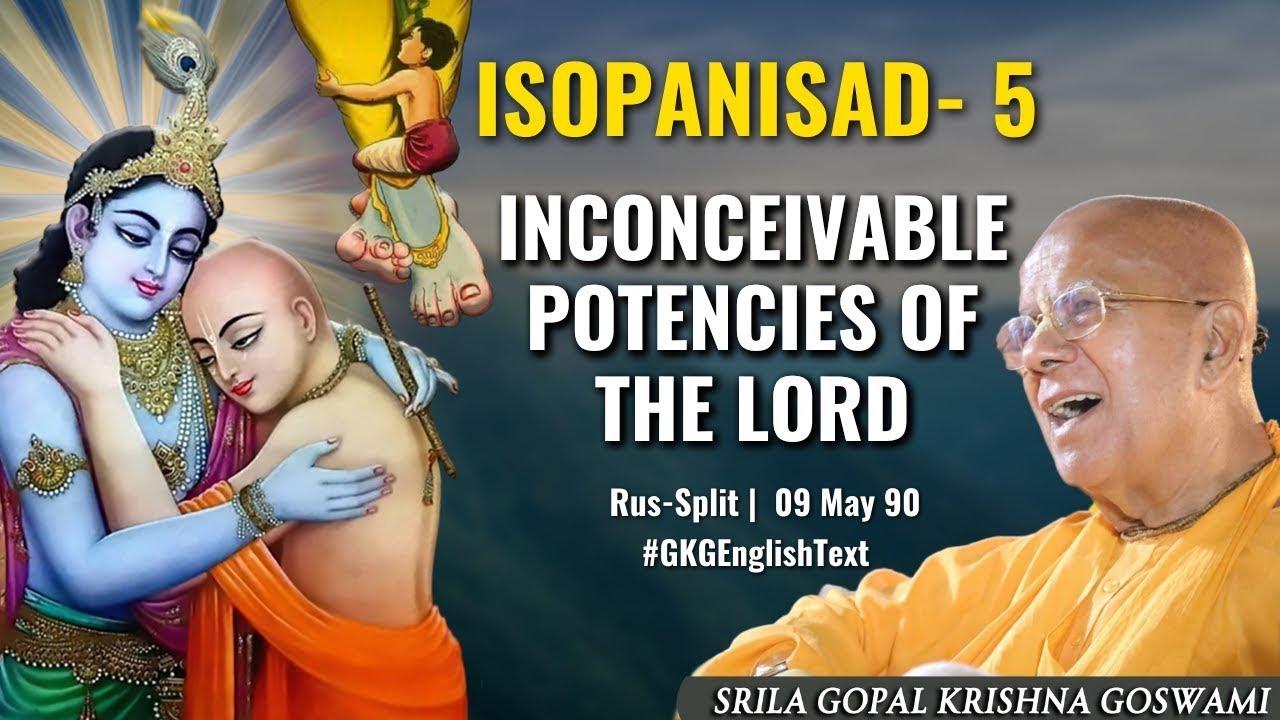
In this lecture Gopal Krishna Goswami expounds on Text 5 of the Śrī Īśopaniṣad, which presents a series of apparent contradictions (the Lord walks and does not walk, is near and far, within and outside all). He argues that these contradictions are intentional, revealing the inconceivable, unlimited nature of the Supreme Lord. The speaker contrasts the personalist (Vaiṣṇava) perspective, which recognises the Lord as a sentient being capable of any activity, with the impersonalist (māyāvādī) view that limits God to abstract, formless concepts. He cites Prabhupāda’s 1932‑36 prayers, Bhaktisiddhānta’s teachings, and scriptural passages (Bhagavad‑gītā, Caitanya‑caritāmṛta) to show that the Supreme is a personal deity who can incarnate as a deity (archa‑vigraha) and be worshipped. Stories such as Sakshi Gopāla, the exchange between Rūpa and Sanātana Gosvāmīs, and Prabhupāda’s train‑analogy illustrate how a deity’s form is a direct manifestation of the Lord when installed by a bona‑fide guru. The lecture also addresses practical devotional questions: the difference between installed and uninstalled deities, proper worship (fixed mangala‑āṛti, 16 rounds of chanting, book distribution), how to recognize true devotees versus māyāvādīs, and the relative importance of attracting devotees versus distributing literature. Throughout, the speaker emphasizes that understanding God through bhakti transcends material senses, and that the contradictions in the verse reflect the differing visions of personalist versus impersonalist devotees.
Chapters
Om namo bhagavate vasudevaya. Om namo bhagavate vasudevaya. Om namo bhagavate vasudevaya. Om namo bhagavate vasudevaya. So today we'll discuss Text 5. So Śrī Īśāpaniṣad, Text 5. You can repeat the Sanskrit after me. Tad ejati tam naijati tad bhure tadvantike tad antarasya sarvasya tad tad-ei jati-ta nai jati-ta dureta dvanti-ke taranta-rasya sarvasya tadu savyasya bhayata ha. So this is a very significant verse because, as I told you the other day, the Śrī Uṣupaniṣad is describing this absolute nature of God. So in this verse, the transcendental activities of the Lord are being described. Now in this verse you may have noted there are many contradictions. Contradictions are not only in the verse but in every line. For example, it is said, Tadejati dan naijati. Ejati means walks, naijati means he does not walk. So in one line it is said he walks and he does not walk. And in the next line there's another contradiction. He is very far and he's also very near. And in the next line, again another contradiction: He is within everything and outside of everything. So contradictions are given over here to show the inconceivable potency of the Lord. Just because we cannot see God with our contaminated eyes, it does not mean that God does not have a form. The abode of the Lord is beyond this material sky, and we cannot see it with our material eyes. So when the Īśopaniṣad says the Lord walks and He does not walk, it is conveying a very important purpose. For the devotee who accepts the personal form of the Lord, the Lord can do anything. He's inconceivable. And for one who's trying to limit God, who's trying to measure God with his material senses using the Dr. Frog philosophy, for him God cannot walk. And to the, for the impersonalist, God is very far. Tasya-dure. Very, very far. And to the personalist who recognizes, īkśvora-sarva-bhūtānām hēṣdaye rājṇāt teṣṭhati, who recognizes that God is in everyone's heart, for him God is very near. And He is within everything and outside everything. He is all-pervasive, and this is the verdict of the devotee. So the impersonalist, they are always trying to limit God. They don't understand the inconceivable nature of God or that God is capable of doing anything. The devotee recognizes that God is a sentient being. In other words, God is an individual with senses, and this person also has feelings and senses. So Prabhupāda in 1936, He, in 1932, he wrote a very famous vyāspujā offering to his guru maharaja. And in that famous prayer Prabhupāda said: "Absolute is sentient, thou hast proved. Impersonal calamity thou hast removed." So Prabhupāda said: "You have established Bhaktisiddhānta-jī, that the Supreme is a person, and the concept that God has no form has been destroyed by you." So because this was very important, this was the theme of Prabhupāda's offering. That the Supreme is a person with senses. And the so-called talk of impersonalism has been destroyed by Bhaktisiddhānta Mahāprabhu's teachings. There are these so-called māyāvādīs. They do not accept that God is capable of descending in a human form and performing His pastimes. But these māyāvādīs, they don't accept the form of Kṛṣṇa. There are so many millions of people, for example, in India, They will go in front of the temple of Kṛṣṇa, but they will not go inside. Because they— or even if they go inside, they will not bow down. Why? Because they become māyāvādīs. They say God cannot descend in a human, in the form of a mūrti. So the Supreme is a person, the Supreme has senses, and when the Supreme descends on this earth, He remains the Supreme. The Lord descends in His archa-vigraha form. Archa-vigraha. Vigraha means form. So the Lord descends in His Deity form. And there is no difference between the Lord and the Deity form. In the Caitanya-caritāmṛta, there is a very nice story known as the story of Sakshi Gopal. There was once a very rich old man. Who had gone to a place of pilgrimage. And in that place of pilgrimage, the old man had become sick. So one young Brahmin, he helped the old man. The old man was very obliged to this young Brahmin, and he said, "You have done so much for me. You have saved my life. What can I do for you? I can give you my daughter in marriage." When the old man came back to his house, He told his family members that I was in difficulty, so this young poor Brahman helped me, and I have promised my daughter in marriage to this young Brahman. So the other members of this old man's family, they were very angry. They said, no, we cannot let our daughter be married to this poor Brahman. So the members of this old man's family They started telling the Brahman that, "You have forced our father to give you this promise that he will marry his daughter to you. You are a rascal." And they started destroying his reputation. So the old Brahman said, "Now it is a question of my honor." Because a Brahman cannot be dishonored. A Brahman cannot be said that he is a cheater. So the The young Brahmin boy said, "Now I must produce some witness who can testify that I did not force his old man to promise his daughter, but he voluntarily agreed." This promise to marry his daughter to this young Brahmin was given by the old man in front of the Deity which is known as the Deity of Gopal. So The Brahmin boy went running to the Deity of Gopal. He fell at the feet of Gopal and he said, "Please save my honor." So the young Brahmin said, "My honor is in your hands. You know that this old man voluntarily promised his daughter in marriage. Please testify and save my honor." So the Deity of Gopal said, "How can I testify?" I cannot walk to that man's house. So the young Brahmin said, my dear Lord, if you can talk, then you can also walk. And then the Lord agreed to follow him, and the Lord agreed to testify. So this is known as the story of Sakshi Gopal in the Caitanya-caritāmṛta. Sakshi means witness. So to the layman, when he sees a mūrti of Rādhā-Kṛṣṇa, He may say, "Oh, this is some statue made of brass or wood." But a devotee knows, a Vaiṣṇava knows that this Deity is Kṛṣṇa. There is no difference between the Lord and His archa-vigraha form. Bhaṁ mehiti parmaḍma iti bhāgvan iti śabdayate. The Supreme can be realized in different phases, beginning with Brahman, leading on to parmaḍma, and eventually culminating in Bhāgvan. It is not that regardless of any path you take, the end result is going to be the same. Brahman and Paramatma realizations only give you partial understanding of God's potencies. But through the Bhagavan's approach, you understand God completely. Prabhupada gave the example that once in a village in India, a new railway station was built. So the villagers were having a meeting And they were discussing, now tomorrow the first train is going to come in this village, and nobody had ever seen the train before. So they decided they will send a delegation of 3 people to the city, to the railway station, to look at the train. The first person just saw the light in front of the engine, and he ran back to the village and said, "I saw the train." People said, "What did it look like?" And he said, "Oh, there's a light in the front." The second person waited a little longer. He saw the light in front of the engine, then he saw the engine, and he thought this was what the train looked like. So he ran back to the village and he gave his explanation of what the train looked like. The third person, he was more patient. He saw the front of the engine, the light, the engine, he saw all the compartments, and then he saw the train leave. So he went back to the village and he gave his explanation of what the train looked like. So of these three definitions, whose definition of the train is most complete? Similarly, understanding God through the Brahman and Paramātmā features, they only give you partial understanding of God. We must understand that God is unlimited. You cannot say that God only has one son. Prabhupāda said, The Christians say that God only has one son, but an ordinary man can have 100 sons. So how can you say that God can only have one son? So the devotee acknowledges the presence of God in the archa-vigraha, mūrti form, and the devotee's desire is just to serve the Deities. Just like in your Leningrad temple, you have these small Golnitai Deities. Now these Deities are not installed Deities, but so this does not mean that Gaura-nityāya is not here. It all depends upon the angle of the devotee. If you think that here is God, then this God will also speak to you. And if you say, "Oh, this is just 10-inch brass Deities," or what some people say is Gaura-nityāya, but maybe Gaura-nityāya may not be. And how can God be in this Deity? So the point is that we have to accept the inconceivable nature of God and the capacity for God to incarnate in His Deity form. Rupa Goswami and Sanatana Goswami, Sanatana Goswami, you know, Rupa and Sanatana Goswami, they were living underneath a different tree every day in Vrindavan. So Sanatana Goswami, he had Deities that he was worshipping in his tree. He was offering him dry chapatis every day because that is all that they ate. One day a very beautiful young girl came and she brought with her very nice foodstuff and gave it to Sanatana Gosvāmī. So when Rūpa Gosvāmī came for lunch, they were both brothers, Rūpa Gosvāmī said, "Oh, today you have cooked such a big feast. Where did he get this feast from?" So Sanatana Gosvāmī said, One very beautiful young girl had come. She gave me all these presents. So I cooked it. Rupa Gosvāmī then said, this young girl was Śrīmatī Rādhārāṇī. How did you take service from Rādhārāṇī? So the reason I gave this story is because a devotee does not like to take any service from Kṛṣṇa. A devotee is ready to serve the Lord but never take any service from the Lord. So the, the māyāvādīs, when you tell them that Kṛṣṇa descends and perform this divya-līlā, superhuman līlā. They say, "No, God cannot descend." Therefore the Īśopaniṣad is saying He walked and He does not walk. So for the Vaiṣṇava devotee, God can do anything because he understands God is unlimited. But for the māyāvādī, he thinks God is limited. So for him God cannot walk. Prabhupāda said, "The māyāvādīs are saying, 'God, You have no form, no eyes, no legs, no hands, no mouth.'" So for them God is very, very far. And for the personless devotees, God is very dear. The devotee knows that if he approaches God through the process of devotional service, then God can be understood. And Kṛṣṇa is within everything and outside of everything. So the contradictions in this verse reflect the contradictions in the vision of the personless and the impersonalist. The devotee understands the inconceivable nature of God and the impersonalness. They cannot understand the inconceivable nature of God. Kṛṣṇa says in the Gītā, janma-karma-cāma-devyam evāṁ vibhūti-tātpataḥ taktadeham panaḥ janma-netivam iti sarva-junaḥ. That is, my coming and going from this world both are completely devyam, transcendental. So Kṛṣṇa's coming and going are both transcendental. That means that when Kṛṣṇa comes to this earth planet, He comes in His superhuman transcendental form. Īśvara-parma-kṛṣṇa-saḥ-cid-ananda-vigrahaḥ anādirādir-govindā sarvakārṇa-kāraṇa. This is the explanation by Lord Brahmā of the transcendental nature of God. So īśvara-parma-kṛṣṇa. There are many controllers, but the Supreme Controller is whom? Kṛṣṇa. sat-cit-ananda-vigraha. He is eternal, full of knowledge, and blissful. So eternal. We, you and I are also eternal, but there's a difference between Him and us. nityo nitya-nāma nityo nitya-nāma caitanya-caitanya-nāma eko bhāvanām vidyāt. Gāti-kāma. I am eternal and the Lord is eternal, but the difference is that that singular eternal is maintaining all other eternals. So, sācid-ananda. He is eternal, full of knowledge, and always blissful. And we are full of ignorance and we are always sad. And this Lord is the cause of all causes and nobody is His cause. In the Bhāma-samhita, many other transcendental attributes of the Lord are revealed. Adyam purāṇa puruṣa. Though He is the oldest entity, He appears ever youthful. He is situated in a spiritual planet of Goloka Vrindavan, but nevertheless He is all-pervasive. So we must understand the nature of God through the scriptures. Advaita means there is no difference between His body and soul. If it is a difference between your body and your soul and my body and my soul. But there is no difference between the Lord and His body. He is acchuta, He is acchuta. He does not make any mistake. And ananta-rūpa, He manifests Himself in many different forms. Vedesu durlabham adurlabham ātmabhakto govindamādhipuruṣam tamām haṁ bhajāmi. God Brahmā further says, vedesu durlabham, by trying to understand Him through the Vedas, It is impossible. Adurlabham ātmabhakto. But if somehow or the other one approaches Him through the medium of bhakti, then what is difficult becomes easy. So with our imperfect senses we cannot see God, but through the medium of Guru, sadhu, shastra, we can understand about God. In the Bhagavad-gītā, Kṛṣṇa says, ye yākamām prapadeyante, all of them as they surrender to Me, I reward them accordingly. In other words, Kṛṣṇa reveals Himself in proportion to our surrender. So if we approach Kṛṣṇa through the personalist path and we follow His instructions, then this Kṛṣṇa can be understood. Then we can understand Kṛṣṇa. So we approach the Lord through the personalist path. If we accept His divine instructions, then Kṛṣṇa will reveal Himself more and more. So in this verse, It is being described that based upon our understanding, we will understand God. So if a form of the Lord is carved according to the ingredients that are coming from God, and the mūrti is installed on the desire of the spiritual master, then that ācārya-vigraha is non-different from the Lord. Aham sarvasya prabhavo mataḥ sarvam pravartate. I am the source of everything material and spiritual. This is the verdict of Kṛṣṇa. So the Lord is present in His Ārtha-vigraha form so that the conditioned souls can easily focus upon Him. Prabhupāda gives a nice example on this point. He says to post your letter, you can post your letter in the big post office or in the small post box in the corner. So if you have an authorized post box in front of your house, and you post your letter there, or you post a letter in the big post office, the letter will go to its destination. But if you just put a dummy post box in front of your house and post the letter, the letter will remain there all its life. So similarly, if you worship God in His bona fide form, then that Deity is non-different from Kṛṣṇa. God is all-pervasive. When Hiranyakaśipu asked Prahlāda, Where is your God? What did Prahlāda say? Everywhere. Parīyāni-kāśipū did not believe that He could be inside the pillar. Yesterday I read the whole story to you. But the Lord appeared from inside the pillar. So to the devotee, God is all-pervasive, and to the impersonalist, God is limited. Just as heat and light, they both come from fire. So everything actually is coming from God. So we will end our discussion on this verse. In this 5th verse of the Īśopaniṣad, the author Vyasadeva is giving us further information about the inconceivable nature of God. The contradictions that appear in this verse are really not contradictions, but they appear to be contradictions because there are two schools of devotees, the personalist and the impersonalist. And the personalist, they understand the unlimited nature of God, and the impersonalist, they don't understand. Hare Kṛṣṇa.
Hare Kṛṣṇa.
Did you all understand this verse? This was a difficult verse.
It is said that God is inconceivable, but it is also said that we can understand Him somehow. What does it mean to understand God?
It is inconceivable to understand God through your material senses. But if you understand God through the process of bhakti, then you can understand Him.
Devotee have no interest in Brahman, in intelligence. And it is also said that devotee will see the Brahman and Paramātmā feature at the same time. Is it true?
Devotee is not interested in Brahman, nor is he interested in Paramātmā. Paramātmā realization is higher than Brahman realization. A devotee is only interested in Bhagavan feature of the God. He will realize the Bhagavan feature if he serves the Bhagavan feature. If he doesn't serve the Bhagavan feature, then he may be standing in front of Kṛṣṇa, but he won't understand Kṛṣṇa. There is one very big man in Delhi. Prabhupāda used to stay in his house, and in his house he has Rādhā-Kṛṣṇa mūrtis. But he changes the dress, his wife changes the dress, or used to change the dress of the Rādhā-Kṛṣṇa Deities only once a year. And once a year only. So if you accept that here are Rādhā-Kṛṣṇa mūrtis, here is God, you're not going to change His clothes once a year. So there's so many people, they have Rādhā-Kṛṣṇa mūrtis at home, they'll even have Rādhā-Kṛṣṇa temple at home. Still they won't understand here is God. So his question is, what's the difference between installed Deities and not installed Deities? The process is that Kṛṣṇa appears on the call of the Ācārya or the Guru. And when the Deity is installed by a bona fide representative of Kṛṣṇa, then Kṛṣṇa manifests, then Kṛṣṇa becomes fully manifested. And once the Deity is installed, you have to have very strict standard of worship. Now, uninstalled Deities should also be considered like installed by the devotee. Just like now you have Gauṇitāi Deities here. These are not installed Deities. Now your devotee should not feel, "Oh, these Deities are not installed, so I can eat prasad in front of them, or when I come in front of them, I don't have to bow down." Technically, there's a difference between installed and uninstalled Deities. In front of the installed Deities, you have to be very careful, no offenses. All offenses should be avoided. If they are uninstalled, go-nethai Deities, then some offenses may be tolerated. But in the devotee's heart, the uninstalled Deities are like installed. Therefore, he doesn't want to risk making offenses even in front of uninstalled Deities. When you see here is God present in Gauranithai form, then this Gauranithai will even talk to you. There's so many stories I can tell you where the Deities have spoken, but there's no time.
There may be some māyavādya. And externally they may look like a devotee. They may even chant mantra, do something like that seems to be—
Yes, there are many people like this. Even in Vrindavan, there are so many temples where Kṛṣṇa is being worshiped, but the pujari, he has no love for Kṛṣṇa. In some temples, even in Vrindavan, whenever the pujari gets up, he does mangala-ārati. So actually the pujaris' business is to wake Kṛṣṇa up at the right time, but that is not their standard. Whenever they get up, they will get ready, do aṛti. 6 o'clock, 7 o'clock. Yes, many people will keep Kṛṣṇa just for business reasons.
How to distinguish between such devotees? In our practical life, maybe Prasada meant.
Oh, so your question is how to recognize the, the māyāvādī devotee. You see that they don't have proper respect for Kṛṣṇa. Because if they have respect for Kṛṣṇa, they'll worship Kṛṣṇa strictly according to shastra. In shastra it is said, mangala-ārti must be at fixed time. But they will not do aarti at fixed time. They'll do aarti whenever they get up. They do not worship Kṛṣṇa like God. God, if you worship Kṛṣṇa like God, you do everything perfectly according to scriptures.
What should devotee do who has not enough time or who may be sick and cannot worship the Deities according to all rules? And have he any right to keep Deities in his home?
If he cannot take care of the Deities properly, don't worry. Just chant Hare Krishna 16 rounds, read and do a little bit of book distribution. That's all. If you can take care of the Deities properly, haraśo. But if you can't take care of the Deities, then don't bother. In Kali Yuga, this chanting is so powerful, this can give you all the effect. You don't have to worry about anything else.
But in this case, can devotee have Deities?
Agree, Hasta devotees can have Gauranithai Deities at home. But then you should have Mangala-Arthi at the proper time. Make it like a fixed time. Those who live near the temple, they should worship the Lord in the temple. But in your country, as many of you live away from the temple, some of you are 1 hour away, 2 hours away, so naturally it is not practical to come here every day. So you can do aartis at home. Hare Naam. Hare Naam is very important, but doing 16 rounds every day is more important. If you just go on the Hare Naam and you don't do your 16 rounds, then not very good.
What is the more important thing, to distribute more books or to Or to attract more people.
Thakur Bhaktivedanta said that Vaiṣṇava is recognized by the number of devotees he attracts. So both are important. You do book distribution, you're going to attract people, and you preach and you're going to attract people.
How should we consider the name of the Lord? As one of the features of the Lord or one of qualities?
It's the same as the Lord. Lama, lama, hale hale.
More from PRASAD

Rare Pastimes & Timeless Lessons of Guru Mahārāja | Stories Every Disciple Should Hear

ISKCON Legends- pure devotees meet-HH Jayapataka Swami, HH Gopal Krishna Goswami, HH Radhanath Swami



Jagannātha Ratha-yātrā Through Śrīla Prabhupāda's Mercy | 29 April 2006 | Nairobi, Kenya

Lord Jagannātha's Appearance Pastime | 21.07.2019 | ISKCON Calgary | Śrīla Gopāla Kṛṣṇa Gosvāmī

The Ācārya Teaches by His Own ExampleGuṇḍicā Mārjana by Guru Mahārāja #shorts

Guṇḍicā Mārjana – Lord Jagannātha's Pastime | 21.7.2019 | ISKCON Calgary |Śrīla Gopāla Kṛṣṇa Gosvāmī

H.H. Gopāla Kṛṣṇa Gosvāmī Mahārāja - Exemplary Sādhana and Deity Worship # shorts

भगवान की कृपा कैसे प्राप्त होगी ? | 11 Jan 2014 | Punjabi Bagh | Srila Gopal Krishna Goswami

Material Education vs Spiritual Education | Srila Gopal Krishna Goswami #shorts