Krishna Consciousness Makes one Fearless | SB 7.5.46 | 17 May 1997 | Vrindavan |Gopāl Kṛṣṇa Goswāmī
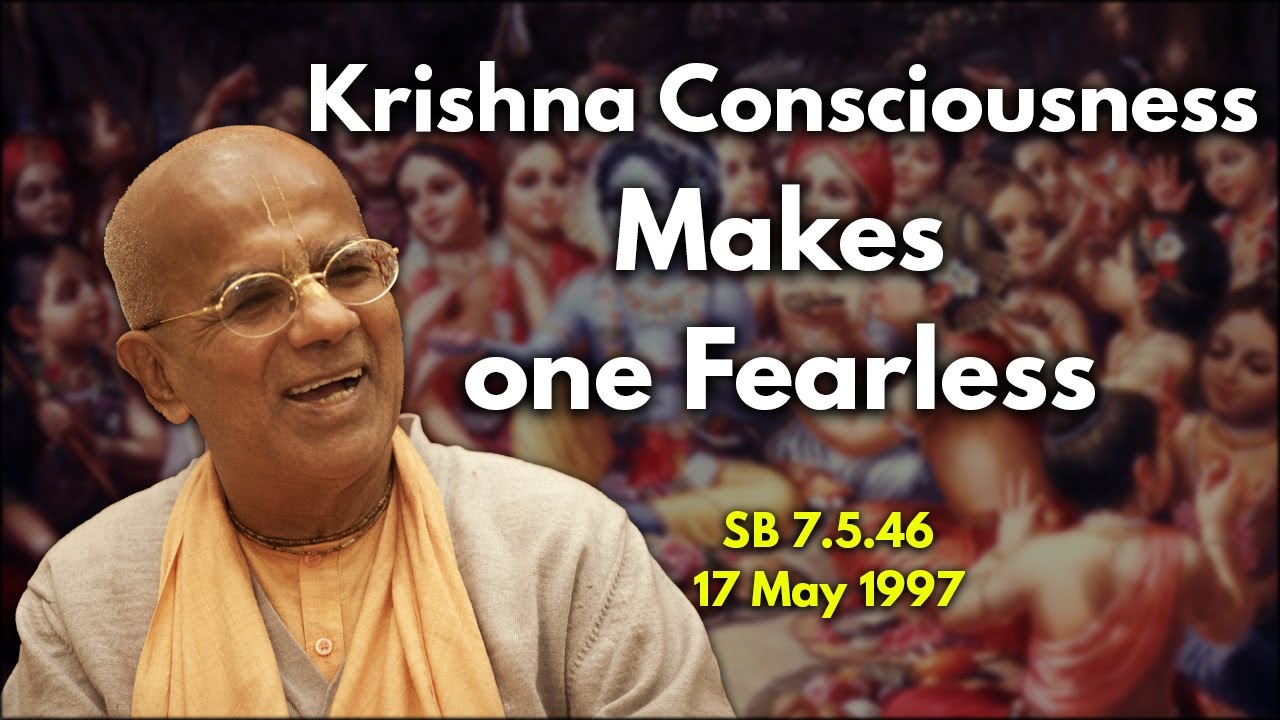
In this lecture Gopāl Kṛṣṇa Goswāmī expounds Śrīmad Bhāgavatam 7.5.46, which describes the child‑devotee Prahlāda Mahārāja’s absolute fearlessness despite the relentless persecution of his demon father Hiranyakāśipu. The speaker interprets the verse’s metaphor of a dog’s curved tail as the unbreakable attachment of a true devotee to Lord Viṣṇu. He recounts the scriptural background—Narada’s instruction to Prahlāda in the womb, the demigods’ fear of Hiranyakāśipu, and the extreme trials (elephants, snakes, fire, poison, stone‑throwing) that Prahlāda endured without injury, illustrating the protective power of constant remembrance of Krishna. The talk then broadens to discuss the nature of materialist diplomacy versus Vaishnava non‑violence, the importance of sincere surrender, and the role of faith in Krishna’s protection. Historical examples such as Haridās Thākur and the prostitute Pingalā are cited to show how desperation can lead to surrender. The lecture connects these ancient principles to contemporary ISKCON practice, emphasizing deity worship, kīrtan, preaching, and book distribution as means to cultivate fearlessness and constant remembrance of Krishna. It stresses that effort must be combined with dependence on Krishna, following Srila Prabhupāda’s example, and that the ultimate goal is to surrender to Krishna, abandon all other dharmas, and trust in His protection.
Chapters
Om Namo Bhagavate Vasudevaya. Om Namo Bhagavate Vasudevaya. Om Namo Bhagavate Vasudevaya. Śrīmad Bhāgavatam, Kṛṣṇa 7, chapter 5, text 46. Vartamaṇo vidurevāya, vartamaṇo vidurevāya, bālopīyaḍādhīrayāma, bālopīyaḍādhīrayāma, nā viṣmarati meṇaryāma, nā viṣmarati meṇaryāma, śūnasya paivāpabhu, śūnasya paivāpabhu, Translation: Although he is very near to Me and is merely a child, he is situated in complete fearlessness. He resembles a dog's curved tail which can never be straightened, because he never forgets his misbehavior and his connection with his master, Lord Viṣṇu. Responsibly, Purified by His Divine Grace A.C. Bhaktivedānta Swāmī Śrīla Prabhupāda. Śrīla Prabhupāda kei prasāda raṇām. The word shuna means of a dog and shepa means tail. The example is ordinary. However one may try to straighten a dog's tail, it is never straight but always curved. Shuna Shepa is also the name of the second son of Ajikarta. He was sold to Harishchandra, but he later took shelter of Vishvamitra, Harishchandra's enemy, and never left his side. Om Gyānti mīrandaasya, jñānānjanāśalakyaḥ, chaakṣūraṇ mṛtaṇyena, tasmai śrī-gurave namaḥ. So we have been witnessing in this chapter Hiranyakāśipu's anger. At whom? His son Prahlāda. Of course, as we know, Prahlāda was not an ordinary child. The Vedic scriptures accept him as one of the spiritual authorities. Sāyamūrṇarāḍa sambhukāmāla-kapilomanu. Pralādo janakabhismo bali vāya sakervayām. So Pralāda is one of the mahajans. Today in India, mahajans become a caste. You meet Mr. Mahajans all the time, just like you meet Mr. Goswamis all the time. But mahajan means a spiritual authority. Goswami means one who has control over the mind and the senses. So Prahlāda, he had the great fortune of having received the transcendental knowledge when he was in the womb of his mother from the great sage Nārada Muni. The background is that the demigods were already troubled enough by Hiranyakāśipu. He had obtained so much power by his austerities. So when Hiranyakāśipu was out practicing austerities, practicing austerities in Mandara Hill, the demigods had actually kidnapped his wife when Prahlāda was in her mother's, was in his mother's womb. And the plan was that as soon as the child comes out, they would kill the child. Like you say in English, like father, like son, huh. So they were anticipating the son to be another demon. They already had Hiranyakashipu senior, and they were concerned that the next child may be Hiranyakashipu junior. So they had made a plan to annihilate the child. But then they were assured by Narada Muni that the child in the womb was not an ordinary child, but was going to be a great spiritual authority. And on Narada Muni's assurance, the demigods released Prahlad's mother. Who was then given shelter by the great sage Narada. And then Narada instructed her on the philosophy of Bhagavad-dharma, which Prahlāda heard when he was in the womb of his mother. And then Prahlāda was able to explain this later. So Prahlāda had the great fortune of having received this transcendental wisdom when he was in the womb of his mother. And Hiranyakāśipu, his demonic father, was very envious of Lord Viṣṇu. And because of his envy towards Lord Viṣṇu, because Viṣṇu had killed his brother, of course, anyone who gets killed by the Lord is actually very, very fortunate. Many times in India also you meet people who say, "Oh, you people worship Kṛṣṇa, but on the battlefield of Kurukṣetra, so many soldiers were killed." What type of religion is this? But they don't realize that everyone who died in the Battle of Kurukshetra were all liberated because they had the unique privilege of seeing the Personality of Godhead. Seihrāṇikāśipu's anger was very intense against the Lord, and his son Prahlāda was just the opposite. Actually, we've all heard these stories of Pralāda. We actually, these days you probably hear it every day because every verse is, you know, with a similar message. But the wonderful nature of transcendental topics is you never get tired. You can talk about Pralāda every day, you can hear about Pralāda every day, and you can talk about Kṛṣṇa every day, never get tired. That's the nature or spiritual philosophy, spiritual sound. We chant the same mantra every day and you never get tired. The materialist can never comprehend the potency and the omnipotent nature of spiritual sound and spiritual philosophy. But the transcendentalist and aspiring transcendentalist can. So Hiranyakāśipu, over here we see that he's reached a point of desperation. His anger became more intense when he questioned his son. After he questioned his son as to what he had learned in school, he was hoping to hear something diplomatic because Hiranyakashipu was also, had also instructed the sons of Chukracharya, Sandana and Anarka, to train Apralāda in diplomacy. You know, they were, Hiranyakashipu actually tried everything. In the Bhāgavad-gītā it is explained, that in diplomacy there are 4 steps involved. The first step in diplomacy is legislation, legal orders. Meaning you try to control someone by legal orders. Then another way is pacification. You try to pacify the individual, huh? Sometimes we have to go through these processes even in our ISKCON temples. You tell them, "This is the law of Prabhupada." He doesn't want to follow the law. Then you try to pacify him, huh. So when it doesn't work with pacification, then you go to the next step. This is more common in diplomatic circles than in ISKCON probably. Offer him a post. You offer him a position, hoping that now you offer him a position, the guy is going to become less volatile. But even if that doesn't work, then you resort to the last alternative, which is weapons. This, of course, in ISKCON we have no room. Vaiṣṇavas never resort to violence. But the materialists, they stoop to any level to get their aims realized. So Hiranyakāśipu, he had tried, you know, he was trained in diplomacy. So he tried his best to control his son through legal orders, didn't work. Then he tried pacification. He put his son on his lap, tried to pat him on his head, everything. Of course, there was no question of offering him post. Of course, he wanted him to become a ruler. But now that when everything failed, Hiranyakashipu had decided, "Now I have no alternative but to resort to cruel techniques." And he actually didn't spare any cruel technique. You know, we've all heard of violence, devotees being put through inconveniences, just like in the former Soviet Union when a movement first started. Devotees were harassed, they had to go through so many difficulties. Some of them were sent into Siberia, some of them were made to stay in frozen, cold, cold rooms with no heat. They had to eat dry bread that was, you know, weeks old and so on. But no one actually has had to undergo the difficulty that Prahlāda had to undergo, isn't it? I mean, just look at what Prahlāda had to go through. He was thrown beneath the feet of big elephants. Then he was thrown among snakes. You know, normally when we see a snake, we run away, isn't it? I know some of the devotees who live in Gosha, they always complain sometimes they have to cross snakes while coming to the temple. So they don't want to live in the Gosala. So Prahlāda was surrounded by snakes. Then hurling him from the top of a hill. My God! Vīrāṇakaśipu's demons, assistants, threw, took Prahlāda to the top of a mountain and threw him from the top of the mountain. Still nothing happened to Prahlāda. Then he was administered poison. He was probably administered a big dose of poison, not a drop of poison. Still nothing happened. Then Pralad was starved. Imagine, 5-year-old kid, he was starved. Then he was exposed to severe cold. You can't even imagine what this cold may be. Here in Vṛndāvana, it's a little cold with no closure and you feel like, He was so concerned, but he was exposed to severe cold, winds, fire, and water. Then none of this worked. Then Hiranyakashipu said, "Throw stones on him." So very heavy stones were thrown on Praśad RAVAL RAVAL RAVAL, who was only a 5-year-old kid. Still none of this worked. Then what did Hiranyakāśipu think? Hiranyakāśipu realized, after all Hiranyakāśipu was not a complete fool. By Kṛṣṇa's illusory energy and by the transcendental will of the Lord, he was playing the role of a demon. But we should never forget that in the core of his heart he was a devotee. After all, at one time there were Jaya and Vajra, isn't it? But they, they agreed to play the role of a demon to make the Lord's pastimes on this planet more relishable. Because when the Lord appears and when the Lord has to display his superhuman powers, his opponent cannot be an ordinary person. It has to be a very powerful person. So Hiranyakāśipu, and also Hiranyakāśipu had recognized that if he has to become powerful, he has to practice austerities. That is why we see that hiranyakashipu practiced extreme austerities. Present day there is no shortage of hiranyakashipus, isn't it? Like Prabhupada said, at one time there was one hiranyakashipu, but today almost everywhere you turn around there is a junior hiranyakashipu in action. People are just interested in gold or money and women. So, but this hiranyakashipu, the original hiranyakashipu, Kāśyapa knew that even if you want material strength, you have to practice austerities. So Hiranyakāśyapa could realize that, "I have been so severe on this child, and still this child is not dying. This child must be having some shakti." So he recognized that this child is actually sinless. He is sinless, and this child never forgets Kṛṣṇa. He has mastered one thing: the art of remembering Kṛṣṇa or Viṣṇu in every situation. And a very nice analogy is given over here. Actually, if you read the Bhāgavatam and the Caitanya-caritāmṛta, you can find such beautiful analogies. Than the mature brain can ever think of, isn't it? Look at this analogy. It's just like a dog's curved tail can never be straightened. No, no, dog's curved tail, you can try as much as you want, it will never become straight. So similarly, Pralad, though he's a complete child, he is situated in complete fearlessness, and he never forgets his master. Who was his master? Vishnu. So that is the position of a devotee. A devotee should become fearless, but a devotee can only become fearless if he is closely connected to his master Vishnu. If you are not closely connected to your master Vishnu, then you can never become fearless. For example, Govinda Das, In his Bājāhurimāna prayer, what did he say? Bājāhurimāna śrī-nanda-nandana abhaya-charna pravendare. "My dear mind, please become, you can become fearless only if you take shelter of the sun of Mahārāja Nanda." If we do not take shelter of the sun of Mahārāja Nanda, then of course There is no question of becoming fearless. So Prahlāda was fearless. Just like we read about Haridas Thakur. Like Haridas Thakur, he was also fearless. The Muhammadan qadi told him, "Go on, stop chanting Hare Kṛṣṇa." "What's the harm? I am chanting the names of God." "No, but you are born Muslim. You can't chant the names of Hindu gods." God is one. So, here Hīrāṇikāśyapa. So then, Haridas, he was chained in different marketplaces, 22 marketplaces. So Prasāda, because he was always remembering his master Viṣṇu, eka-lai Īśvā-kriṣṇa-ārtha-bhṛtaya, as the Caitanya-caritāmṛta explains, Kṛṣṇa is the only master, and we are all His servants. So this is the conclusion of devotional service. This is the conclusion of all the Vedic scriptures. That is, the Kṛṣṇaik is the only master. The demigods are also subordinate to Kṛṣṇa. Just like in the 7th Canto, it is also explained that when we talk about kīrtan, Kīrtan means glorification of Kṛṣṇa, not just glorification of any demigods. Kīrtan means glorification of Kṛṣṇa, the Supreme Personality of Godhead. So, somehow or the other, we should focus our lives in such a way that we can always remember Kṛṣṇa and never forget Kṛṣṇa. In the Bhakti-rasa-amṛta-sindhu, Śrīla Rūpa Gosvāmī explains that all these rules and regulations that are there, they are all meant to bring us to one point, and that one point is: always remember Kṛṣṇa and never forget Kṛṣṇa. Why is it that even though we take to devotional service, we are always fearful, huh? Many times you meet devotees who give so many material logics as to why they should reduce their devotional service, etc. What's the real reason? The real reason is that we don't have faith that Kṛṣṇa is going to protect me. Rākhe Kṛṣṇa mare ke, mare Kṛṣṇa rākhe ke. Who Kṛṣṇa wants to protect, no one can annihilate. And who Kṛṣṇa wants to annihilate, No one can protect. You see, in your own experience we've all seen, sometimes in an accident one man survives and another man dies, isn't it? And sometimes a man has a small minor disease and nothing happens, and he— something fatal happens. And something— a man has a minor disease and something fatal happens. So we shouldn't forget That the law of karma determines our quota of happiness and distress, and ultimately everything is under the control of the Supreme Personality of Godhead. And Kṛṣṇa says, sarvā-dharmām paritājya mām ekaṁ śrī-nāmad-bhajāham tvam sarva-pāpebhyo mukṣuṣāmi māṣu-cāraḥ. Sarvā-dharmām, give up all varieties of religiousness and just surrender unto Me. All varieties of religiousness means Give up the concept of dharma, artha, kama, moksha. Give up the worship of the demigods, etc. Come exclusively to the path of pure devotional service. And then Kṛṣṇa says, "I'll protect you." And we have the classic example that we are reading about, the example of Prahlāda Mahārāja. How Prahlāda Mahārāja had to go through such severe tests. So when a devotee has to go through tests in devotional life, he should not in any way feel discouraged or disheartened. Rather, as Queen Kunti has exemplified, we should use these difficult moments as an opportunity to further depend upon Kṛṣṇa, to further increase that dependence on Kṛṣṇa, to get more absorbed in devotional service and thereby realize happiness. In the Bhāgavatam, you read the story of this prostitute Pingala. The prostitute Pingala had many material ambitions, and she had taken to prostitution for two reasons: as a means to get money and as a means to get sense enjoyment. So once she had dressed herself very beautifully in order to attract potential customers, and she was waiting in her balcony all day hoping that the next individual that passes by is going to be her customer. But all day passed by and she didn't get any customer. Then ultimately, in desperation, she threw away all her ornamentation, beautiful clothes, etc., and surrendered at the feet of the Lord and became happy. So desperation also leads to spiritual happiness if desperation is going to result in surrendering to the Supreme Personality of Godhead. On our own attempts, we may try our best, but if we depend on Kṛṣṇa and still make the effort— depending on Kṛṣṇa is sometimes misunderstood. Depending on Kṛṣṇa is sometimes misunderstood to mean that you don't make an effort, you just, you just think Kṛṣṇa is going to work for you. But that's not the mentality that Kṛṣṇa induces us to understand through the Bhāgavad-gītā. Kṛṣṇa had no point to tell Arjuna, "You just sit down and I'll make you victorious." No, He wanted Arjuna to act. Similarly, Prabhupāda, by his example, showed us how Prabhupāda had to endeavor, how Prabhupāda had to struggle for years and years and years to get this Kṛṣṇa conscious movement established. So similarly, as devotees, we also have to endeavor, as Kṛṣṇa says, tasma sarveśya kaleśya mama nismara yudhacār, "Fight, but also think of Me." So this is very important, that we gain the ability to think of Viṣṇu, to think of Viṣṇu's form, to think of Viṣṇu's instructions, to think of Viṣṇu's desires, to think of the Supreme Personality of Godhead. This is very, very important. Hiranyakashyapu is acknowledging his defeat. He is acknowledging that, "I have failed in all my attempts to kill the small child. This child is sinless. This child never forgets Vishnu." So that is the stage that we have to come to, never forget Vishnu in all situations, in happiness and distress, We should always remember Vishnu as our Lord. That is why we read in the Bhagavad-gītā such great emphasis upon controlling the mind, isn't it? There is a lot of effort on this point that we have to control the mind. Man mana bhāvā mad-bhāsūr mādhya-dī-mānamaskarū mānu-vāśari satyam te pratījanaḥ priyaśyam e. Become My devotee. "Think of Me, bow down to Me, offer your homage unto Me." So we have to train our lives so that we always think of Kṛṣṇa, because thinking of Kṛṣṇa is the only thing that will give you happiness. Everything, everything else that you are trying to think of is not going to give you happiness. It's just going to be like the poor man who on the beach was building a castle from sand. Prabhupāda gives the story of a man, a beggar was building a castle from sand on the beach. And then another man came and just walked on that castle and the castle was crushed. So when you make mental plans, then that's exactly what happens. Whereas if we take shelter of Kṛṣṇa by thinking of Kṛṣṇa's instructions, thinking of Kṛṣṇa's desires, thinking of Kṛṣṇa's pastimes, thinking of Kṛṣṇa's transcendental form, Then one can be happy, because then you know that nothing is in your hand in any case. You can just make the effort and leave the results in Kṛṣṇa's hand. The devotee's understanding is, the only thing in my control is my effort. Kṛṣṇa has given us all this free will. The free will to surrender to Him and the free will to be independent of Him. Beyond that, nothing is in your hand. These, the sincerity, the is in your hand. If you make a determined effort to be sincere, then as Kṛṣṇa says, "Those who serve Me with love, I make up what they lack and I preserve what they have." So if you are making a sincere attempt to understand Kṛṣṇa, Kṛṣṇa is going to give you the understanding, He's going to give you the environment, He's going to give you the association, He's going to give you the instructions by which you can understand Him. So by being constantly in the association of devotees And by taking to this process of śrīla-nama-kīrtanam, we can get the atmosphere necessary to always remember Kṛṣṇa. Actually, we should be so fortunate that Śrīla Prabhupāda has created such a wonderful institution in which we have so many opportunities for always remembering Kṛṣṇa. So many. I do not think any individual on this planet has such a wonderful opportunity to remember Kṛṣṇa. As you have in ISKCON. For example, in all these wonderful temples that Prabhupada created, he installed such nice process of Deity worship, isn't it? Everyone acknowledges in India and everywhere that the ISKCON Deities are the most beautiful. Am I right? People often ask us, "Where do you get your Deities made from?" And we give the address of the murtiwala in Jaipur. A few weeks ago I had gone to Jaipur to look at the murtis that have been made for the Delhi temple, and I saw the murtiwala writes on his board, Murtiwala of ISKCON Deities. So the murtiwala is claiming full credit for the beauty of the Deities. We can give him small credit. But the real credit is the worship of the devotees. The devotees are worshipping the Deities according to the Shāstras. And because they are worshipping the Deities according to a certain standard that Prabhupāda has established, therefore the Deities are able to manifest their transcendental beauty. So that's one way of remembering, huh. You meditate on the wonderful Deities that are there in your temple. And here in Vṛndāvana you have the wonderful Deities of Kṛṣṇa-Bāla-dhama, Rādhā-śyām-sundara and Gaura-nitāya and Prabhupāda and Bhaktisiddhānta Nityānanda and Prabhupāda's samādhi-mūrti. So that's one way of meditating. Wherever your mind wanders, bring it back to these great personalities who are from the spiritual world. Then you have the instructions. You have the Bhāgavatam class, the Bhāgavatam philosophy, the ślokas. Then you have the service. Just like you see about Prahlāda. Prahlāda had this intense mood to preach. We will see later on in this chapter that Prahlāda's father told his teachers, kṛṣṇa, the sons of Śukracharya, to instruct him in diplomacy. So whenever his teachers would be out doing household duties, Prahlāda would preach. He would preach to his classmates about the philosophy that he had heard from Nārada Muni. So, embracing the mood of Prahlāda Mahārāja, devotees should be anxious to preach. And preaching is the essence of all different types of devotional service that one can engage in. Prabhupāda also said that preaching is the essence. One can, one can engage in a variety of devotional services. There are unlimited variety of services. But the most powerful of all these types of services is the service of preaching. And preaching involves telling people about Kṛṣṇa, telling people about the goal of life, distributing Śrīla Prabhupāda's transcendental literature, distributing Śrīla Prabhupāda's books, etc. Here in Vṛndāvana we have unlimited opportunities for preaching because people are coming here. So many visitors come here every day, isn't it? So all these leaded devotees are coming here because they have some faith that Kṛṣṇa is Supreme. So if we preach to them, give them our association, then they will be more inspired to take to the chanting of the Holy Name. Because these people already have some element of faith that Kṛṣṇa is Supreme. That's why they come to Vṛndāvana. It's not that everyone in India comes to Vṛndāvana. No, there's so many people who've never been to Vṛndāvana, who've never heard of Vṛndāvana. These are the people who have no faith. But the people who come here are obviously the people who have some faith in Kṛṣṇa and Bhāgavad-gītā. So they are as you would call, good prospects for preaching, because they already have some element of bhakti in their heart. So we should be anxious to give them our association to preach to them. And then of course there's the preaching through the medium of book distribution. Just like today, we are going to thank the devotees who took part in the Prabhupāda book distribution marathon. Prabhupāda said, if you tell someone something He will forget it after 2 or 3 days. But if you give him a book, he will read it, reread it, and give others to read these books. That's why Prabhupāda emphasized this activity of book distribution as one of our principal services. And it should not mean that here in India we don't believe in book distribution. Prabhupāda said India can be the leader in book distribution. So here in Vṛndāvana, the devotees in Vṛndāvana have a little more difficult task because they are preaching in an area where there is a lot of competition from Gītā Press, which has cheap books out in the market, and the books were not subsidized. But nevertheless, we are very grateful that the devotees went out on the book distribution marathon. They worked hard and they distributed their books. Of course, sometimes in India devotees think book distribution, seva is only for 1 month in 12 months. So they go for 1 month, and 11 months they have a little relaxed mood. But no, no, no, no, no. There is Bhakti-spirit in that service for every day of the year. Every day of the year devotees have to be in a marathon, on a marathon to save the conditioned souls. The conditioned souls are on a marathon for sense enjoyment. Devotees have to be on a marathon for saving these people from sense enjoyment. And the only way you can save them from sense enjoyment is by giving them this transcendental literature. Hare Krishna. Lama Lama Ale Ale.
More from PRASAD

Rare Pastimes & Timeless Lessons of Guru Mahārāja | Stories Every Disciple Should Hear

ISKCON Legends- pure devotees meet-HH Jayapataka Swami, HH Gopal Krishna Goswami, HH Radhanath Swami



Jagannātha Ratha-yātrā Through Śrīla Prabhupāda's Mercy | 29 April 2006 | Nairobi, Kenya

Lord Jagannātha's Appearance Pastime | 21.07.2019 | ISKCON Calgary | Śrīla Gopāla Kṛṣṇa Gosvāmī

The Ācārya Teaches by His Own ExampleGuṇḍicā Mārjana by Guru Mahārāja #shorts

Guṇḍicā Mārjana – Lord Jagannātha's Pastime | 21.7.2019 | ISKCON Calgary |Śrīla Gopāla Kṛṣṇa Gosvāmī

H.H. Gopāla Kṛṣṇa Gosvāmī Mahārāja - Exemplary Sādhana and Deity Worship # shorts

भगवान की कृपा कैसे प्राप्त होगी ? | 11 Jan 2014 | Punjabi Bagh | Srila Gopal Krishna Goswami

Material Education vs Spiritual Education | Srila Gopal Krishna Goswami #shorts