Krishna- The Cause of all Causes | SB 03.09.03 | Rus-Split | 2 Aug 2007 | Gopal Krishna Goswami
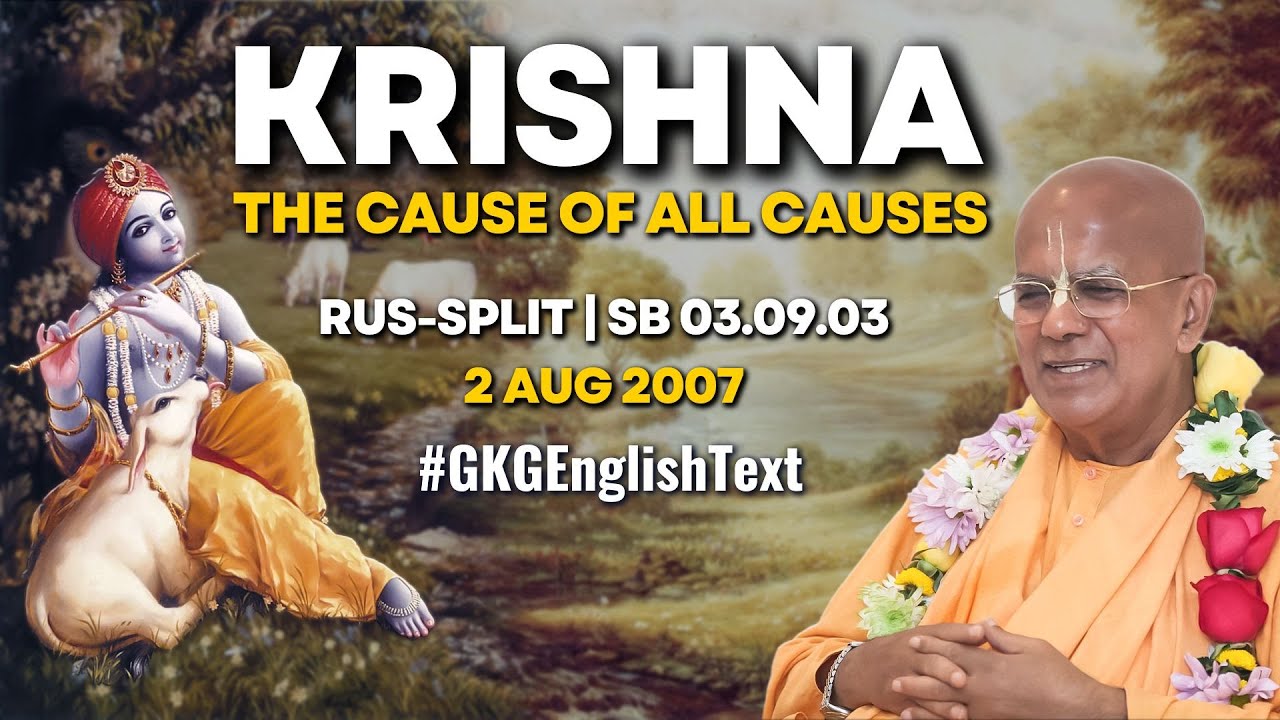
The lecture, presented by two speakers, explores Lord Brahma’s prayers from the Śrīmad‑Bhāgavatam and the Brahma‑samhita, using them to illustrate the supreme nature of Lord Kṛṣṇa. It explains how Brahma, after 100 divine years of intense austerities, attained a vision of the personal form of the Supreme Personality of Godhead, realizing that the impersonal Brahma‑jyoti is only a partial manifestation of the Lord. The talk details Brahma’s immense lifespan, the scale of his time (one divine day equals 4.2 million human years multiplied by a thousand), and his four‑headed form, which led him to search for his creator. The narrative recounts the encounter with countless other Brahmas, emphasizing Brahma’s insignificance compared to the infinite number of divine beings. It recounts Krishna’s childhood pastimes, such as the rescue of cows and the defeat of demons, to demonstrate the Lord’s inconceivable powers. The speakers discuss the six divine opulences (beauty, knowledge, strength, fame, wealth, renunciation) that Krishna possesses in unlimited degree, and the theological distinction between Brahman, Paramātmā, and Bhagavān. Central to the lecture is the assertion that only through pure devotional service (bhakti‑yoga) can one partially know the Lord, as emphasized by A. C. Bhaktivedanta Swāmī Prabhupāda’s purports. The talk also outlines the six categories of avatars (Purusha, Lila, Guna, Manvantara, Yuga, Shakta‑Veshava) and explains Brahma’s role as a secondary creator who, after creating various aspects of illusion (anger, fear, false proprietorship, etc.), recognized the futility of Maya. The lecture concludes with practical advice for devotees: recite, meditate on, and internalize Brahma’s prayers, recognizing Krishna as the original cause of all causes.
Chapters
Om namo bhagavate vasudevaya! Om namo bhagavate vasudevaya! Om namo bahagate Vasudevaiahya! Om namo Bahagwatai Vaasudhevayahyam! Nātā paramparamāyādvabhātā svarūpam. Ananda-matāma vikalpam aviddha-vārcha. Paśyāmi veśvāśajām eka-aviśvām Ātmām. Putindiyātmakām alātā paśritasmī.
Hare Krishna, Hare Krishna, Hare Krishna. O my Lord, I do not see a form superior to Your present form of eternal bliss and knowledge. In Your impersonal Brahman effulgence in the spiritual sky, there is no occasional change and no deterioration of internal potency. I surrender unto You because whereas I am proud of my material body and senses, Your Lordship is the cause of the cosmic manifestation, and yet You are untouched by matter. As stated in Bhagavad-gītā, bhakti-mām abhijñānti yavānachāsmi tattvataḥ, the Supreme Personality of Godhead can only be partially known and only by the process of devotional service to the Lord. Lord Brahmā became aware that the Supreme Lord Kṛṣṇa has many, many eternal blissful forms of knowledge. He has described such expansions of the Supreme Lord in his Brahma-samhita as follows: adveitā-muciuta-manādi-ananta-rūpam adyām-purāna-puruṣaṁ na vyāvanam ca vedaḥ-suddhurlabham-adhurlabham ātmabhakto govindamādi-puruṣaṁ tamām-ahaṁ bhajāmi. I worship Govinda, the primeval Lord, who is non-dual and infallible. He is the original cause of all causes, even though He expands in many, many forms.
Although He is the oldest personality, He is ever youthful, unaffected by old age. The Supreme Personality of Godhead cannot be known by the academic wisdom of the Vedas. One has to approach the devotee of the Lord to understand Him. The only way to understand the Lord as He is, is by devotional service to the Lord or by approaching the devotee of the Lord who always has the Lord in his heart. By devotional perfection, one can understand that the impersonal Brahmajyoti is only a partial representation of the Supreme Personality of Godhead and that the three puruṣa expansions of the material creation are His plenary portions. In the spiritual sky of the Brahmajyoti, there is no change of various kalpas or millenniums, and there are no creative activities in the Vaikuntha worlds. The influence of time is conspicuous by its absence. The rays of the transcendental body of the Lord, the unlimited Brahmajyotis, are undeterred by the influence of material energy. In the material world also, the initial creator is the Lord Himself. He brings about the creation of Brahma, who became the subsequent creator empowered by the Lord. So this chapter is called Brahma's Prayers for Creative Energy. And actually, if you analyze the Śrīmad-Bhāgavatam, it is nothing but a prayer book. A prayer book in which different devotees of the Lord are addressing the Lord by offering different prayers. In this 9th chapter of the 3rd canto, Brahmā in the opening verse has mentioned that after many, many years of penance, he was able to understand the transcendental personality of Godhead. How long was Brahma's penance? For 100 divya years. For 100 years, Brahma performed extreme austerities. You may say, "What's 100 years? It's nothing much, isn't it?" But his years were 100 divya or transcendental years. One day of Brahmā is equal to the duration of 4 ages multiplied by 1,000. 4 ages. Satya Yuga ran for 18 lakh years. Treta Yuga ran for about 12. Dwapara Yuga ran for 800,000. And Kali Yuga is 432,000. So you add 432, write down, plus 800, plus 1.2 million, plus 1.8 million. 1.8 by 1.2 is 3 million, 3.8, 4.2 million. So approximately, if you take 4.2 million years, multiply it by 1,000, That is equal to Brahma's one day, only one day. So you multiply that further by 100, and that is the duration of Brahma's austerity. You understand? So Brahma, when he appeared, he could not trace his source. And then Brahma started looking on all the four sides. How did I take birth? That's why Brahma became four-headed, because he looked left, right, front, back. He was trying to find out who is my creator. So after performing austerities for 100 years, Brahma was able to see the wonderful transcendental form of the Lord. And when he saw this form of the Lord, it gave him immense pleasure as it is stated in the previous verses. Brahmā has also stated, tapaseva param jyotir bhāgavatam adhokṣajam. He says that Kṛṣṇa is adhokṣaja. What does adhokṣaja mean? Very difficult to comprehend. But through the medium of tapasya, one can actually understand the Supreme Personality of Godhead. And Brahmā himself performed extreme austerities. And Brahmā's lifespan is also— how long does Brahmā live? 411 trillion and 40 billion years. That's his lifespan also. So Lord Brahmā performed extreme austerities and then he was able to realize the personal form of the Lord. Now this Lord Brahmā, we just mentioned that Lord Brahmā was searching for his origin. Looking left, right, behind, and he became four-headed. But actually this four-headed Brahma is the smallest of all the Brahmas. You know that? In the Caitanya-caritāmṛta, you read the story that once our four-headed Brahma went to Dvāraka to see the Supreme Lord.
And when he went to see the Supreme Lord, He was stopped at the gate. You go to see a big man, the chaukidar will stop you. So, the chaukidar went and told the Lord that Brahma has come to see him. The Lord said, "Which Brahma?" So, the watchman came and said, "Which Brahma are you?" You know, sometimes, you know, people come to our temple, they say they're looking for Mr. Das. Everybody hears that das, then we have to tell them, "Which das are you looking for?" So the Chaukidar came and said, "Which Brahma are you?" So this Brahma, the four-headed Brahma, was shocked when he heard this inquiry. So when he went to the Lord, he had barely finished Offering his obeisances, and the Lord said, "Sir Brahma, what brings you here?" You know, we, whenever we would go to see Prabhupada, so Prabhupada would often say, "Sir, what brings you here? Why are you coming?" So Brahma said, "Before I tell you why I'm here, I have a question to you. And are there 'Any other Brahmas besides me?' And Brahma had not even finished answering his question, asking his question, when instantly there appeared innumerable other Brahmas, and Brahma discovered that he was the smallest of the Brahmas.
There were other Brahmas with 1,000 heads, million heads.
And they were— and he felt like a rabbit in the midst of elephants. If you have all elephants everywhere and you have your rabbit in the middle, the rabbit is so insignificant, isn't it?
So Lord Brahma felt completely insignificant compared to the other Lord Brahmas.
Even Lord Caitanya was describing that this cosmic manifestation that we are aware of, this is only a tiny, tiny portion of God's total creation. Just like if you were to take one mustard seed out of a bag of mustard seeds, that would be so insignificant, isn't it? So this creation that we are aware of, this cosmic manifestation, is only a small, tiny aspect of the Lord's total creation. So Lord Brahmā is saying, "O my Lord." The Brahmā acknowledges that Kṛṣṇa is supreme. If you read the 10th canto of the Bhāgavatam, you see that Brahmā Shiva or Indra, all these predominating demigods, they all acknowledge the position of Kṛṣṇa.
Just like you also read the story in the 10th canto that Lord Brahmā had heard about the wonderful pastimes that the Lord had already displayed. If you look at Kṛṣṇa's pastimes, They go to confirm Kṛṣṇa's statement in the Bhagavad-gītā, janma-karma-cāma-devyam. Kṛṣṇa says, "My appearance and disappearance are both devyam." So Kṛṣṇa has already performed so many wonderful pastimes, killing the demon Putana, Cinnāvārta, showing the universe in his mouth to his mother. So Lord Brahmā wanted to test This wonder boy Krishna, actually when the Lord was performing His pastimes and when these different demons would get killed, the brahmacaris would say, "Maybe our son is a demigod. Maybe he has the special blessings of Narayana." Every time the demons come to attack Him, He does the impossible. He's a young child killing the demon Putana. When the Lord was only a small child, He kicked a huge cart that was heavily loaded and the cart came tumbling down and the Tṛṇāvarta came like a whirlpool. So Brahmā also wanted to test the transcendental nature of this wonder boy. So Brahma, the Lord, had gone on a picnic with his friends, and the cows and the calves are grazing. The cowherd boys were all worried that the cows and calves may not get too far, may not go out of sight. So they were always eating and looking around, 'Ah, ke dadae, where are the cows, cows?' But Lord said, "Don't worry, I'm with you. What are you worried about? Eat, eat your prasad. Enjoy your picnic." And as the cows and calves grazed beyond a certain point, they got kidnapped by Brahma. And when they got kidnapped by Lord Brahma, the cowherd boys went searching. They could not find their cows. So the Lord had no alternative but to expand Himself. And He expanded Himself into these unlimited cows and calves. And when they returned home, the mothers had even greater affection than before. When the bridge passes the elderly gopis, were watching Mother Yashoda display these wonderful pastimes with her son, the elderly gopis had a desire that may we also have this opportunity to have a son as brilliant as Mother Yashoda's son. So Krishna had expanded himself into unlimited calves, and cowherd boys. And when they went back home, the mothers had even greater affection than before. And this went on for a year. Except Balaram, nobody really knew what had happened. And then one day Brahma saw that these calves and cows are again grazing.
So he thought that maybe they've woken up.
He had put them to sleep, but maybe they've gone up, they've got up.
So he went to verify.
Is it a fact that they've got up? Just like, you know, you go for surgery, they give you chloroform and they make you go to sleep. So Brahma had a very powerful chloroform and put them to sleep for more than one year.
So, but when he went back, he saw they were still sleeping. Then Brahmā could realize that this is the inconceivable of Kṛṣṇa. Therefore, when Kṛṣṇa says, "Think of Me," He says, "Think of Me as one who is acintya, inconceivable." Inconceivable means you can do, you can't try and understand the Lord with the material senses.
Prabhupāda used to give us the statement, the Dr. Frog philosophy. Dr. Frog was trying to measure the length and breadth of the vast Indian Ocean, and he was trying to do it by pumping his own belly.
And in the end, what happened? The belly burst. So Brahmā realized that he is insignificant compared to the Supreme Lord. And then Brahmā offered very wonderful prayers. Glorifying the supreme position of the Lord, just like you read Indra offering wonderful prayers after his attempts to flood Braj with water failed. So Lord Brahma, as a result of having performed very extensive austerities, he was finally able to see the superior form of the Supreme Personality of Godhead. And seeing the superior form gave Him immense pleasure. Just like Dhruva Maharaj was performing his charities, and Dhruva Maharaj had the opportunity to see the personal form of the Lord, which gave him immense pleasure. Now Brahmā says, "I do not see a form superior to Your present form of eternal bliss and knowledge." So, first point that gets established here is that the form of the Lord is superior to all other forms. The transcendental form of the Lord is incomparable and it is full of eternal bliss and knowledge. As it is said, the Supreme Lord, Praśād rāvalī explains, There are 6 characteristics of the Lord. What are they? He, Eśvarasya sama-gracia, vīnayāśraya, īśāśraya, jñāna-virāgyāva, caiva-sanna-bhāgā-itṛṅgṇa. He is the richest. What else? The most famous, beautiful, knowledgeable, renowned, and strongest. So one who is in possession of these 6 opulences to an unlimited degree, all at the same time. It's not that in the material world you may see somebody is rich but he may not be strong. Somebody is strong but he may not be beautiful. Somebody is beautiful but he may not be rich. Somebody is rich but he may not be knowledgeable. And somebody may be knowledgeable but he may not be renounced. But Krishna simultaneously manifested all these 6 opulences to an unlimited degree.
Then it says eternal bliss and knowledge, 'sacchidananda-vigraha.' It is described that the Lord is eternal, full of knowledge, and bliss. And in comparison, what's a living entity? We are also eternal. Isn't it? Nitya. So someone may say, "You are eternal, I am eternal, God is eternal, I am eternal, so we are God." So how will you defeat that? We say you are eternal, we say the Lord is eternal, then what's the difference between us and God? What's the difference? Who knows? Nityo nityanam ceto na ceto nānām ekobahunām vidāti kāmām. They for the shastra's sake, we are eternal and He's eternal, but the difference is that single eternal is maintaining all other eternals. So the Lord is eternal and He's blissful. And it is said, that anybody who links up to Him also becomes blissful. He is blissful and one who gets connected to Him also becomes blissful. Therefore we see that when people take to the process of Kṛṣṇa consciousness, they realize real bliss. In the material life, the so-called bliss here manifest is artificial bliss. People make a show of being happy. People make a show of always smiling, but they're not really happy. But one who engages on the path of devotional service can realize real bliss. And the Supreme Lord is also the source of all knowledge. You have relative knowledge and you have absolute knowledge. Just like we read the Bhagavad-gītā. Now how old is the Bhagavad-gītā? How old? No, lot older than that. 5,000 years ago it was only retold to Arjuna.
Why?
Because you are my most confidential friend and devotee. Therefore, you can understand the transcendental secrets of this great science. So it is said here that the Lord is also full of knowledge. Even when Krishna was on the planet, he could speak all the languages. He could even speak with the birds and the beasts. Can you communicate with the birds? You hear them chirping in the morning. Do you know what they're communicating? No. But they are communicating a message. But you don't understand it, so you think they are just some crazy sound. But it's not a crazy sound. Krishna could communicate with the birds and the beasts. He could speak all the languages. So Lord Brahma is saying that you are also the source of unlimited knowledge. And he says, "I surrender unto you." So that is the perfection of life, to surrender to the Supreme Personality of Godhead. And He says, "You are the cause of this cosmic manifestation." So the Lord is the cause of the cosmic manifestation. As Krishna says in the Bhagavad-gītā, "Āma sarva-sa-prabhūmataḥ sarvaṁ pravartate." I am the source of everything, material and spiritual. And the Lord is untouched by matter.
This is important to understand. The Lord doesn't get contaminated when it comes to the material world.
Prabhupada used to give an example in this connection. Who knows that example? Prabhupada used to give the example of, huh? Of a king who comes to the prison house. A king may come to the prison house to check the prison house. That doesn't mean he becomes a prisoner, isn't it? So it is not that when the Lord descends to this material world, He becomes like one of us. The impersonalist, they cannot understand the inconceivable nature of the Lord. Therefore, even when they look at the archa-vigraha manifestation of the Lord, what do they say? They say, This is just some statue made of brass or metal or wood. But actually the Lord is capable of incarnating in the archa-vigraha form, is capable of incarnating in the Holy Name, and He's capable of performing inconceivable pastimes. Just like when Krishna appeared in front of Vāsudeva and Devaki, He did not appear like an ordinary child. He appeared in His four-handed form, beautifully ornamented and decorated, and then when He was requested by His parents to transform Himself into an ordinary child, He transformed Himself into an ordinary child.
So the Supreme Lord does not get contaminated by the material nature. He always remains sat cit ananda-vigraha. Now in the purport, Prabhupada makes the point. He quotes this famous text 55 from the 18th chapter. Actually in this chapter, almost in every verse, every purport Prabhupada quotes this verse.
So what is that verse, 18:55?
Bhakti-yamam aijñānaṁ. Kṛṣṇa clearly establishes that I can only be known by the path of devotional service. So Prabhupāda dwells on this point that the Lord Brahmā became aware of the Supreme Lord also because he had performed his austerities. So bhakti is a medium through which you can attract the Supreme Personality of Godhead. You cannot attract the Lord by a mundane knowledge or by some material logic, but you can attract the Lord through the medium of pure devotional service. Therefore, Krishna also says in the Bhagavad Gita, patram puspan phalam toyam yome bhaktya prayocati, that if you offer Me with love and devotion, Even a leaf, water, I will accept it. So the entire emphasis is on Bhagwa, is on Bhakti. Just like Vyāsadeva, even after having compiled the vast Vedic literature, was still feeling despondent, isn't it? You read about this in the first canto of the Bhāgavatam. Vyāsadeva was feeling despondent, unhappy. He was lamenting. He was trying to understand, "Why am I feeling unhappy even though I have compiled this Vāsuvādika literature?" And as he was meditating, his spiritual master Narada Muni appeared on the scene and told him that the real cause was that he has not exclusively presented the path of pure devotional service. Bhakti is the conclusion. The Śrīmad-Bhāgavatam concludes that bhakti is the medium through which the Lord can be understood. The Bhāgavad-gītā concludes that bhakti is the medium through which the Lord can be understood. Therefore Prabhupāda is saying that the Supreme Personality of Godhead can only be partially known. Also over here Prabhupāda says only partially known, not fully known. Don't think that now I'm doing bhakti yoga, so I know Kṛṣṇa completely. I know everything. No. Even if you're the best, you will only know Kṛṣṇa partially. Even Ananta Seva, how many tongues does Ananta Seva have? Thousands, unlimited. Even with unlimited tongues, they cannot fully describe the unlimited qualities of the Lord. Because the qualities of the Lord are increasing every second. You know, by the time you finish the class, Krishna's qualities would have gone up even more. So you can't, we cannot fully understand the Lord. Doesn't matter how hard you try.
At best, when you read about the transcendental attributes of the Lord in the scriptures, you're just getting a partial understanding of the Lord's unlimited transcendental qualities. So through the process of bhakti, you can understand the inconceivable nature of the Supreme Lord. We see in our Kṛṣṇa consciousness movement, people join, people have never heard about Kṛṣṇa, but they are in the movement for few years or even few months. But they are rendering devotional service and they have a better understanding of the Supreme Lord than these Sanskrit pundits in India. So bhakti is a medium through which you can cleanse your heart, cleanse your impure senses, and understand the transcendental nature of the Lord. Now what does bhakti actually mean? Then the next step, what does Bhakti Yoga actually mean? So Bhakti Yoga actually means the employment of the mind, intelligence, and senses in service of the Lord. And initially there may be no spontaneous attraction, but Rūpa Gosvāmī, Prasad RAVAL describes in the Bhakti-rasa-mṛta-sindhu how by following the process of Bhakti-yoga you can get to the stage of rāgūṇa-bhakti. In other words, by following a certain discipline of rules and regulations, then you can get to the stage where you spontaneously feel like engaging in service to the Lord. But that stage is only attainable after you perform the process of Bhakti Yoga under some superior direction. Now further, Prabhupada in the purport quotes this famous prayer from Brahma Samhita. Lord Brahma, After he came to the mature realization about the supreme position of Krishna, he composed this very wonderful prayer known as Brahma Samhita, which Lord Caitanya found in a temple in South India. Lord Caitanya gave great emphasis to this very wonderful offering of Brahma Samhita. So Prabhupāda quotes this first prayer from Brahma-samhita. Advaita-macchuta-manādi-anānta-rūpam. So what is Lord Brahmā saying? I worship Govinda, the primeval Lord. So Govinda is also known as Adi-puruṣa. He is the original personality. Then who is infallible, aciuta, and non-dual, Advaita. Advaita means there is no difference between his body and soul. In our case, there's a difference, isn't it? But in the case of the Supreme Lord, there is no difference. Then he's aciuta. None of us can claim to be that. But the Supreme Lord is infallible. Then anādhi-manantā-rūpaṁ. He is the cause of all causes. So somebody may say, "If He's the cause of all causes, who is His cause?" Don't people say that? Sometimes when you go out preaching, you say, "Kṛṣṇa is the cause of all causes." Then they say, "Hey, but then who is the cause of Kṛṣṇa?" So therefore it is said here, anādem anāntam rūpa. He's the cause of all causes, but nobody can claim to be His cause. Now anānta-rūpa, He manifests Himself in unlimited forms. You cannot limit God's potencies. Just like we Vaishnavas, Also worshiped Lord Vāra. What did Lord appear as? A boar. Now in normal life, do you ever worship a pig?
You say, "It's all dirty." But we worship.
The Lord appeared as half man, half lion. He appeared as a fish, as a tortoise. So ananda-rūpam, they are unlimited forms of the Lord. They are unlimited forms in which He can appear. Adyam purāṇa-puruṣa nāvi-āvanam ca.
Thou He, the oldest, what does He look like? He looks ever youthful. Isn't it? Prabhupāda used to say that in the Battle of Kurukṣetra, By material standards, Kṛṣṇa was over 100 years of age. He was estimated to be about 125 years of age. But what does he look like? 16, 20, 22. You never see pictures of Kṛṣṇa with wrinkled cheeks or contact lenses or something. So, even because he is transcendental, he doesn't age with the passage of time. Vedais adurlabham adurlabham ātmabhakto. To understand the Lord just by an academic study is not going to be possible. Just like we gave you the example, there's so many Sanskrit scholars in India, but they have a very limited understanding of the nature of God. And then on the other hand, you may have some A totally simple devotee who is engaging in devotional service, scrubbing the floor, chanting Hare Krishna, but he has firm understanding, "Yes, Krishna is the Supreme Lord." Even in our India, you may see, we have so many uneducated devotees who join, but they're very sincere. They do their service so nicely. They know who the Supreme Lord is. And even you may have so many scholars who may have no understanding. So the Lord Brahmā is saying, that only by devotional service, vedesu durlabham. Durlabham means difficult and adurlabham means the opposite. So he's saying if you just try to understand the Supreme Lord by studying the Vedic literature, this is going to be impossible. But if you take to the process of bhakti, then you can. And then in the Brahma Samhita, but not quoted here in the purport, Prabhupada, Lord Brahma also said, angani yasya sakalandhah vritibhanti, that He's all-pervasive. He's situated in one place, but He's all-pervasive. And with any one part of His body, He can perform the function of any other part. Just like We Vaishnavas, when we offer prasad to the Lord, how does the Lord eat? He eats with His eyes and ears. So because He can perform any function with any one part of His body. So Prabhupada makes a point that only by devotional service can you understand the transcendental nature of the Lord and the impersonal Brahmajyoti is only a partial understanding or manifestation of the Lord's potency. Brahmeti paramātmātmeti bhāgavān iti śadyate. The first canto of the Bhāgavad-gītā explains how the Lord can be realized in different stages. Brahman, Paramātmā, and Bhāgavān. So Brahman realization is partial realization. Just like you may see a mountain top from a distance, you only see the mountain top. But then if you go closer, you'll see a little bit of variety. And if you go on top of the Ta mountain, you'll see the ultimate variety. So similarly, Brahman and Paramātmā realizations are only partial realizations of the Supreme Lord. And, but the ultimate understanding of the Lord in His Bhagwan feature.
And then Prabhupāda also mentioned the puruṣa incarnation. There are different categories of avatars of the Lord. Avatar means one who descends from the spiritual world. So there is the Purusha Avatar, Lila Avatar, Gunavatar, Manvantara Avatar, Yuga Avatar, and Shakta Veshava Avatar. These are the 6 broad categories of incarnation that appear. And here Prabhupada makes reference to the Purusha Avatar category. That is the Garbhodakṣayi Viṣṇu, Śrīrdakṣayi Viṣṇu, Kānadaṣaī Viṣṇu, of the Lord expands and maintains these different universes. So it is being explained very clearly that the impersonal Brahman realization is only a partial realization, and the Supreme Lord does not get touched by matter. Lord Brahma has made this point in many verses. In today's verse, this point is made And in yesterday's verse also this point was made that the Supreme Lord does not get contaminated by matter. So therefore, those who take to the path of pure devotional service are able to understand the inconceivable nature of the Supreme Lord. And over here, Lord Brahmā is offering us His mature realization. And what is the mature realization? That Krishna is the Supreme Lord. Prabhupada was once receiving, he started a lecture in New York right after greeting the deities. And he said, he started his lecture by saying, govinda-mādhī-puruṣaṁ tamāmaha-muhāmājāmī. He said, we are not worshipping some bogus personality. We are worshipping Govinda, the Ādhipuruṣaṁ, the original person. So when we read the Deities every day accompanied by the Govindam prayers, we acknowledge how the Supreme Lord is the origin of everything, the source of everything, the cause of everything. And as a result, our natural endeavor should be to engage in devotional service. So to summarize the verse over here, in this chapter, Brahma is offering his prayers for creative energy. Brahma is called the creator, but it should be recognized that Brahma is a subsequent creator. The original creator is the Supreme Lord, and Brahma gets recognized as a subsequent creator. And when Brahma was given the task of doing this creation, Brahma first created the different aspects of illusion. What did he do? He created different aspects of nonsense. What did he do? He first created the principle of innocence. Then he created the principle of anger after frustration. You get angry after you're frustrated. Then he created the principle of fear of death. Just like everyone is scared of death. But it is said a Self-realized soul is not scared of death. Just like When the wings of a bird develop, the bird flies out of the nest. So, except one who is Self-realized, everyone is fearful of death. So this was created by Brahma. And then Brahma created this concept of false sense of proprietorship. The false sense of proprietorship. This is my land, my country, my property, my, my, my. So Brahma created these different aspects of illusion. One was also the principle of self-deception, which means not recognizing and identifying your true identity. But then Brahma created these different aspects of illusion, and he realized that he's made a tremendous mistake. He said, 'Now all I've created is Maya. I've just created the different aspects of illusion.' So that means People will just get bound even further.
So then he created the four aspects of—
he did different paths of knowledge. He created the path of austerity, he created the path of jnana, sankhya, so that— and he gave us knowledge. So then the living entity could decide which path he wants to follow, and then he gets the results accordingly. So Lord Brahma is the creator, but he is a secondary creator or the subsequent creator. And Lord Brahma has recognized that this form of the Lord is superior to everything. And over here again, he establishes the supreme transcendental nature of the Lord. So as you read this chapter, you will see many wonderful prayers. Where Lord Brahmā is glorifying the Supreme Lord. And we devotees should read these prayers and meditate on these prayers and always try to glorify the Supreme Lord by repeating these prayers. Or if you cannot exactly repeat the prayers, you can memorize the meaning of the prayers and offer the meaning as an offering.
Hare Kṛṣṇa.
More from PRASAD

Rare Pastimes & Timeless Lessons of Guru Mahārāja | Stories Every Disciple Should Hear

ISKCON Legends- pure devotees meet-HH Jayapataka Swami, HH Gopal Krishna Goswami, HH Radhanath Swami



Jagannātha Ratha-yātrā Through Śrīla Prabhupāda's Mercy | 29 April 2006 | Nairobi, Kenya

Lord Jagannātha's Appearance Pastime | 21.07.2019 | ISKCON Calgary | Śrīla Gopāla Kṛṣṇa Gosvāmī

The Ācārya Teaches by His Own ExampleGuṇḍicā Mārjana by Guru Mahārāja #shorts

Guṇḍicā Mārjana – Lord Jagannātha's Pastime | 21.7.2019 | ISKCON Calgary |Śrīla Gopāla Kṛṣṇa Gosvāmī

H.H. Gopāla Kṛṣṇa Gosvāmī Mahārāja - Exemplary Sādhana and Deity Worship # shorts

भगवान की कृपा कैसे प्राप्त होगी ? | 11 Jan 2014 | Punjabi Bagh | Srila Gopal Krishna Goswami

Material Education vs Spiritual Education | Srila Gopal Krishna Goswami #shorts