Live Lecture | 26 July 2022 | Farmington | Srila Gopal Krishna Goswami
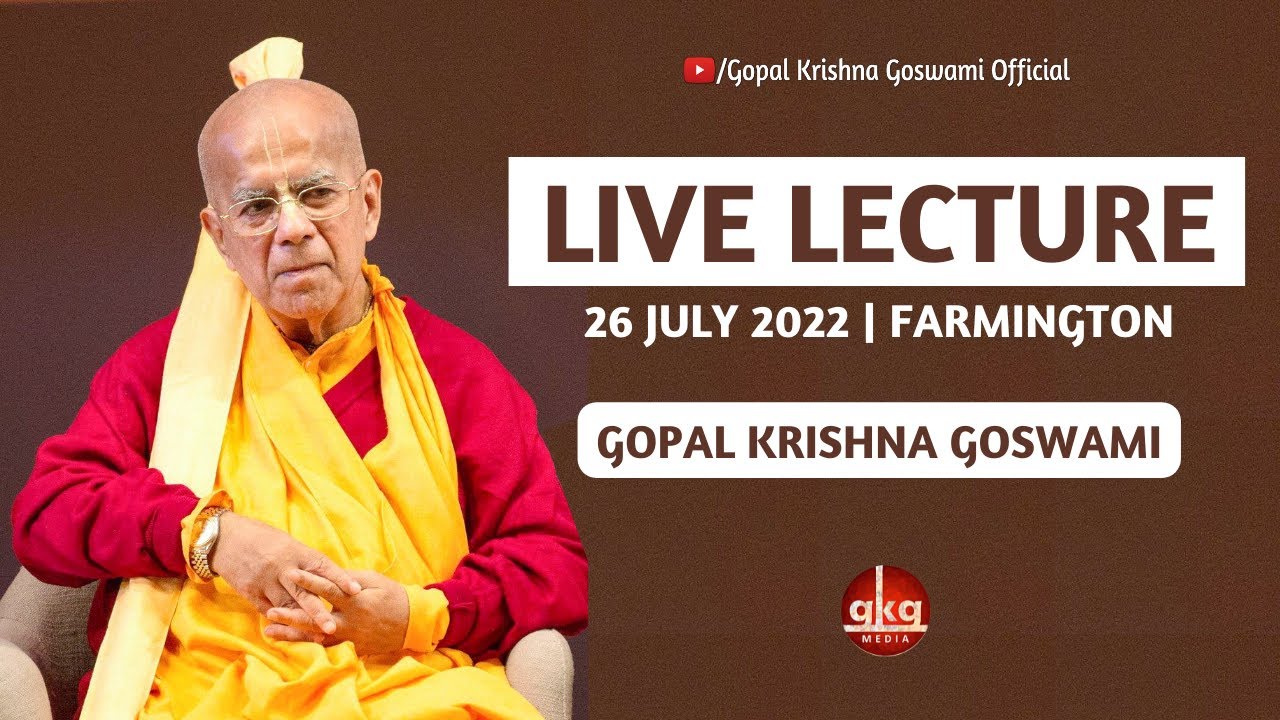
In this live lecture recorded on July 26, 2022, Srila Gopal Krishna Goswami addressed a mixed audience of devotees, sharing historical, theological, and practical insights. He began with anecdotes about senior ISKCON leaders (e.g., Jagadguru, Prasad Raval) and highlighted Lord Caitanya Mahaprabhu’s historic tour of South India, describing how Caitanya’s ecstatic chanting sparked a contagious spiritual epidemic that transformed villages and inspired countless followers. Goswami then linked that ancient example to contemporary ISKCON practice, emphasizing the central importance of chanting the Hare Krishna maha‑mantra, reading sacred texts, and preaching the glories of Krishna to alleviate modern suffering. He discussed the theological concept of devotional suffering, explaining that great devotees willingly accept material hardships as opportunities for deeper meditation and service, and he illustrated this with stories of Vāsudeva, the Kurma Brahmin, and other pastimes. The lecture moved to organizational matters, recounting how Srila Prabhupada established the Governing Body Commission (GBC) to maintain unity after his departure, and how devotion, humility, and collective effort keep the movement cohesive despite internal challenges. Goswami offered concrete preaching advice: approach everyone without discrimination, persist despite low book‑selling success, and view effort as pleasing to the Lord. He answered audience questions about developing humility, coping with loss of faith, and handling community disputes, urging seekers to seek senior guidance, maintain sadhana‑sangha, and cultivate the attitude of “not being qualified.” Throughout, the tone remained devotional, instructional, and compassionate, with a sentiment of enthusiastic encouragement toward personal and collective spiritual growth.
Questions this video answers
By cultivating humility, recognizing that qualification comes through sincere effort over many lifetimes, and consistently practicing chanting and scriptural study; progress is gradual, not instantaneous.
Seek shelter of a senior devotee, increase chanting and reading of scriptures, stay in sadhana‑sangha, and remember Prabhupada’s promise that a single step by the devotee invites ten steps from the Lord.
Chapters
BBD Chairman, BBD Trustee. And apart from that, as a GBC, actually he became a GBC in 1974. And since then has been traveling in his position as GBC and spreading Krishna Consciousness in variety of ways.
So A professional—
Jagadguru told me one time he knew more than 7 languages!
I think... "Hari Om!" No, everything very Indian you will hear. That's exactly right.
But at least, you know, I saw Maharaj speaking to somebody in Russian. Very comfortably. Amazing. So I think He was entrusted with the responsibility of travelling to Russia and preaching in 1977. So he has been doing, is undertaking the responsibility very well. So he comes to Detroit because he has all the beloved disciples here. So Maharaj travels in America, Canada, all over the world to spread Krishna consciousness, you know. So what can I speak about him?
Thank you.
Thank you. Prasad Raaval.
Prasad Raaval. Vaishnava is a very generous. No, I usually tell people you can discount 50% what you got. So we'll get started and understand. Deities are closed. You open at what time?
8:30.
What time? 8:30.
8:20 for offering and 8:45 for worship.
Aye la ma! Aye la ma! I'm doing a program with Maharaj, I think after ages. I think he said we want to do a program together in London. I haven't seen Maharaj for a long time. Om Namo Bhagavate Vasudevaya. Om Namo Bhagavate Vasudevaya. Om Namo Bhagavate Vasudevaya. Om Namah Shivaya. Om Namah Shivaya. Om Namah Shivaya. Om Namah Shivaya. How many people in this audience are from South India?
Oh.
Okay. I'll tell you why I asked you this. Because I was going to discuss Lord Chaitanya Mahaprabhu. Tour of India. Is that okay? I have a bad throat, but can you hear me in the back? Yes. From all the four corners. So as I said, now we will discuss briefly Lord Caitanya's tour of Vrindavan. You all know that Lord Caitanya is Ananda Svari Hudi, Supreme Personality of Godhead. Hare Krishna Caitanya, Hare Krishna Naihanya. Caitanya Mahāprabhu, Rādhā and Kṛṣṇa incarnated in the form of Caitanya Mahāprabhu. And in the Rādhā-nāṭṭhā-gītā, it is happily said, "Of all the incarnations of the Lord, the most merciful and compassionate is who? Caitanya Mahāprabhu." Caitanya Mahāprabhu appeared and promoted staunch impersonalism. Called Subbu Murachaya, the path of Vaishnavism. Subbu Murachaya was a very proud scholar, but he was an impersonalist, and Arjuna convinced him the path of Vaishnavism. He had a brother-in-law called Gopinatha Charya. Gopinatha Charya would preach to Subbu Murachaya. Lord Caitanya is none else but the Supreme Lord. In Gopinathacarya and Rūmānacārya, we say. He's not God, but I understand he has some outstanding features. So after Lord Caitanya converted Rūmānacārya to the path of personalism, he was staunch impersonal before, but Caitanya said, now I want to go on a tour of South India. And he— so he took permission from his devotee. Nature of the Lord is he is controlled by his devotee. So Lord Caitanya said, "Can someone control the Lord?" So Lord Caitanya took permission, wanted to take permission from Sarvamumurthyaya. And he can go to South India. And Lord Sarvamurthyaya said, "You can go, but we are still not satisfied with the limited time you spent. Please stay here for 5 more days." Then Lord Chaitanya stayed there for 5 more days. And then he said, "We can't go alone." You have to take someone with you and the necessary paraphernalia. So, Achyutanya, after satisfying the devotees, he proceeded to Hastura, South India. He visited South India historically. He walked nearly 24,000 miles, and over there he met a great devotee called Ramana Maharshi. So Lord Chaitanya started his tour of South India, and he was going from one village to another village, one town to another town, and he was so impressive. Whichever town he went to, people would see him chanting and they would begin to chant. You don't have that luck. You go in Hainan, everyone who sees you also begins to chant. Lord Caitanya was God. So wherever he would go, villagers would come to see, and they would see him chanting in such ecstasy. They would also begin to chant. And then, when these people would go back to their respective areas, others by seeing them would also chant. This is how a spiritual epidemic spreads. May Ajapa Jyoti. Pretty much like a material epidemic. That's why are we so scared? Why is everyone so scared of COVID And when I was leaving India, everyone said, "Don't go, there's so many cases in America." How is this COVID spread? It also spreads from A to B to C. I mean, a few years ago, there was a disease, I forget what it is. It was brought to Canada by somebody flying in from Hong Kong. And from there it went to be able to see, get delivered all over the country. So this is how a material epidemic spreads. So Lord Caitanya was in Vrindavan, and people would come to see him, and immediately upon seeing him, they would begin to chant Hare Krishna. Then when they would go back to their respective residences, otherwise seeing them, how they were going to chant. So in a brief period, Arjuna Sena converted all of South India to what? Vaishnavism. There was no more chanting of Hare Krishna. Today if you go to South India, you see a totally different picture. You see that every telephone booth— church or a mosque. And the temples of worshiping disappeared from the map. Very few. We remember the rest. Arjuna Desai, who really wanted to fight, then Arjuna Desai came and stayed in the house of a devotee called Guru Kurma was a Brahmin, genuine Brahmin, not in present day, Shiva Murti Brahmin. He was a Brahmin but he was also a grihasta, also had a wife and children, and he was very frustrated in grihasta life, but that's nothing uncommon. One day he keeps saying, "Gukul ma, shiv loj detaniya." He washed his feet, Lord's feet, took the water on his forehead and said, "How fortunate my family is. They have the privilege to bathe Lord Shiva's feet."— would have been. But then the Kurma Brahmin, after giving the Lord a warm welcome, said, "I must tell you one thing, my Lord. I'm very unhappy in Kaupadala. Please take me with you. I don't want to stay with my family." And Lord Krishna said, "No! You have to stay here only." I'd do the following. What was it? Chant Hare Kṛṣṇa and preach the glories of Hare Kṛṣṇa. Read the Śrīmad-Bhāgavatam and preach the glories of the Bhāgavatam. And if you do these things, you will never be separated from Me, and I will never be— what? Separated from you. So this is what Archie went into. Many times when somebody wants to join a movement, the family guys just say, oh, you will leave home. Archie here was telling Archie, I want to leave home. Archie didn't say, oh no, you can't Lord Śrīla Nārādhana Mahāprabhu, when He was in the Āmṣodara Āśrama, Āmṣodara Āśrama, this is my spiritual discipline. In the 7th canto of the Bhāgavata, Bhāgavata, Gīrīśa Mahārāja had inquired from another muni. He said, "How can one win the kriyā-sādhana?" Arjuna, live according to religious principles, so that you can go back to God. And Lord, he said, 'Na, dhumuni,' gave the explanation based on religious principles. So Lord Chaitanya told Karmavrata, 'No, you can't come with me, but you stay where you are.' And what did he do? 'Shan-da-buri' in Hindi, and preach the glories of Rūpa and read the Bhāgavatam and Gītā and preach the glories of Bhāgavatam and Gītā. In this way, he said, you will always be with me and I will always be with you. So this order that Lord Caitanya gave, karmā, is applicable to all of us. In the right Chant and preach the glories of Zen. Read the book of the Venerable, preach the glories. In this way one will never be separated from the law. So many times, even when a woman, family member, is going to get upset, don't you then again a very practical way. So Narasimhadeva was going from location to location, converting everyone to the path of Vaishnava. Then there was a Brahmin devotee called Vasudeva Mitra. Actually, you read about two Vasudevas in the Caitanya-caritamrta. One was Vasudeva Dasa, one was Mādhūla was very compassionate and he was just in anxiety how the whole world can be saved from the path of going to hell. So Mādhūla prayed to the Lord. He said, my dear Lord, please take away 'All my sins, when I gave in, I prayed the Lord, "Deliver me, the condition is so bad. I'll take on the suffering. You please deliver them."' That's what I was. I addressed the Lord, 'Please relieve the suffering of these relations of mine.' And what I would say, 'Karma is...' I was going to do the suffering. He was so compassionate. So Vāsudeva Viprāya was also a great devotee of the Lord. Vāsudeva Viprāya, he was a great devotee of Lord Caitanya, but he did not know that the Lord has come and stayed in the house of Guru Mahāprabhu. Prabhu. So when he knew that Lord Caitanya had been to the Kurva Brahmin's house, then he came running. When he came running, he was informed, what? The Lord has already departed. The Lord has already departed from Kurva's house. And I'm sorry, You found out that the Lord has already departed. So the great shock and agony, once they were— Prasad RAVAL, he got a heart attack. He fainted. Lord Caitanya is the Supreme Lord and Ishvara Selva, uttara Indigenous, I am situated in everyone's heart. So Lord Caitanya knew it was a vibhara. He was in a state of shock. Why? Why was he in a state of shock? Because Mahāprabhu had departed and he didn't have the facility of raising him. So he, Lord Caitanya, being the Supreme Lord, he cut short his trip. He went back to Kurma Brahman's house. And when he reached Kurma Brahman's house, there he saw Vāsudeva Viprāhṇa. Lord Caitanya embraced Vāsudeva Viprāhṇa, and when he embraced him, One such vibhara was transformed. One such vibhara was suffering from intense leprosy, and his whole body was full of worms and ants, whole body. And he was so compassionate, when an ant would, or an insect would fall on the floor, he would pick it up and and put it back. He would fall down, he would pick up and put it back. That was his compassion. So Lord Caitanya knew that, was a little afraid, extremely compassionate. What did the Lord do? He embraced him. I mean, he embraced him, his ugly body, with obnoxious started, became a very handsome body. There was no smell coming from his body. He was transformed to become a very handsome youth. So this can only be done by Lord's miracle. You know, the Christians have a lot of radio and TV programs. In all their TV programs, they have one folk about how Jesus touched the person and he got transformed. We also have our miracles, we don't promote them. We promote the philosophy. But some people are expert in promoting these miracles. So Lord Caitanya transformed— a very handsome man. And this is what he said, "My dear Lord, previously I was so ugly, so obnoxious, that nobody would come even near me. Now you have embraced me and made me a very handsome man. My body is no longer stinking, I'm afraid." I may become proud. But generally when you have a lot of wealth, position, education, you become proud. "I am so great." In material life everyone wants to think, "I am greater than." But on the spiritual path, you are safe where you can say, "I am totally insignificant, an eternal servant of the Lord." Saraswati vibhara. Saraswati vibhara. He transformed into a very handsome young man. The smell was gone. He said, "I'm scared I may become proud." This is a devotee's mentality. He always cares I may not become proud, I may not become arrogant, I may not become rude. So this is the inner desire of a devotee. So Vāsudeva Vipra said, "Now what shall I do? I don't want to become proud." So Rāja-senīya gave him the instruction. He said, "You chant Hare Kṛṣṇa." and preach the glory of the Holy Spirit. And you should read a book and preach the glory of this book. In this way, you will always remain humble and meek and never get, never get proud. I say, "Well, Prasad, you know what, I may now become proud. Previously no one would talk to me." me. But now I become so handsome, people want to chase me. He was saying my body was— his body would smell so bad and if he was walking on the left side of the road, everyone would switch over to the right side. He was so— such a critical person. Now I became Then Master Devipra recited a very beautiful word from the Tenkantra Vipavatam. In the Tenkantra Vipavatam, we read the story of Sudama Brahman. Sudama Brahman was a poor man. The Brahman, the genuine Brahman doesn't feel bad even if he is for. Then Brahman, he doesn't blame anyone. Normally in our lives, we keep blaming each other. "Because of you, this happened to me." And the other person, "Because of you." Then Brahman thinks, "It's my karma. Let me willingly experience the reaction." So, Sadhava Brahman was satisfied satisfied. A Brahman is satisfied in any condition. In material life, everyone's satisfaction, does it ever happen? No. Okay? In material life, nobody's ever satisfied. Anybody? Story of Lord Ramana Maharshi incarnated as a Brahmin boy and came to the assembly of Balimana Maharshi. Balimana Maharshi received him very warmly and said, "Is there anything I can do for you?" And Brahmin boy said, "If you want to give me something, just give me enough land." I can give 3 footsteps. And Madhyamuna said, you don't look intelligent to me. You don't go to big man and ask him a such a small gift. Ask me for something more. I can give you whole planet. What is a 3-foot step? And then Rāmānanda said, even if I A man who can't control his senses, even if you give him the whole world, he will not be satisfied. Whereas the one who is spiritually fixed is satisfied in any condition. So, Siddhartha Brahman was always a satisfied person. His wife knew that her husband had a rich friend.
Where?
In the varaka. She would say, "Why don't you go and meet your rich friend?" She wouldn't tell him directly. She only had one sari. She was not so good-looking. So, Siddhartha Brahman finally, on the persuasion of his wife, proceeded to his wife. He was so poor, and before he left he told his wife, "Give me some gift that I can take for my friend. It's no good I go all the way empty-handed. Isn't there something in the house?" So his wife was searching in all the four corners. She couldn't find even a little green, take out a Then his wife went to the neighbour and said, "I get hungry." So Siddhartha Brahman, with a cap in hand, he proceeded to Dwarka. And he was by the road all dirty by the time he reached Dwarka. As soon as he reached, he went to the palace of Krishna. Krishna had thousands of palaces. This is not fiction. This is reality. Long ago, about 40 years ago, the archaeological department of India had done a survey. They found that, yes, in Dwarka there were many palaces. This is how a Brahmin walked straight to He should have panicked. "Neh Krishna sohna." "Neh Krishna si." He saw Siddhartha and he recognized him instantly. "Siddhartha! Where you coming from?" He got out of his— and the king's Krishna servant, all bewildered. This Siddhartha looks like a beggar, all dirty clothes, dirty body, and here is the Lord embracing him. So then they talked over the childhood pastime and how they had gone to serve their Guru, and then without asking anything, he proceeded home. As he was proceeding to his house, he was thinking, "What am I going to tell my wife?" 'No, I came all the way to please her, but I didn't ask Krishna for anything.' He was in anxiety. And when he reached his house, what did he see? His hut had become into a palace. And in that palace there were umpteen number of servants. And his wife always wore a toad sari, a very fancy, narcissistic sari, with jewelry and everything. So then Siddhartha knew, "All this has happened by the mercy of the Lord." So Siddhartha Vikra, after he was transformed, he became a very handsome man, Then he recited these words from the Chand Gyan Chal. The Siddhava Brahman recited it. He saw that his heart was becoming better. The Siddhava Brahman was also concerned that I may not become proud. He asked the Lord what to do. And He said, Lord Rūpa Gosvāmī. Prasāda RAVALī. So Prasāda RAVALī, in the purport of this famous pastime, speaks as follows. Prasāda RAVALī: Just like this Brahmin got cured in the morning of the Kṛṣṇa Mahājaṇa movement, I also got cured once in my life. And now I have been transformed to look like big, thin man. Just like Lord Caitanya told Sādhana Mahāmādhava, "Chant and preach." I also propose that every devotee of the Kṛṣṇa consciousness movement should chant and preach the glories. And they do it, you know, on their behalf. That's the command from Prabhupāda. We should all Chant the Holy Name and read a book. And please and glory is a book. Just standing or buying a book for show is not enough. You read this book, and that will give you newer realization. Asilāvam Rāmān. I'm sorry if I was very bad. Started doing the largest Indian tour of South India, very memorable. He walked for nearly 24,000— he covered nearly 24,000 miles on foot and then converted everyone to the path of Krishna. Did he either open Yes. This was in brief the story of Lord Chidambaram touring South India. He went to South India and he came to the banks of the river Godavari. On the banks of the river Godavari, Ramana Maharshi told him, you will meet a very prominent scholar and a royal person. There. And what was his name? Amma Narayana. Amma Narayana was the governor of South India working under a king who was also a devotee, King Pallapuruza. So some of Amma's rishayas told him he would meet this great scholar. So when he came to the banks of the river Godavari, he recognized He was sitting on a horse. He had hundreds of servants supporting him. Lord Caitanya said, "Are you Ramana Maharshi?" And he said, "Yes." And then Lord Caitanya asked, "Ramana Maharshi, let's see the question." Normally we see the word is asked of the Lord. Here we see Lord asking His devotee. That means the Lord is anxious to glorify His devotee. Therefore He has inquired. It is like, when Viṣvadeva was departing, Lord Holy Krishna, "You are Viṣvadeva, worshiped in duty of men." Then Lord Caitanya Mahāprabhu, many questions there in the chapter. So one of the questions he asked was, why should the living entity constantly chant, recite, every day constantly recite the Holy Name of the Lord? I think I'll stop here. One more question. We have Darshan of the Deity. Am I going to take one question? Am I going to take one question? Am I going to take one question? Yes. But why are you going to be walking? 2 minutes. Take questions? You can speak for 2 minutes. Can I just speak? You can speak for 2 minutes, Maharaj. 2 minutes? As much time as you want. I just have darshan of Prasad.
I was planning to speak Om Megha Nithyananda Seva Keṇa Thanāsya Lakṣmaṇa. Satsangini Nāma Nithyananda Seva Nithyananda Seva Kramaṇa. Jīvā. I just want to thank Maharaj for emphasizing what is the most needed thing in the world today, especially within our society, the importance of chanting the Hare Kṛṣṇa Mahā-mantra. And at the same time, Mārcey Kali's movement is to— it's not about simply becoming Kṛṣṇa conscious, it's becoming Kṛṣṇa conscious in a way that we can also give others Kṛṣṇa consciousness. In the material world, the conditioned souls are always thinking, at least some people, are always thinking how to do good to others. So they give out food to people who are needy, they give out clothing, shelter, various types of economic or social benefits. But still we can see everyone is still struggling and suffering. Well, when a person becomes Krishna consciousness, or when a person connects themselves with Krishna, their eternal lover, then ultimately at least they can fulfill all of their needs and satisfy all of their prāṇas. So as Mahārāja has emphasized through all of these pastimes that he so wonderfully narrated, that it's important for us to understand our position. The legacy of Śrīla Prabhupāda's movement is that Śrīla Prabhupāda has asked us to become Kṛṣṇa conscious. But that's not good enough. He said, now we have to give that same mercy to others. Make the unfortunate fortunate. And we see that when a person somehow or others takes interest in their in their spiritual life comes to Kṛṣṇa consciousness, chants the holy names of the Lord, the life becomes transformed. They become happy and at the same time they can also make others happy. We heard about how Śrī Caitanya Mahāprabhu, as he was traveling through South India, he was chanting and dancing and everyone who saw him also became inspired to chant and dance. And what did they do? They did the same thing. So, there was a wave, it was like a tsunami of transcendental mercy being spread simply by one personality. Of course, that was the Supreme Lord, but He did it in such a way as to inspire others to do the same. And so, when we think about it, we can think, "Oh, I have been made fortunate." I am fortunate by the mercy of Śrīla Prabhupāda, by the mercy of my spiritual master. And therefore I have to also see how I can give that same mercy to others. Sometimes we call it preaching, but it's more than just preaching. It's actually doing the highest welfare work for the society. It's a way to show kindness to all living entities. Because people are suffering, and there's no doubt about that. We see as Kali Yuga continues to take its toll, there are more and more social, economic, political, and mental disturbances continuing going on. And what I've seen in the last 2 years, ever since this lockdown started, beginning of 2020, is that more and more people are now looking towards spiritual life for solutions. So we have to be ready. We have to be there to be able to fulfill that need. And as Maharaj says, this pleases Śrī Caitanya Mahāprabhu, very much. Prabhupāda said, if you become an instrument for the mercy of the Lord, the Lord recognizes you. In other words, we want to be recognized by the Lord. Of course, being recognized by the Lord is not a small thing. It's not a small thing at all. To be recognized by the Supreme Personality of Godhead is a rare, rare the greatest gift that one can receive. That recognition becomes available when we see how important it is, because Mahāprabhu and of course the great Ācāryas and even Kṛṣṇa Himself, why did They come to the material world? To give Their mercy to others, to make others Kṛṣṇa conscious. So when we think in different ways, put together here as a group to spread Kṛṣṇa consciousness, how dear we become to the Lord. And Prabhupāda would always say, "One who preaches the mercy of the Lord, that person becomes very dear to the Lord." So, griheta ko bona eta paśyata animo vidāpe. It doesn't matter what position you're in. Anyone, everyone, whoever you are, wherever wherever you are, whatever position you have, you can somehow or other use that to show mercy to others. Like as Jīgāñi Mahāprabhu told the Karmavāda brahmins, wherever you meet, tell them about Kṛṣṇa. Wherever you meet, tell them to chant Hare Kṛṣṇa.
Hare Kṛṣṇa! Hare Kṛṣṇa! Hare Rama, Hare Rama, Rama Rama Hare Hare.
And that is the highest form of compassion one can. And one becomes very dear to the Lord, and because you are bringing others to the Lord, and that is the Lord's desire, to make everyone His devotee, in other words, everyone Krishna conscious. Thank you very much for inspiring us in that moment of deep understanding of what is our position and how important it is right now. Thank you.
You can take on some questions if you want. Questions or comments? Question? Do you have any question? Yes.
Since you spoke about Vāsudeva Datta, how he was having anxiety to deliver all the conditioned souls, what is the criteria of developing such anxiety in our lives to spread Krishna consciousness or distribute books or preach the message of Krishna?
He was not sure what to learn. He genuinely had compassion in his heart. He genuinely meant, he said, "Please take on a sinful reaction, you to everyone, and let me suffer on their behalf." He had a genuine concern which developed due to his purity and surrender. So in our case, we may not have the same level of feeling, but by following in the footsteps of Master Devadatta, you don't have to have that feeling if you're meditating. Master Devadatta, he was so compassionate. You are ready to take unnecessary action. And you should also be compassionate. And you may never, and you will also never develop these qualities. Just like we follow what the great Acharya has said. We are not fitted by having faith, by also thinking this way, I can get elevated. You'll also get elevated. In material life, people copy a movie star, sports star, politician. In spiritual life, you can also follow in the footsteps of Guru Sri Hari Hari and get inspired to do better. Okay. More? Yes.
Hare Krishna, Guru Maharaj. Thank you for the wonderful class. Guru Maharaj, why do Lord's dearest devotees suffer a lot, like Kuntimaraṇī, Sudāma, Viṣṇupitāma? Why do they suffer a lot? Is it the līlā of Lord to make them suffer?
The beauty is Even when yogis are suffering, they are joyful. And they say, Queen Kunti says, "My dear Lord, please increase my anxiety. Please increase my calamities. For the more calamities I have, the more I meditate on the Lord's feet. The more I meditate on the Lord's feet, the faster I gain freedom." You know, Prasad Raaval was in there. If a devotee has to observe some calamity or some misfortune, he doesn't say, "My Lord, why did You do this to me?" That's mean. He accepts it as his karmic punishment. "I have been having greatly many money." In the right world. Let those calamities come again and again. Queen Mani prays for that. Just traveling is calamity. Everything that's happening is a challenge, isn't it?
Yeah, I've heard for great souls, it appears to us they're suffering, but they're not suffering. It's they accept some difficulty in order in order to show compassion to the fallen souls. It looks like suffering from our point of view, but actually it's their way of showing love to the Lord by making personal sacrifices for the benefit of others. They don't suffer because they're already connected with God. Suffering means separation from the Lord, or suffering means ignoring the Lord, accepting something else. They're not suffering, they're just going through some little apparent difficulty. But that the difficulty is their bhakti. It's their bhakti. As Queen Kṛṣṇa plays, she's playing for calamities. Why? Because she wants to come more, she wants to remember the Lord more and more. She wants to give up whatever prestige she has because she's honored as Kṛṣṇa's aunt. She's glorified, she has two great families, she's feeling all of this causes me to forget You, Prasad Raaval. So, to forget You is worse than any calamity that I can think of. These material calamities are nothing.
We will not be surprised when we have to face calamities in Jyotish Kalani. A lot of people, almost every day I meet someone, says, "Why did God do this with me?" Any more? Yeah. Hare Krishna, Guru Mahārāja. Guru Mahārāja, while trying to spread the message of Kṛṣṇa Mahāprabhu, The mind always has a predisposition to a person, like, "Oh, this person will take Kṛṣṇa consciousness, maybe this will not." How to overcome that mentality? When you go to preach, that's the position I take, when you go to preach, preach to everyone without discrimination. Just like the clouds, they pour water. Pour water equally everywhere, on mountaintop, ocean, river, the land. Even more moon clouded, I said, I'm not going to throw any water on the moon rock. No discrimination. Similarly, when we go to preach, we should have an open mind and preach to everyone and not get discouraged. We don't get 100% success. The problem that we have is we go out for a few hours, we don't sell as many books. Our wish is everyone we approach should buy a book. That would be great. The reality is it doesn't happen. So instead of getting discouraged, you go on preaching. And the Lord sees their effort. Lord will see. Yes, for 6 hours he was preaching. Lord reward you. Even when Lord Nithyananda and Chidambarama went, Lord Nithyananda Narayana, uncle, preaching from house to house. Somehow they went They got a very warm reception. "Oh! Sadhus come to my house? Sit down, won't you?" And they would serve them. Some places they went, the people inside said, "These are thieves in the dress of a sannyasi. They've come to see what we have and they're coming to plunder." And some would say, when we came to be a president, you know, Hari Naam Sampradaya, we were stopped. No, you can't come in in that hard collar. So this was the reception. To whom? Hari Naam Sampradaya. If they can get that, you are a thief, so we will be smashed also. No comparison. Any more questions? Maharaj, please accept my humble obeisance.
I am here to speak. Maharaj, Śrīla Prabhupāda, there is one famous audio where Śrīla Prabhupāda is crying and Prabhupāda is telling to Kṛṣṇa that he is expressing his one ecstasy that I'm most rotten, I'm most unqualified, but please accept this. So how to develop this mood that I'm not qualified?
Because it's true, but how to really develop this mood? And Prabhupāda was once greeting the ladies in London, I think, at the manor, and Prabhupāda offered some prayer prayer. The devotee asked him, "What were you praying?" And Prasad Raaval said, "I was praying to Kṛṣṇa that I may never fall in māyā." So a devotee, that is what I want. He thinks, "I need the mercy of the Lord." So what was your question?
How to develop the mood that I'm not qualified for this?
You need to develop humility. Everything can be developed by making an effort. Nothing's going to happen overnight. We have to understand that we've gone through, in Bhagavan Bose's words, several lifetimes. Now when you come to the path of devotion, you'll gradually get to that state. You have to keep making an effort. Practice makes a man perfect. If you practice something, then gradually you'll become perfect. Any more?
Prasad Raaval. This is like a feast for our eyes to see you all, to see you both and seeing those loving exchanges. I really want to understand, after Srila Prabhupada left the planet, there were so many differences. What is that that you all kept together and kept this movement going? And we want to know because we go through these differences in the communities and how can we develop This is a very heavy question, but I'll give a reply.
Prabhupāda had, on the advice of his guru, emphasized that there should be a governing body commission, G.B.C., to run the Society. And Prabhupāda's followers were sincere Even though they had to face challenges, he took the responsibility and kept the movement together. As long as you understand the importance of that duty, there will never be a problem. Prabhupada said, none of you individually will make the decision for the body. And you know how many people do that. And they were trained also. Most of us were, but he wasn't a fan. So the GBC was loyal to Prabhupada. They were being criticized, some leaders fell out. Still, the GBC body as a whole was very united. And there were two aspects of What is the second aspect?
I want to understand that how can we overcome the challenges that we face in our communities so that we can—
There will always be challenges. There will always be difficulties. But we should be determined. I often recommend, I always recommend, you read the Dhamma Sutta very carefully and we should chant around own identity. That will give you the strength to face challenges. We don't come to Kṛṣṇa consciousness with the intention, "Now I become a devotee, everything I touch will become gold." Sometimes people say, "Why did this happen to me?" That's a common thing. Why do bad things happen to good people? Make an effort. Prabhupāda said, "You take one step towards Kṛṣṇa, Kṛṣṇa will take 10 steps towards you." We should have faith. Okay. Okay, any more? Hare Kṛṣṇa, Mahārāja.
What should we do if we start to lose faith in Kṛṣṇa?
Take shelter of a senior devotee and tell him, "Please help me out." Chant your Ramana and read, and your faith will be enforced. Okay, thank you. Then Prasad Raaval said, "Sādhana sangha, sādhana sangha, sādhana sangha." Stay in spiritual association. Generally you see that people sometimes want to avoid, but we should take advantage and have a gratitude inquiry. What can I do to improve? Guru Prabhupada Swami talks about 6 rasas among devotees. One of the rasas is revealing your mind to whom? To those who are more advanced. Ones. If you really wanted to do the more advanced, you get proper guidance.
I have a question.
How can one start— I'm sorry, can you repeat?
Hare Krishna Maharaj, I have a question. How can one start to really attentively listen?
Listen. Listen. Hearing. Hearing. Hearing and chanting. Hearing and chanting. Very good. What I say, when you intended chanting, doesn't mean when you're chanting your mind will not wander. I myself went to Prabhupada once in June of '68. I said the mind was troubling. I was ignoring. No, it's sad. So you ignore the mind, and even in chanting, focus on only chanting. Not that you are chanting and doing 2 other things that are different. And if you're chanting, it will help you control the other senses. OK, Vishnu. Thank God you are here. Any more question?
Yes. Prasadam Maharaj. Maharaj, we have all seen your TV interviews in the early days where you answer many reporters others. And not trying to imitate You, Maharaj, but whenever I see those videos, I feel like how nice it would be if I could also develop that quality and benefit so many souls. So if one has to develop that kind of conviction and be able to answer any atheistic or any non-devoting people, what is the secret to developing that conviction, Maharaj? You could kindly give us.
Practice will make you perfect. Kṛṣṇa distributes His mercy equally to everybody. Kṛṣṇa enlightens us. And Kṛṣṇa says, "For those who worship Me with—" Kṛṣṇa says, "Those who worship Me with devotion, I preserve what they have and I make up what they lack." We may have some qualities Krishna will help you to put it up. And you may be lacking some skill. Krishna says, "I will help you to overcome. Don't worry." He says that in the Gītā, doesn't he? Okay, it's time to pack up. Okay, I remember last time we did a lot of books. Okay, thank you very much. Any more questions?
More from PRASAD

Rare Pastimes & Timeless Lessons of Guru Mahārāja | Stories Every Disciple Should Hear

ISKCON Legends- pure devotees meet-HH Jayapataka Swami, HH Gopal Krishna Goswami, HH Radhanath Swami



Jagannātha Ratha-yātrā Through Śrīla Prabhupāda's Mercy | 29 April 2006 | Nairobi, Kenya

Lord Jagannātha's Appearance Pastime | 21.07.2019 | ISKCON Calgary | Śrīla Gopāla Kṛṣṇa Gosvāmī

The Ācārya Teaches by His Own ExampleGuṇḍicā Mārjana by Guru Mahārāja #shorts

Guṇḍicā Mārjana – Lord Jagannātha's Pastime | 21.7.2019 | ISKCON Calgary |Śrīla Gopāla Kṛṣṇa Gosvāmī

H.H. Gopāla Kṛṣṇa Gosvāmī Mahārāja - Exemplary Sādhana and Deity Worship # shorts

भगवान की कृपा कैसे प्राप्त होगी ? | 11 Jan 2014 | Punjabi Bagh | Srila Gopal Krishna Goswami

Material Education vs Spiritual Education | Srila Gopal Krishna Goswami #shorts