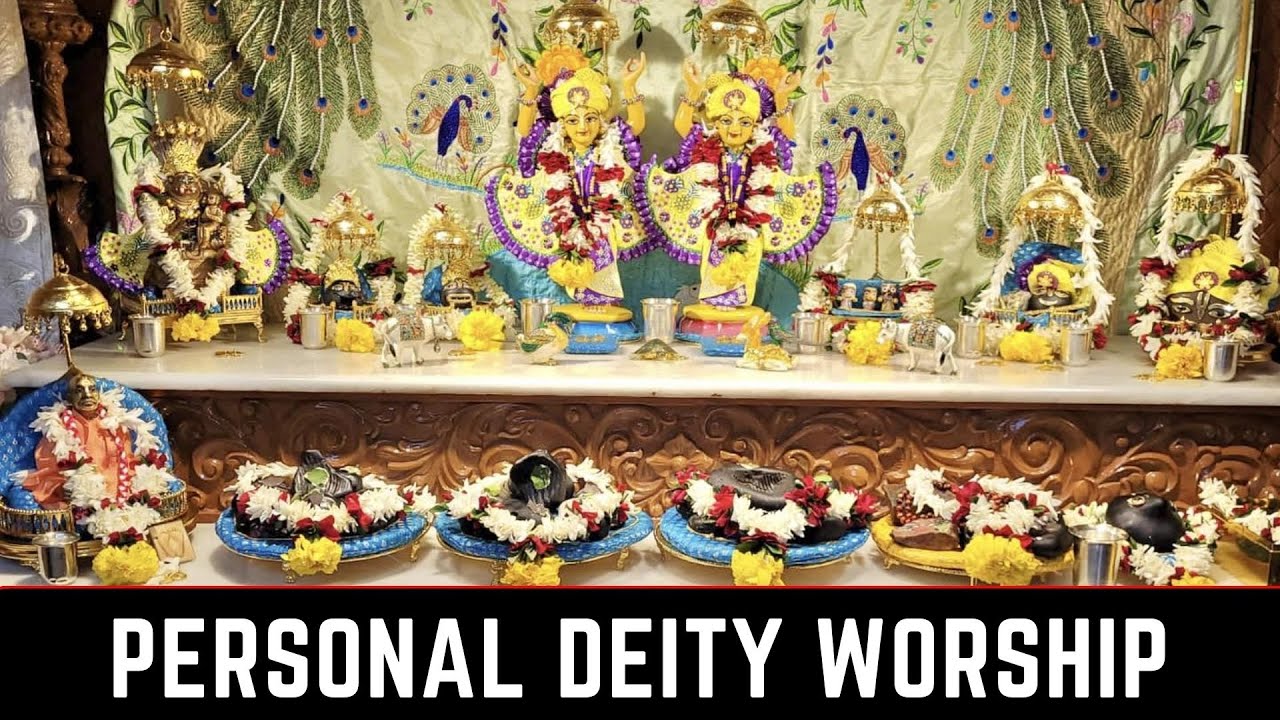
Live || Personal Deity worship || Srila Gopal Krishna Goswami
The live session begins with a devotional Sanskrit/Bengali kirtan that praises the guru, Srila Gopal Krishna Goswami, and invokes the names of Krishna and Rama. Following the chant, Prasad Raval delivers an extensive English exposition on Chapter 6 (verses 11‑12) of the Srimad‑Bhāgavatam, which narrates the story of the asura Vṛtasūra. Raval translates multiple verses, highlighting Vṛtasūra’s heroic stance, his condemnation of cowardice among demonic commanders and demigods, and his fierce battle with Indra, including the episode where Vṛtasūra catches Indra’s club and strikes the elephant Airavata. The commentary repeatedly emphasizes Vṛtasūra’s unwavering devotion to the Supreme Personality of Godhead, his renunciation of material opulence, and his desire to die at the hands of Indra’s thunderbolt so that he may return to the spiritual realm. Raval draws theological conclusions that victory and defeat are ultimately orchestrated by Lord Krishna, that true devotees should surrender to the lotus‑feet of the Lord and his servants, and that material pursuits generate anxiety and bondage. The lecture concludes with practical devotional guidance: seeking association with pure devotees, performing one’s prescribed duty without attachment to results, and cultivating constant remembrance of Krishna. Throughout, references to the Bhagavata, Bhagavad‑Gītā, and other scriptural authorities are provided, along with analogies from Tulasi Das, Chanakya, and other commentators.
Chapters
Yuktasya bhaktan śrīññanjato pi. Bande Guru Śrī Charanāravinda. Chaturveda Śrī Bhagavad Prasada. Swādvana triptaṇ haribhakti sangaḥ. Prithvāye vijetaṣadayeva. Bande Guru Sri Chaitanya Rabindra. Sri Radhika Madhava Yorapara Madhurya Leela. Guru Narupana Nam Pratishana Swa Dhanalalupasya. Bande Guru Sri Charanāravindam, ne kunjayo na rati ke li siddhe, yāya liberiyo kṛṭṛrāpekṣaṇīya, tatrāti dakṣādati valābhasya, vande guru Śrī Charanāravindam. Bhutale Shrimad Bhaktivedanta Swaminithināminenāmaste Sarasvatideve Gauravānīprachārīne nirviśeśaśunyavādi. Vāśyatyā deśeta rīnendya ya Śrī Kṛṣṇa ca itanyaḥ prabhu-netyānandaḥ Śrī Advaita-gadādhara Śrī Vāsadhī gaura-bhakta-vṛndārī Kṛṣṇa. Hare Krishna, Krishna, Krishna, Hare Hare. Hare Rama, Hare Rama, Rama Rama, Hare Hare, Hare Krishna. Samsārdava? Samsārdava nā līda loka. Dharnayaka runyagana ganatham, praptasya kalyana gurnarnavasya. Vande Guru Sri Charanaravinda, Maha Prabhu Kirtananitya Gita. Vaditra Madhyam Manasora Sena. Romanche kampasutaraṅgabāja. Vande guru Śrī Charanāravinda. Śrī Vekrārādhani ca nāna. Śrīṅāratanmāndirmaṣenaḍo. Yuktaśya bhaktāṇ śrīñuñjato pi. Vandeh Guru Shri Charanarvinda. Chaturvidha Shri Bhagavad Prasado. Swadhwana Triptan. Hari Bhakti Sanghan. Kritvaiva Triptim. Vajetasadeva. Vandeh Guru Shri Charanarvinda. Shri Radhika Madhavayorapara Maduryalila Gunarupanamnam Pratishanasvadanalolupasya Bandeguru Shri Charanaravinda Nikunjayonarathikelisi day. Vandeh Guru Shri Charanāravinda. Vandeh Guru Shri Charanāravinda. Vandeh Guru Shri Charanāravinda. Nama'om vishnu-padāya prasāda-prastāya bhūtale. Shrimad Bhagavad Gītā. Swāmi Nityānāmi Nenamaste. Sarasvatī Devī. Gauramāṇi Prachārīne. Raviṣeṣa Śūnyavādhi. Namaste, Nara Singh Gaya. Jaya Nrsimhadev! Nrsimhadev! Prasadmara Deva! Jaya Prahlad Mara! Jaya Jaya Prabhupada! Prabhupada! Prabhupada! Tulasī Kṛṣṇa prāsy nama-namaḥ. Rādhā Kṛṣṇa sevāpābhoḥ, eiya vilāśī, eto māraśarāṇlo. Jugalaru parāsi, e inivedanaḍharo sakīraṇu gātākāro. Seva adhikāraḍye kara-nijetaḥ si, inākṛṣṇaṇḍāse ko'ī. Hare Krishna, Hare Krishna, Krishna Krishna Hare Hare, Hare Rama, Hare Rama, Rama Rama Hare Hare. Jaya Tulsi Maharani, Jaya Bhrindadevi. Tulsi Maharani, Jaya Bhrindadevi. Prandaya Tulasi Devi praye Keshava Satchāva Krishna bhaktī prasad devī satyavataye namo namaḥ—Pran dayay tulasy devey prayey kēśava saccāvakaṣṇabhaktiy prasad evī satyavataye namo namaḥ—
Kanto 6, Chapter 11, The Transcendental Qualities of Vrittasura. This chapter describes Vrittasura's great qualities. When the prominent commanders of the demons fled, not sharing Vrittasura's advice, Vrittasura condemned that all as cowards. Speaking very bravely, he stood alone to face the demigods. When the demigods saw Vritrasura's attitude, they were so afraid that they practically fainted, and Vritrasura began trampling them down. Unable to tolerate this, Indra, the king of the demigods, threw his club at Vritrasura. But Vritrasura was such a great hero that he easily caught the club with his left hand and used it to beat Indra's elephant. Struck by the blow of Vritasura, the elephant was pushed back 14 yards and fell with Indra on its back. King Indra had first accepted Vishwaroop as his priest and thereafter killed him, reminding Indra of his Haniya's activities. Vṛtāsūra said, if one is a devotee of the Supreme Personality of Godhead, Lord Viṣṇu, and depends on Lord Viṣṇu in every respect, then victory, opulence, and peace of mind are all inevitably available. Such a person has nothing for him to aspire in the three worlds. The Supreme Lord is so kind that He especially favors such a devotee by not giving him opulence. That will hamper his devotional service. Therefore, I wish to give up everything for the service of the Lord. I wish always to chant the glories of the Lord and engage in His service. Let me become unattached to my worldly family and make friendships with the devotees of the Lord. I do not desire to be promoted to the higher planetary systems, even to Dhruva-loka, or brahmaloka, nor do I desire an unconquerable position within this material world. I have no need for such things. Text 1 translation: Śrī Śukadeva Gosvāmī said, O King Vṛtasūr, the commander-in-chief of the demons advised his lieutenants in the principles of religion, but the cowardly demonic commanders intend upon fleeing the battlefield, were so disturbed by fear that they could not accept his words. Text 2 and 3 translation: O King Pariksit, the demigods, taking advantage of a favorable opportunity presented by time, attacked the army of the demons from the rear and began driving away the demonic soldiers, scattering them here and there as if their army had no leader. Seeing the pitiable condition of his soldiers, Vrittasura, the best of the Asuras, who was called Indrastru, the enemy of Indra, was very much aggrieved. Unable to tolerate such reverses, he stopped and forcefully rebuked the demigods, speaking the following words in in an angry mood. Text number 4 translation: O demigods, these demonic soldiers have taken birth uselessly. Indeed, they have come from the bodies of their mothers exactly like stool. What is the benefit of killing such enemies from behind while they are running in fear? One who considers himself a hero should not kill an enemy who is afraid of losing his life. Such killing is never glorious, nor can it promote one to the heavenly planets. Prasad RAVALAL. Vrittasura rebuked both the demigods and demonic soldiers because the demons were running in fear of their lives and the demigods were killing them from behind. The actions of both were abominable. When a fight takes place, the opposing parties must be prepared to fight like heroes. A hero never runs from the field of battle. He always fights face to face, determined to gain victory or lay down his life in the fight. That is heroic. Killing an enemy from behind is also inglorious. When an enemy turns his back and runs in fear of his life, he should not be killed. This is the etiquette of military science. Vritasura insulted the demonic soldiers by comparing them to the stool of their mothers. Both stool and a cowardly son come from the abdomen of the mother, and Vritasura said that there is no difference between them. A similar comparison was given by Tulasi Das, who commented that a son and urine both come from the same channel. In other words, semen and urine both come from the genitals. But semen produces a child, whereas urine produces nothing. Therefore, if a child is neither a hero nor a devotee, he is not a son but urine. Similarly, Chanakya Pandit also says, what is the use of a son who is neither glorious nor devoted to the Lord? Such a son is like a blind eye which simply gives pain but cannot help one see. Text 5 translation: Oh, insignificant demigods, if you truly have faith in your heroism, if you have passion in the cores of your hearts, and if you are not ambitious for sense gratification, please stand before me for a moment. Parpar rebuking the demigods, Vrittasu challenged: Oh, demigods, if you are actually heroes, stand before me now and try to show your prowess. If you do not wish to fight, if you are afraid of losing your lives, I shall not kill you, for unlike you, I am not so evil-minded as to kill persons who are neither heroic nor willing to fight. If you have faith in your heroism, please stand before me. Text 6 translation: Sugdev Goswami said, Vitāśur, the angry and most powerful hero, terrified the demigods with his stout and strongly built body. When he roared like a resounding voice, nearly all living entities fainted. Text 7 translation: When all the demigods heard Vitasur's tumultuous roar, which resembled that of a lion, they fainted and fell to the ground as if struck by thunderbolts. Text 8 translation: As the demigods closed their eyes in fear, Vritasura, taking up his trident and making the earth tremble with his great strength, trampled the demigods beneath his feet on the battlefield the way a mad elephant tramples hollow bombos in the forest. Text 9 translation: Seeing Vritasura's decomposition, Indra The king of heaven became intolerant and threw at him one of his great clubs, which are extremely difficult to counteract. However, as the club flew toward him, Vritrasura easily caught it with his left hand. Text and translation. O King Parikshit, the powerful Vritrasura, the enemy of King Indra, angrily struck the head of Indra's elephant with that club. Making a tumultuous sound on battlefield. For this heroic deed, the soldiers on both sides glorified him. Text 11 translation: Struck with the club by Vrittasura like a mountain struck by a thunderbolt, the elephant Airavata, feeling great pain and spitting blood from its broken mouth, was pushed back 14 yards. In great distress, the elephant fell with Indra on its back. Text 12 translation: When he saw Indra's carrier elephant thus fatigued and injured, and when he saw Indra morose because his carrier had been harmed in that way, the great soul Vritasura, following religious principles, refrained from again striking Indra with the club. Taking this opportunity, Indra touched the elephant with his nectar-producing hand. Thus relieving the animal's pain and curing its injuries. Then the elephant and Indra both stood silently. Text 13, translation: O king, when the great hero Vrittasura saw Indra, his enemy, the killer of his brother, standing before him with a thunderbolt in his hand, desiring to fight, Vrittasura remembered how Indra and how Indra had cruelly killed his brother. Thinking of Indra's sinful activities, he became mad with lamentation and forgetfulness. Laughing sarcastically, he spoke as follows. Text 14, translation: Śrīvātāsūr said, he who has killed a brahmana, he who has killed his spiritual master, indeed he who has killed my brother is now by good fortune standing before me face to face as my enemy. O most abominable one! When I pierce your stone-like heart with my trident, I shall be freed from my debt to my brother. Text 15 translation: Only for the sake of living in the heavenly planets, you killed my elder brother, a self-realized, sinless, qualified brahmana who had been appointed your chief priest. He was your spiritual master, but although he you and trusted him with the performance of your sacrifice. You later mercilessly severed his head from his body the way one butchers an animal. Text 16, translation: Indra, you are bereft of all shame, mercy, glory, and good fortune. Deprived, deprived of these qualities by the reactions of your fruitive activities, you are to be condemned even by the man-eaters, rakshas. Now I shall pierce your body with my trident, and after you die with great pain, even fire will not touch you. Only the vultures will eat your body. Text 17 translation: You are naturally cruel. If the other demigods, unaware of my prowess, follow you by attack, uh, attacking me with raised weapons, I shall sever your heads with this sharp trident. With those heads, I shall perform a sacrifice to Bhairav and the other leaders of the ghosts, along with their hordes. Text 18 translation: But if in this battle you cut off my head with your thunderbolt and kill my soldiers, O Indra, O great hero, I shall take great pleasure in offering my body to other living entities, such as jackals and vultures. I shall thus be relieved of my obligations to the reactions of my karma, and my fortune will be to receive the dust from the lotus feet of great devotees like Nārada-mūñi. Parpāda. Śrīla Nārādhana dāsa ṭhākura says, I am the servant of the six Gosvāmīs, and the dust of their lotus feet provides my 5 kinds of food. A Vaiṣṇava always desires the dust of the lotus feet of previous Ācāryas and Vaiṣṇavas. Vṛtasūra was certain that he would be killed in the battle with Indra because this was the desire of Lord Viṣṇu. He was prepared for death because he knew that after his death he was destined to return home back to Godhead. This is a great destination and it is achieved by the grace of Vaiṣṇava. "No one has ever gone back to Godhead without being favored by a Vaiṣṇava." In this verse, therefore, we find the words: "Māṇaśvī-nāma-padāraja prapatsya." "I shall receive the dust of the lotus feet of great devotees." The word māṇaśvī-nāma refers to great devotees who always think of Kṛṣṇa. They are always peaceful, thinking of Kṛṣṇa, and therefore they are called dhīra. The best example of such a devotee is Nārada Muni. If one receives the dust of the lotus feet of a maṇuṣvī, a great devotee, he certainly returns home back to Godhead. Text 19. Translation: O King of the demigods, since I, your enemy, am standing before you, why don't you hurl your thunderbolt at me? Although your attack upon me with your club was certainly useless, like a request of money from a miser, the thunderbolt you carry will not be useless. You need have no doubts about this. Perfect. When King Indra threw his club at Vritrasura, Vritrasura caught it in his left hand and retaliated by using it to strike the head of Indra's elephant. Thus Indra's attack was a disastrous failure. Indeed, Indra's elephant was injured and thrown back 14 yards. Therefore, even though Indra stood with the great thunderbolt to hurl against Vrittasura, he was doubtful, thinking that the thunderbolt might also fail. Vrittasura, however, being a Vaishnava, assured Indra that the thunderbolt would not fail, for Vrittasura knew that it had been prepared in accordance with the instructions of Lord Vishnu. Although Indra had doubts because he could not understand that Lord Vishnu's order never fails, Vritasura understood Lord Vishnu's purpose. Vritasura was eager to be killed by the thunderbolt manufactured according to Lord Vishnu's instruction because he was sure that he would thus return home back to Godhead. He was simply waiting for the opportunity of the thunderbolts being released. In fact, therefore, Vitāsūrta told Indra, 'If you want to kill me, since I am your enemy, take this opportunity, kill me. You will gain victory and I shall go back to Godhead. Your deed will be equally beneficial for both of us. Do it immediately.' Text 20, translation: 'O Indra, King of Heaven, the thunderbolt you carry to kill me has been empowered by the prowess of Lord Viśṇū. And the strength of the riches, austerity. Since you have come here to kill me, according to Lord Vishnu's order, there is no doubt that I shall be killed by the release of your thunderbolt. Lord Vishnu has sided with you. Therefore, your victory, opulence, and all good qualities are assured. Vrittasura not only assured King Indra that the thunderbolt was in invincible, but also encouraged Indra to use it against him as soon as possible. Vrittasura was eager to die with the stroke of the thunderbolt sent by Lord Vishnu so that he could immediately return home back to God, and by hurling the thunderbolt, Indra would gain victory and enjoy the heavenly planets. Remaining in the material world for repeated birth and death, Indra wanted to gain victory over Vittasura and thereby become happy. But that would not at all be happiness. The heavenly planets are just below Brahmaloka, just as stated by the Supreme Lord Kṛṣṇa: 'Āpramābhojanāloka punarāvartino 'arjuna.' If one achieves Brahmaloka, he must still fall to the lower planetary system again and again. However, if one goes back to Godhead, he never returns to this material world. By killing Vritrasura, Indra would not actually gain. He would remain in the material world. Vritrasura, however, would go to the spiritual world. Therefore, victory was destined for Vritrasura, not for Indra. Text 21 translation: By the force of your tender bolt, I shall be freed of material bondage and shall give up this body and this world of material desires. "Fixing my mind upon the lotus feet of Lord Śrī Kṛṣṇa, I shall attain the destination of such great sages as Nārada Muni, such as Lord Śrī Kṛṣṇa has said." Parpata. The words aham samādhyamana indicate that the most important duty at the time of death is to concentrate one's mind. If one can fix his mind on the lotus feet of Kṛṣṇa, Viṣṇu, Śrī Kṛṣṇa, or any Viṣṇu-mūrti, his life will be successful. Successful. To be killed while fixing his mind at the lotus feet of Śrī Kṛṣṇa, Vṛtasūra asked Indra to release his vajra or thunderbolt. He was destined to be killed by the thunderbolt given by Lord Viṣṇu. There was no question of its being baffled. Therefore Vṛtasūra requested Indra to release that thunderbolt immediately, and he prepared himself by fixing his mind at the lotus feet of Kṛṣṇa. A devotee is always ready to give up his material body, which is described here as gram— gramya-pāśya, the rope of material attachment. The body is not at all good. It is simply a cause of bondage to the material world. Unfortunately, even though the body is destined for destruction, fools and rascals invest all their faith in the body and are never eager to return home, back to Godhead. Text 22, translation: Persons who fully surrender at the lotus feet of the Supreme Personality of Godhead and always think of his lotus feet are accepted and recognized by the Lord as his own personal assistants or servants. The Lord never bestows upon such servants the brilliant opulences of the upper, lower, and middle planetary systems of this material world. When one possesses material opulence in any of these three divisions of the universe, his possessions naturally increase his enmity, anxiety, mental agitation, pride and belligerence. Thus one goes through such endeavor to increase and maintain his possession, and he suffers great unhappiness when he loses them. In Bhagavad-gītā 4.11, the Lord says, 'As devotees surrender unto Me, I reward them accordingly. Everyone follows My path in all respects. O son of Pritha, both Indra and Vritasura were certainly devotees of the Lord. Although Indra took instructions from Vishnu to kill Vritasura, the Lord was actually more favorable to Vritasura because after being killed by Indra's thunderbolt, Vritasura would go back to Godhead, whereas the victorious Indra would rot in this material world. Because both of them were devotees, the Lord awarded them the respective benedictions they wanted. Vritasura never wanted material possessions. For he knew very well the nature of such possessions. To accumulate material possession, one must labor very hard, and when he gets them, he creates many enemies because this material world is full, is always full of revelry. If one becomes rich, his friends or relatives are envious. For a Kaanta-bhaktas, anala-devotees, Krishna therefore never provides material possessions. A devotee sometimes needs some material possessions for preaching, but the possessions of a preacher are not like those of a karmī. A karmī's possessions are achieved as a result of karma, but those of a devotee are arranged by the Supreme Personality of Godhead just to facilitate his devotional activities. Because a devotee never uses material possessions for any purpose other than the service of the Lord, the possessions of a devotee are not to be compared to those of a karmī. Text 23, translation: Our Lord, the Supreme Personality of Godhead, forbids His devotee to endeavor uselessly for religion, economic development, sense gratification. O Indra, one can thus infer how kind the Lord is. Such mercy is obtainable only by unalloyed devotees, not by persons who aspire for material gains. There are four objectives in human life, namely religiosity, economic development, sense gratification, and liberation from the bondage of material existence. People generally aspire for religiosity, economic development, sense gratification, but devotee has no other desire than to serve the Supreme Personality of Godhead both in this life and in the next life, and in the next. The special mercy for for the unalloyed devotee is that the Lord saves him from the hard labor to achieve the results of religion, economic development, and sense gratification. Of course, if one wants such benefits, the Lord certainly awards them. Indra, for example, although a devotee, was not much interested in release from material bondage. Instead, he desired sense gratification and a higher standard of material happiness in the heavenly planets. Vrittasura, however, being an unalloyed devotee, aspired only to serve the Supreme Personality of Godhead. Therefore the Lord arranged for him to go back to Godhead after his bodily bondage was destroyed by Indra. Vrittasura requested Indra to release his thunderbolt against him as soon as possible so that he and Indra would benefit according to their Proportionate advancement in devotional service. Text 24, translation. O my Lord, O Supreme Personality of Godhead, will I be— will I again be able to be a servant of Your eternal servants who find shelter only at Your lotus feet? O Lord of my life, may I again become their servant so that my mind may always think of Your transcendental attributes. My Lord, My words always glorify those attributes and my body always engaged in the loving service of Your Lordship. This verse gives the sum and substance of devotional life. One must first become a servant of the servant of servant of the Lord. Das dasanudas. Śrī Caitanya Mahāprabhu advised and He also showed by His own example that a living entity should always desire to be servant of the servant of the servant. Of Kṛṣṇa, the material of the gopīs. This means that one must accept a spiritual master who comes in the disciplic succession and is a servant of the servant of the Lord. Under his direction, one must then engage one's three properties, namely his body, mind, and word. The body should be engaged in physical activities in the order of the master. The mind should think of Kṛṣṇa in one's mind should be engaged in preaching the glories of the Lord, and if one is thus engaged in the loving service of the Lord, one's life is successful. Text 25 translation: O my Lord, source of all opportunities, I do not desire to join in Dhruva-loka and the heavenly planets or the planet where Lord Brahma resides, nor do I want to be the supreme ruler of all the earthly planets or the lower planetary planets. I do not desire to be the master of the powers of mystic yoga, nor do I want liberation if I have to give up Your lotus feet. A pure devotee never desires to gain material opportunities by rendering transcendental loving service to the Lord. A pure devotee desires only to engage in loving service to the Lord in constant association of the Lord and His eternal associates. As stated in the previous verse, as confirmed by Nārtanabhaṣṭhākura, to serve the Lord and the servants of His servants in the association of devotees is the only objective of a pure, unalloyed devotee. Text 26 translation. O lotus-eyed Lord, as baby birds that have not developed their wings always look for their mother to return and feed them, As small calves tied with ropes await anxiously the time of milking when they will be allowed to drink the milk of their mothers, or as a morose wife whose husband is away from home always longs for him to return and satisfy her in all respects, I always yearn for the opportunity to render direct service unto You. A pure devotee always earns yants to associate personally with the Lord and render service unto Him. This example gives— the examples given in this regard are most appropriate. A small baby bird is practically never satisfied except when the mother bird comes to feed it. A small calf is not satisfied unless allowed to suck the milk from the mother's A chaste devoted wife whose husband is away from the home is never satisfied until she has the association of her beloved husband. Text 27 translation: Oh my Lord, my Master, I am wandering throughout this material world as a result of my furtive activities. Therefore I simply seek friendship in the association of your pious and enlightened devotees. My attachment to my body, wife, children, and home is continuing by the spell of your external energy, but I wish to be attached to them no longer. Let my mind, my consciousness, and everything I have, I have been attached to you, only to you. Chapter 12: Vritasura's Glorious Death. This chapter describes how Indra, the king of heaven, killed Vritasura's despite great reluctance. After Vritrasura finished speaking, he released his trident against King Indra with great anger. But Indra, using his thunderbolt, which was many times more powerful than the trident, broke the trident to pieces and cut off one of Vritrasura's arm. Nevertheless, Vritrasura used his remaining arm to strike Indra with an iron mace, making the thunderbolt fall from Indra's hand. Indra, being very ashamed of this, did not pick up the thunderbolt from the ground, but Vittasura encouraged King Indra to pick it up and fight. Vittasura then spoke to King Indra as follows, instructing him very well: The Supreme Personality of Godhead, he said, is the cause of victory and defeat. Not knowing that the Supreme Lord is the cause of all causes, fools and rascals try to take credit for victory or defeat themselves, but everything is actually under the control of the Lord. No one but Him has any independence. The puruṣa and prakṛti are under the control of the Lord, for it is by His supervision that everything works systematically. Not showing the hand of the Supreme. In every action, a fool considers himself the ruler and controller of everything. When one understands, however, that the real controller is the Supreme Personality of Godhead, he is freed from the relativities of the world, such as distress, happiness, fear, and impurity. Thus Indra and Vrta should not only fought but also engage in philosophical discourses. Then they began to fight again. This time Indra was more powerful and he severed Vritrasura's remaining arm. Vritrasura then assumed a gigantic form and swallowed King Indra. But King Indra, being protected by the talisman known as Narayankavach, was able to protect himself even within Vritrasura's body. Then he emerged from within his abdomen and severed the demon's head from his body with his powerful thunderbolt. Severing the demon's head took one complete year to accomplish. Text 7, translation: Shishuke Goswami says, desiring to give up his body, Drikasura considered death in the battle preferable to victory. O King Pariksit, He vigorously took up his freedom and with great force attacked Lord Indra, the king of heaven, just as Katab had forcefully attacked the Supreme Personality of Godhead when the universe was inundated. Although Visakhī repetitively entreated Indra to kill him, with a thunderbolt. King Indra was morose at having to kill such a great devotee and was hesitant to throw it. Vrittasura, disappointed that King Indra was reluctant despite his encouragement, took the initiative very forcefully by throwing his trident at Indra. Vrittasura was not at all interested in victory. He was interested in being killed so that he could immediately return home back to Godhead. As confirmed in the Bhagavad Gita, takti adhem punar janma neti mam, takti adhem punar janma neti. After giving up his body, a devotee immediately returns to Lord Krishna and never returns to accept another body. This was Vittasura's interest. Text to translation. Then Vittasura, the great hero of the demons, welched his trident, which had points like the flames of the blazing fire, at the end of the millennium. With great force and anger, he threw it at Indra, roaring and exclaiming loudly, 'O sinful one, thus shall I kill you!' Text 3 translation: Flying in the sky, Vikasur's Trident resembled a brilliant meteor. Although the blazing weapon was difficult to look upon, King Indra, unafraid, cut it to pieces with his thunderbolt. Simultaneously, he cut off one of Jyotashura's arms, which was as thick as the body of Vasuki, the king of the serpents. Text 4 translation: Although one of his arms was severed from his body, Jyotashura angrily approached King Indra and struck him on the jaw with an iron bat. He also struck the elephant that carries Indra. So Indra dropped the thunderbolt on Indra. Text 5 translation: The denizens of various planets like the demigods, demons, charans, and siddhas praised Vitasur deep, but when they observed that Indra was in great danger, they lamented, alas, alas! Text 6 translation: Having dropped the thunderbolt from his hand in the presence of his enemy, Indra was practically defeated and was very much ashamed. He dared not pick up his weapon again. Vritasura, however, encouraged him, saying, take up your thunderbolt and kill your enemy. This is not the time to lament your fate. Text 7 translation: Vritasura continued, O Indra, No one is guaranteed of being always victorious but the original enjoyer, the Supreme Personality of Godhead, Bhagavan. He is the cause of creation, maintenance, and annihilation, and He knows everything. Being dependent and being obliged to accept material bodies, belligerent subordinates are sometimes victorious and sometimes defeated. But, but the Lord says in Bhagavad-gītā 15.15, I am seated in everyone's heart, and from Me come remembrance, knowledge, and forgetfulness. When two parties fight, the fighting actually goes on under the direction of the Supreme Personality of Godhead, who is Paramātmā, the Super Soul, elsewhere in the Bhāgavad-gītā the Lord says. Spirit soul, under the influence of the three modes of material nature, thinks himself the doer of activities that are actually carried out by nature. The living entities work only under the direction of the Supreme Lord. The Lord gives orders to material nature, and he arranges— and she arranges facilities for the living entities. The living entities are not independent. Although they foolishly think themselves the doers, karta, victory is always with the Supreme Personality of Godhead. As for the subordinate living entities, they fight under the arrangement of the Supreme Personality of Godhead. Victory or defeat is not actually theirs; it is an arrangement by the Lord through the agency of material nature. Pride in victory or moroseness in in defeat is useless. One should fully depend on the Supreme Personality of Godhead, who is responsible for the victory and defeat of all living entities. The Lord advises, nityam guru-karma-tvam karma-jyo 'hayakarmana'—perform your prescribed duty, for action is better than inaction. The living entity is ordered to act according to his position. Victory or defeat depends on the Supreme Personality, on the Supreme Lord. Karmāneva dikāraste mā phaleṣukā-darśanā. You have a right to perform your prescribed duty, but you are not entitled to the fruits of action. One must act sincerely according to his position. Victory or defeat depends on the Lord. Pretasura encouraged Indra, saying, saying, don't be morose because of my victory. There is no need to stop fighting. Indeed, you should go on with your duty. When Krishna desires, you will certainly be victorious. This verse is very instructive for sincere workers in this Krishna Consciousness movement. We should not be jubilant in the— in victory or moroseness, morose in defeat. We should always ask or we should make a sincere effort to implement the will of Kṛṣṇa, or 'śrī-chātana-mābhu', and we should not be concerned with victory and defeat. Our only duty is to work sincerely so that our activities may be recognized by Kṛṣṇa.
More from PRASAD

Rare Pastimes & Timeless Lessons of Guru Mahārāja | Stories Every Disciple Should Hear

ISKCON Legends- pure devotees meet-HH Jayapataka Swami, HH Gopal Krishna Goswami, HH Radhanath Swami



Jagannātha Ratha-yātrā Through Śrīla Prabhupāda's Mercy | 29 April 2006 | Nairobi, Kenya

Lord Jagannātha's Appearance Pastime | 21.07.2019 | ISKCON Calgary | Śrīla Gopāla Kṛṣṇa Gosvāmī

The Ācārya Teaches by His Own ExampleGuṇḍicā Mārjana by Guru Mahārāja #shorts

Guṇḍicā Mārjana – Lord Jagannātha's Pastime | 21.7.2019 | ISKCON Calgary |Śrīla Gopāla Kṛṣṇa Gosvāmī

H.H. Gopāla Kṛṣṇa Gosvāmī Mahārāja - Exemplary Sādhana and Deity Worship # shorts

भगवान की कृपा कैसे प्राप्त होगी ? | 11 Jan 2014 | Punjabi Bagh | Srila Gopal Krishna Goswami

Material Education vs Spiritual Education | Srila Gopal Krishna Goswami #shorts