Lord Chaitanya instructs Rupa and Sanatana Goswami | 09 July 1998 | Moscow | Gopāl Kṛṣṇa Goswāmī
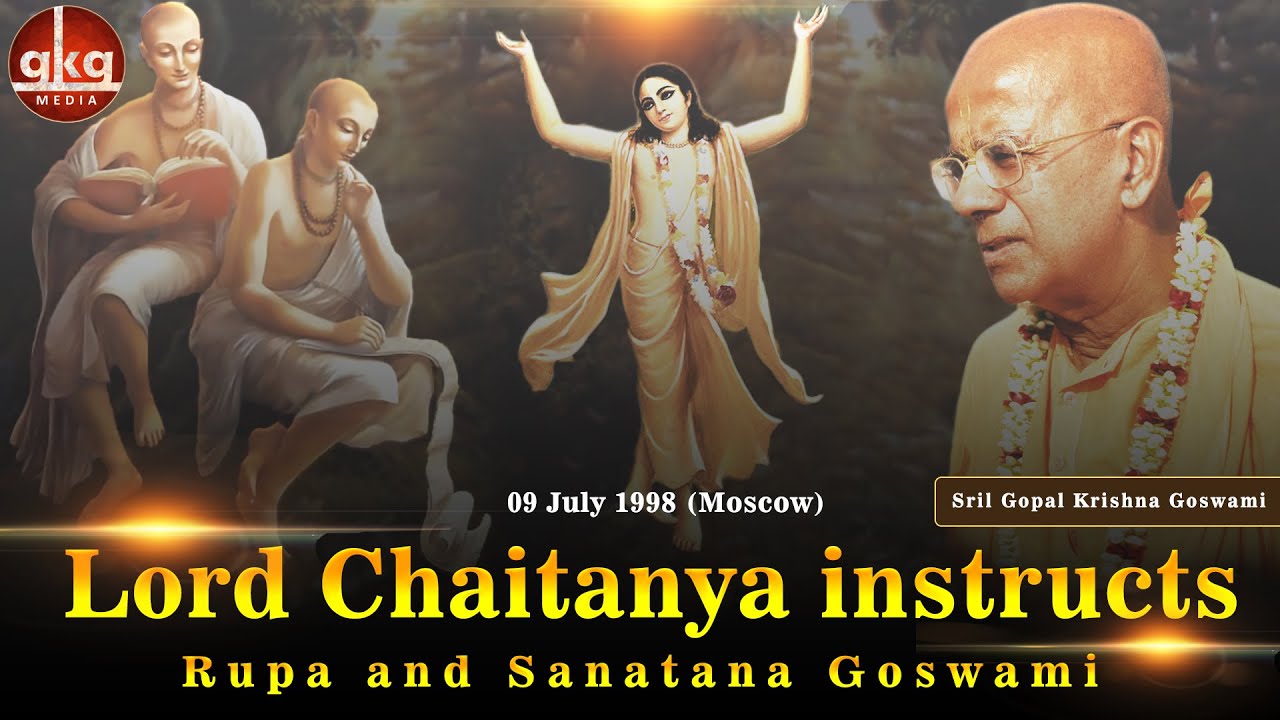
In this devotional lecture Gopāl Kṛṣṇa Goswāmī recounts several pivotal pastimes of Lord Caitanya Mahāprabhu that illustrate his role as a sannyāsi‑devotee, his interaction with the eminent Sanskrit scholar Vasudeva Sarvabhauma Bhattacharya, and the profound Vedānta dialogue that culminated in the revelation of Caitanya’s six‑handed (sād‑bhūja) form. The speaker then shifts to Caitanya’s specific instruction to Rūpa Gosvāmī, using the metaphor of a seed that grows through śrāvana‑kīrtana but can be destroyed by Vaishnava‑apārāda (offenses). Several illustrative anecdotes follow: the plight of Subuddhi Rāya, the envious Brahmin who defamed Śrīvāsācārya, and the severe consequences of Vaishnava‑prasāda. The lecture emphasizes the necessity of keeping the devotional “garden” fenced by constant association with sincere devotees, who can correct faults and protect the bhakti‑seed from the “mad elephant” of offense. The talk concludes with examples of forgiveness among devotees, reinforcing a compassionate, humble attitude in spiritual life.
Chapters
Sādhana. So we're going to continue with our discussion on Lord Caitanya's instructions to Rūpa and Sanātha. So for the past 2 days we've been discussing instructions to Rūpa Gosvāmī, and today also we'll discuss Lord Caitanya's instruction to Rūpa Gosvāmī. So Caitanya Mahāprabhu took sannyāsa at the young age of 24. Once Caitanya Mahāprabhu was singing the names of Gopi, Gopi, Gopi, Gopi, Gopi, Gopi, Gopi. There was a Sanskrit scholar who heard him chant that. What is this Gopi, Gopi, Gopi, Gopi? So Lord Caitanya teased that Sanskrit Pandit and eventually went into a crowd of 1,000 Sanskrit Pandits. And then all these Pandits came with a stick to fight with Caitanya Mahāprabhu. Of course, at that time he was known as Nimai Pandit. So, chetanem ha, so Nimai began to reflect on his mission, which was to save conditioned souls. So he decided to take sannyāsa, because in India a sannyāsi is automatically respected. Even these bogus sannyāsis, they get respected. So he took sannyāsa, but his mother wanted him to stay in Jagannāthpura because, so that she could get regular news about her son. So as a sannyāsi, Lord Caitanya started traveling. He came to Jagannāthpuri. All of you know Jagannāthpuri? He came to Jagannāthpuri to have darshan of Lord Jagannātha. Lord Caitanya was playing the role of a devotee, and He appeared in the mood of Rādhārāṇī. When He came to Jagannāthpuri, He met a very prominent devotee called Vasudeva Sarvabhauma Bhattacharya. His full name was Vasudeva Sarvabhauma Bhattacharya. He was almost 80 years of age, almost equal to being Caitanya Mahāprabhu's grandfather. He had started a Sanskrit school in Navadvīpa, but then he was thrown out of Navadvīpa by Nawāb Husseīn Shāh, a Muhammadan ruler. So he left Navadvīpa. And came to Jagannātha Puri. So when he came to Jagannātha Puri, Lord Caitanya went straight to Lord Jagannātha's temple. He saw Lord Jagannātha's mother, Bāla Rāma, and he couldn't even pronounce the word Jagannātha. He said, "Jaga, jaga, jaga," and he fainted. He became unconscious. He was in so much ecstasy that he couldn't even pronounce Jagannātha. He just said, "Jaga, jaga, jaga," and he Became unconscious. So all the temple officials, they got very worried when they saw this handsome man lying unconscious in the temple. So he saw, they called Sarvabhoombhattacharya. Sarvabhoombhattacharya felt his pulse, his heart, his different parts of his body, and he saw, "Oh, this man is dead." But then he put some cotton on his nose and he saw, The cotton was moving. The baddha charioteer knew that many people make a show of spiritual ecstasy by artificially fainting. But when he saw the cotton swab moving, he could understand, yes, this man is in real ecstasy of love of God. He tried to wake up Lord Caitanya, but Lord Caitanya would not get up. And then Came Nityānanda looking for Lord Caitanya. Nityānanda came to the temple of Jagannātha and said, "Hey, did you see a handsome man chanting and dancing?" The gatekeeper said, "Yes, one man had come, but he was unconscious, so he had been taken to the house of Sarubhava Balacharya." So they at once knew this was Viṣṇṇudāsa Mahāprabhu. So they came running to Sarubhava Balacharya's house. And Nityānanda Prabhu knew how to bring Caitanya Mahāprabhu to consciousness. What did he do? They did Hare Naam kīrtan. And as soon as they did kīrtan, Caitanya Mahāprabhu came back to consciousness. Sarvabhaumana Ācārya had a brother-in-law called Gopināda Ācārya. He knew that Caitanya Mahāprabhu was none else but the incarnation of God that was predicted for Kali-yuga. But Sarvabhaumana Ācārya would say, "You're crazy! This man is not God. He's a handsome man and looks pious, but not God." Sarvabhumabhattacarya was attracted to Caitanya Mahāprabhu. He said, "He is like my grandson." So he got attached to him. So he said, "I want you to listen to the Vedānta. Because you are a young sannyāsi, you should be educated about the goal of life." So for 7 days and nights, Caitanya Mahāprabhu heard the Vedānta's explanation from Sarvabhumabhattacarya. But Caitanya Mahāprabhu didn't say one word for 7 days. Kīñī-devotees, Live with someone for 7 days without saying a word? We are so impatient, we don't even let the other person finish his talk and we are ready to cut in. Lord Caitanya didn't say one word for 7 days and nights. So on the 8th day, Śrīla Bhagavān Mahāprabhu said, "Young man, are you understanding what I am speaking? You haven't said one word about my explanation or asked me any questions." Then Lord Caitanya said, "Yes, I am a fool, but if you want me to explain, I will explain." He said that the Vedānta is as clear as the sun, and you have covered it with a cloud of speculation. You have hidden the real meaning of the Vedānta with your speculation and interpretation and word jugglery. So Sarvabhumana Ācārya said, "Okay, then you explain to me the meaning of Vedānta." Then he gave the explanation. So Sarvabhumana Ācārya was very impressed. Well, Lord Caitanya's simple explanation. He said, "There is nothing wonderful in my explanation. The Vedānta preachers surrender to Kṛṣṇa, the Supreme Personality of Godhead." Then Lord Caitanya explained a key verse from the Bhāgavatam which is known as the Ātmā-lāma verse. First He said, "You explain, Sarvabhauma." So Sarvabhauma explained the Ātmā-lāma verse in 9 different ways. And then Caitanya Mahāprabhu explained it. He explained it in 6 64 different ways without even touching any of the 9 ways that Sarvabhauma had explained. Sarvabhauma was so impressed, he said, "None else but God could have done this." So he fell at the feet of Caitanya Mahāprabhu and surrendered. And then what did Caitanya Mahāprabhu do? He showed His sād-bhūja form. Sād-bhūja is the six-handed form of the Lord. Two arms that revealed the flute, the playing of the flute by Kṛṣṇa. 2 arms that carry the bow and arrow of Lord Rāmacandra, and 2 arms that carry the water pot and the danda of sannyāsa of Caitanya Mahāprabhu. Finally, He revealed His two-handed form of Lord Kṛṣṇa. Viṣṣava Mādhavacārya was so lucky that he saw the form of Kṛṣṇa that within minutes he composed 108 verses glorifying Caitanya Mahāprabhu as the Supreme Personality of Godhead. So this was Caitanya Mahāprabhu's pastime. This was Caitanya Mahāprabhu's pastime with Sarvabhaumana Bhattacarya. There's another story here about Sarvabhaumana Bhattacarya and his son-in-law and Caitanya Mahāprabhu, but we will keep that for tomorrow. This was a little long story, but it's one of the most important stories of Caitanya-caritāmṛta. And the 108 verses that Sarvabhaumana Bhattacarya composed in glorifying Lord Caitanya are so sweet. So we'll go on to Lord Caitanya's instructions to Rūpa Gosvāmī. I'll tell you one small pastime of Rūpa Gosvāmī quickly. Rūpa Gosvāmī had gone to Vrindavan where he met a devotee called Subuddhi Rāya. Subuddhi Rāya at one time was a very big landlord in Bengal. And as fortune would have it, The present Nawab Hussain Shah was a servant in his house. So one day Nawab Subodhi Roy had hit Nawab Hussain Shah, who was a servant, with a cane, and it left a mark on his body, on the back. So one day the Nawab Hussain Shah's wife saw that mark and said, hey, who put that mark on your back? So the Nawab said, When I was young and poor, I was a servant in the house of Subodhi Roy. And one day, for a mistake I committed, he came to me and on my back. So the wife said, now you are the king, kill this man. How dare he hit you when you were young? I can't kill him. He took care of me like a child when I was young. How can I kill him? Please don't Don't tell me to do that. Okay, I'll make him an outcast from Hinduism. Those days, the society was very conservative. From his water pot, he took some water and sprinkled it on Subodhi Roy's head. So Advait Subodhi Roy became a Muslim. So he went to Bārānāsī. He asked the Mayāvādīs, what should I do? I've become an outcast. I've become a Muslim now. They said, Drink burning, boiling hot ghee and commit suicide. So in the meantime, Chaitanya Mahāprabhu arrived in Varnāśrama. So Subhādi Rāya asked him, what should I do? He says, the Māyāvādīs are saying I should commit suicide. Chaitanya Mahāprabhu said, don't commit suicide. Go to Vṛndāvana and roll on the ground and chant Hare Kṛṣṇa, and that will eradicate all sins. So Rūpa Gosvāmī met Subhādi Rāya in Vṛndāvana. Then Subhuti Rāya took him to all the 12 forests of Vṛndāvana. So Chaitanya Mahāprabhu explained yesterday to Rūpa how the tree of seed of devotional service, when it gets watered, it grows taller and taller, crosses the Braja River, and takes shelter at the lotus feet of Lord Śrī Kṛṣṇa in Gauka Vṛndāvana. You remember that? But there's one danger which can cause the tree not to grow. And what is that danger? Vaiṣṇava-aparāda. So we'll read one verse from Caitanya-caritāmṛta to you. Yadi vaiṣṇava-aparāda ute hati mātā, upādevācini tara-sukhi-apātā. So please hear the translation and purport by His Divine Grace A.C. Bhaktivedānta Swāmi Śrīla Prabhupāda. Śrīla Prabhupāda ke. So Chaitanya Mahāprabhu told Rūpa Gosvāmī that the seed of devotional service is guaranteed to grow taller and taller if you water the seed through the process of śrāvana and kīrtanam. Śrāvana-kīrtanam is not only chanting and hearing the glories of, not only chanting and hearing the Hare Kṛṣṇa mantra, but it also includes hearing and chanting the glories of the Lord, the recitation of Bhāgavatam, Bhāgavad-gītā, etc. Devotee is anxious to engage in Kṛṣṇa-katha and avoid prajñālpa. Now, one impediment on the devotional path is if you commit offenses. And the example cited is a mad elephant that destroys a beautiful garden or devotional service. Ṛṣabhūṣṇaṁ śloṇaṁ, me caśkarbliñe śrauñu ca śrī-bhūṣṇaṁ śloṇaṁ, katora rāstaṣṭhāptavit, prikrāṣṇe saḍ preḍhāṇa-slojanya. You may have a beautiful garden, but if you let a mad elephant come in, everything's going to be uprooted. You may have a very beautiful sitting room, but you let the kids play over there, it'll all get ruined. Similarly, by committing Vaiṣṇava prāda, a spiritual life gets ruined. There are many types of Vaishnava pride. So Prabhupada in the purport talks about offending the spiritual master. The spiritual master is a representative of all the predecessor ācāryas, and one should always think oneself as a servant of the servant. In material life, we love to be proud and pride ourselves as the best in every area, but in spiritual life In this life, it is best if we take a humble position and try to serve the Vaiṣṇavas and take the dust from their feet. Preṣṭha Mahārāja was an incarnation of Godhead. He was a Śaktavaśava-tāpa. Preṣṭha Mahārāja said, "I want the dust from the feet of the brāhmanas and the Vaiṣṇavas. The dust from their feet will cleanse my sinful reactions and create in me all desirable transcendental qualities." Vaishnava prasada, as we said, is of various types. Basically, it's motivated by envy. One aspect of Vaishnava prasada is disobeying the instructions of the spiritual master. Another aspect of Vaishnava prasada is being disrespectful to other Vaishnavas. In the 10 offenses that we chant every morning in our temples, the first offense is vaishnava prasada, blaspheming those who have dedicated their lives for propagating the mission of the Lord. Do all of you know the 10 offenses? Can I take a test? Everyone's quiet, they don't want to test. Okay, so the first is to blame the prasadan vaishnavas. So vaishnava prasada should be avoided. Ultimately, vaishnava prasada uproots your own devotional creeper. In our scriptures, there are some examples to illustrate this point. One point we want to make before we get to the stories is in the Chaitanya Ācārya-caritāmṛta, there's a statement that we may go on chanting for birth after birth, but we do go on committing offenses, then our spiritual creeper will be, then we will not develop love of God. Bahujanma kariyādi śravana-kīrtana tabhūtana paya kṛṣṇa-padepreemadhāna. If you chant birth after birth, but unless you avoid the offenses, you will not get Kṛṣṇa-prema. So Vaiṣṇava Praśada, should be avoided. Yesterday we gave you the story of Lord Caitanya Mahāprabhu performed kīrtana for 1 year in the house of Śrīvāsācārya. So there was one brahmin who was very envious that Śrīvāsācārya is getting so much mercy from Caitanya Mahāprabhu. So he wanted to defame him. Everyone was saying, "See the fortune of Śrīvāsācārya. Every day Caitanya Mahāprabhu is coming with His associates." She is enjoying kirtan in his courtyard. So this Brahmin was envious. What did he do? He kept the paraphernalia for worshiping Goddess Durga in front of his door. So in the morning, when Śrīvastākāra opened his door, there he saw beer bottle, liquor bottle, and all the paraphernalia for worshiping Goddess Durga. So he said, "Neighbors!" Come here, I will reveal something to you. I am a devotee of Durga. Here is the proof. I was never a devotee of Kṛṣṇa. I was just making a show. The neighbors said, no, you are a devotee of Kṛṣṇa. This is the work of some crook. Some envious person has played a trick upon you. So they cleaned everything with cow dung and urine. This Brahman later on got affected with a very severe disease, very serious disease. Once he met Caitanya Mahāprabhu when he was going to the Ganga for his bath. He begged Caitanya Mahāprabhu for his forgiveness. He refused to forgive him. He went on suffering. Ultimately he again went to Caitanya Mahāprabhu years later. He said, "I have suffered immensely." Caitanya Mahāprabhu said, "I can't forgive you, but if Śrīvāsṭhākura wants, he can." So then he went back to Śrīvāsṭhākura and then he forgave him. He embraced him and his disease was gone. So this is one story of how the reaction for Vaiṣṇava prasāda is very severe. In the Bhāgavatam, you read about how Durvāsa Muni was envious of Amṛśvarāja's exalted position. Durvāsa was invited for prasāda. Durvāsa said, "Okay, let me take a bath." Sannyāsis take 3 baths a day. But when he went for his bath, he fell in trance. So Amṛśvarāja, the time to break his fast was fast approaching. He didn't know what to do. He didn't want to eat without his ghosti. But the ghost, so he consulted the brāhmanas. 'Okay, you can drink water. Drinking water is considered breaking fast and not breaking fast.' So he drank water. Dervasa was a mystic yogi. He knew at once that Amrish has broken his fast. He said, 'This king had the audacity to invite me for prasad and eat without waiting for me. I'll teach him a lesson.' So as soon as he confronted Amrish, He produced a demon from his sika. Can you brahmacharis and grihastas with sikas produce a demon from your sikas? Mojna? So, but Amritsvaraj was unmoved. Sāve mana-kṛṣṇa-padālabhindayo. His mind was fixed at the lotus feet of the Lord. And what happened? The Sudarshan chakra of the Lord was released. Chakra is a weapon wheel and Sudarshan means auspicious. Sasū, then the Sudarshan Chakra started chasing. It started chasing Durvāsa Muni. Ultimately Durvāsa was able to reach the Lord. He begged forgiveness. But the Lord said, "I can't forgive you. My devotees are so dear. They reside in my heart and I reside in their heart." So ultimately Durvāsa came to Amṛśa. And what did Amṛśa do? "I'll teach you a lesson now." Is that what he said? He gladly forgave her. And then the two had prasāda together. So Vaiṣṇava was very forgiving. So you devotees, in your dealings with each other, should be very forgiving. We don't believe in tit for tat, an eye for an eye. Yudhiṣṭhira Mahārāja was so kind that after the Battle of Kurukṣetra, he offered a very magnanimous palace to live to Dhṛtarāṣṭra. Dhṛtarāṣṭra tried his best to kill the Pāṇḍavas, but in the Battle of Kurukṣetra, all his sons, grandsons, Everyone died. Only Gandhari and he were left. So after the battle, he could have easily said, now, Dhritharashtra, you are arrested. After the battle, he could have easily said, Dhritharashtra, now you are under arrest. Is that what he said? No, he said, my dear uncle, I'm very sorry that all your sons and grandsons have died. Please live in this palace. So that's the forgiving nature of a devotee. Once We had gone to a high school engagement with Śrīla Prabhupāda. This was in Canada, in a Christian school. So after the lecture, as usual, Prabhupāda would ask questions. So one Indian gentleman severely insulted Prabhupāda in the audience. So devotees were so angry, but Prabhupāda was cool. Then before leaving Montreal, Prabhupāda once told me, okay, please call that gentleman. I said, Prabhupāda, why do you want to see him? Prabhupāda said, "Call him." He said, "I must have done something to him in my previous life for which he took revenge." And he blessed him before leaving. So devotee is very fruitful. So Caitanya Mahāprabhu told Rūpa Gosvāmī, "Avoid Vaishnava aprāda." Then He said, satyamālay yatna-kri-kriyavarāna aprāda hastira yacchināhayā udgamāva. The gardener must defend himself by fencing it all around so that the powerful offenses, the powerful elephant of offenses, may not come in. In other words, Lord Caitanya told Rūpa Gosvāmī, if you want to avoid this mad elephant offense, keep yourself in the association of devotees. When the bhakti-lata bija is growing You must fence it by surrounding yourself with devotees. If you surround yourself with good devotees, then you will not let the mad elephant offense destroy your bhakti-lata beach. Why? If you are in the association of good devotees and advanced devotees, then if you are committing a mistake, they'll correct you. In other words, a real Vaishnava He loves, he wants to protect committing Vaiṣṇava prasāda. Real Vaiṣṇava, when he sees a fault or a weakness in someone, he points it out. Normally we all love flattery. If someone says, "Oh, mochen karaṣo priyādhane," and someone says, "Prabhu, this is some defect in your chanting," then you get angry with him. "Why are you pointing out my defect?" As if your chanting is perfect. So we don't like being corrected. Bhaktivedānta Mahāprabhu used to say, beware of flatterers. If someone's coming to flatter you, then you should get scared. So we have the opportunity of associating with those who are more advanced, equally advanced, and less advanced. If we choose the association of those who are more advanced, then we'll make good spiritual advancement. Nārada Muni in his previous life was serving in the house of a maid's— Nārada Muni in his previous life had the fortune of associating with advanced sages. He would eat the remnants of foodstuff that they would leave and listen to their discourses for only 4 months a year in the rainy season. And he developed such great attachment to the Lord as a result of this association. The hunter, as reflected in the Caitanya-caritāmṛta, got purified by Nārada Muni's association. So to protect yourself from the mad elephant offense, Keep yourself in the association of devotees, especially good devotees. And if you do that, then there's a very good chance your mad elephant offense will not uproot your spiritual creeper. Hare Krishna. Hare Krishna. Hare Krishna.
More from PRASAD

Rare Pastimes & Timeless Lessons of Guru Mahārāja | Stories Every Disciple Should Hear

ISKCON Legends- pure devotees meet-HH Jayapataka Swami, HH Gopal Krishna Goswami, HH Radhanath Swami



Jagannātha Ratha-yātrā Through Śrīla Prabhupāda's Mercy | 29 April 2006 | Nairobi, Kenya

Lord Jagannātha's Appearance Pastime | 21.07.2019 | ISKCON Calgary | Śrīla Gopāla Kṛṣṇa Gosvāmī

The Ācārya Teaches by His Own ExampleGuṇḍicā Mārjana by Guru Mahārāja #shorts

Guṇḍicā Mārjana – Lord Jagannātha's Pastime | 21.7.2019 | ISKCON Calgary |Śrīla Gopāla Kṛṣṇa Gosvāmī

H.H. Gopāla Kṛṣṇa Gosvāmī Mahārāja - Exemplary Sādhana and Deity Worship # shorts

भगवान की कृपा कैसे प्राप्त होगी ? | 11 Jan 2014 | Punjabi Bagh | Srila Gopal Krishna Goswami

Material Education vs Spiritual Education | Srila Gopal Krishna Goswami #shorts