Lord Chaitanya Pastimes and Instructions | 12 July 1998 | Russia (Moscow) | Gopāl Kṛṣṇa Goswāmī
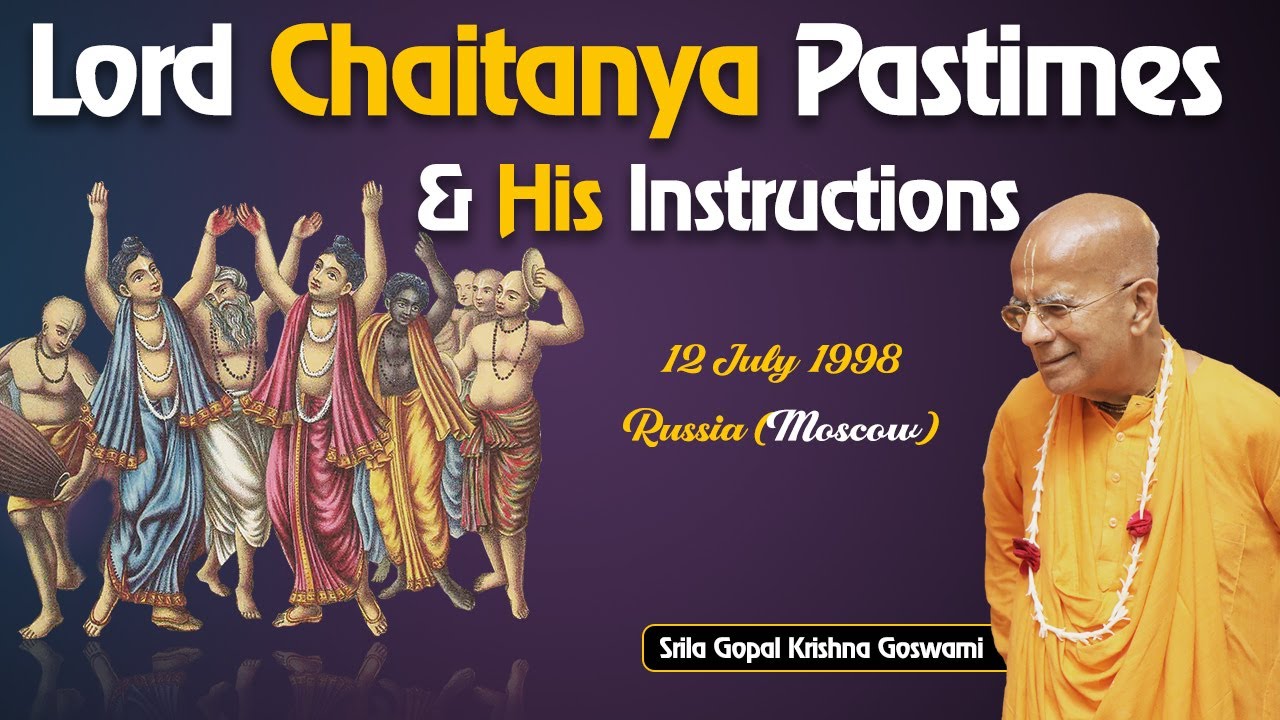
In this devotional lecture, Gopal Krishna Goswāmī reviews selected pastimes of Lord Caitanya Mahāprabhu and expounds the instructions He gave to his principal disciples Rūpa and Sanātana Gosvāmīs. He recounts the episode of King Prataparudra of Orissa, who, after persistent pleading, witnessed the Lord simultaneously present in seven sankirtan groups during the Rath Yatra. He then narrates the transformation of Amalga, the son‑in‑law of Sarubhuma Bhadra Chārya, who, after confronting the Lord about his opulent eating, repented, beat his cheeks in remorse, and became a devoted follower. The core of the talk focuses on the 26 qualities that Lord Caitanya instructed Sanātana to cultivate, such as mercy (kṛpālu), humility, truthfulness (satya‑sāra), equality (sama), faultlessness, magnanimity, cleanliness (suci), desirelessness (akāma), exclusive surrender (kṛṣṇa‑ikāya‑śaraṇa), and others. Goswāmī provides practical guidance for developing these virtues, emphasizing book distribution, respect for fellow Vaishnavas, and internal/external cleanliness. He also offers a detailed exposition of the Hare Kṛṣṇa mahā‑mantra as presented in the Haribhakti Vilāsa, explaining each syllable’s devotional meaning. The lecture introduces the concept of yuktaviragya—using material possessions in service of the Lord rather than renouncing them artificially—citing examples of past acharyas who used modern transport. Throughout, the speaker urges listeners to meditate on these pastimes and qualities, to preach the teachings, and to maintain disciplined devotional practice.
Chapters
Om namah bhagavate vasudevaya. Om namah bhagavate vasudevaya. Om namah bhagavate vasudevaya. Om namah bhagavate vasudevaya. So we're going to continue with our discussion. On Lord Caitanya's instructions to Rupa and Sanātan, we have yesterday explained to you the 6 principles of surrender, and we also explained Lord Caitanya's pastimes to you, including yesterday the pastime with Vāsudeva Vipra. So like usual, we'll give you 1 or 2 pastimes and some philosophy. 500 years ago, At the time Lord Caitanya was on the planet, there was a king of Orissa called King Prataparudra. He was a great devotee of Lord Caitanya Mahāprabhu. He knew who Caitanya Mahāprabhu was, the Supreme Personality of Godhead. So King Prataparudra had a great desire to see the Lord. But for some reason, but Lord Caitanya, in order to increase his anxiety, would always refuse to see him. Even Lord Nityananda pleaded, but still Lord Caitanya won't see him. Lord Caitanya said, 'Ama sannyasi!' I can't meet a king, one who has to do with money and worldly activities. Actually, the Lord was doing this to increase King Pratapudra's anxiety. So the Lord said, they requested Nityananda. First, the Lord gave some of His clothing which was being, which was worshipped by King Pratupadura. It was the clothing, the paraphernalia of the Lord is also respected and worshipable. Then the King, then the Lord agreed to see, receive his son. The son is the representative of the father. But then the Lord gave a special benediction at the time of the Rath Yatra. Lord Caitanya had organized very big sankirtan party which was divided into 7 different groups. 7 groups with 2 mridangas in each. Can you imagine the sankirtan sound? And Lord Caitanya, by His mystic powers, He was present in all the 7 kirtan groups. He was saying, "Hare Hare! All glories to Lord Jagadguru!" But actually, only King Prataparudra could see that the Lord was present in all 7 sankirtan groups. Even though initially Lord Caitanya was, was not meeting the king, but he gave him the special benediction that he could see him in all 7 parties. And he was amazed when he saw that the Lord was simultaneously present in all 7 parties. The other kirtan groups could only see Lord Caitanya in their group, but King Prataparudra was able to see the Lord in all the 7 groups. There's one other pastime we'll say. That's the Lord's experience with Amalga. Amalga was the son-in-law of Sarubhuma Bhadra Charya, and he did not accept the supreme position of Caitanya Mahāprabhu. He could not accept Caitanya Mahāprabhu as God. So when Lord Caitanya used to go to any city, He used to be invited for prasada by different householders. So he was invited to prasada by Sarvabhaumana Bhattacarya for several days. Sarvabhaumana Bhattacarya's wife would cook many offerings for the Lord, even though the Lord would eat very little. Sarvabhaumana Bhattacarya knew his son-in-law's mentality. He was envious of Caitanya Mahāprabhu's supreme position. So he would stand at the door to make sure that Amoga did not see what was being eaten inside. So one day, Amoga, Lord Sarvabhomaracharya had to leave the entrance to help his wife in the kitchen. So Amoga came in and saw many items were on the table of Lord Chaitanya. Amoga started saying, "Look at this sannyasi, he's eating so opulently." So then Sarvabhomaracharya chased Amoga out of the house. Very sick, he was on his deathbed. So Lord Chaitanya went to see him. After all, his father-in-law Or he was his dear most devotee. So Lord Caitanya, as soon as He kept His hand on the chest of Amoga, He said, "Amoga, as long as you have enmity in your heart, Kṛṣṇa will not reside over there." So as soon as Lord Caitanya said that, Amoga got up from his bed and he started dancing in ecstasy and he apologized at the feet of Lord Caitanya for his envious attitude. And then Amoga started beating his cheeks. He beat his cheeks till the cheeks became swollen because he was feeling very bad that he was envious of Chaitanya Mahāprabhu. And then Amarga became a great devotee of the Lord then. So Lord Chaitanya transformed millionaires. Raghunātha dāsa Gosvāmī came from a millionaire's family. He transformed intellectuals. He transformed māyāvādīs, Buddhists, everyone to the path of Vaiṣṇavism. So we are discussing Chaitanya Mahāprabhu's instructions to Rūpa and Sanātana Gosvāmī. We were supposed to have an exam today, isn't it? We forgot. Anyway, we are concluding our teachings. We have already concluded teachings to Rūpa Gosvāmī, and today we're going to conclude the teachings to Sanātana Gosvāmī. As I said yesterday, today we will discuss the 26 qualities that Lord Chaitanya explained to Sanātana Gosvāmī, which should be developed by every Vaiṣṇava. Even though you have all these qualities, It will not hurt to hear them again. Do all of you have all the 26 qualities? Kripālo vakraṇa-dvauva-satyasāra-sāma nidośyavad anāya-midu-suci-kiñcanaḥ sarvopakaarkāśānta-karṣṇāya-kāśaranaḥ akāma-anihā sthira-vijaytaḥ satgunāḥ mītabhūkha-pramātamanāḥ dāmānīḥ tamhīla-kṛṇa-metra-kavidaḥ-camauṇīḥ So we'll just quickly discuss some of these qualities. First is kripalu, which means merciful. The different types of mercy that people can bestow, just like sometimes a drunkard will ask someone for money to buy liquor and somebody will give it. He'll say, "Oh, poor man, he doesn't have money to buy beer, so take a dollar." Is that mercy? Real mercy is giving people knowledge by which they can become free from the cycle of birth and death. So what do devotees do? Distribute Kṛṣṇa consciousness. Because unless we take to Kṛṣṇa consciousness, all our endeavours will be futile. You may have one zero, you may have hundred zeros, they add up to zero. So unless you add one, the zeros mean nothing. So real mercy means To get people to understand how to get out of the bodily concept of life, and that is through the medium of preaching, book distribution. That's why this is the highest service one can engage in, distributing these transcendental books of Prabhupāda. These are like bombs. When they explode and destroy the material ambitions, then humble, akhārata-broha. We've all heard about the importance of humility. So we can cultivate humility by offering respects to all Vaishnavas. Very often devotees want to know how to cultivate humility. Do you want to know that also? Offer respects to all Vaishnavas. Look at the good qualities in all Vaishnavas. Vaishnava has done something nice, appreciate it. Feel the need to take guidance from spiritual master and advanced Vaishnavas. These simple guidelines will help you to be humble. In the Bhagavad Gītā, there's an example given that just like when the weight of the— when the fruits are ripe, it pulls the branches down, and when the fruits are raw, the branches shoot up. So similarly, as you advance spiritually, you tend to become more and more humble. Srīla Dharmagīrī Gosvāmī was walking in Jagannātha Puri on the hot sand. He was worried that he would walk— if he walked in the shady area, his contaminated body may touch somebody else's body. So we should understand that humility is an ornament for a devotee. Satya-sāra. Satya-sāra means being truthful. So devotee is truthful. You have heard this before. Truthfulness is one of the four essential ingredients of religion. Big meaning of truthfulness is Being truthful to the teachings of Lord Śrī Kṛṣṇa. Extension is being truthful to instructions of the spiritual master, being truthful in our dealings. Why did Prabhupāda call Bhāgavad-gītā ka-khāna-yas? He presented Kṛṣṇa's teachings without any distortion. So that is truthfulness. You don't take Kṛṣṇa's teachings and then twist it. Then sama. Sama means equal. So a devotee doesn't divide society into friends and enemies. Pralad Maharaja's father wanted Pralad to be trained up in diplomacy. Pralad said, "I'm not interested in this. For me, everyone is my friend." So devotee is equal to all. The dosha: faultless. Faultless doesn't mean he doesn't make any mistakes. Faultless means that he doesn't make any mistakes in and neglecting the philosophy of life. Then a devotee, Vārānāya, magnanimous, who is the most magnanimous of all incarnations to appear. Why? Why? He freely distributed this love of God. Just like the clouds, they pour water without discrimination. So Lord Caitanya freely distributed this process of love of God without considering who was fit and who was unfit. In the Bhājan that we sing, Śrī Kṛṣṇa Caitanya Prabhu daya-koramore, what do we say? Pati pavan hito tava avatāra. Lord Caitanya appeared in order to reclaim the most fallen people of Kali-yuga. So following in the footsteps of Caitanya Mahāprabhu, We devotees also have to endeavor in the mood of magnanimity. We should also be magnanimous. But we believe in real magnanimity, real charity. Just see how magnanimous Śrīla Prabhupāda was. Even when Śrīla Prabhupāda wasn't physically well, he would not stop preaching and translation. He would go on translating and preaching. Even when he was advised to take rest, He did not take rest. He went to America at the old age of 70, all alone with no money and no contacts, just depending on Kṛṣṇa. So devotee is magnanimous and forgiving. I discussed this point the other day. Then another quality— we're not going to discuss all, we're just discussing some— another quality is suci, which means clean. So suci means clean, internal cleanliness and external cleanliness. External cleanliness is important and so is internal cleanliness. Internal cleanliness means cleansing of the heart. And how is that possible? What does Caitanya Mahāprabhu say in the first line of the Sikṣāṣṭaka? Ceto-darpaṇ-mārjanam. This cleansing of the heart is possible by the chanting of the holy name. Then there must be external cleanliness. And external cleanliness is possible by keeping our temples clean, and keeping the Deity worship standard very clean. So both are important, external and internal. When Prabhupāda would go to any temple, he would see what is the standard of cleanliness. So both external and internal cleanliness are important. In the Haribhakti Vilāsa, there is a detailed explanation of the meaning of the Hare Kṛṣṇa Mahā-mantra, each of the syllables of the Hare Kṛṣṇa Mahā-mantra. Would you like to hear that? There are 16 words: Hare Kṛṣṇa, Hare Kṛṣṇa, Kṛṣṇa, Kṛṣṇa, Hare, Hare, Hare Rāma, Hare Rāma, Rāma, Rāma, Hare, Hare. So, Haribhakti Vrāda explains this as follows. First is Hare, which is an address to O Radharāṇī, the internal energy of the Lord. Meaning it says, it's a prayer, "Oh Radharani, please attract my mind and free me from this material entanglement." What's the next word? So the meaning is, "Oh Kṛṣṇa, please attract my mind." Then it's hare again. It's in address to Radharani, to please attract my heart by showing me Your sweetness. Then the next word is again Kṛṣṇa. Which is, "Oh Kṛṣṇa, please purify my mind by giving me knowledge how to worship You. I am Your devotee." We worship Kṛṣṇa through the medium of His devotee. Then the next kṛṣṇa is again an address to Lord Śrī Kṛṣṇa. "Please give me the qualities to appreciate With these statements to appreciate Name, qualities, and pastimes. Then the next kṛṣṇa is again a prayer: "Please give me a taste for serving You." Hare is an address to Rādhārāṇī. Prayer: "Please make me qualified to serve You." The next Hare is again a prayer to Rādhārāṇī: "Please instruct me how can I serve You." Next Hare: Is again an address to Śrīmatī Rādhārāṇī. Please give me the capacity to understand your transcendental pastimes. Again, next Rāma is an address to the Lord. Please give me the capacity to understand your transcendental pastimes. Next, Har-eṣaṇa is an address to Śrīmatī Rādhārāṇī. Please reveal to me your transcendental pastimes with Kṛṣṇa. The next Rāma has the same meaning. Please reveal to me your transcendental pastimes to Śrīmatī Rādhārāṇī. And rāma, it means, "O Lord, please engage me in remembering your transcendental pastime." Next rāma is, "Please make me qualified to engage in your service." Next haré haré is an address to Śrīmatī Rādhārāṇī, "Please, I beg you, please be pleased with my service." So this is just a summary explanation of Hari-bhakti-vilāsa. From the Hare Bhakti Vrata about the breakup of the meaning of the Hare Kṛṣṇa mantra. So Caitanya Mahāprabhu said, "Suci." This cleanliness is very important for a transcendentalist. "Nenakimcana." Without material possessions. This doesn't mean that you can't have material possessions. It means if you have material possessions, use them in service to the Lord. A devotee can use everything in service of the Lord. We don't believe in artificial renunciation. Our philosophy is the process of yuktavirāgya, which is genuine renunciation. Amongst our ācāryas, Bhaktisiddhānta ṭhāti was the first ācārya who used an automobile, and Prabhupāda was the first ācārya who used aeroplanes. So yuktavirāgya, it says that Kṛṣṇa, without material possessions, What that really means is a devotee understands that all material possessions, facilities should be used in service of the Lord. Sarva-upārakaḥ means working for the welfare of others. How can you work for the welfare of others? How? By giving them Kṛṣṇa consciousness. When you have a boil with pus inside, you don't blow out the boil, but you press the boil and get the pus out. Out, then shanta means peaceful. Why is it that we are not peaceful? Because of the conflict in the mind between material desires and spiritual desires. But if it becomes single-pointed, as we were explaining the other day, then you'll become peaceful. So those devotees who are single-pointed in realizing the spiritual mission of life are peaceful. They're happy in any condition of life. Otherwise, maturely, doesn't matter how much you may realize, you're always unhappy. Then kṛṣṇa-ikāyaśarana, exclusively surrendered to Kṛṣṇa. Though we have the choice of even surrendering to the demigods, we take exclusive shelter of Kṛṣṇa. Yesterday we were explaining Caitanya Mahāprabhu instructing Sanatana Gosvāmī about the 6 6 principles of śrī-nāgadī. Chira! Do you still remember them? One of them was kṛṣṇaikā śarana, to understand that Kṛṣṇa is your only protector and maintainer. Therefore, we exclusively surrender to the Lord. We worship the Lord, sing His glories, and preach His glories. In the Bhāgavad-gītā, 18th chapter, Kṛṣṇa says, Do 4 things and I guarantee you will come back to me. He says, one, think of me, manmana, think of me. Then madbhakto, become my devotee. Then worship me. Then offer your homage unto me. And I guarantee you that you will come back to me. So Krishnaikashyana is to do these 4 things that Krishna says in the Bhagavad Gita. And as you execute the process of devotional service, You give the strength to do it. Akāma means desireless. So what does this mean, that devotee doesn't have any desires? He does have desires. So desirelessness in spiritual life means that your desires are consistent with the Lord's desires. Caitanya Mahāprabhu wanted the holy name to be spread to every town and village of the world. So when the devotees Manifest the same desire and work to fulfill that desire, that is a karma. Desirelessness should not be misinterpreted. It doesn't mean that you have no desires. It means your desires are consistent with Kṛṣṇa's desires as represented by the spiritual master. In Hindi we call it is kīra, fixed. How do you become fixed on the devotional path? This we explained a few days ago. Through the process of bhajana kriya. By regularly executing bhajana kriya, you can become sthira. This is very important. And when you become fixed, then you're single-pointed. Vijeta sat guna. It means completely controlling the anarthas. These anarthas are a stumbling block on the path back to Godhead. And these anarthas can only be overcome by one weapon. So we should never compromise on the process of bhajana kriya. Vegeta satguna, completely controlling the 6 bad qualities. Last time, meeta bhuk means eating only as much as required. That would be good news for the cooks if you stop overeating. Generally, we all tend to overeat. Prasadam is nice here. So eat only as much as required. The Vedic formula is fill half your hunger with foodstuff, 25% with water, and balance with air. Manada, respectful. As we said, the devotee offers his respects to everyone. And even if he has to speak the truth, we always speak the truth, but we present the truth in a palatable manner. If we present the truth in a palatable manner, There's a good chance people will accept it, and even if they don't accept it, they'll remember you as somebody who was a gentleman. Another quality is mouni, silent. Silent doesn't mean you don't speak. Jat Bharata in the first canto was pretending as if he was deaf and dumb, but when the opportunity to preach came, he spoke like a lion. So silence means Avoid nonsense talk or prajalpa. So these are some of the qualities that Caitanya Mahāprabhu mentioned to Sanatana Gosvāmī. The good news today is the prasādam is on time. So what does this mean to you and me? We have to end the lecture on time. When prasādam is late, we go overboard. So today it's on time. So with these explanations, we are concluding our summary presentation Lord Caitanya's teachings to Rupa and Sanatana Gosvāmī, because today is the last day, at least of our seminar. Just to summarize for all of you, we started with a presentation of Lord Caitanya's childhood pastimes and Lord Caitanya's explaining— explanation to Rupa Gosvāmī about the measurement of the living entity and how the living entity is transmigrating from one planet to another, one species to another. We continued with Lord Caitanya's pastimes and with Lord's instructions to Rupa Gosvāmī. And last two days we discussed the Lord's past instructions to Sanatana Gosvāmī. These are found in the Madhya-līlā section, chapters 19 to 22 of the Caitanya-caritāmṛta. Meditate on these pastimes. Meditate on these instructions. Many of the preaching points that we use in our preaching were originally given by Lord Caitanya to Rupa and Sanata. So now that you've heard it, please meditate on it and preach. Hare Krishna. Hare Krishna.
More from PRASAD

Rare Pastimes & Timeless Lessons of Guru Mahārāja | Stories Every Disciple Should Hear

ISKCON Legends- pure devotees meet-HH Jayapataka Swami, HH Gopal Krishna Goswami, HH Radhanath Swami



Jagannātha Ratha-yātrā Through Śrīla Prabhupāda's Mercy | 29 April 2006 | Nairobi, Kenya

Lord Jagannātha's Appearance Pastime | 21.07.2019 | ISKCON Calgary | Śrīla Gopāla Kṛṣṇa Gosvāmī

The Ācārya Teaches by His Own ExampleGuṇḍicā Mārjana by Guru Mahārāja #shorts

Guṇḍicā Mārjana – Lord Jagannātha's Pastime | 21.7.2019 | ISKCON Calgary |Śrīla Gopāla Kṛṣṇa Gosvāmī

H.H. Gopāla Kṛṣṇa Gosvāmī Mahārāja - Exemplary Sādhana and Deity Worship # shorts

भगवान की कृपा कैसे प्राप्त होगी ? | 11 Jan 2014 | Punjabi Bagh | Srila Gopal Krishna Goswami

Material Education vs Spiritual Education | Srila Gopal Krishna Goswami #shorts