Morning deity worship, 14th Dec 2023 | Live Now | Srila Gopal Krishna Goswami
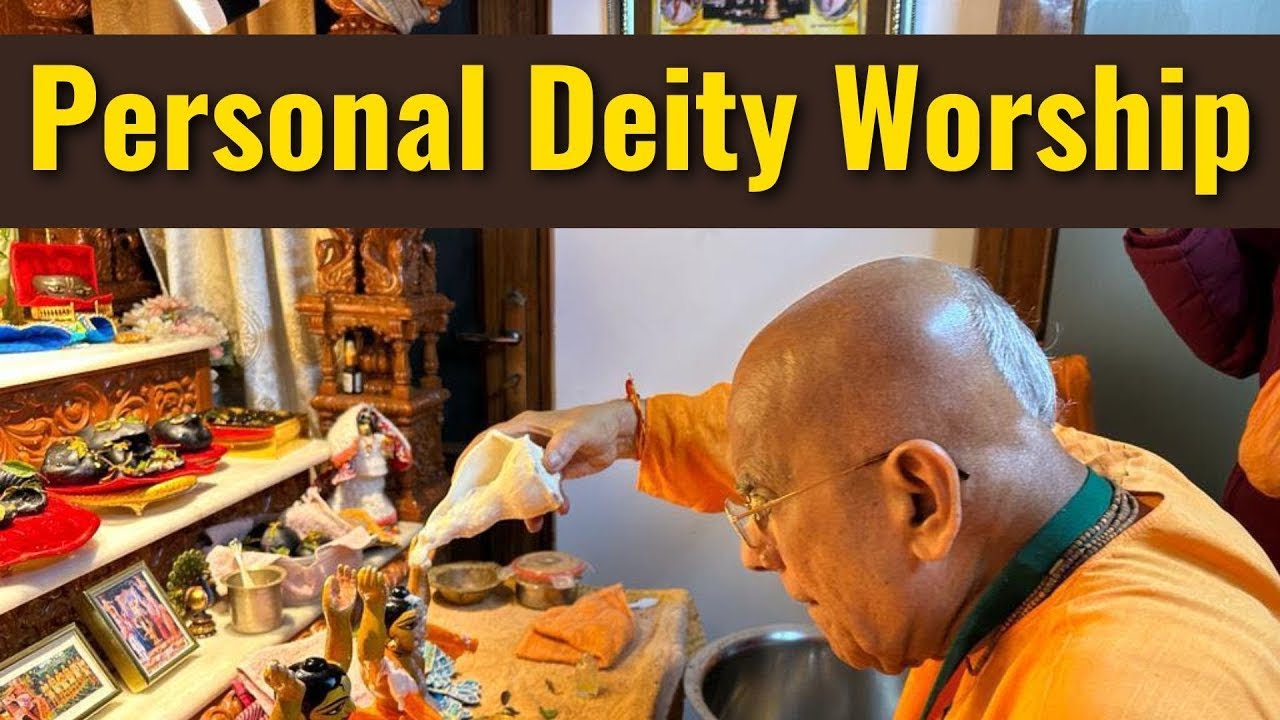
The recording captures a live morning deity worship session led by Srila Gopal Krishna Goswami, featuring three speakers (A, B, C) who read verses from the Srimad Bhagavatam and the Bhagavad‑gītā and then engage in a theological dialogue. The discourse explores the nature of the Supreme Personality of Godhead, Krishna, emphasizing his simultaneous immanence in Vṛndāvana and transcendence beyond all material qualities. It critiques the Mayāvāda view that the Supreme lacks a form, affirming instead that Krishna retains a transcendental form while pervading every corner of creation. The speakers delineate the three aspects of the Absolute—Brahman, Paramātmā, and Bhagavān—explaining their hierarchical relationship. A substantial portion is devoted to distinguishing sakama (material‑motivated) and akama (pure) devotees, their differing attitudes toward the Lord’s assistance, and the spiritual consequences of each. The talk also recounts the Lord’s incarnations (Vāmana, Nṛsiṁha, etc.) as purposeful interventions to protect devotees and eliminate demonic forces, underscoring Krishna’s impartial mercy toward both devotees and non‑devotees. Devotional practice is highlighted through repeated prayers to the Lord’s lotus feet as a shelter from material distress. Throughout, the participants intersperse personal queries, logistical remarks, and affirmations, creating a dynamic, devotional atmosphere that blends scriptural exegesis with lived devotion.
Chapters
Namaste, Naresimha. Kalade la de la iyu. Eran ya ka shiku nasha. Shilaram ka nakala hi. Etona sima. Paretona sima. Reading from Canto 9, reading from Canto 6, Chapter 9, Verse number 34. O Lord, you need no support, and although you have no material body, you do not need cooperation from, from us, since you are the cause of the cosmic manifestation and you supply its material ingredients without being transformed. You create, maintain, and annihilate this cosmic manifestation by yourself. Nevertheless, although you appear engaged in material activity, you are transcendental to all material qualities. Consequently, these transcendental activities of yours are extremely difficult to understand.
Purpose.
Brahman Bhagavad-gītā says, the Supreme Personality of Godhead, Kṛṣṇa, is always situated in Bolo-vrindavan. It is also said, Kṛṣṇa never goes even a step from Vṛndāvana. Nevertheless, although Kṛṣṇa is situated in His own abode, Bolo-vrindavan, He is simultaneously all-premieries and is therefore present everywhere. This is This is very difficult for a conditioned soul to understand, but devotees can understand how Kṛṣṇa, without undergoing any changes, can simultaneously be in His abode and all persons' places. The demigods are understood to be various limbs of the Supreme Lord's body. Although the Supreme Lord has no material body and does not need anyone's help, He is Gurumaharaj?
Then what? Gurumaharaj, I don't know him. Can he be right? Last night Gurumaharaj sat down with him, that's the way. He is really— So you are here following me, eh? I'm here until Sunday Gurumaharaj, the 17th. Are you in India for long?
India until the 28th of January. We are going for South India, there are some devotees from Master.
From Monday I am going to school. Oh, you work here? Yes, Guru Maharaj. Oh, how are you?
Guru Maharaj, going very well, and by your mercy we printed new books and I would like to offer this to you. Not much, Gurumurthy. I was just focusing on— they're a bit quiet now, everything is.
He's not present everywhere.
You really, you, you, you can.
Yes, yes, nevertheless, he is not present everywhere in his spiritual form.
Nevertheless, he is not present everywhere in his spiritual form. According to the Mayāvād philosophy, the Supreme Truth, being all-persuasive, does not need a transcendental form. The Mayāvādīs suppose that since his form is distributed everywhere, he has no form. This is untrue. The Lord keeps his transcendental form and at the same time he extends everywhere in every nook and corner of material creation?
Text 35.
These are our inquiries. The ordinary condition— soul is subject to the material laws and he thus receives the fruits of his actions. Does Your Lordship, like an ordinary human being, exist within material creation? A body produced from material modes? Do you enjoy or suffer the good or bad result of action under the influence of time, past work, and so forth? Or, on the contrary, are you present here only as a neutral witness who is self-sufficient, free from all material desires, and always full of spiritual potency? We certainly cannot understand your actual position. In Bhagavad Gita, Krishna says that he descends to this material world for two purposes, namely paritranaya sadhana, munayasha and shuddhishekha, to relieve the devotees and kill demons or non-devotees. These two kinds of actions are the same for the absolute Lord. When the Lord comes to punish the demons, he bestows his favor upon similarly, when he delivers his devotees and gives them relief, he also bestows his favors. Thus the Lord bestows his favor equally onto the conditioned souls. When a conditioned soul gives relief to others, he acts piously. When he gives trouble to others, he acts impiously. But the Lord is neither pious nor impious. He is always full of full in his spiritual potency, by which he shows equal mercy to the punishable and the protected. The Lord is a param dharmic vision. He is never contaminated by the reaction of so-called sinful activities. When Krishna was present on this earth, he killed many inimical non-devotees, but they all received savitriya. In other words, they returned to their original spiritual bodies. One who does not know the Lord's position says that God is unfair to him but merciful to others. Actually, the Lord says in Bhagavad-gītā 9.29, 'I am equal to everyone. No one is my enemy and no one is my friend.' But He also says, if one becomes becomes my devotee and fully surrenders unto me, I give him special attention.
O Supreme Personality of Godhead, all contradictions can be reconciled in You, O Lord, since You are the O Supreme Person, the reservoir of the unlimited spiritual qualities, the Supreme Controller, Your unlimited glories are insensible to the conditioned souls. Many modern theologians argue about right and wrong without knowing what is actually right. Their arguments are always false and their judgments inconclusive because they have no authorized evidence with which to to gain knowledge of you. Because their minds are educated by scriptures containing false conclusions, they are unable to understand the truth concerning you. Furthermore, because of polluted eagerness to arrive at the right conclusion, their theories are incapable of revealing you, who are transcendental to their material conceptions. You are one without a second, and therefore in you contradictions like doing and not doing, happiness and distress are not contradicted. Your potency is so great that it can do and undo anything as you like. With the help of that potency, what is impossible for you? Since there is no duality in your constitutional position, you can do everything by the influence of your energy.
Perfect.
The Supreme Personality of Godhead, being self-sufficient, is full of transcendental bliss, ātmārāma. He enjoys bliss in two ways: when He appears happy and when He appears distressed. Distinctions and contradictions are impossible in Him because only from Him have they emanated. The Supreme Personality of Godhead is the reservoir of all knowledge. All-potency, all-strength, opulence, and influence. There is no limit to His powers. Since He is full in all transcendental attributes, nothing abominable from the material world can exist in Him. He is transcendental and spiritual, and therefore conceptions of material happiness and distress do not apply to Him. We should not be astonished to find Kāṇḍa contradictions in the Supreme Personality of Godhead. Actually, there are no contradictions. That is the meaning of His being supreme. Because He is all-powerful, He is not subject to the conditioned soul's arguments regarding His existence or non-existence. He is pleased to protect His devotees by killing their enemies. He enjoys both the killing and the protecting. Such Freedom from duality applies not only to the Lord but also to His devotees. In Vṛndāvana, the damsels of Prajābhūminī enjoy transcendental bliss in the company of the Supreme Personality of Godhead Kṛṣṇa, and they feel the same transcendental bliss in separation when Kṛṣṇa and Balarama leave Vṛndāvana for Mathura. There is no question of material pains or pleasures for either the Supreme Personality of Godhead or His pure devotees. Although He is sometimes superficially said to be distressed or happy, one who is Ātmārāma is blissful in both ways. Non-devotees cannot understand the contradictions present in the Supreme Lord or His devotees. Therefore, in Bhagavad-gītā, the Lord says, bhaktyāmām abhijñānāti, Their transcendental pastimes can be understood through the devotional service. To non-devotees, they are inconceivable. Acintya-khalute bhāvanās paṁ tākhenā yojaye. The Supreme Lord and His form, name, pastimes, and paraphernalia are inconceivable to non-devotees.
Shall I continue reading, Guru Mahārāja? This is Matilda. 37.
A rope causes fear for a bewildered person who considers it a snake. Snake, but not for a person with proper intelligence who knows it to be only a rope. Similarly, You as the Super Soul in everyone's heart inspire fear or fearlessness according to one's intelligence, but in You there is no duality. In Bhagavad-gītā 4.11, the Lord says, ye yathāmaṁ prabuddhyante tām sthataiva pajañyam, as one surrenders unto me, I reward him accordingly. The Supreme Personality of Godhead is the reservoir of everything, including all knowledge, all truth, and all contradictions. The example cited here is very appropriate. A rope is one truth, but some mistake it for a snake, whereas others know it to be a rope. Similarly, devotees who know the Supreme Personality of Godhead head do not see contradictions in Him, but non-devotees regard Him as the snake-like source of all fear. For example, when Nrsimhadeva appeared, Prahlada Maharaja saw the Lord as the supreme solace, whereas his father, a demon, saw Him as the ultimate death. As stated in Srimad Bhagavatam 11:37, bhayam vitiya bhineveshadas sādhvām Prasada Raval. Fear results from being absorbed in duality. When one is in knowledge of duality, one knows both fear and bliss. The same Supreme Lord is a source of bliss to devotees and fear to non-devotees who have a poor fund of knowledge. God is one, but people understand the Absolute Truth from different angles of vision. The unintelligent see contradictions in Him, but sober devotees find no contradictions.
Text 38.
With deliberation, one will see that the Supreme— Super Soul, although manifested in different ways, is actually the basic principle of everything. The total material energy is the cause of the material manifestation, but the material energy is caused by Him. Therefore, He is the cause of all causes, the man— the manifestor of intelligence and the senses. He is perceived as the super soul of everything. Without Him, everything would be dead. You, as that super soul, the supreme controller, are the only one remaining. The words sarva vastuni vastu sarupa indicates that the Supreme Lord's active principle is the active principle of everything, as described in Brahma-samhita 5.35: Eko pyasauracitam jagalanda-kurtim yac caktyerastu jagalanda-kayantas-taha andhāntarastu paramānujayāntarastham govindamādhipuruṣaṁṣva-mahāmdayām. I worship the Personality of Godhead Govinda, Who enters the existence of every universe and every atom by one of His plenary portions and thus manifests His infinite energy throughout the material creation. By His one plenary portion as Paramatma, antaryami, the Lord is all-pervading. Throughout the unlimited universes, He is the pratyak or antaryami of the living entities. The Lord says in Bhagavad-gītā 13.3, "Shetrajñām ca api mām vijñī sarvākṣetreṣu bhārataḥ"—"O son of Bharata, you should understand that I am also the knower in all bodies." Because the Lord is the Supersoul, He is the active principle of every living entity and even the atom. Andāntarastha-phraṇaṇu-cayāntarastham—He is the actual reality according to Through various stages of intelligence, one realizes the presence of the Supreme in everything through the manifestations of His energy. The entire world is permeated by the three gunas, and one can understand His presence according to one's modes of material nature. Text 31. Therefore, O killer of the Madhu demon, incessant transcendental bliss Bliss flows in the minds of those who have even once tasted but a drop of the nectar from the ocean of Your glories. Such exalted devotees forget tiny reflection of so-called material happiness produced from the material senses of sight and sound. Freedom, free from all desires, such devotees are the real friends consciousness of all living entities. Offering their minds unto You and enjoying transcendental bliss, they are expert in achieving the real goal of life. O Lord, You are the sole and dear friend of such devotees who never need return to this material world. How could they give up engagement in Your devotional service? Purport: Although non-devotees, because of their eager knowledge and speculative habits cannot understand the real nature of the Lord. A devotee who has once tasted the nectar of the Lord's lotus feet can realize what transcendental pleasure there is in the Lord's devotional service. A devotee knows that simply by rendering service to the Lord, he serves everyone. Therefore, devotees are real friends. To all living entities. Only a pure devotee can preach the glory of the Lord for the benefit of all conditioned souls. Text 14. O Lord, O personified Three Worlds, Father of the Three Worlds, O Strength of the Three Worlds, in the form of the Vāmana incarnation, O Three-Eyed form of Nrsimhadeva, O most beautiful person within the three worlds. Everything and everyone, including human beings and even the daitya demons and the danavas, is but an expansion of your energy. O supremely powerful one, you have always appeared in your forms as the various incarnations to punish the demons as soon as they become very powerful. You appear as Lord Vamanadeva, Lord Rama, and Lord Krishna. You appear sometimes as an animal like Lord Bhuva, sometimes a mixed incarnation like Lord Nrsimhadeva and Lord Hayagriva, and sometimes aquatic like Lord Fish and Lord Tosa. Assuming such various forms, You have always punished the demons and danavas. We therefore pray that Your Lordship appear today as another incarnation, if You so desire. Desire to kill the great demon Vrindrasura. Purpose. There are two kinds of devotees, known as sakama and akama. Pure devotees are akama, whereas devotees in other planetary systems, such as the demigods, are called sakama because they still want to enjoy material opulence. Because of their pious activities, the sakama devotees are promoted to the higher planetary systems, but at heart they still desire to lord it over the material resources. The sakama devotees are sometimes disturbed by the demons and rakshasas, but the Lord is so kind that He always saves them by appearing as an incarnation. The Lord's incarnations are so powerful that Lord Vamanadeva Śrīla Prasada RAVALALADA covered the entire universe with 2 steps and therefore had no place for His 3rd step. The Lord is called Trivikrama because He showed His strength by delivering the entire universe with merely 3 steps. The difference between sakama and akama devotees is that when sakama devotees, like the demigods, fall into difficulty, they approach approach the Supreme Personality of Godhead for relief, whereas akama devotees, even in the greatest danger, never disturb the Lord for material benefits. Even if when akama devotee is suffering, he thinks this is due to his past impious activities and agrees to suffer the consequences, he never disturbs the Lord. Sakama Devotees immediately pray to the Lord as soon as they are in difficulty, but they regard it as pious because they consider themselves fully dependent on the mercy of the Lord, as stated in Śrīmad-Bhāgavatam 10.14.8: Tat te anukampāṁ sūsamikṣamāno hunjena yevātmā-kṛtam vipārkaṁ, uddvāgavapadiṣviddhaṁ manasteh, jāyete ye mṛtir adhīsaḥ. Prasada Yāvā. Even while suffering in the midst of difficulties, devotees simply offer their prayers and service more enthusiastically. In this way, they become firmly fixed in devotional service and are eligible to return home, back to Goloka, without a doubt. Sakāma-devotees, of course, achieve from the Lord the results they desire from their prayers. But they do not immediately become fit to return to Godhead. It is to be noted herein that Lord Viṣṇu, in His various incarnations, is always the protector of His devotees. Śrīla Madhvācārya says, Vibhidham bhāva pratrātvāt sarve viṣṇuṇu bhūtayah. Kṛṣṇa is the original personality of Godhead. Kṛṣṇa-stu aghvān svayam. All the other incarnations proceed from Lord Vishnu. Text 41. O Supreme Controller, O Grandfather, O Supreme Pure, O Lord, we are all surrendered souls at your lotus feet. Indeed, our minds are bound to your lotus feet in meditation by chains of love. Now please manifest your incarnation, accepting us As Your own eternal servants and devotees, be pleased with us and sympathetic towards us. By Your love-filled glance with its cool and pleasing smile of sympathy, by the sweet nectarian words emanating from Your beautiful face, free us from the anxiety caused by this Vritrasura who always pains the crows of our hearts. 39. O Lord, Lord Brahma is considered the father of the demigods, but Krishna, or Lord Vishnu, is the father of Brahma because Brahma took birth from the lotus flower growing from the Lord's abdomen. 40.
Truth.
O Lord, as a small spark of fire cannot possibly perform the actions of the whole fire, we, Sparks of your Lordship cannot inform you of the necessities of our lives. You are the complete whole, therefore, of what do we need to inform you? You know everything because you are the original cause of cosmic manifestation, the maintainer and the annihilator of entire universal creation. You always engage in your pastimes with your spiritual and material energies, for you are the controller of all these varied energies. You exist within all living entities, within the cosmic manifestation, and also beyond them. You exist internally as Parabrahman and externally as ingredients of the material creation. Therefore, although manifested in various stages at different times and places and in various God is, You, the Personality of Godhead, are the original cause of all causes. Indeed, You are the original element. You are the witness of all activities, but because You are as great as the sky, You are never touched by any of them. You are the witness of everything as Parabrahman and Paramatma. O Supreme Personality of Godhead, nothing is unknown to you. The absolute truth exists in three phases of spiritual understanding: Brahman, Paramatma, and Bhagavan. Brahmeti paramatmeti bhagavan iti shabdhate. Bhagavan, the Supreme Personality of Godhead, is the cause of Brahman and Paramatma. Brahman, the impersonal absolute truth, is all-pervading, and Paramatma is locally situated in everyone's heart, but Bhagavan who is worshipable by the devotees, the original cause of all causes. A pure devotee is aware that since nothing is unknown to the Supreme Personality of Godhead, He need not be informed of a devotee's conveniences or inconveniences. A pure devotee knows that there is no need to ask the Absolute Truth or admit many material necessities. Therefore, while informing the Supreme Lord about their distress in being attacked by Budrasura, the demigods apologized for offering prayers for their safety. A neophyte devotee, of course, approaches the Supreme Lord for relief from distress or poverty, or for spiritual knowledge, speculative knowledge, of the Lord. Bhagavad-gītā 7.16 mentions four kinds of pious people who begin devotional service to the Lord: one who is distressed, Ārtha; one who is in need of money, Astarkī; one who is inquisitive, Jñānānṣū; and one who is searching for the Absolute Truth, Jñānaṇ. A pure devotee, however, knows that since the Lord is omnipresent, omnipotent and omniscient, there is no need to offer prayers or worship Him for one's personal benefit. A pure devotee always engages in the service of the Lord without demanding anything. The Lord is present everywhere and knows the necessities of devotees, and consequently there is no need to disturb Him by asking Him for material benefits. 43. Dear Lord, you are omniscient and therefore you know very well. Thank you, Lord.
620.
Dear Lord, You are omniscient and therefore You know very well why we have taken shelter at Your lotus feet, which provide a shade that gives relief from all material disturbances. Since You are the supreme spiritual master and You know everything, we have sought shelter at Your lotus feet for instruction. Please give us relief by counteracting our present distress. Your lotus feet are the only shelter for a fully surrendered devotee and are the only means for subduing all the tribulations of this material world. One need only seek shelter of the shade of the Lord's lotus feet, then all the material tribulations that disturb him will be subdued, just as when one comes under the shadow of a big tree, the Disturbances caused by the heat of the scorching sun are immediately mitigated without one's asking for relief. Therefore, the whole concern of the conditioned soul should be the lotus feet of the Lord. The conditioned soul, suffering from various tribulations because of existing in this material world, can be relieved only when he takes shelter at the lotus feet of the Lord. Text 44. Therefore, O Lord, O Supreme Controller, O Lord Krishna, please annihilate this dangerous demon, Rudrasura, Tvastā's son, who has already swallowed all our weapons, our paraphernalia for fighting, and our strength and influence. The Lord says It says in Bhagavad-gītā 7:15-16, namaṁ duṣkṛtiṇau mohaḥ prapacante naraḥ dhamāṁ, māyāya pākṛtaḥ jñānaḥ aśurim bhāvam aśrikaḥ, caturvidaḥ bhajante mām jñānaḥ suḥkṛtiṇau arjunaḥ, Ārthuḥ vidyāsiḥ athārthī, jñāniḥ cāraḥ atharśabhaḥ. Those miscreants who are grossly foolish, lowest among mankind, whose knowledge is stolen by illusion and who partake of the atheistic nature of demons do not surrender unto Me, O best among the Bharatas, Arjuna. Four kinds of pious men render devotional service unto Me: the distressed, the desirer of wealth, the inquisitive, and he who is searching for knowledge of the Absolute. The fourth Those classes of neophyte devotees who approach the Supreme Lord, Supreme Personality of Godhead, to offer devotional service because of material motives are not pure devotees. But the advantage of such materialistic devotees is that they sometimes give up their material desires and become pure. When the demigods are utterly helpless, they approach the Supreme Personality of Godhead in grief and with tears in their eyes, praying to the Lord, and thus they become almost pure devotees, free from material desires, admitting that they have forgotten pure devotional service because of extensive material opportunities. They fully surrender to the Lord, leaving to His consideration whether to maintain them or annihilate them. Such surrender is necessary. Bhakti Vinod Thakur sings, 'Maar Abhi Rakhabi, Yo Ichha Tohara.' Oh Lord, I fully surrender unto your lotus feet. Now, as you desire, you may protect me or annihilate me. You have the full right to do either. What will come? Oh Lord, O Supreme Pure, You live within the core of everyone's heart and observe all the desires and activities of the conditioned souls. O Supreme Personality of Godhead known as Lord Kṛṣṇa, Your reputation is bright and illuminating. You have no beginning, for You are the beginning of everything. This is understood by pure devotees because You are easily accessible is accessible to the pure and truthful. When the conditioned souls are liberated and sheltered at Your lotus feet after roaming throughout the material world for many millions of years, they attain the highest success of life. Therefore, O Lord, O Supreme Personality of Godhead, we offer our respectful obeisances at Your lotus feet. The demigods certainly wanted Lord Viṣṇu to relieve their anxiety, but now they directly approach Lord Kṛṣṇa, for although there is no difference between Lord Kṛṣṇa and Lord Viṣṇu, Kṛṣṇa descends to this planet in His Vāsudeva feature for the purpose of paritranāya sadhūnām vināśāya ca druṣpatām, protecting His devotees and annihilating the miscreants. Demons are thieves. Atheists always disturb the demigods, our devotees, and therefore Kṛṣṇa descends to punish the atheists and demons and fulfill the desires of His devotees. Kṛṣṇa, being the original cause of everything, is the Supreme Person, above even Viṣṇu and Narayana. Therefore, there is no difference between these different forms of the Lord, as explained Brahma-samhita 5:46, dipācerevahī daśāntaram ampyedetya, dipāyate vivratahī to samānā-dharmaṁ, yastādrigevahī ca viṣṇuṭaya vidhādi govindamāṇaḥ. Krishna expands Himself as Viṣṇu the way a bright candle kindles another. Although there is no difference between the power of one candle and another, Kṛṣṇa is compared to the original candle. The word bruṣṭa-yaśyāse is significant because herein Kṛṣṇa is always famous for relieving His devotees from danger. A devotee who has sacrificed everything for the service of Kṛṣṇa, whose only source of relief is the Lord, is known as akinchana. As expressed in the praise offered by Queen Kunti, the Lord is akinchana-vittāṁ, the property of such a devotee. Those who are liberated from the bondage of conditioned life are elevated to the spiritual world, where they achieve five kinds of liberation: saijya, salokya, sarupya, sāsti, and samipya. They personally associate with the Lord in five melows: śrīnta, dāsyā, sātya, vāsarya, and mātarya. These rasas are all emanations from Kṛṣṇa. As described by Viṣṇu Mahāprabhupāda, the original mellow, Ādirasa, is the conjugal love. Kṛṣṇa is the origin of pure and spiritual conjugal love. 46. Śrī Śrīla Gosvāmī Mahāprabhupāda continues: O parīkṣita, When the demigods offered the Lord their sincere prayers in this way, the Lord listened by His causeless mercy. Being pleased, He then replied to the demigods. Text 47. The Supreme Personality of Godhead said: 'O beloved demigods, you have offered your prayers to Me with great knowledge, and I am certainly most pleased with you. A person A person is liberated by such knowledge, and thus he remembers My exalted position which is above the conditions of material life. Such a devotee is fully purified by offering prayers in full knowledge. This is the source of devotional service to Me. Another name of the Supreme Personality of Godhead is Uttamaśloka, which means that He is offered offer prayers with selected verses. Bhakti means śrīvānām kīrtanām Viṣṇuḥ, chanting and hearing about Lord Viṣṇu. Impersonalists cannot be purified, for they do not offer personal prayers to the Supreme Personality of Godhead. Even though they sometimes offer prayers, these prayers are not directed toward the Supreme Person. Impersonalists and sometimes show their incomplete knowledge by addressing the Lord as being nameless. They always offer prayers indirectly saying, "You are this, You are that," but they do not know to whom they are praying. A devotee, however, always offers personal prayers. A devotee says, govindam adi-purusam tamaham bhajanam. I offer my respectful obeisance 'Jesus unto Govinda unto Kṛṣṇa.' That is the way to offer prayers. If one continues to offer such personal prayers to the Supreme Personality of Godhead, he is eligible to become a pure devotee and return home, back to Godhead, for eternity. O best of the intelligent amigos, although it is It is true that nothing is difficult for one to attain when I am pleased with him. A pure devotee whose mind is exclusively fixed upon Me does not ask Me for anything but the opportunity to engage in devotional service. When the demigods finished offering their prayers, they anxiously waited for their enemy, Vritrasura, to be killed. Prasad RAVAL. This means that the demigods are not pure devotees. Although without difficulty one can get anything he desires if the Lord is pleased, the demigods aspired for material profit by pleasing the Lord. The Lord wanted the demigods to pray for unalloyed devotional service, but instead they prayed for an opportunity to kill their enemy. This is the difference between a pure devotee and a devotee of the material world. Indirectly, the Lord regretted that the demigods did not ask for pure devotional service.
48.
Those who think material assets to be everything and art to be the ultimate goal of life are called misers, śrīpānās. They do not know the ultimate necessity of the soul. Moreover, if one averse that which is desired by such fools, he must also be considered foolish. There are two classes of men, namely, Kṛpāṇa and the brahmana. A brahmana is one
More from PRASAD

Rare Pastimes & Timeless Lessons of Guru Mahārāja | Stories Every Disciple Should Hear

ISKCON Legends- pure devotees meet-HH Jayapataka Swami, HH Gopal Krishna Goswami, HH Radhanath Swami



Jagannātha Ratha-yātrā Through Śrīla Prabhupāda's Mercy | 29 April 2006 | Nairobi, Kenya

Lord Jagannātha's Appearance Pastime | 21.07.2019 | ISKCON Calgary | Śrīla Gopāla Kṛṣṇa Gosvāmī

The Ācārya Teaches by His Own ExampleGuṇḍicā Mārjana by Guru Mahārāja #shorts

Guṇḍicā Mārjana – Lord Jagannātha's Pastime | 21.7.2019 | ISKCON Calgary |Śrīla Gopāla Kṛṣṇa Gosvāmī

H.H. Gopāla Kṛṣṇa Gosvāmī Mahārāja - Exemplary Sādhana and Deity Worship # shorts

भगवान की कृपा कैसे प्राप्त होगी ? | 11 Jan 2014 | Punjabi Bagh | Srila Gopal Krishna Goswami

Material Education vs Spiritual Education | Srila Gopal Krishna Goswami #shorts