Morning deity worship | 16 Mar 2023 | Srila Gopal Krishna Goswami
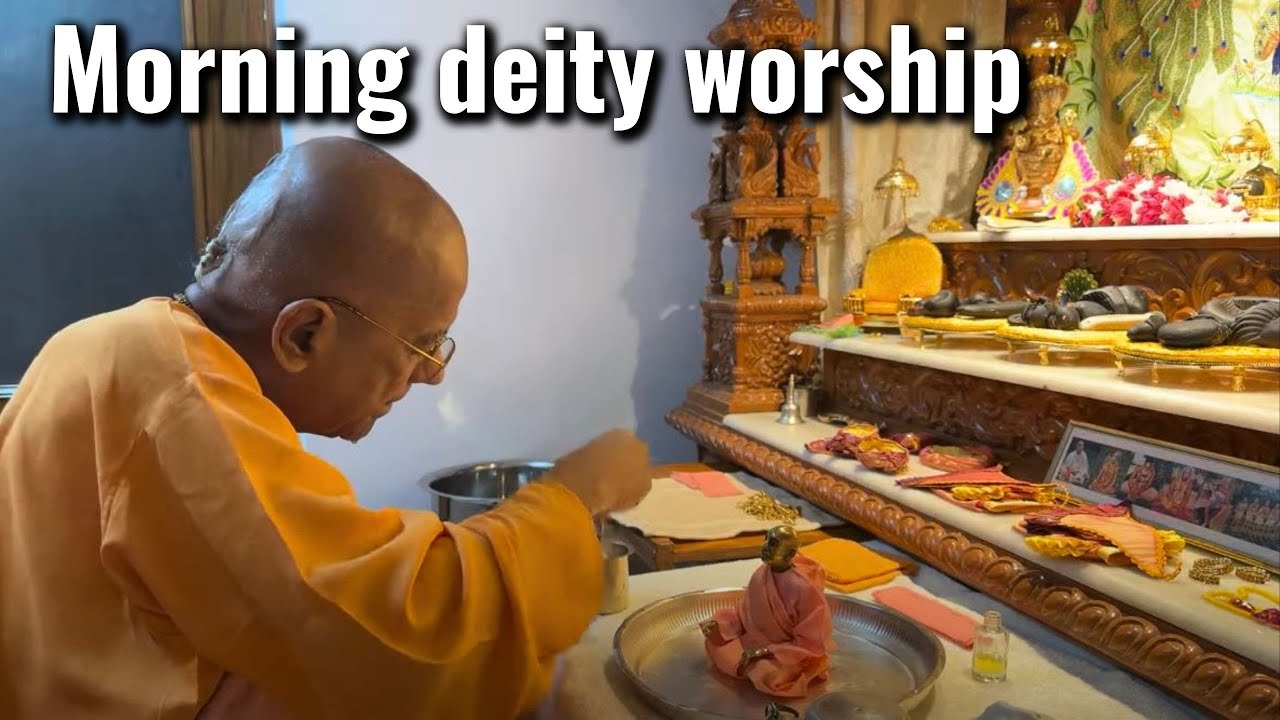
The video presents a devotional lecture that begins with a Sanskrit chant and proceeds to a detailed exposition of Chapter 19 (the appearance of Sukadeva Gosvāmī) from the First Canto of the Srimad Bhagavatam. The speaker explains Maharaja Parikshit’s deep remorse after unintentionally offending a powerful brahmana, emphasizing the spiritual importance of repentance, the protection of brahmins and cows, and the centrality of Brahminical culture for a civilized society. The lecture connects these themes to the Varnāśrama‑dharma system, illustrating how a devotee prepares for death and seeks liberation through Krishna consciousness. It highlights the sanctity of the Ganga and Yamuna rivers, describing how their waters are sanctified by Lord Krishna’s lotus feet, and underscores the ultimate goal of attaining the spiritual realm of Goloka Vrindavan rather than material worlds. Throughout, the speaker stresses that true welfare for a state lies in upholding brahmana culture, cow protection, and devotion to Krishna, presenting Maharaja Parikshit as an exemplar of self‑realization and detachment.
Chapters
Romance, compassion, compassion. Mandegarashi, charity, love. Shibi graha, dana, dana. Shingaritan, wonder, wonder. Marjanaardo, eukasibatas. Jani anjata pi, vande guru ashi, chedana revinna, chaturvidha ashi, bhagavan prasada, sadhvanatripta, haribhakta sana, vedpeyvatriti. Namaste, Naresen, hiya. Yugaleru peraashi. Eini ve danataraa. Sakira no gaataaro. Tevadi kara diee. Kara oniiyedaaashi. Brahman Hriday Ka Neecha, Dhani Dhani Prana Shanti. Pradakshina Pade Pade, Yahaani Ka Neecha Paapali. Brahman Hriday Ka Neecha, Dhani Dhani Prana Shanti. Chare Nam Rebindam Sakshatari Peinam Samastha Shastre Uktasthatabhavate Vasadi Kintu Pravorya Priyavatasya Bandhe Gurashi Chare Nam Rebindam Yes, sir. Prasad. Prasad. Yes, sir. Prasad.
First Canto, last chapter. Chapter 19. The Appearance of Sukadeva Gosvāmī. Translation: Śrī Śrīla Gosvāmī said, while returning home, the king Maharāja Parīkṣit felt that the act he had committed against the faultless and powerful brahmana was heinous and uncivilized. Consequently, he was distressed. Purpose: The pious king regretted his accidental improper treatment of the powerful brahmana who was faultless. Such repentance is natural for a good man like the king, and such repentance delivers a devotee from all kinds of sins accidentally committed. The devotees are naturally faultless. Accidental sins committed by a devotee are sincerely regretted, and by the grace of the Lord, all sins unwillingly committed by a devotee are burnt in the fire of repentance. Text 2. Translation: King Parīkṣit thought, due to my neglecting the injunctions of the Supreme Lord, I must certainly expect some difficulty to overcome me in the near future. I now desire without reservation that the calamity come now, for in this way I may be freed of the sinful action and not commit such an offense again. But the Supreme Lord enjoins that brahmanas and cows must be given all protection. The Lord is Himself very much inclined to do good to brahmanas and cows. Go brahman hitaicha. Maharaja Pariksit knew all this, and thus he concluded that his insulting a powerful brahmana was certainly to be punished by the law of the Lord, and he was expelled expecting something very difficult in the very near future. He therefore desired the imminent calamity to fall on him and not on his family members. A man's personal misconduct affects all his family members. Therefore, Maharaj Parikshit desired that the calamity to fall on him alone. By suffering personally, he would be restrained from future sins, and at the same time, the sin which he had committed would be counteracted so that his descendants would not suffer. That is the way a responsible devotee thinks. The family members of a devotee also share the effects of a devotee's service unto the Lord. Maharaja Prahlad saved his demon father by his personal devotional service. A devotee son in the family is the greatest boon or blessings of the Lord. Text 3. I am uncivilized and sinful due to my neglect of Brahminical culture, God consciousness, and cow protection. Therefore, I wish that my kingdom, strength, and riches burn up immediately by the fire of the Brahmanaj wrath, so that in the future I may not be guided by such inauspicious attitudes. Perfect progressive human civilization is based on Brahminical culture, God consciousness, and protection of cows all economic development of the state by trade, commerce, agriculture, and industries must be fully utilized in relation to the above principles. Otherwise, all so-called economic development becomes a source of degradation. Cow protection means feeding the Brahminical culture, which leads to towards God consciousness, and thus perfection of human civilization is achieved. The age of Kali aims at killing the higher principle of life, and although Maharaj Parikshit strongly recited the domination of the personality of Kali within the world, the influence of the age of Kali came at the opportune moment, and even a strong king like Maharaj Parikshit was induced to disregard the Brahminical culture due to a slight provocation of hunger and thirst. Maharaj Parikshit lamented the accidental incident and he desired that all his kingdom, strength, and accumulation of wealth would be burned up for not being engaged in brahminical culture, etc. Where wealth and strength are not engaged in the advancement of brahminical culture, God consciousness and cow protection, the state and home are surely doomed by Providence. If we want peace and prosperity in the world, we should take lesson from this verse. Every state and every home must endeavor to advance the cause of Brahminical culture for self-purification, God consciousness for self-realization, and cow protection for getting sufficient milk and the best food to continue a perfect civilization. Text 4 translation: While the king was thus repenting, he received news of his imminent death, which would be due to the bite of snake bird occasioned by the curse spoken by the Sage son, the king accepted this as good news, for it would be the cause of his indifference towards worldly things. Real happiness is achieved by spiritual existence or by cessation of the repetition of birth and death. One can stop the repetition of birth and death only by going back to Godhead. In the material world, even by attaining the topmost planet, Brahmaloka, one cannot get rid of, of the conditions of repeated birth and death. But still we do not accept the path of attaining perfection. The path of perfection frees one from all material attachments, and thus one becomes fit to enter into the spiritual kingdom. Therefore, those who are materially poverty-stricken are better candidates than those who are materially prosperous. Maharaj Pariksit was a great devotee of the Lord and a bona fide candidate for entering into the kingdom of God. But even though he was so rich, material asset as the emperor of the world were setbacks to perfect attainment of his rightful status as one of the associates of the Lord in the spiritual sky. As a devotee of the Lord, he could understand that the cursing of the brahmana boy, although unwise, was a blessing upon him. Being the cause of detachment from worldly affairs, both political and social, Samikāmūnī also, after regretting the incident, conveyed the news to the king as a matter of duty so that the king would be able to prepare himself to go back to Godhead. Samikāmūnī sent news to the king that Foolish Sringi, his son, although a powerful Brahmana boy, unfortunately had misused his spiritual power by cursing the king unlawfully. The incident of the king garlanding the muni was not sufficient cause for being cursed to death, but since there was no way to attract the curse. The king was informed to prepare for death within a week. Both Samikamuni and the king were self-realized souls. Samikamuni was a mystic and Maharaj Parikshit was a devotee. Therefore, there was no difference between them in self-realization. Neither of them was afraid of meeting death Maharaja Pariksit could have gone to the muni to beg his pardon, but the news of imminent death was conveyed to the king with so much regret by the muni that the king did not want to shame the muni further by his presence there. He decided to prepare himself for his imminent death and find out the way to go back to Godhead. The life of human being is a chance to prepare oneself to go back to Godhead or to get rid of the material existence, the repetition of birth and death. Thus, in the system of Varnāśrama-dharma, every man and woman is trained for this purpose. In other words, the system of Varnāśrama-dharma is known also as Sanatana-dharma. Or the eternal occupation. The system of Varnāsāmdharma prepares a man for going back to Godhead, and thus a householder is ordered to go to the forest as vanaprastha to acquire complete knowledge and then to take sannyāsa prior to his inevitable death. Parikshit Maharaj was fortunate to get a 7-day notice to meet his inevitable death, but for the common man there is no definite notice, although death is inevitable for all. Foolish men forget this sure fact of death and neglect the duty of preparing themselves for going back to Godhead. They spoil their lives in animal propensities to eat, drink, be merry, and enjoy. Such an irresponsible life is adopted by the people in the age of Kali because of a sinful desire to condemn brahminical culture, God consciousness, and cow protection for which the state is responsible. The state must employ revenue to advance these three items and thus educate the populace to prepare for death. The state which does so is the real welfare state. The state of India should better follow the examples of Maharaj Parikshit, the ideal executive head, than to imitate other materialistic state which had no idea of the kingdom of Godhead, the ultimate goal of human life. Detonation of the ideals of Indian civilization has brought about the deterioration of civic life not only in India but also abroad. Maharaj Parikshit sat down firmly on the banks of the Ganga to concentrate his mind in Krishna consciousness, rejecting all other practices of self-realization because transcendental loving service to Krishna is the greatest achievement, superseding all other methods. Perfect. For a devotee like Maharaj Parīkṣit, None of the material planets, even the topmost Brahmaloka, is as desirable as Goloka Vrindavan, the abode of Lord Kṛṣṇa, the primeval Lord and original personality of Godhead. This earth is one of the innumerable material planets within the universe, and there are innumerable universes also within the compass of the Mahat-Tattva. The devotees are told by the Lord and His representatives, the spiritual masters or ācāryas, that not one of the planets within all the innumerable universes is suitable for the residential purpose of a devotee. The devotee always desires to go back, home back to Godhead, just to become one of the associates of the Lord in the capacity of servitor, friend, parent, or conjugal lover of the Lord, either in one of the innumerable vakunta planets or in Goloka Vrindavan, the planet of Lord Sri Krishna. All these planets are eternally situated in the spiritual sky. The Paravyoma, which is on the other side of casual causal ocean within the Mahatattva. Maharaj Pariksit was already aware of all this information due to his accumulated piety and birth in a high family of devotees, Vaishnavas, and thus he was not at all interested in the material planets. Modern scientists are very eager to reach the moon by material arrangements, but they cannot conceive of the highest planet of this universe. But a devotee like Maharaj Parikshit does not care of— care of— for the moon or for the matter, any of the material planets. So when he was Assured of his death on a fixed date, he became more determined in the transcendental loving service of the Lord Krishna by complete fasting on the bank of the transcendental river Yamuna, which flows down by the capital of Hastinapur in Delhi state. Both the Ganga and the Yamuna are amartya, transcendental rivers, and the Yamuna is still more sanctified for the following reasons. The river Ganga, Ganga, by which the king said to fall fast, carries the most auspicious water, which is mixed with the dust of the lotus feet of the Lord and tulsi leaves. Therefore, that water sanctifies the three worlds inside and outside and even sanctifies Lord Shiva and other demigods. Consequently, everyone who is destined to die must take shelter of this river. Perfect. Maharaj Pariksit, just after receiving the news of his death, within 7 days at once retired from family life and shifted himself to the scared bank of the Yamuna River. Generally, it is said that the king took shelter— the king took shelter on the bank of the Ganges, but according to Silaji Goswami, the the king took shelter on the bank of the Yamuna. Srila Jiva Gosvami's statement appears to be more accurate because of the geographical situation. Maharaja Pariksit resided in his capital Hastinapur, situated near present-day Delhi, and the river Yamuna flows down past the city. Naturally, the king would stay took shelter of the river Yamuna because she was flowing past his palace door. And as far as sannyasi is concerned, the river Yamuna is more directly connected with Lord Krishna. Sadhu ji. Hare Krishna. Then the Ganges. The Lord sanctified the river Yamuna from the beginning of His transcendental pastimes in the world while His father Vasudeva was crossing the Yamuna with the baby Lord Krishna for a safe place at Gokul on the other bank of the river from Mathura. The Lord fell down in the river and by the dust of His lotus feet, the river at once became sanctified. It is especially mentioned herein that Maharaj Parikshit took shelter of that particular river which is beautifully flowing, carrying the dust of the lotus feet of Lord Krishna, mixed with tulsi leaves. Lord Krishna's lotus feet are always besmeared with the tulsi leaves, and thus, as soon as His lotus feet contact the water of Ganges and Yamuna, the rivers become at once sanctified. The Lord, however, contacted the river Yamuna more than the Ganges. According to the Worth Quran, as quoted by Srila Jiva Gosvami: There is no difference between the water of the Ganges and the Yamuna, but when the water of the Ganges is sanctified 100 times, it is called that Yamuna. Similarly, it is said in the scriptures that 1,000 names of Vishnu are equal to one name of Rāma, and three names of Lord Rāma are equal to one name of Kṛṣṇa.
Thus the king, the worldly descendant of Pandavas, decided once and for all and sat on the Ganges bank to fast until death and give himself up to the lotus feet of Lord Kṛṣṇa, who alone is able to avoid depression. So freeing himself from all kind of association and attachments, he accepted the vow of a sage. The water of Ganges sanctified all the three worlds, including the gods and the demigods, because it emanates from the lotus feet of the Personality of Godhead, Vishnu. Lord Krishna is the fountainhead of the principle of Vishnu-tattva. And therefore shelter of His lotus feet can deliver one from all sins, including an offense committed by a king onto a brahmana. Maharaj Pariksit therefore decided to meditate upon the lotus feet of Lord Sri Krishna, who is Mukunda, or the giver of liberation to all the descriptions. The bank of the Ganges or the Yamuna gives one a chance to remember the Lord continuously. Mārāt-prasāṅkṣatvri freed himself from all the sort of material associations and meditated upon the lotus feet of Lord Kṛṣṇa. And that is the way of liberation. To be free from all material association means to cease completely from committing any form of sin. To meditate upon the lotus feet of Lord means to become free from the effects of all previous sins. The conditions of the material world are so made that one has to commit sins willingly or unwillingly.
More from PRASAD

Rare Pastimes & Timeless Lessons of Guru Mahārāja | Stories Every Disciple Should Hear

ISKCON Legends- pure devotees meet-HH Jayapataka Swami, HH Gopal Krishna Goswami, HH Radhanath Swami



Jagannātha Ratha-yātrā Through Śrīla Prabhupāda's Mercy | 29 April 2006 | Nairobi, Kenya

Lord Jagannātha's Appearance Pastime | 21.07.2019 | ISKCON Calgary | Śrīla Gopāla Kṛṣṇa Gosvāmī

The Ācārya Teaches by His Own ExampleGuṇḍicā Mārjana by Guru Mahārāja #shorts

Guṇḍicā Mārjana – Lord Jagannātha's Pastime | 21.7.2019 | ISKCON Calgary |Śrīla Gopāla Kṛṣṇa Gosvāmī

H.H. Gopāla Kṛṣṇa Gosvāmī Mahārāja - Exemplary Sādhana and Deity Worship # shorts

भगवान की कृपा कैसे प्राप्त होगी ? | 11 Jan 2014 | Punjabi Bagh | Srila Gopal Krishna Goswami

Material Education vs Spiritual Education | Srila Gopal Krishna Goswami #shorts