Morning Deity worship,17th June 2023 Live Now | Srila Gopal Krishna Goswami
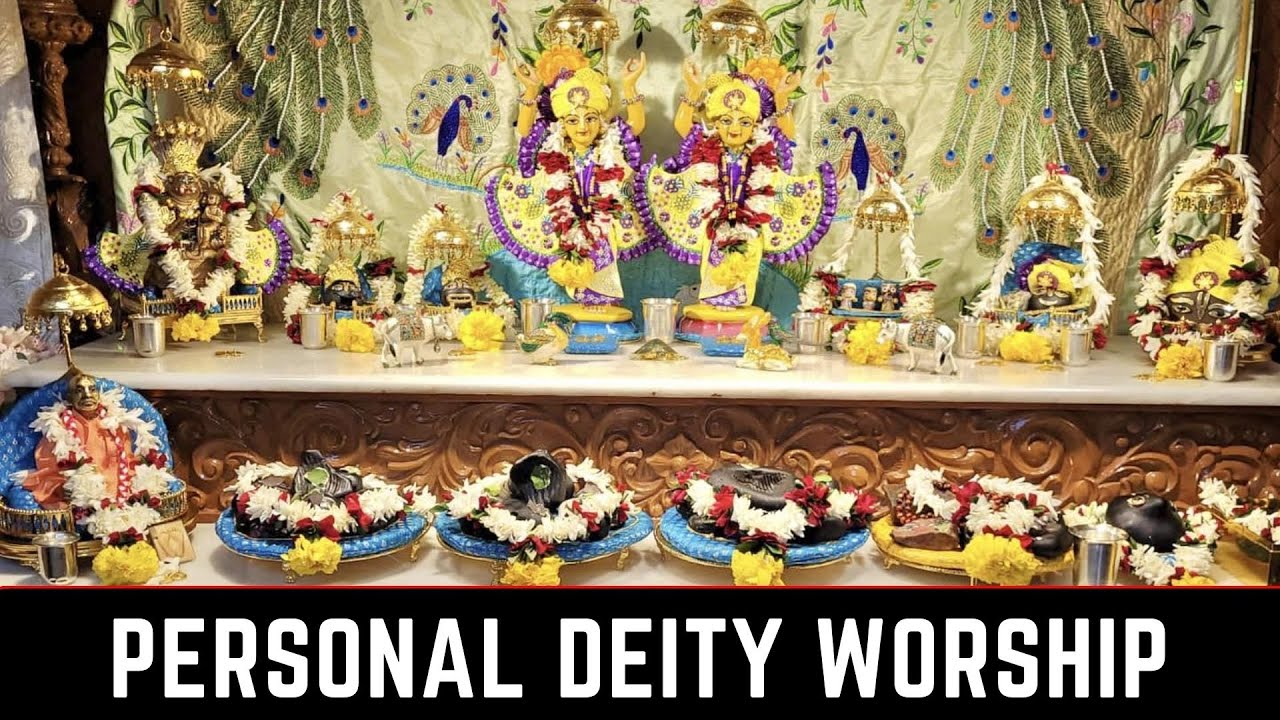
In this devotional lecture Srila Gopal Krishna Goswami reads and expounds upon A.C. Bhaktivedanta Swami Prabhupada’s 1969 talk given on the appearance day of Bhaktivedanta Thakura. He outlines the concept of guru‑parampara (disciplic succession) from Krishna through Brahma, Narada, Vyasa, Madhva, Chaitanya and the modern line that includes Prasad Raval, Keshordas Babuji Maharaj, his own master and his disciples. The speaker stresses that authentic spiritual knowledge must be received from a bona‑fide guru rather than derived by speculation, likening the guru to a lawyer or physician whose authority is essential. He illustrates this principle with the life of Bhaktivedanta Thakura— a householder, magistrate, prolific author, and social reformer— showing that spiritual authority is independent of caste, renunciation status, or occupation. Practical guidance on minimizing sleep, food, and sensual activities is presented as a means to focus on Krishna consciousness. A vivid anecdote recounts Thakura’s investigation of a fraudulent pseudo‑yogi in Jagannath Puri, his decisive legal action, and the yogi’s eventual death, underscoring the guru’s duty to protect devotees. The lecture critiques modern “animal civilization” limited to eating, sleeping, mating and defending, arguing that humanity’s purpose is to know God, the soul, and the material world, which requires guidance from the acharya. Scriptural citations (e.g., Sādhalas leśāno, tad vijñānaḥ, Ādā‑guru‑āśraya) are used to reinforce the necessity of guru‑upāsana. The talk concludes with a call to worship Bhaktivedanta Thakura, celebrate his contributions, and seek his blessings for progress in Krishna consciousness.
Chapters
I am reading through Prabhupada's lecture which he gave on the appearance day of Bhaktivedanta Ṭhākura. So today is a very auspicious day, ṭhākura Bhaktivedanta's birthday. He is the picture, here is the picture of Satchidananda Bhaktivedanta. Date, this lecture was given on 23rd September 1969. So today is the very auspicious day, Thakur Bhaktivedanta's birthday. Here is the, here is the picture of Thakur Sachidananda Bhaktivedanta. He was one of the acharyas of the disciplic succession from Krishna. We have got a succession table from Krishna. There are two kinds of, uh, some parampara. One by the seminal father, his son, his son, like that. That is material. And there is one spiritual, disciplic succession. Just like Krishna, Krishna the original father, Supreme Personality of Godhead, he spoke the Vedic knowledge to Brahma. Lord Brahma, he spoke to Narada. Narada spoke to Vyāsa. Vyāsa spoke to Madhvācārya. So in this disciplic succession, Lord Caitanya, from Lord Caitanya, the six Gosvāmīs, and similarly coming down bhakti, we know Prasad RAVAL. Then God Keshordas Babuji Maharaj, then my spiritual master, then we are next generation, my disciples. So there is a disciplic succession, and the acharyas, the authorities— our process of knowledge is very simple. We take it from the authority. We don't speculate. Speculation will not help us to come to the real knowledge. Just like when we are in difficulty In legal implication, we go to some authority, lawyer. When we are diseased, we go to a physician, the authority. There is no use of speculation. Suppose I am in difficulty in some legal implication, I simply speculate, I shall be free in this way and that way. That will not help. We have got to the lawyer who know things. And he gives us instructions that you do, you do not do this, then you'll be free. Similarly, when we are diseased, if I speculate at home that my disease will be cured in this way and that way, no, that is useless. You go to an authorized physician and he will give you a nice prescription and you'll be cured. That is the process of knowledge. But in the modern age, People think that I am free, I am independent, and I can make my own solution. That is raskritam. That's not good. So Arjuna, when he was walking, he was talking with Krishna as friend, but when he saw that there was no solution talking like this, he surrendered to Krishna. He said, myself I surrender unto you as your disciple. Prapannam means surrender. So that is the Vedic injunction, that if you want to know transcendental knowledge or science— transcendental means beyond the scope of your direct perception. So spiritual master is beyond the scope of our sense perception, beyond the scope. Just like when a soul, a a spiritual spark only leaves this body, you cannot see. Therefore, atheistic class of men, they speculate there may be a soul, there may not be a soul, or the bodily function was going like this, now it stopped. The blood corpuscles now cease, it is no more red. Therefore, the atheistic class of men, they keep on speculating. There may be soul, there may not be soul. The bodily function was going like this, now it stopped. The blood corpuscles now cease. It is no more red, it is white. Therefore, life— there are speculations. This is not actual knowledge. Actual knowledge you get from the authority. Krishna. He says, just like the soul is passing through the different stages, means the body, in this body there is Dehi. Dehi means who is the owner of this body. This is, that is soul that is passing through childhood, boyhood, Babyhood, youthhood, old age, everyone. You can perceive that you were a child, you were a baby, you were a boy. Now you are young or old man, so you are there. So as you are passing through different types of bodies, similarly when you give up this body, you accept another body. What is the difficulty? There is no question of becoming astonished how transmigration of the soul takes place. The vivid example is here. Simply you require little intelligence. That intelligence is developed through the instructions of Acharya. Therefore, Vedic injunction is not to acquire knowledge by speculation. That is useless. Sādhalas leśāno 'angrata evahīna chañya ekopicheram vijñvam. Picheram vijñvam. Picheram means for thousands of years you can speculate, you cannot understand what is God. That is not possible. But if you receive knowledge from the devotee, he can deliver you. Therefore, Vedic injunction is that tad vijñāna In order to understand Tattvik Jnana, Jnana means science. If you want to know the transcendental science, then you must approach a Guru. Tattvik Jnana Artham. In order to— if you are at all interested to understand the spiritual science, Tattvik Jnana Artham, sa Guru meva bivacche. You must approach a Guru. Guru means this disciplic succession, as I have explained. So Bhaktivedanta Thakur is an ideal Guru. He was not a sannyasi, he was grihastha, householder, living with family, wife, children. Still he was guru. So anyone can become guru. Not that a sannyasi can become guru. A householder also can become guru, provided he knows the science. Chaitanya Mahaprabhu, when he was talking with Ramananda Rai, Chaitanya Mahaprabhu was a sannyasi, very highly born in Brahmin family, very learned scholar. So he was talking with Ramanand Rai, a grahashta, governor of Madras, and he was questioning and Ramanand Rai was answering. That means he was taking the part of guru and Chaitanya Mahaprabhu was taking the part of a disciple. So he was hesitating, Ramanand Rai, he thought himself that I am a grahashta, I am not even a Brahmana. 'Besides that, I am dealing in material affairs, I am a governor in politics, and Chaitanya Mahāprabhu is a sannyāsi born of a high-class Brahmin family, so it does not look well that I shall teach him.' So he was hesitating. Chaitanya Mahāprabhu said, 'Oh, why are you hesitating?' Ki bābhi prakīva-nāsi kenenāya jai Kṛṣṇa tatvaveta sei guru. He said, don't hesitate. Either one may become a Brahman or one may become a Shudra. Ki ba vipra ki ba shudra. Vipra means Brahman and Shudra. Shudra is the fourth class human being. Brahman is the first grade. So ki ba vipra ki ba shudra. He may be a first grade human being or the lowest grade human being, or he may become a sannyasi or a grahashta. It does not matter. Anyone who knows the science of Krishna, he can become a guru. This is the verdict, because spiritual science does not belong to the bodily platform. It is on the spiritual platform. It is very nice. Just like when you go to a lawyer, to an engineer, or to physician, you do not inquire whether he is a Brahmana or Shudra. Simply you have to know whether he is a lawyer, that's all. Whether he is physician actually, if he knows the medical science, he may be a Brahmana, he may be a Shudra, he may be a Sannyasi, he may be a householder, it doesn't matter. Your business is with a physician, with a lawyer. Similarly, your business is to understand Krishna. So anyone who knows Krishna perfectly, you have to go there. Tat vijñānātamsa gurum evā vigacchet, It is the Vedic injunction. It is not that you have to approach a sannyasi or a grahasta or an Indian or an American. No, guru. And guru means who knows the science of Krishna. So this Bhaktivedanta Thakur was grahasta, very responsible officer, magistrate, and he was so exalted that he would come from his office generally at 5 o'clock. Then take up his supper and immediately go to bed. Immediately, say at 7 o'clock in the evening, he goes to bed and he wakes up at 12 o'clock. So suppose he goes to bed at 7 o'clock in the evening and wakes up at 12 o'clock at night, it is sufficient sleep, 5 hours. One should not sleep more than 5 to 6 hours, minimize as far as possible. The Goswami is used to sleep not more than 1.5 hours or 2 hours. Sleeping is not very important thing. Even big politicians, they used to sleep for 2 hours. So especially in spiritual line, they should minimize as far as possible eating, sleeping, mating, and defending. Minimize. Gradually it comes to death. Raghunatha Goswami, he was eating only a piece of butter every alternate days, not daily. So this Bhaktivedanta Thakura, regularly he was coming from his office and after taking his supper, immediately he goes to bed and wakes up at 12 o'clock. And he used to write books. He wrote, he left behind him about 100 books. And he excavated the birthplace of Lord Chaitanya or organized how to develop that birth site, Mayapur. He made many businesses. He used to go to preach about Chaitanya's philosophy. He used to sell books to foreign countries. In 1896, he attempted to sell Life and Precepts of Chaitanya in the McGill University in Montreal. So he was a busy acharaya. So one has to adjust things. Not that because I am grahashta, householder, I cannot become a preacher. It is the business. It is the business of the sannyasi or brahmachari. It is the business of everyone. The whole world is suffering for want of knowledge. The present civilization is animal civilization. They do not know anything beyond eating, sleeping, mating, and defending. That's all. This is animal civilization. Animal does not No, beyond these 4 principles of eating, sleeping, mating, and defending, that's all. No, human life is meant for something else. What I am, what is God, what is my relationship with God, what is the material world, why I am here, why I have to go next. So many things one has to learn. Athato brahma jijyasya. This is human life. Not that eat, sleep, and have sex and die someday like cats and dogs. Therefore, there is a need of ācāryas, teachers, for propagating spiritual knowledge, Kṛṣṇa consciousness, bhakti. Although he was a grihastha, householder, a government officer, magistrate, but he was an ācārya. So from his dealing From his life we should know how one can become a preacher in any stage of life. It doesn't matter what he is. There was one incidence, very interesting, when he was a magistrate in Jagannath Puri. The system is, Jagannath Temple is a very big establishment. In the temple, 56 times daily bhoga is offered, and you will find in the temple always at least 500 to 1000 people gather and they come from outside and prasad is ready. If you go and ask in the Jagannath Temple, we are 100 men come from outside, we want prasad. Yes, immediately ready. So it is a huge temple. This is one temple, but there are many other thousands of temples in India where prasad is distributed. Now is minimized by our present government. They think that it is unnecessary expenditure. They are minimizing, but not unnecessary expenditure. They do not understand. Formerly in India, there was no necessity of hotel. Anyone goes anywhere, even in a village, he goes to a temple, Prasad is ready. There is no need of going to a hotel. You pay or you don't pay. If you say that I want little prasad, yes, pay. That is the system still. There is the Lax Dwara Temple in Rajasthan. You pay 2 annas only. 2 annas means 1 cent. You get some twist prasad for 2 men. All very nice prasad still. So prasad distribution in temple is long-standing usage. So Bhakti Vinod Thakur— the Jagannath Temple is managed by a body, and it is the custom that the local magistrate of the district, he becomes the president or manager. So Bhakti Vinod Thakur was the manager in that sense because he was magistrate. The managing committee was being presided by him. So there was a complaint in Odisha. This Jagannath Temple is situated in Odisha, Utkal. Utkal, this state was originally belonging to Dhruv Maharaj. His name was Utkal, Maharaj Utkal. Anyway, so this Utkal, there was a pseudo yogi. He declared himself that, just like you'll find nowadays also, there are so many rascals declaring that I am an incarnation of God, and they know some mystic power. Play some jugglery and foolish people take them. Oh, he's caught. So, so there people, there appeared one, one like such pseudo, pseudo god Vishnu in a village of Odisha, and he was dancing rasadans, and foolish people were sending their daughters and wives to dance with him. You see, there were, there were so many Not only that, people are so foolish, they do not know. They wanted to become— they want to be cheated, and their cheaters come. He declared that I am God, I am Vishnu. So there were, there were sane men also, they took objection. What is this nonsense? This man is dancing with ladies and, and gentlemen, girls. So they fight a complained. At that time it was British rule. They complained to the governor or the commissioner, very high officer. The commissioner knew that Dr. Vinod Thakur— his name was Kedar Nath Datta, so Datta, Kedar Nath Datta, his householder name. So the commissioner of the division, he knew that Kedar Nath Datta is a religious man, and he's magistrate in charge. So he handed over the case to inquiry. What is the— what is this complaint? You please inquire and do the needful. So he was a pure devotee and he understood that this rascal is a bogus man cheating people. I must inquire. So he went to the village in plain dress with some constables, police constables. They were also in plain dress. And as soon as he approached that rascal yogi, he said, "Oh, you are Kedarnath Das, you are so very nice, you are. I shall make you the king of India. Please don't try to bother me." Because he could know that he has come to inquire about my Rasalila. So Bhaktivedanta Thakur first of all said, "Sir, you are such a great yogi, why you are in this village? Why don't you go to Jagannath Puri. There's a temple and Lord Jagannath is there. Better you go there and see the Lord and be happy. Why are— why you are in this village? Oh, Jagannath? Ah, that is made of wood. I am personally the Supreme Lord. That is made of wood. Oh, then Bhakti— no, he was a devotee. He became fire. He was insulting. Ācārya śrīla Dīr-guruṣu nāramāte. According to śāstra, if somebody thinks, just like here is Deity, if somebody thinks, oh, it is made of stone, it is stone to the eyes of the non-devotee, but it is personally Supreme Personality of Godhead to the devotees. It requires the eyes to see. So devotees see in a different angle of vision, just like Chaitanya Mahāprabhu When he entered Jagannātha Temple, immediately he fainted. Oh, here is my Lord! And the non-devotee is seeing it is wood, a lump of wood. Therefore, to the non-devotee, He remains always a wood, but to the devotee He speaks. That is the difference. Premañjana-cchhara-ta bhakti-vilochanena. If God is everything, why wood? Through wood and stone, God cannot manifest. If God is everything, according to Mayavad philosophy, that's a fact. God omnipotent, he can express himself even through wood or wood and stone. That is God's omnipotency. That is called omnipotency. Not that God is unable to express himself through wood and stone. Then how he is omnipotent? Omnipotent means his potency can be expressed expressed through anything, because anything, everything is an expansion of God's energy. Varaasa brahma shaktes tatheta akalam jan. The whole world is manifestation of different energies of God. Therefore, just like through the energy of electricity, the electric powerhouse, although far, far away from this place, was expressing— there is electricity through this glass through these wires, the power can be expressed. There is a process. So Bhaktivedanta Thakur became very much— because a devotee cannot tolerate blaspheming another devotee or God. So as soon as he said, 'Why shall I go to Jagannath Puri to see the wooden Jagannath? I am personally Vishnu,' Bhaktivedanta Thakur immediately ordered his constables, 'Arrest him, arrest this Rasputin.' So he was arrested, and when he was arrested, he had some yogic mystic powers. All the constables, Bhaktinath Thakur and his family members became affected with high fever, 105-degree fever. So when he came back, his wife became very much disturbed that, 'You arrested Vishnu and we are all going to die. We have now high fever.' Bhakti Vinod Thakur replied, yes, let us die, but this rascal must be punished. This is the view of pure devotee. So he was put into the custody and there was a date fixed for his trial. And all these days, Bhakti Vinod Thakur himself and his wife especially, they were suffering from high fever. Maybe that yogi was planning to kill the whole family, but it was going on fever. So on the trial day, Bhaktivedanta Thakur, Kedarnath Datta, when he came to the bench, then man was presented, the so-called yogi. He had big, big hair. So Bhaktivedanta Thakur ordered that bring one barber and cut his hair. So no barber dared. The barber thought, oh, he is Vishnu. If I offend, as he is suffering from fever, so I shall also die. So Bhakti Vinod Thakur ordered that give me the scissor, I'll cut. So he cut his hair and ordered him to put into jail for 6 months. And in the jail, that Vishnu incarnation managed to take some poison and he died. So this is one of the incidents. There are many incidences. He was very strong man. He punished many pandas in the tirthas who exploit visitors. This is the position of devotees. In spite of his becoming a responsible magistrate, a householder, still he was Acharya. So we have to follow the Acharyas. If we at all, if we are at all interested in spiritual science, then we must follow the Vedic instruction. Tadvikyanartham sagurum evabhigacchet. We must approach. You cannot have spiritual life simply by— you must go to, go to the spiritual master. In the Bhagavad Gita, therefore, it is recommended, not only worshiping the Lord but also the acharya. Krishna. One should seek favor of both of them. Not that I am now seeking favor of Krishna, what is the use of guru or acharya? No, you cannot overlap acharya and go to Krishna. That is not possible. Krishna will not accept you. Just like if you want to see big man, you should go through his secretary, through his orderly doorkeeper. Similarly, our process is acharya pasu. Go through the Ācārya. That is the injunction of the Vedas. If you want to enter into the spiritual world, you cannot get through simply by arguments, because there is no limit of argument. I place my argument in one way, another man who is better arguer, he places this argument in another way. So if you simply go on arguing, it is not possible. It will never help you. If you think that I shall read scriptures and I shall understand God, no, that is not possible. Scriptures are also different because scriptures are made according to time, circumstances, people. Just like Bible. Bible, Lord Jesus Christ preached in the desert, Jerusalem. Oh, what it is, people who were not so advanced, Therefore, his injunction, first injunction was, 'Thou shall not kill.' That means they were very much engaged in killing affairs. Otherwise, why is this instruction? And actually, it so happened that they killed Jesus Christ. So that society was not very enlightened society. So a scripture for a society which is not very enlightened and a scripture for a society which is very enlightened must be different. So just like a dictionary, for the schoolboy a pocket dictionary and for a college student international big dictionary. Both of them are dictionaries, but the small dictionary is not equal to the big dictionary because it is different, made for different classes of men. So scriptures are made according to different classes of men. There are three classes of men: first class, second class, and third class. The third-class men cannot understand the philosophy and scriptures, scriptural injunctions of the high-class men. That is not possible. Higher mathematics cannot be understood by the small schoolboys who are simply trying to understand 2 2 4. But 2 2 4 is equally good to the higher mathematics students. But still, higher mathematics and the lower mathematics are different. Therefore it is said, 'Shrutayo vidhinna'— the scriptures are different. So if you simply try to understand what is God by reading scriptures, you cannot achieve. You must approach a Guru. Just like a medical book, it cannot— it can be available in the market. If you purchase one medical book and study and you become doctor, that is not possible. You must hear the medical book from a medical man. In the college, medical college, then you will be qualified. And if you say, sir, I have read all the medical books, recognize me as a medical practitioner— no, that will not help. So scriptures are different arguments, that is not also not helpful. One man may argue better than me. Then philosophy, the philosophy, it is said, naso muner yasth madam hibinna One philosopher is different, is differing from another philosopher. Just now, today, Shankaracharya has purchased one book about different philosophers, so that you also cannot ascertain what is truth. Therefore, Shastri says, dharmasthitatvam nihitam gohayam, the truth is very confidential. So if you want to know that truth, mahajano yena katha sapanta, You should have to follow the great Ācāryas, then you will understand. Therefore, Ācārya upāsana is essential. Ācārya upāsana is very essential. In all the Vedic Shāstras, that injunction is that tad vijñānaḥ sa guruṁ eva vigacchayḥ śo 'tryam brahmanishtam tasmaḥ guruḥ bandheta jijñāsushrutamaḥ. Anyone who is inquisitive to understand here, higher truth, he must surrender to Guru. Tasmād guru-prapadyeta ajikyaso śrīrtama. One who is inquisitive, who is now inquiring about transcendental subject matter, tad vidi-pranipātena paripraśnena sevā. So all the śāstras say, in our Vaiṣṇava śāstras also, Rūpa Gosvāmī says, Ādā-guru-āśraya. At the first beginning, you must take shelter of a one of Vaikuntha. So this Bhaktiratha Thakur's birthday we should adore, we should worship, because in the modern age he reintroduced the disciplic succession from Chaitanya Mahaprabhu. 500— From Chaitanya Mahaprabhu, 500 years ago, Chaitanya Mahaprabhu taught this philosophy, but within 200 years because this material world is so made that whatever you introduce, in due course of time it will deteriorate. You make a nice house, but after 100 years, 200 years, or nowadays even after 50 years, it becomes dilapidated. That is nature's law, Kaala. Time will destroy everything. Now British Empire, such a big vast empire, now it is finished. The kala, the time will make everything finished. That is material, anything material. It has given, it has birth, it has growth, it has got some offening, dwindling, then finished. That is the way of material. So we are interested in spiritual subject matter. Therefore the process is Adau Guru Ashrayam. One has to accept a purified spiritual master That is our purpose. Without accepting a bona fide spiritual master, we cannot make any progress. It is important. So Bhaktivedanta Mahāprabhu happens to be Ācārya, one of the Ācāryas, and he has left behind many books. Jātānaṣikṣāṁbe, Jai Rudraḥ. These are very important books. They are in Bengali. He has prepared many, many books of songs. The song, 'Aye Naam Gaae Gaura Chandar Mother's Story,' that is Bhaktivedanta Thakur's song. So we are trying to present Bhaktivedanta Thakur's books also in English translation. Gradually you will get it. So our adoration, our worship to Bhaktivedanta Thakur today, because he may bless us to make peacefully progress in Kṛṣṇa consciousness. Ācārya upāsaḥ. Simply by the rapid progress. Yedey śuddha-lavam dṛṇdala-vātṇaḥ. It means, yastha prasāda bhāgav prasāda, we sing every day, by the mercy of the spiritual master.
More from PRASAD

Rare Pastimes & Timeless Lessons of Guru Mahārāja | Stories Every Disciple Should Hear

ISKCON Legends- pure devotees meet-HH Jayapataka Swami, HH Gopal Krishna Goswami, HH Radhanath Swami



Jagannātha Ratha-yātrā Through Śrīla Prabhupāda's Mercy | 29 April 2006 | Nairobi, Kenya

Lord Jagannātha's Appearance Pastime | 21.07.2019 | ISKCON Calgary | Śrīla Gopāla Kṛṣṇa Gosvāmī

The Ācārya Teaches by His Own ExampleGuṇḍicā Mārjana by Guru Mahārāja #shorts

Guṇḍicā Mārjana – Lord Jagannātha's Pastime | 21.7.2019 | ISKCON Calgary |Śrīla Gopāla Kṛṣṇa Gosvāmī

H.H. Gopāla Kṛṣṇa Gosvāmī Mahārāja - Exemplary Sādhana and Deity Worship # shorts

भगवान की कृपा कैसे प्राप्त होगी ? | 11 Jan 2014 | Punjabi Bagh | Srila Gopal Krishna Goswami

Material Education vs Spiritual Education | Srila Gopal Krishna Goswami #shorts