Morning Deity worship, ISKCON Juhu, 14th June 2023| Live Now | Srila Gopal Krishna Goswami
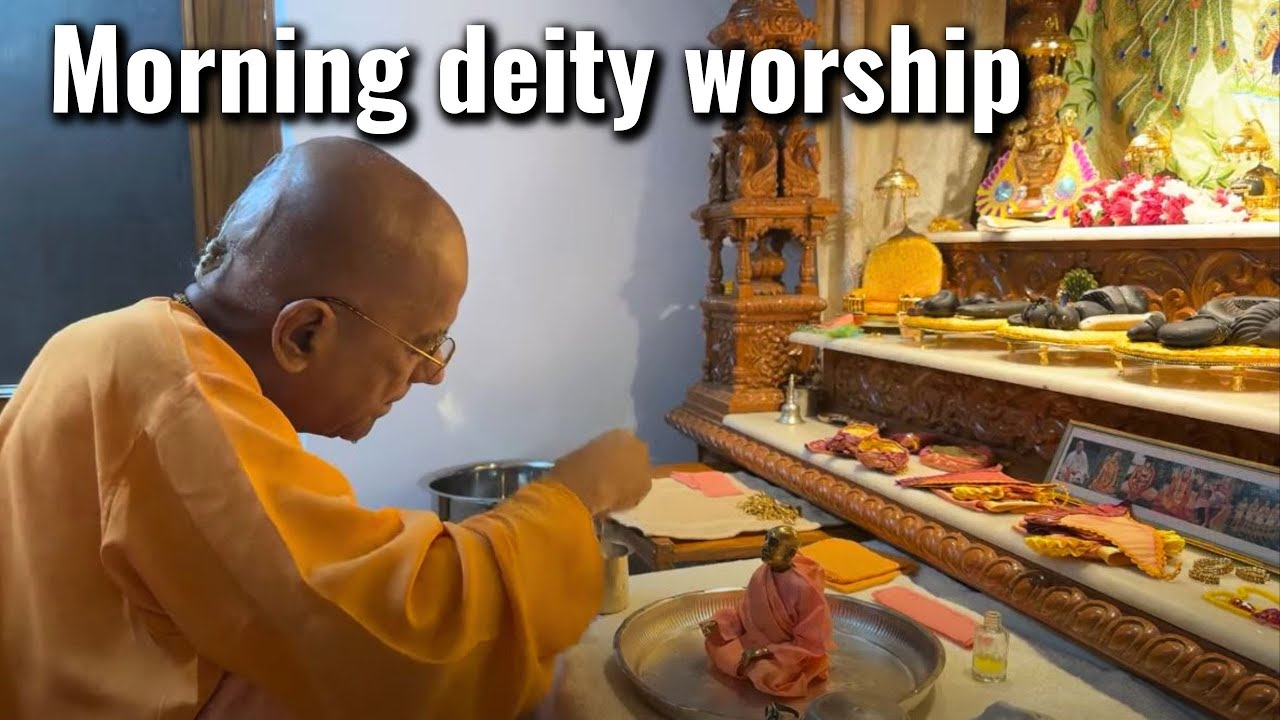
This content was created by PRASAD RAVAL. This content was uploaded by PRASAD RAVAL. This is a YouTube video titled "Morning Deity worship, ISKCON Juhu, 14th June 2023 | Live Now | Srila Gopal Krishna Goswami" (created 2023-06-14). The excerpt is a devotional lecture/recitation and commentary on Vedic scripture (Krishna-lila), primarily recounting the story of Kalyavan and Muchkunda (Mushkunda) with translations and purports from traditional Ācāryas (Śukadeva Gosvāmī, Śrīla Prabhupāda, Vishvanatha Chakravarti, Jīvānanda Gosvāmī, etc.). It contains theological reflections on renunciation, devotion, the nature of the Lord (Krishna/Narayana), and the human condition, and also includes a brief contemporary illustrative remark by Prasad Raval about the fate of the body in different societies. The speaker/teacher is Srila Gopal Krishna Goswami (ISKCON Juhu presentation), with scriptural voices quoted throughout and occasional inserted commentary.
Chapters
Bhagavan and Lord Krishna. After placing his family members safely within the Dwarka fortress, Sri Krishna went out of Mathura. He appeared like the rising moon. Kalyavan saw that Krishna's brilliantly effulgent body matched Narada's description of the Lord, and thus the Yavan knew he was the Personality of Godhead. Seeing that the Lord carried no weapons, Kalyavan put his own weapons aside and ran towards him from behind, wanting to fight with him. Sri Krishna ran from the yavan's sting just barely beyond Kalyavan's grasp at every step, and eventually leading him a long distance towards a mountain cave. As Kalyavan ran, he hurled insults at the Lord, but he could not grasp him, since his stock of impious karma was not yet depleted. Śrī Kṛṣṇa entered the cave, whereupon Kālevarṇa followed after him and saw a man lying on the ground. Taking him for Śrī Kṛṣṇa, Kālevarṇa kicked him. The man had been sleeping for a very long time, and now, having been violently awakened, he looked around angrily in all directions and saw Kalevan. The man started harshly at him, igniting a fire in Kalevan's body and in a moment burning him to ashes. This extraordinary person was a son of Mandhata named Mushkunda. He was devoted to Brahminical culture and always true to his vow. Previously, he had spent many long years helping to protect the demigods from the demons. When the demigods had eventually obtained Kartikeya as their protector, they allowed Muchkunda to retire, offering him any boon other than liberation, which only Lord Vishnu can bestow. Muchkunda had chosen from the demigods the benediction of being covered by sleep, and thus since then he had been lying asleep within the cave. Upon Kalevan's immolation, Sri Krishna showed himself to Mushkunda, who was struck with wonder at seeing Krishna's incomparable beauty. Mushkunda asked Lord Krishna who he was and also explained to the Lord his own identity. Mushkunda said, after growing weary from remaining awake for a long time, I was enjoying my sleep here in the cave. When some stranger disturbed me and suffering the reaction of his sins was burnt to ashes. O Lord, O conqueror of all enemies, it's my great fortune that I now have the vision of your beautiful form. Lord Sri Krishna then told Mushkunda who he was and offered him a boon. The wise Mushkunda, understanding the futility of material life, asked only that he might be allowed to take shelter of Lord Kṛṣṇa's lotus feet. Pleased by this request, the Lord said to Muchkunda, 'My devotees are never enticed by material benedictions offered to them. Only non-devotees, namely yogis and speculative philosophers, are interested in material benedictions, having mundane desires in their hearts. My dear Muchkunda, 'You will have perpetual devotion for Me. Now, always remaining surrendered to Me, go perform penances to eradicate the sinful reactions incurred from killing you had to do in your role as a warrior. In your next life, you will become a first-class Brahman and attain Me.' Thus the Lord Back is straight. No, not much, ma'am. It's okay. Thus the Lord offered Muschkunda his blessings. Text 1 to 6 translation. Śukadeva Gosvāmī said, Kālevan said, the Lord, come out from Mathura like the rising moon. The Lord was most beautiful to behold with his dark blue complexion and yellow silk garment. Upon his chest he bore the mark of Shivatssa, and the Kaustubh gem adorned his neck. His four arms were sturdy and long. He displayed his ever joyful lotus-like face with eyes pink like lotuses, beautifully effulgent cheeks, with a pristine smile and glittering shark-shaped earrings. The barbarian thought, this person must indeed be Vasudeva, since he possesses the characteristics Narada mentioned. He is marked with shivatsa, he has four hands, his eyes are like lotuses, he wears a garland of forest flowers, and he is extremely handsome. He cannot be anyone else. Since he goes on foot and unarmed, I will fight with him without weapons. Resolving thus, he ran after the Lord, who turned his back and ran away. Kalyavan hoped to catch Lord Krishna through great mystic yogis, cannot attain him. Purpose: Although Kalyavan was seeing Lord Krishna with his own eyes, he could not adequately appreciate the beautiful Lord. Thus, instead of worshiping Kṛṣṇa, he attacked Him. Similarly, it is not uncommon for modern men to attack Kṛṣṇa in the name of philosophy, law and order, and even religion. Text 7. Appearing virtually within reach of Kālevalaṇa's hands at every moment, Lord Hārī led the king of the Yāvanas far away to a mountain cave. Text 8. While chasing the Lord, the Yavana cast insults at Him, saying, "You took birth in the Yadu dynasty. It's not proper for You to run away." But still Kaliyavan could not reach Lord Kṛṣṇa because his sinful reactions had not been cleansed away. Text 9. Although insulted in this way, the Supreme Lord entered the mountain cave. Kalevan also entered, and there he saw another man lying asleep. Purpose: The Lord exhibits here his opulence of renunciation. Determined to execute his plan and give his blessings to Muchkunda, the Lord ignored Kalevan's insults and calmly proceeded with his program. Text 10: So after leading me such a long distance, now he is Lying here like some serpent. Thus thinking the sleeping man to be Lord Krishna, he deluded fool kicked him with all his strength. Text 11: The man awoke after a long sleep and slowly opened his eyes. Looking all about, he saw Kalivan standing beside him. Text 12: The awakened man was angry and cast his glance at Kalivan, whose body burst into flames in a single moment. O King Parikshit, Kalevan was burnt into ashes. Purpur. The man who incinerated Kalevan with his glance was named Muchkunda. As he will explain to Lord Krishna, he had fought for a long time on behalf of the demigods, finally taking as his benediction the right to sleep undisturbed. The Harivamsa explains he secured the further benediction of being able to destroy anyone who disturbed his sleep, which Vinod Chakravarti Thakur quotes from the Harivamsa as follows: Again and again, Mushkula said, "O demigods, with eyes blazing with anger, may I incinerate anyone who awakens me from sleep?" Srila Vishvanatha Chakravarti explains that Mushkunda made this rather morbid request to scare Lord Indra, who Mushkunda thought might otherwise wake him repeatedly to request his help in fighting Indra's cosmic enemies. Indra's consent to Mushkunda's quest is described in Śrī Viṣṇu Purāṇa as follows: The demigods declared, whoever we can see from sleep will suddenly be burnt to ashes by the fire generated from his own body. Text 13. King Parīkṣit said, who was this person, O brahmana? To which family did he belong, and what were his powers? Why did the destroyer of the barbarians lie down to sleep in the cave and and whose son was he? Text 14. Śrīdev Gosvāmī said, Mukunda was the name of this great personality who was born in the Ikṣvāku dynasty as the son of Mandhāta. He was devoted to brahminical culture and always true to the vow of battle. Text 15: Begged by Indra and the other demigods to help protect them when they terrorized by the demons, Mushkunda defended them for a long time. Text 16: When the demigods obtained Kartikeya as their general, they told Mushkunda, okay, you may now give up your troublesome duty of guarding us. Text 17: Abandoning an unopposed kingdom in the world of men, O valiant one, you neglected all your personal desires while engaging in protecting us. Text 18. The children, queens, relatives, ministers, advisers, and subjects who were your competitors are no longer alive. They have all been swept away by time. Text 19. Inexhaustible time, stronger than the strong, is the Supreme Personality of Godhead Himself. Like a herdsman moving his animals along, He moves modern creatures as His pastimes. For what? The universe is created to gradually rectify the contaminated souls trying to exploit the material nature. The Lord moves the conditioned souls along according to their karma through the various stages of spiritual rectification. Thus the Lord is like a herdsman who moves the creatures sheep under his protection to various pastures and watering spots in order to protect them and sustain them. A further analogy is that of a doctor who moves a patient under his care to various areas of a hospital for diverse kinds of examinations and treatment. Similarly, the Lord brings us through the network of material existence in a gradual cleansing process so that we can enjoy our material— eternal life of bliss and knowledge as His enlightened associates. Thus all of Muchkunda's relatives, friends, and co-workers had long ago been swept away by the force of time, which of course is Kṛṣṇa Himself. All good fortune to you. Now please choose a benediction from us, anything but liberation, since only the invaluable a Supreme Lord can bestow that. Text 21. Addressed thus, King Muchkunda took his respectful leave of the demigods and went to the cave where he lay down to enjoy the sleep they had granted him. Śrīla Bhaktisiddhānta Sarasvatī ṭhākura gives following lines from from an alternate reading of this chapter. These lines are to be inserted between the two halves of the verse. The king, exhausted by his labor, then chose sleep as his benediction. He further stated, 'O best of the demigods, may whoever disturbs my sleep be immediately burned to ashes.' The demigods replied, 'So be it,' and told him that an insensitive person who Who wakes you in the middle of your sleep will immediately turn to ashes simply by your singing. Text 22. After the Yavana was burned to ashes, the Supreme Lord, chief of the Viṣāṭṭhutas, revealed Himself to the wise Mukunda. Text 23-26. As he gazed at the Lord, King Mukunda saw that He was dark blue blue like a cloud, had four arms and wore a yellow silk garment. On his chest he bore the Shiva's mark and on his head the brilliantly glowing Kotu gem. Adorned with Vajranti garland, the Lord displayed his handsome, beautiful face, peaceful face which attracts the eyes of all the mankind in the earth with its sharp-shaped earrings and apparently affectionate smiling glance. The beauty of his youthful form was unexcelled, and he moved with the nobility of an angry lion. The Lord's highly intelligent king was overwhelmed by the effulgence which showed him to be invincible. Expressing his uncertainty, Vatskhunda hesitatingly questioned Lord Krishna as follows. It is significant that text 24, Chaturvajam Rūpa Maṇam, the Lord was seen in the beauty of His four-armed form. Throughout this great work, we find Lord Krishna manifesting His various transcendental forms, most prominently the two the two-armed form of Kṛṣṇa and the four-armed form of Narayana or Viṣṇu. Thus there is no doubt that Kṛṣṇa and Viṣṇu are non-different and that Kṛṣṇa is the original form of the Lord. These things are sometimes misunderstood, but the great Ācāryas, experts in spiritual science, have clarified the matter for us. God, who in His original form, form is not merely the creator, maintainer, and destroyer or the punisher of conditioned souls, but rather than infinitely beautiful Godhead enjoying in his own right, in his own abode. This is the form of Krishna, the same Krishna who expands himself into Vishnu form for the maintenance of the bumbling world. Śrīla Jīvānanda Gosvāmī mentions that the word sankhita having some doubt indicates that Muchkunda was thinking, is this indeed the Supreme Lord? He expresses himself frankly in the following words. Text 27. Sri Muchkunda said, who are you who have come to this mountain cave in the forest? Having walked on the thorny ground with the feet as soft as lotus petals. Text 28. Perhaps you are the potency of all potent beings, or maybe you are the powerful god of fire, or the sun god, or the moon god, or the king of heaven, or the ruling demigod of some planet. I think you are the supreme personality among the chief demigods, since You drive away the darkness of this cave as a lamp disperses darkness with its light. Purport: Vishnachakravarti points out that with his effulgence, Lord Krishna dispersed not only the darkness of the mountain cave but also the darkness in the Mushkunda's heart. In Sanskrit, the heart is sometimes metaphorically referred to as 'buha'. Kaver, a deep and secret place. Text 30. Oh, best amongst men, if you like, please truly describe your birth activities and lineage to us who are eager to hear you. Purpose: When the Supreme Personality of Godhead descends to this world, He certainly becomes Narapungava, the most eminent member of human society. Of course, The Lord is not actually a human being, and Muchkunda's questions will lead to a clarification to this matter. Thus, the term 'śrīśrutam'—to us who are sincerely eager to hear—indicates that Muchkunda is inquiring in a noble way for his own and others' benefit. Text 31. As for ourselves, O tiger among men, who belong to a family of fallen Kshatriyas, the descendants of King Ikshvaku. My name is Mushkunda, my lord, and I am the son of your Yanaashva. It is common in Vedic culture that the Kshatriya will humbly introduce himself as Shatrabandhu, a mere relative in a Kshatriya family, or in other words, fallen Kshatriya. In ancient Vedic culture, to claim a A particular status on the basis of one's family relations was itself indicative of a fallen position. Kshatriyas and Brahmanas should be given status according to their merit, by their qualities of work and character. When the caste system in India became degraded, people proudly claimed to be the relatives of Kshatriyas or Brahmanas. Though in the past such a claim, unaccompanied by tangible qualifications, indicated a fallen position. Text 32: I was fatigued after remaining awake for a long time, and my senses were overwhelmed by sleep. Thus I slept comfortably here in the solitary place. Just now someone woke me. Text 33: The man who woke me was burnt to ashes by the reaction of his sins. Just then I saw you possessing a glorious appearance and the power to chastise your enemies. Purpose: Kaliyavan had declared himself the enemy of Sri Krishna and the Yadu dynasty. Through Mushkunda, Sri Krishna destroyed the opposition of that foolish barbarian. Text 34. Your Unbreakably brilliant effulgence overwhelms our strength, and thus we cannot fix our gaze upon You, O exalted One. You are to be honored by all the embodied beings. Text 35. Śrīdev Gosvāmī continued: Thus addressed by the king, the Supreme Personality of Godhead, origin of all creations, smiled and then replied to him in a voice as deep as rumbling of clouds. Text 36: The Supreme Lord said, 'My dear friend, I have taken thousands of births, lived thousands of lives, and accepted thousands of names. In fact, my birth activities and names are limitless, and thus I even— I cannot count them.' Text 37: After many lifetimes, some Someone might count the dust particles on the earth, but no one can ever finish counting my qualities, activities, names, and births. O King, the greatest sages enumerate my birth and activities which take place throughout the three phases of time, but never do they reach to the end of them. Nonetheless, O friend, I will I will tell you about my current birth, name, and activities. Kindly hear. Some time ago, Lord Brahma requested me to protect religious principles and destroy the demigods, the demons who were burdening the earth. Thus I descended in the Yadu dynasty in the womb of Anakadandavi. Indeed, because I am the son of Vasudeva, people call me as Vasudeva. Text 41. I have killed Kalnemi, reborn as Tamsa, as well as Pralamba and other enemies of the pious. And now, O King, the barbarian has been burned to ashes by your piercing glance. Since in the past you repeatedly prayed to me, I have personally come to this cave to show you mercy, for I am affectionately inclined to my devotees. It is apparent from this verse that Viśkunda was a devotee of the Supreme Lord. He had prayed for the Lord's association and now Śrī Kṛṣṇa granted this, his fervent request. Text 43. Now choose some benediction from Me, O saintly king. I will fulfill all your desires. One who has satisfied Me need never again lament. The Ācāryas explain that we lament when we feel incomplete, when we have lost something, or when we fail to achieve something desirable. One who has satisfied Kṛṣṇa and thus attained the Lord's mercy will never be troubled in this way. Lord Kṛṣṇa is the reservoir of all pleasure, and He enjoys sharing His spiritual bliss with all living beings. We need only cooperate with the Supreme Lord. Text 44. Śrīkṛṣṇa Gosvāmī said, 'Puṣkandha bowed down to the Lord when he heard this. Remembering the words of the sage Garga, he joyfully recognized Kṛṣṇa to be the Supreme Lord Nārāyaṇa.' The king then addressed him as follows: 'Although the Lord here appears as four-armed a four-handed Narayana, we may say that Yuvashakunda was addressing Sri Krishna. All of this is taking place with the context of Krishna Leela, the pastimes of Lord Krishna. It is well known to Vaishnavas that the four-handed forms of Vishnu and Narayana are expansions of Sri Krishna. Thus, within the pastimes of Lord Krishna, there may also appear Vishnu Leela, the activities of Vishnu. Such are the qualities and activities of the Supreme Godhead. Deeds that for us would be extraordinarily nearly and even impossible are commonplace, effortless pastimes of the Supreme Personality of Godhead. Śrīla Śrīda Svāmī informs us that Vāsukunda was aware of the predictions the great ancient sage Garga that in the 28th millennium the Supreme Lord would descend. According to Acharya Vishvanatha, Gargmani further informed Utkunda that he would personally see the Lord. Now it was all happening. Text 45. Śrīma Utkunda said, 'O Lord, the people of this world, both men and women, are are bewildered by your illusory energy. Unaware of their real benediction, they do not worship you but instead seek happiness by entangling themselves in family affairs, which are actually sources of their suffering. Purport: Bhaskanda immediately makes it clear that he is not going to ask the Lord for material blessings. He has advanced spiritually far beyond those who try to exploit religion for all kinds of material benefits. Ārtha means value, and the negation of this word, anārtha, means that which is valueless or useless. Thus the Lord— does the term anārtha-drikṣṇa indicate those whose vision is focused on valueless things, who have not understood what actual Ārtha or valueless. All that matters is Lord Kṛṣṇa. In Mukunda, here emphatically stated that he should not ruin our spiritual chances by entangling ourselves in the fool's pole of bodily relationships. We are meant to love the Lord. Text 46: That person has an impure mind who, despite having somehow or automatically obtained the rare and highly evolved Human form of life does not worship your lotus feet. Like an animal that has been— that has fallen into a blind well, such a person has fallen into the darkness of a material home. Purpur, our real home is in the kingdom of God. Despite our tenacious determination to remain in our material home, death will rudely eject us from the theater of material affairs. To stay at home is not bad, nor it is bad to devote ourselves to our loved ones, but we must understand that our real home is eternal in the spiritual kingdom. The word 'ayatnuta' indicates that human life has been automatically awarded to us. We have not constructed our human bodies, and therefore we should not foolishly claim this body is mine. The human form is a gift of God and should be used to achieve the perfection of God consciousness. One who does not understand this is asanmati, possessed by, possessed of dull mundane understanding. I have wasted all this time, O conquerable one, becoming more and and more intoxicated by my domain and opulence as an earthly king, misidentifying the mortal body as the self, becoming attached to children, wives, treasury, and land, I suffered endless anxiety. Prakrut. Having the previous verse condemned those who misuse the valuable human form of life for mundane purposes, possesses. Vāskandha now admits that he himself falling into this category. He intelligently wants to take advantage of the Lord's association and become a pure devotee once and for all. Text 48. With deep ignorance, arrogance, I took myself to be the body, which is material object like a pot or a wall, thinking myself a God among men. I traveled the earth surrounded by my charioteers, elephants, cavalry, foot soldiers, and generals, disregarding you in my deluding pride. Text 49. A man obsessed with thoughts of what he thinks needs to be done. Vitasri Giri and 6:15. Yes, 6:15. And delighting in sense enjoyment, it suddenly confronted you who are ever alert. Like a hungry snake licking its fangs before a mouse, you appear before him as death. Purport: We may note here that the contrast between the words pramattam and aparamatta Those who are trying to exploit the material world are pramatta, deluded, bewildered, maddened by desire. But the Lord is a-pramatta, Lord, sober and unbelieved. In our madness, we may deny God or His laws, but the Lord is sober and will not fail to reward or punish us according to the quality of our activities. Text 15. The body that at first rides high on fierce elephants and chariots adorned with gold and is known by the name King is later, by the invincible power of time, caused feces, worms, and ashes. Prasad RAVAL. In the United States and other materially developed countries, dead bodies are cosmetically disposed off in a tidy ceremonial way. But in many parts of the world, old, sickly, and injured people die in lonely and neglected places where dogs and jackals consume their bodies and transform them into stool. And if one is so blessed to be buried in a coffin, one's body may very well be consumed consumed by worms and other minuscule creatures, and also many earthly cadavers are burned and thus transformed into ashes. In any case, death is certain, and the ultimate fate of the body is never sublime. That is the real purpose of Mukunda's statement point here that the body, though now called king, prince, beauty, queen, upper middle class, and so on, will eventually be called stool, bones, and ashes. Srila Śrīla Śrīla Prabhupāda quotes the following Vedic statement: After passing through many thousands of species and undergoing great struggle, these conditioned living entities finally obtain the human form. Thus those human beings who still do not worship Lord Vishnu, who can bring them real happiness, have certainly become enemies of both themselves and humanity. Text 51. Having conquered the entire circle of directions and thus being free of conflict, a man sits on a splendid throne, receiving praise from the leaders who were once his equals. But when he enters the woman's chambers, where such pleasure is found, he is led about like a pet animal, O Lord. A king who desires even greater powers than he already has strictly performed his duties, carefully practicing austerity and and foregoing sense enjoyment, but he whose urges are so rampant, thinking I am independent and supreme, cannot attain happiness. When the material life of a wandering soul has ceased, O Achuta, he may attain the association of Your devotees, and when he associates with them, there awakens in him devotion unto You. Who are the goal of the devotees and the Lord of all causes and their effects. Purtvottara Ācārya Jīvā Gosvāmī and Viśnāda Cakravartī agree on the following point. Although it is stated here that when material life ceases, one attains the association of devotees, in fact it is the association of Lord's devotees that enables one to transcend material existence. Existence. Srī Rājiv Gosvāmī explains this apparent inversion of sequence by quoting the Kāve Prakāś as follows: A statement in which the logical order of a cause and its effect is reversed should be understood as atishyopī, emphasis by extreme assertion. Srī Rājiv Gosvāmī cites the following commentary on this statement: To express the swift action of a cause, one may assert the result before the cause. In this connection, Śrī Jīv Gosvāmī and Śrī Viśvācakra Vartī point out that the merciful association of Lord's devotees makes possible our determination to become Kṛṣṇa conscious. And their Ācāryas agree with Śrī Jīv Gosvāmī that this verse is an instance of ātiśhoḥkriya. Text 34. May Lord, I think you have shown me mercy since my attachment to my kingdom has spontaneously ceased. Such freedom is prayed for by saintly rulers of vast empires who desire to enter the forest for a great life of solitude. Text 55. O all-powerful one, I desired no boon other than service to your lotus feet, the boon most eagerly sought by those free from material desire. O Hari, what enlightened person who worships you, the giver of liberation, would choose a boon that causes his own bondage? 4. The Lord offered Mushkunda anything he desired, but Mushkunda desired only the Lord. This is pure Krishna consciousness. Text 56. Therefore, O Lord, having put aside all objects of material desire which are bound to the modes of passion, ignorance, and rudeness, I am approaching You, the Supreme Personality of Godhead, for shelter. You are not covered by mundane designations; rather, You are the supreme absolute truth. Full and pure knowledge, Ote, and transcendental to the material worlds. The word nirguna here indicates that the Lord's existence is beyond the qualities of material nature. One might argue that Lord Krishna's body is made of material nature, but here the word advayam refutes that argument. There is no duality in Lord's Lord Krishna's existence. His eternal spiritual body is Krishna, and Krishna is God. Text 57. For so long I have been pained by troubles in the world and have been burning with lamentation. My six enemies are never satiated, and I can find no peace. Therefore, O giver of shelter, O Supreme Lord, please protect me. O Lord, in the midst of danger, I have by good fortune approached your lotus feet, which are the truth and which does make us fearless and free of sorrow. Text 58. The Supreme Lord said, 'O Emperor, O great ruler, your mind is pure and potent. Though I enticed you with benedictions, your mind was not overcome by material desires. Desires. Understand that I enticed you with benedictions just to prove that you are not a devotee. The intelligence of My unalloyed devotees is never diverted by material blessings. The minds of non-devotees who engage in such practices of pranayama are not fully cleansed of material desires. Oh, thus, oh King, material desires are again seem to arise in their minds. Wonders this earth are filled, your mind fixed upon Me. May you always possess such unfailing devotion to Me. Because you followed the principles of Satya, you killed living beings and beings while hunting and performing other duties, you must manifest your sins thus and unfold by carefully examining executing penances, but remaining surrendered to me. Okay, in your next life you will become an excellent Brahmana, the greatest well-wisher of all creatures, and certainly come to me alone. Purpose: Shri Krishna states in the Bhagavad Gita, 'Sruhidam sarva dehinam'— a person attains peace by understanding me to be the well-wishing friend of all living beings. Lord Krishna, by his pure devotees, work together to rescue the fallen souls from the ocean of illusion. This is the real purpose to the Krishna consciousness. Text, Chapter 52: Rukmini's message to Lord Krishna. This chapter describes how Lord Balaram and Lord Krishna are running as if in— 50. Sorry? The chapter is 51. 50. Chapter 50: Krishna Establishes the City of Dwarka. Introduction. This chapter relates how Lord Krishna defeated Jarāṣaṇa, 17 tigres in battle and then constructed the city of Dwarka. After Kansa was killed, his two queens, Asthi and Prasadi, went to the home of their father Jarasan and sorrowfully described to him how Krishna had made them widows.
More from PRASAD

Rare Pastimes & Timeless Lessons of Guru Mahārāja | Stories Every Disciple Should Hear

ISKCON Legends- pure devotees meet-HH Jayapataka Swami, HH Gopal Krishna Goswami, HH Radhanath Swami



Jagannātha Ratha-yātrā Through Śrīla Prabhupāda's Mercy | 29 April 2006 | Nairobi, Kenya

Lord Jagannātha's Appearance Pastime | 21.07.2019 | ISKCON Calgary | Śrīla Gopāla Kṛṣṇa Gosvāmī

The Ācārya Teaches by His Own ExampleGuṇḍicā Mārjana by Guru Mahārāja #shorts

Guṇḍicā Mārjana – Lord Jagannātha's Pastime | 21.7.2019 | ISKCON Calgary |Śrīla Gopāla Kṛṣṇa Gosvāmī

H.H. Gopāla Kṛṣṇa Gosvāmī Mahārāja - Exemplary Sādhana and Deity Worship # shorts

भगवान की कृपा कैसे प्राप्त होगी ? | 11 Jan 2014 | Punjabi Bagh | Srila Gopal Krishna Goswami

Material Education vs Spiritual Education | Srila Gopal Krishna Goswami #shorts