No difference between the archa-vigraha & the Lord | 08 July 1998 | Moscow | Gopāl Kṛṣṇa Goswāmī
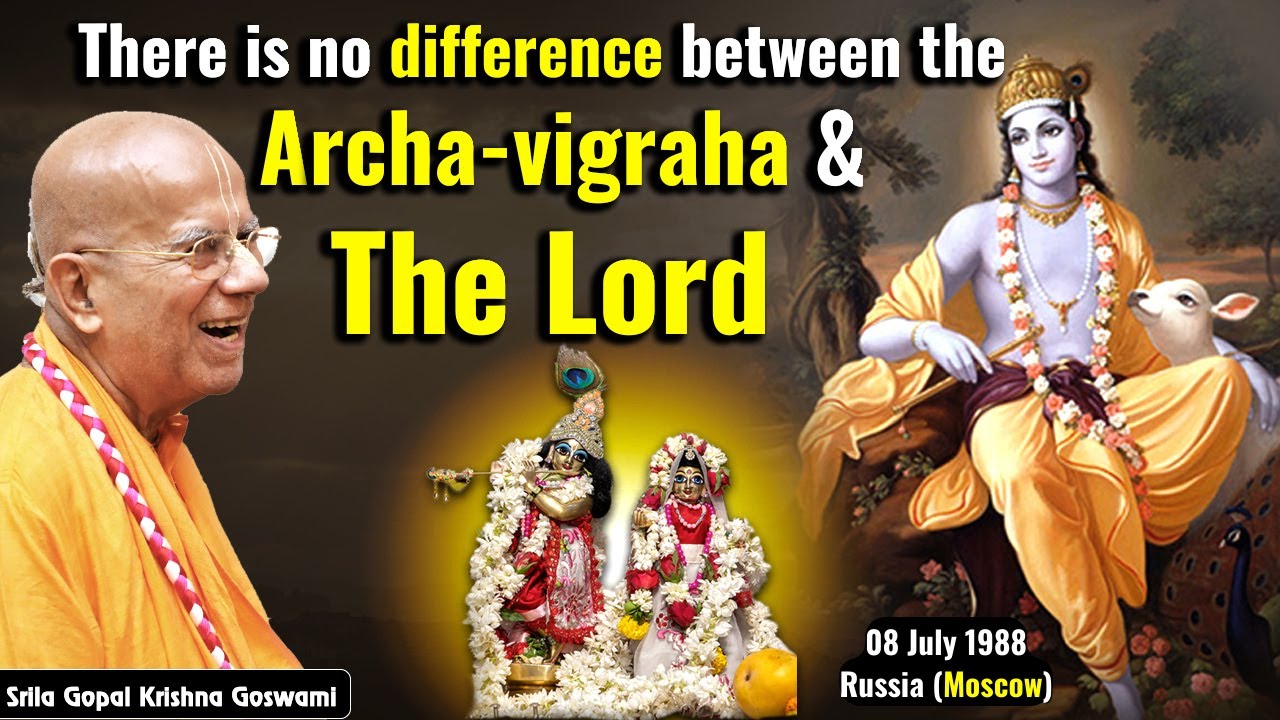
Gopāl Kṛṣṇa Goswāmī teaches that the deity is not different from the Lord himself. He explains how devotion grows through hearing and chanting, recommends a minimum of 16 rounds daily, and recounts miracles where the deity provided for temples, including mango trees that appeared to feed Sanātana and Rūpa Goswāmīs.
Chapters
Varanasi is also known as Banaras, and traditionally has been a seat of Sanskrit learning. We have a nice temple there, and we may be getting a big property there. There were thousands of Mayavadi sannyasis there headed by Prakashananda Saraswati. As some of you may know, Lord Caitanya had already established his credentials as a Sanskrit scholar when he I was young. Yesterday I explained to you that when Lord Caitanya would teach grammar, he would teach grammar in such a way that in the end it would culminate with knowledge of Kṛṣṇa. So many of these Vaiṣṇava sannyāsis were very critical of Caitanya Mahāprabhu. They described him as a sentimental madman and they would avoid his association. So one devotee of the Lord, he invited all the sannyāsis to his house. Lord Caitanya accepted the invitation also. Lord Caitanya did not sit on the high seat with the sannyāsis, but sat at a distance where they washed the feet. The sannyāsis said, "Why aren't You sitting with us? Why are You sitting over there at a distance?" Lord Caitanya said, "I am not so eduhaṣṭ." However, the sannyāsa, Lord Caitanya manifested His divine opulence. They could soon see so much effulgence coming from Lord Caitanya's body. They said, "Oh, he must be Narayana Himself." The Māyāvādīs say, "We'll become Narayana." But they thought He has already become Narayana. So they dragged Him by His hand and made Him sit on the same level as them. And then Lord Caitanya explained to them the meaning of the Vedānta, and they all became Vaiṣṇavas. So similarly, Lord Caitanya was performing kīrtan in the house of Śrīvāsṭhākura. Every evening for one year they went on with kīrtan. But one day at the end of the kīrtan, The devotees all said that they were very hungry. They said, "We want prasad." So Lord Caitanya planted a seed, and instantly that seed grew into a mango tree. And in the mango tree, there were 200 fully ripe mangoes. The mangoes were red and yellow in color, and each mango was so big that just by eating one mango, It was enough to satisfy their hunger. And there were no seeds and no skin even in the mangoes. So all those who claim to be God today, give them this challenge. These are— there's so many people who claim to be Bhoga. So tell them, here's a mango seed, plant it so it may grow immediately and produce fruits. And once when they were doing kirtan, clouds had appeared in the sky, heavy clouds, and Lord Caitanya just looked at the clouds, and the clouds understood it's time for them to disperse. And the clouds dispersed, and they were able to go on with their sankirtana. And then of course, you know how the qazi had stopped their kirtan by breaking their mridanga. And Lord Caitanya organized 3 massive sankirtana parties. In the front was Haridas Thakur, Advaita Charya was leading the kirtan in the middle, and Lord Caitanya was in the rear. Can you imagine a kirtan party with Haridas Thakur in the front, Advaita Acharya in the middle, and Lord Caitanya in the rear. And they went to the Kazi, and the Kazi was convinced about the philosophy. In fact, the Kazi said, the day they broke the mridangas, in the night he had a dream, and Lord Nrsimhadeva had come to him in a dream and said, "If you ever do this again, then I'll tear your body like you broke the mridangas." So the Kazi gave orders to his future descendants never to disturb Lord Caitanya's sankirtan army. There were several Muslims who were complaining to the qazi to stop this Hare Rama character. So the qazi told them, "Why are you always chanting Hare, Hare, Hare?" And they said, "Ever since we heard these names of Hare and Krishna, we don't know what's happened." We just can't give it up. So we now go continue with Lord Caitanya's teachings through Rupa Gosvāmī. Few pastimes and then the philosophy. That's the formula. So yesterday we came as far as Krishna-bhaktānena skāmāte eva śānta, in which Lord Caitanya said the devotees of Krishna are peaceful and the other so-called transcendentalists are not peaceful. And We start with the point where one receives Bhakti-lata bija. Is receiving Bhakti-lata bija the end of the story? No. Okay, so what to do with Bhakti-lata bija is explained in this verse. I would like you all to hear the translation and purport by His Divine Grace A.C. Bhaktivedanta Swami Prabhupada to one very important verse. Mālai hana-kade sei bija-āropana śraunakṛṭṇa-jale-kraya-se ca to discuss all 1,500 verses will be impossible in 5 or 6 days. So I'm only selecting few important verses that convey our philosophy. So we have seen, as you know, this is Lord Chaitanya, Lord Chaitanya instructing Rupa Gosvāmī in Prayāga. So we have seen that Lord Chaitanya has explained how the living entity is traveling through many different births in different species, and how the fortunate soul gets the bhakti-lata beat. In other words, he receives knowledge that he must serve Kṛṣṇa. You must perfectly human life, don't waste it. Now this seed has to be watered. So each of us has to become a transcendental gardener. And as a transcendental gardener, the seed which has been planted has to be watered. Now, how do you water the seed? Through the process of shravanam and kirtanam. I'm sure you hear this almost every day in the classes you attend. So Lord Caitanya says just receiving the seed is not enough, but you must water the process through the process of hearing and chanting. Shravanam kirtanam is the beginning of the ninefold process of devotional service. Prasad Maharaj, When he was in the womb of his mother, he had the great fortune of receiving instructions from Nārada Muni. Prahlāda's father, as you know, was a well-known demon. So when Prahlāda was in his mother's womb, the demigods were concerned that the child from this lady may be like the father. So they were dragging, they kidnapped Prahlāda's mother, and they were dragging her with a plan that they would keep her under their custody till the child was born. But Narada Muni entered the scene and he said, "What are you doing? You don't know? She is Mrs. Hiranyakashipu and she's pregnant. The child could be another demon. We are scared the child is going to become another demon. So we're going to kill the child as soon as he's born." Narada Muni said, No! The child in this lady's womb is going to be a great sage. Have no fear. So they released her. So Narada Muni gave her shelter and instructions. And he gave instruction on the ninefold process of devotional service. So, śrāvanaṁ kṛṭṇaṁ viśṇuṣvaṇaṁ pāda-sevanām arcaṇaṁ vandyaṁ drasyaṁ sakyaṁ Ātmānivedaṁ. These represent the ninefold process of devotional service. Śrīlankīrtanam is hearing and chanting. Viṣṭu-smārṇam is remembering the Lord. Pāda-sēvṇam is worshipping the lotus feet of the Lord. Then worshipping the Deity of the Lord, offering prayers to the Lord, carrying out the orders of the Lord, serving the Lord as a friend, and surrendering everything to the Lord. However, hearing and chanting is the basis. Unless your hearing and chanting is solid, vṛṣṇa-smārṇa, or meditation on the Lord, will not be possible. So all devotees in this Kṛṣṇa conscious movement have been recommended by Śrīla Prabhupāda that you must chant minimum 16 rounds a day. You can chant more, but not less. Now if we chant sincerely and attentively, then this bhakti-latā beej will grow. But if our chanting is not attentive, if our chanting is not regular, if our chanting is not high quality, then the bhakti-lādhā-beet will not grow rapidly. In the scriptures you read about 26 qualities of a devotee, qualities that Lord Caitanya explained to Sanatana Gosvāmī that we'll discuss later. You read about aspects of knowledge in the Bhāgavad-gītā. So devotees often want to know, how can I develop these qualities? So the foundation Our ability to develop these good qualities comes from śrāvanam and kīrtanam. So this must be our first duty. Whether you are a brahmachari or a grihastha, whether you're living in the temple or at home, whether you're a full-time devotee or a congregational member, if you want to make spiritual advancement, then the śrāvanam-kīrtanam must be very regular. You must understand the holy names are not different from the Lord. Nama-cantām nāma-kṛṣṇa-cetaraṣa-vigraha. Purno śuddha-nitya-mukta-vinātām nāma-nāmināha. The holy names are identical with Kṛṣṇa. So the more attentive you are, the greater will be your spiritual advancement. Don't just chant rounds, but chant good quality rounds. Sometimes devotees have a habit to chant their rounds or go through it very fast like a rapid train. There was once a father who told his son, son, you must chant 16 rounds. And the son said, okay. The father said, have you done your rounds? He said, yes. How did you do them so fast? In 10 minutes you finished 16 rounds. He said, very easy. On the first bead I chanted the whole mantra, and on the other beads I just said Toja, Toja, Toja, Toja. So you finish your rounds very fast. So we should not chant Toja rounds. Now when the purport Now, when we are chanting, not only should we chant regularly without fail, chanting in the morning hours is most auspicious. We should also make sure that we're not skipping on beads when we chant. You'll be amazed how easy it is to skip on beads and think you finished a round. So Lord Caitanya told Rupa Gosvāmī, the living entity is wandering through so many births in different species, and if he's fortunate, he receives the seed of bhakti. Then the seed of bhakti must be watered, and if you water it, then the seed will grow and eventually go and take shelter in Goloka Vrindavan. Now in the purport that you read, Prabhupada had listed many important points that we will just run through fast. The first point that Prabhupada's making is that a śraddham-kīrtana must be accompanied by Deity worship. The Lord manifests Himself in His archa-virāhā form. And in the archa-vigraha form, He gives us a chance to serve Him. Prabhupada says don't imitate Haridas Thakur. What was Haridas doing? Sitting in front of a tulsi plant and chanting 300,000 times. So Prabhupada is warning us, don't think you can imitate Haridas, not give attention to daily worship. Therefore, in all our ISKCON temples, you have deities. You begin with pictures of Pancha Tattva. Then you have Deities, small Deities. Then you're going to have big Gaura-natha. And then as you progress further, you can have Radha-Kṛṣṇa. So the point is, this Arjavedra form is not different from the Lord. It all depends with what mentality we approach the Lord, and the Lord will reciprocate accordingly. I think you devotees know the story of Madhvandapuri, how the Deity even stole, uh, rice for Madhvindapuri. I'll tell you two stories of the Deities, one in connection with Sanatana Gosvāmī, one in connection with Rūpa Gosvāmī. There was a Deity of Gopāla on the top of Govardhana Hill. This was the Deity installed by Madhvindapuri. Rūpa Gosvāmī had a great desire to have darshan of this Deity. But to have darshan of the Deity, he would have to step on the Govardhana stone to climb up. We Vaiṣṇavas don't climb on Govardhana stone. Gaura-dān stone, because that Gaura-dān shield or stone is non-different from Kṛṣṇa. So Rūpa Gosvāmī was always lamenting that I can't have darshan of the Gopāl Deity. So the Gopāl Deity spread the word that the Mahāmānanda are coming, they're coming to destroy the temple. So the pujaris were very concerned about Gopāl's welfare. So they took the Deity of Gopāl and took it to a devotee's house in Mathura. And at that time, Rūpa Gosvāmī along with Rākṇaṇaṇa and Jīva Gosvāmī also living in Mathura. Rupa Gosvāmī was able to have darshan of the Gopāldīdī when it was brought from Mathura. So how the Deity reciprocated with Rupa Gosvāmī's desire to have His darshan. Both Rupa and Sanātan, dāvat, one time they had great wealth, but when they came to Vrindāvana, they were living like beggars, as we said yesterday. So Sanātan Gosvāmī also used to go every day begging from house to house. What is this called, this begging every house to house? What is it called? So Sanatana Gosvāmī one day came to a house that had a very beautiful Deity of Madhava and Gopāla. Just at first sight, Sanatana fell in love with that Deity. He was just meditating, how can I get this Deity? So every day, under the plea of Madhu kari. He would go to the house that had the Madam Gopal Deity in their house. The wife of the house that had the Deity was very attached to this Deity. She used to treat her son and the Deity both like her children. Srila Caitanya Mahāprabhu told her that He is the Lord. You should treat Him as a Lord of worship, not like your son. But then that lady had a dream in which the Deity of Madangopal said, "No, no, no, I was happy when you were treating me like your son." So Nādhana had a great desire to get that Deity, but he could not get it because that lady was very attached to worshipping him. So one day the Deity of Madangopal told that lady in a dream, "Please give me over to this mendicant who comes to your house every day to beg." So the next day when Sanatana went to the lady's house to beg and have darshan of Madangopal, the lady said, "Mendicant, I'm an old woman now. I can't take care of my Deity anymore. My Lord told me in a dream that I should give Him to you." So Sanatana was thrilled. He was very happy that he at last got the Deity of Madangopal that he was meditating on for such a long time. Then he brought the Deity of Madangopal home. He made a special hut in which the Deity of Madangopal was being worshipped. But in his heart he wanted Madangopal to have a nice opulent home. But he had no money. But he was still worshipping the Deity in a hut. One day there was a businessman going in a boat that was in front of Sanatana's hut. And the boat got stuck in front of Sanatana's house. So the businessman who was traveling in the boat was in anxiety. He tried his best to get the boat out, but it would not move. He saw there were two huts nearby where there was some light. So he went to Sanātan Gosvāmī and said, "Can you help me get my boat out? I'm stuck. I have to go quickly to make some business." Sanātan said, "I can't, but maybe Madan Gopāl can." So that devotee prayed to Madan Gopāl, and then he came back to his boat. There was a fresh current of water coming from another direction. As a result, his boat which was stuck started moving. And the boat started moving. Then the businessman was very happy. And he went and he made a huge profit. He was a grateful businessman. So he recognized that he made the profit by the mercy of Madam Gopal. So he brought all the profit and gave it to Sanatana Gosvāmī. Sanatana Gosvāmī said, Make a temple out of this Lakshmi. And then he made this temple of Madangopal in Vrindavan. These Gosamis of Vrindavan inspired the construction of many big projects. Rupa Gosami inspired the construction of Radha Govindji Temple. We'll tell you the story tomorrow. And Sanatana Gosami, this was built in Madangopal Temple. So the Deity reciprocates with your desire and your devotion. In the story of Sakshi Gopal, The Deity came to the rescue of the Brahman. You know the story of Sakshi Gopal. Now in the purport, Prabhupada makes another point of pleasing the bona fide spiritual master. So in the Bhaktirasamhita Sindhu, Rūpa Gosvāmī explains to us as follows. First step is you must accept shelter of a bona fide spiritual guru. Then second stage is initiation from a bona fide. Third stage is obey with faith and devotion the instructions of the bona fide spiritual master. In other words, with faith and devotion we should obey, carry out these instructions. We must have faith what I'm being told is for my spiritual betterment. Follow in the footsteps of the previous ācāryas under the direction of the bona fide spiritual master. In other words, the genuine spiritual master doesn't concoct anything. He just considers himself to be a transcendental postman. Just like a postman delivers the letter intact, the transcendental post spiritual master delivers the message of the ācāryas intact. Śrīla Prabhupāda had many wonderful qualities, one of which was he never interpreted anything. He presented the message of the Lord as it was. So then, so the spiritual master, you can serve him favorably, then you make advancement. And if you serve him unfairly, then the spiritual life can get spoiled. In Chaitanya-caritāmṛta you read about two disciples, Īśvapuri and Rāmacandra-puri. Īśvapuri served the spiritual master like a menial servant. He would even carry his stool and urine, clean his stool and urine. In old age, he would even carry him. And Ramchandrapuri was a traditional fault-finder. He had a habit of fault-finding with sannyasis. First he would feed them. They would say, "No, no, no, I don't need your kacho." He said, "No, no, no, you must. This is Lord Jagannātha Prasāda. How can you say no?" So anyway, so When the sannyasis are to eat, then he would make fun of them. See, artificial renunciate. So Ramchandra Puri could not understand how advanced his spiritual master was. So in his last days, Madhu Nāpuri, out of humility, was lamenting that he hasn't developed love of God. So Ramchandra Puri advised him to meditate on Brahman. So he was— the spiritual Brahman, Madhu Nāpuri, was so upset, he said, get out of my sight, because if I die looking at you, my whole life would have been So Īśvara-pūrī served his spiritual master in such a menial way that he was blessed by the benediction that you'll spread love of God all over the world. So Caitanya Mahāprabhu will say, Sarupakṣaṁhita, serve the spiritual master with faith and devotion, then inquire from him. Inquire how can you make spiritual advancement. This should be our concern. Am I making spiritual advancement or no? Whether you are brahmachari, brahmacharini, or grihastha, doesn't matter. Our real goal should be to make spiritual advancement. Just like when you're diseased, you're in anxiety to get your temperature lowered. So we should be anxious to get our material temperature lowered. So Caitanya Mahāprabhu is giving us the solution: śrāvanaṁ kṛṭṇa. And Rūpa Gosvāmī says, Give up whatever is unfavorable for making spiritual advancement. So naturally, when it comes to spiritual life, sometimes you have to make certain adjustments to make spiritual advancement. Just like if you get a disease, you have to make some adjustments to recover from the disease. If you have a disease and you're advised by the doctor, okay, don't eat sweets anymore, then you have to give it up. Similarly, give up what's unfavorable for spiritual advancement. Now if you keep watering the seed, the seed bhakti-lata-beet, then this seed will grow into a tree. And then Caitanya Mahāprabhu explained, this seed will grow, will grow beyond this material universe. It will go beyond the Viraja River. The Viraja River is between the spiritual world and the material world. Go beyond the Brahmaloka and go and take shelter at But you have to endeavor. Just like Rupa Gosvāmī says, by this process of bhajana-kriyā, the anarthas begin to get destroyed. And as the anarthas get destroyed, you develop determination, eventually culminating in Kṛṣṇa-prema. So the creeper of devotional service attains the shelter of the lotus feet of the Lord if you go go on watering it regularly. And it takes shelter of Gauka Vrindavan, which is the topmost region in the spiritual sky, even beyond the Vaikuntha planet. Gauka Vrindavan is the highest planet in the spiritual world. So this chanting and hearing is so important. Now there's certain guidelines how you can chant and hear to the best advantage. I think this we will discuss tomorrow. Now we have about 10 minutes left. We can keep those for questions. Yesterday, you devotees had lot of questions. Hare Kṛṣṇa. Hare Kṛṣṇa.
More from PRASAD

Rare Pastimes & Timeless Lessons of Guru Mahārāja | Stories Every Disciple Should Hear

ISKCON Legends- pure devotees meet-HH Jayapataka Swami, HH Gopal Krishna Goswami, HH Radhanath Swami



Jagannātha Ratha-yātrā Through Śrīla Prabhupāda's Mercy | 29 April 2006 | Nairobi, Kenya

Lord Jagannātha's Appearance Pastime | 21.07.2019 | ISKCON Calgary | Śrīla Gopāla Kṛṣṇa Gosvāmī

The Ācārya Teaches by His Own ExampleGuṇḍicā Mārjana by Guru Mahārāja #shorts

Guṇḍicā Mārjana – Lord Jagannātha's Pastime | 21.7.2019 | ISKCON Calgary |Śrīla Gopāla Kṛṣṇa Gosvāmī

H.H. Gopāla Kṛṣṇa Gosvāmī Mahārāja - Exemplary Sādhana and Deity Worship # shorts

भगवान की कृपा कैसे प्राप्त होगी ? | 11 Jan 2014 | Punjabi Bagh | Srila Gopal Krishna Goswami

Material Education vs Spiritual Education | Srila Gopal Krishna Goswami #shorts