NOD- The Six Goswamis and Science of Devotion | Rus-Split | 29.5.91 | Śrīla Gopāl Kṛṣṇa Goswāmī
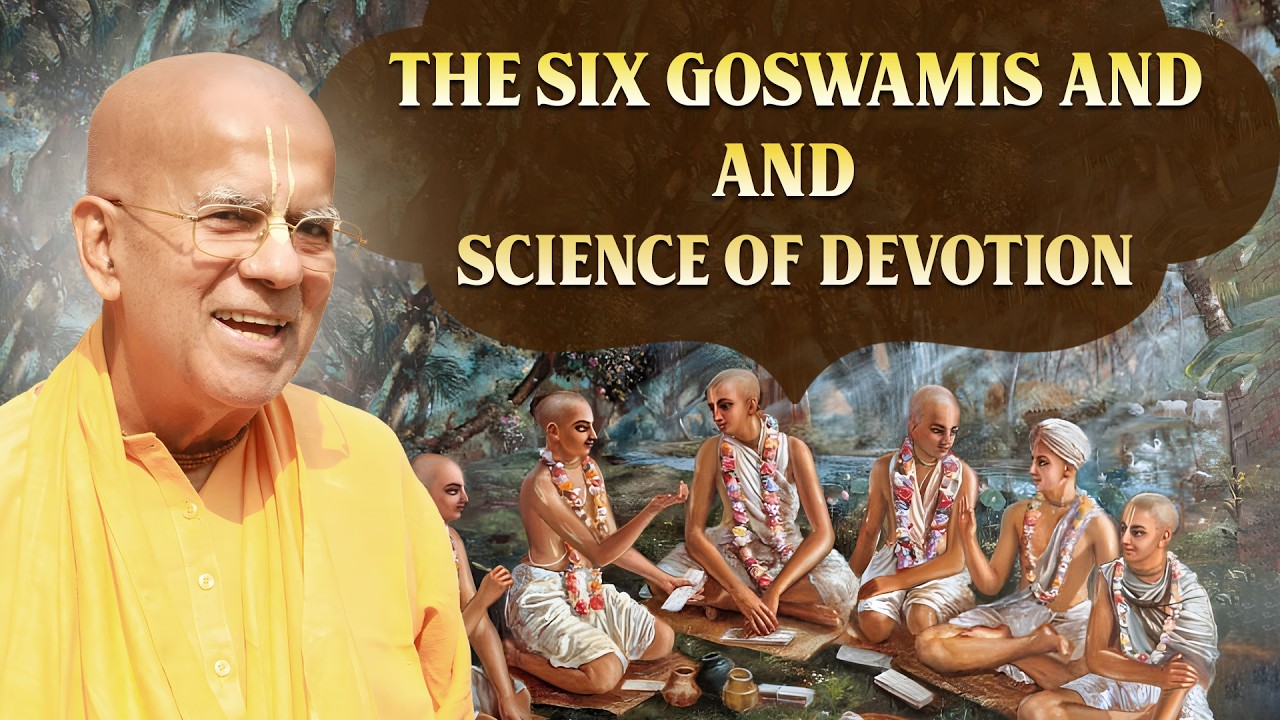
In this extended lecture Śrīla Gopāl Kṛṣṇa Goswāmī presents a comprehensive overview of the Six Goswamis—especially Rūpa Gosvāmī—detailing their aristocratic origins, forced service under the Muslim ruler of Bengal, and eventual renunciation to become the principal authors of the science of devotional service (Bhakti‑Rasāmṛta‑Sindhu). He explains the purpose of the text, outlines the six reasons Rūpa Gosvāmī gives for taking up devotional service, and describes the classification of human actions (akarma, karma, vikarma) together with the four progressive stages of sinful reaction as described in the Padma Purāṇa. The talk then moves to the universal auspiciousness of Krishna consciousness, illustrated with anecdotes about a controversial Indian film, animal chanting, and the impact of the movement in the Soviet Union. Goswāmī contrasts three sources of happiness—material, impersonal (Brahmanic), and devotional—arguing that only devotional happiness is lasting. He emphasizes the principle of "simple living, high thinking" exemplified by the Goswamis and modern devotees, and stresses the ongoing missionary effort of translating and distributing scriptures in Russian, Latvian and other languages. The lecture concludes with practical advice on facing difficulties as a "burden of joy," stories of Prabhupāda’s perseverance, and a call to chant Hare Krishna, avoid the ten offenses, associate with devotees, and continue book distribution, asserting that the movement’s legacy endures as long as its literature is shared.
Chapters
But India was there. The whole planet was called India. In fact, uh, 10 days ago I was having a discussion in Washington with one of the senior devotees of our movement. His name is Brahmananda Prabhu. In fact, we had lunch together just before I left Washington for Moscow. So he's now putting together a book to show how Lord Caitanya's influence was all over the planet 500 years ago. So Rupa Gosvāmī was the prime minister of the richest kingdom, um, at that time. Actually, Rupa Gosvāmī was born in a Brahmin family, and he and his brothers from the very birth were very trained in Vedic scriptures. But the Muslim ruler of Bengal, he was very keen that Rupa Gosvāmī come and work for him. Because Rupa Goswami was very popular with the subjects, with the citizens, and most of the citizens were Hindus and the king was Muslim. So Rupa Goswami and his brother Sanatana, they refused to the king's request that they come and serve the king. But then he threatened them that if you don't come and work for me, then I will destroy these Hindu temples. Then under force they went and started working for the Muslim ruler. So Rupa Gosvāmī, of course, when he met Caitanya Mahāprabhu, he was very happy, and ultimately he resigned from his government service. And then Rupa Gosvāmī was instructed by Caitanya Mahāprabhu to write books on the science of devotional service. The Vedic literatures are very, very vast. As you— as I— we have been explaining in the morning Bhāgavatam classes, Vyāsa Deva first compiled one Veda, which was divided into four, then the 108 Upaniṣads, then the Purāṇas. So the Vedic scriptures are so vast that if you try to read them, you'll be confused and you won't be able to finish even a fraction during your lifetime. So Caitanya Mahāprabhu told Rūpa Gosvāmī to go to Vrindavan, study the Vedic scriptures, and summarize them in different scriptures, and to write books in honor of devotion, in honor of devotional service. So Rupa Gosvāmī, when he went to Vrindāvana, he did two things. He studied books and wrote volumes of books on devotional service, and he also helped build the big temples in Vrindāvana. A lot of the big temples in Vrindāvana that your devotees visit when you go to India every year were built under the inspiration of Rupa Gosvāmī and Sanātan Gosvāmī. So Bhaktirāṣṇa-mṛta-sindhu is a summary presentation of the science of devotional service. Actually, this Kṛṣṇa consciousness movement has so many books. We have such a large base of spiritual literature that nobody in the world can challenge us. There is no other sampradāya in India or anywhere else, there is no other religious group or religious faith that has as many scriptures as a basis as the Kṛṣṇa consciousness movement has. So you can be rest assured for your whole life. You'll constantly be getting new books in Russian and Latvian languages and new books to distribute also all your life. Even now, the BBT America is bringing out so many new books on Prabhupada. They've just published a huge, um, 30 or 40 volume Prabhupada's conversation book, a huge— so many volumes of Prabhupada's conversations books. Now they're publishing another book, Prabhupada's lectures on the Bhagavad Gita. So there's going to be so much, there's going to be books coming out at least for the duration of our lives on this planet. So you all will have plenty of books to read and distribute for this life, so don't worry. So Rupa Gosvāmī wrote many books, but Bhaktirāṣṇa-mṛta-sindhu is a summary presentation of the laws of devotional service. The Gosvāmīs were completely absorbed in transcendental service to the Supreme Lord. They were in the same mood as the mood of the gopis, and they were constantly engaged in loving service of Rādhā and Kṛṣṇa. What is the meaning of a Gosvāmī? Who knows it?
King of senses, they are saying.
King of senses, okay, one word. Any other explanation? What's the meaning of Gosvāmī?
A master of the senses.
Yes, king or master, controller of the senses. So the Gosvāmīs were all controllers of the senses. They were all from very, very rich background. Don't think that they were ordinary, uh, from poor background. Rūpa Gosvāmī, Saṣṇātana Gosvāmī, Raghunādh-bhatta Gosvāmī, Raghunādh-dāsa Gosvāmī, Jīvā Gosvāmī, Gopāl-bhatta Gosvāmī. They were very expert in studying all the revealed scriptures, and they were expert in all languages. They could speak several languages, and they have all compiled scriptures to describe the process of service to God. I have explained to you that Rupa and Sanātan were born in a prominent Brahmin family, but then they took on government service of the Muslim king. Do you know who Raghunātha Gosvāmī was? Who knows? No one. Raghunātha Gosvāmī was the only son of the richest landowner of that time. His father was the biggest zamindar. What do you say, zamindar, landowner in Russian?
Pamishik.
Pamishik. His father was the biggest pamishik, and Raghunath was the only son, so he was naturally the favorite in the family. When you are the only child, you become the favorite. This is universal rule all over the world, isn't it? So Raghunath Das, uh, when he heard about Caitanya Mahāprabhu, he became very attracted to the process of devotional service. His parents got very worried. So don't think that if your parents get worried when it comes to spiritual life, it is something new. Even Raghunātha dāsa's parents got very worried. They tried their best to stop Raghunātha from joining Caitanya Mahāprabhu. They were like your parents. They were telling Raghunātha, "Stay at dōma. Why do you want to go with Caitanya Mahāprabhu?" But Raghunātha's heart was in joining Caitanya Mahāprabhu. So Raghunātha's father got him married to a very beautiful young girl. And he was thinking that now my son will be attracted to this beautiful wife and he will forget Caitanya Mahāprabhu. So don't think these tricks that parents are thinking today is something new. Parents have been trying these tricks for hundreds of years. But Caitanya— Raghunādhāsa Gosvāmī was not attracted to his beautiful wife. He was constantly thinking how can he join Caitanya Mahāprabhu. So Raghunādhāsa's parents had Raghunath not only married to a beautiful wife, but they also had the militia all over his, all around his house, the police, security force, watchmen to guard that he may not run away in the night. So his parents were, his father was very smart. He couldn't have been the richest landowner unless he was very smart. You don't become rich unless you're smart. So, but Raghunath was still managed to run away. From his father's house and he joined, uh, Chaitanya Mahāprabhu's movement. So Raghunātha Gosvāmī was also not an ordinary person. Jīvā Gosvāmī was also a great Sanskrit scholar. So was Gopālbhatta Gosvāmī. So, uh, all these Gosvāmīs were very, very qualified. You know, this Kṛṣṇa conscious movement comes from a very great heritage. Sometimes in the Western countries people say, oh, only the— only you hippies are taking to Krishna consciousness. Of course, these days they don't have hippies even in the Western countries. The hippies are dead. They don't have hippies anymore. Prabhupada used to say— Prabhupada used to say, we're not hippies, we are happies. So, uh, actually we have many great exalted souls who have taken to Krishna consciousness and laid the foundation of what you and I are practicing and preaching today. So even though these Gauṣvāmīs all came from a very rich background, when they went to Vṛndāvana, they lived very, very simply. They would live underneath a different tree every day. And to eat, they were eating only dry chapatis and salt. So the Gauṣvāmīs, they didn't have any kvaṭyā or kṛmṇata or dōma. Near Kṛmṇaṭṭha, near dōma, near kautiyā. They used— they— the Kṛmṇaṭṭha and dōma was a tree. Of course, we are not saying that all of you should start living under trees now and give up your kṛmṇaṭṭhas and kautiyās and dōmas. Then the television will really criticize us. Then they will really think that we are crazy. Right now they want to think we are crazy, but they cannot prove that we are crazy. They, they're always thinking they will attack us, but they don't have any argument to attack us. Just like today we went for this television interview. The television interviewer asked me questions which were very, very friendly. There was nothing challenging in them at all. And I understand that even in the interview with that daughter who was interviewed, there was nothing challenging asked. Because they have nothing to criticize us for. What wrong are we doing? We are following laws of moral— morality and ethics. We are not killing animals. We don't take intoxication. We don't take any gambling. We don't eat meat. All good habits we have. Few months ago in Moscow, there was big demonstration because people were angry that they could not get cigarettes. So we are saving the government. No, we don't want any tobacco. Mr. Gorbachev has 100 times told the Soviet people, stop drinking vodka, but they won't stop. Even now the price of vodka has gone up, still you see such big lines in front of all vodka shops. So we are telling them, okay, we won't take your vodka, no problem. So what wrong are we doing? They say they don't like our looks, they don't like the way we look. We tell them, well, shaving of hair is only done by those who become full-time monks. And when we go on the street and do Hare Nam, everybody likes us. In fact, even in America, one complaint that I hear from people when I meet, when I travel, is they say, oh, we don't see you as much as we used to see you before. People like listening to, seeing devotees in the Hare Kṛṣṇa Nama because everywhere else they see miserable faces, but devotees they see smiling and jumping. They are struggling so hard to find happiness. From morning to night they're endeavoring just to get a little bit of smile, a little bit of happiness, but they can't find it. And devotees begin to chant and start jumping up at 4:30 in the morning at Mangala-Arthi. I was seeing today that people on the other side of the street were looking inside and thinking, what are these people doing 4:30 in the morning? And when it comes to philosophical discussions, we can defeat everyone because nobody can deny that God is pure. Religion has to be pure, and today everything is impure. So what we are presenting is something very solid. Once somebody asked Prabhupada, how is it, Prabhupada, you always preach so forcefully? So Prabhupada said, When you are standing on the strong foundation, you have nothing to fear. So we are standing on a very strong foundation. And like I said yesterday in the talk on Harinama Chintamani, doesn't matter how unqualified you may be, but if you, if you get hooked on to the Holy Name and the process of devotional service, then you will also become strong like Prahlada and Haridas. So the devotees draw inspiration from the character of the Gosvamis, how they lived a life of complete simplicity. How they were totally renounced and detached from all worldly possessions. And how they were only interested in Kṛṣṇa-katha and glorification of the Lord. Kṛṣṇa-katha means discussing philosophy spoken by Kṛṣṇa, discussing philosophy spoken about Kṛṣṇa. So we should be interested only in Kṛṣṇa-katha. We have the Bhāgavad-gītā, Bhāgavatam, Caitanya-caritāmṛta, and so many other books to meditate on. Prabhupāda said Bhāgavad-gītā is high school. Bhāgavatam is college and Caitanya-caritāmṛta is postgraduate education. So we have Kṛṣṇa-kathā to choose from college, school, and postgraduate education. So why do we worship the Gosvāmīs? One, they were fully immersed in the mood of the gopīs. Their only absorption was service to Kṛṣṇa. Second, they were learned in the scriptures. Then third, they were totally detached. They all came from very opulent conditions, but they renounced everything to execute service to Prabhupada. Used to say spiritual life means simple living and high thinking. You understand this? Simple living, high thinking. One good thing that communism has done to your country is it has encouraged you all to have simple living compared to the Western countries where capitalism had destroyed their simple habits. So say spiritual life means simple living and Thinking high, thinking in terms of self-realization. And material life means the opposite— high living and simple thinking. You want to live like the tsars and think like the animals, live like the kings and think like the animals. So simplicity is appreciated in spiritual life. So the Goswamis have set the example. They sacrificed everything for spiritual advancement. So this Bhakti Rasamrita Sindhu was written in Sanskrit language. But you don't have to worry about learning Sanskrit. Prabhupada has summarized all these books in very nice, easy-to-understand language in English. And now our devotees are making them available in Russian, Latvian, and every language of your country. So Rupa Gosvāmī says there are 6 reasons why you should take to devotional service. Because if I ask all of you, even a new bhakta, one day, why are you taking to devotional service, they'll all say to develop love of God. Why? Why are you taking the devotional service? Okay, so one answer is for serving Lord Krishna. But Rupa Gosvami gives you 6 reasons why you should take the devotional service. So you want to know those 6 reasons? So I won't be able to finish them before aarti, so after aarti I'll continue with them. Okay, at aarti time I have to have a little meeting with Rupa Raghunath on few things he wants, so I'll just go up for 20 minutes and then come back after aarti to continue on this discussion. So first characteristic of pure devotional service that Rūpa Gosvāmī says is pure devotional service brings— frees oneself from all material distress. Kṛṣṇa says, sarva-dharmaṁ paritajyāvām ekam śaṇam rājaḥ aṁ tomaṁ sarva-pāpebhyo mokṣām imāsujjahaḥ. Give up all varieties of religious and just surrender unto Me, and I will protect you from all sinful reaction. So there is sinful reaction to all our activities. All activities we perform can fall in one of the three areas: karma, vikarma, akarma. Akarma is activity that is performed exclusively for the pleasure of the Lord, for which there is no reaction. Just like a child, when he works under the direction of the mother and father, then they take all the responsibility. And vikarma is activity against the orders of the Lord, sinful activity. And karma is according to the scriptures, but it is fruitive work, so it is not pure bhakti. So Rūpa Gosvāmī maintains that the living entity has to experience the reaction for all sins that he performs. For some, the reaction is being felt, and some, the reaction is not being has not been felt as yet. In the ancient Vedic scripture Padma Puran, it is said that the sins that you perform, the results fall in 4 categories. Or let me put it another way, there are 4 effects, 4 stages of effects to every sin you perform. First is the effect which is not yet fructified. Second is the effect which is lying as a seed in the heart. Third is the effect which is almost mature. Fourth is which is already mature. Has anybody understood this explanation? No. So I'll explain this in detail. One should not think that if I commit sinful activity today, the result is going to be experienced tomorrow. The first stage is— the first stage is the effect which is not yet fructified. That means you have committed a sin, Now that has been noted by Yama Raj and the result is going to be given but it will take time. The second stage is when it is lying as seed. Seed means the result is now going to be felt but it is going to take little time. Just like you plant the seed in the garden. Now that seed will eventually grow into a tree but it will take time. But at least when it is planted as a seed, you know And then our seed will become a tree one day. So your sinful reaction is— lies as a seed. That means the result will be felt, but it will take a little time. Then the seed grows into a tree. So the sinful reaction moves from seed to— it begins to grow, but the result has not been felt as yet, but it's going to be felt. And so the fourth stage is when the effect is mature. Just like you have a tree, in the tree there are mangoes, but the mango is raw. When the mango becomes ripe, then you take it out and eat. So when you are feeling the effect of your sin, that means the sin has become mature, effect is mature. And before the mango becomes ripe, it is raw, but you know this raw mango will become ripe in few days. So similarly, the sin for which the reaction has not been felt but it is going to be felt is known as almost mature. Suppose somebody has an accident, or suppose somebody falls very sick, or some, some disaster happens, then we can say the sin has become mature, effect has become mature. You understand now? So one should not think, if I commit sinful activity tomorrow, the result is going to be day after tomorrow. Sometimes people say, "Look at those rich people, they're living in big houses, they don't worship Kṛṣṇa, they're eating meat, doing so many sinful activities, why they're not getting the effect?" So sometimes it takes time for the effect to be realized, but eventually the effect will be realized. So Rūpa Gosvāmī says that you become free from all sinful reaction by taking to the process of devotional service. Because by coming to Krishna consciousness, you change your habits. You learn the art of engaging your senses in service to God. How many more minutes do I have?
39.
No, ready? Okay, so I'll continue after the adi. Now there's spiritual intermission. So spiritual— you said spiritual intermission. Um, in the 6th Canto, Parikṣit Mahārāja wanted to know from Śukadeva Gosvāmī How can people stop going to hell? Śukadeva— Parikṣita Mahārāja was interested in the process of real atonement, genuine atonement. Genuine atonement means that you resolve not to repeat these sinful activities again. If you repeat the sinful activities again, then what is the value? The example is given in the Bhāgavatam of the elephant. The elephant has a bath in the river, then it comes out and sits in the mud and becomes dirty again. We go to the church, we apologize for our sins, but the moment we come out of the church, we start sinning again. Prabhupada used to say that Jesus Christ has not made a contract with you that you go on sinning and he'll go on atoning, he'll go on excusing you. So, uh, there has to be genuine atonement. So that genuine atonement comes when you engage the senses in a positive manner. So by engaging in devotional service You're learning the science of engaging the senses in a positive manner. And because you're engaging the senses in a positive manner, you'll become free from all material distress because you'll be engaged in devotional service. Do you understand this point, all of you? Everyone is quiet. What does that mean? Either you understand or you don't. You can't be in a mayavadi stage of voidism. Do you understand? Daau niyat. Okay, so of course I only have about half an hour more, so I'm going to go a little fast on the other 5 points, unless you want me to speak all night. Then I'll have to miss my train. So another, another characteristic of Krishna consciousness is that it is all auspicious. What is the meaning of auspiciousness? What's the Russian word? Slava. So in the material world, different people have different definitions of what is auspicious, just like We have an organization called United Nations. Everyone thinks this United Nations will create peace on this planet. But is there peace? There's a war going on every day. So what is auspicious and what is inauspicious is not understood by everyone. Just like in poor countries like India or other countries, a rich man, if he wants to give something in charity, he will— he won't give to a Hare Krishna temple. But he'll go give it for building a hospital or school in memory of his father or mother or something. They want material fame. But you may build a hospital or a school, you may give people some material benefit, but you will not give them spiritual benefit till you teach them how to stop sinning. For example, a rich man builds a charitable hospital. A person has a disease of the eye. He gets the disease rectified, but then If his eyesight is restored and he uses the eyes to see obscene, vulgar movies and pictures, then he is misusing the eyes and he will have to take on more karmic reactions. Since you're doing some good, you put him into more danger. Similarly, we have all these educational institutions all over the world. They give you so much education, but they don't tell you who you are. Once Prabhupada was giving a lecture at one of the biggest institutes in America known as MIT, Massachusetts Institute of Technology. So Prabhupada opened that lecture by saying, is there any department in, in this great institute that tells you what happens after death? And everyone was quiet. There's no department that tells you what happens after death. So what is the value of that education? Prabhupada used to give us a story in this connection. You want to hear it? Which is the tallest mountain in the world? Let me see how good your vocabulary is. Himalayas. Oh, once there was a rumor that the Himalayas were going to give birth to something very powerful. So everybody gathered from the whole world at the foothills of the Himalayas, just waiting to see what's going to happen now. So they kept waiting, the suspense went on increasing. What miracle is the Himalayas going to do now? Finally, from the top of the Himalayas, what came? A lot of mouses, they were running. A whole chain of mouses. So everybody was disappointed. They were expecting some big miracle, and all they saw is mouses. So Prabhupada said, this is what these big, big educational institutions are doing. Big, big institute, big, big titles, but what do they produce? Animals. So the real auspicious activity is when you give people knowledge of God. And Krishna consciousness is so auspicious That knowingly or unknowingly, anybody who comes in contact with it benefits. Just like fire. Even if a child places his hand on the fire, the fire will burn his hand. The fire is not going to say, "You're a child, I won't burn your hand." So anyone who comes in contact with Kṛṣṇa consciousness, he benefits. You want to hear another story? I'll have to charge you for each story.
Okay.
So in 1972, One very big movie star in India had made a movie called Hare Rama Hare Krishna. So this movie was made right after Prabhupada— in around 1970, Prabhupada had gone to India with his Western disciples for the first time. So they became a big craze in India, just like the first time the Soviet devotees came to India, they got a hero's welcome. But now when the Soviet devotees come, they don't get hero's welcome. Okay, so this man had made a movie called Hare Rama Hare Krishna. And in this movie he's showing that the people who chant Hare Krishna, they take drugs at the same time. They had a very famous song, Smoke Ganja and Sing Hare Ram Hare Krishna. So I went to Prabhupada in 1972, uh, and I said, Prabhupada, this movie will give, will give us such a bad name. Everybody in India will think that we Hare Krishnas take drugs. But Prabhupada said No, nothing will be lost. People will hear Hare Kṛṣṇa. Nothing to worry. Because in that whole movie, in the background, the Hare Kṛṣṇa melody was playing. So Kṛṣṇa consciousness is auspicious for everyone. Just like when you go on harinama and some smart man comes and says, "Look at those crazy Hare Kṛṣṇas." Still he benefits because he uttered Hare Kṛṣṇa. So when Caitanya Mahāprabhu was passing through the forest of Jalakanda, Jharkhand is in central India. He was able, able to make the animals chant and dance the Hare Krishna melody. He splashed water on the tiger and the lion, and the tiger and the lion started chanting Hare Krishna and dancing. Of course, you and I are not so powerful. Next time you go to the zoo, you can try to see if they'll chant Hare Krishna. Don't go to the forest if you want to try this experiment. Try it in the zoo where you'll be away from the animals, okay? Otherwise I'll get the blame. They'll say Maharaj said try getting the animals to chant, okay? So Rupa Goswami's point is Krishna consciousness is auspicious for everyone, whether it's a child or an adult, everyone benefits. Third characteristic, or third reason why you should take the devotional services, according to Rupa Goswami, that devotional service gives you real happiness. So the different types of happiness that one can get Material happiness and spiritual happiness. Rūpa Gosvāmī says 3 types of happiness: happiness from material activities, happiness from impersonal Brahman realization, and happiness from devotional service. Do all of you agree there are only 3 sources of happiness, or does anyone know of a secret 4th source of happiness? Is there a 4th source or no? Nah, niat. Rūpa Gosvāmī says tolka— only 3 sources of happiness. So Happiness obtained through impersonal realization, Rūpa Gosvāmī says, is not real happiness. Because people take to this path, but after this, after some time, they find this path so dry, so full of without any life, they return to philanthropic material activities. After all, how long can you close your eyes and meditate on the void? One day you'll get bored. Over my past 23 years in Kṛṣṇa consciousness, I've met many people and gurus who've been advocating the impersonal process of meditation, meditation on void. But my experience is, after 2, 3, 4 years, they all end up becoming karmis or semi-karmis because there's no juice. Then happiness from material activities, Rupa Gosvāmī says, is temporary. You may even become Mr. Rockefeller, the richest man of the world, but even the richest man of the world, at any day he can die. So I can assure you, no one's happy in the material world. In India, we have one very good friend of our society. That man has 110 Rolls-Royce cars. I— many of you may not even have heard of Rolls-Royce, the most expensive car in the world. Like, 2 or 3 Mercedes cars is equal to one Rolls-Royce, and about 10 Ladas are equal to one Mercedes. So you can say this man has about 300 Ladas. But still he doesn't look happy whenever I meet him. So material happiness, Rūpa Gosvāmī says, it's temporary. It can end at any moment. You may be the most handsome man today, but tomorrow you're not going to remain handsome. You have heard of this famous boxer called Cassius Clay, Muhammad Ali. He was world number one heavyweight champion. Anyway, he was number one boxing, boxing champion. But now he's suffering from such a severe disease that he's so miserable. So it is temporary. But happiness obtained from spiritual activity, Rūpa Gosvāmī says, never ends. The happiness obtained by devotional service goes on increasing and increasing and increasing. It's an ocean or a river?
River.
Just like if you go on the bank of an ocean, you'll see that the waves of the ocean have a limit. Tolkārīga devotee or siddhā devotee? All the devotees. Same, all. I'll wish in my last statements, but everything I'm saying is my wish. No separate Vaishnava. I'll come to that at the end. Yes, is that your question also? Same question? You two, you two might be having intellectual connection.
Can we say when, uh, Christians, Catholics are saying Satan, they mean Yamaraja?
I'm not an expert on the Bible, so I don't want to. Any other questions?
One hand, it was said that Krishna, Kaṇiṣṇa's path is path of difficulties, and on the other hand, it said that path of happiness even on this planet. So has she rightly understood that? Is it a kind of happiness you are getting from—
Okay, I understand. The difficulty a devotee has to encounter is simply a burden of joy. It's just like a mother who is bringing up a small child. Of course, I'm not talking about karmi mothers because they have a different mentality than devotee mothers. So a mother who is bringing up a child, she may have to get up 10 times in the night because the child is passing stool and urine. She may even complain, oh, my child keeps me awake all night, he cries all night. But to the mother, it's just a burden of joy. She takes delight in bringing up the child, so therefore she doesn't want to be away from the child for a minute. So a devotee may have to go through difficulties to him it's just a burden of joy. To struggle for Krishna is also a privilege. Once Prabhupada— I'll give you one final story. This will have to be paid in currency, not in ruples. So once Prabhupada was coming down the lift of, uh, of the New York building with his disciples, and Prabhupada's health was not so good those days. So the disciples were telling him, Prabhupada, you please go to Gita Nagari and rest and write your books. Please stop traveling. Take rest. Kṛṣṇa looked up to them and said, please don't take away my privilege to struggle for Kṛṣṇa. So the struggle for Kṛṣṇa is a great benediction. Queen Kunti says, the more struggle you give me, the more I meditate at the lotus feet, and the more I meditate at the lotus feet, the more I remember you, and the more I remember you, the faster do I become free from the cycle of birth and death. So the struggle for Kṛṣṇa is a great privilege. Now this doesn't mean that you purposely invite difficulties. Just like tomorrow when you're out on some kid and You purposely tell the militia, "Please arrest me. I want to be in difficulty." If a difficulty comes on its own, then you depend upon, you meditate on Kṛṣṇa. Not that tomorrow when you're cutting sabji in the kitchen, you purposely cut your finger so you get sympathy. So if a difficulty comes on its own, you just depend upon Kṛṣṇa and face it. I was talking to one of our book distributors in Moscow. Who was recently arrested by the militia for book distribution. So I told, asked him, "What do they do when they take you to the police station?" He said, "They just let me preach to them, and after I preach to them, they say, 'Okay, now you can go.'" So doesn't matter, look at it from any angle, in Kṛṣṇa consciousness everything is positive. Just like he had that recent incident of that mother going on television. She went on television, we went on television. So million people will hear about Hare Kṛṣṇa, 2 million people will hear about Kṛṣṇa now. So if some difficulty comes on its own, we have nothing to fear. We have— we face it with full confidence. Don't create difficulty. If Kṛṣṇa creates it through material nature, then Kṛṣṇa will also give you the courage how to face it. Kṛṣṇa had Parīkṣit Mahārāja cursed to die by a Brahmin boy, isn't it? Is that right or no? But then Kṛṣṇa sent the solution. He sent Sukadeva Gosvāmī to deliver Parīkṣita Mahārāja. So when you try your best and still you have to face difficulty, then you just depend upon Kṛṣṇa and try your best, and Kṛṣṇa will send the solution. Hare Kṛṣṇa. Hare Kṛṣṇa. My time is up. So I want to thank the devotees for giving me the opportunity to preach to you for 2 days. By Kṛṣṇa's kindness, mercy, my throat was better today than yesterday. So I hope I was able to help all of you with some degree of spiritual philosophy. So I was asked earlier, what is my message for all of you? My message is the same that Prabhupada gave to all of us: chant Hare Krishna and be happy. So chant Hare Krishna, avoid the 10 offenses, read the scriptures, associate with devotees, go on book distribution, and you will always be happy. It says in English, an idle brain is the devil's workshop. Do you have a phrase like this in Latvian also, or Ruski? Anyway, an idle brain is the devil's workshop. Do all of you understand it? So the moment you keep your brain idle, be rest assured, Maya will give you millions of reasons why you should stop chanting Hare Krishna. And once you stop chanting Hare Krishna, you, you won't be able to fight Maya. Just like if you're fighting a battle and somebody takes away your arms then what can you do? So our real weapon for fighting Maya is Hare Krishna mantra. So I was very happy to see that great progress has been made in the Riga Yatra in the last, uh, one year. As I said yesterday, I've been very impressed by the Deity worship standard here. I would have stayed here longer. Everywhere I go, I don't feel like leaving, but Krishna doesn't want us to get attached. So since I have GBC responsibilities and Leningrad, Almata, Baku, Erevan, all those places. I have to visit those places now. So therefore I can only stay in your wonderful temple for 2 days. So I'll be preaching in Soviet Union till January— till June 25th, and then I go back to Brindavan and Bombay for 2 months, and then return in September to Soviet Union. So please keep increasing book distribution. As long as you distribute books, Prabhupada said he will always live. Hare Krishna.
Hare Bhagavan.
Hare Krishna, Maharāja Ki. Jai.
More from PRASAD

Rare Pastimes & Timeless Lessons of Guru Mahārāja | Stories Every Disciple Should Hear

ISKCON Legends- pure devotees meet-HH Jayapataka Swami, HH Gopal Krishna Goswami, HH Radhanath Swami



Jagannātha Ratha-yātrā Through Śrīla Prabhupāda's Mercy | 29 April 2006 | Nairobi, Kenya

Lord Jagannātha's Appearance Pastime | 21.07.2019 | ISKCON Calgary | Śrīla Gopāla Kṛṣṇa Gosvāmī

The Ācārya Teaches by His Own ExampleGuṇḍicā Mārjana by Guru Mahārāja #shorts

Guṇḍicā Mārjana – Lord Jagannātha's Pastime | 21.7.2019 | ISKCON Calgary |Śrīla Gopāla Kṛṣṇa Gosvāmī

H.H. Gopāla Kṛṣṇa Gosvāmī Mahārāja - Exemplary Sādhana and Deity Worship # shorts

भगवान की कृपा कैसे प्राप्त होगी ? | 11 Jan 2014 | Punjabi Bagh | Srila Gopal Krishna Goswami

Material Education vs Spiritual Education | Srila Gopal Krishna Goswami #shorts