NOI 4- Vaiṣṇava-aparādha- A mad elephant offense | Rus-Split | 21.1.91 | Śrīla Gopāl Kṛṣṇa Goswāmī
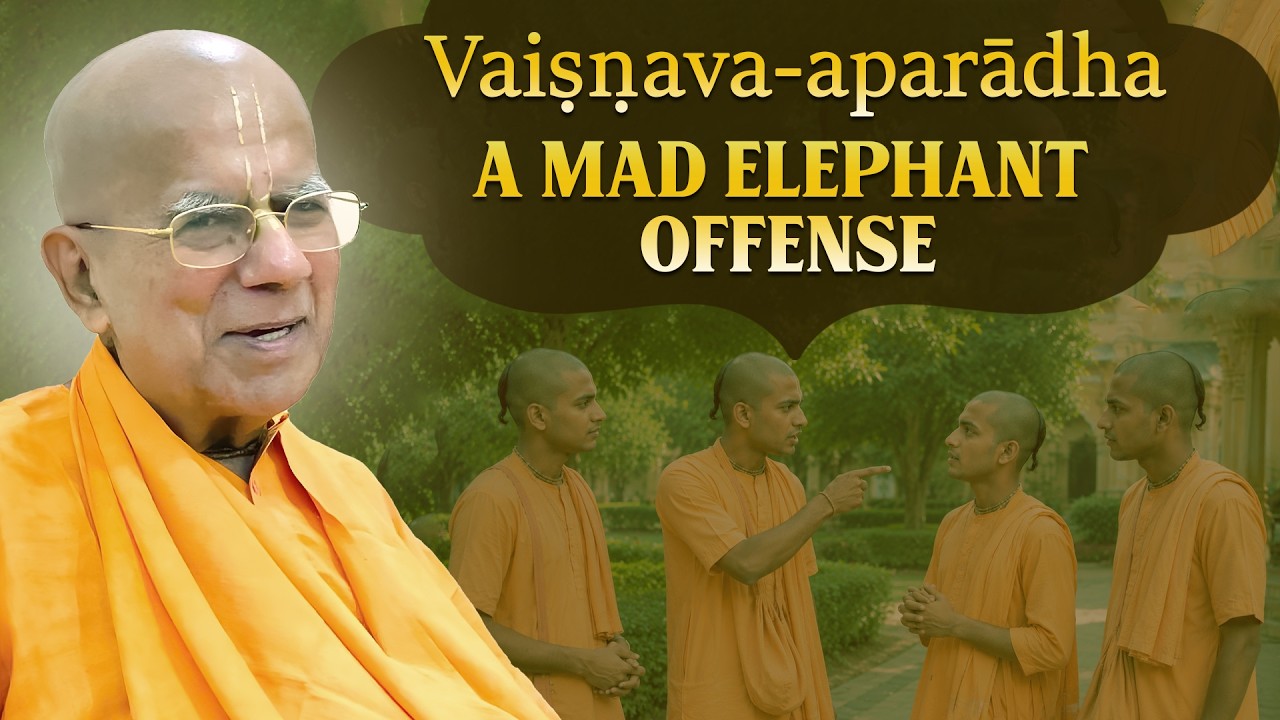
In this lecture Śrīla Gopāl Kṛṣṇa Goswāmī explains the concept of Vaishnava‑aparādha (offense) using Caitanya Mahāprabhu’s ‘mad elephant’ metaphor: a devotee’s garden of devotional service is destroyed when a reckless, critical mind enters. The talk outlines the six loving exchanges (rāṣas) that structure harmonious relationships among devotees—giving and receiving charity, revealing one’s mind to senior practitioners, accepting instruction, offering and accepting prasāda. It stresses that true Vaishnava etiquette requires respect for all devotees, not just one’s guru, and that unity in ISKCON rests on the three common foundations of Krishna, the Bhagavad‑gītā, and the Hare Kṛṣṇa mantra. The speaker warns that fault‑finding and envy act like a cancer, spreading from minor criticism to blasphemy of the Lord. A detailed case study of Ramchandrapuri illustrates how relentless criticism, spying, and false accusations lead to spiritual decline and eventual mayavādī status. Contrastingly, the devotion of Īśvāpuri toward his guru demonstrates the power of selfless service and forgiveness. Scriptural examples from the Caitanya‑caritāmṛta, the Bhagavatam (Durvasa’s envy toward Amṛśarāja), and the Mahābhārata (Prahlāda) are used to show that Krishna himself cannot tolerate offenses against his devotees. The lecture concludes with practical advice: avoid flattery, guard against envy, cultivate humility, and maintain the six loving exchanges to prevent offenses and progress in devotional life.
Chapters
English translation. So I said we will discuss this today. Vaishnava prāda is known as offense, and Caitanya Mahāprabhu has described this as the mad elephant offense. Caitanya Mahāprabhu told Sanatana Gosvāmī that this process of devotional service is like a beautiful garden. Now this beautiful garden can only be spoiled if a mad elephant comes into it. Therefore, the first of the 10 offenses is blaspheming devotees. And when we talk about blaspheming devotees, we talk about blaspheming any type of devotee, senior or junior. Sometimes devotees think, I'll be respectful to my guru but disrespectful to everybody else. But that is not pleasing to the guru. What is pleasing to the guru is to see the disciple be respectful to everyone. So Vaishnava etiquette or Vaishnava behavior is very, very important for devotees. If the Vaishnava etiquette is maintained, then we will have a very sweet and harmonious relationship with everyone. Prabhupada has said in Nectar of Instruction that this Krishna conscious movement has been created to provide for loving exchanges amongst devotees. Essentially, there are 6 types of loving exchanges that devotees can have. One is to give in charity, and the other is to receive in charity. Then is to reveal your mind to those who are more advanced and to take instructions from those who are more advanced. Then to offer prasadam and to accept prasadam. So these type of 6 loving rāṣas are very important amongst devotees. Just like the materialist, they are members of different clubs. Just like over here, we are using the facilities of a sports club. So there are different clubs for different purposes. Like the bar. The bar is an institution where people who want to drink together get together. Casino. Casino is a place where all those who want to gamble, they get together. So similarly, you also have spiritual clubs. And one of them, and the principal of them is ISKCON. So Prabhupada said that the ISKCON institution has been created to facilitate these 6 types of loving rāsās amongst devotees. So the first aspect of this rāsā is to give in charity. What do we give in charity? You may say we devotees don't have a penny in the bank, so where is the question of our giving in charity? You give in charity spiritual knowledge. Just like we go out and distribute books. This is an act of charity. And in exchange for that book, We get a certain donation, which is accepting of charity. Then we reveal our mind to those who are more advanced. A devotee doesn't keep anything in his heart. He doesn't keep anything in his mind. He always shares it with others because he knows that if he shares it, then if something is wrong, it can be corrected. Therefore, Rūpa Gosvāmī says, One must reveal his mind. You don't have to think, "Oh, if I reveal my mind, then the other person may retaliate at me." Suppose you say something, then the other person may get angry and take revenge on me. If somebody takes revenge on you, then he is not a Vaiṣṇava. Only short while ago we discussed the glorious character of Yudhiṣṭhira. Even though that the Rāstra had given him so much pain, so much trouble, still Yudhiṣṭhira said, You will live like a king. Because the Vaishnava is never revengeful. So Rūpa Gosvāmī says, please reveal your mind to those who are more advanced. Reveal your mind to the spiritual master and then accept instructions. Sometimes the devotees would go to Prabhupāda and think Prabhupāda would know everything by just looking at them. But Prabhupāda, even though he knew everything, but Prabhupāda would say, I am not God, you tell me the problem. So you should not think that your problem will get, will get corrected automatically. So revealing your mind and accepting instructions from those who are more advanced. Then offering prasada and accepting prasada. We eat prasada together, Vaishnavas. We do prasada distribution and we accept prasada. So these are in brief 6 types of loving rāsās amongst devotees. Now generally There is a breakdown in the system of harmonious relationships when we let envy influence our activities. In the material world, everyone is envious of the other person. A is envious of B, B is envious of C, C is envious of D. Nobody is really anyone's friend. They may pose for photographs all smiling together, but their hearts are not smiling at each other. You can see how much disunity there is everywhere. You can see the divorce rate is so high. So there is disunity because everybody has vested interest, vested selfish interest. But we should have no selfish interest because we only have one principle in life, to please Kṛṣṇa. We only have one boss. We don't have 100 bosses. Eka la Īśvara-kṛṣṇa-ārṣa-bhṛtaya. Kṛṣṇa is the only master and we are all his servants. So we should all be united. And our uniting, Our unifying factor is Kṛṣṇa. Once Prabhupāda was talking to few religious leaders in Mexico. So they were saying, Swāmiji, we should have a religious conference of world leaders to unite everyone. Prabhupāda said, sure. But unity on what basis? First you must know on what basis you will unite. Otherwise how will you unite? So Prabhupāda said, one God, Kṛṣṇa. One scripture, Bhāgavad-gītā. One mantra, Hare Kṛṣṇa mantra. Then we can unite. So at least in ISKCON there is no disunity on these three points. Because everybody who comes to ISKCON accepts these three points. Otherwise he doesn't come to ISKCON. So there should be no disunity. In the spiritual world, when somebody sees that somebody else is doing more service than me, then that person is very happy. Just like Lalita and Chandravali, these are two gopis of Kṛṣṇa. When Chandravali, when, or Viśākha and Lalita, when Viśākha sees that Lalita is doing so much more service, then she does not criticize Lalita, but she just says, "Oh, I must do even better, more than her." And similarly, there is spiritual competition between Chandrawali and Radharani. Of course, Radharani always wins, but Chandrawali doesn't feel bad. So this is spiritual competition. In spiritual life, there's no question of pulling each other's leg. In material life, everyone is pulling each other's leg. So in spiritual life, Vaishnava etiquette, or the art of dealing with Vaishnavas, must be preserved. Of course, Vaishnava etiquette is a very big topic, and by no means I can exhaust all the points in a half an hour lecture. But I am just going to refer to this one point of Vaishnava aprāda. And this habit of fault-finding is so dangerous that if we don't stop it, it spreads to the point where one day you will even criticize the Lord. It is just like Cancer. Cancer starts with a small dot. You don't even notice that dot, but then cancer spreads itself so much that it's all over the body, and then it's incurable. So fault-finding is of a similar nature, is a disease of a similar nature. You start criticizing, you don't even know that you're committing an aprāsaḍ, and slowly, slowly, you just start seeing more and more faults in everyone. So in the Caitanya-caritāmṛta There's a very beautiful story of Ramchandrapuri. Who knows this story? So Ramchandrapuri was a spiritual uncle of Caitanya Mahāprabhu. Caitanya Mahāprabhu also had a guru, and his guru's name was Īśvārapuri. And Īśvārapuri's guru was Madhvanda Puri. And, yeah, and Ramchandrapuri was the godbrother of Īśvārapuri. Ramchandrapuri was a sannyāsi. But then because of his offenses, he became a mayavadi. When you commit Vaishnava fraud, two reactions will take place. Slowly, slowly, your material desires will increase, and then you will not feel like chanting. Or you will become a mayavadi and, and, and be against the principle of God being a person. Both are dangerous. Both the reactions are dangerous. So Rāñchandrāpuri, His habit was to always criticize others. First, he would spy on other Vaiṣṇava sannyāsis. He would look for their faults. He was like the KGB after the sannyāsis. He used to go and find out what is their schedule. When does the sannyāsi get up in the morning? Does he chant his rounds? Is he eating too much? Is he eating too many sweets? So he was always looking for faults. So Rāmchandrapuri was also severely rebuked by his spiritual master. The prasad is there, but now we won't stop, okay. The devotees say they don't want to eat prasad today. Does that mean they can eat prasad outside when the hall is— or does it mean that they have to eat prasad before 5? They have to eat prasad before 5 or they have to leave the hall before 5? Okay. So we will stop the class at 4 o'clock. So Ramchandrapuri, he even would criticize his own guru. On one occasion when his guru Madhvandarpuri was getting ready to leave his body, he was saying, "Kṛṣṇa, Kṛṣṇa, where are you? I haven't achieved love of God." So Ramchandrapuri was so offensive, he started advising his guru to meditate on Brahman. He did not understand that his guru was actually being very humble because a devotee of the Lord, even when he has realized the Lord, he is always saying, I have not realized the Lord. So Ramchandrapuri, so Madhvanda Puri was so angry with Ramchandrapuri, he said, go away from my vision. I don't want to see you when I am leaving this body. And Ramchandrapuri was banned from coming in front of his Guru because his Guru was getting ready to leave his body. And he did not want to see the face of an offender while leaving this body. Now, Īśvāpuri, the godbrother of Rāmachandrapuri and the spiritual master of Caitanya Mahāprabhu, he had a complete attitude of seva, service towards his guru. This is the spiritual attitude. Disciple should always be anxious to serve the guru. So Īśvāpuri, when he saw that his spiritual master was so sick and getting ready to leave his body, Eswarapuri was serving him like a menial servant. He would even clean his stool and urine, just like the mother takes care of the child's stool and urine in old age. Also, the old man, the old man has to be taken care of. So when Madhvampuri was old, Īśvāpuri was still cleaning his stool and urine all the time. And Īśvāpuri would also chant Hare Kṛṣṇa mantra for the benefit of his guru, because his guru was getting ready to leave the planet. Just like when Prabhupāda was getting ready to leave the planet in Vṛndāvana, his disciples were doing 24-hour kīrtan. So Prabhupāda was hearing kīrtan 24 hours. So Īśvāpuri, when he saw that his spiritual master was sick, he was even chanting for his spiritual master so his spiritual master would hear the names of Kṛṣṇa while leaving the planet. So Madhvendra Puri, he blessed— Madhvendra Puri was so pleased with the service of his beloved disciple Īśvāpuri that he blessed Īśvāpuri to become an instrument for flooding the whole world with Kṛṣṇa consciousness. And he chastised Ramchandrapuri for his offensive attitude towards him. So it's not that the spiritual master blesses everyone equally. Based upon the surrender of the disciple, the spiritual master blesses the disciple. Just like Krishna reciprocates also based upon our surrender. Krishna doesn't say everybody will come back to me. Only those who surrender to him will come back to him. So Ramchandrapuri was a fault-finder. He had a very unique style. First, he would invite a sannyasi for prasad. He would serve him a lot of prasad. Then when the sannyasi would wash his hands and sit down, then he would start his commentary. There was one sannyasi, Jagannanda Pandit. So Ramchandra Puri fed him lot of prasad. Then after he finished the prasad, he said, look at these sannyasis, they eat so much, so much prasad and eat so much sweets. So everybody knew what Ramchandra Puri what he was doing. And Caitanya Mahāprabhu also knew what he was doing. He was blaspheming everybody on his back. And he was also blaspheming Caitanya Mahāprabhu on his back. Even though he was criticizing Caitanya Mahāprabhu, still when Ramchandrapuri would come in front of Caitanya Mahāprabhu, Caitanya Mahāprabhu would offer him his danda bāts. Just see how offensive Ramchandrapuri was. But because he was the godbrother of his spiritual master, Caitanya Mahāprabhu would offer him respects. This is Vaiṣṇava etiquette. Even if you don't agree, still you offer dandapaḍa. Not that you offer obeisance only when you two see eye to eye, when you two agree on everything. So Rāmacandra Puri was, as I told you, was busy spying on Caitanya Mahāprabhu. He was asking all his devotees what time that Caitanya Mahāprabhu would get up in the morning. Does he chant his rounds? Does he talk to women? Does he eat a lot of sweets? But he couldn't find any faults. Chaitanya Mahāprabhu was God. He was perfect in all respects. One day, Rāmchandra Puri went to Chaitanya Mahāprabhu's room. So it was summer, hot season in India. Now you may know that in hot season, the ants, they come from underneath the floor on the surface. You follow? Ramchandrapuri went to Caitanya Mahāprabhu's room and there were ants crawling on the floor. So Ramchandrapuri says, Sannyasis are eating too many sweets these days. Last night you must have eaten too many sweets. But Caitanya Mahāprabhu had not eaten any sweets at all. The ants were crawling not because there were sweets on the ground, but because it was hot. So they had to come out from the earth above the flooring. So Ramchandrapuri was always saying, 'Sannyasis are eating too many sweets. They eat too much. Where is their renunciation? They are acting like sannyasis just to get respect, but they are not renounced, they are attached.' So he, when Caitanya Mahāprabhu heard Ramchandra Puri was criticizing him, he would cut his eating by half. When Govinda— Govinda was the secretary of Caitanya Mahāprabhu— When Govindāya and the other devotees heard that Caitanya Mahāprabhu has reduced his eating because of Rāmcandapuri's criticism, they were very, very angry. Rāmcandapuri heard that Caitanya Mahāprabhu has reduced his eating. So Rāmcandapuri went to meet Caitanya Mahāprabhu again. And as soon as Caitanya Mahāprabhu saw him coming, he offered him his obeisances. And Caitanya Mahāprabhu said, "I am so fortunate that Rāmcandapuri is always correcting me." So Rāmcandapuri said, I have heard that now you have reduced your eating by half. You are already so skinny, and now you have reduced your eating, you will become more skinny. This type of artificial renunciation is not to be manifested by a sannyasi. You must eat more. So in English there is a saying, you are damned if you do, you are damned if you don't. So this was the position with Che Ramchandarpuri. If you reduce your eating, Then he would say it's artificial renunciation. And if you ate normally, he would say sannyasis are overeating. Anyway, Caitanya Mahāprabhu always had a respectful attitude towards him because he was the godbrother of his spiritual master. But the Lord cannot tolerate the offenses at his devotee. Caitanya Mahāprabhu is God himself. He did not say anything, but Caitanya Mahāprabhu was playing the role of a devotee. So Rāñchandrapurī became so offensive. Then later on he became a mayavadi and he left Jagannathpuri and went away. And as soon as he left, Caitanya Mahāprabhu resumed his normal eating. And the devotees felt like a heavy burden has come off their head. Just like sometimes you are travelling with a heavy burden and you are just miserable, but as soon as the burden comes off the head, how light you feel. So, as when you are in material consciousness, You are carrying a heavy burden. And when you come to Kṛṣṇa consciousness, you are like a man who has kept the heavy burden on the ground. In the Vedas it is said a Vaiṣṇava should not praise others and he should not criticize others. And of the two, this habit of criticizing others is more dangerous than praising others. Therefore Bhaktisiddhānta ṣrīla Prabhupāda used to say, Beware of flatterers. If somebody comes and flatters you, then get very scared. Now what does he want? You follow this? Put your minds. If somebody comes and flatters you, says, "Oh, you are such a nice devotee, everything you do is first class, you are a good temple president," then you should get scared. What does he want now? So Bhaktisiddhānta Sādhvārī said, if somebody comes and praises you, Please get very scared of him. In the material world, everybody wants praise. Like when these politicians give speeches, they have a ready audience that will always clap when they say something. So, because everybody wants applause. So Ramchandrapuri lost his devotional service because of his attitude of fault-finding. So you can see How devastating this fault-finding habit is. It is exactly like a hurricane. Hurricane means when it's a big windstorm. When a storm comes, when it's very windy. When a hurricane comes, everything is destroyed. So whatever good points you must have accumulated by chanting and serving will all get destroyed when you commit offenses. Therefore Kṛṣṇa-nātha Kavirāja said, Bhau janma-karaye yadi śravaṇa-kīrtanā tabhūtana-pāya-kṛṣṇa-padhe prema-dhāna. One may go on chanting birth after birth, birth after birth, birth after birth, but unless he avoids the offenses, he cannot develop love of God. There are different stages of chanting the Holy Name. First is the impure stage. Then is the stage where you try to minimize the offenses. And the third is the purified stage. So I'll talk about this tomorrow, different stages of chanting. Now there's another story in the Bhāgavatam that tells you about the effects of offenses at Vaiṣṇava. Kṛṣṇa has said in the 11th canto, tudhava, one who says he's my devotee is not my devotee, but one who says that he's a devotee of my devotee, he's a devotee. So Durvāsa Muni was very envious of Amṛśmarāja. I think most of you know this story, isn't it? Anyway, Durvāsa Dhruvasamuni was very envious, so he produced a demon from his hair hoping that the demon would burn Amritamaraj. But Krishna, when he saw that Amritamaraj was being attacked by this demon, this demon was going to attack Amritamaraj, he released his Sudarshan Chakra, and this Sudarshan Chakra was producing so much heat that that heat was burning Dhruvasamuni's body. So Dhruvasamuni was escaping, the Vāsudeva Mani was escaping the effect of the Sudarshan Chakra. He went to Lord Śiva and told Lord Śiva, please excuse me for the offense I did to Amṛśmarāja. Please take away the effect of the Sudarshan Chakra. Because the Sudarshan Chakra was producing so much heat that his body was being burnt. Then Vāsudeva Mani went to Lord Brahmā. But Brahmā also said, There is nothing I can do. Finally he went to Kṛṣṇa. Because he was a mystic yogi, so he could travel right to Kṛṣṇa. But as he was going up and up, the Sudarśana Chakra was behind him. So he was constantly being burnt. So finally when he went to the Lord and said, please excuse me for the offence I committed at the feet of Amṛśvarāja. Please take away the effect of Sudarśana Chakra. And what did Kṛṣṇa say? I don't have the power to take the effect away. He said, you have to go to my devotee. And ask him to forgive you. I don't have the power to forgive you. Then Dwaraka Samani came to Amrish Maharaj and Amrish Maharaj forgave him. So the Lord told Dwaraka that I reside in the heart of the devotee and the devotee resides in my heart. So we are never separated. So this is very important, this Vaishnava offenses, they avoid it. It's very important that we give up our offensive mentality. The root cause of, the root cause of One of the worst offenses is envy. Why are we in the material world? Because we became envious of Kṛṣṇa. You may find it hard to believe, but it's a fact. In Ukraine, you have 40 million people living. Ask them, do you want to give your life to God? Except for the Hare Kṛṣṇa devotees, nobody will say yes. Because everyone says, why should God be the enjoyer? Why should we offer everything to God? He doesn't need anything. He has everything. So let us enjoy. Like the slogan in India is, "God already has everything, so why do you have to give Him anything?" Everything that is here is for us. So we want to steal God's property. Prabhupāda used to say, "People want God's kingdom without God." It's just like somebody going to a big man's house and saying, "You please give me the keys to your house when you get out." So our envy is towards the Lord. Envy towards the spiritual master and envy towards other Vaiṣṇavas. I have seen in my 23 years in the ISKCON movement that all those devotees who had an offensive attitude towards other, who were offensive in dealing with other Vaiṣṇavas, Kṛṣṇa has kicked them out. Kṛṣṇa will not let you do devotional service with an offensive attitude. You may be the best book distributor, the best manager, the best kīrtan singer, the best the most handsome devotee. But Kṛṣṇa doesn't care for these qualifications. Kṛṣṇa sees how you are dealing with other Vaiṣṇavas. In the Mahābhārata, it is said a devotee does not want to give pain even mentally to another living entity. He doesn't want to give pain to anyone. Prahlāda Mahārāja underwent so many difficulties to prove his loyalty to Kṛṣṇa. In the end, when his father was killed, Lord Nrsimhadeva told Prahlāda, "Prahlāda, now tell me what benediction do you want?" When did the Lord descend to kill Hiranyakāśipu? Do you know? Have you ever meditated on that point? He descended to kill Hiranyakāśipu when he saw that Hiranyakāśipu was determined to kill his devotee Prahlāda. And when he saw that Hiranyakāśipu was determined to kill Prahlāda, then the Lord descended as Nrsimhadeva and tore him apart. So the Lord can never tolerate offense to His devotees. Now after Lord Nrsimhadeva killed Hiranyakāśipu, He was very, very angry. And even Brahmā and Lord and Lakṣmījī were scared to go near Him. Lakṣmī is always massaging the feet of Narayana. So she saw Lord Nrsimhadeva in such an angry mood. Brahmā told her, "Go, go, go, pacify the Lord." She said, "No, no, no." And Lord Brahmā He wanted to go and pacify the Lord, but when he saw that Sengadeva was roaring like a lion, he also didn't go. It's just like at home sometimes. When you were children, you must have seen your father in such a bad mood, nobody wanted to go in front of him. But Prahlāda, when he saw, he went and he garlanded the Lord. And as soon as he garlanded the Lord, his anger was gone. Hare Kṛṣṇa, Hare Kṛṣṇa.
More from PRASAD

Rare Pastimes & Timeless Lessons of Guru Mahārāja | Stories Every Disciple Should Hear

ISKCON Legends- pure devotees meet-HH Jayapataka Swami, HH Gopal Krishna Goswami, HH Radhanath Swami



Jagannātha Ratha-yātrā Through Śrīla Prabhupāda's Mercy | 29 April 2006 | Nairobi, Kenya

Lord Jagannātha's Appearance Pastime | 21.07.2019 | ISKCON Calgary | Śrīla Gopāla Kṛṣṇa Gosvāmī

The Ācārya Teaches by His Own ExampleGuṇḍicā Mārjana by Guru Mahārāja #shorts

Guṇḍicā Mārjana – Lord Jagannātha's Pastime | 21.7.2019 | ISKCON Calgary |Śrīla Gopāla Kṛṣṇa Gosvāmī

H.H. Gopāla Kṛṣṇa Gosvāmī Mahārāja - Exemplary Sādhana and Deity Worship # shorts

भगवान की कृपा कैसे प्राप्त होगी ? | 11 Jan 2014 | Punjabi Bagh | Srila Gopal Krishna Goswami

Material Education vs Spiritual Education | Srila Gopal Krishna Goswami #shorts